TL;DR
An effective About Me is a 75-to-150-word evidence chain, not a personality statement. Build four sentences — identity, trajectory, proof, direction — starting from your resume so every claim is defensible. Replace trait claims ("passionate," "hardworking," "excellent communicator") with actions and results, since NACE research found communication rated highly important by 96.3% of graduates and 96.1% of employers while only 53.5% of employers rated graduates proficient versus 78.1% of students — roughly a 24.6-point perception gap you close by demonstrating rather than claiming. Keep one version as the source of truth across LinkedIn, resume, website, and cover letters, adapting emphasis but never facts. Use the template that matches where your credibility comes from: early-career candidates fill the proof blank first, career switchers fill the bridge sentence first, and anyone describing working strengths should name a demonstrable capability rather than a broad label. Then run four editing passes fact, clarity, tone, platform before publishing anywhere.
An effective About Me is a short evidence chain of roughly 75 to 150 words that links your identity, the problem you solve, two or three quantified proof points, and the role you want next. Write four sentences that make those elements clear, then use the same core version across LinkedIn, your resume, your website, and interview practice.
You probably have a half-finished paragraph open in a document right now. It starts with “I'm a hardworking and passionate professional,” mentions a few responsibilities, and ends with a vague statement about seeking growth. It sounds harmless, but it gives a recruiter very little reason to remember you.
The fix is straightforward. Treat your About Me as a resume-locked talking-point generator, not a personality statement. Every claim should connect to evidence you can defend, and every sentence should be useful when you answer an interview question aloud.
What Should You Write in an About Me?
Write a short evidence chain of roughly 75 to 150 words - four sentences that link your identity, the problem you solve, two or three quantified proof points, and the role you want next. Then use that same core across LinkedIn, your resume, your website, and interview practice.
The four-part structure:
- Identity — Name your professional direction and target domain. Not "hardworking marketing professional with a passion for business," but "early-career marketing coordinator who helps education and technology teams turn complex information into clear campaigns."
- Problem — Explain the type of work, customer need, or business problem you understand.
- Proof — Add one or two concrete outcomes with accurate measurements pulled from resume bullets, project records, or portfolio analytics.
- Direction — State the role, project, or opportunity you're pursuing. Skip "open to anything" unless you genuinely have no direction.
Why this structure works: it replaces adjectives with relevance. "Organized, motivated, and passionate" could describe anyone. A named role plus a real project result tells the reader what you do and where your evidence comes from.
Each sentence doubles as interview material. Sentence one answers "Tell me about yourself." Sentence two supports "Why this type of work?" Sentence three gives you a result to walk through. Sentence four answers "What are you looking for next?"
Start with your resume, not a blank page. Pull the strongest evidence first and build the narrative around it — that prevents writing a polished identity the rest of your application can't support.
Tailor emphasis by surface, never facts. A LinkedIn summary can carry more context, a resume summary prioritizes role alignment and evidence, and a website bio can include motivation that reinforces the professional story. If LinkedIn says cybersecurity while your resume emphasizes marketing, recruiters question your direction rather than appreciate your range.
The test: if a line can't support either a hiring decision or an interview answer, delete it.
What to Write in About Me and Why It Matters
A hiring manager doesn't need your autobiography. They need to understand who you are professionally, what kind of work you handle, proof that you can handle it, and what you want next. If your About Me doesn't answer those questions quickly, the reader has to do the interpretation for you. Most won't.
The strongest version follows a four-part evidence chain:
- Identity: Name your professional direction and target domain.
- Problem: Explain the type of work, customer need, or business problem you understand.
- Proof: Add one or two concrete outcomes, preferably with accurate measurements.
- Direction: State the role, project, or opportunity you're pursuing.
That structure works because it replaces adjectives with relevance. “Organized, motivated, and passionate” could describe almost anyone. “I'm an economics graduate interested in data analysis, and I built a reporting dashboard during my internship to help the team identify delayed orders faster” tells the reader what you do and where your evidence comes from.
Make one version the source of truth
Use the four-sentence version as the stable core across your LinkedIn profile, resume summary, personal website, and cover-letter opener. The wording can change slightly for each audience, but the facts shouldn't. If your LinkedIn profile says you're moving into cybersecurity while your resume emphasizes marketing, recruiters may question your direction rather than appreciate your range.
The same sentences should also generate interview material. Sentence one answers “Tell me about yourself.” Sentence two supports “Why this type of work?” Sentence three gives you a result to explain. Sentence four answers “What are you looking for next?”
Practical rule: If a line can't support either a hiring decision or an interview answer, delete it.
Early-career candidates can draw evidence from internships, coursework, volunteering, research, student organizations, and personal projects. Career switchers should lead with transferable value instead of apologizing for a non-linear path. Neurodivergent candidates can describe specific working strengths, systems, and outcomes without disclosing anything they don't want to share.
For more guidance on turning this core into a stronger LinkedIn presence, use this practical resource on LinkedIn profile optimization for 2026. The principle is the same everywhere: make your professional identity easy to understand and your evidence easy to verify.
What Recruiters Actually Read First
Recruiters, applicant tracking systems, and referral contacts don't read an About Me in the same way. A recruiter scans for role fit and proof. An ATS looks for terminology that matches the job description. A referral contact wants enough context to explain why introducing you would make sense.
That means your opening can't rely on a trait claim such as “passionate and driven.” Those words make the reader do all the work. An evidence-backed statement, such as “I redesigned onboarding documentation and reduced onboarding time by 20%,” gives the reader an action and a result. That example comes from the evidence-led guidance in the University of Phoenix career summary guide, which recommends translating skills into employer outcomes.
Communication is a useful test case. NACE's research found that communication was rated highly important by 96.3% of new graduates and 96.1% of employers, while only 78.1% of graduates were rated very or extremely proficient by students, compared with 53.5% by employers. That creates an approximate 24.6 percentage-point perception gap between how graduates and employers view proficiency. Those figures come from NACE's career-readiness competencies research. Your About Me should close that gap by demonstrating communication instead of claiming it.
Give each surface a different job
A LinkedIn summary can carry a little more context because readers may be exploring your background. A resume summary should prioritize role alignment and evidence. A website bio can include motivation or interests, provided those details reinforce your professional story.
Surface Recruiter scan time Top signals sought Failure mode
LinkedIn summary
Quick scan
Target role, keywords, career direction, proof
A generic biography that isn't tailored to a role
Resume summary
Fast review
Role fit, relevant capabilities, measurable outcomes
A trait list that repeats the job description
Website bio
Exploratory read
Credibility, point of view, selected achievements
Personal history that obscures professional value
Put the most important information at the beginning of every version. Your first lines should name your role or target direction, identify the audience or problem you serve, and point toward evidence. Don't bury your strongest project in a final sentence after a long explanation of your personality.
The opening should communicate four signals: role, proof, audience, and goal. If one is missing, revise before publishing. “Marketing graduate seeking opportunities” has a goal but no proof or audience. “Content specialist who creates clear product education for technical buyers, with experience improving documentation and coordinating cross-functional launches, seeking a product marketing role” gives the reader a much stronger starting point, even before you add the exact outcomes.
Building Your Four-Sentence Draft
Start with your resume, not a blank page. Pull out the strongest evidence first, then build the narrative around it. This prevents the common mistake of writing a polished identity that the rest of your application can't support.
Sentence one identifies your professional value
State your current identity and the audience, domain, or problem area you serve.
Weak:
“I'm a hardworking marketing professional with a passion for many areas of business.”
Stronger:
“I'm an early-career marketing coordinator who helps education and technology teams turn complex information into clear campaigns.”
The second sentence gives the reader a role, a working context, and a useful capability. It doesn't pretend that “passion” is proof.
Sentence two explains the trajectory
Show how your experience connects to the direction you're pursuing. An early-career candidate might mention coursework and an internship. A career switcher might connect operations, customer service, research, or project work to the target field.
For example:
“Through an internship and student projects, I've developed experience in audience research, campaign coordination, and performance reporting.”
This is more useful than listing every task you've completed. It selects the evidence that supports your target role.
Sentence three supplies the proof
Use two or three quantified achievements only when you can verify them. Pull the figures directly from resume bullets, project records, portfolio analytics, or other reliable evidence. The ResumeWay guide to resume accomplishments distinguishes an accomplishment from a responsibility by requiring a measurable result.
Before:
“I'm an organized marketing graduate with strong communication skills. I've worked on social media, email, and events, and I'm eager to grow.”
After:
“I'm an early-career marketing coordinator who helps education and technology teams turn complex information into clear campaigns. During my internship, I supported audience research, email planning, and event promotion while coordinating deliverables across a small project team. I analyzed 1,200 survey responses, trained 12 volunteers on campaign materials, and completed a campaign prototype in four weeks. I'm now seeking a marketing coordinator role where I can combine research, clear writing, and reliable execution to support measurable customer and community outcomes.”
The revised version is roughly 90 words, which makes it compact enough to adapt across platforms while still giving you evidence to discuss. The figures in the example are drawn from valid early-career evidence types identified in the provided resume guidance. Replace them with your own verified results.
Sentence four states the next move
Close with the role or context you want. Don't write “open to anything” unless you genuinely have no direction. A specific goal helps recruiters place you.
“I'm now seeking a marketing coordinator role where I can combine research, clear writing, and reliable execution.”
Treat every proof point as a future interview card. Write down the situation, task, action, and result behind it. The practice interview questions resource can help you test whether each example answers a real question rather than merely sounding impressive.
Keep the final About Me between 75 and 150 spoken words, a range supported by the University of Florida professional-introduction guide. If a platform needs a shorter version, cut context before cutting proof. Your evidence is the part that earns attention.
Templates for Early-Career, Career Switcher, and Neurodivergent Candidates
Don't force every candidate into the same biography. The four-sentence spine stays stable, but the evidence changes depending on where your credibility comes from.
Candidate type Sentence 1 identity Sentence 2 trajectory Sentence 3 proof Sentence 4 goal Editable example
Early-career
Name the target role and field
Connect coursework, internship, or project work
Add one verified project result
State the entry-level direction
“I'm a [target role] focused on [domain]. Through [coursework, internship, or project], I've developed [capability] for [audience]. I [action] and achieved [metric] within [timeframe]. I'm seeking [target role] where I can apply [skill] to [problem].”
Career switcher
Lead with the new professional identity
Explain the bridge from prior work
Use adjacent-industry evidence
Name the role you want next
“I'm an [target role] transitioning from [previous field]. My experience in [transferable area] taught me how to [problem solved], and I've built [new capability] through [training or project]. I [action] and achieved [metric]. I'm seeking [target role] where I can connect [transferable skill] with [new domain].”
Neurodivergent candidate
State specific working strengths
Describe the systems or environments where they help
Show focus, pattern recognition, or process outcomes
Name a suitable role and work context
“I'm a [target role] who brings [specific working strength] to [domain]. I do my best work when solving [problem] through [system, structure, or method]. In [project or role], I [action] and achieved [metric]. I'm seeking [target role] where [strength] supports [team or customer outcome].”
Early-career template
“I'm a [target role] interested in [domain]. Through [coursework, internship, or project], I've learned how to [capability] for [audience]. I [action] and achieved [metric], giving me practical experience with [tool or method]. I'm seeking [target role] where I can contribute to [problem or outcome].”
Fill the proof blank first. A real project result will shape the rest of the paragraph more effectively than a list of aspirations.
Career-switcher template
“I'm an operations analyst transitioning into cybersecurity. My background in process improvement has taught me to identify risk, document procedures, and improve how teams respond to recurring problems. Through incident-response training and a simulated log-analysis project, I [action] and achieved [metric]. I'm seeking [target role] where I can apply structured analysis to security operations.”
Fill the bridge sentence first. It should explain why the move makes sense without sounding apologetic. Don't describe your previous career as irrelevant if it gave you useful habits, judgment, or domain knowledge.
Neurodivergent template
“I'm a [target role] who specializes in [specific strength], especially when work involves [type of problem]. I use [system, workflow, or method] to manage priorities and produce consistent results. In [project or role], I identified [pattern or issue], took [action], and achieved [metric]. I'm seeking [target role] in a team that values clear expectations and thoughtful problem-solving.”
Fill the working-strength blank first. Choose a capability you can demonstrate, not a broad label. You don't need to disclose a diagnosis or frame your working style as a limitation.
For additional help shaping the wording, you can optimize your LinkedIn summary, but don't paste a generated paragraph without checking every fact. A scaffold is useful. Your verified experience must remain the source.
Turning Your About Me into Interview Talking Points
Priya, a mid-level product marketer, has just finished her four-sentence About Me. Her next task isn't memorizing a script. It's turning each sentence into a short, flexible answer.
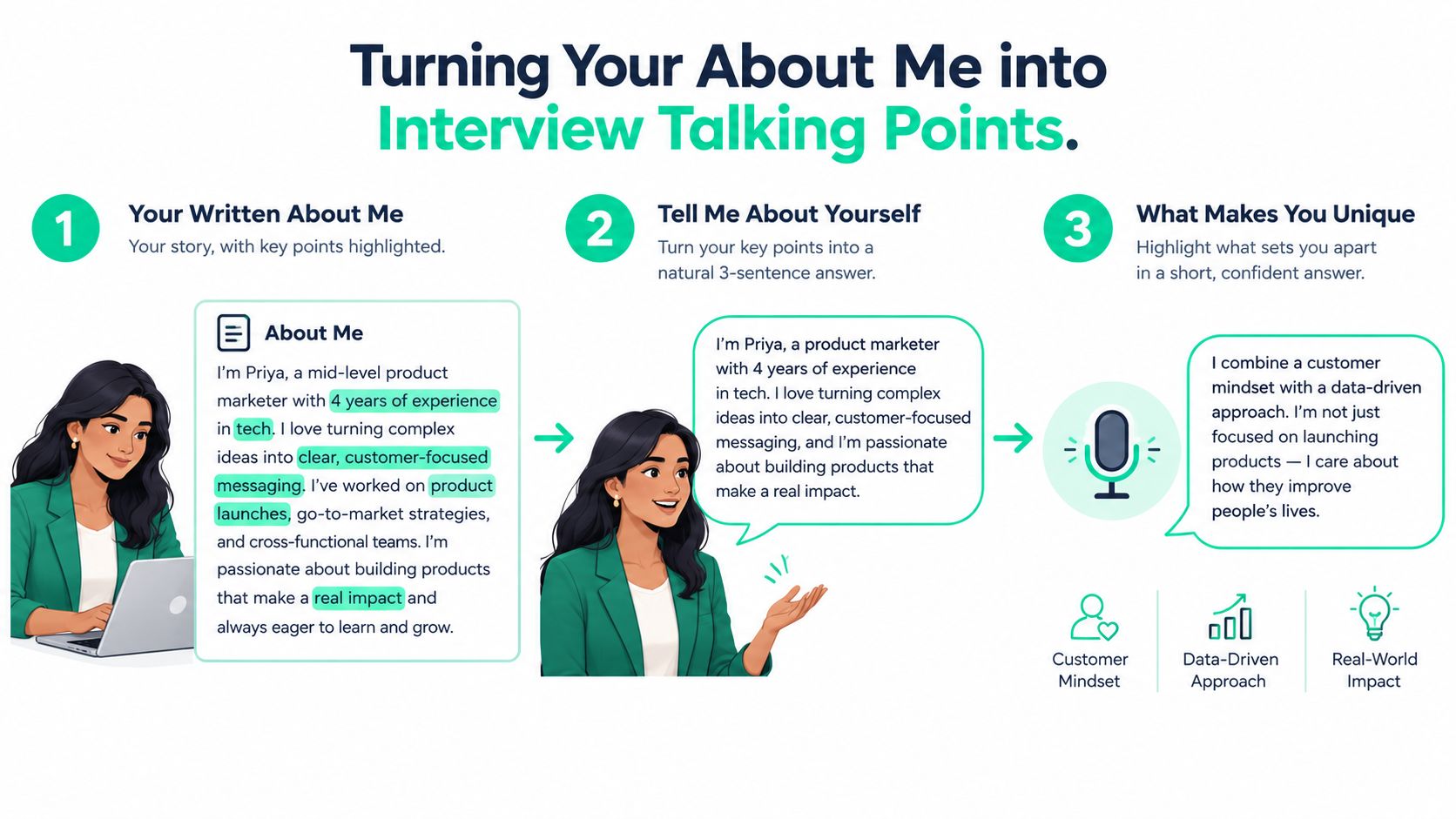
Her first sentence says that she positions technical products for business buyers. That becomes the foundation for “Tell me about yourself.” She can say who she is, who she serves, and what type of work she does without reciting her entire employment history.
Her second sentence explains that she moved from customer research into product marketing because she wanted to connect buyer insight with go-to-market decisions. That supports “Why this role?” The answer follows a clear direction rather than sounding like a random application.
Her third sentence contains a verified campaign result. That becomes the answer to “Walk me through a result you're proud of.” She doesn't need to memorize a paragraph. She needs the problem, the action she took, and the result she can defend.
Her final sentence names the type of product marketing team she wants to join. That gives her a credible answer to “Where do you see yourself in two years?” She can describe the capability she wants to deepen and the problems she wants to work on, without making a grand prediction.
Use the Qcard method for proof
Take one quantified resume point and turn it into a 60-second story:
- Problem: What wasn't working, and who was affected?
- Action: What did Priya personally change, create, analyze, or coordinate?
- Result: What measurable outcome followed?
- Connection: Why does this matter for the role?
For spoken delivery, trim the story to two sentences:
“Our product launch materials weren't answering the questions sales teams heard from technical buyers, so I interviewed internal stakeholders and reorganized the messaging around those objections. The revised materials gave sales a clearer conversation path, and I can explain the evidence and timeframe behind the result.”
The exact metric should come from Priya's resume, not from memory or improvisation. If she can't reconcile it with her source documents, she should remove it until verified.
Use interview preparation guidance to practice the transition from written evidence to spoken answers. The About Me remains the source of truth. Every interview story should trace back to a line, project, or result already represented in the document.
Editing and Verification Checklist
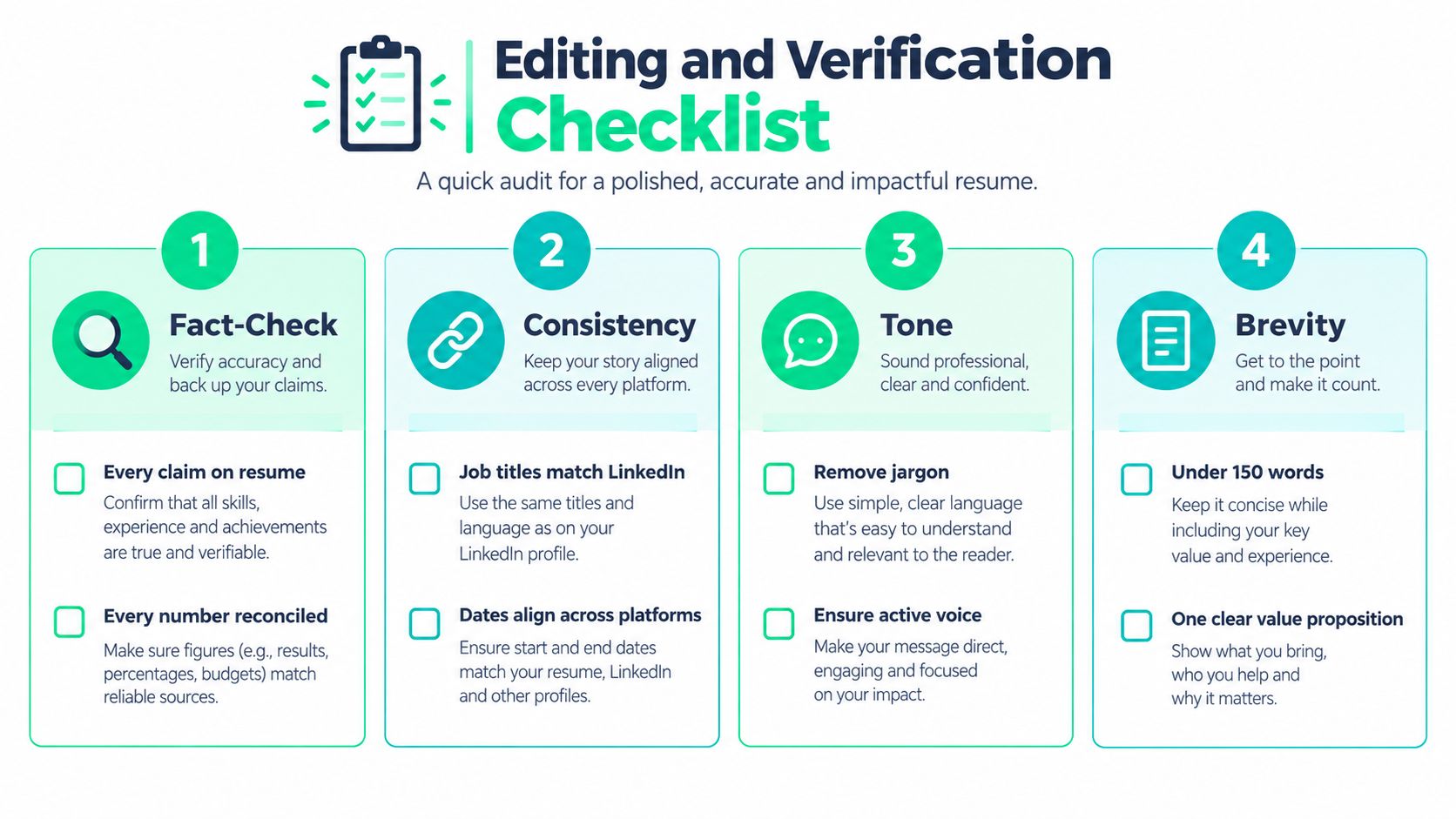
Treat editing as a gate, not a suggestion. If one claim fails verification or one sentence hides your direction, the About Me isn't ready for LinkedIn, a resume, a website, or an application.
Fact-check pass
- Check claims: Confirm every capability appears in your resume, portfolio, or another substantiated record.
- Reconcile numbers: Make sure every percentage, volume, timeframe, and result matches the original source.
- Match titles: Use the same job titles across your resume, LinkedIn profile, portfolio, and application.
- Confirm dates: Ensure employment, education, projects, and transitions align everywhere.
The MIT Communication Lab guidance on professional bios emphasizes specific contributions and details rather than letting prestigious affiliations or broad descriptions carry the story. Apply that standard to every sentence.
Clarity pass
- Delete trait-only lines: Remove “hardworking,” “passionate,” “motivated,” and “excellent communicator” unless an observable example follows.
- Name the problem: Explain what you help a team, customer, or organization do.
- Replace jargon: Rewrite acronyms and specialist language for an informed reader outside your immediate team.
- Make every sentence work: Keep a sentence only if it establishes identity, direction, evidence, or relevance.
Tone pass
- Read it aloud: Rewrite anything that sounds unlike your normal professional voice.
- Use active voice: Put yourself at the start of the action when you personally did the work.
- Control tense: Use present tense for your current role and past tense for completed work.
- Remove inflated claims: Replace “world-class” or “exceptional” with a specific action and result.
Platform pass
- Test the opening: Read only the first lines and check whether your target role remains clear.
- Check keywords: Compare your terminology with recurring requirements in several relevant job descriptions.
- Adapt the closing: Point recruiters toward the role you want and collaborators toward the work you offer.
- Keep the core consistent: Change emphasis by platform, but never change the underlying facts.
A reader should be able to identify who you help, what you do, evidence that you can do it, and what you want next. If they can't, keep editing.
Putting It All Together in One Pass
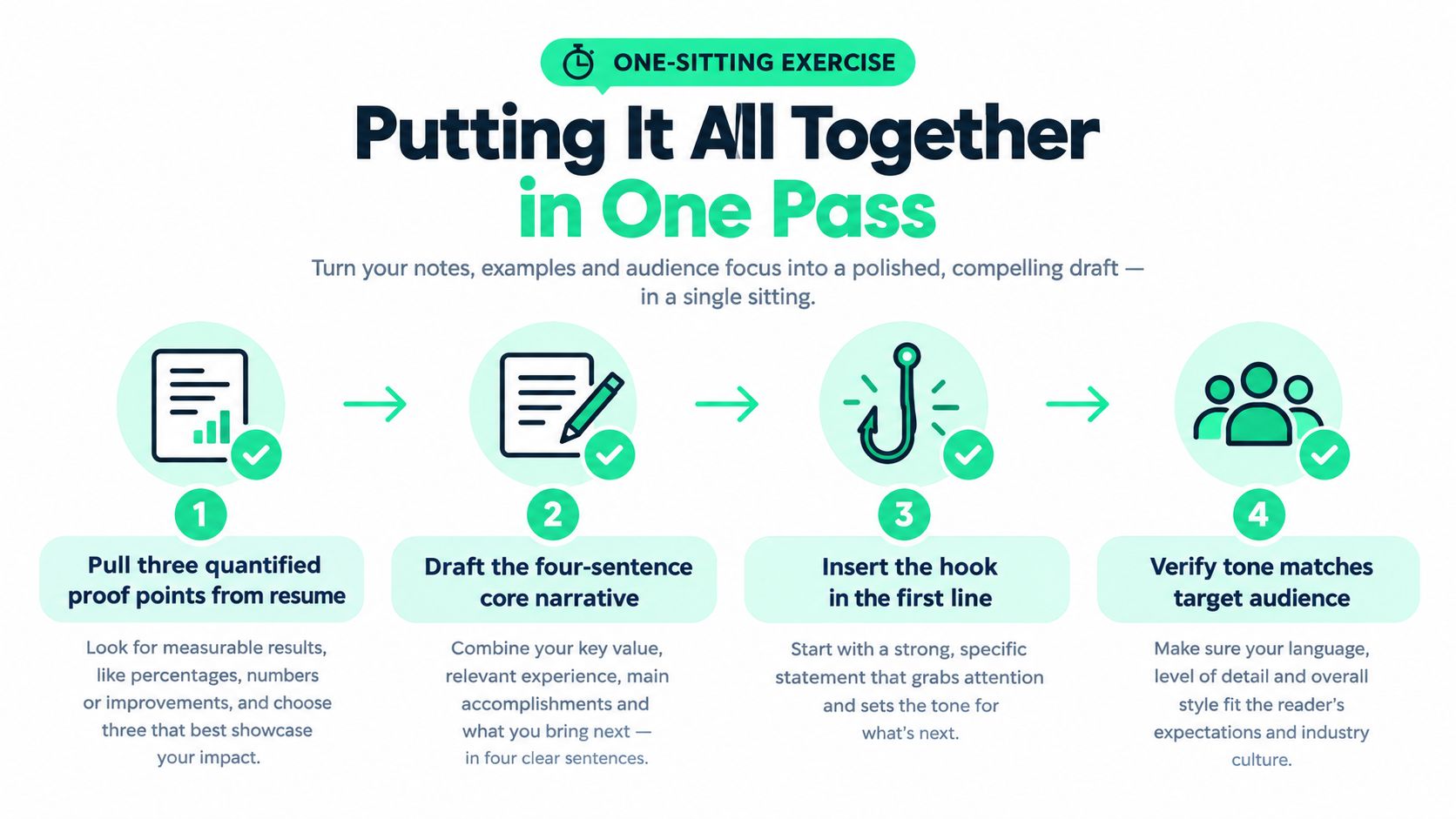
Run the process in one sitting. Start with evidence, not adjectives. Your four sentences should become a resume-locked set of talking points for LinkedIn, your resume, your website, and interview answers.
- Extract proof points first. Pull two or three accurate results from your resume, coursework, internship, volunteering, or portfolio. Record the baseline, action, result, and timeframe where available.
- Write sentences second. Draft the identity, trajectory, proof, and goal sequence. Keep the core between 75 and 150 words.
- Choose the template third. Use the early-career, career-switcher, or neurodivergent scaffold that matches your evidence. Adapt it instead of copying it.
- Edit fourth. Run the fact, clarity, tone, and platform checks. Remove unsupported traits and reconcile every number.
- Publish fifth. Adjust emphasis for each surface, then recheck titles and dates after pasting because platforms can truncate or reformat text.
Read the paragraph aloud as a 30-second interview answer. It should sound natural, support every proof point, and end with a clear goal.
Use this final check:
- Identity sentence anchored to the target role.
- Trajectory sentence showing credible direction.
- Two or three verified proof points.
- Explicit next goal.
- Zero unsupported trait claims.
Key Takeaways
- Trait claims make the reader do all the work — "passionate and driven" gives a recruiter nothing, while "I redesigned onboarding documentation and reduced onboarding time by 20%" gives them an action and a result, which is why every adjective in your draft should either earn an observable example or get deleted.
- Start from your resume rather than a blank page, because writing the identity first produces a polished paragraph the rest of your application can't support — pull two or three verified results with baseline, action, result, and timeframe, then build the sentences around that evidence.
- One core version should feed every surface, with emphasis changing but facts staying fixed — a LinkedIn summary carries more exploratory context, a resume summary prioritizes role alignment, and a website bio can include motivation, but contradictory directions across platforms make recruiters question your focus rather than admire your range.
- The four-sentence spine stays stable while the evidence source changes by candidate type — early-career candidates draw from coursework, internships, volunteering, and projects; career switchers lead with transferable value and a bridge sentence that explains the move without apologizing; and anyone describing working strengths should name a demonstrable capability rather than a broad label, with no requirement to disclose anything personal.
- Every proof point should trace back to a source document before it goes live — reconcile each percentage, volume, timeframe, and result against the original record, match job titles and dates across resume, LinkedIn, and portfolio, and remove any metric you can't reconcile, because the same numbers will need defending out loud in the interview.
Once it works aloud, use a thank-you email guide to keep the same evidence and direction consistent after the interview.
Qcard helps candidates turn verified resume experience into concise talking points for interview answers, including “Tell me about yourself,” without requiring memorized scripts. Visit Qcard to practice your About Me aloud and organize evidence-based stories.
Ready to ace your next interview?
Qcard's AI interview copilot helps you prepare with personalized practice and real-time support.
Try Qcard Free