TL;DR
A situational interview is a structured assessment using hypothetical, job-related scenarios to test future judgment. It differs from a behavioral interview by verb tense: situational asks what you would do, behavioral asks what you did. Employers build scenarios from job analysis, then score answers against anchored rubrics for consistency — and the format holds up, with corrected validity estimates around 0.47. Interviewers evaluate priority, stakeholders, constraints, action sequence, escalation, and follow-up, not a single correct answer. Use an adapted STAR structure where the interviewer's scenario is your "Situation" and your plan is the "Action," weighted roughly 20/10/60/10 with the bulk on Action. Target 60 to 90 seconds and two to three concrete steps. Lead with your intended approach, then add a short real example to support it — never replace the hypothetical with a past story. Prepare with short cue words rather than scripts, and use phrases like "I'd first confirm the facts" to show disciplined thinking rather than indecision.
Situational interviews are structured hiring assessments built around hypothetical, job-related scenarios that test how you would use judgment in the future. Their mean observed validity was about 0.35 across 946 observations, while later corrected estimates reached about 0.47, according to the McDaniel and colleagues meta-analysis.
You're sitting across from an interviewer when they ask, “What would you do if two urgent deadlines collided?” You haven't faced that exact situation, so you pause. Are they looking for a perfect answer, a personal story, or proof that you can stay calm when every option has a cost?
That uncomfortable pause is common. A situational interview isn't a quiz with one hidden correct response. It's a structured way to see how you identify risks, set priorities, communicate with people, and make a reasonable decision when the facts aren't complete.
What Is a Situational Interview?
A situational interview is a structured hiring assessment built around hypothetical, job-related scenarios that test how you would apply judgment in the future. Instead of asking what you did, the interviewer asks what you would do: "What would you do if two urgent deadlines collided?" or "How would you handle an angry customer?"
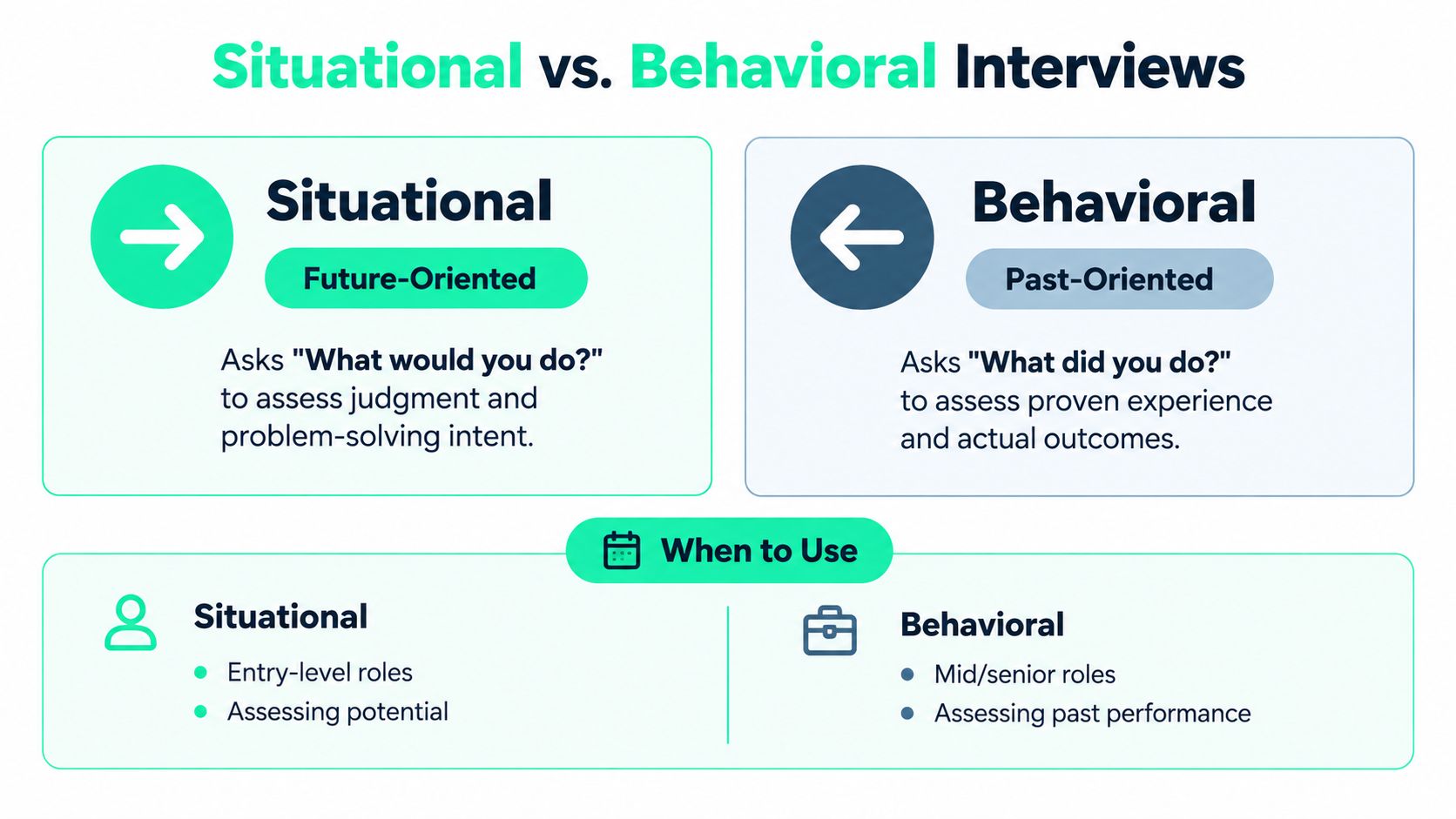
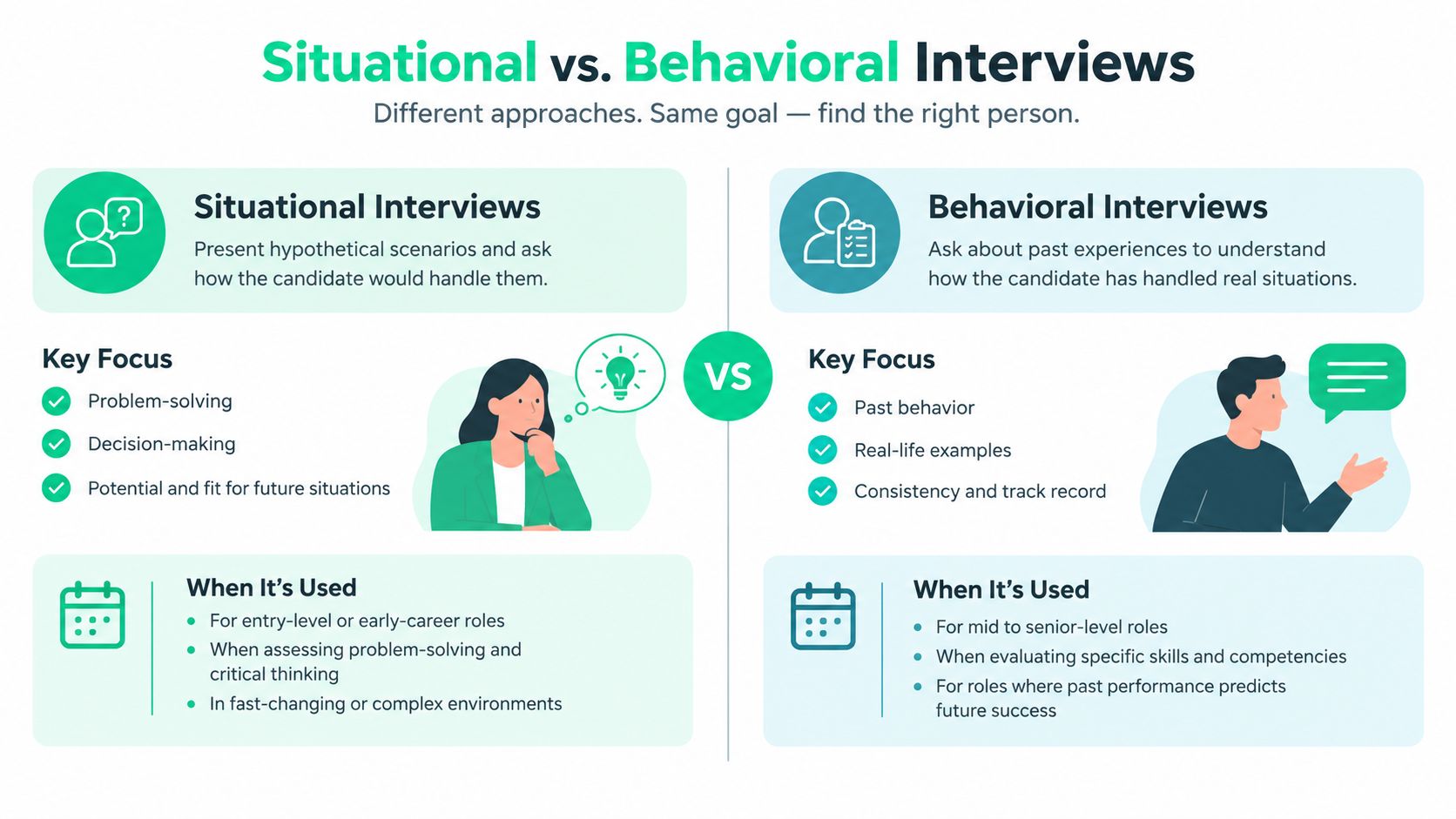
The verb tense is the tell. Situational questions use would and ask about an intended approach. Behavioral questions use did and ask for a past event. Many structured processes use both, because intention and track record answer different questions.
How employers build them. The hiring team runs a job analysis, identifies the capabilities the role requires (prioritization, customer care, ethical judgment, collaboration), then converts those into a realistic scenario. Interviewers score responses against an anchored rubric with consistent criteria across candidates, which makes job-related judgment easier to compare fairly.
The format works. Meta-analytic research put mean observed validity at about 0.35 across 946 observations, with corrected estimates reaching roughly 0.47 — and earlier reviews landing in the 0.41 to 0.47 range.
What a strong answer contains. Interviewers are listening for six things: what you'd assess first and why (priority), who needs information or a decision (stakeholders), what limits your options (constraints), what you'd do and in what order (action), when you'd involve a manager (escalation), and how you'd verify it worked (follow-up).
What weakens an answer. Promising to do everything immediately without checking risk or capacity, blaming others, hiding mistakes, ignoring affected stakeholders, or offering vague traits like "I'm collaborative" instead of a route the interviewer can follow.
You don't need direct experience with every scenario — you need to make your reasoning easy to follow.
Introduction to Situational Interviews
You are asked what you would do if a customer became angry or a project started falling behind. The situation is hypothetical, but the judgment is real. A situational interview examines how you would choose priorities, weigh risks, communicate, and act when the facts are incomplete.
The U.S. Office of Personnel Management guide describes this future-focused format alongside behavioral interviews, which ask about what you did in a past situation. A behavioral response offers evidence from your history. A situational response explains your intended approach, including the tradeoffs you would consider. You do not need to claim experience with every possible workplace problem.
Practical rule: Treat the question like a small workplace simulation, not a demand to predict the future perfectly.
The interviewer is rarely checking for one magic sentence. The prompt creates a controlled test of judgment under uncertainty. Your answer can show whether you clarify the facts, identify who or what may be affected, set a sensible order, and explain when you would seek help. Staying authentic matters because a memorized script can miss the details that change the decision.
Employers build these scenarios from job analysis. They identify duties and capabilities connected to the role, then ask about situations such as an upset customer, conflicting deadlines, or unclear instructions. The same structure may give candidates consistent questions, scoring criteria, and follow-ups, allowing job-related judgment to be compared more fairly.
If you are preparing for your first interview, an interview preparation guide can help you organize role research and practice without scripting every word. Learn the decisions the role requires, then rehearse how you would explain your priorities while leaving room to think.
How Situational Interviews Work in Structured Hiring
A structured situational interview usually follows a chain of decisions made before the interview begins.
From job analysis to scenario
First, the employer identifies important tasks and capabilities through job analysis. These might include prioritization, customer care, ethical judgment, collaboration, or handling quality risks. The hiring team then turns those requirements into a hypothetical situation that resembles a real challenge in the role.
For example, a role that requires careful prioritization might use this prompt:
“Two urgent requests arrive at the same time, and both stakeholders say their work must come first. What would you do?”
The question doesn't test whether you know one company-specific answer. It creates a consistent opportunity to show how you gather information, assess impact, communicate, and choose a sequence.
From scenario to scoring
Next, interviewers decide what a strong response should contain. They may use an anchored rubric that describes different levels of decision quality. A strong answer could recognize customer or business impact, clarify constraints, communicate early, and explain why one task takes priority. A weaker answer might promise to do everything immediately without checking risk or capacity.
Think of the process as a flight simulator for judgment. A simulator doesn't recreate every detail of flying, but it gives a pilot a controlled situation in which decisions matter. A situational interview does something similar for workplace reasoning. It samples how you'd respond without waiting for the exact problem to arise on the job.
Why consistency matters
Standardization improves the usefulness of the comparison. If one candidate receives a friendly conversation and another receives a demanding improvisation exercise, their scores may reflect the interviewers' styles rather than the candidates' capabilities. Consistent administration, job-linked scenarios, and clear scoring criteria reduce that noise.
Research summarized in a review of interview validity places corrected validity for situational interviews at about 0.47, with earlier reviews in the 0.41 to 0.47 range. The practical lesson for candidates is encouraging: employers get more useful evidence when they ask focused questions and score the reasoning consistently, so a clear, role-focused answer gives the interviewer something concrete to evaluate.
Situational vs Behavioral Interviews and When Each Is Used
The fastest way to tell the formats apart is to listen for the verb tense.
A situational question asks about a possible response:
- “What would you do if a key stakeholder rejected your proposal?”
- “How would you respond to an upset customer?”
- “If you discovered an error before a deadline, what steps would you take?”
A behavioral question asks for a past event:
- “Tell me about a time a stakeholder rejected your proposal.”
- “Describe a difficult customer interaction.”
- “Tell me about a mistake you found before a deadline.”
The OPM structured interview guidance describes situational questions as prompts about what applicants would do in a similar on-the-job situation, while behavioral questions focus on past actions. Both can assess judgment and communication, but they draw on different evidence.
Match the answer to the question
If the interviewer asks what you would do, begin with your intended approach. You can add a short example from your experience to make the answer credible, but don't spend the entire response telling a past story while ignoring the hypothetical.
For instance:
“First, I'd clarify the customer impact and the deadline. Then I'd communicate the conflict to both stakeholders, recommend a sequence based on business risk, and confirm the next update point. In a previous project, I used a similar prioritization process when several requests arrived together.”
That answer leads with the future-oriented response. The past example supports it instead of replacing it.
If the interviewer asks what you did, use a specific experience and explain your role. The STAR method, Situation, Task, Action, and Result, works naturally for behavioral questions because it organizes evidence from the past.
When employers use each format
Situational interviews can help employers assess potential, particularly when candidates have limited direct experience. Behavioral interviews are useful when the employer wants evidence of how you handled a comparable event. Many structured hiring processes use both, because intention and past behavior answer different questions.
Don't assume that an entry-level candidate has nothing to discuss. Coursework, volunteering, internships, group projects, part-time work, and personal projects can provide behavioral examples. The important distinction is whether the interviewer asks you to imagine a response or recount an actual one.
What Interviewers Really Evaluate in Your Answer
A scenario gives you incomplete information, competing priorities, and limited time. Your response shows how you make a responsible choice before every fact is available. Interviewers are listening for judgment under uncertainty, not a magical answer that removes the problem.
A difficult prompt may offer no perfect option. Helping one customer quickly could delay another task. Escalating a problem could protect quality but use a senior colleague's time. Meeting a deadline could require reducing scope. Strong answers make the tradeoff visible, then explain which risk you would address first and why.
The judgment underneath the words
Interviewers usually look for several parts of your reasoning:
- Priority: What would you assess first, and what makes it the first concern?
- Stakeholders: Who needs information, support, or a decision?
- Constraints: What limits your choices, such as time, policy, safety, quality, or authority?
- Action: What would you do, and in what order?
- Escalation: When would you involve a manager or specialist?
- Follow-up: How would you check whether the solution worked?
Structured hiring uses consistent questions and scoring criteria to compare job-related judgment and problem-solving. Your answer therefore needs more than a positive trait such as “I'm collaborative.” It should show the evidence behind your choice, like a clear route on a map: the interviewer can follow where you started, which risks you weighed, and why you selected that direction.

How rubrics handle ambiguity
An anchored rubric gives interviewers shared criteria for comparing answers. It may reward clarifying facts before acting, setting a defensible priority, communicating risks early, and protecting the most important outcome. It may lower an evaluation for blaming others, hiding mistakes, ignoring affected stakeholders, or making vague promises.
You cannot see the rubric, so make your choices easy to follow. State what you would check, what you would do first, and which new fact might change your decision.
A thoughtful answer can acknowledge uncertainty without sounding indecisive.
For practice, AI mock interview practice lets you respond aloud to hypothetical prompts and notice where your explanation becomes unclear. Treat the tool as feedback, not as a script. Authenticity comes from explaining your real reasoning in your own words.
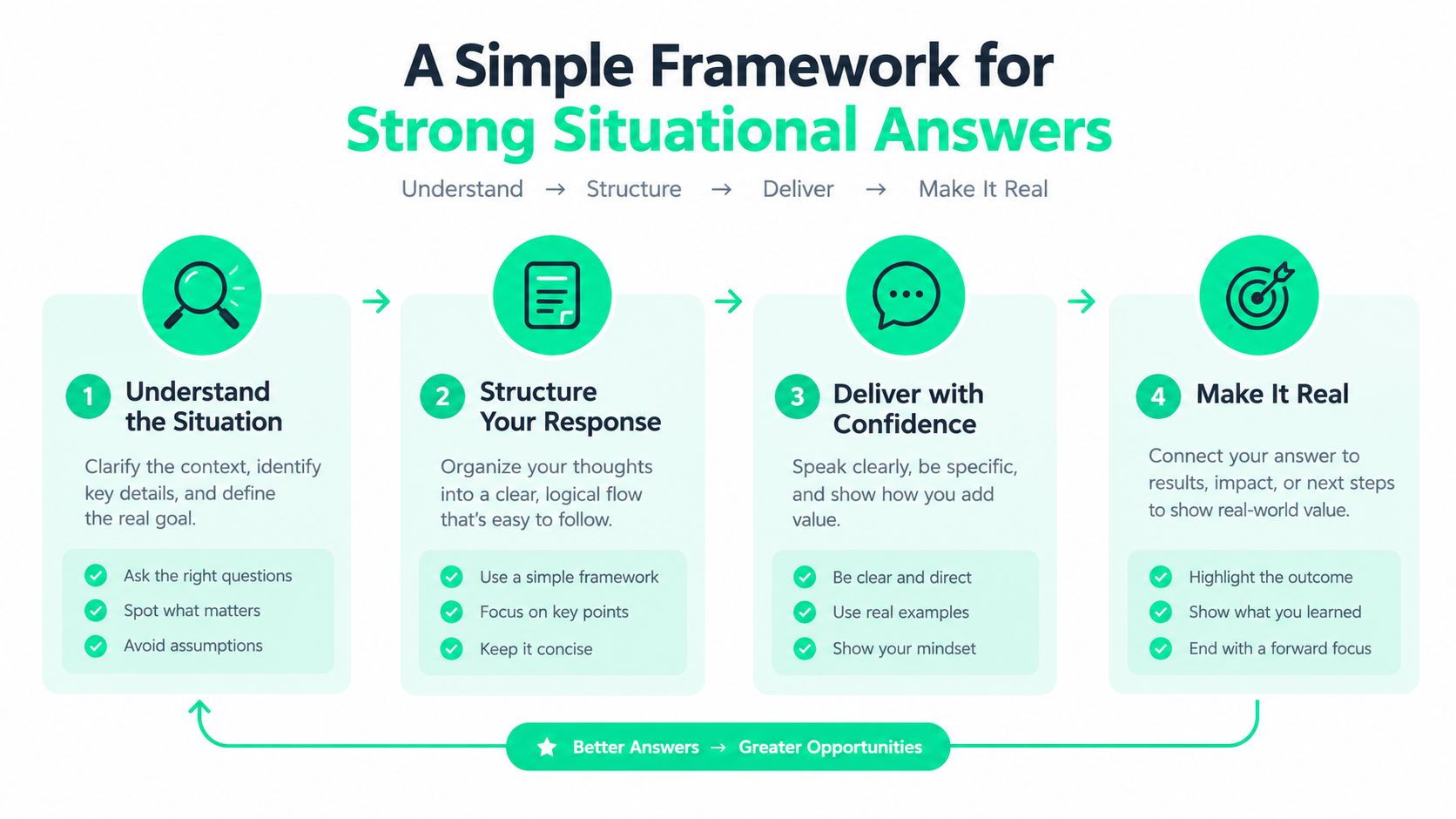
A Simple Framework for Strong Situational Answers
A situational answer can use the STAR structure, but adapt it for a hypothetical question. You aren't reporting a completed event, so your “Situation” is the interviewer's scenario and your “Action” is the plan you'd follow.
A useful response can fit into roughly 60 to 90 seconds, with two to three concrete steps, as recommended by Hyring's situational interview guidance.
Start by framing the situation
Briefly restate the problem in your own words. This shows that you understood the stakes and gives you a moment to organize your thoughts.
“If two urgent deadlines collided, I'd first clarify the impact, dependencies, and flexibility around each deadline.”
That opening is better than jumping straight into a generic promise to “communicate effectively.” It names the information you need before choosing.
Make Action the center
The STAR method emphasizes Action. MIT CAPD breaks the structure into 20% Situation, 10% Task, 60% Action, and 10% Result. For a hypothetical response, spend most of your time describing the order of your decisions.
A practical sequence might be:
- “First, I'd confirm the business or customer impact and identify any fixed constraints.”
- “Second, I'd speak with the relevant stakeholders, explain the conflict, and recommend a priority based on risk.”
- “Third, I'd document the decision, adjust the plan, and set a follow-up check.”
This structure keeps you from listing every possibility. It also gives the interviewer observable actions rather than abstract qualities.
Close with the result you'd protect
End with the outcome or learning you'd aim for. Indeed recommends including what happened because of your actions and what you learned, while noting that measurable outcomes can strengthen the closing.
For a hypothetical answer, you might say, “The goal would be to protect the higher-risk deliverable, keep both stakeholders informed, and review the decision afterward so the same conflict is easier to prevent.”
Don't memorize that sentence word for word. Build a few resume-grounded talking points, such as a time you re-prioritized work, resolved a disagreement, or identified a risk. Then use those facts to support a natural answer.
Example Situational Interview Questions and Model Answers
Examples become useful when they show the reasoning, not just polished wording. The following answers are models to adapt, not scripts to recite.
Conflicting deadlines
Question: “If two urgent deadlines collided, what would you do?”
Model answer: “I'd first confirm the impact, dependencies, and flexibility of each request. Then I'd compare them by business risk and communicate the conflict to both stakeholders, including the sequence I recommend and any effect on timing. If I needed a decision beyond my authority, I'd escalate with the relevant facts rather than waiting. I'd document the plan and follow up to make sure the highest-risk work stays on track.”
Why it works: The answer doesn't claim that everything can be completed instantly. It shows assessment, communication, escalation, and follow-through. A situational interview question practice resource can help you rehearse similar priority conflicts for a specific role.
An upset customer
Question: “How would you handle an angry customer whose issue you couldn't resolve immediately?”
Model answer: “I'd let the customer explain the problem without interrupting, then summarize it to confirm I understood the impact. I'd explain what I could do immediately, what required another team, and when the customer would receive an update. I'd escalate the issue through the correct channel, record the details, and follow up rather than leaving the customer to repeat the story.”
Why it works: It balances empathy with process. The answer doesn't promise an outcome you can't control, but it does promise ownership of communication and follow-up.
A difficult stakeholder
Question: “What would you do if a stakeholder criticized your proposed solution?”
Model answer: “I'd ask which risk or requirement led to the concern, then separate feedback about the idea from feedback about how I presented it. If the criticism identified a genuine issue, I'd revise the proposal and explain the change. If I still believed my approach was safer, I'd present the evidence and tradeoffs calmly, then involve the appropriate decision-maker if we couldn't agree.”
Why it works: You remain open without becoming passive. You show that disagreement should improve the decision, not become a personal conflict.
A mistake before a deadline
Question: “What would you do if you found an error that could affect delivery?”
Model answer: “I'd verify the error and assess who and what it could affect. I'd tell the relevant stakeholders early, propose options such as correcting the work, reducing scope, or requesting support, and recommend the option that protects the most important requirement. After the fix, I'd document the cause and add a check to reduce the chance of repeating it.”
Why it works: It combines accountability with recovery. Interviewers can see how you protect trust when the situation becomes uncomfortable.
How to Prepare Confidently and Stay Authentic
Preparation should reduce cognitive load, not force you to perform a personality that isn't yours. Start by reviewing the job description and identifying the decisions the role may require. For each one, prepare a small set of facts from your real experience, such as a project, responsibility, obstacle, action, and outcome.
Practice in layers:
- Write cues: Record short prompts, not paragraphs. “Deadline conflict, checked impact, aligned stakeholders, documented plan” is easier to retrieve than a memorized speech.
- Speak aloud: Answer without reading. Notice whether you explain your first step and the reason behind it.
- Review delivery: Listen for rushed pacing, repeated filler words, or an answer that wanders away from the role.
- Add uncertainty: Practice saying, “I'd first confirm the facts,” or “That would depend on the policy and customer impact.” These phrases show disciplined thinking.
- Request accommodations: If you need additional processing time, written prompts, or another reasonable adjustment, consider asking the employer or recruiting contact early.
Interview anxiety can affect how well someone communicates what they know. Research coverage from Cornell on autistic applicants and interview preparation discusses rehearsal of socially appropriate responses and teamwork answers, while also highlighting the tension between authenticity and social polish. That tension matters for neurodivergent candidates, international applicants, and anyone interviewing in a language that requires extra processing.
You don't need to erase your communication style. Use a pause, ask to hear the scenario again, or say, “I'd like a moment to organize my approach.” Then return to the sequence: clarify, prioritize, act, communicate, and follow up. A calm structure gives the interviewer access to your actual judgment instead of measuring how quickly you can improvise.
Key Takeaways
- Situational interviews test judgment under uncertainty, not recall — the format gives you incomplete information and competing priorities on purpose, so answers that make the tradeoff visible ("helping this customer quickly delays that task, and here's which risk I'd address first") outperform answers that promise everything gets done immediately.
- Match the answer to the verb tense — if the interviewer asks what you would do, lead with your intended approach and use a past example only as brief support, because spending the whole response on a behavioral story while ignoring the hypothetical is one of the most common ways candidates miss the question entirely.
- Adapt STAR rather than abandoning it — the interviewer's scenario becomes your Situation and your plan becomes your Action, with roughly 60% of a 60-to-90-second answer spent on the order of your decisions, because a sequence of two or three concrete steps gives the interviewer observable actions instead of abstract qualities.
- The scoring rubric rewards a visible route, and you can't see it — so state what you'd check first, what you'd do next, who you'd inform, when you'd escalate, and which new fact would change your decision, which is exactly what anchored rubrics reward and what vague trait claims fail to provide.
- Situational formats can favor candidates with limited direct experience, which makes preparation worth the effort — short cue words ("deadline conflict, checked impact, aligned stakeholders, documented plan") retrieve better under pressure than memorized speeches, and asking for a moment to organize your approach or requesting reasonable accommodations early protects access to your real judgment rather than measuring improvisation speed.
Qcard offers resume-grounded talking points, scored practice, mock interviews, and coaching for pacing, filler words, and answer length without turning responses into scripts. Visit Qcard to practice situational questions with concise memory cues and build a delivery style that still sounds like you.
Ready to ace your next interview?
Qcard's AI interview copilot helps you prepare with personalized practice and real-time support.
Try Qcard Free