How to Prepare for an Upcoming Interview Step by Step
TL;DR
Prepare for an upcoming interview in nested loops rather than one marathon session. Two to three weeks out, map the job description's repeated requirements to six to eight real stories with situation, your actions, result, and lesson. In the final week, convert those notes into spoken answers, prepare two questions for the interviewer, and run a mock. In the final 24 hours, switch from learning to logistics and compress your notes to a one-page cue card. In the final hour, warm up — don't cram. Research shows 92% of U.S. adults feel anxious about job interviews and 90% of hiring managers consider preparation a key success factor, so the goal is deliberate preparation, not endless preparation. Use cues over scripts ("shipped, stalled, fixed") because working memory is already handling the question, the interviewer's reaction, self-monitoring, and time pressure. Schedule three mock sessions roughly 48 hours apart, scoring clarity, structure, pacing, technical depth, and presence, and change only one variable between attempts. Keep recovery scripts ready: announce, reset, continue.
You're sitting at the kitchen table at 9 p.m. Your laptop is open, your notes are spread across the table, and your heart is moving faster than your thoughts. The outfit for tomorrow is already laid out, but your answers are only half finished. Every time you consider going to bed, another possible interview question appears.
That feeling doesn't mean you're unprepared. Interview anxiety is common, and one survey found that 92% of U.S. adults feel anxious about job interviews, with concerns ranging from general anxiety to not knowing an answer or arriving late. The survey findings from Harris Interactive and Everest College also show why content preparation alone isn't enough. You need a system that supports memory, pacing, logistics, and recovery when pressure interrupts recall.
How Do You Prepare for an Upcoming Interview?
Preparation works best as nested loops — you revisit the same material at increasing detail rather than trying to solve everything in one sitting. Four stages:
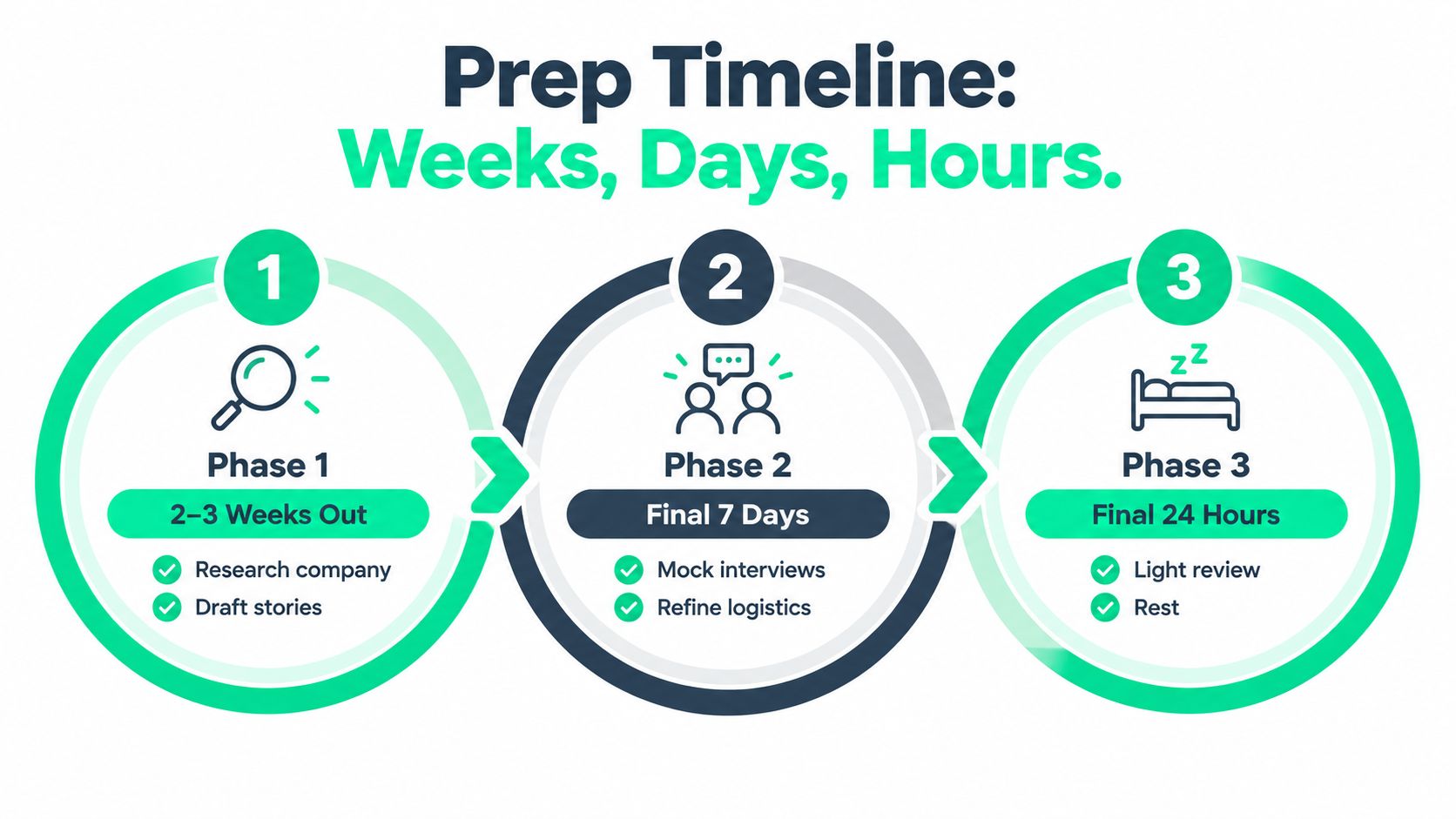
Two to three weeks out — build the evidence. Read the job description and mark the capabilities that repeat. Research the company through its site, product pages, and recent announcements. Then build a bank of six to eight stories from work, school, volunteering, freelance projects, or personal responsibilities — early-career candidates often wrongly dismiss academic examples, but interviewers need evidence of how you approached a problem, not a conventional job title. For each story, record the situation, your responsibility, the actions you took, the result, and one sentence on what you'd do differently now.
Checkpoint: you can name the role's main requirements and match each to a real example.
The final seven days — turn notes into spoken answers. Practice aloud so you can hear whether your explanation is clear, overloaded, or missing your contribution. Prepare two questions that help you understand the work ("What would success look like in this role?"). Run at least one mock interview and listen for filler words, rushed endings, and long introductions.
Checkpoint: you can answer common questions with structure while adapting wording naturally.
The final 24 hours — move from learning to logistics. Confirm the outfit, route or meeting link, documents, food, water, and sleep plan. Reduce your notes to one page of cues: job title, three role requirements, three story cues, two questions, the interviewer's name, and the link or address. Use short phrases like "late launch, found handoff gap, created checklist, fewer missed steps" rather than paragraphs.
Non-negotiable by 8 p.m.: documents and tech ready, notes on one page, and a decision about when preparation ends.
The final hour — warm up, don't cram. Take a short walk or breathing reset, drink water, review only the one-page card, say your introduction and one anchor story aloud, and close unrelated tabs.
The night-before rule: aim to be calmly ready, not perfectly prepared. A rested candidate with clear cues communicates better than an exhausted one holding more facts.
Feeling Ready the Night Before Your Upcoming Interview
The night before an interview isn't the time to learn everything about the company or rewrite your entire career history. Your job now is to consolidate what you already know, reduce decisions for the morning, and protect enough rest for your brain to retrieve information clearly.
Preparation matters. A survey cited by Zirtual found that 90% of hiring managers consider preparation a key factor in candidate success, while another survey reported that 70% see being unprepared as a common interview mistake. The interview preparation statistics collected by Zirtual support a useful distinction: preparation should be deliberate, not endless.
Use the next 60 minutes for three focused moves.
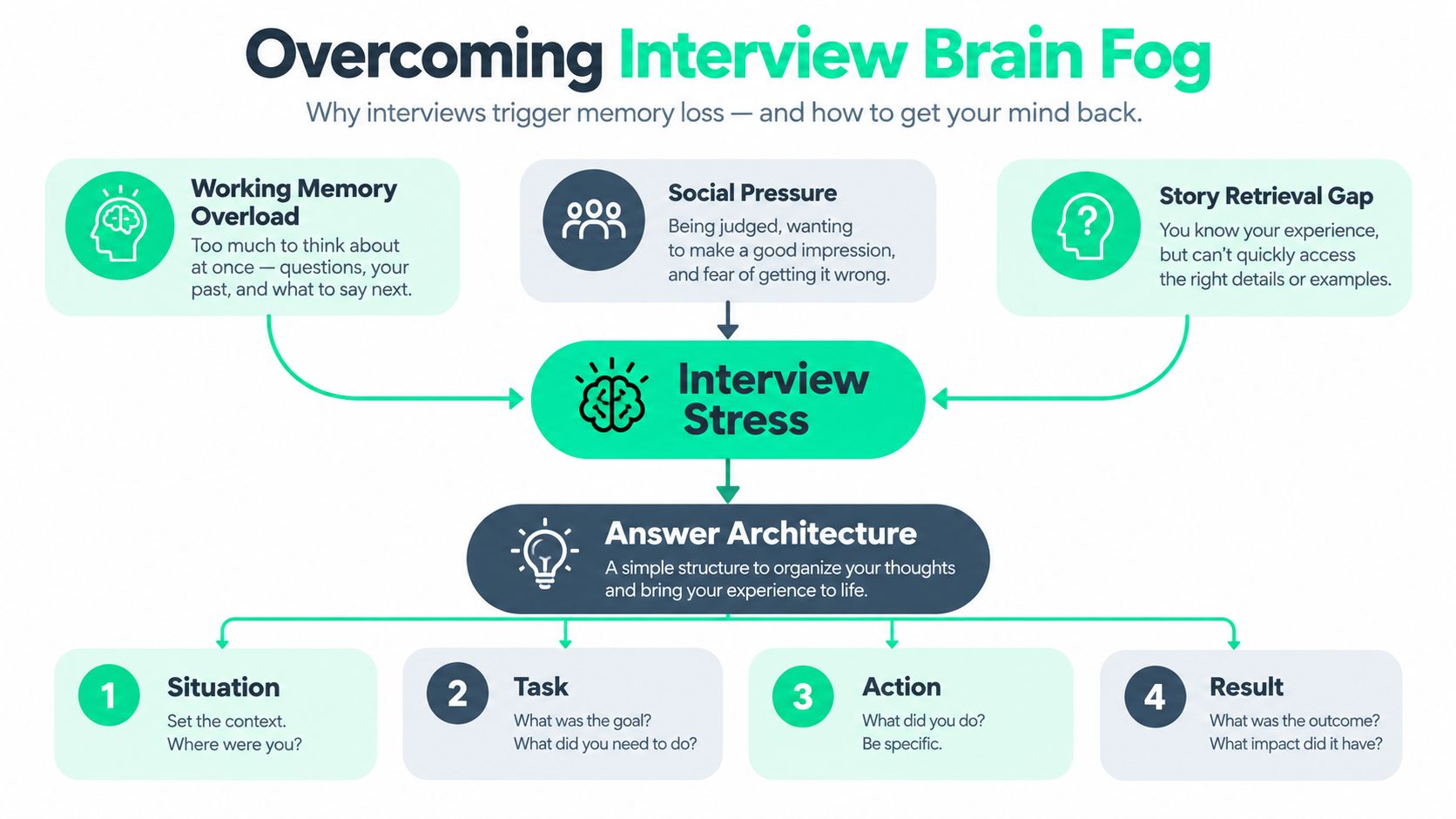
- Spend 10 minutes reviewing one anchor story. Choose an example that demonstrates a central skill for the role, such as handling a difficult customer, learning a tool quickly, improving a process, or resolving a conflict. Say the story aloud once using four cues: Situation, Task, Action, Result. Don't try to memorize every sentence. Remember the sequence and the result.
- Write a one-page cheat sheet, then stop. Put the job title, three role requirements, three story cues, two questions for the interviewer, the interviewer's name, and the meeting link or address on one page. Use short phrases such as “late launch, found handoff gap, created checklist, fewer missed steps” instead of paragraphs. The shorter format gives your memory something to retrieve without encouraging you to read a script.
- Check the physical details. Confirm your outfit, identification, resume, charger, headphones, notebook, route, and interview link. If the interview is online, log in far enough ahead to check the camera and microphone. If it's on-site, verify the route and arrival instructions. Put everything in one place so the morning doesn't begin with a scavenger hunt.
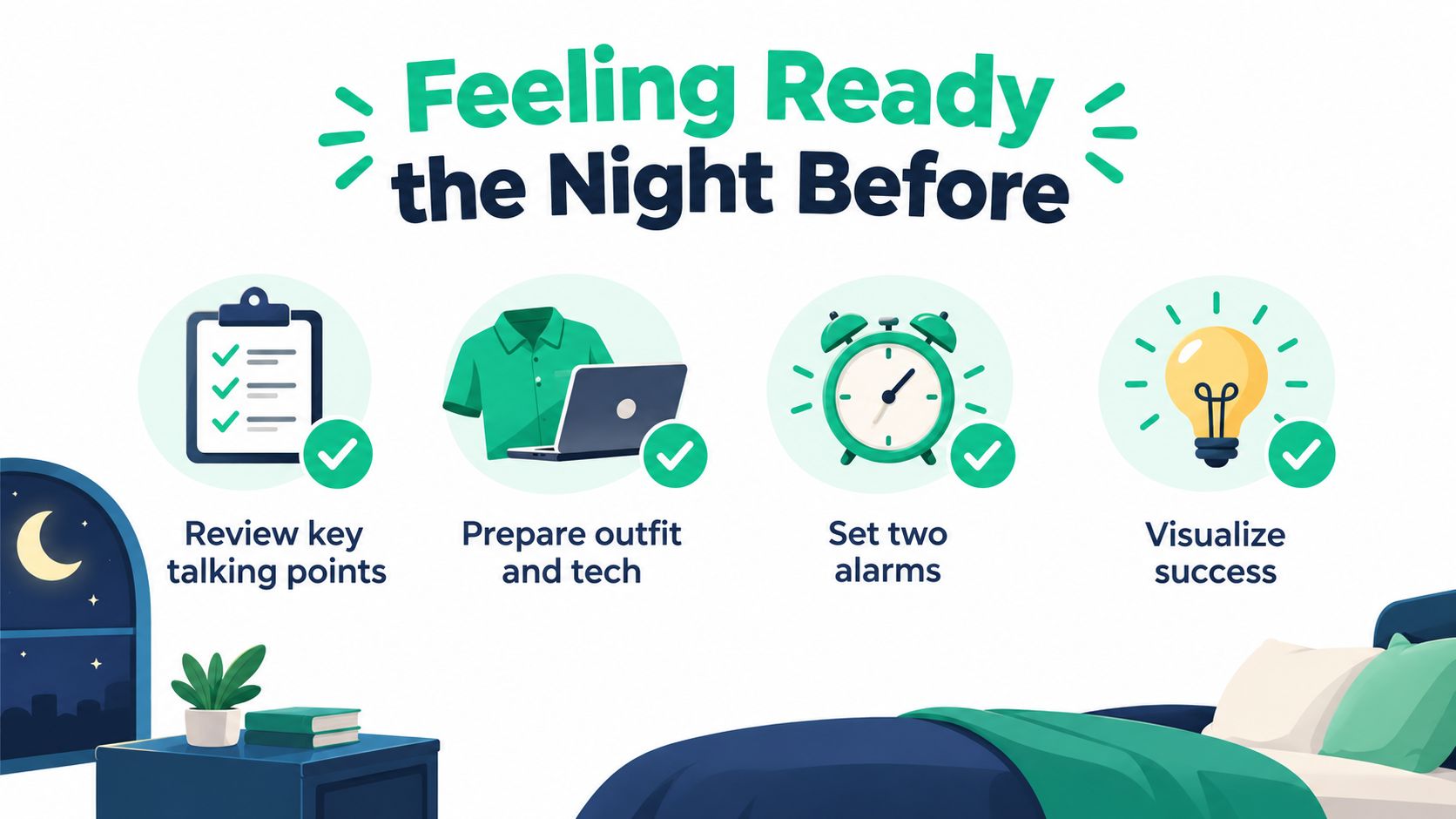
Night-before rule: Aim to be calmly ready, not perfectly prepared.
Finish by setting an alarm, choosing a realistic bedtime, and closing the laptop. A rested candidate with clear cues will usually communicate better than a candidate who has collected more facts but is too tired to access them.
Your Weeks, Days, and Hours Prep Timeline
An upcoming interview becomes easier to manage when preparation works like a set of nested loops. You revisit the same material at increasing levels of detail, rather than attempting to solve everything in one sitting.
Two to three weeks out
Start with the role and the employer. Read the job description closely and mark the capabilities that appear repeatedly. Research the company through its website, public materials, product pages, and recent announcements. Then map your experience to the role.
Build a bank of six to eight stories from work, school, volunteering, freelance projects, or personal responsibilities. Early-career candidates often dismiss academic or project examples because they don't look like conventional employment. Interviewers still need evidence of how you approached a problem, made a decision, collaborated, and learned.
For each story, record the situation, your responsibility, the actions you personally took, and the result. Add one sentence about what you'd do differently now. This gives you material for behavioral questions without forcing you to invent experience you don't have.
Outcome by Friday: you can name the role's main requirements and match each one to at least one real example.
The final seven days
Turn story notes into spoken answers. Practice aloud so you can hear whether your explanation is clear, too detailed, or missing your contribution. Prepare two questions that help you understand the work, such as “What would success look like in this role?” or “Which challenge would the person hired need to address first?”
Run at least one mock interview and listen for filler words, rushed endings, and long introductions. One 2026 interview statistics compilation reported that 41% of candidates use the STAR method, and it associated mock-interview practice with higher scores. The reported behavioral interview statistics from ZipDo reinforce the value of structured rehearsal, but your practice should still sound conversational.
Outcome by the end of the week: you can answer common questions with structure while adapting the wording naturally.
The final 24 hours
Move from learning to logistics. Confirm the outfit, route or meeting link, documents, food, water, sleep plan, and a short morning warm-up. A 15-minute warm-up might include reading your four-bullet card, saying your introduction aloud, and taking a short walk.
Use the upcoming interview preparation guide if you need a compact way to organize these tasks.
Non-negotiable by 8 p.m.: your documents and technology are ready, your notes fit on one page, and you know when preparation ends. Candidates who need more processing time can move research and story collection earlier. The timeline is flexible. The checkpoints are what matter.
Practicing Behavioral and Technical Questions
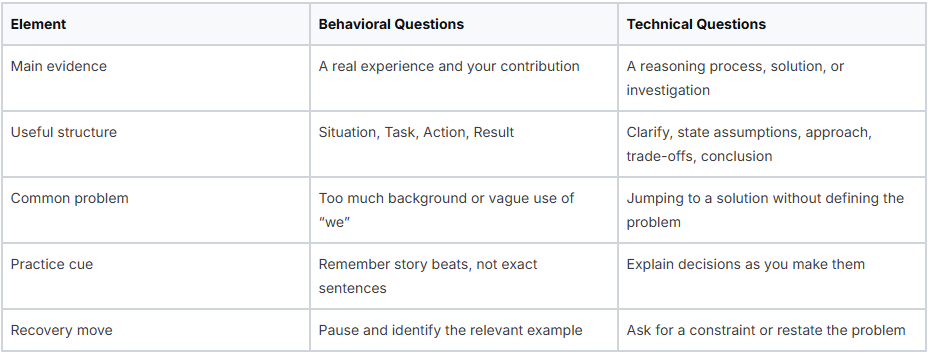
A behavioral answer asks how you acted in a real situation. A technical question asks how you reason through a problem, apply knowledge, or make trade-offs. The two tracks overlap because both require clear thinking, but they need different practice.
Consider the prompt, “Tell me about a time you had to learn something quickly.” A natural 90-second answer might sound like this:
“In a student project, our team needed to use a reporting tool none of us knew. I took responsibility for learning the basic workflow, tested it on a small data set, and wrote a short guide so the rest of the team could work consistently. We delivered the report on time and reduced the manual checking steps from five to three. The main lesson was to learn just enough to create a reliable process, then share that process instead of keeping the knowledge with one person.”
The answer has one story, one clear personal contribution, and one result. The STAR method works because it keeps the response anchored in Situation, Task, Action, and Result. Guidance from MIT Career Advising on the STAR method recommends giving the Action portion the most space and finishing with a quantifiable result when one is available.
Avoid stacking several examples into one response. Don't spend most of the answer describing what “we” did while leaving your own actions unclear. Don't trail off after the result with a second story that weakens the ending.
Technical practice should sound more like visible problem-solving. If asked, “How would you investigate a sudden drop in application performance?”, begin with a clarifying step:
“Before choosing a fix, I'd want to clarify whether the slowdown affects all users, one endpoint, or a recent release. I'd compare current behavior with a known baseline, check recent changes, and then isolate whether the bottleneck is in the application, database, or network.”
If you're unsure, narrate the trade-off rather than pretending certainty:
“I'd start with the least disruptive diagnostic step. A cache change might improve speed quickly, but it could also hide a data consistency issue, so I'd measure the effect and confirm the freshness requirements before keeping it.”
Early-career candidates may face a whiteboard, take-home task, live-coding session, or case exercise. Practice the format you will encounter. Say your assumptions aloud, ask what constraints matter, and explain why you chose one approach over another.
Practice aloud, record yourself once, and listen back once. Ten repeated recordings can make your delivery stiff. For additional prompts, use practice interview questions for behavioral and technical preparation.
Memory Cues and Authenticity Strategies
Brain fog during an interview doesn't necessarily mean you lack knowledge. Working memory is handling the question, the interviewer's reaction, your own self-monitoring, the time limit, and the pressure to appear capable. Social pressure adds another layer, while the story you know well in private may not be indexed for quick retrieval.
A cue-based system reduces that load. Start with a mini-mode for the first 90 seconds of the interview. Prepare a short introduction containing your current focus, one relevant strength, and why this role interests you. This gives you a stable opening while your attention adjusts to the conversation.
Keep a four-bullet card nearby:
- The role's central need
- Your strongest matching example
- One result or metric
- One question to ask
Use three words per STAR beat when rehearsing a story. For example: “shipped, stalled, fixed.” Those words might expand into a project launch, a delayed handoff, and a checklist you created to prevent the same problem. The cue preserves your natural language while giving your memory a path back into the story.
Use a metric as an anchor when you drift. It might be the number of users supported, the delivery date, the reduction in manual steps, the size of the team, or another verified detail from your experience. If you don't have a useful number, use a concrete outcome instead, such as “the team adopted the process” or “the client approved the revised plan.”
Authenticity doesn't mean speaking without preparation. It means bringing your real decision-making process instead of performing a flawless version of yourself. Include uncertainty when it was present, explain the trade-off you made, and describe how you corrected course.
A polished answer might say:
“I aligned stakeholders, optimized the workflow, and delivered the project successfully.”
A more human version might say:
“At first, I assumed the delay was a capacity problem. After speaking with the team, I realized the handoff was unclear, so I changed the checklist and tested it on the next delivery.”
The second answer gives the listener something to evaluate. It shows a hypothesis, a correction, and an action.
Remember two rules: cue over script, and pause over panic. A quiet moment gives you time to retrieve the right story. You can also say, “Let me take a moment to choose the clearest example,” and then begin.
Mock Interviews and Feedback Loops
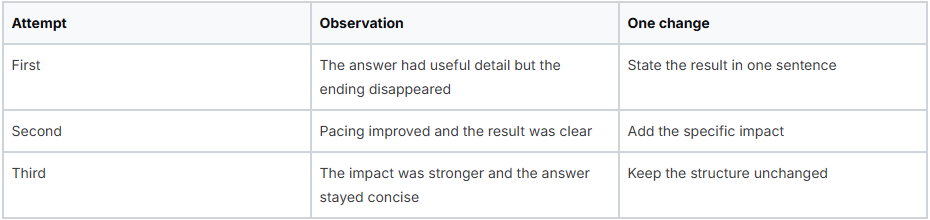
Schedule three mock sessions across the preparation week, with about 48 hours between them. The spacing lets you apply feedback before the next attempt instead of changing everything at once.
Ask your practice partner to score each dimension from 1 to 5 and add one sentence of evidence.
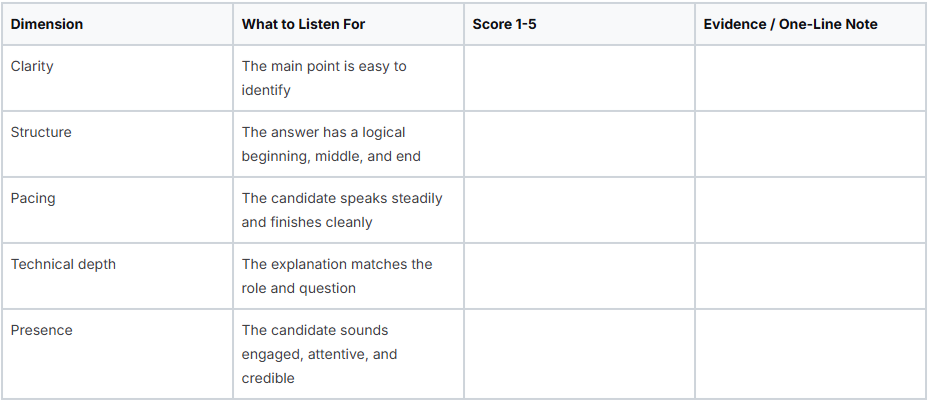
The partner should ask at least one curveball question, time each answer, and never finish your sentence. If you freeze, they should allow the pause. Finishing for you removes the exact recovery practice you need.
Within 10 minutes of the mock, write down three things: what worked, where you lost the thread, and the single change for the next attempt. Only change one main variable between sessions. You might shorten introductions in the second attempt, then add a stronger result in the third.
A useful AI mock interview tool can help solo candidates create question-and-feedback repetitions when a practice partner isn't available. For a self-mock, set a timer, read a question, answer without restarting, and write this debrief prompt afterward: “Where did my answer become hardest to follow, and what one cue would bring me back?”
Tech Setup, Environment, and Quick Recovery
The day of the interview should involve fewer decisions. Match your checklist to the format.
For video, log in to the platform, check your camera framing, test the microphone level, confirm the lighting, and run a 30-second speed test. Keep the camera at eye level and place your notes beside the screen rather than directly in front of your face.
For a phone interview, charge the phone, test your earbuds, choose a quiet room, and keep a printed prompt card nearby. For an on-site interview, confirm the route, parking or transit plan, identification requirements, water bottle, and a backup printed resume.
Energy management should be practical rather than elaborate. Drink water, choose a protein-led breakfast if that works well for you, and take a 10-minute walk before the call. If you have multiple sessions, use a two-minute box-breathing reset between them. Inhale, hold, exhale, and hold for equal counts while keeping your attention on the rhythm.
Audio problems can make you lose confidence even when your answers are strong. If you're reviewing recordings or cleaning practice audio, these prompt strategies for dialogue cleaning can help you describe the unwanted noise, timing issue, or speech characteristic you want to address.
Use short recovery scripts for predictable failures:
- Frozen screen: “My screen appears to have frozen. I'm going to reconnect now, and I'll continue from the last question.”
- Answer goes off course: “I've moved away from the main point. The action I took was this.”
- Unprepared question: “I haven't handled that exact situation, but I can explain how I'd approach it.”
- Brain blank: “I know this is familiar, but I need a moment to organize the example.”
These sentences turn a disruption into part of the conversation. You don't need to apologize repeatedly or explain your anxiety in detail. Announce, reset, continue.
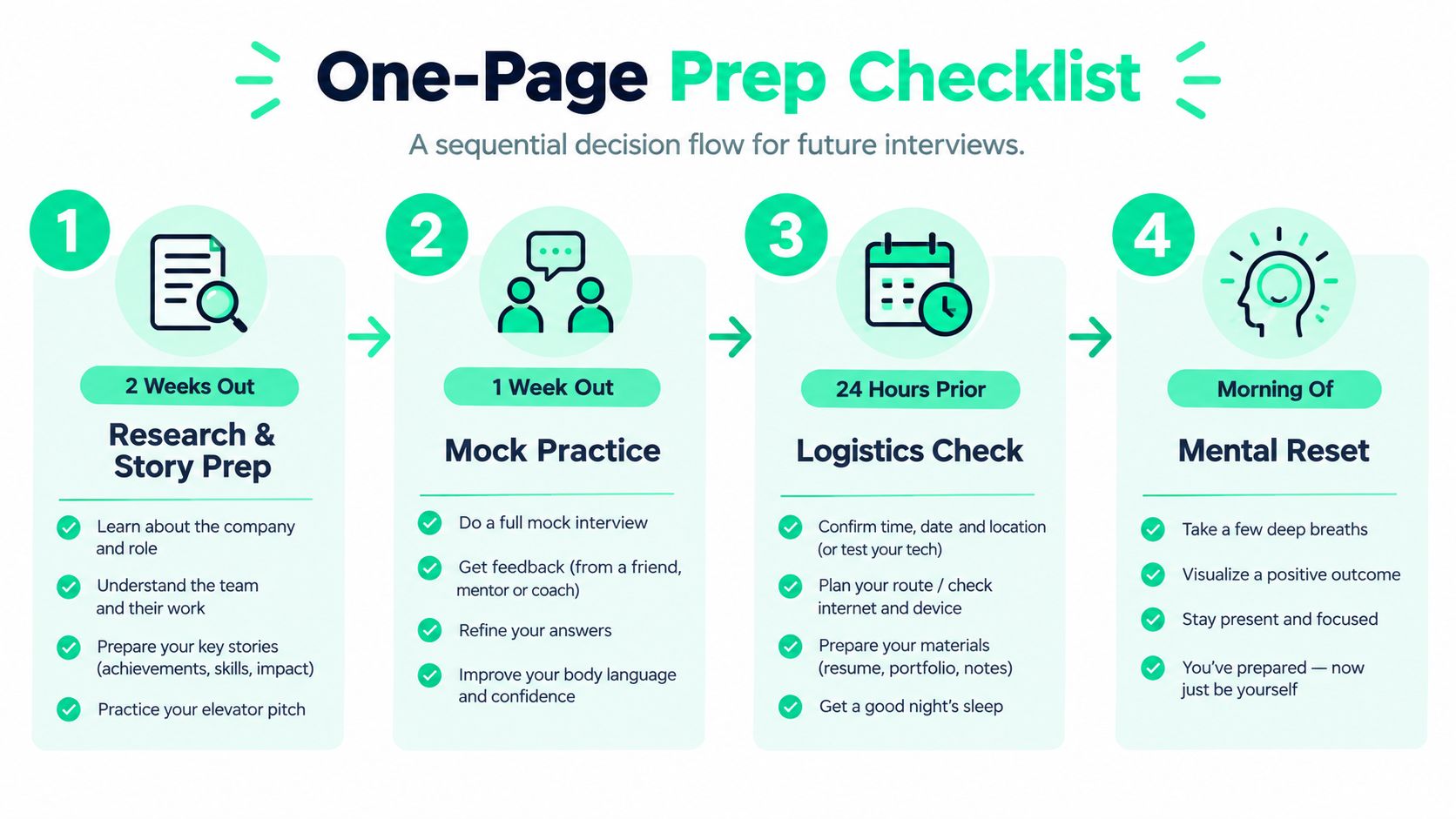
Your One-Page Prep Checklist for Next Time
Print this decision flow and keep it near your desk. Each stage has a small number of actions, so you can see what matters without reopening every note.
Two weeks out
- Research the company and understand the role's main requirements.
- Map the requirements to real work, school, or project examples.
- Start a bank of six to eight stories.
- Note the result and lesson for each story.
One week out
- Practice behavioral answers with STAR cues.
- Prepare for the technical format, whether it's a case, whiteboard, take-home, or live coding.
- Run a mock interview and choose one change to make.
- Confirm the route, platform, documents, and interview time.
- Write two thoughtful questions for the interviewer.
One day out
- Lay out your outfit and gather your resume, identification, notebook, and charger.
- Test the camera, microphone, lighting, or phone setup.
- Prepare food and water, then decide when preparation will stop.
- Reduce your notes to one page of cues.
One hour out
- Take a short walk or use a brief breathing reset.
- Drink water and review only the one-page card.
- Say your introduction and one anchor story aloud.
- Close unrelated tabs and silence unnecessary notifications.
During the interview
- Use the pacing cue: pause, answer, stop.
- Lead with the main point before adding detail.
- Use a recovery script if you lose the thread.
- Ask for clarification when the question has unclear constraints.
After the interview
- Write down what you remember while the conversation is fresh.
- Record one strength, one improvement, and one unanswered question.
- Send a concise thank-you note that refers to a real part of the discussion.
- Update your story cues for the next conversation.
Preparation is a fairness tool, not a test of how long you can cram. It gives your memory a route, gives your body fewer surprises, and gives the interviewer a clearer view of what you can do.
Key Takeaways
- Preparation should be deliberate, not endless — 90% of hiring managers consider preparation a key success factor and 70% cite being unprepared as a common mistake, but the night before an interview is for consolidating what you know and reducing morning decisions, not learning new material or rewriting your career history.
- Cues beat scripts because working memory is already overloaded during an interview — it's simultaneously handling the question, the interviewer's reaction, self-monitoring, the time limit, and the pressure to appear capable, which is why three words per STAR beat ("shipped, stalled, fixed") retrieves your story while leaving your language natural.
- Behavioral and technical questions need different practice — behavioral answers need Situation-Task-Action-Result with the Action section carrying the most space, while technical answers need you to clarify the problem first, state assumptions aloud, explain trade-offs, and narrate decisions as you make them, since the common technical failure is jumping to a solution before defining the problem.
- Mock interviews only compound when you change one variable at a time — three sessions roughly 48 hours apart, scored 1 to 5 on clarity, structure, pacing, technical depth, and presence with one line of evidence each, beats cramming many rounds together, and your practice partner should ask a curveball, time each answer, and never finish your sentences.
- Recovery scripts turn disruptions into part of the conversation — "My screen appears to have frozen, I'm going to reconnect and continue from the last question," "I've moved away from the main point, the action I took was this," and "I need a moment to organize the example" all let you announce, reset, and continue without repeated apologies or explaining your anxiety.
Qcard offers resume-grounded talking points, AI-scored practice, adaptive mock interviews, and live pacing support without turning your answers into scripts. Use Qcard to rehearse your stories, surface concise memory cues, and approach your upcoming interview with a clearer recovery plan.
Ready to ace your next interview?
Qcard's AI interview copilot helps you prepare with personalized practice and real-time support.
Try Qcard Free