Should You Send a Thank You Email After an Interview
TL;DR
Send the email — within 24 hours when you can write it carefully, the next morning when you can’t. The evidence is perception-based rather than experimental, but it’s consistent: 68% of hiring managers say a thank-you affects their decision process, 16% have dismissed candidates for skipping one, 80% of HR managers call the messages helpful, and only 24% of applicants send them. Email is the clear channel choice at 87% employer acceptance versus 38% for handwritten notes. Write to the person, not the process: recruiters get a short logistical note, hiring managers get one strategic topic connected to one verified achievement, and each panelist gets a distinct topic sentence. The note can also hurt you — through misspelled names, generic copy that could go to anyone, invented claims that don’t appear on your résumé, or pressure disguised as enthusiasm. Run the three-sentence test before sending: one specific topic, one verified achievement with no new claims, continued interest without demanding a decision.
Yes, you should send a thank-you email after a substantive interview, ideally within 24 hours, because 68% of hiring managers say it affects their decision and 16% have dismissed a candidate for not sending one. You're probably standing outside the building or staring at a closed video call right now, replaying one answer you wish you'd phrased better. Don't let that replay decide your next move. One short, accurate email tonight or tomorrow morning is useful work, not anxious busywork.
Should You Send a Thank You Email After an Interview?
Yes - after any substantive interview, ideally within 24 hours. A 2017 TopResume survey of 358 recruiters and hiring managers found 68% said a thank-you message affected their decision-making process, and 16% said they had completely dismissed a candidate for not sending one.
That doesn’t mean a polite email rescues a weak interview. It means silence creates a preventable negative signal, and a good note matters when the final choice is close. Robert Half reported that 27% of U.S. hiring managers said that, among candidates with equal skills and experience, those who sent thank-you messages made a positive impression that could tip the scales.
The opportunity is the gap. An Accountemps survey of 300+ HR managers found 80% considered thank-you messages helpful when deciding whom to hire (22% very helpful, 58% somewhat), while only 24% of applicants sent one — down from 51% in 2007.
Use email, not another channel. In a separate Accountemps survey of 500+ HR managers, 87% said email was appropriate, versus 81% for phone, 38% for handwritten notes, and 10% for text.
Timing: send the same day if you can name a specific topic, spell every name correctly, and read it aloud without finding an error. Send the next morning if you’re tired, emotional, or reconstructing a panel. Send within 48 hours if you needed time to find a work sample. Past 48 hours, send a brief continued-interest note without a long apology.
What a useful note does: thanks the person by name, recalls one real topic from the conversation, connects it to evidence already on your résumé, and confirms continued interest. Four moves, no groveling.
If the interview went badly: still send it, if you want the job. Keep it shorter, correct one materially incomplete answer in a sentence, and stop.
The Quick Answer Right After the Interview
You walk out of a panel interview, phone already half out of your pocket. Part of you wants to send something immediately to prove you're keen. Another part wonders if interviewers even read these notes, or if you'll sound desperate for trying. I've sat with enough candidates in that exact spiral to give you a straight answer. Send it, but send a version that helps the reader remember why you fit the job.
The reason isn't etiquette for its own sake. A 2017 TopResume survey of 358 recruiters and hiring managers found that 68% said receiving a thank-you email or note affected their decision-making process and 16% said they had completely dismissed a candidate because no thank-you message was sent. Those numbers don't turn a weak interview into an offer. They do mean silence can create a preventable negative signal, and a good note can matter when the final choice is close.
What a useful note actually does
Think of the email as one clean evaluator touchpoint. It thanks the person by name, recalls one real topic from your conversation, connects that topic to evidence already on your résumé, and confirms you still want the role. You're not re-arguing your whole candidacy, and you're not apologizing for existing.
If you're still rehearsing answers for the next round, keep your preparation grounded in the same verified examples you'd put in this email, for instance by working through structured practice interview questions before you draft. For the mechanics of subject lines, greetings, and sign-offs, the PrayerPetals guide to email polish is a handy refresher before you hit send.
Should you send a thank you email if the interview went badly? Yes, if you still want the job. Keep it shorter, correct one materially incomplete answer if you can do it in a sentence, and stop there.
Actionable example, in full. Subject: Thank you, marketing analyst interview. Body: "Thank you for your time today. Your point about inconsistent weekly reporting stuck with me, because I faced the same problem when I rebuilt our team's reporting template. I'm very interested in the role and happy to share that work if useful." Three moves, no groveling, done.
What the Evidence Actually Shows
I'm not going to sell you a magic trick. The evidence for thank-you emails is real, but it's perception evidence, and you should understand exactly what that means before you rely on it. Hiring managers report that these messages influence them. Nobody in these surveys ran a controlled experiment where identical candidates were randomly assigned to send or skip a note.
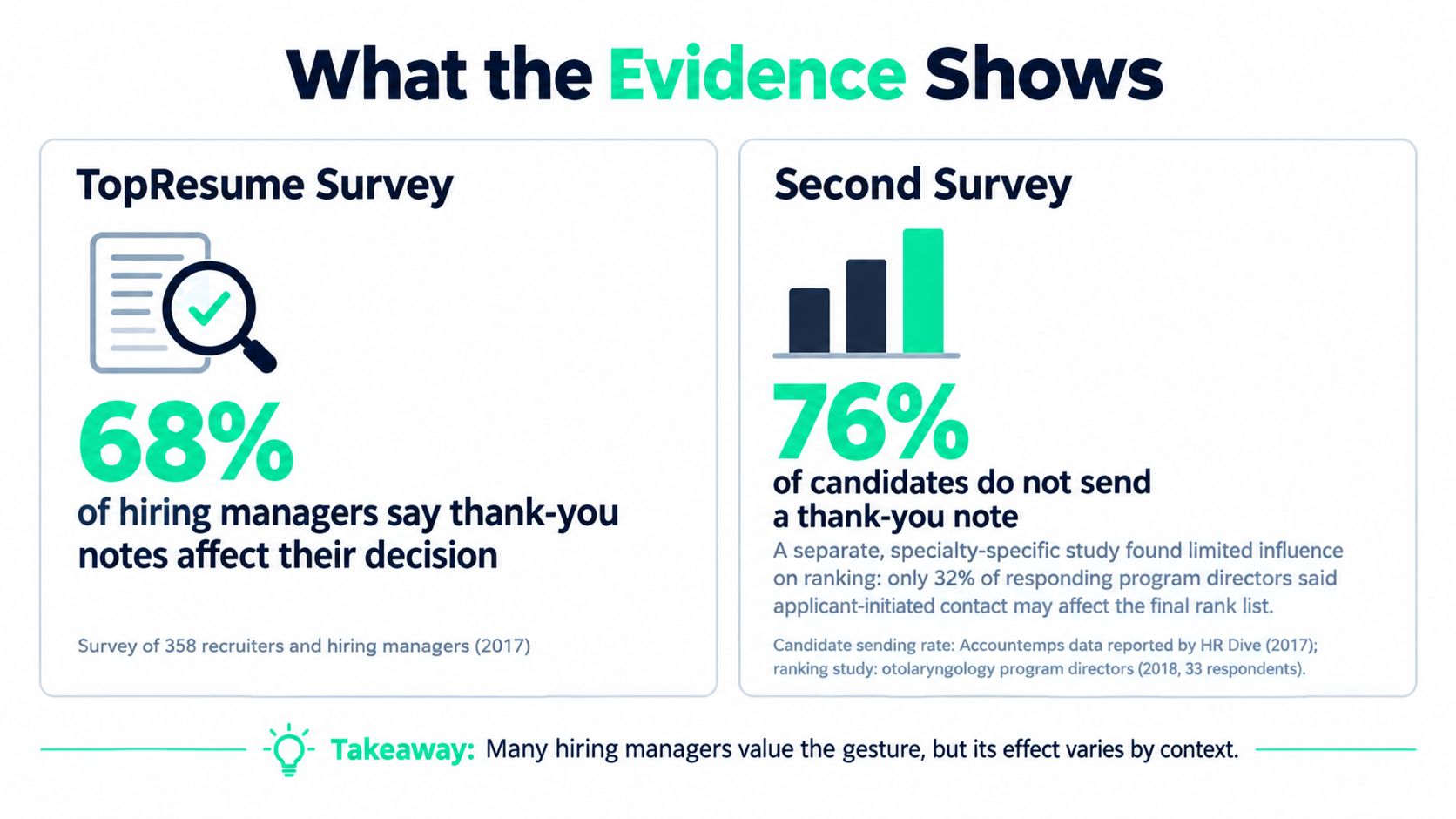
Start with the employer side. An Accountemps survey of more than 300 HR managers at U.S. companies with at least 20 employees found that 80% said thank-you messages were helpful when deciding whom to hire, split between 22% who called them very helpful and 58% who called them somewhat helpful, while the same research showed only 24% of applicants sent one compared with 51% in 2007. That gap is the opportunity. Employers still value the gesture, and far fewer candidates bother than they used to.
A second Accountemps finding settles the channel question. In a survey of more than 500 human-resource managers, 87% said email was appropriate, compared with 81% for phone calls, 38% for handwritten notes, and 10% for text messages. Email is the default. Don't text an interviewer because it feels faster, and don't gamble on a handwritten card arriving before the decision meeting.
The tiebreaker, stated precisely
The most honest framing comes from close comparisons. Robert Half reported that 27% of U.S. hiring managers said that, when candidates had equal skills and experience, applicants who sent thank-you messages made a positive impression that could tip the scales in their favor. Read that carefully. It doesn't say a polite email beats stronger technical evidence. It says the email can matter when the evidence is otherwise level, which is exactly where finalists often sit.
There's also a plausible reason perception surveys look this way, and it's not gratitude alone. A well written note signals conscientiousness, active listening, and written communication quality, all of which employers legitimately care about. The TopResume result covered earlier, where 68% of respondents said the message affected their decision process, likely captures that wider signal rather than pure politeness.
So treat the email as low cost risk reduction. It refreshes your name, gives the interviewer one concrete reason to recall your conversation, and removes the chance that you're the finalist who vanished. It won't rescue missing qualifications, and any coach who promises otherwise is overselling.
Timing the Send Without Overthinking It
Candidates obsess over timing more than over content, and that priority is backwards. You're not trying to win a race into the inbox. You're trying to arrive while the conversation is still fresh, with a message accurate enough to help you. Speed and quality pull against each other, and your job is to manage that tradeoff, not obey a rigid rule.
The standard guidance is clear enough. Miami University career services recommends sending a post-interview thank-you within 24 hours and states that 24 to 48 hours is an acceptable window, with proofreading and a specific reference to the conversation taking priority over raw speed. Hofstra's graduate career guidance points the same way, recommending one business day alongside a specific discussion point and careful proofreading, as summarized in the Miami guidance above.
A simple timing decision
Use this logic instead of watching the clock:
- Send the same day if you can name one specific topic, spell every name correctly, and read the draft aloud without finding an error.
- Send the next morning if you're tired, emotional, or still reconstructing who said what on a panel. A calm note at hour 20 beats a sloppy one at hour 1.
- Send within 48 hours if you needed time to find a requested work sample or verify a fact you want to correct. Attach the material and keep the email short.
That next morning option matters more than most advice admits. If you're an international student writing in a second language, an anxious candidate who needs the adrenaline to settle, or a neurodivergent applicant who processes conversations better after a pause, forcing an immediate send can produce a worse note. Draft your factual bullet points right after the interview while memory is fresh, then turn them into sentences later. You get the recall benefit without the rushed writing.
Draft fast, send deliberately. Capture names, topics, and any promised follow-up within the hour, then write the actual email when you can proofread it properly.
What if 48 hours have already passed? Send it anyway, but change the framing. Don't open with a long apology for being late, because that makes lateness the subject. Write a brief continued interest note instead. For example: "I wanted to thank you again for last week's conversation about the onboarding redesign. I've been reflecting on your point about manager training, and my interest in the role remains strong." If the employer gave you a decision timeline, respect it. A thank-you email is not a disguised status chase, and sending repeated versions of one will read as pressure.
Audience-Specific Guidance for Each Person You Met
One generic email blasted to everyone you met is the fastest way to waste this opportunity. A recruiter, a hiring manager, and a panel member are reading for different things, and each of them heard a different slice of your interview. Write to the person, not to the process.

University of Minnesota career guidance recommends sending an individual note to each interviewer, while guidance from other universities says candidates with limited contact information can ask the recruiter to forward the message to the panel. Follow that order. Individual notes when you have the addresses, a polite forwarding request when you don't, and never a group email with everyone's name pasted into one greeting.
The recruiter
Keep this one short and logistical. Recruiters coordinate process, availability, and next steps, so thank them for organizing the conversation, confirm your continued interest, and make yourself easy to schedule. Actionable example: "Thank you for setting up today's conversations. Speaking with the team confirmed my interest in the role, and I'm available for next steps whenever it's helpful. Please let me know if you need anything from me in the meantime." Don't ask the recruiter to evaluate your technical fit. That isn't the decision they're making at this stage.
The hiring manager
This is your most substantive note, because this person likely makes or heavily shapes the final call. Reference one strategic topic they raised, then connect it to one verified achievement. Actionable example: "Your description of the team's reporting backlog was helpful. In my current role I rebuilt a similar weekly process, and I'd welcome the chance to bring that experience to your team." Notice what's absent. No new claims, no list of every skill you own, no promise you can't support.
Panel members and senior leaders
Each panelist gets a distinct note built around what that person asked. The operations lead who pressed you on process gets the process detail. The senior leader who asked about priorities gets the priorities answer. If you copy the same paragraph to all four people, they will compare notes and your personalization becomes evidence against you. When contact details are limited, prioritize the hiring manager and ask the recruiter to pass brief thanks to the rest rather than hunting down personal addresses.
Three Templates You Can Adapt Today
Templates only help if you know which lines are mechanical and which lines must be real. The greeting, subject, and sign-off can stay formulaic. The middle sentence, the one naming a specific topic and your relevant evidence, has to come from your actual interview. That distinction matters because follow-through is rare enough to notice. A 2017 TopResume survey found that 31% of professionals did not send a thank-you after every interview and 7% never sent one, suggesting consistent follow-up can help distinguish a candidate from otherwise similar applicants.
If you want a refresher on professional email tone before adapting these, this email etiquette and structure advice covers the basics well. Tools can also help you assemble a draft from the interviewer name, role, and discussion topics, and Qcard offers a thank-you email generator for that purpose. Whatever you use, verify every name and claim yourself before sending.
Template one, to a recruiter
Subject: Thank you, [role] interview
"Hi [name], thank you for coordinating my interviews today and for explaining the next steps so clearly. The conversations confirmed my interest in the [role] position. I'm available [your realistic availability] if the team would like to continue, and I'm happy to provide anything else that would be useful. Thanks again, [your full name]."
Adaptation rule: only the availability line and role title change. Don't add achievements here.
Template two, to a hiring manager
Subject: Thank you, [role] interview
"Hi [name], thank you for your time today. I especially valued your explanation of [specific challenge or priority they described]. In my role at [employer], I [one verified achievement that addresses a similar problem, with the result exactly as it appears on your résumé]. That experience is a large part of why this role appeals to me, and I'd be glad to discuss it further. Thank you again for considering me, [your full name]."
Adaptation rule: the bracketed middle is the whole email. If you can't fill it with something true and specific, shorten the note rather than inventing a connection.
Template three, to a panel member
Subject: Thank you for today's conversation
Hi [name], thank you for speaking with me today. Your question about [the topic this person raised] gave me a clearer picture of how the team works, and it strengthened my interest in the role. I appreciated the chance to share how I handled [the example you discussed with them]. Thanks again, [your full name].
Adaptation rule: write a different topic sentence for every panelist, even if the opening and closing stay similar. Two distinct sentences per person is enough. Should you send a thank you email after every round, not just the first? Yes. Each substantive conversation earns its own brief note, and later rounds give you fresher, more specific material to reference.
When a Thank-You Email Actually Hurts You
Most advice pretends this email can only help. That's false. A careless note creates fresh negative evidence at the exact moment interviewers are comparing finalists, and I'd rather you send nothing than send some of what I see candidates produce in a panic.
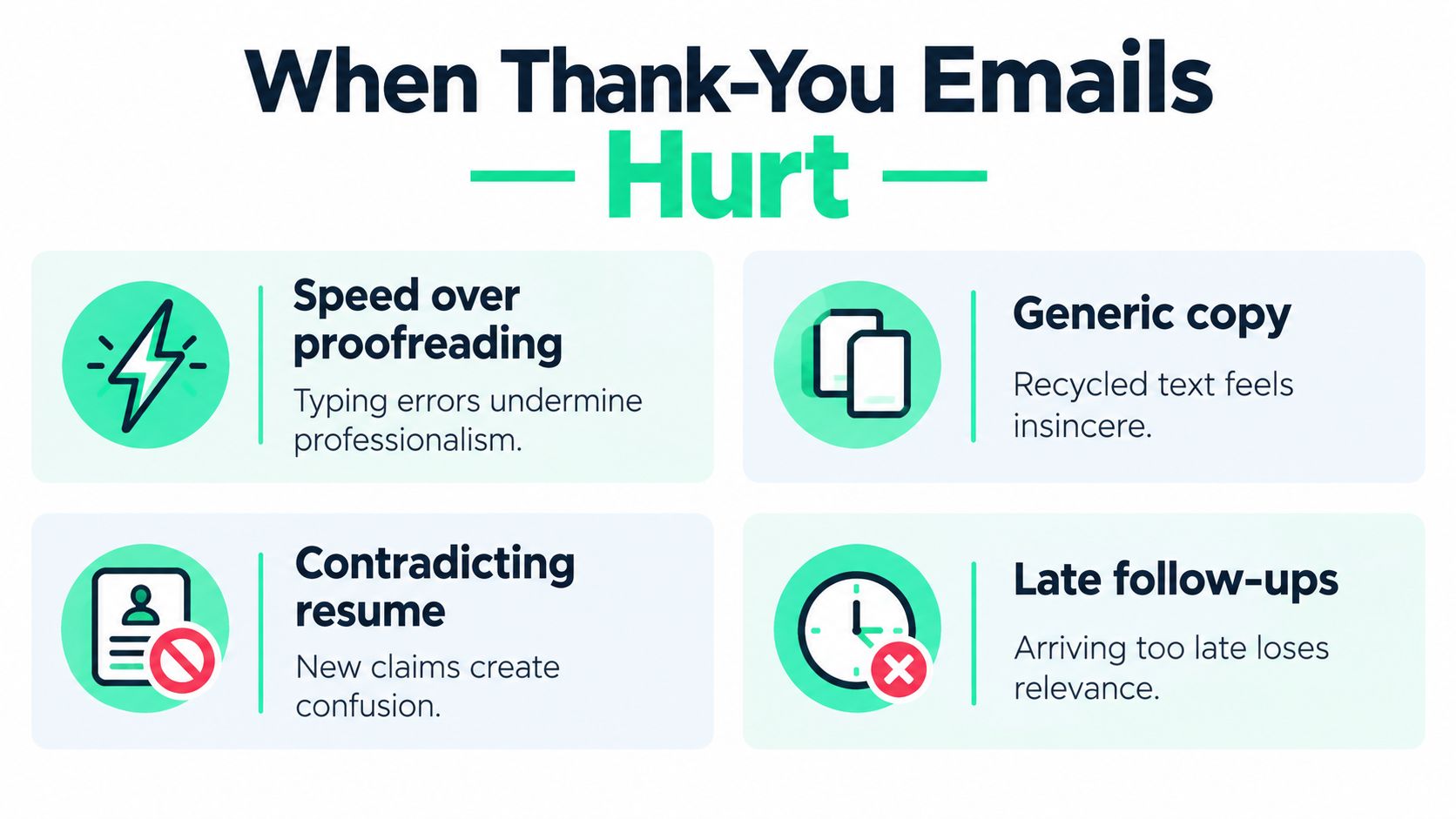
The first failure mode is speed over accuracy. You misspell the hiring manager's name, thank them for a different role, or paste in a company name from yesterday's application. Each error tells the reader your attention to detail collapses under mild pressure. This is why the timing window exists. Use it.
The second is generic copy. "Thank you for the insightful conversation, I believe my skills align perfectly with your needs" could be sent to anyone, so it proves you listened to no one. Panel members share these emails with each other. Identical text across four inboxes reads as a mail merge, not gratitude.
The third is invention. You claim a certification, a result, or a responsibility that never came up in the interview and doesn't appear on your résumé. Now the interviewer isn't thinking about your courtesy. They're wondering which version of you is accurate. If answer quality under pressure is your underlying problem, fix that directly with realistic mock interview practice instead of trying to paper over gaps afterward.
A thank-you email should never ask for immediate feedback, demand a decision date, or argue with an evaluation you haven't even received yet.
The fourth failure is pressure disguised as enthusiasm. Asking when you'll hear back, announcing that you have other offers, or sending a second and third follow-up before the stated timeline passes all shift the reader's impression from interested to difficult. Enthusiasm is one clear sentence. Everything beyond that needs a genuine reason, such as delivering material you promised. Keep the email a thank-you, not a second interview you're conducting on yourself.
Putting It All Together and Your Next Move
Run every draft through a three sentence test before you send it. Did you reference one specific topic from the conversation? Did you connect it to one verified achievement without adding new claims? Did you confirm continued interest without asking for a decision? If all three answers are yes, and every name is spelled correctly, send it and close the tab.
That discipline is exactly what makes the close call scenario work in your favor, since the Robert Half finding cited earlier concerned candidates with equal skills and experience. You're not manufacturing an advantage. You're making sure the evidence you already presented gets remembered accurately. For a broader structure around the rounds still ahead of you, this complete interview preparation guide can help you plan what comes next.
Quick answers to the questions candidates ask me most:
- You forgot entirely and a week passed. Send a short continued interest note with no extended apology.
- Does a LinkedIn message count? No. Use email, which employers accept as appropriate at far higher rates than informal channels, and keep LinkedIn for after the process ends.
- They said they'd be in touch next week. Send the thank-you now, then wait for that timeline before any status follow-up.
- Handwritten note instead? Only as an addition in a very traditional setting, never as a substitute that arrives after the decision.
Key Takeaways
- The evidence is perception-based, not experimental, and worth understanding precisely — hiring managers report these messages influence them, but no controlled study randomly assigned identical candidates to send or skip a note, so treat the email as low-cost risk reduction rather than a mechanism that overcomes missing qualifications.
- The tiebreaker framing is the honest one: Robert Half found 27% of hiring managers said thank-you messages could tip the scales among candidates with equal skills and experience, which is exactly where finalists usually sit, and a well-written note also signals conscientiousness, active listening, and written communication quality that employers legitimately assess.
- Draft fast, send deliberately — capture names, topics, and promised follow-ups within the hour while recall is sharp, then write the actual email when you can proofread it, because a calm note at hour 20 beats a sloppy one at hour 1, especially for international candidates writing in a second language, anxious candidates, and neurodivergent applicants who process conversations better after a pause.
- Write to the person, not the process — recruiters coordinate logistics and should get a short scheduling-friendly note rather than a technical pitch, hiring managers get your most substantive message connecting one strategic topic to one verified achievement, and panelists each get a distinct topic sentence because they compare emails and identical paragraphs read as a mail merge.
- A careless note creates fresh negative evidence at exactly the wrong moment — misspelled names, generic lines that prove you listened to no one, invented claims that never came up and don’t appear on your résumé, and pressure moves like demanding a decision date or announcing competing offers all shift the reader’s impression from interested to difficult.
Your next interview deserves the same discipline before, during, and after the conversation, so visit Qcard to practice with AI scored mock interviews, keep your real achievements in front of you with résumé grounded talking points, and generate a personalized thank-you email while the discussion is still fresh. Start preparing today and walk into your next round ready to give interviewers evidence worth remembering.
Ready to ace your next interview?
Qcard's AI interview copilot helps you prepare with personalized practice and real-time support.
Try Qcard Free