Scenario Based Interview Questions: Master 8 Types for Success
Imagine this: you've polished your resume, memorized your key achievements, and feel ready. Then the interviewer asks, “Tell me about a time you had to deal with a difficult stakeholder while a project was failing.” This is the world of scenario based interview questions, designed to test not just what you've done, but how you think, act, and solve problems under pressure. Unlike simple 'what-if' questions, these scenarios dig into your real-world judgment, resilience, and collaborative skills, the very traits that predict success in any role.
Hiring managers use these questions to see your capabilities in action, moving beyond the curated highlights of your resume to understand your practical problem-solving process. They want to know how you navigate ambiguity, influence others, and make decisions when the stakes are high. Your ability to articulate a clear, structured narrative that demonstrates competence is often more important than the specific outcome of the story itself.
This article breaks down the eight most common types of scenario questions you'll face, from behavioral deep-dives using the STAR method to high-stakes technical architecture challenges. We'll provide actionable examples, role-specific variations for consulting, finance, and tech, and proven strategies to help you deliver authentic, compelling answers. We will also cover how to practice effectively with AI-powered tools like Qcard, which provides real-time, resume-grounded cues to help you recall key metrics and experiences without sounding scripted. Prepare to turn challenging scenarios into your biggest interview wins.
1. The STAR Method (Situation, Task, Action, Result)
The STAR method is a foundational framework for structuring answers to scenario based interview questions. It ensures your responses are clear, concise, and backed by concrete evidence from your past experiences. By breaking down your story into four distinct parts, you guide the interviewer through a logical narrative that highlights your skills and achievements effectively.
This method transforms vague, hypothetical answers into compelling, data-driven proof of your capabilities. It’s a favorite among recruiters at top companies like Amazon and McKinsey because it provides a reliable way to assess a candidate's real-world problem-solving abilities.
How the STAR Method Works
The acronym itself provides the roadmap for your answer:
- Situation: Briefly set the scene. Describe the context of the professional challenge or project. Who was involved? Where and when did this happen?
- Task: Explain your specific responsibility or the goal you were tasked with achieving. What was the core problem or objective?
- Action: Detail the specific steps you took to address the task. Focus on your individual contributions, even if it was a team project. Use strong action verbs.
- Result: Quantify the outcome of your actions. What was the impact on the team, project, or business? Use metrics, percentages, or specific business outcomes to demonstrate your value.
Actionable Tips for Mastery
To excel with the STAR method, preparation is key.
Strategic Insight: Prepare five to seven distinct STAR stories before your interview, covering key competencies like leadership, conflict resolution, innovation, and teamwork. This ensures you have a versatile arsenal of examples ready for various scenario based interview questions.
For instance, a product manager might describe a situation where user engagement was dropping. The task was to reverse the trend. The action was to initiate A/B testing on a new user interface. The result was a 15% increase in daily active users within one quarter.
To refine your delivery, consider using tools designed for structured interview practice. For example, you can practice your STAR stories and get real-time feedback on pacing and conciseness with platforms like Qcard's mock interview feature, which helps ensure your answers are both impactful and well-timed. Always aim to keep each answer between 60-90 seconds to maintain interviewer engagement.
2. The Case Interview / Problem-Solving Scenario
The case interview is a specialized type of scenario based interview question where you're presented with a business problem and asked to solve it in real-time. Popularized by consulting giants like McKinsey and now widely used in product management and finance, it's designed to test your analytical horsepower, structured thinking, and ability to communicate complex ideas clearly under pressure.
Instead of recounting a past experience, you actively work through a live business challenge, demonstrating your problem-solving skills directly to the interviewer. This method is highly effective for assessing how a candidate thinks, rather than just what they know.
How the Case Interview Works
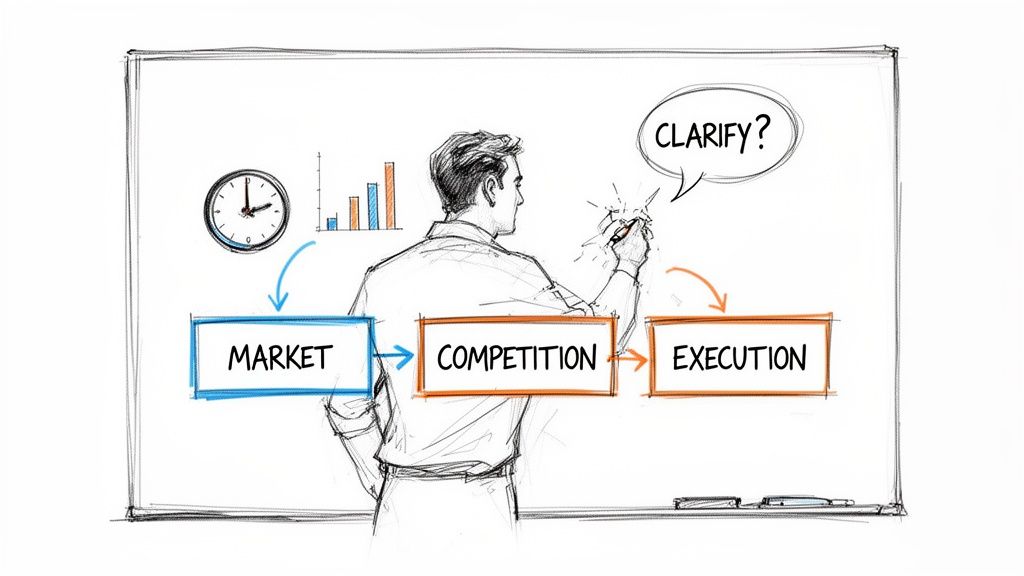
The interviewer presents a business problem, and your goal is to deconstruct it logically. A typical flow includes:
- Clarify: Ask clarifying questions to understand the problem's scope, constraints, and success metrics. Is the goal market entry, profit improvement, or something else?
- Structure: Propose a clear framework or structure for your analysis. For example, "I'll approach this by analyzing three key areas: market size, competitive landscape, and our client's capabilities."
- Analyze: Work through your structure piece by piece, asking the interviewer for data as needed. Perform calculations and draw insights from the information provided.
- Synthesize: Conclude with a clear, data-backed recommendation. Summarize the key findings that led you to your proposed solution.
Actionable Tips for Mastery
Success in a case interview hinges on a methodical, calm approach.
Strategic Insight: Don’t jump to a conclusion. The interviewer is evaluating your thought process, not your ability to guess the "right" answer. Vocalize your assumptions and structure your thinking out loud to guide them through your logic.
For example, when asked to assess a market opportunity for an electric vehicle startup, a strong candidate would first clarify the target geography and timeline. They would then structure their analysis around market sizing (TAM, SAM, SOM), competitive threats, and regulatory hurdles, investigating each before synthesizing a final recommendation.
Practicing with realistic prompts is essential. You can simulate this experience by using a tool like Qcard's mock interview feature, which can help you practice articulating your case frameworks and receive feedback on your pacing and clarity. For more in-depth preparation strategies, explore our resources on the Qcard blog. Remember, clear reasoning is always valued more than a perfect answer.
3. The Situational / Hypothetical Question
Situational or hypothetical questions shift the focus from past events to future possibilities, asking how you would handle a specific workplace scenario. Unlike behavioral questions that mine your history for evidence, these questions are designed to assess your judgment, problem-solving frameworks, and alignment with the company's core values. They test your ability to think on your feet and apply your principles to novel challenges.
This question type is a staple in interviews at companies like Google and Amazon, where culture fit and decision-making integrity are paramount. By presenting a hypothetical dilemma, interviewers can evaluate your raw thought process and see if your natural instincts align with their expectations for leadership, collaboration, and ethical conduct.
How Situational Questions Work
The goal is to present a logical, principled response that demonstrates your professional maturity. Your answer should reveal how you think, not just what you would do.
- Acknowledge and Frame: Start by recognizing the complexity of the situation. Briefly articulate the key challenge or conflict at play.
- Explain Your Framework: State the principles or values that would guide your decision. This could be customer-centricity, data-driven decision-making, or a commitment to transparency.
- State Your Action: Clearly describe the specific, step-by-step actions you would take to resolve the scenario. Be decisive and practical.
- Justify Your Reasoning: Explain why you chose that course of action. Connect your actions back to your framework and the desired positive outcome for the team or business.
Actionable Tips for Mastery
The best answers to scenario based interview questions of this type blend hypothetical reasoning with real-world credibility.
Strategic Insight: Ground your hypothetical answer in a brief, relevant past experience. Starting with, "That's a great question. It reminds me of a time at my last role when..." immediately adds weight and authenticity to the theoretical response that follows.
For example, when asked how you'd handle a disagreeing direct report, you could first mention a similar past discussion over a marketing budget. Then, explain how you would approach the new scenario: listen to their perspective, clarify the strategic goals driving your decision, find points of alignment, and define a clear path forward.
To ensure your responses are both authentic and well-reasoned, you can use tools that connect your past achievements to these hypothetical scenarios. Practicing with a tool like Qcard's mock interview feature can help you articulate your decision-making framework with clarity and receive feedback on how well you justify your proposed actions. This practice helps build a consistent and compelling narrative about your professional judgment.
4. The Technical Deep-Dive / Architecture Question
Technical deep-dive questions move beyond coding algorithms to assess your ability to design, build, or debug complex systems. Common in software engineering, cybersecurity, and data science roles, these scenario based interview questions evaluate your technical depth, system thinking, and your skill in communicating intricate concepts to others.
They are designed to see how you approach unstructured, large-scale problems, forcing you to make trade-offs and justify your architectural decisions. Recruiters use these to gauge not just what you know, but how you apply that knowledge to create robust, scalable, and secure solutions, a key reason top tech companies like Google and Amazon have popularized them.
How the Technical Deep-Dive Works
This question format is an interactive, conversational exploration of a technical problem. The interviewer provides a high-level prompt, and you are expected to lead the discussion:
- Clarify Requirements: Start by asking questions to define the scope. What are the functional requirements (e.g., users can post comments) and non-functional requirements (e.g., system must have 99.99% uptime)?
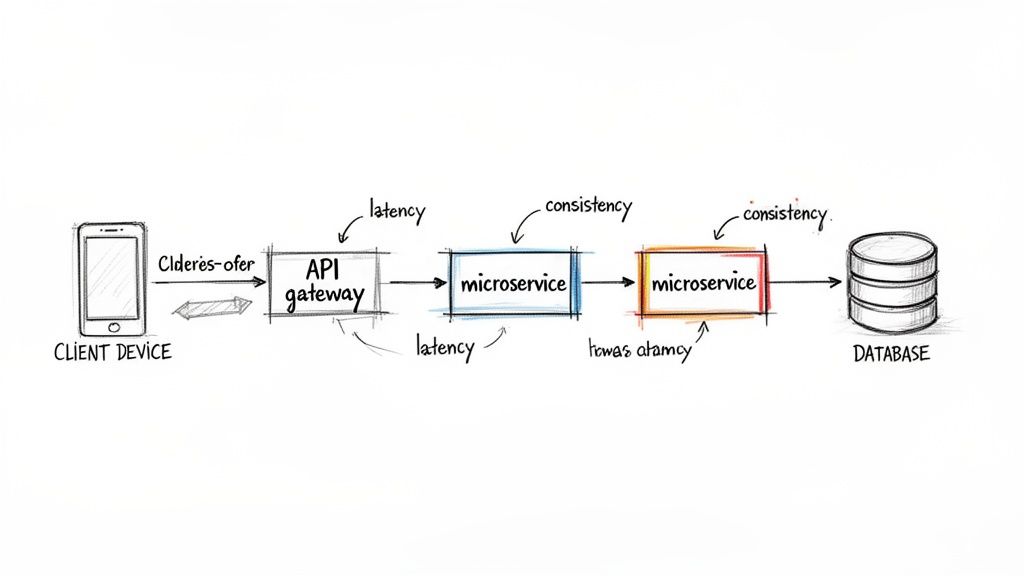
- High-Level Design: Sketch out a broad architecture. Identify the major components like servers, databases, load balancers, and APIs, and explain how they interact.
- Component Deep-Dive: The interviewer will guide you to elaborate on specific parts of your design. You might need to justify your choice of database (SQL vs. NoSQL), explain a caching strategy, or detail an authentication flow.
- Trade-Offs and Scaling: Explicitly discuss the trade-offs you're making (e.g., prioritizing latency over perfect consistency). Explain how your system would handle a significant increase in users or data.
Actionable Tips for Mastery
Success in a technical deep-dive depends on structured thinking and clear communication.
Strategic Insight: Don't jump straight into code or minute details. Always start with a high-level overview and then drill down. Verbally narrate your thought process, stating your assumptions and trade-offs clearly, such as, "I'm choosing a message queue here to decouple the services and handle spikes in traffic."
For example, when asked to design a real-time notification system, a backend engineer would first outline the core services: a notification service, a message queue, and a push notification gateway. They would then detail the data flow, from an event triggering a message to the user receiving a notification, explaining choices like using WebSockets for real-time delivery.
To practice, use a tool that helps structure your past project experiences. You can use platforms that allow mock interviews to rehearse condensing complex architectural decisions into clear narratives. Preparing your explanations for why you chose specific technologies or metrics ensures you are ready for any deep-dive scenario based interview questions. Understanding what employers look for in these structured interviews can give you a significant advantage.
5. The Conflict Resolution / Interpersonal Scenario
Conflict resolution questions are a staple of modern scenario based interview questions. They are designed to probe your emotional intelligence, communication skills, and ability to navigate professional disagreements while maintaining productive relationships. Interviewers want to see that you can handle friction constructively, not just that you can get a task done.
This category of questions is critical because it reveals your approach to collaboration and stakeholder management. Companies like Netflix and Microsoft, which emphasize strong organizational culture and psychological safety, use these scenarios to assess how a candidate will contribute to a healthy team dynamic, not just the bottom line.
How Conflict Resolution Questions Work
These questions ask you to recall a specific time you faced an interpersonal challenge. Your goal is to demonstrate maturity, empathy, and a focus on resolution.
- Common Scenarios: You might be asked about a disagreement with a manager, tension with a difficult teammate, or conflicting priorities between different departments.
- Core Assessment: The interviewer is evaluating your ability to listen, understand different perspectives, communicate your own position clearly, and find a mutually agreeable path forward.
- Focus on Process: The specific outcome is important, but how you reached that outcome is even more critical. They want to see your problem-solving process when dealing with people, not just technical issues.
Actionable Tips for Mastery
To answer these questions effectively, you must showcase both business acumen and emotional intelligence.
Strategic Insight: The best answers focus on finding common ground and preserving the relationship. Frame the conflict not as a battle to be won, but as a shared problem to be solved. Show that you prioritized both the business outcome and the long-term health of your professional relationships.
For example, when asked about a disagreement with a manager, explain how you first sought to understand their perspective fully. Then, detail how you presented your opposing view with data and tied it back to shared team goals. The result should highlight the collaborative solution you reached, demonstrating that you can challenge ideas respectfully and productively.
To prepare, you can use a tool like Qcard's interview features to practice recounting real conflicts from your past. This helps you refine your narrative, ensuring your tone comes across as calm and professional, rather than defensive or blame-focused. Aim to clearly articulate what you said and did to de-escalate the situation and steer it toward a positive resolution.
6. The Product Sense / Customer Impact Question
Product sense questions evaluate your ability to think like a product owner, focusing on user needs, business goals, and strategic trade-offs. Common in roles across product management, UX design, and marketing, these scenario based interview questions test your customer empathy, analytical rigor, and ability to formulate a coherent product strategy. They move beyond past experiences to assess how you would tackle a novel business challenge.
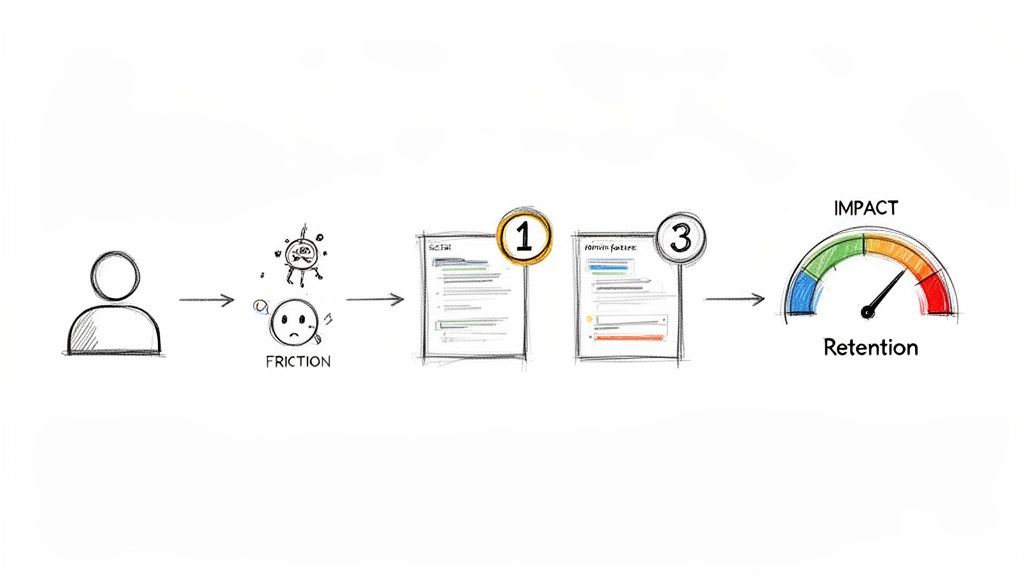
These questions are favored by innovative tech companies like Google, Meta, and Stripe because they reveal a candidate’s innate ability to understand user friction and connect it to business impact. Success here demonstrates that you can navigate ambiguity and make sound decisions that serve both the customer and the company.
How to Approach Product Sense Questions
A structured framework is essential to avoid rambling and demonstrate clear, logical thinking. A common and effective approach involves several key stages:
- Clarify and Define: Start by asking clarifying questions to understand the business goal. For example, if asked to improve Spotify, are we focused on user acquisition, engagement, or retention? Define the target user persona.
- Identify User Problems: Brainstorm the core problems or pain points that the target user faces. What is the friction in their current experience?
- Propose Solutions: Ideate several potential solutions that directly address the identified user problems. Prioritize these solutions based on potential impact and feasibility.
- Define Success Metrics: Explain how you would measure the success of your proposed solution. Be specific with key performance indicators (KPIs) like daily active users, conversion rate, or churn reduction.
Actionable Tips for Mastery
Mastering product sense requires a customer-first mindset and structured communication.
Strategic Insight: Always begin your answer by stating your assumptions and clarifying the core objective. This frames the problem and shows the interviewer you are a methodical thinker who doesn't jump to conclusions.
For a question like, "How would you improve LinkedIn's feed?", you might start by clarifying the goal: "My goal is to increase professional engagement, not just passive scrolling." Then, identify user problems (e.g., irrelevant content), propose solutions (e.g., better content filtering), and define success metrics (e.g., a 10% increase in meaningful comments per user session).
To sharpen these skills, practice with mock interviews on platforms like Qcard, which can provide feedback on your strategic clarity and customer empathy. The tool can also surface relevant metrics and customer insights from your verified experience, helping you ground your hypothetical solutions in real-world data from your past roles.
7. The Coding Challenge / Algorithmic Problem
Coding challenges are a specific type of scenario based interview question designed to directly assess your technical problem-solving and implementation skills. Common in software engineering, data science, and quantitative finance roles, these questions require you to write or discuss code to solve algorithmic, mathematical, or system design puzzles. They test your proficiency in a chosen programming language, your understanding of data structures, and your ability to optimize solutions under pressure.
This approach moves beyond discussing past projects to evaluating your raw problem-solving horsepower in real-time. Companies like Google and Microsoft popularized this format because it provides a standardized, albeit intense, way to measure a candidate's core technical competencies and thought process when faced with a complex, novel problem.
How a Coding Challenge Works
The interview typically follows a structured problem-solving flow:
- Problem Statement: The interviewer presents a well-defined technical problem, often with constraints. For example, "Given an array of integers, find the two numbers that add up to a specific target."
- Clarification: You are expected to ask clarifying questions about constraints, edge cases, and expected input/output formats. This demonstrates diligence and a thorough approach.
- Approach & Pseudocode: You articulate your high-level strategy before writing code. You might outline your logic, discuss the data structures you'll use, or draw a diagram.
- Implementation & Result: You write the code in a shared editor or on a whiteboard. The final result is a working, and ideally optimized, solution that you can walk the interviewer through.
Actionable Tips for Mastery
Success in coding interviews hinges on a methodical approach, not just rote memorization of solutions.
Strategic Insight: Always prioritize a working brute-force solution before attempting optimization. Clearly stating "I will start with a straightforward solution and then discuss how to optimize it" shows the interviewer you can deliver a functional result before pursuing perfection.
For example, when asked to find the longest substring without repeating characters, a candidate could first implement a simple O(n²) solution using nested loops. After confirming it works, they can then discuss and implement a more optimal O(n) solution using a sliding window approach with a hash map. This demonstrates both correctness and optimization skills.
To manage the high cognitive load of these interviews, you can use tools that provide real-time support. For instance, practicing with Qcard’s coding interview mode can help reduce anxiety and build confidence, allowing you to focus purely on the algorithmic problem itself. Always remember to think out loud, communicating your thought process clearly from start to finish.
8. The Leadership / Impact Question
Leadership questions probe your ability to influence, drive outcomes, and inspire action, regardless of your formal title. These scenario based interview questions are critical for managerial roles but are equally important for individual contributors expected to have a broad impact. They assess your capacity to lead projects, navigate ambiguity, mentor others, and drive meaningful organizational change.
These questions move beyond task execution to evaluate your strategic thinking and vision. Recruiters at firms like Korn Ferry and top tech companies use them to identify candidates who not only solve problems but also elevate the performance of their teams and the business as a whole. Answering them effectively demonstrates your readiness for greater responsibility.
How to Frame Your Leadership Story
Your goal is to showcase your influence and the tangible results it produced. The best answers often follow a narrative structure that highlights both your strategic thinking and your ability to execute:
- Set the Context: Briefly describe the business environment and the high-level challenge or opportunity. What was the state of the team, project, or organization?
- Define Your Mandate: Explain your specific leadership role and the goal you were responsible for achieving. What was the vision or desired future state?
- Detail Your Actions: Describe the key strategic decisions and actions you took. How did you align stakeholders, motivate your team, and overcome obstacles? Focus on the "why" behind your choices.
- Showcase the Impact: Quantify the results of your leadership. This is where you connect your actions to business outcomes like revenue growth, cost savings, efficiency gains, or improved team morale.
Actionable Tips for Mastery
To answer leadership questions convincingly, you must connect your actions to significant, measurable outcomes.
Strategic Insight: Prepare stories that demonstrate leadership in different domains: project execution, influencing upwards, mentoring talent, and driving change. For each story, explicitly state the scope of your impact, such as the size of the team, the budget managed, or the number of users affected.
For example, a senior engineer might describe a situation where the team was struggling with technical debt. The task was to secure buy-in for a major refactoring project. The actions included building a data-backed business case showing how the debt was slowing feature releases and presenting it to senior management. The result was securing a dedicated engineering quarter for the project, which ultimately reduced bug-related escalations by 40% and increased developer velocity by 25%.
To ensure your leadership stories are grounded in data, you can use a tool like Qcard to surface relevant metrics and achievements from your professional history. Practicing your delivery in its mock interview environment can also help you refine your leadership presence and communicate your vision with clarity and confidence.
Your Strategic Takeaways for Answering Any Scenario
Mastering the art of the scenario based interview question is not about memorizing a script for every possible situation. Instead, it is about building a versatile, adaptable toolkit that allows you to deconstruct any prompt, articulate a compelling narrative, and showcase your true problem-solving capabilities under pressure. The goal is to move beyond simply reciting your resume and instead, demonstrate your thought process in action.
Throughout this guide, we have explored a wide range of scenarios, from the structured STAR method for behavioral questions to the complex, multi-layered demands of a technical deep-dive. A few core principles have emerged as universal truths, applicable whether you are a consultant dissecting a market-entry case or a cybersecurity analyst responding to a hypothetical data breach.
The Universal Framework: Clarify, Structure, Deliver
Before you even begin to formulate an answer, your first step should always be to clarify. This is not a sign of weakness; it is a signal of strategic thinking. Asking clarifying questions like, "What is the primary success metric for this project?" or "Are there any budget constraints I should be aware of?" demonstrates that you are methodical, detail-oriented, and unwilling to make assumptions. It buys you precious seconds to think and ensures you are solving the right problem.
Next, every answer needs a structure. This is the single most important takeaway. For behavioral questions about past experiences, the STAR or CEAR method provides a reliable narrative arc. For case studies or product sense questions, a custom framework is key: state your assumptions, outline your approach, walk through your analysis, and conclude with a recommendation. This structured approach prevents rambling and shows the interviewer how you organize complex information.
Strategic Insight: A structured answer is easier for the interviewer to follow, remember, and score. It transforms a scattered collection of facts into a clear, logical argument that highlights your competence.
Grounding Your Scenarios in Authentic Experience
While hypothetical questions test your creative problem-solving, your ultimate goal is to connect your answer back to tangible, real-world achievements. Authenticity builds credibility faster than any perfectly rehearsed response. When answering a question about handling a difficult stakeholder, grounding your hypothetical approach in a real past success story makes your answer exponentially more powerful.
This means being deeply familiar with your own career narrative. Before your interview, revisit your key projects and be ready to articulate the specific metrics, challenges, and outcomes. What was the quantifiable impact of your work? What specific technical or interpersonal skill did you deploy? Having these details ready allows you to weave them into any scenario based interview questions, adding weight and authority to your claims.
The Non-Negotiable Role of Practice and Refinement
Finally, none of this becomes second nature without deliberate practice. Reading about frameworks is one thing; executing them flawlessly under pressure is another. This is where active preparation becomes a game-changer.
Your practice should be focused and mimic real-world conditions as closely as possible.
- Verbalize Your Answers: Don't just think through your responses. Practice saying them out loud to a friend, a mentor, or an AI tool. This helps you identify awkward phrasing, smooth out your pacing, and build muscle memory.
- Embrace Feedback: Actively seek feedback on your clarity, structure, and conciseness. Are you using too many filler words? Is your "Result" section in the STAR method compelling enough? Objective feedback is critical for refinement.
- Leverage Technology: Modern tools can provide a significant edge. Accessibility features that offer real-time transcription or memory cues can be invaluable for neurodivergent candidates, ensuring cognitive load is managed effectively. AI-powered mock interviews can provide instant, unbiased feedback on your delivery, helping you identify and correct weak points efficiently.
By internalizing these strategic takeaways, you transform the interview from a daunting test into a platform for demonstration. You are no longer just a candidate answering questions; you are a professional showcasing a thoughtful, structured, and authentic approach to solving the real-world problems the company faces. This is how you leave a lasting, positive impression.
Scenario Based Interview Frequently Asked Questions
What are scenario-based interview questions?
Scenario-based questions present you with a realistic workplace challenge to assess your problem-solving, judgment, and interpersonal skills in action. Unlike simple 'what-if' questions, they dig into how you navigate ambiguity, influence others, and make decisions when the stakes are high.
How is the STAR method used for scenario questions?
The STAR method (Situation, Task, Action, Result) is a foundational framework for structuring your answers. It transforms vague responses into compelling, evidence-based stories. Set the scene (Situation), state your goal (Task), detail your specific contributions (Action), and quantify the outcome (Result) to demonstrate your capabilities.
What is a case interview, and how should I approach it?
A case interview is a live problem-solving scenario, common in consulting, where you work through a business challenge in real-time. Start by asking clarifying questions, then propose a clear analytical framework, work through it step-by-step, and conclude with a data-backed recommendation. The interviewer is evaluating your thought process, not just the final answer.
How are hypothetical situational questions different from behavioral questions?
Behavioral questions ask about your past experiences (e.g., "Tell me about a time when..."). Hypothetical questions ask how you would handle a future scenario (e.g., "What would you do if..."). They assess your judgment, principles, and how you would apply your values to a novel challenge.
What are technical deep-dive questions, and how do I prepare for them?
Technical deep-dives, common in engineering roles, assess your ability to design or debug complex systems. Start with a high-level overview, clarify requirements, and then drill down into specific components. Verbally narrate your thought process, explicitly discussing the trade-offs you are making for scalability, security, or performance.
Ready to turn theory into practice and master your delivery? Qcard provides a powerful platform for just that, offering low-latency mock interviews with AI-driven follow-ups and real-time feedback cues designed to sharpen your responses to any scenario based interview questions. Stop just preparing and start performing by visiting Qcard to build the confidence you need to land your next role.
Ready to ace your next interview?
Qcard's AI interview copilot helps you prepare with personalized practice and real-time support.
Try Qcard Free