TL;DR
A thank-you email earns its place when it carries four things: appreciation, one verifiable conversation detail, one resume-grounded fit point, and a clear next step. TopResume found 68% of hiring managers weighted thank-you notes more heavily post-2020, with nearly one in five having dismissed a candidate for skipping one. Use the template that matches the relationship — post-interview, rejection feedback, networking, mentoring, offer acceptance, or referral — because the same words can't serve a hiring manager, a mentor, and a referrer. Send same-day or within 24 hours per USC and UC Davis guidance, and write individual notes to each panel member rather than one group email. Capture your detail before drafting, never invent a memorable moment to sound more personal, and only include metrics that appear on your resume or in your notes. Then proofread names, titles, dates, and technical terms, and read it aloud once — if it sounds like a script, swap one generic line for a real detail.
You've just finished an interview. You remember the hiring manager's question about risk controls, the recruiter's explanation of the next step, and one answer you wish you'd phrased more clearly. Then the blank email opens, and “Thank you for your time” suddenly feels too generic.
A useful sample email for thank you does more than confirm good manners. It combines appreciation, one accurate conversation detail, one relevant point grounded in your resume, and a clear next step. TopResume's survey of 334 hiring managers conducted between August and September 2020 found that 68% said a candidate's thank-you email or note, or the absence of one, had greater importance in evaluating candidates than before the COVID-19 pandemic. Nearly one in five interviewers said they'd completely dismissed a candidate who failed to send one, as reported by CNBC's coverage of the survey.
The six templates below cover hiring managers, feedback conversations, networking contacts, mentors, new employers, and referrals. You'll also find practical timing guidance, plain international-English wording, panel personalization, and ways Qcard can help you retrieve authentic talking points without copying a script. Use a professional sign-off that fits the relationship, with further guidance in SigFinch's sign off advice.
What Should a Thank You Email Include?
A strong thank-you email combines four elements: appreciation, one accurate detail from the conversation, one relevant point grounded in your resume, and a clear next step. "Thank you for your time" alone does none of that work.
The stakes are real. TopResume's survey of 334 hiring managers found that 68% said a candidate's thank-you note — or its absence — carried more weight in evaluation than before 2020, and nearly one in five interviewers said they had completely dismissed a candidate who failed to send one.
Match the template to the relationship:
- Post-interview (hiring manager or recruiter) — Link one interview topic to one verified resume achievement, reaffirm interest, and ask about next steps.
- After rejection or feedback — Acknowledge the specific point, explain how you'll act on it, and leave the door open. Wait a day if emotions are high.
- Informational interview or networking — Name what you learned and what you'll do with it. Keep it under 150 words. Don't turn it into a disguised application.
- Interview prep support or mentoring — Say which advice you used and where it helped, then offer something concrete in return. Send it before you know the result.
- Offer acceptance — State acceptance clearly, confirm the start date, and ask about first-day logistics. Don't reopen negotiations here.
- Referral or internal recommendation — Tell the referrer what happened, even when it didn't work out, and claim only what you can verify about their role in it.
Timing: USC Career Center guidance recommends sending the same day and asking for the interviewer's email before you leave; UC Davis recommends within 24 hours to every person you interviewed with. Speed shouldn't produce a fabricated detail — a genuine message later beats a rushed, generic one.
For panels: send individualized emails referencing a topic discussed with each person, not one group message.
1. Professional Gratitude Thank You Email
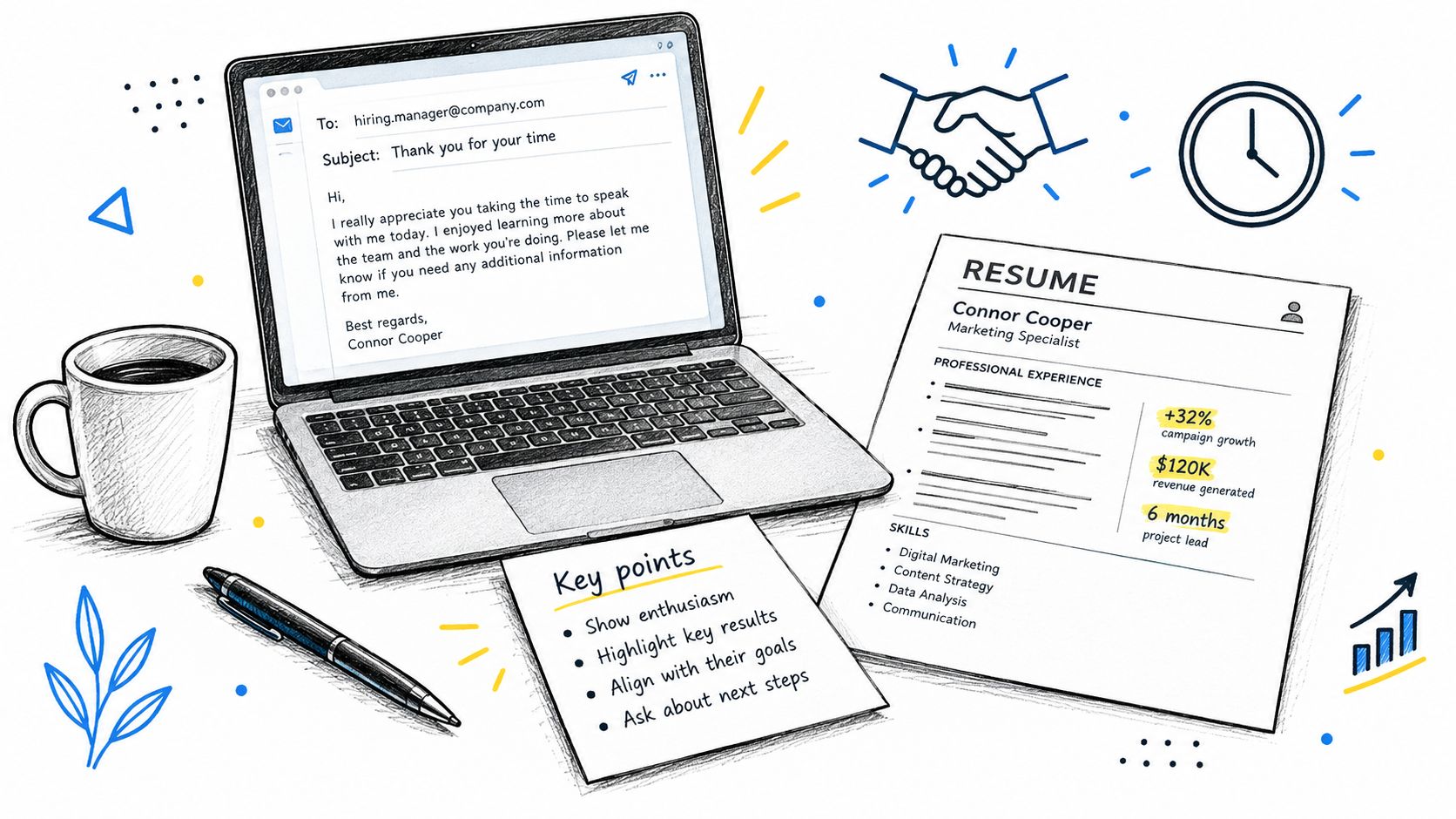
This is the dependable post-interview message for a hiring manager, recruiter, or interviewer. It should reinforce your interest without replaying the entire conversation. The strongest version links one topic from the interview to one verified achievement from your resume, creating continuity between what you said live and what you write afterward.
Timing requires judgment. USC Career Center guidance recommends sending a thank-you note on the same day and asking for the interviewer's email address before leaving, while UC Davis Career Center guidance recommends sending a brief message within 24 hours to every person interviewed. Some advice pushes a two-to-four-hour window, but speed shouldn't produce a fabricated detail or an obviously automated email. If you need more time to check your notes, a genuine message later is better than skipping it.
Practical rule: Capture one accurate detail, one employer priority, and one resume-grounded fit point before you draft.
Subject: Thank you for discussing the Risk Analyst role
Hi [Interviewer's Name],
Thank you for taking the time to discuss the Risk Analyst position at [Company] today. I appreciated learning how the team evaluates operational risk while balancing efficient decision-making.
Our discussion about scenario testing stood out to me. In my previous role, I used structured analysis to identify control gaps and recommend practical next steps, and I'd be excited to apply that approach to your team's risk-management work.
I remain very interested in the opportunity. Please let me know if I can provide any additional information, and I look forward to hearing about the next steps.
Best,
[Your Name]
[Phone Number]
[Email Address]
Make the evidence specific
For a banking interview, reference the risk scenario you discussed, then connect it to a real resume achievement. For a consulting case interview, mention the analytical framework or assumption you refined. For a technical role, name the stack discussed and connect it to a project you completed. Don't add a metric unless it appears on your resume or in your interview notes.
Keep paragraphs short and proofread the interviewer's name, company, role title, and technical terms. If you met a panel, send individualized emails rather than one group message. Indeed guidance, summarized by practical interview follow-up advice, supports separate personalized notes, with each message referring to a topic discussed with that person.
You can use a warm closing, but avoid overfamiliar language when the relationship is still formal. For more ideas on making professional messages feel human, see these tips for cheerful emails.
2. Appreciation Email for Interview Feedback or Rejection
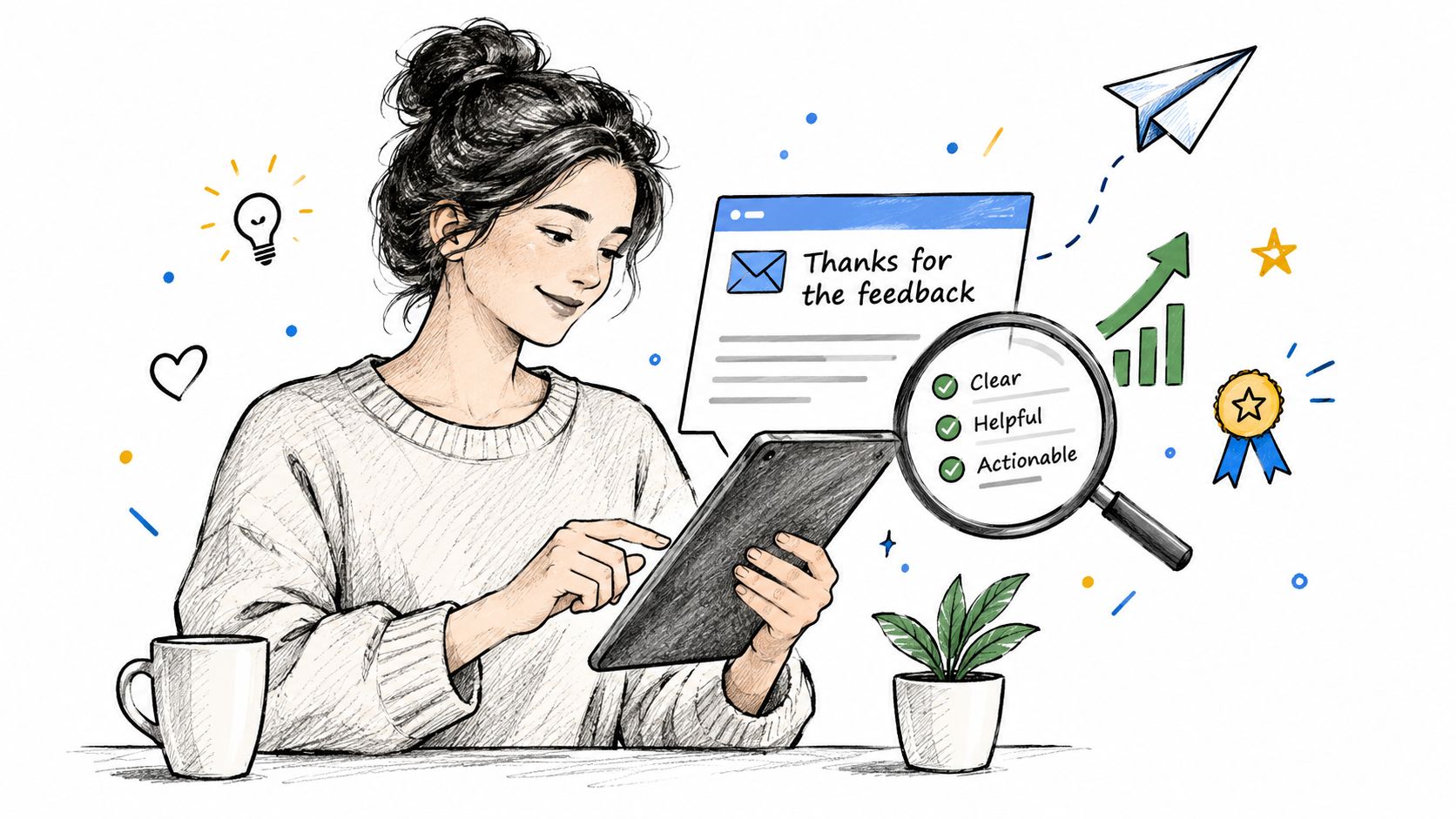
A rejection email can close one application without ending the professional relationship. If the interviewer offers useful feedback, acknowledge the specific point, explain how you'll act on it, and leave room for future opportunities. Don't turn the reply into an argument or a long defense of your candidacy.
Wait until your emotions have settled before writing. That often means allowing a day before responding, especially when the decision feels personal. Career changers can frame the feedback as information about the skills they're building, while neurodivergent candidates may find a fixed structure helpful when rejection makes spontaneous wording difficult.
Subject: Thank you for your feedback
Hi [Interviewer's Name],
Thank you for letting me know about the decision and for sharing your feedback on my technical depth. I appreciated the opportunity to learn more about [Company] and the cybersecurity team.
Your comments gave me a clearer development path. I'm planning to deepen my experience through [specific certification, project, or course], while continuing to build on my background in [verified area from your resume]. If a junior-level opportunity becomes available in the future, I'd be grateful to be considered.
Thank you again for your time and candor. If you're open to it, I'd value a brief informational conversation later in the year to learn more about developing in this field.
Kind regards,
[Your Name]
Keep the door open without asking for too much
The request for a coffee chat or informational conversation should be optional and proportionate. If the person has already given detailed feedback, thank them first and make any additional request easy to decline. Don't ask them to reconsider unless they identified a factual error or misunderstood a material part of your experience.
If you're unsure how to structure the message, Qcard's interview thank-you email resource can help turn accurate interview details into a concise draft. You should still edit the result so the development plan reflects your actual goals.
Avoid phrases such as “I'm disappointed you didn't see my potential” or “I hope you'll change your mind.” They shift attention from professional growth to emotional pressure. A stronger email shows that you listened, can accept information, and intend to act on it.
3. Thank You Email After Informational Interview or Networking Meeting
An informational conversation isn't a disguised application. Your contact gave you context, experience, or access to a professional world you're still learning to find your way around in. The follow-up should show what you learned and what you'll do with it, rather than forcing a claim that you're already a perfect fit for a role.
This distinction matters for graduates, international students, and career switchers. A short, specific note can establish credibility without asking the contact to solve your entire job search. Send it within 24 hours, while the advice and names of resources are still easy to recall.
Subject: Thank you for sharing your cybersecurity experience
Hi [Name],
Thank you for speaking with me about cybersecurity in financial institutions. I especially appreciated your explanation of how threat teams balance incident response with communication across compliance and engineering groups.
Your recommendation to explore [specific certification or learning resource] gave me a practical next step as I build on my background in [relevant resume area]. I'll review it this week and attend [company event or professional event] if you're planning to participate.
Thank you again for sharing your perspective. I'd be glad to stay in touch, and I'd appreciate an introduction to [person or team] if you still think that connection would be useful.
Best,
[Your Name]
Show interest through follow-through
Generic praise, such as “Your career story was inspiring,” doesn't give the recipient much to remember. Refer instead to a concrete idea, such as their approach to cross-functional work, a certification they recommended, or a project-based learning opportunity they mentioned.
If you're an international student speaking with someone established in your target country, it's fine to say that their perspective helped you understand local professional expectations. Use plain English and avoid idioms that may sound unnatural or be difficult to interpret.
For preparation before future conversations, Qcard's practice interview questions can help you organize questions around a target field. The follow-up should still be based on what this person said, not on a generic networking script.
Keep the note brief, ideally under 150 words. If the contact offered to introduce you to someone, mention that offer directly and confirm whether they'd like any information from you first. A clear next step makes the relationship easier to continue.
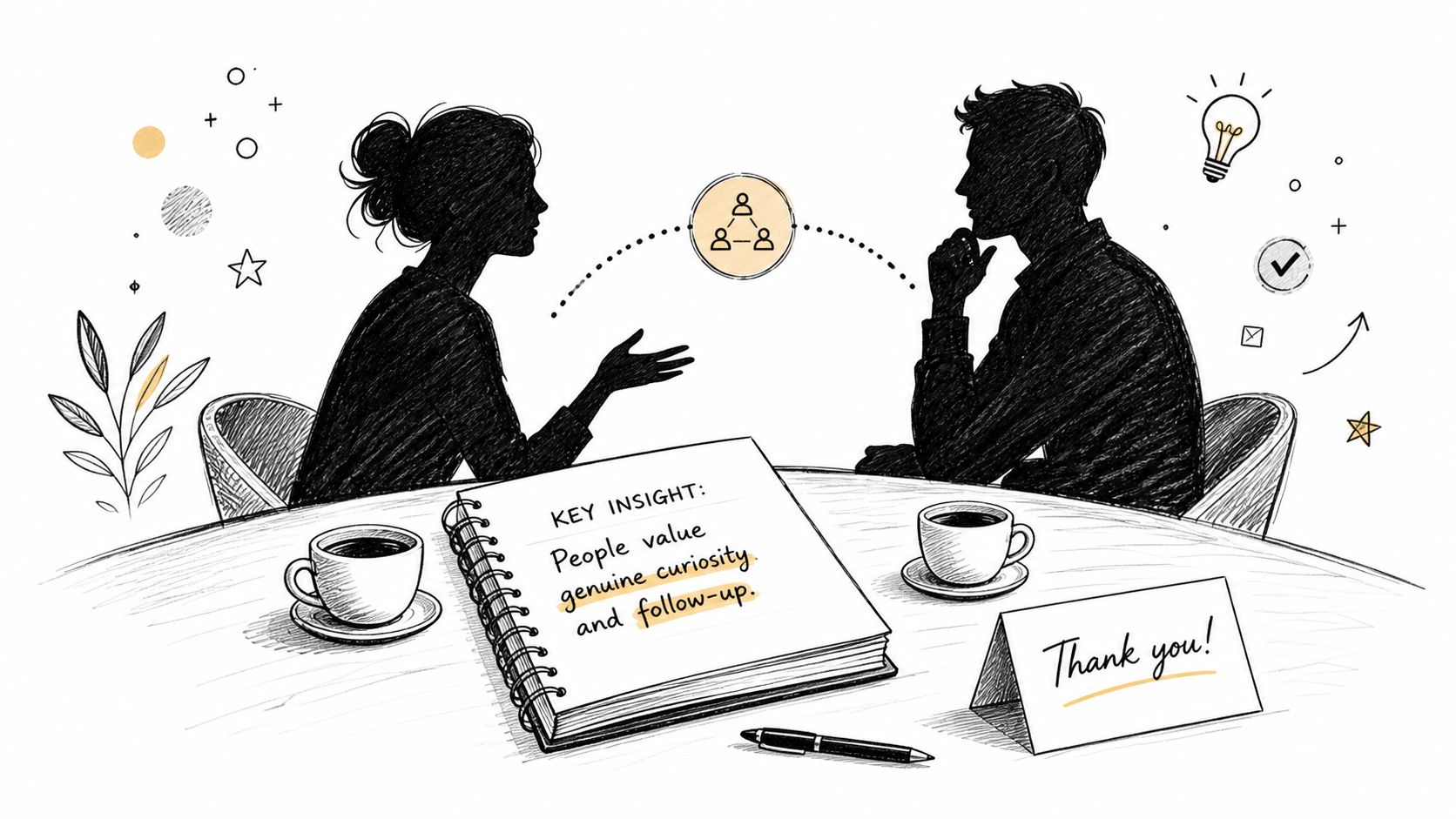
4. Thank You Email for Interview Preparation Support or Mentoring
The person who ran your mock interview, reviewed your resume, or explained system design concepts deserves thanks before you know the result. Their help contributed to your preparation, not necessarily to an offer, so don't make your gratitude conditional on success.
Specificity makes this message meaningful. Mention the advice you used, where it helped, and the kind of support you'd be willing to offer in return. A mentor doesn't need a dramatic outcome report. They need evidence that their time changed how you prepared or communicated.
Subject: Thank you for your interview preparation support
Hi [Name],
Thank you for helping me prepare for the product interview. Your advice to lead with the customer problem before describing the solution helped me make my answers clearer, and I used that structure when discussing a recent project from my resume.
I also appreciated the mock follow-up questions. They helped me stay focused when the interviewer asked me to explain my assumptions in more detail, and I felt more prepared to pause rather than rush.
I'd be happy to return the favor by reviewing your resume or helping with [area where you have relevant expertise]. I'll keep you updated as I hear about next steps.
Best,
[Your Name]
Acknowledge the kind of support you received
For a career coach, mention a behavioral improvement such as reducing filler words or clarifying a story. For a peer who practiced banking interviews with you, identify how their follow-up questions deepened your answers. For a technical mentor, explain how their system design guidance helped you articulate your problem-solving process.
Neurodivergent candidates may choose to say that the preparation reduced anxiety or helped them stay focused. That's useful context, not an apology. International students can mention how the person helped bridge language or cultural expectations without suggesting that their identity is a deficiency.
You can also use Qcard's interview preparation guide as a structured starting point, but your thank-you email should name the mentor's actual contribution. Don't claim that someone's advice solved a problem if you didn't use it.
If their support helped you land the role, send a later update about a genuine milestone. Mentors often value knowing how their investment translated into your progress, but that update should be separate from the immediate thank-you.
5. Thank You Email Following an Offer or Acceptance
An offer changes the purpose of the message. You're no longer trying to prove that you belong in the hiring process. You're beginning a relationship with the manager and team, confirming the practical details, and setting a professional tone for onboarding.
If you've accepted, state that clearly and confirm the agreed start date. If you're still reviewing the offer, thank the hiring manager without implying acceptance. Salary, benefits, and accommodation discussions belong in the relevant negotiation or onboarding conversation, not in a general appreciation note.
Subject: Thank you for the offer
Hi [Hiring Manager's Name],
Thank you for offering me the [Job Title] position. I'm pleased to accept, and I'm excited to join [Company] on [Start Date].
I appreciated learning about the team's approach to threat detection during the interview process, and I'm looking forward to contributing my experience in [verified skill or area]. Please let me know who I should contact about first-day logistics, system access, and any outstanding administrative requirements.
Thank you again for your confidence in me. I'm looking forward to working with you and the team.
Best regards,
[Your Name]
[Phone Number]
Confirm logistics, not competing offers
The useful details are the start date, first-day contact, required documents, equipment, access, and any other administrative items the employer has mentioned. Keep them factual. Don't attach a new resume unless requested, and don't use this message to reopen negotiations.
Career changers can briefly affirm that they're confident about bringing their transferable experience into the new field. If the employer discussed accommodations, you can acknowledge that those arrangements will help you do your best work. Keep the wording direct and professional.
A warm tone doesn't require exaggerated enthusiasm. “I'm excited to contribute to the team's product work” is more credible than a series of superlatives. You're setting expectations for future communication, so clarity matters more than performance.
If you haven't formally accepted, use this alternative:
Thank you for the offer and for the time you and the team invested throughout the process. I'm reviewing the details carefully and will respond by [date]. I'm enthusiastic about the role and appreciate your patience while I complete that review.
Send the confirmation promptly after acceptance, then keep later questions in the appropriate channel so the hiring manager can act on them efficiently.
6. Thank You Email for Referral or Internal Recommendation
A referral carries the other person's professional reputation. Thank the referrer even when the opportunity doesn't work out, and tell them what happened so they aren't left guessing. The email should explain how their support helped without overstating the effect of their introduction.
This is particularly important for early-career candidates, international students, and career switchers. A former manager, peer, or professional contact may have helped you overcome unfamiliarity with a new industry or professional market. A specific update shows that you respected the effort they made on your behalf.
Subject: Thank you for referring me to [Role Title]
Hi [Name],
Thank you for referring me to the [Role Title] opportunity at [Company] and for sharing your perspective on the team's culture. Your introduction helped me enter the process with a clearer understanding of the role and how to present my experience from [previous field] in a relevant way.
I completed the interview process and learned that the team selected another candidate. Although I'm disappointed, I'm grateful that you put your reputation behind my application and gave me the opportunity to learn more about cybersecurity.
I'd like to return the support where I can. I'd be happy to review a resume, make an introduction in my network, or help with [relevant area]. I hope we'll stay in touch.
Kind regards,
[Your Name]
Update the relationship, not just the application
If you received an offer, replace the outcome paragraph with a concise update:
I'm happy to share that I accepted the offer. Your referral helped me understand the team and prepare for the conversations, and I'm grateful for the confidence you showed in my transition into product management.
If you're still interviewing, say so and give the person a simple status update. Don't ask them to lobby the hiring team again unless they offer. Their initial referral may already have required social and professional capital, so respect the boundary.
Avoid phrases such as “Your referral got me the interview” unless you know that sequence is accurate. Say what you can verify, such as “Your introduction connected me with the recruiter” or “Your context helped me prepare.” For international students, you can acknowledge that the contact helped you understand professional norms in a new country. For career switchers, name the transition directly and explain how their advocacy helped the employer see relevant transferable skills.
A reciprocal offer should be concrete. “Let me know if I can ever help” is polite but vague. Offer resume review, an introduction, or expertise you genuinely possess. Then follow through if they accept.
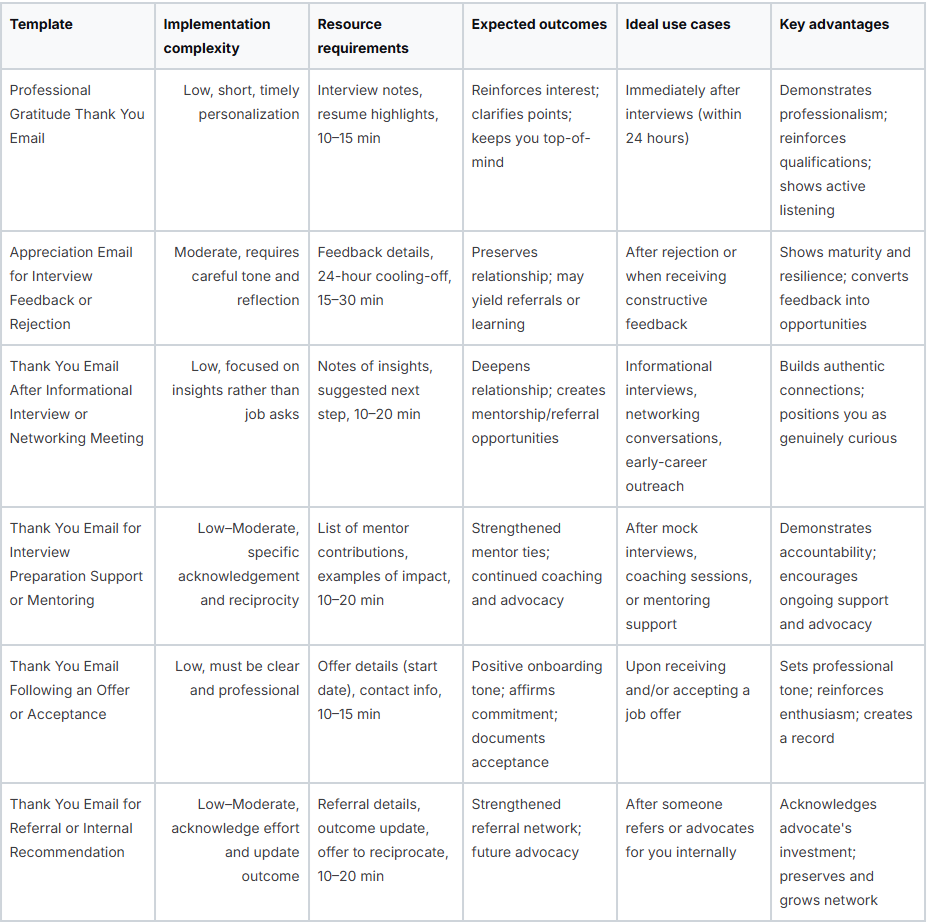
Comparison of 6 Thank-You Email Examples
Turn Appreciation Into a Stronger Professional Signal
Start by identifying the recipient and the outcome you want the email to support. A hiring manager needs a concise confirmation of fit, a mentor needs recognition of specific help, and a referrer needs a clear update. The same words shouldn't serve all three relationships.
Next, choose one conversation detail you can verify. It might be a risk-management scenario, a certification recommendation, a team priority, or a question you answered with help from a mentor. If you remember only a broad topic, use that broad topic. Don't invent a memorable detail to make the message appear more personal.
Then connect the detail to one resume-grounded point. The connection can be qualitative, such as “my experience coordinating research across teams,” or quantitative when the achievement is well documented. The TopResume evidence supports treating the email as a meaningful decision-stage communication, but it doesn't show that sending an email alone causes an offer. Your message should reinforce the evidence you already have, not create new evidence.
State the next step clearly. You might confirm that you'll provide information, ask about the hiring timeline, follow up on an introduction, confirm a start date, or offer reciprocal help. Remove generic praise, exaggerated claims, defensive wording, and anything you can't verify.
Timing should remain practical rather than punitive. Same-day sending can preserve detail, and UC Davis guidance supports a 24-hour window, but a late, accurate email is better than silence. For panel interviews, write separately to each person when possible. Use plain international English, avoid idioms, and choose a greeting and sign-off that match the relationship. If you need more examples of professional closings, SigFinch's sign off advice offers useful options, but don't reuse the same external guidance as a substitute for personalization.
Finish with a careful proofreading pass. Check the recipient's name, company, role, dates, technical terms, links, and every resume claim. Read the email aloud once. If it sounds like a script, replace one generic sentence with an accurate detail from your notes.
Qcard's thank-you email generation can be an optional way to turn authentic interview notes into concise, resume-grounded follow-up communication. Use the generated draft as a starting point, then make sure every detail belongs to your real conversation and experience.
Key Takeaways
- The thank-you note is a decision-stage communication, not a courtesy — TopResume's survey of 334 hiring managers found 68% weighting it more heavily than before 2020 and nearly one in five having dismissed a candidate who didn't send one, but the evidence supports treating it as reinforcement of existing evidence rather than something that creates an offer on its own.
- Match the template to the relationship, because the goal changes with the recipient — a hiring manager needs a concise confirmation of fit, a mentor needs recognition of the specific advice you used, and a referrer needs an honest outcome update so they aren't left guessing after putting their reputation behind you.
- Never invent a detail to sound more personal — if you only remember a broad topic, use the broad topic, and skip any metric that doesn't appear on your resume or in your interview notes, since fabricated specifics are the fastest way to undercut a message meant to build trust.
- Rejection replies work when they show you can accept information — acknowledge the specific feedback, name the certification, project, or course you'll pursue, and make any follow-up request easy to decline, while avoiding "I'm disappointed you didn't see my potential" or any attempt to argue the decision.
- Reciprocal offers should be concrete, not polite filler — "let me know if I can ever help" gives the recipient nothing, while offering a resume review, a specific introduction, or expertise you actually have creates a real exchange, provided you follow through if they accept.
Qcard helps candidates prepare with resume-grounded talking points, practice questions, and thank-you email generation based on interview details. Turn your notes into a concise follow-up, edit the tone, and send a message that still sounds like you by visiting Qcard.
Ready to ace your next interview?
Qcard's AI interview copilot helps you prepare with personalized practice and real-time support.
Try Qcard Free