TL;DR
The best resume proves value with evidence rather than describing potential — and the right format depends entirely on the role, career stage, and what the reader needs to verify. Ten formats cover most candidates: chronological for banking where progression matters, functional for career switchers who need capability recognized first, technical for engineers who must show depth fast, consulting for compressed case-study bullets, product for metrics-driven decision narratives, cybersecurity for certifications paired with operational results, international for credential translation, neurodivergent-friendly for concrete evidence over vague traits, academic for research credibility plus practical impact, and creative for portfolio-led storytelling that still parses in ATS. The editing sequence that works: choose the format that matches the role, replace vague claims with action-and-outcome evidence, verify every metric, preserve readable formatting, and prepare one short talking point per major bullet. Adapt these examples rather than copying them — a banking resume shouldn't borrow product language, and a creative resume still needs ATS-compatible structure. If you can't defend a number in conversation, it probably doesn't belong on the page.
The best resume shows evidence, not just potential. A single format does not fit every candidate, because recruiters read differently depending on the role, the career stage, and the kind of proof they want to see. A strong resume with examples makes role fit visible through concrete actions, measurable outcomes, readable structure, and interview-ready talking points that hold up under follow-up questions.
That matters more now than it used to. In a 2026 recruiter survey, 96.6% said formatting influences their decision, 98.8% valued clean and consistent formatting, 98.7% valued quantifiable achievements, and 80.1% preferred bullet points over paragraphs, while 76.8% preferred PDF submissions and 51% preferred 2-page resumes, according to Jobseeker's hiring statistics overview. At the same time, Greenhouse benchmark data cited in 2026 reported an average of 244 applications per posting in 2025, up from 115 in 2022, across more than 6,000 companies and 640 million applications, which helps explain why resume guidance for 2026 keeps pushing clarity and specificity.
The examples below are built for real people, not templates alone. Early-career graduates, career switchers, international candidates, technical professionals, researchers, creatives, and neurodivergent job seekers all need different ways to show value without sounding scripted. Qcard can be useful as an optional practice aid here, because it turns resume bullets into memory cues for interviews instead of replacing preparation.
What Does a Strong Resume with Examples Look Like?
The best resume shows evidence, not just potential — and no single format fits every candidate, because recruiters read differently depending on role, career stage, and the kind of proof they want. A strong resume makes role fit visible through concrete actions, measurable outcomes, readable structure, and interview-ready talking points that hold up under follow-up questions.
The stakes have risen. In a 2026 recruiter survey, 96.6% said formatting influences their decision, 98.7% valued quantifiable achievements, 80.1% preferred bullet points over paragraphs, and 76.8% preferred PDF submissions. Greenhouse benchmark data cited in 2026 reported an average of 244 applications per posting in 2025, up from 115 in 2022 — which explains why clarity and specificity matter more than ever.
Here are the ten formats and when each one works:
1. Chronological for corporate banking — Fits when promotion history and tenure matter. Lead each bullet with a verb, then attach scale: "Managed a $50M corporate loan portfolio with zero defaults."
2. Functional for career switchers — Centers transferable skills over timeline. Choose 3 to 5 skill categories, add evidence under each, and keep dates visible so it feels honest rather than evasive.
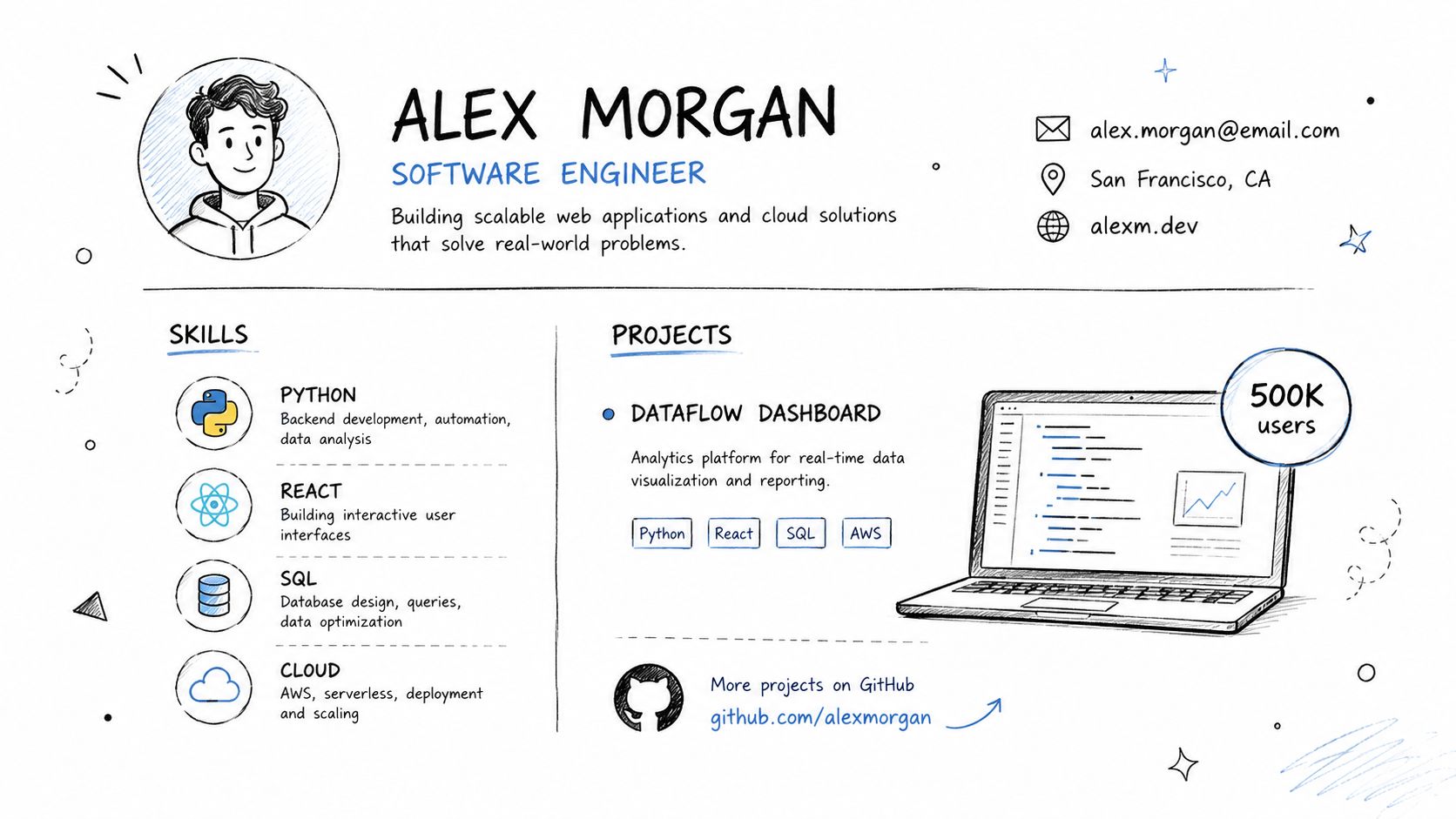
3. Technical for engineers and coding roles — Group skills by category (Languages, Frontend, Backend and Databases, DevOps and Cloud), show deployment complexity, and avoid tool stuffing that hides which languages you used in production.
4. Behavioral consulting — Reads like compressed case studies: challenge, approach, and impact in one line. "Analyzed supply chain bottlenecks, recommended 3 process changes, reduced lead time 22%, saved $2.3M annually."
5. Product management — A sequence of decisions and outcomes. Pair leading and lagging indicators: "Reduced time-to-value from 8 weeks to 3 weeks, improved NPS by 12 points, and reduced churn by 8%."
6. Cybersecurity — Certifications sit beside real incident or testing work. "Deployed SIEM solution reducing incident detection time from 72 hours to 4 hours."
7. International student — Translation work, not just documentation. Add equivalency, rank, language proficiency, and work authorization plainly.
8. Neurodivergent-friendly — Replaces traits with evidence. "Strong organizational skills" becomes "Implemented task management system for a team of 6, reduced project delays by 40%."
9. Academic or research-focused — Publications, grants, and citations arranged so a non-specialist can see the significance quickly.
10. Visual or creative with portfolio integration — Feature 2 to 3 projects, attach metrics to creative outcomes, and keep the layout ATS-parseable.
1. Chronological Resume for Corporate Banking
A chronological format fits corporate banking because promotion history, tenure, and responsibility growth matter. Recruiters in finance want to see whether you moved from analyst to senior analyst, whether you handled bigger accounts over time, and whether your bullet points prove judgment under pressure. This style works best when the career path is coherent and the experience lines up with the target role.
A graduate who moved from analyst to senior analyst at JPMorgan over three years should not bury that progression under general duties. The stronger approach is to lead each bullet with a verb and then attach scale, such as managing a portfolio, coordinating deal work, or supporting revenue-generating activity. That style also aligns with quantified-resume guidance from ATS Verification, which recommends an outcome-first structure.
What makes it work
- Show progression clearly. Put roles in reverse chronological order so the reader can see growth at a glance.
- Quantify responsibility. A banking bullet like “Managed a $50M corporate loan portfolio with zero defaults” signals scope and risk awareness.
- Tie experience to business outcomes. Deal support, client retention, and revenue influence matter more than generic “team player” language.
- Keep dates and titles consistent. Clean formatting helps the reader trust the document before they read a single bullet.
- Use role language from the posting. If the job asks for credit analysis or treasury support, reflect those exact phrases where truthful.
Recruiters in banking rarely need a creative layout, they need fast proof that you can handle structured work, client pressure, and measurable responsibility.
An international student transitioning from a regional bank internship to a full-time role at a major institution can use the same format, but the bullets must make the leap legible. The resume should show that the internship was not just observation, it produced work that translated into the next step. In interviews, the best talking point is simple, “Here's what I owned, here's what changed, and here's why that matters for this desk.”
2. Functional Resume for Career Switchers
A functional resume makes sense when the timeline is less important than the skills. Career switchers, international professionals, and candidates with employment gaps can use this structure to center transferable strengths instead of making the reader work backward through every title. It works best when the target role is clearly stated and the skill groups map directly to the job description.
A software engineer moving into product management can organize the page around Cross-functional Communication, Technical Architecture Review, and Roadmap Planning. A finance professional pivoting into behavioral consulting can group experience under Problem-Solving, Data Analysis, and Stakeholder Management. The structure helps the reader see capability first, then history second.
Build the skills section around proof
- Choose 3 to 5 skill categories. More than that starts to look unfocused.
- Add evidence under each category. “Data Analysis: Built Python dashboards tracking customer churn for 2M users” is stronger than a label alone.
- Keep company names and dates visible. Subordinate them, don't hide them, so the resume still feels honest.
- Write a direct summary. State the target role and the reason for the transition in plain language.
- Match categories to the posting. If the job wants client work, make that obvious.
The risk with a functional resume is that it can feel evasive if the career change is not explained cleanly. That's why the summary should say what you want next and why you're credible now. In interviews, the best answer is not a defense of the switch, it's a short bridge from prior experience to current fit.
A useful way to think about this format is cognitive load. It helps the recruiter scan by capability, which is helpful for a switcher who needs relevance recognized quickly. It also helps you prepare talking points, because each skill heading becomes a cluster of examples you can rehearse without sounding memorized.
3. Technical Resume for Software Engineers and Coding Roles
Technical resumes need to show depth fast. Hiring teams want to see languages, frameworks, deployment experience, and project scope, not just a list of tools. For engineers, cybersecurity candidates, and product-adjacent technical roles, the strongest resume with examples makes it easy to verify what you can build and how you think.
A strong early-career developer example might highlight Python, React, and PostgreSQL, plus links to a production web app and open-source work on a data analysis library. A cybersecurity candidate can list penetration testing tools, cloud platforms, and certifications, then anchor the experience with concrete results such as identifying critical vulnerabilities across client networks. For practical interview prep, Qcard's interview question practice page can help you turn those projects into clear explanations of trade-offs, implementation decisions, and debugging choices.
Structure that technical reviewers can scan
- Group skills by category. Use headings like Languages, Frontend Frameworks, Backend and Databases, DevOps and Cloud, Tools and Platforms.
- Show scale and deployment complexity. A bullet about architecting microservices for a high-volume product is more useful than saying “built backend systems.”
- Keep GitHub current. Interviewers will check the repo, so stale README files weaken the whole page.
- List certifications with dates when relevant. That makes the credential current and easier to verify.
- Use project bullets that explain the why. A project is stronger when it shows a problem, your choice, and the result.
One of the most common failures in technical resumes is tool stuffing. A long list of languages does not help if the reader cannot tell which ones you used in production versus which ones you touched in school. Another failure is over-technical wording without business context. Even in coding roles, the resume has to answer the same question every other resume does, “What changed because you were there?”
The best interview talking point from a technical resume usually follows this pattern, “I chose this stack because the product needed X, I handled Y constraint, and the trade-off was Z.” That keeps the resume grounded in decisions rather than buzzwords.
4. Behavioral Consulting Resume for Strategy and Management Consulting
Consulting resumes need to read like compressed case studies. The reader wants challenge, approach, and impact, because that's how future interviews will work too. If your bullets don't show measurable business value, they won't stand out against equally polished peers.
An MBA candidate might write, “Led market entry analysis for a Fortune 500 CPG client across 8 geographies, identified $120M TAM, and recommended a product mix that drove $15M incremental revenue in Year 1.” An undergraduate intern might write, “Analyzed supply chain bottlenecks for a manufacturing client, recommended 3 process changes, reduced lead time 22%, and saved $2.3M annually.” Those bullets work because they combine scope, method, and outcome in one line.
Consultants read for evidence of thinking, not just activity. If the bullet doesn't show what you found, what you changed, and what happened next, it will feel incomplete.
The best consulting format uses direct, outcome-heavy bullets, but it still needs judgment. If an NDA limits naming the client, use a clear descriptor such as a regional healthcare provider or a mid-market SaaS startup. If the work involved assumptions or models, be ready to explain them. That is where Qcard's interview prep guide can help by turning resume bullets into practiced responses about methodology and business impact.
A consulting resume can fail in two ways. First, it can become a wall of polished language with no hard numbers. Second, it can over-index on framework names and under-explain the actual contribution. The strongest version balances both. It shows that you can solve problems, work with clients, and explain recommendations in a way that survives cross-examination.
For behavioral interviews, each consulting bullet should become a mini story. State the problem, name your action, and explain the result without overselling it. If you can't defend the number in conversation, it probably doesn't belong on the page.
5. Product Management Resume with Metrics-Driven Narrative
Product management resumes work best when they read like a sequence of decisions and outcomes. Hiring managers want to see that you can prioritize features, work across engineering and design, and understand user behavior without hiding behind vague “collaboration” language. A metrics-driven narrative gives the reader a clear line from initiative to impact.
An associate PM at a consumer app could write, “Launched personalized recommendation engine for feed, drove an 18% increase in daily active users and a 23% improvement in session length within 90 days.” A PM at a B2B platform might say, “Owned onboarding redesign for enterprise clients, reduced time-to-value from 8 weeks to 3 weeks, improved NPS by 12 points, and reduced churn by 8%.” Those bullets work because they pair a product decision with leading and lagging indicators.
What product reviewers look for
- Start with the initiative. Lead with the feature or change, not the metric alone.
- Include both types of metrics. Engagement and retention together tell a stronger story than one outcome in isolation.
- Name your role in cross-functional work. “Led sprint planning with engineering” is clearer than “worked with teams.”
- Use A/B tests when available. Controlled experiments are strong proof of product judgment.
- Show prioritization. Good product resumes reveal why one idea won over another.
A product resume can fail if it sounds like a feature list instead of a judgment record. Listing every release is not the goal. The goal is to show that you can make trade-offs, measure results, and explain why a decision mattered to users and the business. If you can discuss the hypothesis, the constraint, and the final call, the resume starts to feel credible.
Product managers also need a clean story for interview follow-up. A bullet about onboarding redesign should lead to questions about segmentation, drop-off, experimentation, and stakeholder alignment. That is a good thing, because it means the resume has created a real conversation instead of a generic screening pass.
6. Cybersecurity Resume with Certifications and Technical Depth
Cybersecurity resumes need both breadth and proof. The reader wants to know whether you can monitor threats, respond under pressure, and use the right tools without hand-holding. Certifications matter, but they need to sit beside real incident, detection, or testing work so the page feels operational, not ornamental.
A security analyst can write, “Deployed SIEM solution reducing incident detection time from 72 hours to 4 hours, investigated 450+ daily alerts, and identified 12 critical threats for remediation.” A penetration tester can write, “Conducted 18 security assessments across healthcare and financial services, identified 287 vulnerabilities, including 47 critical findings, and achieved a 100% remediation rate within 90 days.” Those examples are strong because they show scale, priority, and result.
Make the security story concrete
- List certifications prominently. Put valid-through dates next to current credentials so the reader can trust the status.
- Show both defense and offense. Incident response and penetration testing belong on the same page when you've done both.
- Name tools with context. Splunk, Elasticsearch, Fortinet FortiGate, and AWS GuardDuty mean more when tied to what you used them for.
- Quantify risk reduction. If you can defend a reduced detection window or avoided exposure, say so.
- Prepare for incident questions. Hiring teams often ask how you handled time pressure, escalation, or ambiguity.
Cybersecurity resumes often fail when candidates list tools but skip outcomes. That leaves the reviewer guessing whether the tool was used daily, tested once, or only learned in a lab. A stronger structure makes the action visible and the result legible. It also gives you interview material, because each bullet can turn into a response about triage, prioritization, or how you balanced speed with accuracy.
If you're moving into security from another technical role, use the resume to show the mindset shift. Risk awareness, structured troubleshooting, and documentation discipline all translate well. The page should make that translation obvious without pretending every experience was security-specific.
7. International Student Resume Adapting Credentials Across Education Systems
International resumes work best when they translate, not just list. Employers often understand the title of a degree less than they understand the context around it, so a good resume with examples explains the credential in language that travels well. That means adding equivalency, rank, language ability, and work authorization where appropriate.
An Indian engineer might write, “Bachelor of Technology, Computer Science, Indian Institute of Technology Delhi, equivalent to a US Bachelor of Science, GPA 3.8/4.0, ranked #2 in cohort.” A Canadian business school graduate might write, “MBA, Rotman School of Management, University of Toronto, equivalent to a US two-year program, Graduated with Distinction, GPA 3.85/4.0.” The point is not to over-explain, it's to reduce ambiguity for the hiring manager.
Make global experience legible
- Use recognized equivalency frameworks. NACES and World Education Services can help clarify how credentials map across systems.
- Add rank or percentile when helpful. “Top 5%” or “Ranked 47 of 1,200” gives context US readers understand.
- List languages clearly. Say fluent, business-level, or professional working proficiency, not just the language name.
- Frame cross-border work as an asset. Leading teams across India and Singapore time zones shows coordination skill, not confusion.
- State work authorization plainly. Put it in the summary if it affects your candidacy.
The failure mode here is leaving the employer to decode everything. A title that makes perfect sense in one country can sound vague in another. A grade scale may be impressive but meaningless without context. International candidates should treat the resume as translation work, not just documentation.
This format also helps in interviews because it gives you a clean answer when someone asks about your background. You can explain the educational system briefly, then move straight to the skills or outcomes that matter for the role. That keeps the conversation focused on capability instead of confusion.
8. Neurodivergent-Friendly Resume Emphasizing Strengths and Concrete Examples
A neurodivergent-friendly resume should reduce cognitive friction for the reader and for the writer. Clear structure, predictable patterns, and concrete examples help candidates who are ADHD, autistic, dyslexic, or otherwise neurodivergent present their strengths without fighting vague corporate language. The best version is not simpler in substance, it is cleaner in communication.
An ADHD professional can replace “strong organizational skills” with “Implemented task management system for a team of 6, used color-coded prioritization, reduced project delays by 40%, and improved deadline hit rate to 100%.” An autistic engineer can replace “excellent communication” with “Documented 23 API endpoints with step-by-step examples, and 95% of 30+ engineers reported no need for follow-up clarification.” These bullets work because they show behavior, process, and result.
Predictability helps. If every bullet uses a similar structure, the resume becomes easier to scan, and the candidate has a better chance of remembering what each line means in an interview.
Design for clarity and recall
- Replace traits with evidence. “Problem-solver” becomes a specific debugging story with a measurable result.
- Use consistent tenses and structures. Repetition lowers cognitive load.
- Chunk the bullets visually. One or two sentences per bullet is easier to read than long blocks.
- Include process and outcome together. A checklist, template, or system should be tied to the result it produced.
- Frame neurodivergence as context if you mention it. Strengths matter more than labels, but honesty matters too.
For interview practice, Qcard's mock interview tool can be especially useful because it turns resume bullets into low-stress talking points instead of forcing a full script. That matters for candidates who freeze under pressure or lose track when answers become too abstract.
The format can fail if it tries too hard to sound “professional” and ends up vague again. It can also fail if the layout is cluttered, because too many design flourishes can make scanning harder. Clean headings, repeatable bullet patterns, and concrete language are the safest path.
9. Academic or Research-Focused Resume for Scholars and Research-Heavy Roles
Research resumes need to show scholarly credibility and practical impact at the same time. Publications, grants, presentations, and datasets matter, but they should still be arranged so a non-specialist reader can see the significance quickly. The strongest resume with examples proves that the work is real, useful, and explainable.
A PhD candidate in machine learning might write, “First-author publication in Nature Machine Intelligence on federated learning for healthcare data, 15+ citations within 12 months, awarded NIH R01 grant extension of $1.2M over 3 years.” A postdoc moving into biotech might write, “Led research team of 3 graduate students studying protein folding, produced 7 peer-reviewed publications in top-tier journals, and delivered 9 invited talks at conferences with a combined audience of 2,000+ researchers.” These are strong because they combine scholarship, leadership, and reach.
Translate research into impact
- List publications with context. DOI links and journal names help reviewers gauge credibility quickly.
- Show research influence when possible. Citations, downloads, or downstream use make the work feel alive.
- Include grant role and scope. Dollar amount, duration, and your role matter more than a grant name alone.
- Connect research to industry value. If the work supports a product or platform, say so in plain language.
- Practice the non-technical explanation. Employers outside academia need to know what changed because of the research.
A research resume can fail if it assumes the reader will decode every acronym or theoretical term. It can also fail if it over-explains the science and hides the result. The better version turns academic output into practical evidence. That is especially important for industry transitions, where hiring managers want to know whether your research habits will translate into product, data, or R&D work.
For interviews, the best talking point is usually a bridge between rigor and relevance. Explain the question, the method, and the practical consequence. Keep the jargon only where it adds clarity.
10. Visual or Creative Professional Resume with Portfolio Integration
Creative resumes need personality, but they still need structure. Designers, marketers, and creative technologists can use visual hierarchy and portfolio links to show taste, while still making the document parseable for ATS systems. The goal is to make the work feel distinctive without making the resume hard to read.
A UX designer might link a case study showing the redesign process, user testing insights, and a 34% conversion lift. A brand strategist might feature 6 client brand refresh projects with before-and-after visuals, a +45% positive mention shift, and a clear creative direction approach. The strongest versions tell a story, not just show pretty artifacts.
The portfolio link should be the most prominent element after the name, and the page should still be readable by automated systems. If you want inspiration for structure that balances visual polish and machine readability, see creative resume examples that pass ATS.
Keep the design strategic
- Use one visual system. Color, typography, and spacing should feel intentional, not decorative for its own sake.
- Feature 2 to 3 projects. More than that can dilute the strongest work.
- Attach metrics to creative outcomes. Brand recall, conversion, or engagement helps non-designers understand impact.
- Match the aesthetic to the industry. Minimalist often fits fintech, while bold layouts may suit agencies.
- Make the portfolio story-based. Problem, approach, measurable impact is the clearest sequence.
A creative resume can fail when the layout overwhelms the content. Too many fonts, colors, or icons make the page harder to trust. It can also fail when the portfolio exists but the resume doesn't explain what the candidate did. The best version lets the visual identity support the story, not replace it.
For interviews, the resume should prepare you to talk through your design decisions verbally. Employers want to know why you chose a direction, what constraints shaped the work, and how you know the result mattered. That's the core value of a creative resume with examples; it turns aesthetics into evidence.
Turn Every Resume Bullet Into an Interview Advantage
The best editing sequence is simple. Choose the format that matches the role, replace vague claims with action-and-outcome evidence, verify every metric, preserve readable formatting, and prepare one short talking point for each major bullet. That keeps the resume honest and makes it easier to answer follow-up questions without sounding rehearsed.
Adapt the examples, don't copy them. A banking resume should not borrow product language, a consulting resume should not hide behind generic teamwork phrases, and a creative resume still needs ATS-compatible structure. Confidential information should stay protected, so use client descriptors or generalized context when NDAs require it. The strongest resumes are specific enough to prove value and careful enough to stay credible.
The format also has to support the interview. Each bullet should become a memory cue, not a script. That is where tools like Qcard can fit naturally, because its resume-locked cues and practice features help you rehearse authentic answers from your own verified experience instead of memorizing lines. For ATS-focused cleanup and broader resume strategy, the guidance in 2026 job seeker resume advice reinforces the same core idea, clarity wins.
If your resume already has strong raw material, don't overwrite it with jargon. Tighten the structure, sharpen the numbers, and make sure each line can survive a question in the interview room. That's how a resume becomes more than a document, it becomes a reliable starting point for the conversation employers care about.
Key Takeaways
- Format choice is a strategic decision, not a style preference — chronological works when your progression tells the story, functional works when your capability outruns your titles, and technical or creative formats work when the reader needs to verify specific skills fast, which is why copying a single template across every application weakens all of them.
- Recruiter data confirms that specificity and formatting carry real weight — 96.6% said formatting influences their decision, 98.7% valued quantifiable achievements, and 80.1% preferred bullet points over paragraphs, while application volume jumped from an average of 115 per posting in 2022 to 244 in 2025, which means clarity is now competing against far more noise.
- The most common failure across every format is the same: activity without outcome — tool stuffing on technical resumes, framework name-dropping on consulting resumes, feature lists on product resumes, and certifications without operational context on security resumes all leave the reviewer guessing what actually changed because you were there.
- Vague traits should always be replaced with evidence, which is especially valuable for neurodivergent candidates — "strong organizational skills" becomes "implemented a task management system for a team of 6, reduced project delays by 40%," and "excellent communication" becomes "documented 23 API endpoints with step-by-step examples, and 95% of 30+ engineers reported no need for follow-up clarification."
- Every bullet should double as an interview memory cue, not a script — if a line can't survive a follow-up question about your methodology, your trade-off, or how you measured the result, it either needs rewriting or shouldn't be on the page, and confidential work should use descriptors like "a mid-market SaaS startup" rather than being omitted entirely.
Qcard helps you turn a resume like this into interview-ready talking points without turning it into a script. If you want a tool that keeps answers grounded in your actual experience, visit Qcard and use it to practice the bullets you'll need to explain with confidence.
Ready to ace your next interview?
Qcard's AI interview copilot helps you prepare with personalized practice and real-time support.
Try Qcard Free