7 Resume Samples and Examples for Every Career Stage
TL;DR
Resume sample libraries solve different problems, so pick by task rather than popularity. Indeed is the best free starting point for role language. Zety, ResumeGenius, LiveCareer, and Resume.io connect examples to builder workflows, though formatted exports usually sit behind a paywall (free tiers are typically TXT only). Novorésumé suits candidates who want clean structure with US-Letter formatting. The Muse is strongest when you need the reasoning behind format decisions. Across all of them, the same rule applies: copy the structure, never the wording, because a sample can't supply your scope, tools, decisions, or results. Build every bullet around three questions — what did you do, what was the scope, and what changed — and add numbers only when you can explain the baseline, calculation, and your personal contribution. Format defensively with a single-column layout, standard headings, 1-inch margins, 10–12 point text, and left alignment. Then practice explaining every bullet aloud, because your resume opens the conversation and the interview decides it.
You tailor the resume, mirror the job description, and still receive no interview invitation. Often, the obstacle is not your experience. It is the time required for a recruiter to see why that experience matters.
Recruiters may spend only 6–8 seconds on an initial resume scan, while industry summaries report that only about 2% of candidates get to the interview stage. Those conditions make immediate clarity essential. A polished template cannot resolve unclear evidence, weak prioritization, or formatting that hides relevant details.
This guide examines 7 resume samples and examples across career stages and job-search needs. Each review identifies useful choices, practical trade-offs, and friction points, then shows how to adapt the example instead of copying it. You'll see before-and-after edits that replace vague duties with evidence, ATS-friendly formatting tactics that preserve readability, and notes for neurodivergent candidates who benefit from a clearer, less overwhelming writing process. The goal is a resume that explains your value quickly and accurately.
Where Can You Find the Best Resume Samples and Examples?
Recruiters spend only 6 to 8 seconds on an initial resume scan, and industry summaries report that only about 2% of candidates reach the interview stage. A polished template can't fix unclear evidence or formatting that hides your relevant details — which is why the right sample library depends on what you actually need to solve.
Here are the seven libraries and when each one fits:
1. Indeed — Free, no account required, covering common US roles across healthcare, administration, retail, and technology. Plain formatting means you study section order and language rather than getting attached to design. Best first stop for early-career applicants who need a recognizable structure.
2. Zety — Broad range across entry-level, career switcher, and experienced levels, paired with a builder that turns a reference into a working draft. Formatted PDF and Word exports require a paid plan; the free option is TXT only.
3. Novorésumé — Design-conscious but clarity-focused, with US-Letter formatting and strong ATS guidance. Especially useful for career switchers who need a summary connecting previous experience to a new target role. Polished exports sit behind a paid plan.
4. ResumeGenius — Preview cards leading into a guided builder with content suggestions. Best when you're facing a blank page and need structure fast. Downloads require a paid subscription or trial, so check cancellation terms.
5. LiveCareer — The broadest catalog here with 2,000+ examples across industries and seniority levels. Free TXT download lets you test substance before paying. The risk is genericness — start with one job description and narrow deliberately.
6. Resume.io — 500+ examples with edit timestamps on example pages, so you can assess whether guidance has been maintained. Free TXT export preserves content without paying for styled files. Concise format suits candidates controlling length.
7. The Muse — Editorial rather than a template gallery, explaining the reasoning behind format and positioning trade-offs. Best for career changers and anyone who needs to understand why a sample is structured a certain way.
Whichever library you use, treat it as an annotated reference — copy the structure, replace every generic sentence with your own verified evidence.
1. Indeed Resume Samples and Examples
Indeed is a sensible first stop when you need role-specific wording without paying for a builder. Its resume samples and examples library covers common US roles across areas such as healthcare, administration, retail, and technology. The pages use plain formatting, so you can study the order of sections and adapt the language without becoming attached to decorative design.
The strongest feature is accessibility. You can browse the career-advice hub, copy structural ideas, and compare role expectations without creating an account. The trade-off is that Indeed focuses more on content than finished visual files. You'll usually recreate the final layout in Word or Google Docs.
What to copy, and what to rewrite
A weak sample bullet describes activity:
Managed customer requests and helped improve service.
A stronger version identifies the action and its effect:
Resolved customer requests through email and phone support, improving response consistency across recurring service issues.
The second version still needs your real evidence, but it gives the reader a clearer picture of what you did. If you have a verified measure, add it. University of Alabama career guidance recommends an action-verb-plus-results formula, which is more useful than copying a generic responsibility sentence.
Indeed's examples work particularly well for early-career applicants who need a recognizable structure:
- Headline: Name the target role rather than writing “seeking opportunities.”
- Summary: Connect your strongest relevant skill to the employer's need.
- Experience: Start bullets with verbs such as coordinated, analyzed, resolved, or created.
- Skills: Use terms that appear in the target job description.
Before sending applications, turn the resume into interview preparation. Qcard's resume interview questions tool can help you practise questions based on the experience you've listed, which is useful when your resume includes projects, internships, or transferable work that you'll need to explain clearly.
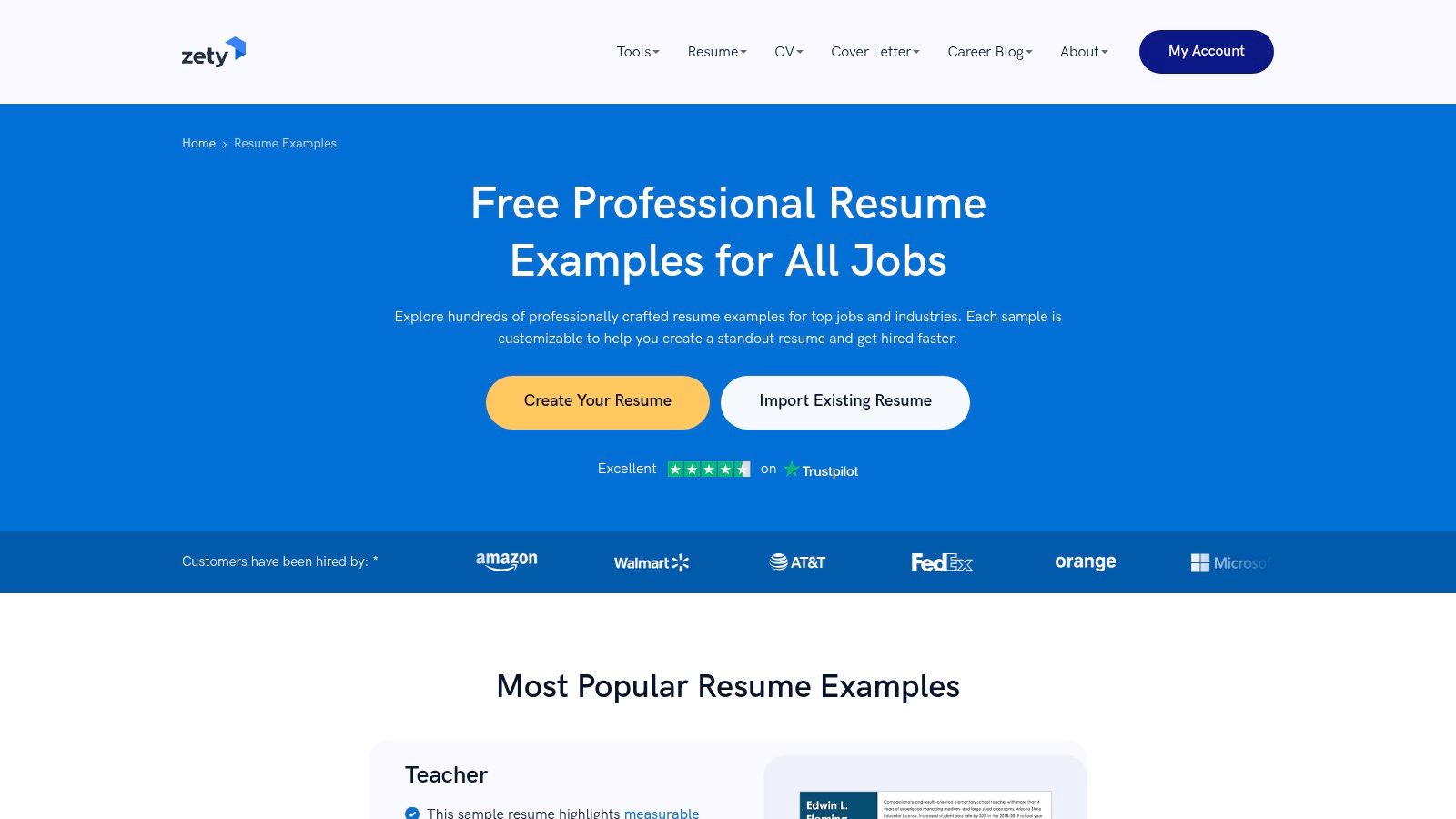
2. Zety Resume Examples Library
Zety pairs a broad resume examples collection with an online builder. Samples are organized by role and industry, then connected to templates and writing guidance. That workflow helps when you need to turn a reference into a working draft rather than collect examples without editing them.
Its strongest feature is range. Entry-level applicants, career switchers, and experienced professionals can compare examples with different levels of responsibility. The layouts are generally restrained for recruiter review, but inspect the exported file before applying. Columns, icons, graphics, and unusual text placement can affect ATS parsing, so a visually polished design may require a plainer version.
The builder is useful, but the payment boundary matters
You can review content before choosing a finished export. Formatted PDF and Word downloads require a paid plan, while the free option is limited to TXT. That difference matters if you want to develop resume content without paying for a designed document. Check renewal terms before subscribing if you only need a short editing session.
Use Zety's samples as a phrase bank, then replace borrowed wording with evidence from your own work. For example:
- Generic: Responsible for onboarding new employees.
- More useful: Coordinated onboarding setup, prepared access requests, and standardized first-day materials for new employees.
- Outcome-led: Reduced onboarding setup time from 3 days to 24 hours by standardizing access requests and first-day materials.
The final version follows the structure shown in resume metrics examples, but the details belong in your resume only if you can verify them. A result without evidence creates a credibility problem in interviews.
For neurodivergent job seekers, predictable headings and explicit bullet structure can reduce editing friction. Keep one idea per bullet, use familiar section labels, and remove decorative elements that compete with the reading order. Test the saved file by selecting its text and checking whether the sequence remains logical.
After finishing a Zety draft, prepare to explain every bullet without reading it aloud. Qcard's interview preparation guide can help turn resume language into concise talking points, especially when the builder has prompted you to include many skills.
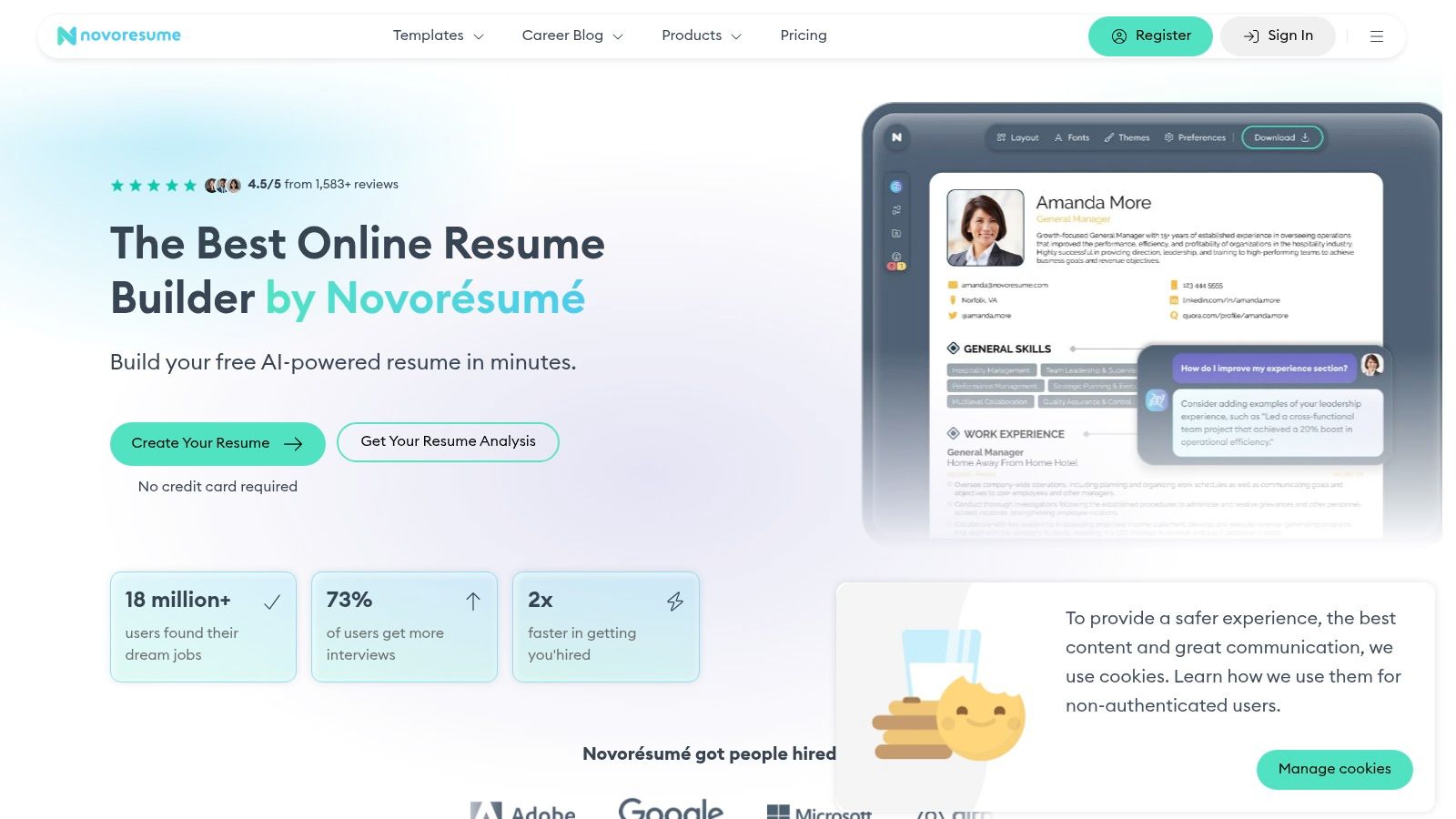
3. Novorésumé Examples, Templates, and Guides
Novorésumé takes a more design-conscious approach while keeping clarity at the center. Its resume platform combines role-specific examples, writing walkthroughs, templates, and guidance about ATS parsing. The US-Letter formatting option is particularly helpful for candidates applying to employers that expect US resume conventions.
This platform suits applicants who want a polished structure without building every spacing decision from scratch. Early-career candidates can use the clean hierarchy to give education, projects, internships, and skills enough visibility. Career switchers can also benefit from a summary that connects previous experience to a new target role.
Use the format to support the story
A career switcher might begin with a job title that hides the relevant evidence:
Retail Supervisor
That title is accurate, but it doesn't immediately connect to a project coordinator role. A more targeted headline and summary could read:
Project Coordination Candidate
Organized operations professional with experience scheduling teams, resolving workflow issues, and coordinating time-sensitive customer initiatives. Brings structured planning and stakeholder communication to project environments.
The summary should be followed by evidence, not more adjectives. A project bullet might say:
Coordinated weekly staffing schedules, resolved coverage conflicts, and maintained service continuity during high-volume periods.
If the candidate has volunteer work, freelance projects, or unpaid coordination experience, that material can appear in the experience section. NIH guidance recommends including paid and unpaid work, including volunteer work, and permits relevant experience to lead when someone is changing careers. Its federal resume guidance also supports reverse chronology by default, with relevance taking priority for career changers.
Novorésumé's polished exports and styling generally sit behind a paid plan, and its examples are distributed across guides and templates rather than presented in one giant index. That's a strength for learning, but a weakness if you want to scan every role from a single page.
Before an interview, use a mock interview AI tool to test whether your new narrative sounds coherent aloud, not just attractive on the page.
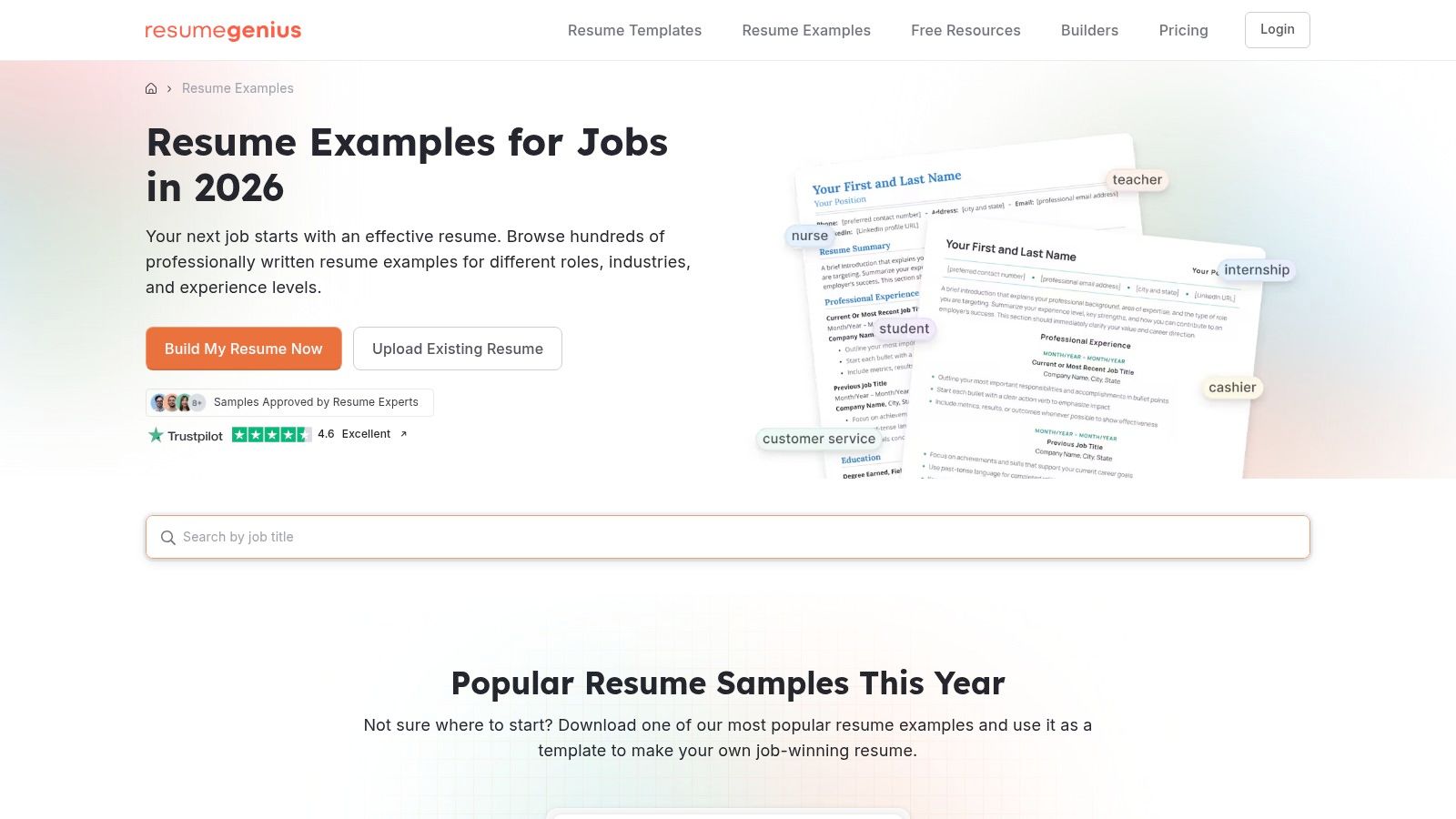
4. ResumeGenius Resume Samples
ResumeGenius helps candidates move from browsing to drafting quickly. Its resume samples gallery organizes job-specific examples into preview cards, then leads into a guided builder with content suggestions and formatting support. That workflow suits someone facing a blank page and needing a clear starting structure.
The examples work best for common US job titles. Review how each sample orders the summary, skills, experience, and education, then adapt the pattern to your own evidence. Copying the wording creates a generic resume, because a sample cannot provide your scope, tools, decisions, or results.
A before-and-after edit for duty-heavy writing
Start with a duty-heavy bullet:
Helped with inventory and worked with vendors.
The wording leaves the reader guessing. A hiring manager still does not know what the inventory involved or whether “worked with” meant negotiating, reconciling, forecasting, or communicating.
A clearer revision is:
Reconciled inventory records, coordinated vendor updates, and flagged stock discrepancies for follow-up.
With a verifiable result, it can become:
Cut material costs by 11% through vendor renegotiation and tighter purchasing controls, using an outcome-first approach to resume metrics.
Use the number only when you can explain its baseline, calculation, and personal contribution. Those details often become interview follow-up questions.
ResumeGenius makes a finished draft easier to assemble, but PDF and Word downloads require a paid subscription or trial. Review the cancellation terms before entering payment details. For a neurodivergent candidate, guided prompts can reduce decision fatigue. Still, export the text and inspect the final document independently for repeated phrases, crowded formatting, inconsistent headings, and ATS-unfriendly elements such as text inside graphics. A strong sample should guide decisions, not replace them.
5. LiveCareer 2,000+ Resume Examples
LiveCareer offers the broadest catalog in this comparison, with 2,000+ resume examples covering industries and seniority levels. Its searchable resume examples library connects those samples with a builder, writing guidance, and content suggestions. The range helps when your target role is specialized or when several adjacent titles could describe your experience.
The free TXT download is useful for testing substance before paying for a designed export. Copy the text into your own document, then compare section order, role-specific keywords, and the evidence used in each bullet. PDF and Word downloads require payment, and some examples are closely connected to the builder rather than offered as independent files.
Use the catalog to narrow your message
A large library can also make a resume generic. Browsing sales, account management, business development, and customer success examples may leave you with familiar phrases but no clear decision about which outcomes represent your work.
Begin with one job description. Mark the repeated responsibilities, tools, and results it emphasizes. Select a sample with a similar seniority level, then adapt only the sections you can support with your own records. This approach is easier to follow when dense pages create decision fatigue, because each edit has a defined purpose.
- For operations: Show scheduling, process control, throughput, or cost.
- For finance: Show reconciliation, reporting, controls, or audit readiness.
- For technology: Show systems, implementation, troubleshooting, or delivery.
- For customer-facing roles: Show resolution, retention, service quality, or account growth when the result is verifiable.
Keep the skills section selective. A resume statistics summary reports that 40% of recruiters identify failure to quantify accomplishments as the biggest resume mistake, while 60% cite too many buzzwords. Those figures are reported in Resume Now's resume statistics summary. Replace a vague skill label with a bullet showing where you used the skill, what you did, and what changed.
LiveCareer examples were described as updated in 2026, but that label does not replace your own review. Check the text for accurate keywords, readable headings, consistent spacing, and ATS-compatible formatting before treating any sample as a model. Use the library for research first, then build a resume that reflects your evidence rather than its template language.
6. Resume.io 500+ Resume Examples
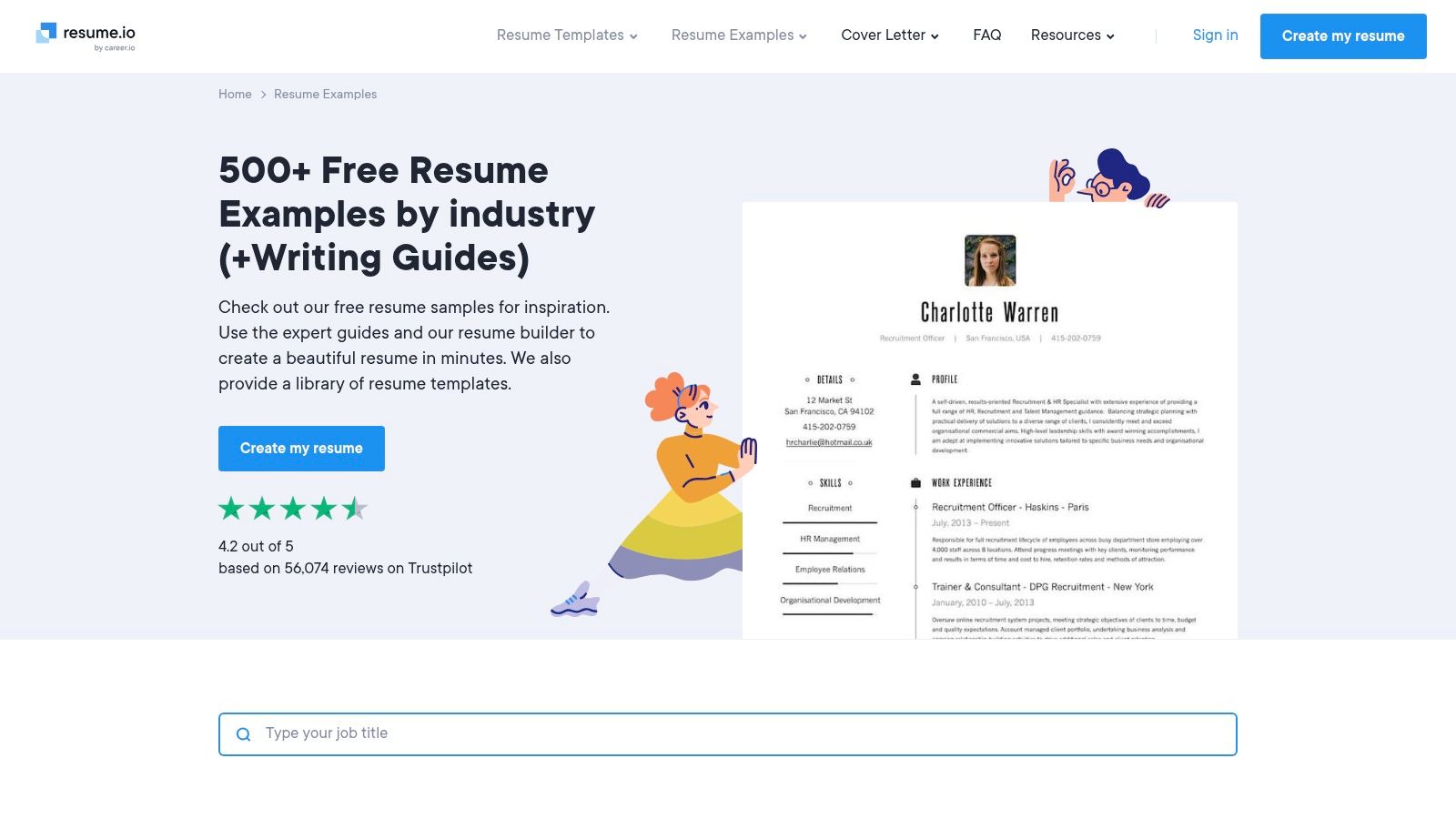
A marketing assistant can lose space to generic duties before showing any evidence of judgment. Resume.io's collection of 500+ resume examples helps solve that problem by pairing role and industry samples with template previews. The Resume.io examples library also displays edit timestamps on example pages, giving you a way to assess whether guidance has been maintained instead of copied forward indefinitely.
The concise format suits early-career applicants who need to control length. Historical resume research places the average resume at roughly 489–490 words, while common guidance favors one page for many early-career candidates and a tightly written two-page format for experienced professionals. The broader resume statistics context is summarized by Qureos. Use those figures as context, not a target. Cut material that does not help the hiring decision.
Make compact writing carry more evidence
A short resume still needs proof. Compare these versions:
Supported marketing campaigns and social media content.
Wrote campaign copy, scheduled social posts, and tracked engagement themes to inform content planning.
The revision names the work and links execution to learning without claiming an unsupported performance lift. Add a verified number only when records support it or you can explain the calculation. For neurodivergent applicants, this concrete structure can also make editing easier: identify the action, the object, and the resulting insight before refining the wording.
Resume.io's free TXT export preserves your content without requiring payment for a styled PDF or Word file. That option suits applicants who prefer to format the document themselves in a simple, single-column layout. Template styling and formatted exports sit behind the paid boundary, and example pages may direct you toward the builder rather than keeping design decisions fully separate. For ATS screening, test headings, spacing, and text order after export. A visually attractive sample still needs clean, selectable text.
If dense pages create processing friction, work through one example at a time. Choose the target role, select three relevant achievements, then build the summary and bullets around them. This sequence limits copying and gives every section a clear job.
7. The Muse Resume Examples and Guides
The Muse takes an editorial approach instead of competing primarily as a downloadable template gallery. Its resume examples and guides explain summaries, formats, role-specific choices, and the reasoning behind common trade-offs. That makes it particularly valuable for career changers, early-career candidates, and applicants who need to understand why a sample is structured a certain way.
The guidance is free and easy to adapt, but examples mainly live inside articles. The Muse doesn't offer the same large template and download catalog as dedicated builder platforms, and its optional builder is more limited than tools designed around document production.
Choose chronology or relevance deliberately
A standard reverse-chronological resume makes progression easy to inspect. It's usually the safer option when your recent jobs match the target role. A career changer may instead lead with relevant volunteer work, project work, or a skills section, while still listing employment history clearly enough that the reader doesn't have to guess what happened.
Avoid hiding dates entirely. Peer-reviewed hiring research examined observable resume signals including work experience, career progression, employment gaps, and listed skills. The Bertrand and Mullainathan field study supports a practical conclusion: structure itself communicates information. A resume that makes continuity and relevant skill development easy to understand creates a stronger signal than one that forces the reader to reconstruct the timeline.
For formatting, federal guidance recommends 1-inch margins when possible, never below 1/2 inch, text between 10 and 12 points, and left-aligned rather than block-justified text. The National Archives federal resume guide provides those concrete standards. They're sensible for many private-sector resumes too, especially when ATS parsing and readability matter more than visual novelty.
If you're applying for a federal role, follow the agency's requirements instead of copying a private-sector sample. USAJOBS says federal resumes must be two pages or less, use plain language, avoid unexplained acronyms, and include employer name, job title, start and end dates with month and year, and hours worked per week. The official USAJOBS resume guidance is the authority to check before submission.
Action Plan to Update Your Resume
Start with the example library that addresses your immediate task. Indeed helps when you need free, readable role language. Zety, ResumeGenius, LiveCareer, and Resume.io connect examples to builder workflows. Novorésumé fits candidates seeking a clean, structured presentation. The Muse is more useful when you need the reasoning behind format and positioning choices. Treat these libraries as annotated references, not finished documents.
Choose a structure, then replace each generic sentence with evidence from your own work. A practical resume needs a target headline, concise summary, relevant skills, and experience bullets showing action, context, and outcome. Keep wording easy to scan. Automated screening can reject resumes that use layouts or text those systems cannot read, so format decisions affect whether a recruiter sees your evidence. The ATS and resume-format findings are summarized by Resume Now.
Use a single-column layout when you are unsure how a system will parse the file. Avoid text boxes, charts, sliders, decorative icons, and dense sidebars. A polished sample may look strong in a browser yet lose content during upload. Use standard section headings, left alignment, consistent dates, and role-specific keywords you can explain in conversation. For neurodivergent candidates, predictable headings and uncluttered spacing can also reduce the effort required to find and review information.
Build each bullet around three questions:
- What did you do? Start with a precise action verb.
- What was the scope? Name the process, team, system, customer group, or project.
- What changed? Add a verified result involving cost, speed, volume, quality, risk, or another meaningful outcome.
“Renegotiated supplier terms and reduced annual travel spend by 14%, equal to $22,000” gives a reader more evidence than “Managed travel expenses,” provided the figures are accurate and explainable. Outcome-first examples can help you decide which results belong in a bullet. The resume metrics guide
Practise the resume instead of memorizing it. Upload the final PDF or paste its text into a resume-grounded practice tool, then rehearse projects, transitions, and metrics likely to prompt follow-up questions. Qcard can help candidates organise concise memory cues from verified experience, which may support neurodivergent applicants and anyone who experiences brain fog during interviews. Your resume opens the conversation. Preparation makes the evidence easier to discuss naturally.
Key Takeaways
- Resume samples are annotated references, not finished documents — with recruiters spending 6 to 8 seconds on an initial scan and only about 2% of candidates reaching interviews, the value of a library is in studying section order, prioritization, and role-specific language, then replacing every borrowed sentence with your own evidence.
- The three-question bullet formula fixes duty-heavy writing fast — "Helped with inventory and worked with vendors" leaves the reader guessing, while "Reconciled inventory records, coordinated vendor updates, and flagged stock discrepancies for follow-up" names the action, scope, and outcome a hiring manager can actually evaluate.
- Quantify only what you can defend — 40% of recruiters identify failure to quantify accomplishments as the biggest resume mistake while 60% cite too many buzzwords, but a number you can't explain (baseline, calculation, your personal contribution) becomes a credibility problem the moment an interviewer follows up on it.
- Formatting decisions determine whether your evidence gets seen at all — a single-column layout, standard headings, left alignment, 1-inch margins where possible (never below 1/2 inch), and 10-to-12-point text protect ATS parsing, while text boxes, charts, sliders, sidebars, and decorative icons can silently drop content during upload.
- Free tiers are usually TXT-only, and that's often enough — Indeed requires no account at all, while Zety, LiveCareer, and Resume.io let you develop content for free before deciding whether a styled PDF or Word export is worth the subscription, so check renewal and cancellation terms if you only need one editing session.
Qcard turns a finished resume into resume-grounded interview practice, concise talking points, and questions based on actual experience rather than invented scripts. Visit Qcard to prepare achievements, practise explaining key metrics, and approach interviews with clearer, more authentic answers.
Ready to ace your next interview?
Qcard's AI interview copilot helps you prepare with personalized practice and real-time support.
Try Qcard Free