Product Manager Interview Questions: 10 Key Types
TL;DR
Product manager interviews test product design, strategy, estimation, behavioral judgment, analytics, and product critique — often in the same loop. The ten questions above map to those capabilities: decisions with incomplete data, roadmap building from zero, disagreement and influence, defining feature success, customer requests versus technical debt, handling unhappy customers, evaluating your own decisions, market awareness, being wrong about user needs, and behavioral preparation itself. Across all ten, the same standards apply: make the Action section the center of every STAR story, state assumptions explicitly, connect decisions to customer and business outcomes, and never invent a metric. If you lack a verified number, say what you measured and what you learned. Prepare two lengths per story, write three likely follow-ups for each ("What was your role?", "Who disagreed?", "How did you know it worked?"), and practice aloud rather than memorizing — scripts break the moment an interviewer approaches the same question from a different angle.
You know the terminology. You can explain product-market fit, RICE, activation, retention, and trade-offs. Then an interviewer asks you to reason through a messy product decision, and your answer loses its shape. You remember the conclusion but not the sequence that led there.
Strong answers make your thinking easy to follow. They state assumptions, connect decisions to customer and business outcomes, acknowledge constraints, and finish with measurement or learning. That matters because PM interviews assess several capabilities at once. Stanford Online's framework groups the classic format into product design, product strategy, market estimation, behavioral skills, product analytics and metrics, and favorite-product critique, while a 2026 analysis of 10,374 responses from 480 live product manager sessions found that behavioral questions averaged 67.7/100, strategy and prioritization 66.2/100, and metrics and analytics 65.8/100 (Stanford Online's PM interview framework, the 2026 interview analysis).
The 10 product manager interview questions below are organized by the capability each one tests. Use the examples as patterns, not scripts. Replace them with verified experiences from your work, studies, volunteering, or portfolio. Plain formatting, short sections, signposted frameworks, written prompts, and deliberate pause time can also make practice more accessible for neurodivergent candidates.
What Are the Most Common Product Manager Interview Questions?
PM interviews assess several capabilities at once — product design, product strategy, market estimation, behavioral skills, product analytics, and favorite-product critique. The questions below are organized by the capability each one tests, which matters more than the wording, since interviewers rephrase constantly.
The ten product manager interview questions that appear most consistently:
- Tell me about a time you made a product decision with incomplete data — Tests judgment under uncertainty. Name what you lacked, why it mattered, and why waiting wouldn't have changed the call.
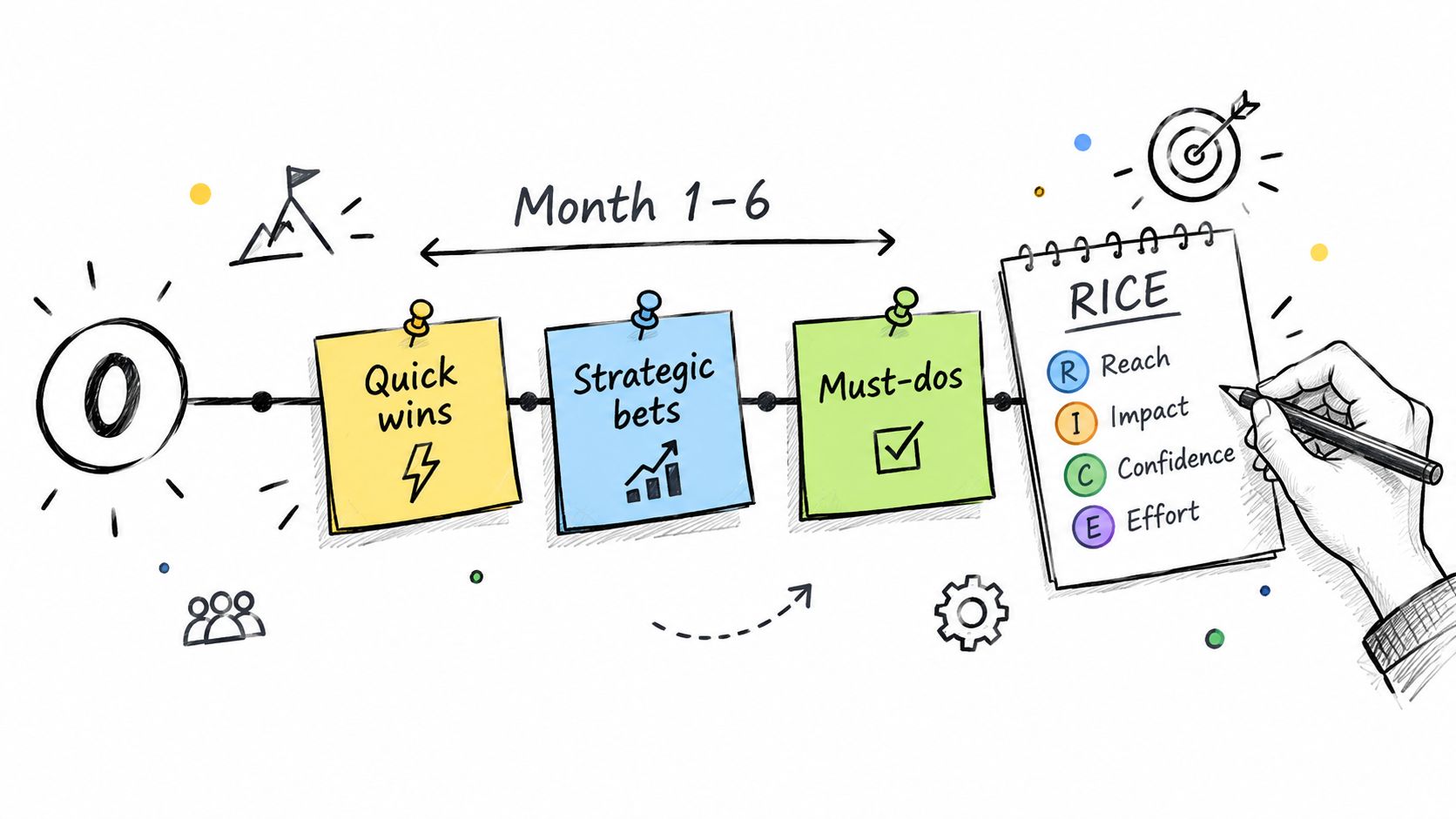
- Walk me through building a roadmap from zero — Tests sequencing, not feature lists. Frame the problem, test the opportunity, choose deliberately, make trade-offs visible, set review points.
- Describe a decision you disagreed with and how you handled it — Tests influence without authority. Show the evidence you gathered, the alternative you proposed, and how you supported the final call.
- How do you define and measure success for a feature? — Tests measurement discipline. Lead with a hypothesis, then primary outcome, leading indicators, business connection, guardrails, and qualitative evidence.
- Prioritizing customer requests vs. technical debt — Tests portfolio thinking. Translate debt into customer consequences, then explain the sequencing choice.
- Talking to customers about a change they dislike — Tests empathy with conviction: listen, clarify, explain the trade-off, offer action, follow up in writing.
- Walk me through a decision and how you'd evaluate whether it was right — Tests self-assessment. State success criteria before the result, then separate outcome from interpretation.
- How do you stay on top of trends and customer needs? — Tests synthesis, not consumption. Use market signal → customer implication → company implication.
- Tell me about a time your intuition was wrong — Tests validation discipline. The update matters more than the original belief.
- How do you prepare for behavioral rounds? — Tests whether you have an evidence bank or a set of memorized speeches.
A 2026 analysis of 10,374 responses across 480 live PM sessions found behavioral questions averaging 67.7/100, strategy and prioritization 66.2/100, and metrics and analytics 65.8/100 — none of these categories is a gimme.
1. Tell me about a time you had to make a product decision with incomplete data
Interviewers want to hear how you act when the evidence is useful but unfinished. A strong response doesn't pretend uncertainty disappeared. It shows how you identified the decision, gathered the most valuable missing information, assessed risk, and chose a reversible or bounded next step.
Use STAR, Situation, Task, Action, Result, but make the Action section the center of the story. Rice University's guidance recommends giving only the context you need, clarifying your responsibility, explaining your approach, and showing the impact (Rice University's behavioral interview guidance).
A practical answer shape
- Situation: “We were preparing a feature launch, but research coverage was limited and support tickets suggested conflicting needs.”
- Task: “I owned the decision about whether to launch the full scope or a smaller version.”
- Action: “I listed the assumptions, used a risk-impact matrix, checked existing analytics, spoke with support, and ran a lightweight validation exercise.”
- Result: “We launched the lower-risk version, monitored the agreed signals, and learned which assumption needed deeper research.”
Don't invent a survey size, adoption rate, or revenue result. If your experience has a verified outcome, state it precisely. If it doesn't, explain what you measured and what you learned.
Practical rule: Say what information you lacked, why it mattered, and why waiting for more data would or wouldn't have changed the decision.
Likely follow-ups include: “What would have changed your mind?”, “Who disagreed?”, and “What did you do afterward?” Prepare one sentence for each. A written decision log can help you pause, separate facts from assumptions, and avoid answering every uncertainty at once. Candidates changing careers can use a research, operations, analytics, or coursework example, as long as they make their personal decision visible. You can also rehearse this type of response with practice interview questions for product roles.

2. Walk me through how you would approach building a product roadmap from zero
A strong roadmap answer starts with a messy situation: several customer requests, limited engineering capacity, and no agreed order. Explain how you would turn that uncertainty into a sequence of choices, rather than presenting a feature list.
Begin by asking what the roadmap must support. Clarify the company strategy, target customer, business outcome, constraints, and planning horizon. Then connect each proposed initiative to a customer problem and an outcome the team can review.
Use a decision trail instead of a repeated checklist:
- Frame the problem: Gather input from customers, sales, support, design, engineering, and product data. Separate recurring problems from individual feature requests.
- Test the opportunity: Examine evidence, dependencies, technical risks, and assumptions. Mark what is known, estimated, or still uncertain.
- Choose deliberately: Apply RICE, ICE, weighted scoring, or another agreed method. Explain how impact, business value, effort, confidence, and strategic fit affect the order.
- Make trade-offs visible: Show what the team selected, what it deferred, and the reason for each decision.
- Set review points: Give major initiatives an expected outcome, owner, assumption, and point at which the team will reassess them.
A concise early-career response could be: “I would first clarify the strategy and customer segment, then turn research and internal evidence into problem statements. I would compare those opportunities against agreed criteria, review feasibility with engineering, and publish a roadmap centered on outcomes. I would label uncertain items as hypotheses rather than presenting them as commitments.”
Practice with a scenario in which the CEO requests an urgent feature after the roadmap is drafted. Explain how you would assess the request, compare its value and urgency with current commitments, and state which capacity trade-off the change creates. Likely follow-ups include, “What would you remove?”, “How would you handle disagreement?”, and “When would you revisit the roadmap?” Candidates who process information better in writing can prepare a one-page decision table before answering.
3. Describe a product feature or decision you disagreed with and how you handled it
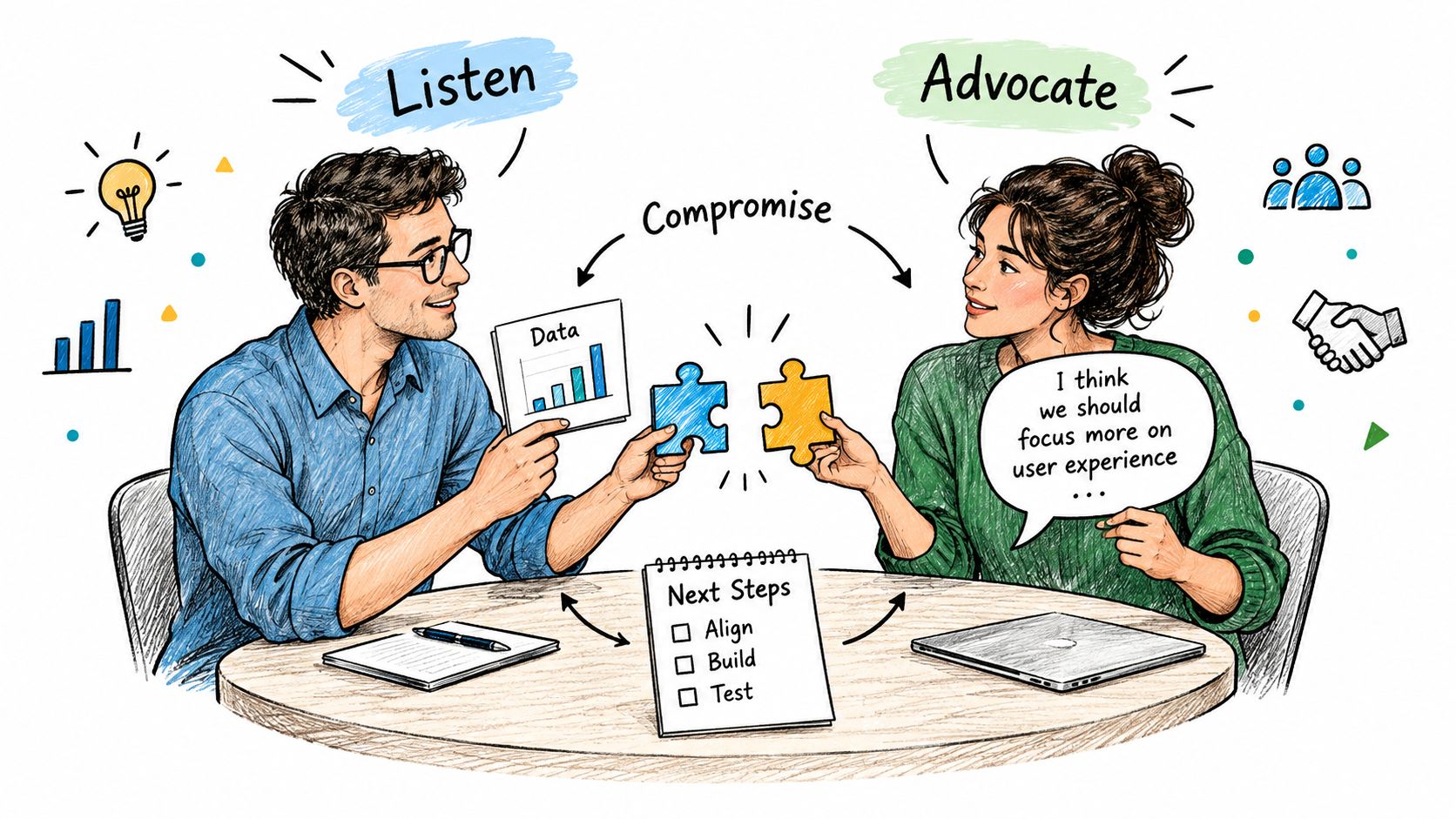
A disagreement story shows how you influence a decision when you do not control the final call. Strong answers demonstrate curiosity, evidence, respectful challenge, and reliable follow-through, rather than just proving that your opinion prevailed.
Start with the decision, your concern, and the people affected. Then show how you examined the other perspective before suggesting a different path. The Situation, Problem, Solution, Impact framework can keep the story focused (I Got An Offer's behavioral interview guidance).
One example might be: “The team planned to release a workflow without confirming that target users had the problem. I worried that we would spend engineering capacity on the wrong solution. I asked what evidence supported the request, reviewed customer feedback, and proposed a small validation step. The results changed the scope, and I helped the team deliver the revised approach.”
Use the story to make your reasoning visible. Identify whether your concern came from customer feedback, product data, technical constraints, or business risk. Ask, “What assumption am I missing?” before arguing for your preferred option. Then offer a practical alternative, such as a smaller experiment, phased release, or different solution.
The outcome may still differ from your recommendation. Explain how you supported the decision, communicated it clearly, and monitored its effects. Including a point where you were partly wrong can strengthen the answer because it shows that you update your view when new evidence appears.
For practice, choose one real disagreement and write four short notes: the decision, your concern, the evidence, and the relationship you needed to preserve. Rehearse each note as a complete sentence, then connect them into a story. Candidates who find live improvisation difficult can bring the sequence to mind as four labeled cards. Likely follow-ups include, “How did the other person respond?”, “What would you do differently?”, and “What happened after the decision?”
4. How do you define and measure success for a product feature
A feature launch creates a decision problem: did it solve the intended customer need, and did it introduce new costs? Build your answer around a hypothesis that names the change, user, expected outcome, and reason. For example: “We believe simplifying onboarding will help new users reach their first successful task because fewer steps remove confusion.”
Choose one primary outcome that reflects customer value. Activation may suit an onboarding change, while task completion or repeat usage may better measure a feature for existing users. Page views can show attention, but they may not show whether the user achieved anything.
Use a measurement map rather than a long metric list:
- Primary outcome: The clearest evidence that the intended benefit occurred.
- Leading indicators: Early actions that suggest users are approaching that outcome.
- Business connection: How the customer result supports the company's goals.
- Guardrails: Measures for harm, such as support burden, reliability, or retention.
- Qualitative evidence: Interviews, surveys, usability sessions, and support conversations that explain the numbers.
If verified values are available, state the baseline and target. If they are not, explain how you would establish them before launch. Cover the measurement window, user segment, comparison group, and the thresholds that would lead you to continue, change, or stop the feature.
A follow-up may ask, “What if usage rises but retention falls?” Start by checking which segment changed and whether the result is reliable. Then test whether the feature created short-term curiosity without lasting value. Strong product measurement connects evidence to action.
For practice, write a one-page success brief with the hypothesis, primary metric, baseline, target, guardrail, measurement period, and qualitative method. Use a simple table or color-coded cards if dense text is hard to recall. Rehearse how the brief would align engineering, design, and leadership before launch.
5. Tell me about a time you had to prioritize between customer requests and technical debt
Customer requests feel urgent because someone is asking for visible value. Technical debt feels abstract until it slows delivery, causes reliability problems, increases operational risk, or makes every future change harder. Your answer should show that you can translate both into customer and business consequences.
Start by asking engineering to describe the debt in observable terms. Is it creating defects, slowing releases, limiting scale, weakening security, or increasing support work? Then place the customer request and the debt on the same decision frame. You might compare customer impact, risk reduction, strategic value, urgency, effort, and reversibility.
Make the trade-off explicit
A credible answer could sound like this: “Customers requested new reporting capabilities, while engineering identified a fragile data pipeline. I worked with the engineering lead to understand which customer experiences the fragility affected, compared the request with the risk of continuing, and proposed delivering the smallest useful reporting improvement alongside targeted platform work. I documented what we deferred, why, and which signals would tell us whether the decision worked.”
Don't say that technical debt “won.” Explain the portfolio choice. You might fund a specific reliability improvement, reduce scope on a customer-facing initiative, sequence the work, or reserve capacity for recurring platform needs. The important point is that customers still matter in the analysis.
A technical debt register can help you prepare. For each item, record the affected user experience, business risk, engineering consequence, and decision date. Candidates who think visually may map initiatives by customer impact and platform-health impact. That can make a difficult conversation less emotionally overwhelming and give the interviewer a clear view of your reasoning.
Expect follow-ups such as, “How did you persuade leadership?”, “What did you defer?”, and “How did you know the debt work helped?” Prepare answers that credit engineering partnership and identify the evidence you reviewed after delivery.
6. How would you approach talking to customers about a feature or product change they don't like
A dissatisfied customer may be reacting to disruption, a genuine usability problem, a missing edge case, or a change that conflicts with their workflow. Your first responsibility is to distinguish those possibilities without becoming defensive.
Open with curiosity: “Tell me more about what isn't working.” Ask what task became harder, what they expected to happen, which users are affected, and what workaround they use now. Listen for the underlying job rather than treating the customer's first proposed fix as the requirement.
A conversation framework
- Listen: Let the customer describe the problem without interrupting or correcting their interpretation.
- Clarify: Separate emotional frustration from specific product friction.
- Explain: State the problem the change was intended to solve and acknowledge the trade-off.
- Offer action: Identify what you can investigate, fix, document, or escalate.
- Follow up: Send a written summary of what you heard, what happens next, and what remains undecided.
For example: “A key customer disliked a redesigned workflow. I asked which task was failing, learned that their team had relied on the old navigation, and also found an edge case that the redesign handled poorly. I shared the reasoning behind the change, arranged guidance for the transition, documented the edge case, and followed up with the customer after the investigation.”
That response demonstrates empathy without promising to reverse every decision. It also shows conviction with flexibility. You can explain why the product changed while remaining open to evidence that the new experience creates unacceptable friction.
Neurodivergent candidates may benefit from preparing a conversation card with four lines: “What changed?”, “Why did we change it?”, “What might the customer need?”, and “What can I commit to?” Following up in writing isn't merely administrative. It creates a precise record and gives you space to communicate carefully.
7. Walk me through a product decision you made and how you'd evaluate whether it was right
This question tests whether you can evaluate your own judgment. A polished answer doesn't need a perfect outcome. It needs a clear prediction, a fair evaluation, an explanation of what happened, and a change in your future practice.
State the decision and success criteria before describing the result. For instance: “I decided to simplify a workflow because I believed it would reduce friction for new users. Before launch, I defined the behavior that would indicate improvement, identified a guardrail for experienced users, and planned interviews to understand unexpected results.”
Then separate outcome from interpretation. If the metric improved, explain why you think it moved and what evidence supports that explanation. If it didn't, don't hide behind external factors. Investigate segments, funnel steps, instrumentation, user feedback, and alternative explanations.
A useful answer can contain both a success and a failure. The credibility comes from explaining the gap between what you expected and what users actually did.
A strong follow-up response might say: “The main outcome improved, but a smaller segment struggled. I reviewed the segment data, watched users complete the task, and changed the experience to preserve flexibility for that group. The lesson was that optimizing the average user without checking important segments can create a misleading result.”
For accessibility, write the prediction in one sentence before practicing. Use a simple sequence: Decision, Hypothesis, Evidence, Outcome, Learning. This reduces working-memory demands and keeps you from giving a retrospective story that sounds as though you selected the metric after seeing the result.
When you're ready to test the story aloud, Qcard's AI mock interview practice can help you rehearse follow-up pressure while keeping the focus on your own evidence.
8. How do you stay on top of trends, competitors, and customer needs to inform your product direction
Good product awareness isn't a pile of bookmarked articles. It's a repeatable way to collect signals, compare them, and decide whether they deserve product attention.
Describe your information diet in categories. Customer conversations reveal unmet needs and changing workflows. Direct competitors show alternative solutions. Adjacent products can reveal interaction patterns or business models that your category hasn't adopted. Industry writing, communities, events, and product announcements can add context, but they shouldn't replace customer evidence.
Show the synthesis, not just the consumption
Use a simple three-line template:
- Market signal: “Several competitors are emphasizing a particular workflow.”
- Customer implication: “Our target users may increasingly expect that workflow or may be changing how they evaluate products.”
- Company implication: “We should validate the need, assess our constraints, and decide whether to invest, differentiate, or deliberately ignore it.”
Then give a real example from your experience. Perhaps repeated customer conversations changed your understanding of a problem, or competitor research caused you to test a positioning assumption. The example matters more than naming a long list of newsletters.
Set a cadence you can sustain. You might review customer feedback regularly, maintain a shared competitive digest, and synthesize observations during planning. Don't claim a precise routine unless you follow it. Interviewers care about the connection between learning and action.
Candidates with attention or sensory constraints can use a backlog for reading instead of trying to follow every update in real time. A dedicated folder, calendar reminder, and one-page synthesis template can turn an unbounded research task into a predictable system.
Likely follow-ups include, “Which competitor do you watch?”, “How do you avoid copying competitors?”, and “Tell me about a decision your research influenced.” Prepare to explain not only what you noticed, but why the signal was relevant to your users and strategy.
9. Tell me about a time your intuition was wrong about what customers wanted
Product intuition helps you form a hypothesis quickly. It becomes dangerous when you treat it as evidence. This question gives you a chance to show humility, validation discipline, and the ability to change direction without protecting your ego.
Choose a story where your initial belief was reasonable. Maybe you assumed more customization would help users, expected a new workflow to reduce friction, or believed a frequently requested capability would drive adoption. Explain why the idea made sense from your perspective, then show how customer evidence challenged it.
The most important part is the update
Use this sequence:
- Initial belief: What did you expect and why?
- Validation: How did you test the assumption?
- Contradiction: What did customers do or say that surprised you?
- Response: What did you change, stop, or investigate?
- Learning: Which part of your product process changed afterward?
A concrete practice prompt is: “Tell a story in which your first solution was wrong, but the customer problem was real.” This keeps the story from becoming a confession with no product insight.
Don't present customers as confused because they rejected your idea. Ask what your research method missed. Perhaps you tested with power users, showed a polished concept instead of observing real behavior, or asked leading questions. Your explanation should show how you corrected the research or segmentation problem.
Neurodivergent candidates may find it easier to write two columns, “I predicted” and “Users showed.” That visual contrast helps you avoid overexplaining the original idea. Keep the ending specific: “I now validate this assumption with broader user evidence before committing scope,” rather than “I learned to listen more.”
10. Interview preparation with practical approaches and habits for product behavioral questions
Preparation works best when it builds retrieval, not recitation. You want a compact library of real stories that you can adapt when an interviewer changes the wording or asks a follow-up.
Start by mapping experiences to themes: ambiguity, roadmap decisions, disagreement, success measurement, technical debt, customer dissatisfaction, failure, learning, and influence. Prepare more than one example for important themes so you aren't forced to use the same story for every question.
Build a reusable practice system
- Create story cards: Record the context, your responsibility, actions, outcome, metric, stakeholders, and lesson.
- Name the framework: Use STAR for behavioral stories, a hypothesis-to-metric structure for measurement, and Discovery to Execution for roadmap questions.
- Prepare two lengths: Practice a concise version and a fuller version that includes decision detail.
- Write follow-ups: Note the likely questions about timeline, ownership, disagreement, measurement, and what you'd change.
- Practice aloud: Listen for missing assumptions, vague verbs, team-credit confusion, and conclusions without evidence.
- Use pause cues: Mark places where you can breathe, ask for a moment, or confirm the question.
A behavioral answer should emphasize what you personally did while giving the team appropriate credit. The guidance from Invensis Learning on concise STAR answers recommends short context, a clear task, specific actions, and quantified results when those results are available. Don't add a number merely to make the story sound stronger. Say what changed, how you evaluated it, and what you learned.
For neurodivergent candidates, a written one-page framework, predictable practice environment, and permission to pause can reduce cognitive load. For international candidates, practice plain explanations of idioms, organizational context, and acronyms. You don't need to sound scripted. You need to make your reasoning accessible.
A focused product interview preparation guide can add another set of structured prompts, but your evidence should always come from your own experience.
Turn Questions Into Reusable Evidence
The strongest preparation doesn't produce 10 polished speeches. It produces a flexible evidence bank. Start with your resume, portfolio, coursework, internships, volunteer work, or career-switch projects, and map each verified experience to the capabilities behind these questions.
For every story, write five lines: the situation, the decision or responsibility, the actions you personally took, the observable result, and the learning. Add the stakeholders involved and the trade-off you had to manage. This prevents a common PM interview problem, where a candidate describes activity but can't explain what changed because of it.
Prepare both a short and full version. The short version should communicate the situation, decision, action, and result quickly. The full version should be ready when the interviewer asks how you gathered evidence, handled disagreement, measured impact, or changed your mind. Don't memorize exact sentences. Memorization can make an answer brittle when the interviewer asks the same question from a different angle.
Define metrics before discussing outcomes. If your story concerns onboarding, decide whether activation, task completion, support demand, retention, or another signal reflects the intended value. Include guardrails when relevant. If you don't have a numerical result, be precise about the evidence you do have, such as user feedback, observed behavior, a decision log, a launch review, or a change in process.
Rehearse likely follow-ups separately. For each story, answer: “What was your role?”, “What alternatives did you consider?”, “Who disagreed?”, “What would you do differently?”, and “How did you know it worked?” Those questions expose whether your story is your own, so prepare honest answers rather than defensive ones.
Practice aloud with pauses, written prompts, and a predictable structure. A pause isn't a failure. It gives you time to identify the question type, choose the right story, and avoid answering a different question. If you need clarification, ask for it. Product managers are expected to clarify ambiguous problems, not pretend every prompt is complete.
Qcard is one optional preparation and interview-support tool for this process. Its zero-script, resume-locked approach is designed to surface high-level memory cues from verified experience rather than generate a speech, and its preparation tools include AI-scored practice, mock interviews with follow-ups, and feedback that can support pacing, filler words, and answer length. Qcard also positions its product around cognitive equity, which may be useful for neurodivergent and neurotypical candidates who want to speak naturally while remembering key evidence. Learn more at Qcard.
Choose two questions today. Draft one evidence-based answer for each, write three likely follow-ups, and schedule a timed practice session in which you answer aloud without reading a script. Then revise only the parts that were unclear, unsupported, or difficult to retrieve.
Key Takeaways
- The capability behind the question matters more than the wording — interviewers rephrase constantly, so mapping your experiences to themes (ambiguity, roadmap decisions, disagreement, measurement, technical debt, customer dissatisfaction, failure, influence) prepares you far better than memorizing ten specific answers.
- Never invent a metric to make a story sound stronger — if your experience has a verified outcome, state it precisely; if it doesn't, explain what you measured and what you learned, because a fabricated survey size or adoption rate collapses the moment an interviewer asks how you calculated it.
- Measurement answers need a map, not a metric list — a hypothesis naming the change, user, and expected outcome, followed by one primary outcome, leading indicators, business connection, guardrails, and qualitative evidence, is what separates candidates who measure from candidates who report numbers.
- Technical debt questions are won by translation, not advocacy — asking engineering to describe the debt in observable terms (defects, slower releases, scale limits, security, support load), then placing it on the same decision frame as the customer request, shows portfolio thinking rather than a winner-takes-all answer.
- Follow-ups are where borrowed stories fall apart, so rehearse them separately — "What was your role?", "What alternatives did you considered?", "Who disagreed?", "What would you do differently?", and "How did you know it worked?" expose whether the experience is genuinely yours, which is why honest answers beat defensive ones.
Qcard offers resume-grounded talking points, AI-scored practice, and mock interviews with follow-ups to help you prepare for product manager interview questions without memorizing scripts. Visit Qcard to turn your verified experience into clear, natural answers.
Ready to ace your next interview?
Qcard's AI interview copilot helps you prepare with personalized practice and real-time support.
Try Qcard Free