7 Top Sources for Practice Questions for Interviews in 2026
TL;DR
Practice questions for interviews only build performance when matched to your specific interview type and practiced under realistic pressure — not skimmed and recognized. The seven tools reviewed here serve different jobs: Qcard for behavioral and resume-grounded delivery practice, LeetCode for coding pattern repetition, interviewing.io for live mock pressure, Exponent for product and role-specific frameworks, RocketBlocks for case component drilling, Glassdoor for company-specific question intelligence, and Wall Street Oasis for finance recruiting depth. The strongest prep stack uses three tools at most — a question source, a delivery practice tool, and a pressure-test mechanism. The review block is where most candidates improve fastest: fixing the specific weak patterns visible in your own sessions rather than collecting more prompts.
You have a major interview next week. You've searched for practice questions for interviews, opened a dozen tabs, and found the same recycled prompts dressed up in different templates. “Tell me about yourself.” “What's your biggest weakness?” “Describe a challenge.” Useful, yes. Sufficient, no.
Real interview prep breaks down when candidates confuse recognition with readiness. Reading a question and thinking, “I know how I'd answer that,” isn't the same as answering it out loud, under time pressure, while someone interrupts, asks for specifics, and expects a clear point. That gap is where strong candidates lose momentum.
The better approach is to practice by interview type. Behavioral rounds need story recall and concise structure. Coding rounds need repetition under constraints. Case and strategy rounds need live thinking, not memorized frameworks. For data and quantitative roles, the expectation is also broader than many candidates realize. Interview prep repositories document roughly 39 to 40 standardized statistics questions across major business platforms, and core topics such as the Central Limit Theorem, confidence intervals versus prediction intervals, z-tests versus t-tests, and the Law of Large Numbers show up as baseline knowledge in many prep materials, as compiled in this statistics interview preparation collection.
That's why a generic list of questions won't carry you very far. You need tools that help you rehearse delivery, pressure-test your thinking, and spot weak points before a hiring manager does. The best resources below do different jobs well. Some are built for coding reps. Some are strongest for company-specific question mining. Some are best when you need a realistic mock interview instead of another worksheet. One of them, Qcard, stands out for turning scattered prep into an actual system.
What Are the Best Practice Questions for Interviews?
The best practice questions for interviews are not a generic list — they are the questions that match your specific interview type, target role, and the weak point your preparation needs to fix. Reading common questions and thinking "I know how I'd answer that" is not the same skill as answering them aloud, under time pressure, with a follow-up question coming.
Practice questions for interviews break into five distinct categories, each requiring a different preparation approach:
Behavioral questions ("tell me about a time when...") test your ability to retrieve specific, structured stories from your real experience and deliver them concisely under pressure. They need STAR or STAR-L structure, heavy emphasis on your personal Action and a concrete Result, and rehearsal under follow-up questioning — not written review.
Coding and technical questions test pattern recognition, problem decomposition, and verbal narration of your reasoning. LeetCode-style practice works here, but only when you solve under time pressure, speak your approach before you code, and review why you missed a solution — not just what the solution was.
Case and strategy questions test live structured thinking, estimation, and recommendation clarity. Frameworks help, but passive consumption of model answers does not. You need timed reps on component skills: mental math, chart interpretation, prioritization logic, and synthesis under interruption.
Product and leadership questions test judgment, cross-functional communication, and decision-making under ambiguity. Exponent, Qcard, and role-specific company reports are strongest here — especially when combined with a weekly delivery block where you practice out loud rather than review notes.
Finance and technical domain questions for investment banking, private equity, and quantitative roles require specialized vocabulary, accounting fluency, and market-aware delivery. Generic platforms do not replicate that depth — Wall Street Oasis and firm-specific Glassdoor reports are more effective.
The seven platforms reviewed in this post — Qcard, LeetCode, interviewing.io, Exponent, RocketBlocks, Glassdoor, and Wall Street Oasis — each serve one or more of these categories well. The most effective prep stack is usually small: one question source, one delivery practice tool, and one pressure-test mechanism such as a live or AI mock. The goal is not to collect more questions. It is to build the habit of answering them clearly, specifically, and composedly when it counts.
1. Qcard, Inc.

A common failure pattern looks like this. The candidate has done the work, knows their resume, and has decent answers on paper. Then the interviewer interrupts, asks for an example with numbers, or pushes on a weak point, and the answer falls apart. Qcard, Inc. is useful for that specific problem.
It fits candidates who need structured reps across more than one interview type. Behavioral rounds, consulting and banking interviews, product conversations, cybersecurity panels, and technical screens all test recall under pressure. Qcard focuses on the how of practice. It uses your resume and verified experience to build memory cues, then lets you rehearse delivery with feedback instead of memorizing a script that sounds polished alone and stiff in the room.
Where Qcard fits best
Qcard is strongest for candidates who know their background but struggle to retrieve it cleanly on demand. I see that often with people balancing multiple interviews at once, and with candidates who get thrown off by follow-up questions even when their underlying experience is strong.
That gap also shows up in mainstream prep advice. Generic STAR templates are everywhere, but customized support for recall, pacing, and structure is harder to find, as discussed in this situational interview guidance and related gap analysis. Qcard is built more like a practice system than a question bank. It helps candidates organize examples, rehearse them in different formats, and get feedback on how the answer is received.
Practical rule: If an answer only works word-for-word, it will usually break under follow-up pressure.
The platform also covers more ground than behavioral prep alone. It includes AI-scored practice sessions, mock interviews with follow-up questions, a coding editor with hints, recording and feedback workflows, prep checklists, interview timelines, and thank-you email drafting. That range is useful if your interview loop mixes story-based rounds, technical screens, and role-specific prompts. Fragmented prep creates a predictable problem. Candidates get coding reps in one tool, behavioral reps in another, company notes in a third, and never practice switching between them the way a real interview process requires.
What works and what doesn't
The strongest part of Qcard is the resume-locked setup. Generic prompts often push candidates toward generic answers. A system built around your own projects, metrics, and examples makes it easier to stay specific when the interviewer asks about conflict, influence, trade-offs, or missed targets.
A practical way to use it is to run one story through three levels of pressure:
- Base answer practice: Give the clean two-minute version.
- Follow-up pressure: Re-answer after a tougher prompt such as “what did you miss?” or “what would your manager criticize?”
- Compression round: Cut the answer to thirty or forty seconds without losing the outcome.
That sequence is simple, but it mirrors real interviews better than repeating the same polished answer five times.
Qcard does have limits. It will not replace deep technical study for software engineering, data science, quantitative roles, or finance. You still need domain-specific reps for those interviews. For example, firms commonly test probability and statistics across clear difficulty tiers, and one roundup from Interview Query lists about 40 probability and statistics interview questions used by companies including Facebook, Amazon, Two Sigma, Bloomberg, Uber, and Microsoft in this probability interview question roundup. Qcard helps you structure prep, improve delivery, and hold onto your thread. It is one layer of the stack, not the whole stack.
The second trade-off is pricing clarity. Getting started is straightforward, but the site does not lay out detailed tiers as clearly as some competing tools. That may not stop the right user, but it does make side-by-side comparison harder.
For candidates who ramble, freeze, or lose specificity under pressure, Qcard addresses a problem that generic lists of practice questions rarely solve. It trains answer delivery by interview type and gives those practice reps a structure.
2. LeetCode
LeetCode is still one of the clearest answers for anyone preparing for coding interviews. If your interview process includes algorithms, data structures, SQL, or technical screening rounds where speed and pattern recognition matter, LeetCode belongs in your stack.
Its value isn't subtle. It gives you a large bank of questions, language support in the browser, editorial solutions, and active community discussion. That combination makes it useful for both early-stage learning and serious repetition once interviews are on the calendar.
Best use case
LeetCode is strongest when you already know the categories you need to train. Arrays, graphs, dynamic programming, trees, SQL joins, window functions. You pick a bucket, solve repeatedly, then review where your thinking breaks.
That's different from passive study. Coding interviews reward fluency under constraints. You need to recognize patterns quickly, narrate trade-offs, and recover when your first approach fails. A static list of practice questions for interviews won't build that skill. Repetition under timed conditions will.
Here's the mistake I see often. Candidates spend a week reading solutions, then wonder why they still struggle in a live screen. Reading solutions helps with familiarity. It doesn't build retrieval speed.
What LeetCode does well
LeetCode mirrors real coding interview pressure better than many broad interview platforms because it keeps the focus narrow. You're there to solve problems. That simplicity is useful.
Use it in a deliberate way:
- Topic blocks: Spend a session on one pattern, not random problems.
- Timed reps: Solve one problem cold with a visible timer.
- Verbal explanation: Say your approach out loud before you type.
- Post-mortem review: Write down why you missed the solution, whether it was syntax, pattern recognition, or edge cases.
Don't judge your coding prep by how many problems you've seen. Judge it by how often you can explain a workable approach before you touch the keyboard.
Where it falls short
LeetCode is not a full interview simulator. It doesn't naturally train behavioral communication, interviewer interruptions, or end-to-end mock structure. It also can pull candidates into a trap where they optimize for platform streaks instead of interview readiness.
That matters most for experienced engineers. Senior candidates often need system design, leadership stories, architecture judgment, and prioritization thinking. LeetCode helps with one important slice of that, not the whole thing.
It's also less useful if your role is only lightly technical. Product managers, strategy candidates, and many analytics applicants don't need this level of algorithm drilling. For them, another tool will give better returns.
Still, if coding rounds are a major part of your process, LeetCode remains one of the most practical sources of practice questions for interviews because it lets you train exactly what interviewers watch. How you decompose the problem, how you choose an approach, and how you recover when the ideal solution doesn't appear immediately.
3. interviewing.io
You finish a practice problem alone and feel solid. Then the actual interview starts, someone interrupts your first idea, asks why you chose that trade-off, and your pacing falls apart. interviewing.io is built for that exact failure point.
interviewing.io is strongest when solo prep is no longer the problem. The value is live pressure. You have to explain your thinking in real time, recover after a weak start, and handle follow-up questions from someone who is evaluating the quality of your reasoning.
That makes it especially useful for engineers preparing for coding interviews, systems design rounds, ML interviews, and senior-level technical conversations where judgment matters as much as correctness. It is one of the few platforms that tests whether your answer still works once another person starts steering the conversation.
Why live mocks change the quality of practice
Candidates usually know more than they can show under pressure. A live interviewer exposes the gap fast. You hear where your explanation gets fuzzy, where you defend an average solution too long, and where you lose structure once the conversation stops following your script.
That is why interviewing.io works best as one category of practice, not your whole prep plan. Use question banks and targeted drills to build the raw material. Use live mocks to test delivery, timing, and decision-making. If you want a structured way to rehearse between paid sessions, Qcard's mock interview AI can help you run repeatable reps and tighten weak spots before the next live round. For a broader framework on combining solo drills, AI feedback, and live simulation, this interview prep guide lays out a practical sequence.
The real trade-off
interviewing.io costs more than self-serve platforms, so the timing matters.
Candidates waste money when they book mocks before they can get through a baseline answer on their own. In that case, the interviewer spends the session surfacing obvious issues that cheaper tools could have caught first. The better approach is to use interviewing.io as a checkpoint after you have already done enough reps to produce a workable answer under light pressure.
A practical cadence looks like this:
- Practice core questions alone until you can explain your answer without freezing.
- Book a live mock to expose communication problems, timing mistakes, and weak trade-off reasoning.
- Review the session and fix those patterns in lower-cost drills.
- Book a final mock close to interview week to test whether the fixes hold up.
Where it stands out
The anonymous format helps some candidates focus on the conversation instead of status signals. That matters more than people admit. Candidates who get distracted by title, company brand, or the interviewer's perceived seniority often perform below their actual level.
A good mock should create pressure that reveals your habits. It should not create noise that hides them.
The limitations are real. Interviewer availability can vary by niche, level, and time zone. It also does not replace targeted content prep. If you are weak on algorithms, systems design fundamentals, or behavioral story structure, a live mock will expose the weakness, but it will not fix it for you.
Used well, interviewing.io answers a different question than a question bank does. It tells you whether your preparation survives contact with another human being. That is often the difference between knowing the answer and getting the offer.
4. Exponent

You can usually spot the candidate who prepared with scattered notes and random YouTube clips. Their product answer starts well, then drifts. Their behavioral story runs long. Their execution question misses the trade-off the interviewer cares about.
Exponent helps fix that problem for candidates interviewing across product, TPM, engineering management, data, security, and behavioral rounds. It works best for mixed interview loops where success depends on structure, judgment, and communication under time pressure, not just raw technical recall.
Where Exponent stands out
Exponent is useful because it organizes practice by interview type instead of treating every prompt the same. That matters. Behavioral reps, product strategy questions, system or leadership discussions, and role-specific analytical prompts each break down differently, and candidates who use one generic method for all of them usually plateau early.
Its strongest feature is answer calibration. Candidates often know the common questions already. What they lack is a clear reference for what a strong answer sounds like at the level they are targeting. Exponent gives examples that make the gap visible. You can hear how stronger candidates set context quickly, choose a framework without sounding scripted, and explain trade-offs in plain language.
That makes it especially helpful for product and TPM candidates. These interviews often sit between pure technical screens and classic behavioral rounds, so preparation has to cover both content and delivery.
How to use it without wasting reps
The mistake is passive consumption. Watching polished answers feels productive, but it rarely changes your own interview performance unless you turn the material into drills.
A better workflow is to map Exponent content to the kind of interview you are preparing for:
- Behavioral practice: Watch how a strong answer handles context, ownership, and results. Then retell your own story out loud in a tighter format.
- Product or case-style practice: Study how the answer frames the goal, narrows scope, and prioritizes trade-offs before giving a recommendation.
- Leadership or cross-functional practice: Focus on how the speaker handles disagreement, alignment, and decision criteria.
Then run the rep properly:
- Pick one question.
- Watch one strong model answer.
- Close the tab and answer it yourself from memory.
- Review where your structure broke, where you rambled, and where you skipped the trade-off.
- Repeat the same prompt under a tighter time limit.
Candidates who want more structure across those practice types can pair Exponent with this interview prep guide from Qcard, especially for planning sessions, separating behavioral work from case or technical prep, and getting feedback between live mocks.
Trade-offs and limits
Exponent is broad, and that is both its value and its limit. If the interview loop is heavily coding-focused, a dedicated coding platform will still give you more repetition and better pattern coverage. Exponent is stronger when the primary challenge is shaping a good answer, defending a decision, or sounding credible in ambiguous discussions.
Its peer mock option can also help, but I treat peer feedback carefully. Peers are good at catching pacing issues, weak openings, and unclear structure. They are less consistent at judging whether your answer would hold up with a hiring manager who has strong domain context.
Used well, Exponent fills a specific gap in interview prep. It helps candidates practice the middle layer between knowing a framework and delivering a persuasive answer under pressure. That is often where good candidates lose ground.
5. RocketBlocks

RocketBlocks is the tool I'd recommend when someone says, “I know the broad frameworks, but I'm still weak on the actual mechanics.” RocketBlocks is built around drills for case math, chart interpretation, product sense, and structured problem solving. That makes it especially useful for consulting, product, PMM, strategy, and business operations interviews.
Many candidates over-practice full cases and under-practice component skills. They'll run one long mock and then miss the simpler issue. Their mental math is slow. Their chart reading is sloppy. Their recommendation comes too late.
Why micro-skills matter
RocketBlocks helps because it isolates the sub-skills interviewers are evaluating. In case-style interviews, your answer quality often depends less on the final recommendation than on whether you can move cleanly through estimation, synthesis, and prioritization.
That aligns with how strong market research interviews are often run. Adaptive questioning frameworks that begin broad and then narrow through conditional follow-ups are used to surface workflows, pain points, decision criteria, and contextual depth, according to this market research interview template and methodology overview. Good case prep should train the same habit. Start wide, then sharpen.
How to get better results with it
Don't use RocketBlocks like a content library. Use it like a gym.
A stronger workflow is:
- Pick one weakness: Case math, chart interpretation, or product sense.
- Do short reps: Train in focused bursts instead of marathon sessions.
- Track repeated errors: Wrong setup, arithmetic mistakes, premature conclusions, weak synthesis.
- Finish with a live case: Test whether the isolated drill improvement transfers to a full conversation.
That transfer step is important. Candidates often improve in drills but still struggle to use the skill fluidly in a live case.
Strong case candidates don't just reach conclusions. They make the interviewer's job easy by showing a clean path to the conclusion.
Where RocketBlocks falls short
It isn't a full substitute for live partner practice. If you're aiming for consulting or strategy roles, you still need reps with another person who can challenge your structure and interrupt your flow. RocketBlocks is best when you want deliberate practice on the component parts before taking those skills into a full mock.
The coaching marketplace can help if you want targeted feedback, but that adds cost. Whether that's worth it depends on how far along you are. If your issue is basic structure, self-serve drills may be enough. If your issue is executive presence or final-round polish, coaching may make sense.
Among tools for practice questions for interviews, RocketBlocks is one of the better choices for candidates who need to tighten analytical fundamentals rather than consume another set of generic case prompts.
6. Glassdoor Interview Questions
The night before a final round, candidates often make the same mistake. They reread generic interview advice instead of checking how this company runs interviews. Glassdoor Interview Questions is useful because it helps you spot the structure of a specific process before you walk into it.
Glassdoor is uneven, but the signal is real if you know how to read it. A single post may be noisy. Ten posts for the same role usually show patterns. You can often tell whether a team cares more about behavioral stories, technical problem solving, case-style reasoning, or a close read of your resume.
That matters because good practice is category-specific. Behavioral prep, coding prep, and case prep are different skills, and candidates lose time when they treat them as one bucket. Use Glassdoor to identify the likely mix, then match your prep tool to that mix. If reports keep mentioning resume walk-throughs and project questions, build a practice set from your own background with this resume-based interview question tool from Qcard. If the loop sounds algorithm-heavy or case-heavy, shift your reps accordingly.
What to extract from Glassdoor
Do not copy questions word for word. Pull out the recurring evaluation themes instead:
- Opening questions: Walk me through your background, why this role, why this company
- Behavioral patterns: Conflict, ownership, prioritization, ambiguity, stakeholder management
- Technical screens: SQL, system design, coding, analytics, product judgment
- Interview format: Recruiter screen, hiring manager round, panel, take-home, presentation
- Pressure points: Speed, communication clarity, whiteboard problem solving, resume defense
That approach works better than memorizing scripts. Interviewers often change phrasing, but they usually stay inside the same evaluation categories.
Where Glassdoor helps most
Glassdoor is strongest late in the process, after you already have core stories and frameworks ready. At that stage, it sharpens your practice. Instead of doing another broad mock, you can run targeted reps that match the company's actual loop.
I have seen this change outcomes. A candidate preparing for a product role may discover that the company asks unusually detailed execution questions in the hiring manager round. Another candidate may learn that a supposedly conversational finance interview includes a technical modeling test. That kind of information changes how you spend your last few prep sessions.
Its limits
The quality varies a lot. Large employers usually have enough submissions to make pattern recognition possible. Small companies may not. Some posts are detailed and credible. Others were written by frustrated candidates and leave out context.
Use repetition as your filter. If several reports mention a case presentation or a heavy resume cross-examination, prepare for it. If one isolated post mentions an odd brainteaser and nothing else supports it, do not let that hijack your plan.
Glassdoor is not a practice platform by itself. It is a calibration tool. Use it to identify what kind of interview you are likely to face, then run the right reps under pressure. That is how you turn scattered interview reports into useful preparation.
7. Wall Street Oasis (WSO)

For finance recruiting, broad interview sites often don't go deep enough. Wall Street Oasis does. If you're preparing for investment banking, private equity, hedge funds, or asset management, WSO is one of the few platforms that feels built for the way high-finance recruiting works.
The advantage is specialization. Finance interviews often combine technical questions, accounting logic, market awareness, deal understanding, and a very specific kind of polished but credible behavioral delivery. Generic job interview resources usually flatten those distinctions.
Where WSO is strongest
WSO is most useful when you need firm-specific technical and cultural intelligence. That can include likely accounting questions, valuation concepts, market discussion patterns, and practical recruiting chatter from candidates who are in the same pipeline.
That specialization matters because technical interviews in finance are rarely just about textbook recall. They often test whether you can explain concepts clearly under pressure and connect them to business judgment. Many business-facing interview guides now emphasize competency-based evaluation over theory alone, especially in roles where candidates must integrate technical concepts with practical decision-making, as noted earlier in the broader prep research.
WSO helps because the examples tend to stay close to that reality.
Best way to use it
Don't disappear into the forums for hours. Use the platform with a filter.
A good finance prep workflow looks like this:
- Start with the firm and role: Focus on the exact recruiting path you're targeting.
- Build a technical hit list: Accounting, valuation, market views, and transaction discussion.
- Rehearse behavioral answers separately: Finance candidates often under-prepare this part.
- Test your delivery aloud: If your explanation of dilution, working capital, or a deal process sounds brittle, fix that before final rounds.
What to watch out for
WSO can be noisy. Forums are helpful, but they can also amplify anxiety and create the illusion that every interview will be hyper-technical. In reality, quality varies by firm, office, group, and interviewer.
It also often requires either contribution or payment to access more of the database and premium material. That's not unusual for niche prep communities, but you should know it going in.
In finance interviews, technical knowledge gets you in range. Clear communication and composure usually decide whether you move forward.
For candidates targeting high finance, WSO is one of the best sources of practice questions for interviews because it narrows the gap between generic prep and actual recruiting conditions. If the role is finance-specific, that focus matters more than having the biggest general question bank.
Interview Practice Platforms, 7-Way Comparison
A weak platform choice usually shows up late. The candidate did plenty of practice, but it was the wrong kind. They solved coding problems without speaking through trade-offs, memorized behavioral answers without pressure-testing delivery, or read company reports without rehearsing under time constraints.
That is why this comparison matters. The best tool depends on the interview type you need to train and the kind of feedback you are missing.
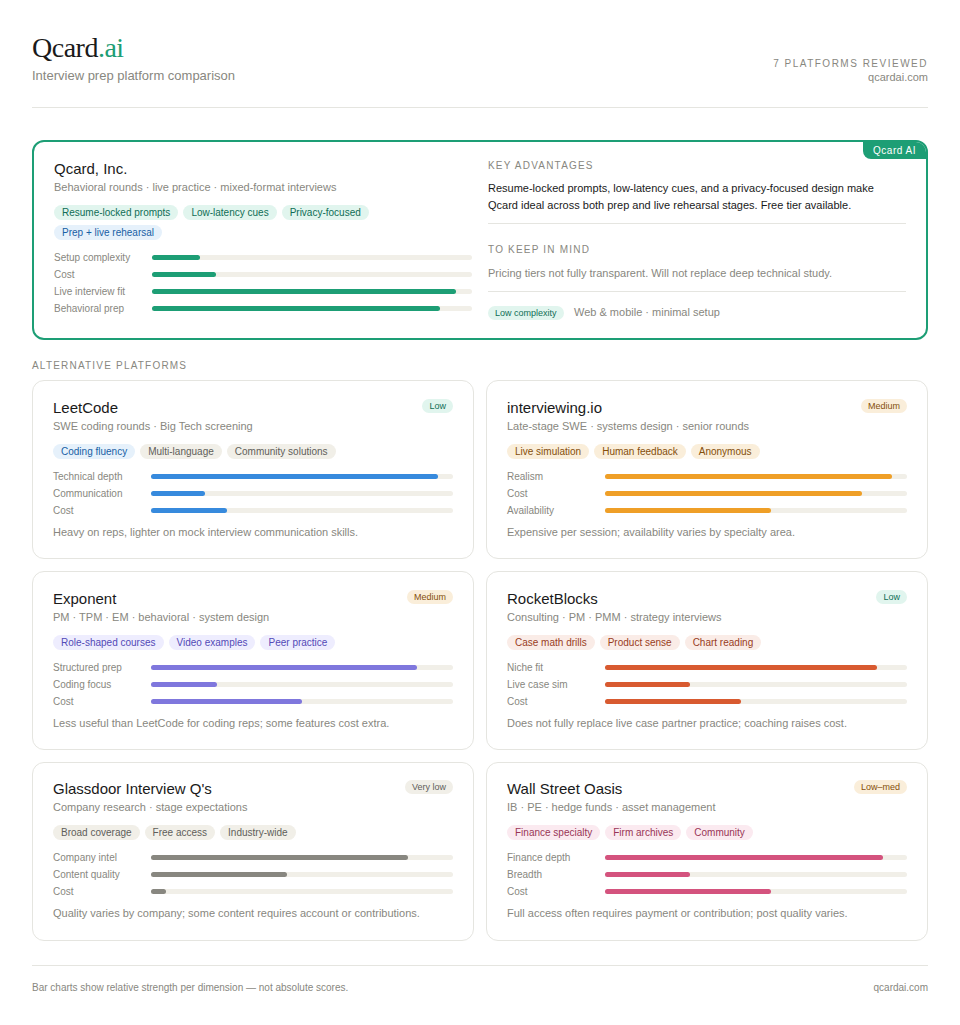
Qcard stands out in a different category from the others because it is less about question discovery and more about execution. It helps structure practice sessions, rehearse with cues, and simulate pressure in a way that fits behavioral interviews especially well. That makes it a useful layer alongside a question source, not a replacement for one.
Use the table that way. Pick the tool that matches the interview format, then pair it with a second tool if your weakness sits elsewhere. That combination usually beats trying to make one platform do every job.
From Practice Reps to a Winning Performance
A candidate can answer every common interview question in practice and still underperform once the actual conversation starts. I see it often. The issue usually is not question exposure. It is weak retrieval under pressure, poor structure, or an answer that falls apart after the first follow-up.
The strongest prep systems match practice to interview type, then add a second layer that tests delivery. Coding interviews need repetition on actual problem patterns. Behavioral interviews need concise stories, clear stakes, and controlled pacing. Case interviews need structured thinking under time pressure. Product and leadership interviews sit somewhere in the middle. They reward judgment, prioritization, and communication as much as raw knowledge.
That is why a mixed setup works better than relying on one platform.
Use LeetCode for coding volume. Use interviewing.io when you need another person in the room and want honest signal on how you perform live. Use Exponent for role-specific frameworks in product, analytics, TPM, and adjacent roles. Use RocketBlocks for case drills and the smaller decision-making skills that candidates often skip. Use Glassdoor or WSO to narrow the field and study what a specific company tends to ask.
Then build practice around the gap that is costing you offers.
For many candidates, Qcard, Inc. fits into that second layer. It is useful for behavioral and resume-based practice because it helps turn loose notes into repeatable drills, adds feedback, and makes answers hold up when the pacing gets uncomfortable. That matters more than candidates expect. A strong story on paper can still sound scattered out loud.
A practical weekly plan looks like this:
- One research block: Review likely themes for target companies and roles.
- Two skill blocks: Coding, case work, product sense, technical explanation, or finance drills.
- Two delivery blocks: Practice behavioral stories and resume walkthroughs out loud.
- One pressure test: Run a human mock or an AI mock with interruptions and follow-ups.
- One review block: Cut weak examples, tighten openings, and fix recurring mistakes.
The review block is where progress usually happens. Candidates often keep collecting new practice questions for interviews when the actual problem is already visible. Their answer starts too slowly. Their example does not show ownership. Their technical explanation assumes background the interviewer does not have. Their conclusion never lands. More prompts will not fix that pattern. Better correction will.
Key Takeaways
- The most common prep mistake is treating recognition as readiness — reading a practice question and knowing vaguely how to answer it is a different skill from delivering that answer aloud, under time pressure, while an interviewer interrupts with a follow-up, which is why oral delivery practice is non-negotiable regardless of which question source you use.
- Practice questions for interviews should be matched to interview type — behavioral, coding, case, product, and finance rounds each break down differently and reward different skills, so using one generic method for all of them creates candidates who are broadly exposed and specifically unprepared.
- A small, deliberate prep stack outperforms a large, scattered one — one question source, one delivery practice tool, and one pressure-test mechanism (live or AI mock) is enough for most interview loops, and candidates who add more tools without increasing practice quality typically plateau rather than improve.
- The review block is where performance gains actually happen — cutting weak examples, tightening openings, fixing recurring structural mistakes, and retiring stories that do not survive follow-up questioning is more valuable than finding another 30 practice prompts to add to the pile.
- For neurodivergent candidates and anyone whose recall breaks down under interview pressure, the delivery practice layer matters more than the question bank — tools that surface resume-grounded memory cues, support structured verbal resets, and allow repeated low-friction reps reduce the cognitive load that causes strong candidates to underperform in live conversations.
Good prep gets specific fast. Specific stories. Specific failure points. Specific interview formats. Specific target companies.
The goal is a controlled performance that still sounds natural. You should be able to answer directly, recover when challenged, and adjust without losing the thread. When practice is organized that way, interview prep stops being a pile of questions and becomes a system you can trust.
Ready to ace your next interview?
Qcard's AI interview copilot helps you prepare with personalized practice and real-time support.
Try Qcard Free