Top 10 Practice Interview Questions to Master in 2026
The job market of 2026 demands more than just rehearsed answers; it requires authenticity, confidence, and the ability to connect your real experience to the role's specific challenges. Standard interview preparation often leads to generic, scripted responses that fail to impress seasoned hiring managers. This comprehensive guide breaks that cycle. Instead of providing canned answers, we will deconstruct the 10 most critical practice interview questions you are almost guaranteed to encounter, transforming your preparation from rote memorization into a strategic skill-building exercise.
This is not just another list of questions. For each one, we provide structured frameworks like STAR (Situation, Task, Action, Result) and specific, actionable coaching cues. You will learn how to pace your delivery, what metrics to emphasize, and how to tailor your responses to demonstrate direct value. We'll cover diverse practice modes, including timed drills and mock interview scripts, helping you build muscle memory for articulate, concise storytelling.
Furthermore, we will explore how to leverage tools like Qcard to surface your genuine achievements in real-time, ensuring you remain authentic and articulate under pressure. This structured approach is especially beneficial for neurodivergent candidates, as it provides essential cognitive support to reduce brain fog and performance anxiety. It allows your true capabilities to shine through without the stress of perfect recall. Prepare to transform your interview performance from a test of memory into a confident demonstration of your professional mastery. We’ll get straight to the questions and the strategies you need to answer them effectively.
1. Tell Me About Yourself
Often the first prompt you'll hear, "Tell me about yourself" is far more than a simple icebreaker. It's a critical test of your ability to craft a concise, compelling narrative that connects your professional journey directly to the role you're seeking. This question sets the tone for the entire interview, and a well-structured answer demonstrates focus, self-awareness, and an understanding of the employer's needs. It's one of the most essential practice interview questions to master.

How to Structure Your Answer
A powerful response avoids rambling and instead follows a clear, logical progression. Think of it as your professional "elevator pitch," designed to capture interest immediately.
- Present: Start with your current role and a key achievement.
- Past: Briefly connect your previous experience to the skills required for this job.
- Future: Conclude by explaining why you are interested in this specific role and company.
Key Insight: This isn't your life story. It's a curated professional summary. Your goal is to deliver a 60-90 second response that makes the interviewer think, "This person is a perfect fit."
Actionable Tips for a Winning Response
To refine your delivery, focus on both content and practice. This question is particularly crucial for neurodivergent candidates, as a pre-rehearsed structure can help mitigate brain fog under pressure.
- Lead with Impact: Instead of "I graduated from...", try "As a risk analyst with five years of investment banking experience, I recently led an M&A deal valued at $200M."
- Quantify Everything: Ground your claims in measurable results. For a tech role, say "I shipped a feature that reduced API latency by 40%," not "I improved performance."
- Use Rehearsal Tools: Use a tool like Qcard in "Full Mode" to get real-time feedback on your pacing and eliminate filler words like "um" or "like."
- Connect to the Role: Always tie your story back to the job description. Explicitly state how your background makes you the ideal candidate to solve their problems.
2. Why Do You Want This Job?
More than just a test of your enthusiasm, this question assesses your motivation, research, and alignment with the company's mission. Interviewers use it to distinguish candidates who genuinely want this specific role from those simply looking for any job. A well-prepared answer demonstrates that you understand the company’s challenges and see a clear path to contributing, making it a vital addition to any set of practice interview questions.
How to Structure Your Answer
Your response should connect your personal career goals with the company's trajectory and the specifics of the role. The goal is to show a thoughtful, researched interest that goes beyond the surface level.
- Company Connection: Start by mentioning something specific about the company that excites you, such as a recent product launch, a strategic acquisition, or its position in the market.
- Role Alignment: Explain how the responsibilities of this role directly align with your skills and what you enjoy doing professionally.
- Future Contribution: Conclude by articulating how you see yourself growing with the company and contributing to its future success.
Key Insight: Avoid generic flattery like "I love your company culture." Instead, prove you've done your homework by referencing specific projects, values, or market movements that resonate with you.
Actionable Tips for a Winning Response
A compelling answer requires deep research and a genuine connection between your skills and the employer's needs. This structured approach can be particularly helpful for neurodivergent candidates, providing a clear framework to organize thoughts under pressure.
- Go Beyond the Homepage: Research recent earnings calls, press releases, or news articles. For a consulting role, mention, "Your firm's recent expansion into ESG consulting aligns with my experience restructuring sustainability operations."
- Connect to Product/Mission: Show you understand their work. For a product role, try: "Your product's approach to accessibility resonates with my background in inclusive design, and I want to contribute to the mobile-first roadmap."
- Refine Talking Points: Use a rehearsal tool's "Mini Mode" to drill your key talking points. This helps distill your research into a concise, powerful narrative without needing a full script.
- Focus on Their Problems: Frame your interest around solving their challenges. Explicitly link your past achievements to the needs outlined in the job description to show you are the solution.
3. Describe a Challenge You Overcame at Work
This classic behavioral question is designed to assess your problem-solving skills, resilience, and ability to learn from adversity. Employers use it to understand how you navigate real-world workplace difficulties, moving beyond theoretical knowledge to practical application. Your response reveals your approach to pressure, your analytical capabilities, and your ownership of outcomes, making it a cornerstone of modern interviewing in tech, finance, and consulting.
How to Structure Your Answer
The universally accepted framework for this question is the STAR method: Situation, Task, Action, and Result. This structure prevents rambling and ensures your story is clear, concise, and impactful. It’s one of the most vital practice interview questions because it trains you to think in a results-oriented way.
- Situation: Briefly set the scene. What was the context of the challenge?
- Task: Clearly state your specific goal or responsibility in that situation.
- Action: Detail the steps you took to address the challenge. This is the core of your story.
- Result: Conclude with the quantifiable outcome of your actions.
Key Insight: The interviewer cares less about the problem itself and more about how you solved it. Focus 70% of your answer on the 'Action' and 'Result' sections to demonstrate your direct contribution and impact.
Actionable Tips for a Winning Response
A compelling story requires more than just a good structure; it needs specific details and a clear focus on your individual role. This question is a prime opportunity to showcase your competencies.
- Choose a Substantial Challenge: Don't describe a minor inconvenience. Pick a genuine obstacle related to technical issues, stakeholder management, or tight deadlines that you successfully resolved.
- Quantify the Outcome: Instead of saying, "I fixed a system vulnerability," say, "By coordinating with engineering and ops, I patched a critical vulnerability in under 24 hours, preventing a potential $2M compliance fine and maintaining customer trust."
- Emphasize Your Contribution: Use "I" statements. The interviewer is hiring you, not your team. Clearly delineate your specific actions from the collective effort.
- Prepare Multiple Stories: Have 3-4 different challenge stories ready that highlight various skills (e.g., technical problem-solving, leadership, conflict resolution). This allows you to adapt to the interviewer's focus.
4. Why Are You Leaving Your Current Job?
This question is a delicate test of your professionalism, emotional intelligence, and motivations. Interviewers use it to screen for red flags like bitterness, a tendency to blame others, or unrealistic expectations. A strong answer demonstrates honesty and a forward-looking perspective, focusing on the future opportunity rather than any past grievances. For experienced hires, this is one of the most critical practice interview questions to master.
How to Structure Your Answer
The key is to frame your departure as a positive move toward a better fit, not an escape from a bad situation. A well-crafted response is concise, professional, and focuses on growth and alignment.
- Focus on the Future: Start by expressing enthusiasm for the new opportunity and how it aligns with your career goals.
- Connect to Growth: Briefly explain what you're seeking that your current role cannot provide, such as new challenges, skill development, or a specific career path.
- Maintain Professionalism: Never speak negatively about your current or former employer, manager, or colleagues.
Key Insight: Your answer should be about what you are moving toward, not what you are running from. Frame your decision as a strategic career choice, not an emotional reaction.
Actionable Tips for a Winning Response
Rehearsing this answer is crucial to ensure you deliver it with a neutral, confident tone. This is especially important if your departure was due to a layoff, as practice can help you state the facts without defensiveness.
- Be Growth-Focused: Instead of "I'm bored," try "I've successfully mastered the scope of my role over the past four years, and I'm eager to take on new challenges in AI infrastructure, which this role is perfectly aligned with."
- Handle Layoffs Factually: If you were laid off, be direct and brief. A simple "The company went through a strategic restructuring that unfortunately eliminated my position" is sufficient.
- Frame Short Tenures Positively: If you were only in a role for a short time, you could say, "The role was a great learning experience, but it evolved to focus less on product strategy, which is where my passion and expertise lie."
- Use Rehearsal Tools: Practice your answer using a tool like Qcard's Interview Coach feature. This helps you refine your tone, ensuring you sound positive and professional, not defensive or resentful.
5. What Are Your Salary Expectations?
This question isn't just a formality; it's a critical financial negotiation that tests your market awareness, value articulation, and readiness to advocate for yourself. A poorly handled answer can leave significant money on the table, while a strategic response can anchor the entire compensation discussion in your favor. It's a high-stakes moment that makes it one of the most important practice interview questions you can prepare for, especially for senior roles.
How to Structure Your Answer
A strong response is built on research and delivered with confidence. The goal is to avoid being undervalued by demonstrating you know your worth in the current market, without pricing yourself out of the role.
- Defer (If Possible): If asked early, politely deflect. Try, "I'm focused on finding the right fit and learning more about the role's responsibilities first. I'm confident we can find a number that's fair for both of us once we confirm it's a mutual match."
- State Your Researched Range: When you must provide a number, give a well-researched range. This shows flexibility while setting a clear floor.
- Justify Your Range: Briefly mention your research sources (e.g., industry data, comparable roles) and connect your experience to the value you bring.
Key Insight: The first person to state a number sets the anchor for the negotiation. Your goal is to ensure that anchor is based on objective market data, not the company's desired budget.
Actionable Tips for a Winning Response
Confidence comes from preparation. Practice articulating your value and salary expectations calmly and professionally.
- Do Your Homework: Before any interview, research salary data on sites like Levels.fyi, Glassdoor, and Blind for your specific role, experience level, and geographic location.
- Anchor High: Your provided range should have its bottom end at a number you'd be happy with, and the top end should be ambitious but justifiable based on your research and skills.
- Consider the Full Package: Frame your answer around total compensation. Mention that you're evaluating the base salary in the context of the bonus structure, equity (RSUs), and other benefits.
- Practice Delivery: Use a tool to rehearse your answer. The financial nature of this question can be nerve-wracking, and practicing helps you deliver your range confidently and without hesitation.
6. Tell Me About a Time You Failed
This question isn't a trap; it's an invitation to demonstrate resilience, humility, and a growth mindset. Interviewers use this prompt to see how you handle setbacks, whether you take ownership, and most importantly, how you learn from your mistakes. Answering well shows you have the self-awareness and maturity to thrive in a real-world environment where things don't always go to plan. It's one of the most revealing practice interview questions you can prepare for.
How to Structure Your Answer
A strong response moves quickly from the problem to the solution and the resulting growth. The failure itself is just the setup; the real substance is in your reflection and subsequent actions.
- Situation: Briefly set the context of the project or task.
- Failure: Clearly state what went wrong and explicitly take ownership of your role in it.
- Learning & Action: Dedicate the bulk of your answer to what you learned and the concrete steps you took to prevent a recurrence.
Key Insight: The interviewer cares less about the failure and more about your ability to analyze it and implement lasting change. Spend 50% of your time on the "learning and action" part of the story.
Actionable Tips for a Winning Response
Your goal is to turn a negative event into a positive testament to your character and professional development. Authenticity and a clear narrative arc are crucial.
- Choose a Real Failure: Select a genuine mistake with tangible consequences, not a disguised success like "I worked too hard." It should be significant enough to have a lesson but not so critical that it questions your core competence for the role.
- Frame with Accountability: Use "I" statements. For example, a Product Manager could say, "I launched a feature without adequate user research, and adoption was only 2%. I learned to require user interview synthesis before designing."
- Show Measurable Change: Connect the lesson to a positive outcome. A Software Engineer might add, "After missing a vulnerability, I established a security checklist for all code reviews. We have had no repeat incidents in over two years."
- Practice Vulnerability: Use mock interviews to rehearse telling the story without becoming defensive or emotional. Your tone should be matter-of-fact and focused on professional growth.
7. How Do You Handle Conflict or Disagreement?
This question probes your emotional intelligence, communication style, and ability to navigate professional friction. Employers ask this to see if you can disagree constructively without damaging team dynamics. It’s a chance to demonstrate maturity and collaborative problem-solving, making it one of the most insightful you can prepare for. A strong answer shows you prioritize shared goals over being right.
How to Structure Your Answer
Your response should tell a concise story that highlights resolution, not just the conflict itself. Avoid blaming others and focus on the process you used to find common ground. A well-structured narrative makes your interpersonal skills tangible.
- Situation: Briefly set the scene, describing the context of the disagreement.
- Action: Detail the specific, collaborative steps you took. Emphasize listening, understanding the other party's perspective, and focusing on shared goals.
- Resolution: Explain the positive outcome that resulted from your approach.
Key Insight: This isn't about winning an argument. It’s about showcasing your ability to separate ideas from egos and facilitate a mutually beneficial outcome. Your story should prove you can turn a point of friction into a moment of alignment.
Actionable Tips for a Winning Response
To deliver a compelling answer, prepare a few stories that illustrate different types of conflict. Your goal is to sound reflective and collaborative, not defensive or adversarial.
- Use the IBR Framework: Frame your story around interests, not positions. For example, "A designer's position was to implement a specific UI feature, but their underlying interest was improving user engagement. I showed how an alternative, less complex feature could achieve that same interest with fewer engineering risks."
- Emphasize Listening: Start your action steps with phrases like, "My first step was to understand their perspective..." or "I asked questions to clarify the goals behind their request."
- Quantify the Resolution: Connect the outcome to a business impact. For example, "By finding a middle ground, we shipped the feature on time and saw a 15% improvement in user retention, avoiding a potential two-week delay."
- Rehearse for Tone: Use Qcard to practice your delivery. Ensure your tone remains open and curious, not confrontational. This question is as much about how you tell the story as what the story is.
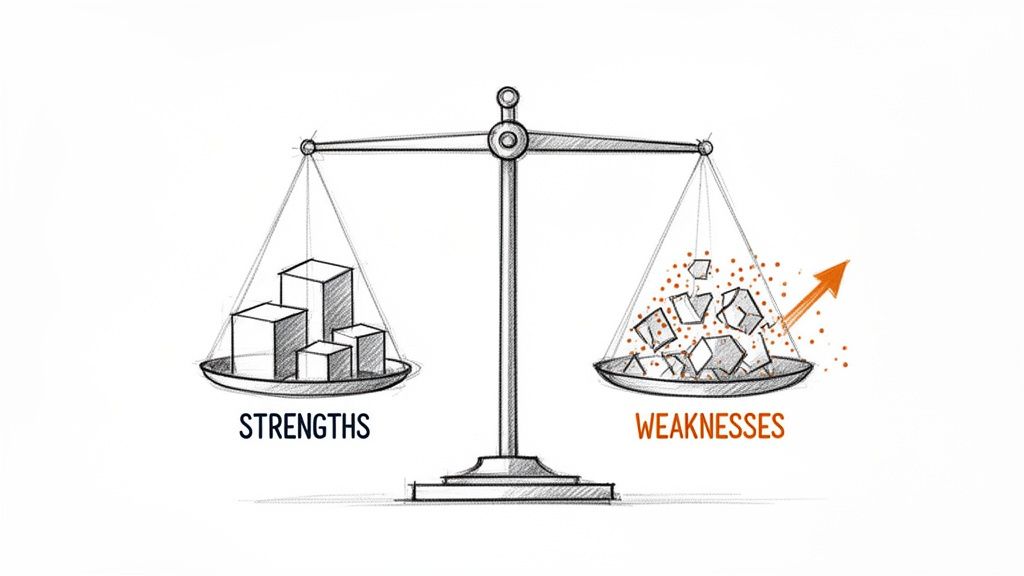
8. What Are Your Strengths and Weaknesses?
This classic pair of questions tests self-awareness, honesty, and your ability to strategically position your skills. While it might feel cliché, interviewers use this prompt to gauge your humility, capacity for growth, and understanding of the role's demands. A thoughtful answer shows you can objectively assess your own capabilities, making it a key set of practice interview questions to prepare for.
How to Structure Your Answer
The goal is to present a balanced view of yourself as a professional who is both competent and committed to improvement. Structure each part of your answer deliberately to avoid common pitfalls.
- Strength: Choose a genuine strength that directly aligns with the top requirements of the job description.
- Proof: Immediately follow your stated strength with a specific, quantified example from your past work.
- Weakness: Select a real, but non-critical, area for development.
- Action & Result: Describe the concrete steps you've taken to improve and the measurable progress you've made.
Key Insight: Avoid the "humble brag" weakness, such as "I'm a perfectionist" or "I work too hard." Interviewers see this as evasive and lacking in genuine self-reflection.
Actionable Tips for a Winning Response
Refining your answers requires a blend of authenticity and strategic alignment. Practice helps ensure your delivery sounds confident, not canned.
- Align Strengths: For a systems thinking strength, say, "I mapped our entire onboarding process and implemented tooling that cut user setup time by 60%."
- Frame Weaknesses Constructively: Instead of just naming a weakness, frame it as a journey. "I've historically not been as detail-oriented in documentation. To fix this, I implemented a checklist system and pair reviews, which reduced post-launch defects by 70% last year."
- Be Authentic: Don't say you have no weaknesses. It signals a lack of self-awareness. Choose a real weakness that isn't a dealbreaker for the role.
- Use Feedback Tools: Rehearse with a tool like Qcard to get AI-powered feedback on whether your tone comes across as authentic and credible, helping you fine-tune your delivery.
9. Walk Me Through Your Resume/Technical Skills
More than just a chronological recap, "Walk me through your resume" is an invitation to narrate your career story. It tests your ability to connect the dots between your past roles and demonstrate a clear, logical progression toward the job you're interviewing for. For technical roles, this question often shifts to a skills deep-dive, requiring you to articulate not just what you did, but why it mattered. A strong answer is a cornerstone of any set of practice interview questions.
How to Structure Your Answer
The goal is to present a cohesive narrative, not a laundry list of job duties. Your answer should be a guided tour that highlights the most relevant stops on your professional journey, leading directly to the interviewer's doorstep.
- Thematic Opening: Start with a high-level summary that frames your career path.
- Narrative Arc: For each major role, briefly explain the role, a key accomplishment, and the primary skill you gained.
- Thematic Close: Conclude by connecting your cumulative experience to the specific requirements and challenges of the role you're applying for.
Key Insight: This is not a verbal recitation of your resume's bullet points. It's a strategic narrative designed to show the interviewer that your career has been a deliberate preparation for this specific opportunity.
Actionable Tips for a Winning Response
Refining this story requires focusing on impact and relevance. The interviewer is looking for a pattern of growth and achievement that aligns with their needs.
- Focus on the "Why": Don't just say what you did. Explain why you made each career move. For example, "I moved from support engineering to a backend role because I taught myself Python to automate ticket responses and discovered a passion for building scalable systems."
- Quantify Technical Impact: When discussing skills, ground them in results. Instead of "I worked with Kafka," say, "I built a payment processing microservice using Go and Kafka that handled 50,000 transactions per second, reducing customer-impacting incidents by 80%."
- Prepare Mini-Dives: Be ready for the interviewer to interrupt and ask for more detail on any project you mention. Have a 2-3 minute deep-dive prepared for each major role on your resume.
- Connect the Dots for Career Switchers: If you're changing fields, be explicit. "My experience in healthcare taught me to manage sensitive data with extreme care, a skill that's directly applicable to the cybersecurity protocols required in this fintech role."
10. Why Should We Hire You Over Other Candidates?
This question is a direct challenge to articulate your unique value proposition with confidence and precision. Often asked in final rounds, it’s a high-stakes test of your ability to synthesize everything you've learned about the role and company. A strong answer proves you've been actively listening and can confidently connect your specific qualifications to their most pressing needs, making it a critical one to include in your list of practice interview questions.
How to Structure Your Answer
Your response should be a sharp, focused sales pitch, not a generic summary. It’s your final opportunity to differentiate yourself from a pool of qualified applicants by presenting a compelling, evidence-based case for why you are the optimal choice.
- Acknowledge the Need: Start by referencing a specific challenge or goal you heard the interviewer mention.
- Present Your Unique Solution: Connect your top 1-2 skills or accomplishments directly to that need.
- Reinforce the Fit: Conclude by summarizing how this unique combination of skills and experience makes you the ideal candidate to deliver results quickly.
Key Insight: This question isn't about arrogance; it's about alignment. Frame your answer as, "You need X, and my unique experience in Y and Z makes me perfectly equipped to deliver it," rather than simply claiming to be the best.
Actionable Tips for a Winning Response
To deliver a powerful closing argument, you need to be both strategic and specific. Your goal is to leave the interviewer with no doubt that you are the solution to their problem.
- Reference Their Words: Start by saying, "You mentioned that [specific company challenge] is a top priority." This demonstrates active listening and immediately frames your answer around their needs.
- Lead with Your Differentiators: Instead of a laundry list, focus on your top 1-2 unique qualifications. For a Product Manager role, try: "You need someone who understands both AI and user behavior to drive your personalization roadmap. I've shipped three personalization features, from building the ML pipeline to delivering a 35% lift in engagement."
- Quantify Your Impact: Anchor your claims with hard numbers. For a cybersecurity role, state: "My background in both security operations and vendor relations allowed me to reduce incident response time by 60% while cutting costs by $200K."
- Practice Your Tone: Use a rehearsal tool to get feedback on your delivery. You want to sound confident and assertive, not arrogant or dismissive of other candidates.
From Practice to Performance: Your Next Steps to Interview Mastery
You have now explored the architecture behind the ten most common yet pivotal practice interview questions. Moving beyond rote memorization, this guide has equipped you with the strategic frameworks, coaching cues, and rehearsal techniques necessary to transform your answers from simple statements into compelling professional narratives. We've deconstructed each question, not to provide a script, but to give you the building blocks for authentic, impactful storytelling.
The journey from a nervous candidate to a confident contender is paved with intentional practice. It’s about more than just knowing what to say; it's about mastering how you say it. By adopting frameworks like STAR (Situation, Task, Action, Result), you create a reliable structure that ensures your answers are clear, concise, and complete. This approach is particularly powerful for neurodivergent candidates or anyone prone to anxiety, as it provides a mental roadmap to follow when the pressure is on.
Key Takeaways: From Theory to Application
Let's distill the core principles we've covered into actionable takeaways that will guide your final preparation stages:
- Authenticity Over Perfection: The goal is not to deliver a flawless, pre-rehearsed monologue. It’s to present an authentic version of your professional self. Your unique experiences, including challenges and failures, are what make you a memorable and relatable candidate.
- Quantification is Your Superpower: Vague claims of success are easily forgotten. Hard numbers, percentages, and specific metrics are not. Weaving quantifiable results into your stories about overcoming challenges or showcasing strengths provides concrete proof of your value.
- Context is King: Always tailor your responses to the specific company and role. A great answer for a startup will differ from a great answer for a Fortune 500 company. Use the job description as your guide to connect your skills and experiences directly to their needs.
- Structure Creates Confidence: Relying on frameworks like STAR doesn't make you robotic; it makes you prepared. This structure frees up your cognitive energy to focus on active listening and building rapport with the interviewer, rather than scrambling to remember your next point.
Your Action Plan for Interview Mastery
Reading about interview techniques is just the first step. True mastery comes from doing. Here is a clear, step-by-step plan to put these concepts into action and solidify your confidence:
- Build Your Story Bank: For each of the ten practice interview questions, write down 2-3 specific examples from your career. Focus on stories that highlight different skills: leadership, collaboration, problem-solving, and resilience.
- Record and Refine: Use your phone or computer to record yourself answering each question. Watch it back and critically assess your pacing, body language, and clarity. Are you using filler words? Are your key metrics coming across clearly?
- Engage in Mock Interviews: Practice with a trusted peer, a mentor, or a career coach. This simulates the real-world pressure of an interview and provides invaluable external feedback on your delivery and content.
- Utilize Accessibility Tools: If you benefit from cognitive support, integrate tools designed to help. Features like real-time memory cues and resume-grounded talking points can be a game-changer, ensuring you stay on track and never forget a critical detail.
Ultimately, the purpose of rigorous practice is to become so familiar with your own stories that you can deliver them naturally and confidently. It’s about internalizing your value so you can communicate it effortlessly. The interview is your stage, and these questions are simply prompts for you to shine. You have the skills, you have the experience, and now you have the strategy. Go forward and turn that practice into a standout performance.
FAQ
Q: What are the most important practice interview questions to prepare in 2026?
You should prioritize mastering the opening "Tell me about yourself," motivation-based questions like "Why do you want this job?," behavioral prompts about challenges and failures, and high-stakes negotiation questions like "What are your salary expectations?" These core questions appear across nearly every industry and level.
Q: How is practicing interview questions different from just memorizing answers?
Memorizing scripts makes you sound robotic and unprepared for follow-ups. Strategic practice focuses on learning flexible frameworks, such as the STAR method, and drilling key talking points. This builds the ability to structure authentic, relevant answers on the spot, adapting your genuine experiences to any question.
Q: What is the best structure for answering "Tell me about yourself"?
Use the Present-Past-Future framework. Start with your current role and a key achievement (Present), briefly connect one or two relevant past experiences that built your skills (Past), and conclude with your specific interest in this role and how you can help the company succeed (Future). Aim for 60-90 seconds.
Q: How should I prepare for the "What are your salary expectations?" question?
First, research market data for your role, level, and location using sites like Levels.fyi or Glassdoor. If possible, politely defer the question until you fully understand the role. When you do provide a number, give a researched range where the bottom is your acceptable minimum. Briefly justify your range based on your experience and market value.
Q: What is the key to answering a question about a past failure?
Interviewers ask this to assess resilience and a growth mindset. Choose a genuine professional setback. Use the STAR method to structure your story, but crucially, spend the majority of your answer on the specific actions you took to fix the mistake and, most importantly, the concrete lessons you learned that changed how you work today.
Ready to elevate your preparation with AI-powered support? Qcard provides a smart copilot that uses your resume to give you real-time memory cues and coaching during mock and real interviews, ensuring you never miss a beat. Transform your approach to answering practice interview questions by visiting Qcard and discover how to interview with unshakable confidence.
Ready to ace your next interview?
Qcard's AI interview copilot helps you prepare with personalized practice and real-time support.
Try Qcard Free