Practice Interview AI: Your Complete Step-by-Step Guide
TL;DR
Practice interview AI is most useful as a repeatable feedback loop, not a script generator — its value is helping you retrieve real experiences, organize your thinking, and speak naturally under pressure. Set up each session with your resume, the job description, the role, seniority, format, and difficulty, and instruct the tool to ask one question at a time with realistic follow-ups and delayed feedback. Match the drill to the format: behavioral practice tests STAR structure with the Action section carrying the most weight, technical practice evaluates assumptions and trade-offs separately from the final answer, and case practice releases information progressively while challenging your logic. Treat every score as a hypothesis rather than a verdict — a 2026 study reported 87.3% accuracy within ±10% of human scores, which is a benchmark, not a guarantee. Always end with a second attempt at the same question. Run 3 to 5 sessions across 1 to 2 weeks with 30-to-45-minute simulations, and protect your privacy by checking retention policies and excluding confidential employer information before uploading anything.
You've rehearsed your introduction until it sounds polished. Then the interviewer asks, “Tell me about a time you failed,” and your mind goes blank. You know the story, but under pressure, the details scatter, your answer grows vague, and the silence feels longer than it is.
That moment isn't evidence that you're unqualified. Interview anxiety is widespread. A cited JDP report says 93% of people have experienced interview-related anxiety, while 41% say their biggest fear is being unable to answer a difficult question. The report on interview anxiety and AI helps explain why practice interview AI has become useful, especially for early-career candidates, career switchers, international students, and professionals who rarely interview.
The effective approach isn't memorizing perfect scripts. It's building a feedback loop that helps you retrieve relevant experiences, organize your thinking, speak naturally, and adjust after every attempt.
How Do You Use Practice Interview AI Effectively?
Practice interview AI works when it builds a feedback loop — not when it hands you a polished script to memorize. The problem it solves is real: a cited JDP report found 93% of people have experienced interview-related anxiety, and 41% say their biggest fear is being unable to answer a difficult question. Memorized answers make that worse, because when an interviewer rephrases a question, you end up searching for an exact prompt instead of recognizing the underlying competency.
Here's how to run it properly:
1. Set up the session with real context. Give the tool your resume and the target job description, then name the role, seniority, industry, interview format, and difficulty. A useful instruction: "Act as a hiring manager interviewing me for a mid-level cybersecurity analyst role. Ask one question at a time, include follow-ups based on my answer, and wait until the end to give feedback." Record your first answers unrehearsed so later sessions show genuine improvement.
2. Match the drill to the format. Behavioral practice should test retrieval and STAR structure — MIT career guidance assigns roughly 20% Situation, 10% Task, 60% Action, and 10% Result, which corrects the most common error of over-explaining background. Technical practice should evaluate how you clarify requirements, state assumptions, and explain trade-offs — not just whether the final answer is right. Case practice should release information progressively and challenge your assumptions as you go.
3. Read feedback as hypotheses, not verdicts. A 2026 AI interview coach paper reported 87.3% accuracy within ±10% of human scores — a benchmark, not proof that every rating is correct. Replay the recording, compare the comments to what you actually said, and decide which pattern deserves attention. "Good answer, be more specific" is not a coaching plan; "you described the team's work but didn't explain your decision when priorities conflicted" is.
4. Always end with a second attempt. After the AI identifies a gap, ask what evidence would make the outcome credible, answer again, and compare both versions. That cycle is what turns anxiety into a trainable response.
5. Build a repeatable rhythm. Run 3 to 5 sessions across 1 to 2 weeks, with full simulations lasting 30 to 45 minutes. Use early sessions to explore questions and find stories, middle sessions to drill recurring weaknesses, and the final session as a realistic simulation with no pauses or do-overs.
Understanding Why AI Practice Changes the Game
Your first difficult question often exposes the weakness in traditional preparation. You may have written excellent answers, highlighted important achievements, and read the job description repeatedly, but none of that guarantees you can retrieve the right example when the interviewer changes the wording.
A candidate preparing for a product role might memorize a response about resolving a roadmap conflict. In the interview, the question becomes, “Tell me about a time you influenced someone without authority.” The story still applies, but memorization makes the candidate search for an exact prompt instead of recognizing the underlying competency. That search creates the familiar mental fog.

Repetition without social pressure
A friend can conduct a mock interview, but friends often soften criticism, ask predictable questions, or focus on encouragement rather than diagnosis. A coach can offer sharper feedback, but access may be limited when you need to practice repeatedly.
Practice interview AI creates a private environment where you can answer the same competency from different angles. You can ask it to interrupt with follow-ups, challenge unsupported claims, or wait until the end before giving a score. That repetition matters because the objective is recall, pacing, and confidence under pressure, not a memorized performance.
Research on reflective interview practice identifies a weakness in many commercial LLM mock interviews: feedback is often one-way, with the system producing ratings or comments without allowing the candidate to question the diagnosis or refine the answer in context. The reflective interview practice prototype points toward a better design. Candidates need a conversational coaching loop, not just a verdict.
Practical rule: Use AI to make practice more demanding and more repeatable, not to make your answers sound less like you.
The strongest session ends with a second attempt. After the AI identifies that your example lacks a clear result, ask what evidence would make the outcome credible, answer again, and compare both versions. That cycle turns anxiety into a trainable response.
Setting Up Your First AI Interview Session
You are ten minutes into practice, and the AI keeps asking questions that have little to do with the vacancy. The problem is usually the setup, not the scoring model. A generic chatbot produces generic prompts until you give it enough context to act like an interviewer for a specific role.
Start with the right context
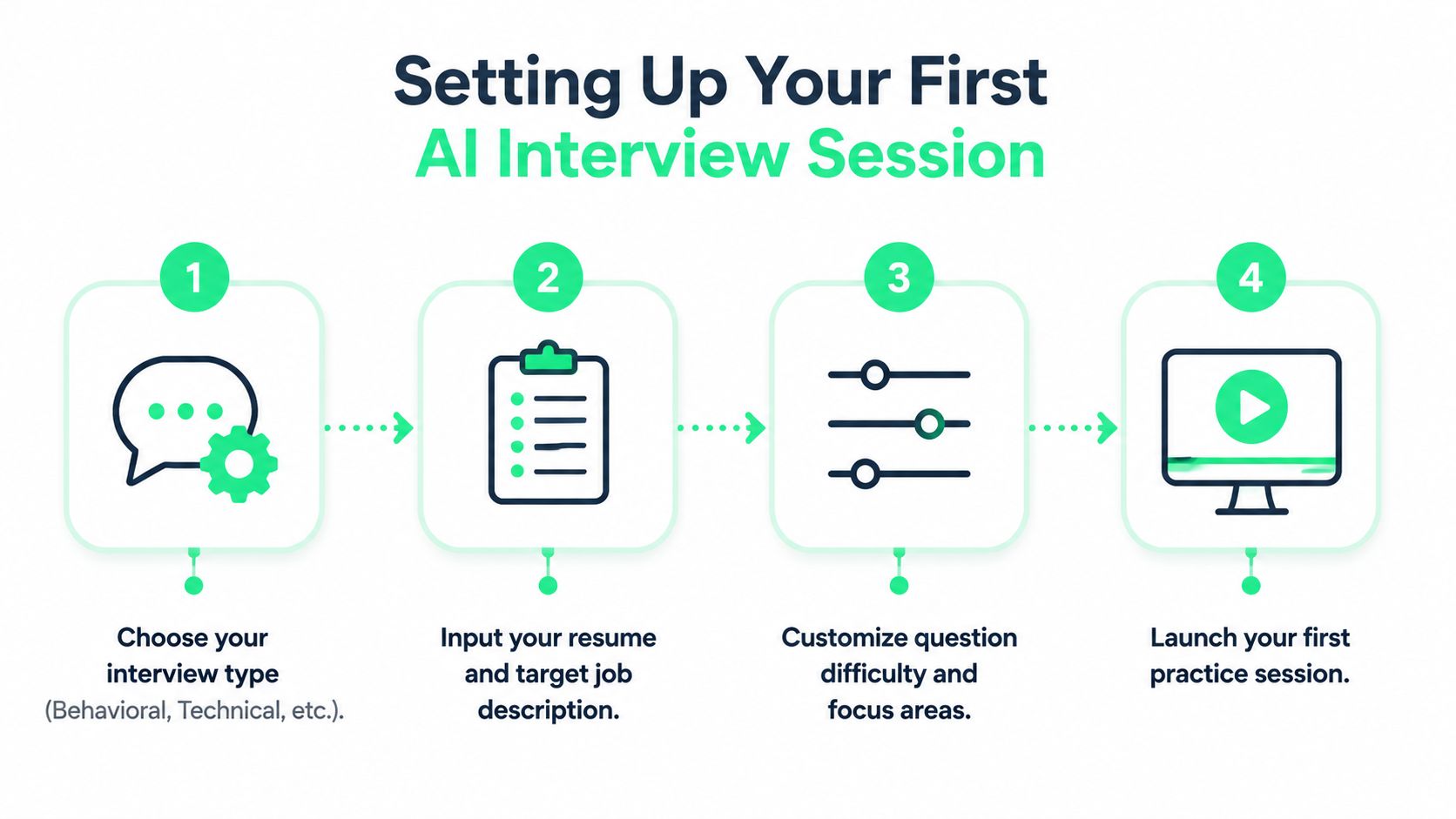
Prepare a clean resume and the target job description. Remove personal details or other information you do not want to share. Then give the tool a direct instruction:
“Act as a hiring manager interviewing me for a mid-level cybersecurity analyst role. Use my resume and this job description to create a realistic behavioral interview. Ask one question at a time, include follow-up questions based on my answer, and wait until the end to give feedback.”
Name the role, seniority, industry, interview format, and difficulty. State whether you want voice, text, or both. Set the feedback criteria too, such as structure, relevance, confidence, filler words, or technical accuracy. This level of control matters for candidates who need predictable pacing, including neurodivergent users and anxious early-career professionals. A clear prompt reduces avoidable uncertainty before the conversation begins.
Configure the session before answering
Choose a session length you can finish without rushing. Plan several mock interviews across a week or two, keep each full run within a manageable block, and review filler words, answer timing, and body language afterward. Prepare a set of common questions for the role, record your sessions, and schedule a deliberate feedback review after each run. The 2025 mock interview practice guide
Highly anxious candidates do not need to begin with a full simulation. Start with focused drills, then increase realism by removing pauses, accepting follow-ups, and completing the interview in one sitting. The goal is a feedback loop, not a single score. Ask the AI to explain a rating, challenge its diagnosis, and let you try the answer again.
Choose a platform that supports that interaction. Qcard's resume-grounded interview practice app is one option for voice practice, AI scoring, and follow-up questions. Before committing, check whether the tool lets you set difficulty, choose an interview type, review transcripts, and question its feedback.
Use this setup checklist:
- Choose the format: Behavioral, technical, case, product, or a combination.
- Add the context: Resume, job description, target company, and relevant constraints.
- Set the coaching behavior: One question at a time, realistic follow-ups, delayed feedback, and clear evaluation criteria.
- Record the baseline: Keep your first answers unrehearsed so later sessions show genuine improvement.
Running Mock Interviews Across Different Formats
An AI session only becomes realistic when it matches the type of interview you're preparing for. Behavioral, technical, and case interviews test different abilities, so they need different prompts and feedback criteria.
Behavioral interviews require retrieval and structure
For behavioral questions, ask the AI to identify the competency behind each prompt and evaluate whether your answer follows STAR. Official career guidance defines STAR as Situation, Task, Action, and Result. The National Careers Service guidance on the STAR method explains the structure, while MIT career guidance assigns 20% to Situation, 10% to Task, 60% to Action, and 10% to Result.
That weighting gives you a practical correction. Candidates often spend too long explaining background and too little time describing what they personally did.
Try this prompt:
“Ask me behavioral questions for this role. After each answer, identify the Situation, Task, Action, and Result. Tell me whether my Action section contains specific decisions, trade-offs, and behaviors. Ask a follow-up if my personal contribution is unclear.”
Suppose you're answering a leadership question. Give brief context, state the goal, spend most of the answer on your decisions and actions, then close with the result. If the result isn't quantifiable, describe the observable change without inventing a number.
Technical interviews need visible reasoning
For technical roles, don't ask AI to judge only whether your final answer is correct. Ask it to evaluate how you clarify the problem, state assumptions, select an approach, test edge cases, and explain trade-offs.
Use a prompt like:
“Give me a technical problem appropriate for this role. Make me clarify requirements before solving it. Don't reveal the solution. After I explain my approach, challenge one assumption and ask how I'd test the implementation.”
Practice speaking while you solve. An answer that looks obvious in written form can sound disorganized aloud. Ask the AI to separate errors in technical reasoning from weaknesses in communication, because each requires a different fix.
Case interviews depend on adaptive follow-ups
Case practice should feel less like answering a worksheet and more like managing an evolving conversation. Tell the AI to provide only the information you request, introduce new facts after you form a hypothesis, and challenge your recommendation.
“Act as a consulting interviewer. Give me a market-sizing case one piece of information at a time. Ask why I'm choosing each assumption, push back when my logic is weak, and evaluate my final recommendation for structure, judgment, and communication.”
Push for harder follow-ups when your first answer is comfortable or rehearsed. Accept a slower pace when you're learning a new format and need to understand why your reasoning failed. The point isn't to make every session punishing. It's to create the right level of friction for the skill you're developing.
Reading and Acting on AI Feedback
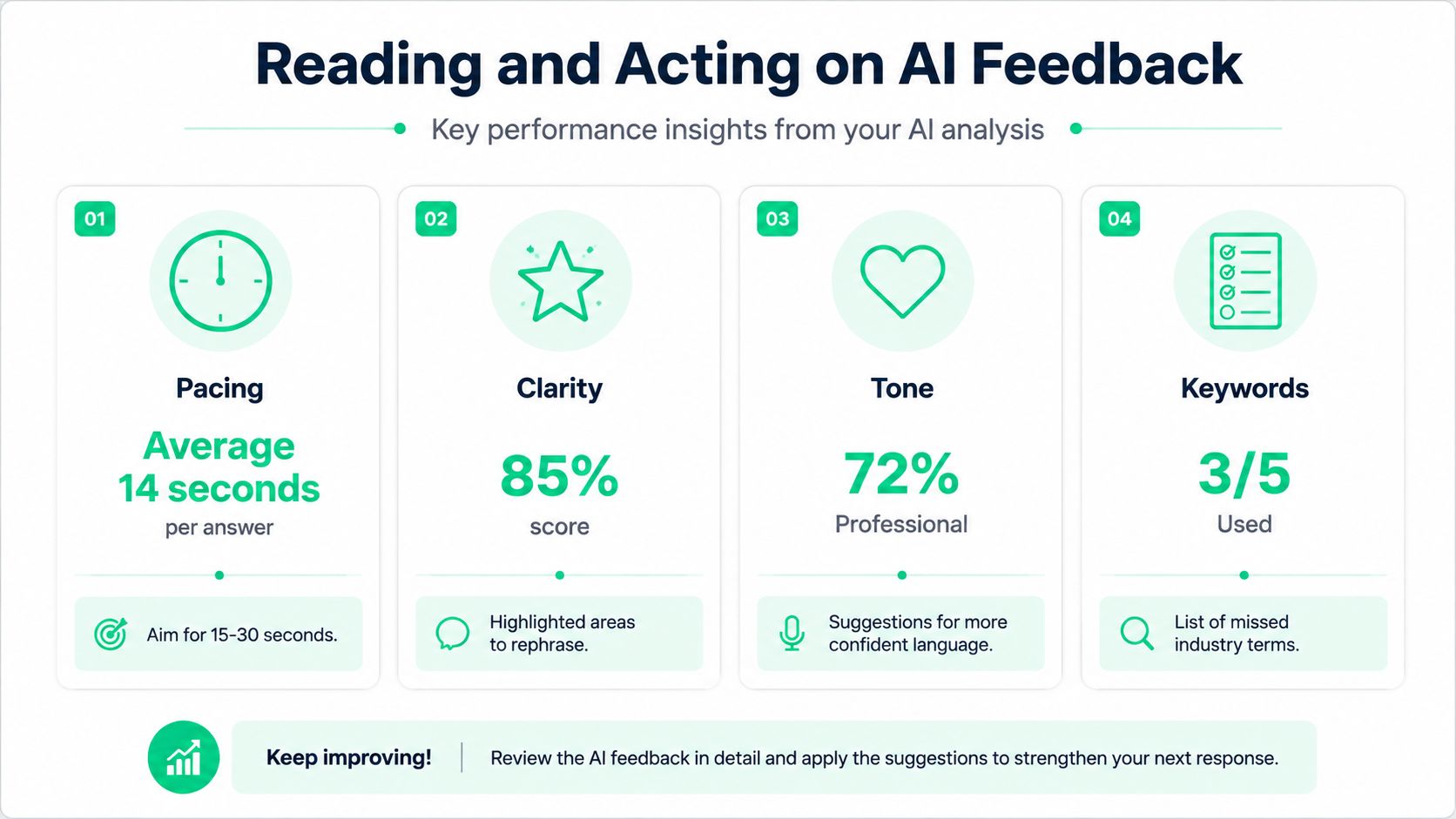
A low score after a difficult question can mean several things: rushed delivery, missing evidence, or an answer that drifted from the prompt. Treat the AI report as a set of hypotheses. Replay the recording, compare the comments with what you said, and decide which pattern deserves attention.
Turn metrics into behaviors
Pacing feedback often exposes a specific trigger. If your speed rises when a question feels difficult, mark that moment, pause before your main point, and rehearse the opening sentence. Slowing every answer can make you sound unnatural, so change the behavior only where clarity suffers.
Filler feedback needs the same treatment. You do not need to remove every “um” or “like.” Replace habitual fillers with a short pause before a decision, transition, or result. For neurodivergent candidates and anxious early-career professionals, a visible pause cue or a follow-up prompt can be more useful than another score.
Use this review sequence:
- Pacing: Mark where speed affects clarity, then rehearse the transition with a pause.
- Fillers: Identify the situations that trigger them, rather than chasing a perfect count.
- Answer length: Cut repeated context and keep the evidence that supports your point.
- Relevance: Highlight sentences that answer a different question from the one asked.
- Structure: Check whether the listener can follow the beginning, decision, action, and outcome.
Separate useful criticism from polished noise
“Good answer, be more specific” is not a coaching plan. Useful feedback identifies missing evidence and provides a repair method. “You described the team's work but did not explain your decision when priorities conflicted” points to a concrete rewrite.
A 2026 AI interview coach paper reported 87.3% accuracy within ±10% of human scores for AI-based evaluation. The AI interview coach research provides a benchmark, not proof that every individual rating is correct. Use an AI interview coach for interactive practice and follow-up feedback, then verify important judgments against the recording and the role's requirements.
Ask the tool to defend its rating:
“Show me the exact sentence that caused this deduction. Explain what evidence was missing, then ask me a follow-up that would let me repair the answer.”
That exchange matters more than a polished dashboard. One-way scoring labels a weakness, while conversational feedback helps you test a revised answer, handle a challenge, and see whether the change holds. Build an internal rubric around clear context, personal action, credible evidence, direct relevance, and a concise result. Over time, it should guide self-review even when no AI is available.
Building a Study Plan From Your Sessions
A useful study plan turns recordings into decisions. Without that step, candidates collect transcripts and scorecards while repeating the same weak habits.
Create a session log with the question, your first answer, the AI's main criticism, your assessment, and the change you will test next. Track patterns such as filler frequency, whether the answer follows a clear structure, and confidence ratings when the tool provides them. Consistency matters more than collecting every available metric. Use the same criteria across sessions, then check whether a revised answer improves under follow-up questions, not just whether its score rises.
Use a repeatable preparation rhythm
A practical routine uses 3–5 sessions over 1–2 weeks, with full-length simulations lasting 30–45 minutes and structured review afterward. Spacing practice gives you time to revise, rest, and return with a clearer answer instead of rehearsing everything during one anxious evening.
Give each session a different job:
- Early sessions: Explore likely questions and identify stories that fit.
- Middle sessions: Drill recurring weaknesses, such as vague actions, long openings, or missing results.
- Final simulation: Recreate the interview without pauses or do-overs, including realistic follow-ups.
If the interview is only a few days away, reduce exploration and focus on the highest-risk questions. With more time, leave space between practice and review. Interactive coaching is especially useful here: ask the AI to challenge a revised answer, then compare the conversation with your original recording. That feedback loop serves anxious early-career candidates and neurodivergent users better than a one-way rating because it tests how well the answer holds up in dialogue.
Use Qcard's interview preparation guide as a planning reference, then adjust the routine to the role and your available time. End with concise talking points, not a memorized script. Prompts should recall your evidence while leaving room to respond naturally.
Protecting Privacy and Avoiding AI Hallucinations
AI feedback can sound authoritative even when it's poorly grounded. A system may assign an unrealistic confidence rating, treat a speech habit as a character flaw, or suggest advice that doesn't fit the role. Candidates in a student pilot reported disagreement with confidence scores and raised concerns about transparency, trust, accuracy, eye-contact tracking, environmental limitations, filler-word penalties, and the absence of human interaction. The pilot on student reactions to AI-generated interview feedback shows why a polished dashboard isn't enough.
Question the scoring model
Ask how the tool defines confidence, clarity, eye contact, and professionalism. A neurodivergent candidate, an international candidate with an accent, or someone practicing by phone may communicate effectively without matching the system's preferred visual or vocal pattern.
Look for controls that let you disable visual analysis, choose phone or audio practice, and request explanations for deductions. Treat body-language feedback as optional context, not an objective measure of employability.
Privacy deserves the same scrutiny. Before uploading a resume or recording, check the provider's retention policy, encryption claims, deletion process, and whether your data is used for model training. Don't include confidential employer information, proprietary code, customer records, or personal details that the session doesn't need.
Verify every generated recommendation
Hallucination risk appears when AI fills gaps with plausible but unsupported guidance. If it claims a company values a particular competency, compare that suggestion with the actual job description and reliable company materials. If it invents a technical requirement, remove it unless the employer or role documentation confirms it.
Trust test: If the tool can't show which part of your resume or job description supports a recommendation, treat the recommendation as a prompt for investigation, not a fact.
The safest workflow uses AI for rehearsal, organization, and reflection while keeping human judgment responsible for fairness, accuracy, and final interpretation.
Putting It All Together with Real Scripts and Schedules
A useful practice system still works when you are tired, anxious, or short on time. Begin by giving the AI the role, interview format, difficulty, and feedback rules. Then instruct it to ask one question at a time, challenge weak answers, and pause for your reflection before scoring anything. That conversational loop produces more useful coaching than a rating delivered after a one-way simulation.
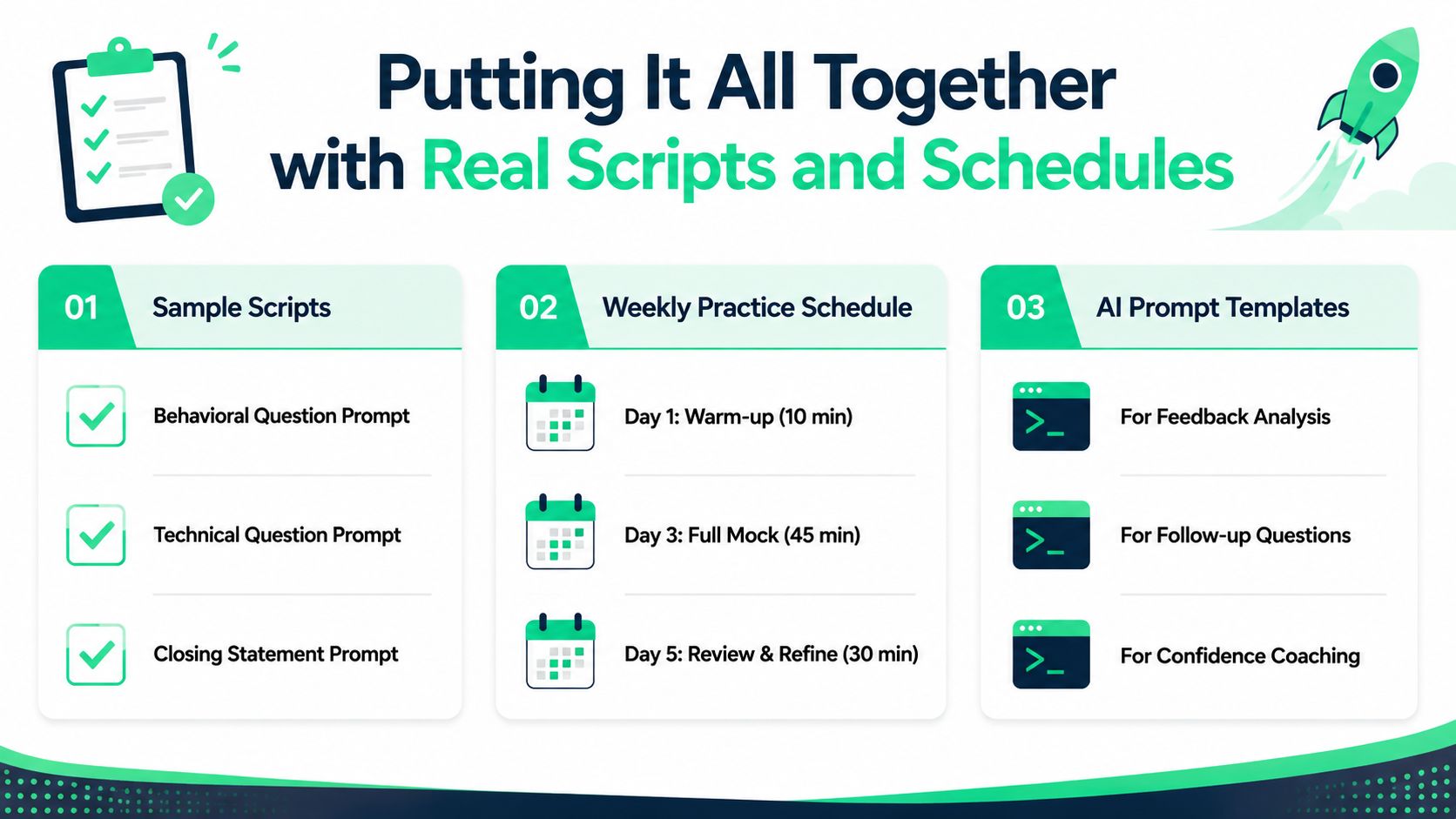
Copyable prompts for three formats
For behavioral practice:
“Interview me for this role using behavioral questions. Ask one question at a time, require a specific example, and use follow-ups to test my personal contribution. After the session, assess STAR structure, relevance, credibility, and result.”
For technical practice:
“Give me a role-appropriate technical problem. Don't provide hints unless I ask. Evaluate my assumptions, reasoning, edge cases, explanation, and final solution separately.”
For case practice:
“Run a case interview with information released progressively. Challenge my assumptions, ask why I'm choosing each approach, and assess my final recommendation for logic, judgment, and communication.”
Match the schedule to the deadline
With three days available, use the first day for targeted questions and story retrieval. Use the second for a full simulation and review. On the third, correct one recurring weakness, then complete a short confidence-building run.
With two weeks, schedule 3–5 mock interviews across 1–2 weeks. Use early sessions to discover gaps, middle sessions for focused drills, and the final session for a realistic simulation. Full sessions of 30–45 minutes, recorded review, and attention to timing, fillers, and body language provide a workable structure. Treat those signals as coaching prompts rather than fixed measures of communication quality.
Neurodivergent candidates should include accommodations in the plan from the start. Options can include receiving questions in advance, taking breaks, using written or phone-based formats, and clarifying expectations about eye contact and body language. This guidance on neurodivergent interview accommodations also identifies 25% extra time as a possible accommodation for written interview tasks.
Request support early so the employer has time to arrange it. Prepare bullet-point memory cues instead of a full script. Use repeated AI practice to work through the questions or transitions that trigger the most anxiety, while checking that the tool's follow-up questions remain relevant to the role.
Stop intensive practice before interview day. Review your evidence, take a short walk, and remember that pausing is acceptable when a difficult question lands. The aim is to make your real experience easier to access, not to recite an AI-generated answer.
Key Takeaways
- Memorization is the failure mode practice interview AI is meant to fix — when a candidate rehearses a scripted answer about a roadmap conflict and the interviewer instead asks about influencing without authority, the story still applies, but memorization causes the candidate to search for an exact prompt instead of recognizing the underlying competency, which is exactly where mental fog begins.
- The setup determines whether the session is useful — a generic chatbot produces generic prompts until you supply the resume, job description, role, seniority, industry, format, difficulty, and explicit feedback criteria, and telling it to ask one question at a time with follow-ups and delayed feedback creates the friction that makes practice realistic.
- Each interview format needs different evaluation criteria — behavioral rounds should be scored on STAR structure with the Action section carrying most of the weight (MIT guidance suggests roughly 60%), technical rounds should separate errors in reasoning from weaknesses in communication because each requires a different fix, and case rounds should force you to defend assumptions as new information arrives.
- Conversational feedback beats one-way scoring, and the second attempt is where improvement happens — asking the tool to show the exact sentence that caused a deduction, explain what evidence was missing, and then pose a follow-up that lets you repair the answer produces more coaching value than any polished dashboard, and research on reflective interview practice specifically identifies one-way feedback as a weakness in commercial LLM mock interviews.
- Scoring models and privacy both deserve scrutiny — students in one pilot reported disagreement with confidence scores and raised concerns about eye-contact tracking and filler-word penalties, which matters for neurodivergent candidates, candidates with accents, and anyone practicing by phone, so look for tools that let you disable visual analysis, request explanations for deductions, and confirm retention, encryption, and deletion policies before uploading a resume or recording.
Qcard provides resume-grounded talking points, AI-scored practice, mock interviews with follow-up prompts, and coaching for pacing, filler words, and answer length. Visit Qcard to build a repeatable practice routine without turning your experience into a script.
Ready to ace your next interview?
Qcard's AI interview copilot helps you prepare with personalized practice and real-time support.
Try Qcard Free