Post Interview Anxiety: How to Calm Down and Move Forward
TL;DR
Post interview anxiety is a waiting-period problem, not a performance review. The interview is fixed; the outcome isn't — so the goal is containing uncertainty rather than forcing calm. Use a structured first hour: write three observable facts before you leave, run a 4-7-8 breathing cycle, move your body for twenty minutes, then complete a debrief (three things you said well, two you'd phrase differently, one open question) and stop. Test your conclusions with a three-column check — what you know, what you're assuming, and what the actual rubric was — since research found the correlation between interview anxiety and job performance is near zero, meaning your discomfort isn't reliable evidence about what happened. Follow up on timing rather than emotion: one thank-you within 24 hours, then a single check-in after the stated decision date or seven to ten business days. Set defined inbox-checking windows, keep applying in parallel, and expect anxiety to return around the evaluation milestone even if you felt fine leaving the room.
You leave the interview, reach the elevator, and immediately replay the answer you wish you'd phrased differently. Then you remember the handshake, the pause before your example, and the interviewer's neutral expression. By the time you reach the street, your stomach has dropped and your mind has already decided you failed.
That reaction is post-interview anxiety, but it isn't leftover interview nerves. The interview is over. The threat has passed. The outcome, however, remains unknown. That gap invites your brain to search for certainty in places where certainty doesn't exist.
The most useful response isn't endless reassurance or forced optimism. It's a practical system for managing the waiting period, separating facts from anxious guesses, following up without chasing, and preparing for the next opportunity while this one remains unresolved.
What Is Post Interview Anxiety and How Do You Manage It?
Post interview anxiety isn't leftover interview nerves. The interview is over and the threat has passed — but the outcome remains unknown, and that gap invites your brain to search for certainty where none exists. Three forces keep the loop running: replay loops (your mind returns to the most awkward moment, not the most important one), loss of control (you can't revise the interview or set the employer's timeline), and ambiguous feedback (a short meeting or neutral expression has several explanations, and anxiety selects the worst one).
Use a structured first hour instead of improvising:
- First ten minutes: Before leaving, write down three observable facts about the room — the question they asked, the example you gave, what they said about next steps. Then run a 4-7-8 breathing cycle (in for four, hold seven, out for eight) as long as it's comfortable. The goal isn't erasing anxiety; it's slowing the escalation so your first interpretation doesn't become your final verdict.
- Next twenty minutes: Walk, change rooms, or use cold water on your wrists. Your body may still carry activation from performing and monitoring social cues, and physical distance helps mark the event as finished.
- Minutes thirty to sixty: Complete a structured debrief — three things you said well, two you'd phrase differently, one question you still have — then stop. Capture lessons in plain language ("lead with the result before explaining the process"), not replacement scripts.
Separate feeling from evidence. A 2026 study found fear of negative evaluation correlated positively with interview anxiety, while the correlation between interview anxiety and job performance was near zero. Rumination typically uses mind reading (deciding what the interviewer thought), fortune telling (predicting rejection), and single-event filtering (one pause outweighing several complete answers). Try: "I feel embarrassed about the pause. The evidence shows that I paused, not that they rejected me."
Anchor follow-up to timing, not anxiety. Send one concise thank-you within 24 hours. If they gave a decision date, wait for it. If not, check in after seven to ten business days. Send a second follow-up only for a concrete reason.
The Spiral After You Leave the Room
You step outside after an interview and remember one answer you would change. Then a pause becomes evidence, a glance becomes rejection, and an uncertain sentence becomes proof that you failed. The replay feels analytical, but anxiety often chooses the verdict before it examines the facts: I performed badly.
Interview-day nerves have a clear target. You are preparing to answer questions, meet unfamiliar people, and explain your experience under pressure. Post-interview anxiety begins after your performance is fixed. The employer controls the timeline, the comparison, and the outcome, while the result still affects your income, plans, confidence, or immigration path.
Three forces keep the loop active:
- Replay loops: Your mind returns to the most awkward moment, not necessarily the most important one.
- Loss of control: You cannot revise the interview or set the employer's decision schedule.
- Ambiguous feedback: A short meeting, neutral expression, or delayed message can have several explanations. Anxiety selects the worst one.
Practical rule: Review the interview once for useful information. Stop reviewing when you are only searching for a hidden verdict.
Treat post-interview anxiety as a waiting-period problem first. Calming your body can help, but it cannot answer an email the employer has not sent or clarify a timeline nobody explained. Early-career candidates may attach silence to their limited experience. Career changers may read it as proof that their transition was a mistake. International job seekers may also worry that silence reflects sponsorship, language, or eligibility concerns. Neurodivergent candidates can face an added burden when they replay eye contact, tone, timing, or other social details that do not reliably predict hiring decisions.
A 2024 industry survey reported heightened job-market anxiety among workers and interview ghosting among job seekers. Because the provided source link does not verify those 2024 figures, the specific percentages are omitted. The broader point still matters: uncertainty after an interview is common, and unclear communication can intensify it.
Your task is to contain uncertainty while protecting your next decision. Record what happened, separate observable facts from anxious interpretations, set a reasonable follow-up point, and keep pursuing other opportunities. That structure gives the physical reaction, mental replay, and professional action a defined place instead of letting the waiting period occupy the whole day.
Calming Down in the First Hour After an Interview
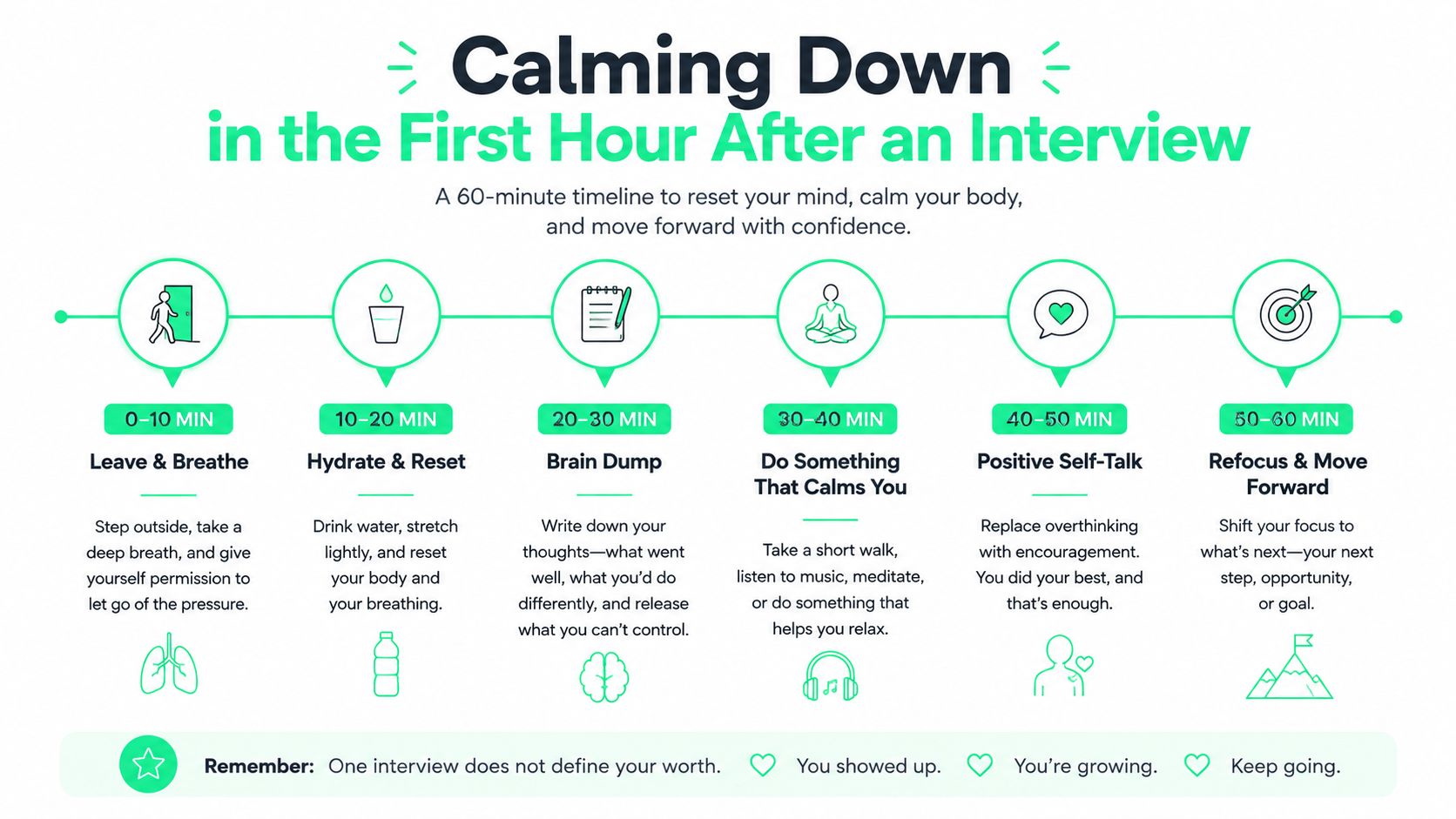
Don't improvise your first hour. Use a sequence that gives your body a reset and your mind a limited place to record what happened.
The first ten minutes
Before stepping outside, write down three facts about the room. For example:
- “They asked about stakeholder conflict.”
- “I gave an example from my internship.”
- “They explained that the next stage involves a practical task.”
Facts keep your memory anchored to observable events. They prevent a neutral expression or a forgotten sentence from becoming the entire interview.
Then try a 4-7-8 breathing cycle. Breathe in for four counts, hold for seven, and exhale for eight. Repeat only as long as it feels comfortable. The point isn't to erase anxiety. It's to slow the escalation enough to stop your first interpretation from becoming your final verdict.
The next twenty minutes
Walk if you can. If you're at home, change rooms and move around rather than collapsing straight into email. Cold water on your wrists can provide a clear sensory reset, and a snack can help if you skipped food before the interview.
These actions matter because post-interview anxiety isn't only a thought pattern. Your body may still be carrying the activation from concentrating, performing, and monitoring social cues. A short walk also creates physical distance from the interview location, which helps mark the event as finished.
Minutes thirty to sixty
Complete a structured debrief, then stop. Write:
- Three things you said well
- Two things you'd phrase differently
- One question you still have
The two changes are for future preparation, not punishment. Don't draft replacement answers for every sentence. Capture the lesson in plain language, such as, “Lead with the result before explaining the process.”
Email and company-site refreshing creates the illusion of control. Check once during a defined evening window, then leave the inbox alone until the next planned check. If you're waiting for a response, repeated checking won't shorten the employer's process. It only gives uncertainty more chances to interrupt your day.
When Feeling Bad Doesn't Mean You Did Bad
Your physical reaction is not a reliable performance review. You can feel shaky after a strong interview, especially if you care about the role or spent the meeting monitoring your speech, eye contact, timing, and facial expressions.
The evidence supports a more precise view. One 2026 Wiley study discussed in the available interview research found that fear of negative evaluation was positively correlated with interview anxiety, while the correlation between interview anxiety and job performance was near zero. Another meta-analytic source identified a moderate negative effect of anxiety on interview performance, which means anxiety can interfere with performance, but it doesn't make your post-interview feelings a dependable measure of what happened.
Use this three-column check:
What you know What you're assuming What the rubric says
You answered the leadership question
They thought your example was weak
Did you provide a clear situation, action, and result?
They asked follow-up questions
They were testing whether you failed
Did you explain your reasoning?
The interview ended at the planned time
They wanted to get rid of you
Did you cover the role's core competencies?
Post-interview rumination commonly uses mind reading, where you decide what the interviewer thought; fortune telling, where you predict rejection; and single-event filtering, where one awkward pause outweighs several complete answers.
Try this sentence: “I feel embarrassed about the pause. The evidence shows that I paused, not that they rejected me.” That distinction sounds simple, but it separates emotional residue from an outcome you can't yet know.
Use a short decision rule. If you covered the core competencies, asked at least one thoughtful question, and weren't cut short, treat the bad feeling as a signal worth noticing, not a verdict. You may still identify something to improve, but you don't need to convert discomfort into a prediction.
Following Up Without Overthinking
Follow-up should be anchored to timing, not to your anxiety level. Send one concise thank-you message within 24 hours, then let the employer's process run without turning your message into a second interview.
A useful note does three things:
- Thanks the interviewer for their time.
- Refers to one specific point from the conversation.
- Restates your interest without pleading for reassurance.
Use this adaptable template:
Subject: Thank you for the interview
Hi [Name],
Thank you for taking the time to discuss the [Position] role. I especially enjoyed our conversation about [specific topic], and it reinforced my interest in contributing to [relevant responsibility]. I'm glad to provide any additional information and look forward to hearing about next steps.
Best,
[Name]
Keep it brief. A five-paragraph recap usually reflects your need to keep working on the interview, not the employer's need for more information. For additional guidance, use this interview thank-you email guide, then send the message instead of rewriting it repeatedly.
Set a silence deadline
If the interviewer gave you a decision date, wait until that date passes. If they didn't provide one, send a polite check-in after seven to ten business days. Use this message:
Subject: Checking in on [Position]
Hi [Name],
I'm following up on our conversation about the [Position] role. I remain interested in the opportunity and wanted to ask whether there are any updates on the hiring timeline. Please let me know if you need anything else from me.
Best,
[Name]
Silence can be procedural. Interviewers may be coordinating feedback, waiting for approvals, comparing schedules, or handling a changed hiring process. None of those possibilities excuses poor communication, but they do mean silence isn't automatically personal.
Send a second follow-up only if you have a concrete reason, such as a promised update that has passed or a material change in your availability. Otherwise, one check-in is enough. After that, move the role to “waiting” in your tracker and continue applying.
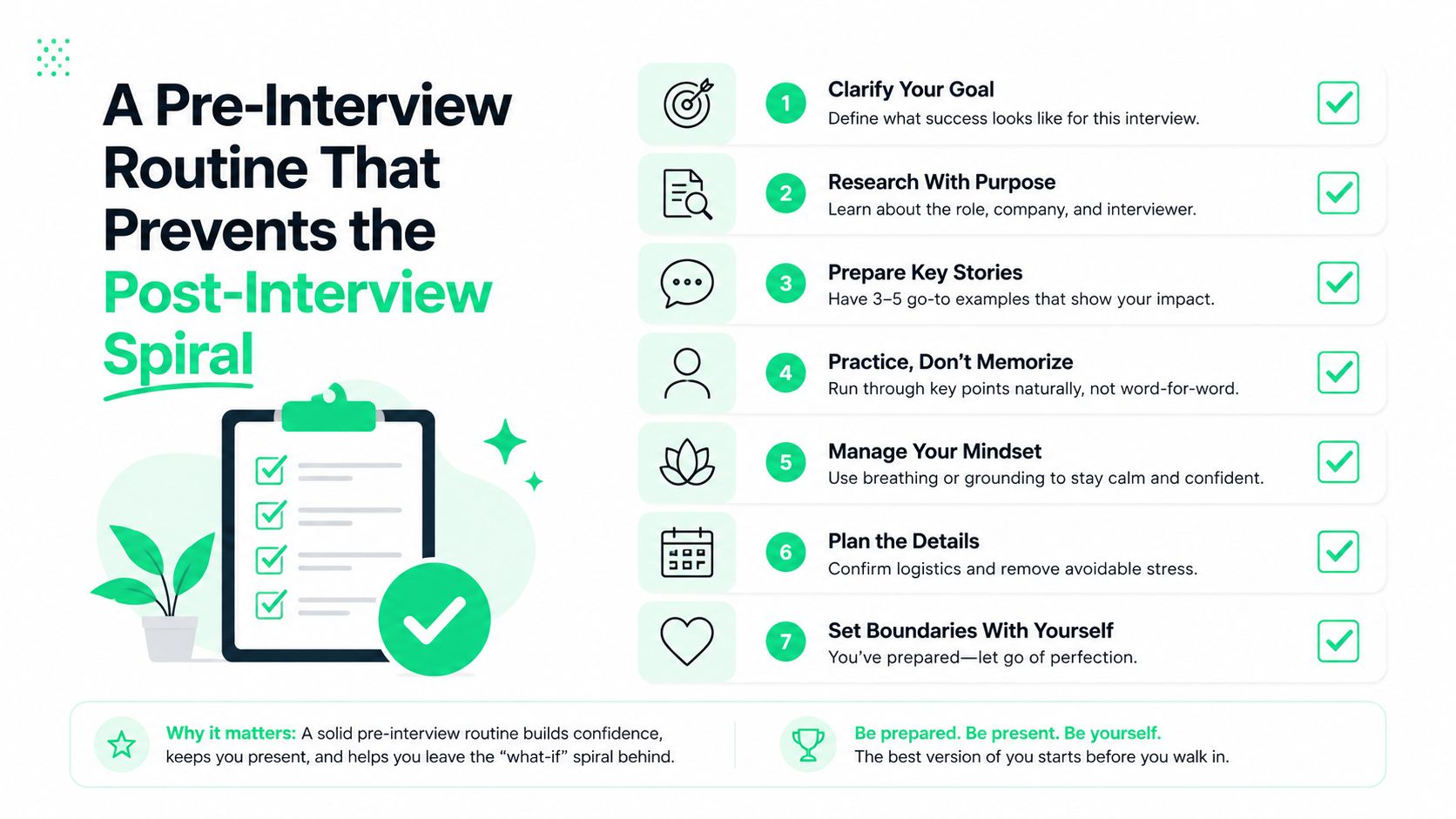
A Pre-Interview Routine That Prevents the Post-Interview Spiral
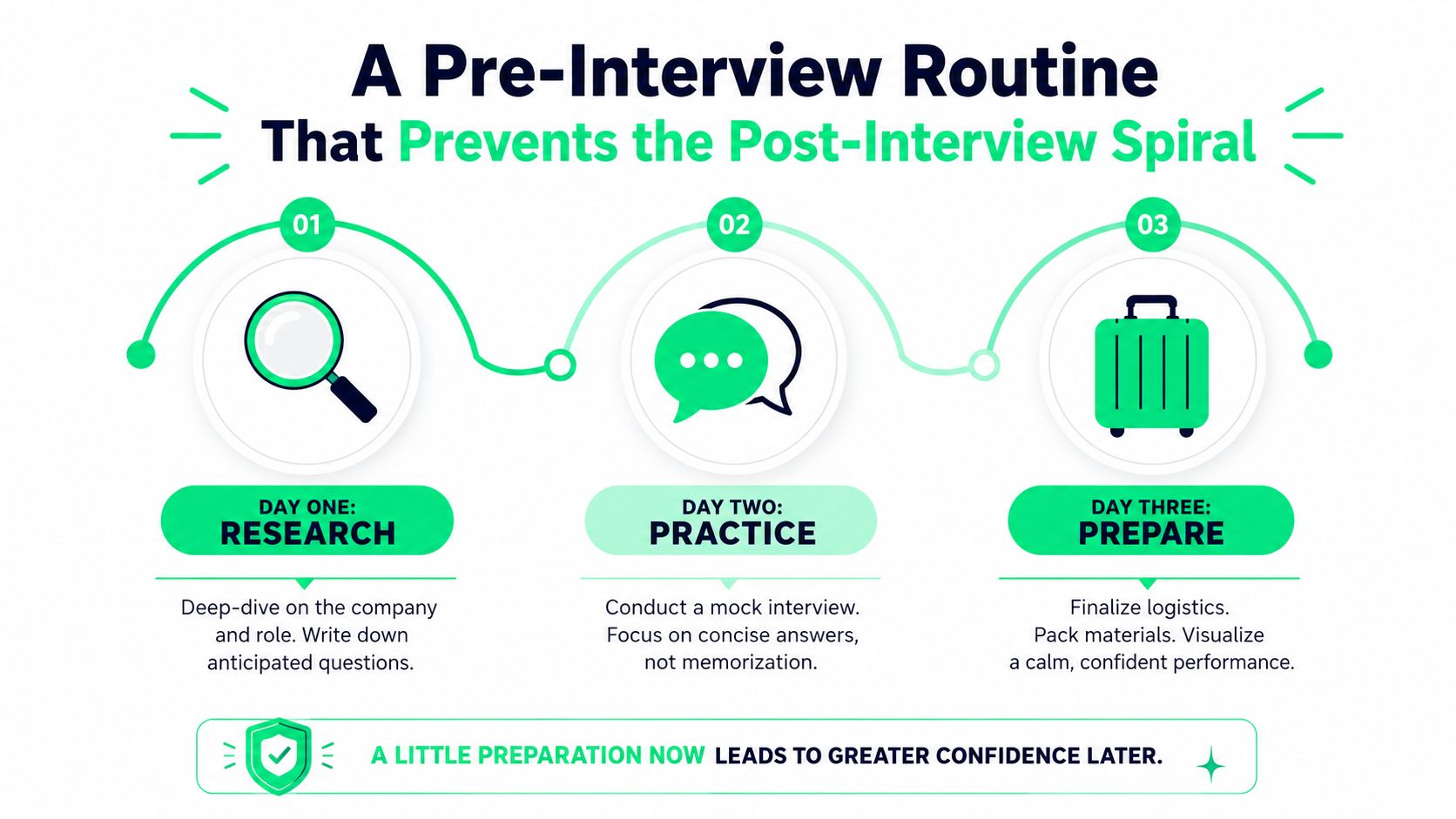
Last-minute cramming gives you more information but fewer memory anchors. A structured routine gives you fewer scattered notes and more confidence that you prepared the right material.
Day one for research
Study the role, the company's work, and the responsibilities you'd own. Write down likely questions and connect each one to an experience you can explain clearly. Don't memorize paragraphs. Build a small example bank around challenges, collaboration, mistakes, results, and learning.
This approach helps after the interview because you can remember the preparation process, not just the one answer that felt shaky. Use the interview prep guide to organize that work into a repeatable preparation process.
Day two for speaking
Say your answers aloud. A silent answer can look polished on paper and collapse when you need to deliver it under pressure. Practice concise openings, transitions, and pauses such as, “Let me take a moment to think about that.”
Ask a friend to interrupt with a follow-up question. Early-career candidates often know their experience but lose their thread when the interviewer asks for a detail. Career changers need the same practice to connect previous work to a new role without over-explaining the transition.
Day three for logistics
Finalize your outfit, route, documents, water, and technology. Build an arrival buffer so lateness doesn't become the first story your nervous system tells you. For a virtual interview, test the platform, camera, microphone, and backup connection.
Use this checklist:
- Materials: Bring or open the resume, job description, questions, and notes you're allowed to use.
- Body needs: Have water and a suitable snack available.
- Environment: Choose a quiet, adequately lit space.
- Timing: Plan to arrive or log in early enough to settle.
- Wind-down: Stop preparation at a defined time the night before.
Preparation standard: You don't need to remember everything. You need reliable access to the few examples that prove you can do the work.
Immediately after the interview, score yourself against three categories: competency coverage, clarity, and connection. Give each a simple low, medium, or high rating, then write one supporting fact. This isn't a grade from the employer. It's a way to prevent anxiety from grading you based on one facial expression.
Tailored Strategies for Neurodivergent Candidates, International Students, and Career Changers
The uncertainty loop is shared across these groups, but the trigger often differs. A neurodivergent candidate may be recovering from sensory overload or masking fatigue. An international student may be decoding unfamiliar communication norms while worrying about status questions. A career changer may be translating experience that doesn't fit the job description neatly.
Neurodivergent candidates
Create a sensory reset before you evaluate your performance. Use headphones, lower the lights, change clothes, or sit somewhere quiet. Then write the debrief instead of trying to hold every impression in working memory.
If accommodations would materially improve access, decide in advance whether and how to request them. You don't need to disclose personal details to justify a practical request. A boundary statement can be: “I'll evaluate the interview using the agreed criteria, not by judging whether I looked typical under pressure.”
International students
Separate visa concerns from interview evidence. Prepare a concise, accurate response about work authorization and sponsorship, then return to your qualifications. If you notice accent-related self-criticism, ask whether the interviewer understood your example and its result, rather than whether every sound matched your ideal.
Cultural signals also deserve caution. A reserved interviewer may not communicate enthusiasm through the expressions or feedback style you expect. Your boundary statement is: “I won't translate a culturally unfamiliar signal into rejection without direct evidence.”
Career changers
Prepare transfer statements that connect your previous work to the new role. For example, a teacher moving into customer success might explain how they managed competing needs, measured progress, and communicated difficult information. Keep a short explanation for gaps or transitions, then stop defending your entire history.
Your boundary statement is: “I'll explain the relevance of my experience once, then let the hiring team assess it.” For practice with follow-up questions and answer structure, Qcard's AI interview coach is one available option.
Audience Top Trigger Primary Tactic Boundary Statement
Neurodivergent candidates
Sensory overload and masking fatigue
Use a quiet reset, then complete a written fact-based debrief
“I won't judge my capability by how comfortable I looked.”
International students
Status questions and unfamiliar social cues
Rehearse a concise authorization answer and clarify ambiguous process details
“I won't treat accent or cultural difference as evidence of poor performance.”
Career changers
Doubts about transferable experience
Build role-specific transfer statements and practice concise gap explanations
“I'll connect my experience without apologizing for my career path.”
The tactic changes, but the core intervention remains the same. Externalize what happened, define what you can control, and refuse to let an unanswered question become a negative conclusion.
Your Post-Interview Reset Toolkit
The interview is over, but the result may remain unknown for days. That waiting period creates its own workload, especially for early-career candidates, neurodivergent professionals managing recovery after masking, and international job seekers reading unfamiliar process cues. Your reset plan should contain uncertainty, not demand instant calm.
Before the evaluation milestone
Create a simple waiting-period system. Record the interviewer's stated timeline, the date you sent your follow-up, and the date you will check in if no update arrives. If no timeline was provided, choose a reasonable check-in point and put it on your calendar.
This step neutralizes the urgency to solve the outcome immediately. You are marking the event as complete.
Keep one factual interview record: the role, the people you met, the process details, and any commitments you made. Add questions only when they require action, such as sending a document or clarifying a logistical point. This record protects you from rebuilding the entire conversation every time anxiety resurfaces.
During the waiting period
Set a boundary around checking. Review your inbox at planned times instead of searching for signs throughout the day. Do not treat silence, a delayed reply, or a change in tone as a verdict. Hiring timelines shift for reasons you cannot observe.
If the employer provided a decision date, wait until that point before following up. If it passes, send one concise message that confirms your continued interest and asks whether the timeline has changed. If the employer remains silent after that message, return your attention to other applications rather than writing increasingly elaborate explanations.
Maintain parallel options. Continue applying, prepare for another interview, and keep commitments that have nothing to do with the search. For international candidates, track any status or authorization questions separately from performance worries. For neurodivergent candidates, use written reminders and a defined checking schedule so executive-function strain does not turn uncertainty into constant monitoring. Career changers can use the waiting time to refine role-specific examples for the next conversation, not replay the last one.
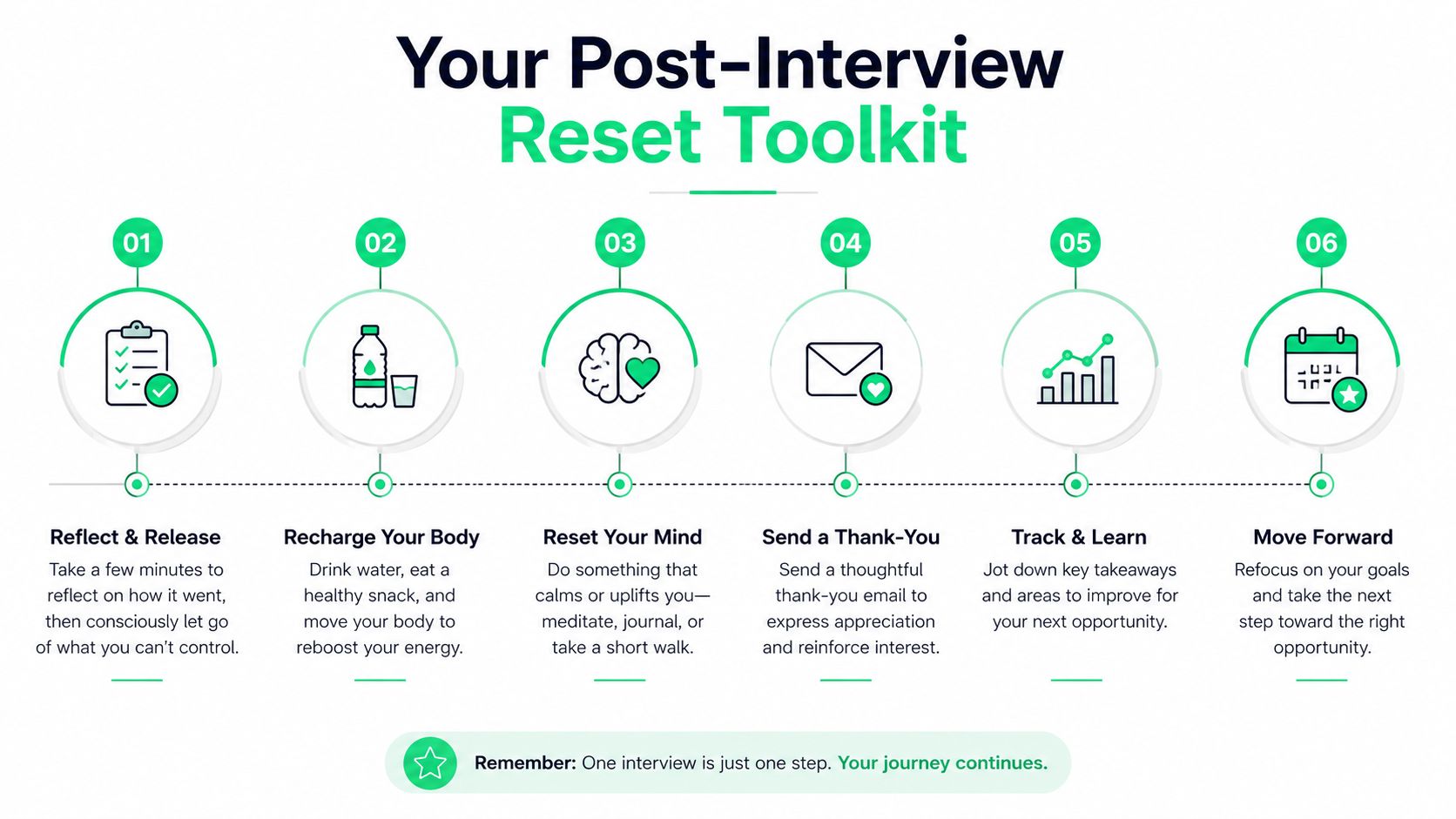
An interview study found that anxiety can stay high through the interview, drop during the release phase, and return around the evaluation milestone, as described in this longitudinal interview study. Feeling calmer after leaving does not guarantee a calm waiting period. Plan for the return of uncertainty before it arrives.
Record the facts, complete required follow-up, set the next decision point, and keep living. The employer owns the decision. You own how much of your day the silence receives.
Key Takeaways
- Post interview anxiety is structurally different from interview nerves — interview-day anxiety has a clear target (answering questions, performing under pressure), while post-interview anxiety begins after your performance is fixed and the employer controls the timeline, comparison, and outcome, which is why calming techniques alone can't resolve it.
- Feeling bad is not evidence you did badly — research found the correlation between interview anxiety and job performance was near zero, and the useful test is a decision rule rather than a gut read: if you covered the core competencies, asked at least one thoughtful question, and weren't cut short, treat the bad feeling as a signal worth noticing, not a verdict.
- The three cognitive distortions that drive the spiral are mind reading, fortune telling, and single-event filtering — separating them requires writing down what you actually know ("they asked follow-up questions") beside what you're assuming ("they were testing whether I failed") and what the rubric would have measured ("did I explain my reasoning?").
- Follow-up should be anchored to timing, not anxiety level — one concise thank-you within 24 hours that references a specific conversation point, then a single check-in after the stated decision date or seven to ten business days if none was given, because a five-paragraph recap usually reflects your need to keep working on the interview rather than the employer's need for more information.
- The trigger differs by candidate group but the intervention is the same — neurodivergent candidates recovering from sensory overload or masking fatigue should use a quiet reset before evaluating anything, international students should separate visa concerns from interview evidence and avoid reading unfamiliar cultural signals as rejection, and career changers should explain relevance once and stop defending their entire history.
Qcard provides personalized practice, resume-grounded talking points, mock interviews, and concise memory cues for moments when nerves create brain fog. Visit Qcard to build a structured interview routine and manage the waiting period with clearer boundaries.
Ready to ace your next interview?
Qcard's AI interview copilot helps you prepare with personalized practice and real-time support.
Try Qcard Free