Overcoming Imposter Syndrome: A Practical Interview Guide
TL;DR
Overcoming imposter syndrome before interviews means preparing for the exact moment confidence drops, rather than waiting to feel confident first. Start by naming your dominant pattern — the perfectionist loop, attribution reversal, or the competence-belief gap — using a three-question self-check after any difficult practice answer. Then build an evidence log of specific competent moments (situation, action, result, skill) you can reread in a minute before an interview. Reframe catastrophic thoughts with a four-part structure that produces a balanced account rather than forced positivity, and use action-based self-talk ("I have prepared for this question") over identity claims ("I am great"). Prepare cue cards with prompts, not scripts, organized by interview stage. Add micro-practices: breath reset, posture prime, an anchor phrase for thinking time, retrieval drills, and silence practice. Track progress by intensity, moments caught, and behavioral wins — expect better recognition by four weeks, behavioral change by eight, broader functioning by twelve. Escalate to a mental health professional if there are panic attacks, rumination-driven sleep disruption, or avoidance of applications.
You're two minutes into a panel interview and things are going well. Then someone asks about a deliverable from three roles ago. Your breath shortens, the answer you prepared for the next question disappears, and a new story takes over: They've finally noticed I don't belong here.
That reaction can feel like a private defect, but imposter feelings are common in high-skill, evaluative settings. A 2019 systematic review of 62 studies involving 14,161 participants found prevalence estimates ranging from 9% to 82%, with much of the variation explained by different screening tools and cutoff scores. A later meta-analysis of 30 studies covering 11,483 people estimated pooled prevalence at 62%, with a 95% confidence interval of 52.6% to 70.6% in its review of imposter syndrome.
Overcoming imposter syndrome before an interview doesn't mean forcing yourself to feel fearless. It means recognizing the pattern, preparing external support for predictable pressure points, and using behavior to keep moving when confidence lags behind competence.
How Do You Overcome Imposter Syndrome Before an Interview?
Overcoming imposter syndrome doesn't mean forcing yourself to feel fearless. It means recognizing the pattern, preparing external support for predictable pressure points, and using behavior to keep moving when confidence lags behind competence.
The feeling is common in evaluative settings. A 2019 systematic review of 62 studies covering 14,161 participants found prevalence estimates from 9% to 82%, while a later meta-analysis of 30 studies and 11,483 people estimated pooled prevalence at 62%. A 2025 survey of 8,247 UK workers found 64% had experienced it, rising to roughly 70% among workers aged 20 to 39.
Step 1 — Name your dominant pattern. Imposter feelings are a distorted attribution process: you discount positive evidence and give negative evidence full authority. Three patterns show up in interviews:
- The perfectionist loop — you blank on one prompt and declare the whole interview a failure. Fix: define performance by decision process, not flawless recall.
- Attribution reversal — praise gets explained away as politeness or luck. Fix: record it as evidence; you don't have to call yourself exceptional, only stop deleting it.
- The competence-belief gap — your experience supports the answer but your certainty hasn't caught up, common for career switchers and international candidates.
Step 2 — Build an evidence log, not affirmations. Record short entries with situation, action, result, and skill. "Worked on migration" is weak. "Mapped dependencies, coordinated the handoff, and prevented a late-stage rollback" gives your memory something to retrieve.
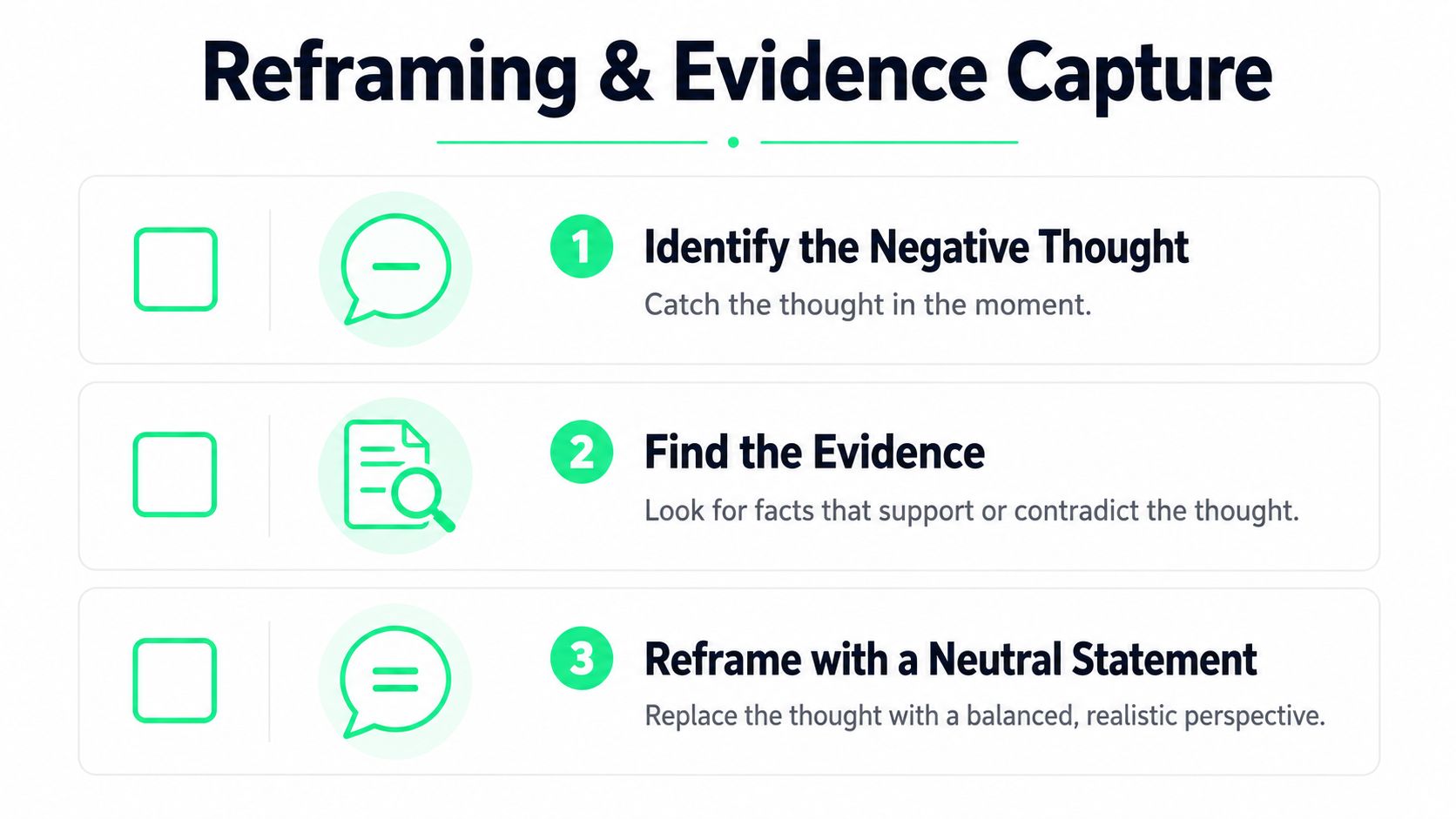
Step 3 — Reframe with a balanced account. State the thought, the evidence for, the evidence against, then the alternative: "I misunderstood the framing, then recovered through clarification." That's credible because it doesn't require calling the interview perfect.
Step 4 — Use action-based self-talk and behavioral anchors. "I have prepared for this question" beats "I am great," because the first points to behavior you can execute. Add a deliberate pause and a phrase like "I'll take a moment to structure that."
Step 5 — Prepare cue cards, not scripts. Write "context, decision, result" per card, organized by interview stage. Scripts make you sound rigid and create another failure condition.
The Moment Imposter Feelings Spike
The candidate recovers from the forgotten deliverable. They give a reasonable answer, but the panel stays quiet for a beat. That silence feels like a verdict. During a technical deep-dive, they interpret one difficult question as evidence that they aren't qualified. During a behavioral prompt, they reject a strong story because it doesn't sound impressive enough. When salary comes up, they lower their expectations before the employer has made an offer.
These moments have a common structure. The interview creates uncertainty, the candidate searches for an explanation, and the mind chooses the most threatening one. A pause becomes disapproval. A request for detail becomes suspicion. A question outside the rehearsal set becomes proof that the candidate has been pretending.
The pressure points are predictable
Imposter feelings often appear at specific points in the interview arc:
- Technical questions: You miss one detail or need time to reason through a problem, then label the entire performance a failure.
- Behavioral prompts: You compare an ordinary but effective example with an imaginary perfect story and decide yours is inadequate.
- Career transitions: You enter a new field, pursue a first management role, or return after a gap, so your previous identity no longer feels like enough evidence.
- Salary negotiation: You treat compensation as a judgment of your worth rather than a discussion about the role and market.
- Silence after answering: You rush to fill the gap, add unnecessary detail, or retract a point that was already sufficient.
The pattern is especially relevant for early-career candidates and career switchers. A 2025 survey of 8,247 UK workers found that 64% had experienced imposter syndrome, while 25% said it happened often. Among workers aged 20 to 39, the rate was about 70% to 71% according to Hays' survey reporting.
That doesn't mean every anxious candidate has a clinical condition, and prevalence estimates vary by measurement method. It does mean your reaction isn't evidence that you're uniquely unprepared. It's a familiar response to evaluation, uncertainty, and a changing professional identity.
Practical rule: Don't wait to feel confident before you answer. Prepare for the exact moment confidence drops.
What Imposter Feelings Actually Are
Imposter feelings are a distorted attribution process. You treat successful outcomes as products of luck, timing, help, or low standards, while treating ambiguous moments as direct evidence of incompetence. The mind gives positive evidence a discount and negative evidence full authority.
The modern concept began in 1978, when Pauline Rose Clance and Suzanne Imes introduced the “imposter phenomenon” in research on high-achieving women. Carol Tavris used the phrase “imposter syndrome” in Vogue in 1982, helping it move into mainstream language. This history of the term matters because the experience has been discussed for decades. It isn't a newly discovered personal flaw.
Three patterns show up in interviews
The perfectionist loop sets an impossible standard, then uses any deviation as proof of failure. You blank on one system design prompt and decide the interview is over, even though you solved the earlier questions clearly. The useful intervention is to define performance by the decision process, not by flawless recall. A strong answer can include clarification, structured reasoning, and a request for a moment to think.
The attribution-reversal pattern takes credit away from you. A recruiter praises your portfolio, and you immediately think they were being polite, the role is less competitive than expected, or someone else must have influenced the decision. Your job is to record the praise as evidence, not explain it away. You don't have to turn it into proof that you're exceptional. You only have to stop deleting it.
The competence-versus-belief gap appears when your experience supports an answer but your internal certainty hasn't caught up. A career switcher may have transferable project skills yet feel fraudulent because the job title is new. An international candidate may understand the work but distrust their ability to explain it in an unfamiliar interview style.
Competitive environments amplify these patterns. A 2025 six-study paper involving 1,288 participants found that competitive work climates increase impostorism through upward social comparison, and it found no evidence that women are more affected in those settings as summarized by the Australian National University. Rankings, visible performance comparisons, and promotion contests give your mind a constant stream of people to compare against.
Use this self-check after a difficult practice answer:
- Did I demand a perfect response?
- Did I dismiss evidence that I performed well?
- Did I confuse unfamiliarity with incapability?
The answer that comes up most often identifies your dominant pattern. Name it before you try to fix it.
Reframing and Behavioral Techniques That Work
Start with evidence capture, not motivational statements. Create a running log of specific moments when you performed competently. Keep each entry short enough to reread in about a minute before an interview:
- Situation: The problem, project, or conversation.
- Action: What you personally did.
- Result: What changed, improved, shipped, or became clearer.
- Skill: The capability the example demonstrates.
“Worked on migration” is weak evidence. “Mapped dependencies, coordinated the handoff, and prevented a late-stage rollback” gives your memory something concrete to retrieve.
Reframe the thought, then change the body
Use this four-part structure:
- Thought: “I misread the curveball question, so they know I'm not ready.”
- Evidence for: You answered the first part inaccurately or needed clarification.
- Evidence against: You asked a useful follow-up, corrected your interpretation, and explained your reasoning.
- Alternative: “I misunderstood the framing, then recovered through clarification.”
That final statement is credible because it doesn't demand that you call the interview perfect. It creates a balanced account.
Behavioral techniques help because anxiety is physical before it becomes verbal. Before a video call, use a brief box-breathing cycle. During a pause, place both feet on the floor and relax your shoulders. Before answering a complex question, take a deliberate ten-second pause and say, “I'll take a moment to structure that.”
Use action-based self-talk: “I have prepared for this question” is more useful than “I am great.” The first statement points to behavior you can execute. The second asks you to win an argument about your identity while under pressure.
Affirmations can feel false when your confidence is low. Action-based language works better because it directs attention toward preparation, clarification, and the next observable move. The interview preparation guide from Qcard can support that process by giving you a place to organize prompts and practice responses.
The intervention evidence is promising but not definitive. A 2023 JBI Evidence Synthesis reported potential benefits from coaching, online self-study modules, and mindfulness-based interventions, while also noting inconsistent study quality and few high-quality studies in its umbrella review. Build your routine around techniques you can repeat, observe, and adjust.
Memory Cues, Mock Interviews, and Micro-Practices
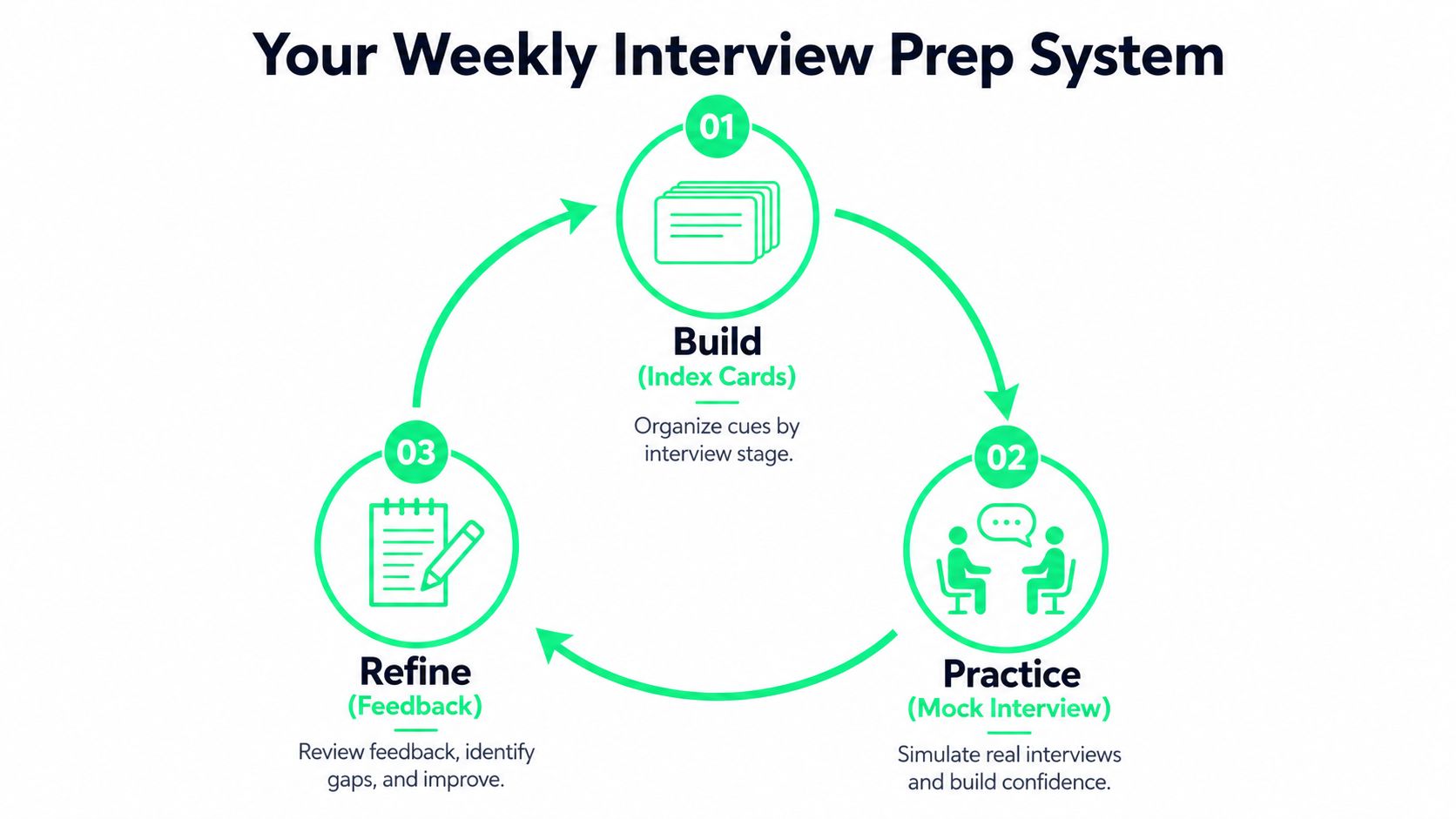
Memory cues reduce the amount you have to hold in your head while someone evaluates you. Organize index cards by interview stage:
- Introduction: Your professional summary, target role, and strongest fit.
- Behavioral: Conflict, failure, leadership, collaboration, and prioritization stories.
- Technical: Frameworks, assumptions, tradeoffs, and questions to clarify.
- Closing: Questions for the interviewer, availability, and follow-up points.
Each card should contain prompts, not a script. Write “context, decision, result” rather than a paragraph you'll try to recite. Scripts make a candidate sound rigid and create another failure condition. Cues help you retrieve your own experience naturally.
Build the practice loop
Choose one feedback partner who can focus on clarity over polish. Run a mock interview, record the questions that caused a freeze, and revise the cue cards rather than rewriting every answer from scratch. A useful partner asks, “What decision did you make?” and “What changed because of your work?” They don't reward decorative detail.
Try these micro-practices throughout the week:
- Breath reset: Slow your breathing before opening the interview platform.
- Posture prime: Sit or stand in a stable position, with your feet supported and shoulders loose.
- Anchor phrase: Use “Let me structure that” when you need thinking time.
- Retrieval drill: Read a cue and speak the answer without looking at your notes.
- Silence practice: Pause after a question without apologizing for thinking.
A worked example makes the system practical. For “Tell me about a conflict,” create one card with the prompts “stake, disagreement, action, result, lesson.” Answer it in 90 seconds, then ask your partner to score whether the conflict, your action, and the outcome were clear. Don't ask whether you sounded impressive. Ask whether the listener could follow the story.
Qcard can function as an unobtrusive cue deck for live interviews, surfacing a queued prompt on your phone when a question stalls you. Use any tool responsibly, and keep prompts grounded in your verified experience so the cue supports recall rather than replacing your thinking. You can also review the AI mock interview tool from Qcard as part of the practice loop.
The aim isn't to eliminate every anxious sensation. It's to make your response reliable enough that anxiety no longer controls the conversation.
Adapting the Plan for Neurodivergent and International Candidates
The playbook should bend around your cognitive load. It shouldn't force you to perform confidence in a way that drains the attention you need for the actual conversation.
Consider an autistic software engineer who masks through panel interviews. They may spend so much energy monitoring eye contact, facial expression, posture, and conversational timing that technical reasoning becomes harder. The answer isn't to rehearse more personality. It may be better to request a clear agenda, choose a format with fewer avoidable sensory demands when options exist, ask for written details, and schedule recovery time after the interview.
A practical disclosure email can be direct:
“I'm looking forward to the interview. To support clear communication, could you share the interview structure and technical format in advance? I may take a short pause to process complex questions, and I provide my strongest answers when I can organize my reasoning before responding.”
You don't have to disclose a diagnosis to request a process adjustment. Ask for what helps you perform the job-relevant task, such as written prompts, processing time, or a scheduled break.
Translation and self-advocacy require scaffolding
Now consider a non-native-English product manager answering US-style storytelling questions. They may understand the work completely but spend extra bandwidth translating idioms, selecting unfamiliar narrative conventions, and worrying that an accent signals lower competence. That pressure can lead to over-apologizing: “Sorry, my English isn't perfect,” before an otherwise strong answer.
Replace the apology with a clarification request:
“Could you repeat the question or give me a moment to organize the example?”
Prepare cue cards with short transitions such as “The situation was,” “My responsibility was,” and “The result was.” These aren't scripts. They're bridges that reduce language load while leaving the substance in your own words.
A second email might say:
“To prepare effectively, could you confirm whether the interview includes case, behavioral, or technical sections? I'd also appreciate written instructions for any exercise so I can review the requirements accurately.”
Memory cues and mock interviews help both candidates because external structure preserves internal bandwidth. The AI interview coach from Qcard is one option for practicing pacing and answer structure, but a trusted human partner can provide equally valuable context about clarity and cultural expectations.
Measuring Progress and Knowing When to Escalate
Track the pattern, not just the outcome. After each practice session or interview, answer three questions:
- How intense were the imposter feelings on a scale from 1 to 10?
- How many moments did I catch and interrupt instead of automatically obeying?
- What was one behavioral win?
A behavioral win might be asking for clarification, pausing before answering, negotiating instead of retreating, or completing an application despite discomfort. A lower intensity score is useful, but catching the pattern earlier is progress too.
Use a simple review horizon
Over the first four weeks, look for better recognition. You should be able to identify whether perfectionism, attribution reversal, or the competence-belief gap is driving the reaction.
By eight weeks, look for behavioral change. You may still feel nervous, but you pause more often, give fuller examples, and recover faster after an imperfect answer.
By twelve weeks, look for broader functioning. You apply for roles you previously avoided, prepare without endless rewriting, and leave interviews with a more accurate account of what happened. Plateaus are normal. They mean you may need a different practice target, not that the method has failed.
Signal Type Examples Action
Progress Signals
You catch negative thoughts, use an anchor phrase, and complete answers despite discomfort.
Continue the routine and refine the cue that helped.
Progress Signals
You can name evidence for and against a catastrophic interpretation.
Add the example to your evidence log.
Escalation Signals
Panic attacks, sleep disruption from rumination, or avoidance of applications.
Consult a qualified mental health professional.
Escalation Signals
Distress persists across work, study, and personal contexts or keeps worsening.
Seek professional support rather than relying only on interview practice.
Escalation Signals
A sensory, communication, or processing barrier affects performance.
Ask the employer about reasonable accommodations in advance.
A coach can help when the issue is interview structure, storytelling, or repeated avoidance of specific questions. A therapist is the right escalation when distress is persistent, frequent, intrusive, or functionally disruptive. Career practice and mental health care can work together, but one shouldn't be used as a substitute for the other.
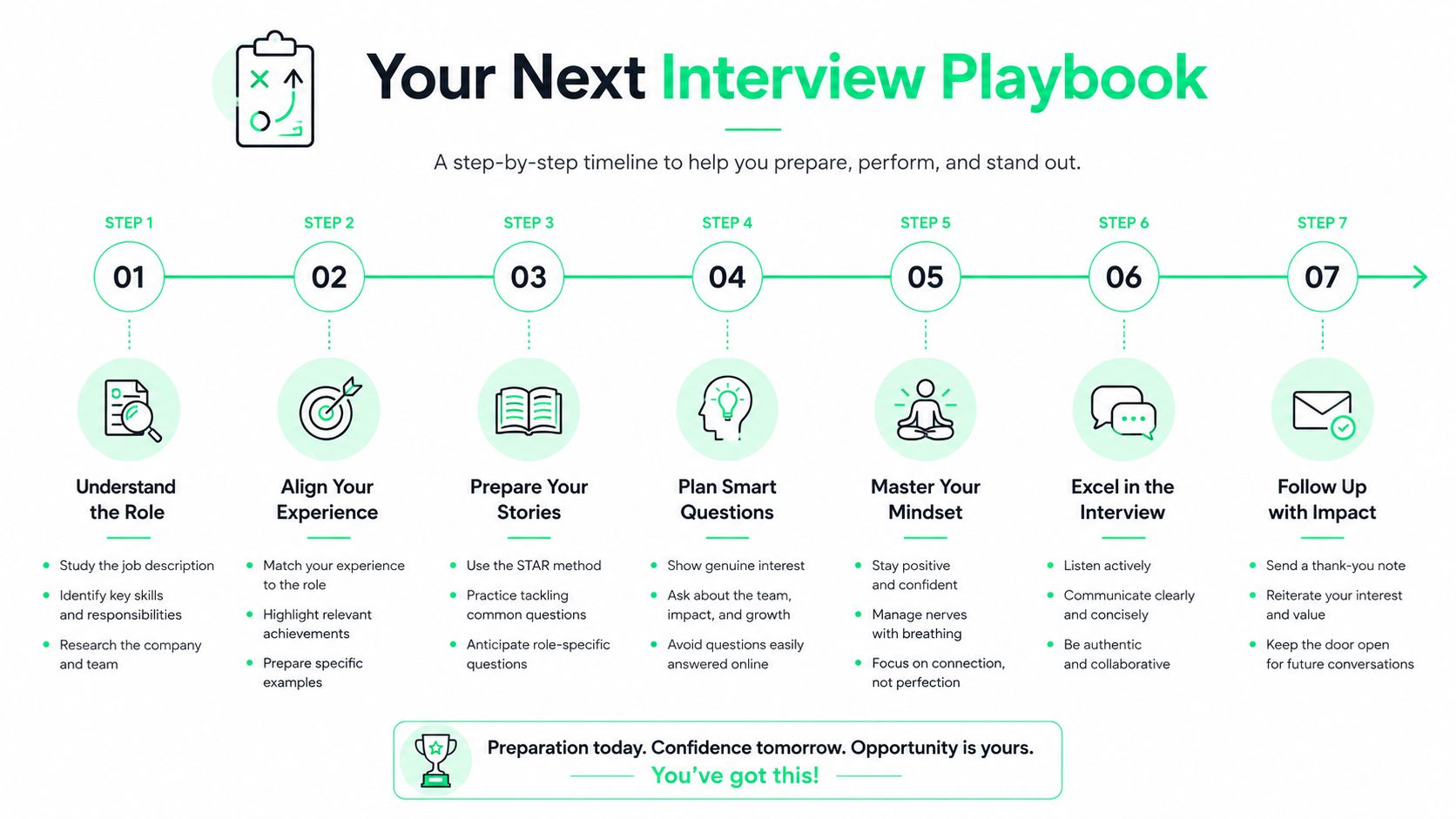
Your Next Interview Playbook
Run the same decision framework every time. Consistency matters more than adding another confidence exercise.
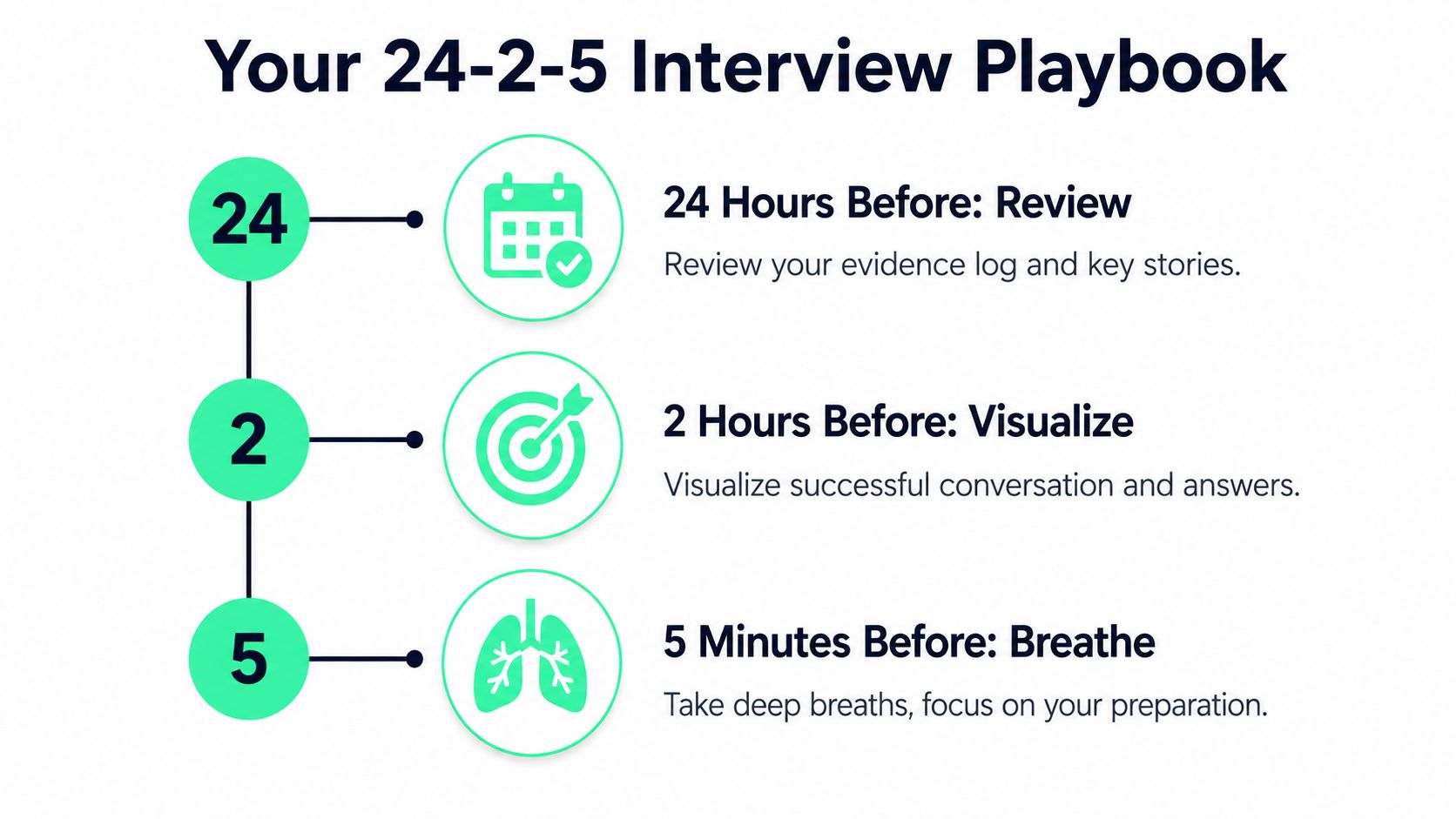
24 hours before
Review your evidence log and select a small set of memory cues for the introduction, behavioral stories, technical reasoning, and closing. Complete a mock interview self-score, then write one reframing card for the thought most likely to appear. If your recurring thought is “I don't have enough experience,” your alternative might be, “I can show how I made decisions, learned quickly, and produced results with the experience I have.”
2 hours before
Do one short retrieval round. Speak your opening summary, one conflict story, one failure story, and one role-specific example without reading full answers. Set up your interview tools and prompts, confirm your notes are concise, and remove anything that encourages you to read instead of listen.
Use the micro-practice loop:
- Reset: Slow your breathing and release physical tension.
- Retrieve: Read a cue and speak from memory.
- Refine: Remove one unnecessary detail.
- Repeat: Practice the answer once more with the clearer structure.
5 minutes before
Don't cram. Put both feet on the floor, take a breathing reset, and choose one behavioral anchor: “Pause before solving,” “Answer the question asked,” or “Evidence over interpretation.”
During the interview, treat each difficult moment as a decision point. Clarify if the question is unclear. Pause if your thoughts scatter. State your assumptions if the problem is technical. Afterward, record what happened before your mind rewrites the conversation as a disaster.
Your next action should take less than twenty minutes. Draft your first three cue cards today, or book one mock interview with a partner who will score clarity rather than charisma. You don't need to prove that imposter feelings are gone. You need to practice responding to them without handing them control.
Key Takeaways
- Imposter feelings are a distorted attribution process, not a private defect — you treat successes as luck or low standards while treating ambiguous moments as proof of incompetence, and prevalence data (a 62% pooled estimate across 11,483 people, and roughly 70% among UK workers aged 20 to 39) confirms the reaction is a familiar response to evaluation rather than evidence you're uniquely unprepared.
- Naming your dominant pattern comes before fixing it — a three-question self-check after any hard practice answer (Did I demand a perfect response? Did I dismiss evidence that I performed well? Did I confuse unfamiliarity with incapability?) identifies whether perfectionism, attribution reversal, or the competence-belief gap is driving the reaction.
- Action-based self-talk outperforms affirmations under pressure — "I have prepared for this question" points to behavior you can execute, while "I am great" asks you to win an argument about your identity mid-interview, which is why anchor phrases like "Let me structure that" and a deliberate ten-second pause work better than trying to feel confident on command.
- Cue cards beat scripts because they preserve bandwidth instead of adding a failure condition — writing "stake, disagreement, action, result, lesson" lets you retrieve your own experience naturally, and the right practice question from a partner is "could the listener follow the story?" not "did I sound impressive?"
- Neurodivergent and international candidates should adapt the plan rather than rehearse more personality — requesting the interview structure, technical format, and written instructions in advance is a process adjustment that requires no diagnosis disclosure, and replacing "sorry, my English isn't perfect" with "could you give me a moment to organize the example?" removes an apology that undercuts an otherwise strong answer.
Qcard offers resume-grounded, high-level talking points that help you retrieve your own experience when brain fog appears during a live interview, along with mock practice and feedback tools for preparation. Visit Qcard to build a cue-based interview routine that helps you speak naturally and accurately under pressure.
Ready to ace your next interview?
Qcard's AI interview copilot helps you prepare with personalized practice and real-time support.
Try Qcard Free