Onsite Interview Mastery: A Practical Guide for 2026
TL;DR
An onsite interview in 2026 is an in-person finalist stage running several hours across roughly 5 to 8 conversations, and it now serves as an authenticity checkpoint as much as a fit assessment — 72.4% of recruiting leaders report using in-person interviews to counter candidate fraud, with client requests rising from 5% in 2024 to 30% in 2025. Prepare with a two-week system: research, then index cards with Situation-Action-Result cues tagged by competency, then recorded mocks reviewed for buried actions and filler words, then a resume consistency check, then a full timed run-through before tapering. Upgrade STAR to CARA (Context, Action, Result, Aftermath) so every answer closes with what changed in your approach. On the day, keep logistics boring, arrive 15 minutes early, target 90-second behavioral answers, and use a physical reset between rooms — a totaljobs report found 65% of jobseekers said nerves stopped them showing their true ability. Request accommodations at the lowest disclosure level that meets your need. Afterward, write per-interviewer notes within two hours, send purposeful thank-you messages, and use a 48-hour rule before responding to an offer.
You've made it through the recruiter screen, the video interview, and perhaps a technical assessment. Now the calendar invite says “onsite interview,” and your mind starts filling in the blanks. You're wondering who you'll meet, whether you'll be watched between rooms, and how to stay composed when the day lasts longer than a normal conversation.
A modern onsite interview is more than a final handshake before an offer. It's a structured opportunity for the employer to confirm your experience, reasoning, communication style, and authenticity in person. It's also your chance to test whether the team, manager, working environment, and expectations match what you need to do good work.
What Is an Onsite Interview and How Do You Prepare for One?
In 2026, an onsite interview usually means an in-person finalist stage lasting several hours, typically following remote screening or a virtual panel kickoff. It's not the old full-day marathon, and it's not a fully remote final round. Employers now combine behavioral questions, a technical or case exercise, cross-functional conversations, and a team or culture discussion — usually across 5 to 8 conversations.
Why they're returning. Industry coverage reports employers including Google, Cisco, and McKinsey bringing back in-person rounds, with recruiting firms reporting client requests rising from 5% in 2024 to 30% in 2025. That coverage cites 72.4% of recruiting leaders using in-person interviews to counter candidate fraud, and 62% of job seekers saying they'd be more likely to apply to employers requiring them. A 2023 American Staffing Association summary found 70% of Americans preferred in-person interviews versus 17% for video.
What each format measures. A hiring manager one-on-one tests ownership depth and role alignment. A cross-functional panel tests collaboration and breadth. A technical or case segment tests reasoning, trade-offs, and adaptability. A lunch or coffee chat tests rapport and communication style.
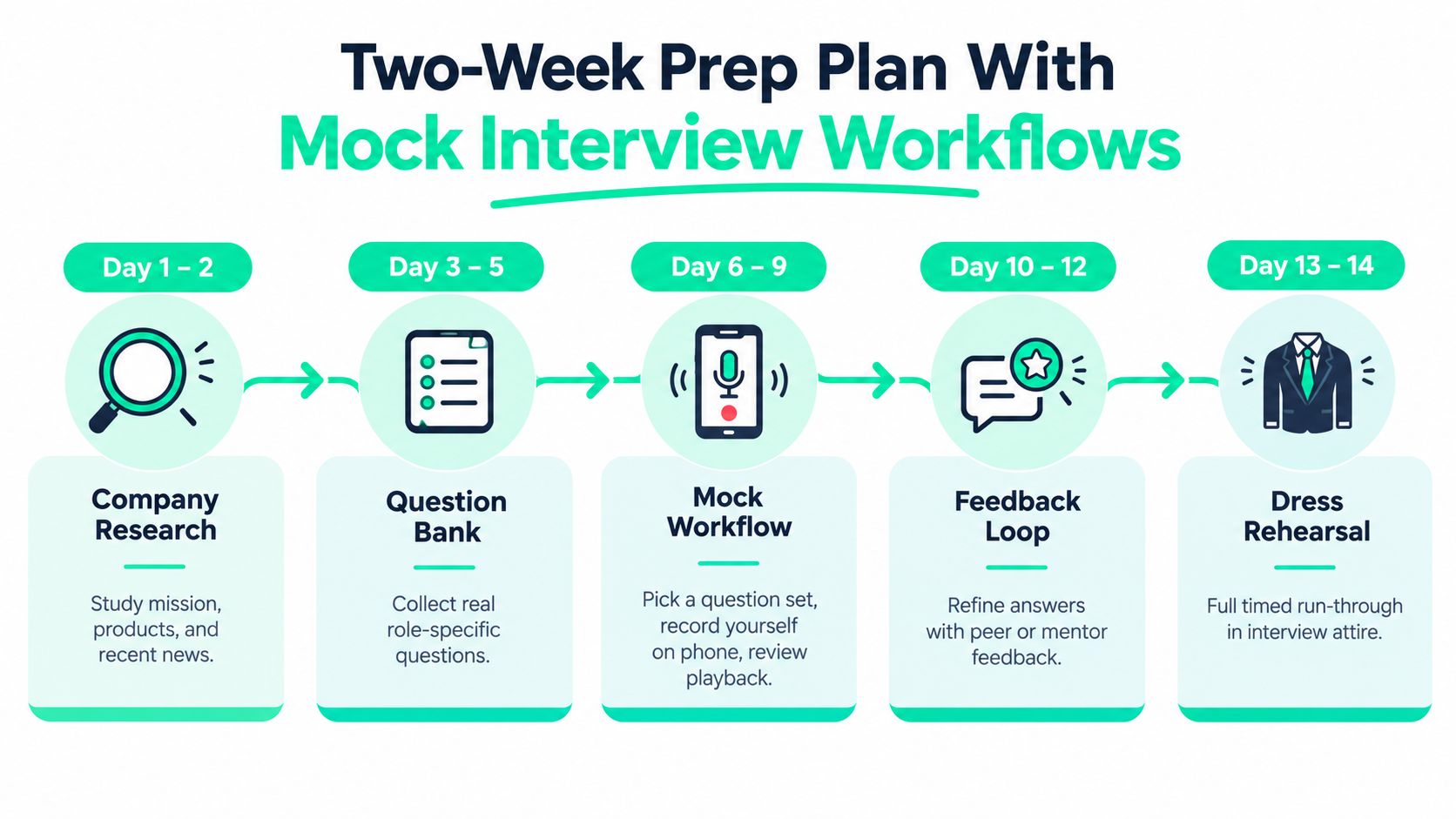
Use a two-week prep system. Days 1–2 for company research. Days 3–5 to build 3x5 index cards with Situation, Action, Result cues tagged by competency. Days 6–9 for recorded mock interviews — review playback, mark buried actions and filler words, then redo with a time cap. Days 10–12 to compare spoken answers against your resume for consistency. Days 13–14 for a full timed run-through in interview clothing, then taper for the final 48 hours.
Pace the day itself. Arrive 15 minutes early. Aim for about 90 seconds on standard behavioral prompts, take a 30-second pause before difficult technical questions, and reset between rooms — drop your shoulders, unclench your jaw, plant both feet. Rehearse around 130 words per minute with a two-second pause between context, action, result, and reflection.
What an Onsite Interview Looks Like in 2026
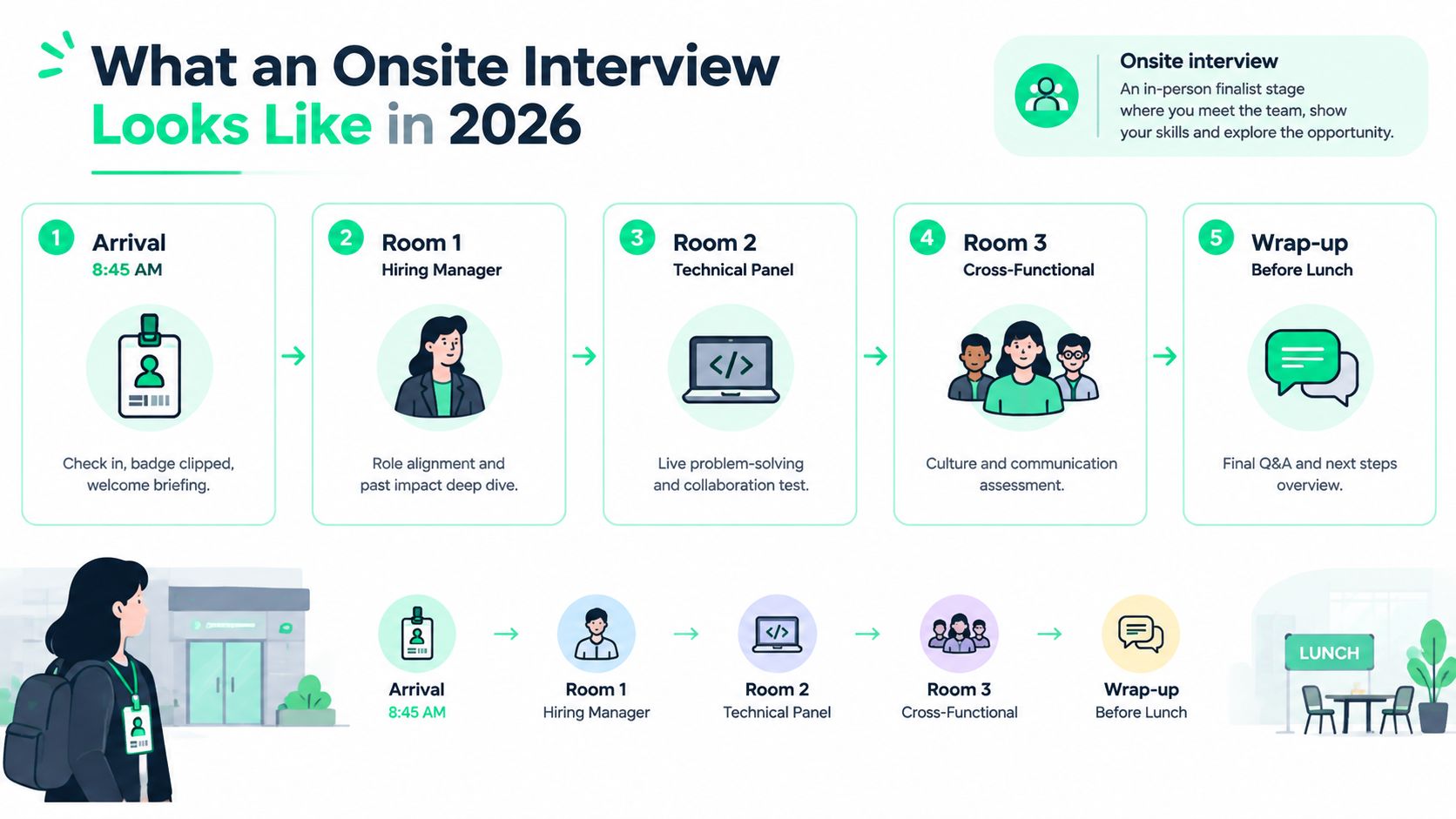
You arrive at 8:45 a.m., badge clipped to your jacket, with a welcome briefing ahead of you. Before lunch, you move through four rooms: a hiring manager conversation, a technical discussion, a cross-functional meeting, and a final team interaction. Each interviewer has a different focus, but the day should feel like one connected evaluation rather than four unrelated interrogations.
In 2026, an onsite interview usually means an in-person finalist stage. It may last several hours and often follows remote screening or a virtual panel kickoff. That differs from the older idea of a single, back-to-back full-day marathon, just as it differs from a fully remote video final. Employers increasingly combine behavioral questions, a technical or case exercise, cross-functional conversations, and a team or culture discussion.
The authenticity checkpoint
The in-person stage can verify more than your identity. Interviewers can observe how you explain a decision without a prepared screen, respond to an unfamiliar question, collaborate at a whiteboard, and move between different audiences. That doesn't mean you need to perform constantly. It means the company wants to compare the person it meets onsite with the candidate it met remotely.
Recent industry coverage describes a shift toward using onsite rounds as fraud-verification checkpoints. It reports that employers including Google, Cisco, and McKinsey have brought back in-person rounds, while recruiting firms reported client requests rising from 5% in 2024 to 30% in 2025 in that coverage. The same report cites 72.4% of recruiting leaders using in-person interviews to counter candidate fraud, and 62% of job seekers saying they'd be more likely to apply to employers requiring in-person interviews. Read the industry analysis of the return to in-person interviews for the broader context.
Your preparation should therefore do two things: make your experience easy to verify and leave room for natural conversation. Bring a consistent career story, but don't memorize every sentence. The onsite isn't a formality. It's a confirmation stage with defined signals.
Why Employers Are Bringing Onsites Back
The job interview has changed before. The modern interview is commonly traced to 1917 through 1921, when Robert S. Woodworth's wartime personality questionnaire and Thomas Edison's written candidate knowledge test introduced early standardized hiring assessments. By the mid-20th century, face-to-face interviews had become a default hiring step across major labor markets, according to this history of the job interview.
Remote hiring disrupted that pattern, but it didn't eliminate the value of meeting candidates in person. Employers now appear to be adding a late onsite round to a mostly remote process because the final decision requires signals that are difficult to assess through a screen.
Three reasons the final round is returning
Fraud verification comes first. Employers may want to confirm that a candidate can independently explain their resume, solve a problem without hidden assistance, and respond naturally to follow-up questions. For you, that means every major resume claim should be easy to narrate: what the situation was, what you personally did, what changed, and what you learned.
Authenticity calibration adds another layer. A video call can reveal communication skill, but an in-person conversation may show how you listen, recover from uncertainty, and adapt your explanation to a new person. Prepare for unscripted moments by practicing principles rather than fixed speeches. If an interviewer challenges your assumption, explain your reasoning and revise it when appropriate.
Hiring risk reduction matters to both sides. A company is committing manager time, team capacity, and onboarding effort. An onsite gives employees a chance to assess the relationship before the decision, while you can evaluate whether the manager answers questions directly, whether colleagues respect one another, and whether the role matches the job description.
Practical rule: Treat every onsite conversation as a mutual decision. You're not only proving that you can do the work. You're collecting evidence about how the work gets done.
A 2023 American Staffing Association Workforce Monitor survey summary found that 70% of Americans preferred in-person interviews, compared with 17% for video calls and 9% for audio-only calls. The same summary reported that 51% of U.S. hiring managers preferred face-to-face interviews. Those figures don't mean every candidate should prefer onsite hiring, but they do show why the format remains relevant.
Typical Formats and Stages of an Onsite Loop
An onsite loop works best when you stop treating every meeting as the same test. A hiring manager wants depth. A cross-functional partner wants evidence that you can influence without formal authority. A technical interviewer wants to watch your thinking. A lunch conversation often reveals how you engage when the room feels less scripted.
What each format measures
A one-on-one with the hiring manager usually focuses on ownership, judgment, motivation, and role alignment. Expect questions about a difficult decision, a project you drove, or a time you changed direction. Give enough context to make the story credible, then spend most of your answer on your choices and trade-offs.
A cross-functional panel measures breadth. Several stakeholders may probe collaboration, prioritization, communication, and conflict. A panel gives the company multiple perspectives, while a one-on-one allows deeper follow-up. If the panel includes an immediate supervisor, a peer, or relevant direct reports, each person should have a distinct competency to explore, as recommended in this onsite interview hiring guide.
A technical or case segment tests structured thinking under pressure. It isn't only about reaching the correct answer. Explain assumptions, ask clarifying questions, identify risks, and show how you'd adjust when new information appears.
A team lunch or coffee chat offers a less formal signal. You still need to be professional, but you don't need to turn a conversation about the product or commute into a rehearsed pitch. Ask what helps new hires succeed and listen for specific answers.
Onsite Interview Formats Compared
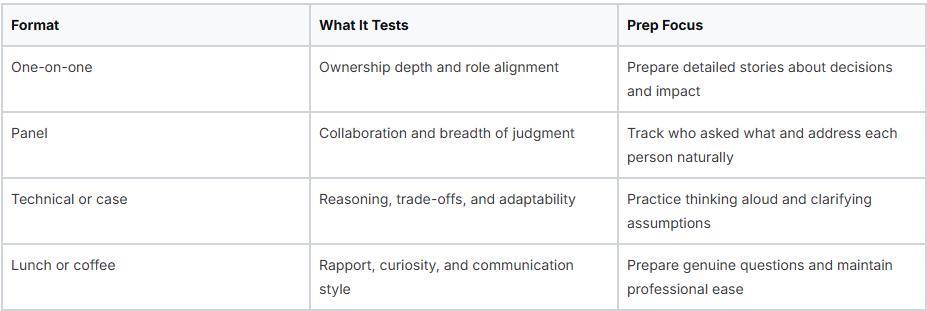
The order often has a purpose. A hiring manager may open the day and establish context, a technical session may appear while your energy is steady, and lunch may come later after initial rapport exists. Don't expect a flat performance across the day. Plan for changing energy, different personalities, and roughly 5 to 8 conversations, depending on the employer and role.
Two-Week Prep Plan With Mock Interview Workflows
A finalist loop can feel like a long exam, especially when you are switching careers, managing nerves, or processing information differently. Treat the two weeks as a rehearsal system. Each day should train one part of the onsite: recalling evidence, explaining decisions, adapting to follow-up questions, and showing that your experience matches your own application.
Days 1 through 5
On Days 1 and 2, study the company's mission, products, customers, leadership messages, and recent news. Note what the role appears to own and where your background connects. This research helps you answer consistently when several interviewers test the same experience from different angles.
On Days 3 through 5, collect role-specific questions from the job description, recruiter guidance, professional communities, and practice interview questions. For each likely behavioral topic, select one genuine experience. Put three cues on a 3x5 index card: Situation, Action, Result. Add a tag such as “leadership,” “ambiguity,” or “conflict.” The card should prompt memory, not replace it with a script.
Days 6 through 12
From Days 6 through 9, use this mock workflow:
- Choose a real question set: Mix behavioral, technical, case, and role-specific prompts.
- Record yourself: Use your phone to hear your speed, filler words, and unfinished explanations.
- Review the playback: Mark answers that bury the action or repeat “um,” “like,” “you know,” or other phrases.
- Transcribe selectively: Write down one answer and count filler words manually.
- Redo with a time cap: Begin with the action, pause between sections, and remove context that does not support your point.
Pair some sessions with a friend, coach, or an AI mock interview tool. Ask the reviewer to score clarity, evidence, structure, listening, and answer length. Request one behavior to keep and one to change. For an authenticity checkpoint, compare your spoken answers with your resume. If your wording, dates, or level of ownership shifts, clarify the story before the onsite. Consistency makes a finalist loop feel less like fraud verification and more like a conversation you have practiced.
Days 13 and 14
Use Days 13 and 14 for a full timed run-through in interview clothing. Practice shifting from a behavioral answer to a technical explanation, then to a question for the interviewer. During the final 48 hours, taper. Do not add a new library of content. Prioritize sleep, hydration, a calm logistics review, and a quick scan of your cue cards.
For pacing, rehearse 130 words per minute, with a two-second pause between context, action, result, and reflection. These are targets, not rules. The aim is a repeatable rhythm that leaves room to listen, think, and answer in your own words.
Day-Of Checklist and Pacing Strategies
The morning should feel boring. Boring is useful because it leaves your attention available for people and problems instead of missing logistics.
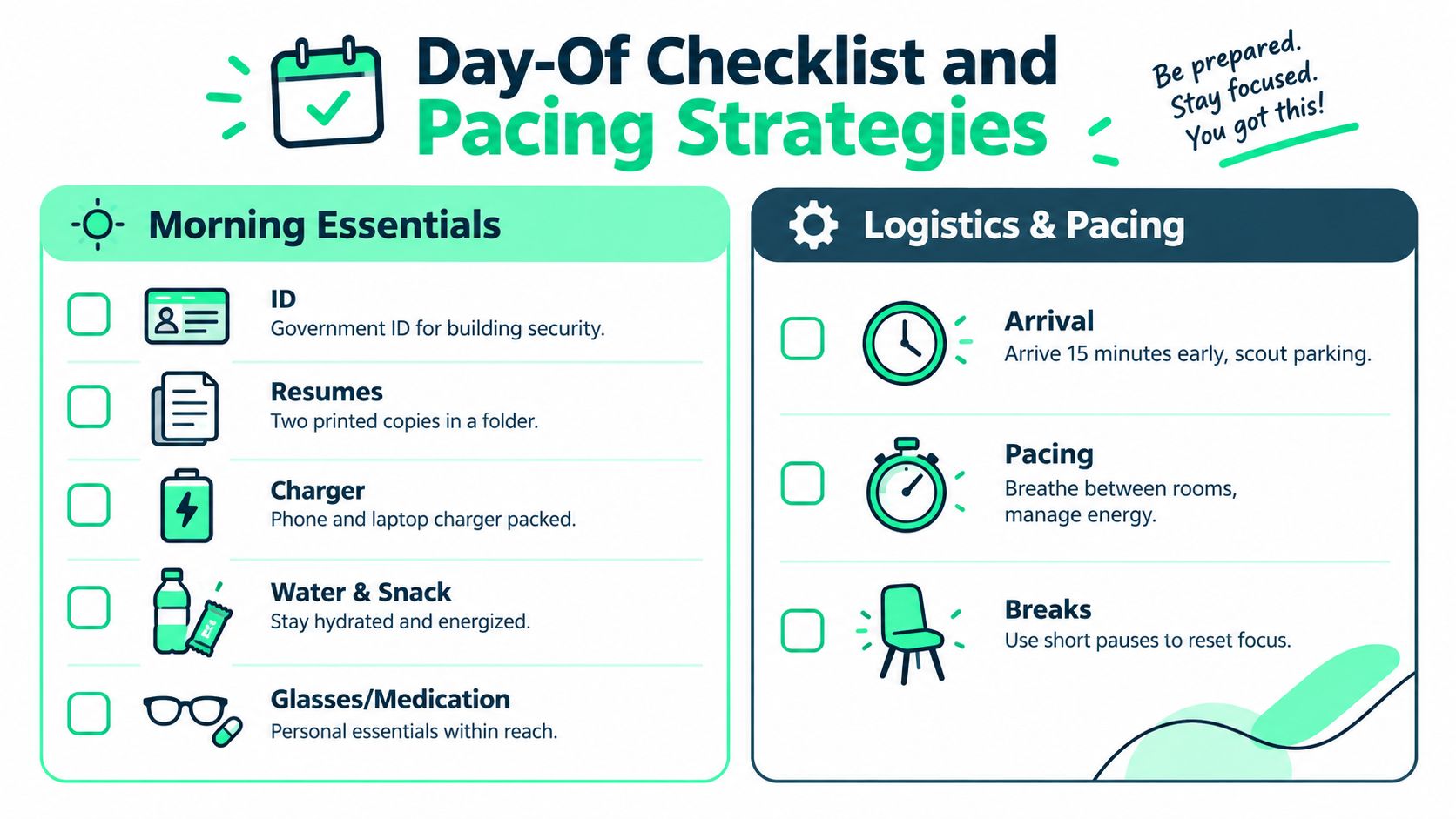
Pack your essentials the night before:
- Identification: Bring the ID required for building security.
- Printed resumes: Carry two copies in a folder, even if the company already has your resume.
- Technology: Pack your phone and laptop charger if you're expected to use either device.
- Comfort items: Bring water, a snack, glasses, medication, and any small item that helps you regulate.
- Route details: Scout parking, public transit, building access, and the lobby entrance.
Arrive 15 minutes early. At reception, use a simple script: “Hi, I'm [name]. I'm here to meet [contact] for an interview.” You don't need to explain your whole career to the security desk.
Your first thirty seconds
When you enter the room, knock if appropriate, smile, offer a handshake or wave based on the setting, and use one grounding sentence such as, “I'm glad to be here and excited to learn more about the team.” Sit, place your materials where they won't distract you, and take a sip of water.
Keep breakfast protein-forward if that supports your energy. If you use caffeine, set a personal limit, and avoid experimenting with a new routine on interview day. Between rounds, try the 4-7-8 breathing pattern if it works for you, or use any breathing method you've already practiced.
For answers, aim for about 90 seconds on a standard behavioral prompt. Before a difficult technical question, take a 30-second pause to clarify the problem and organize your approach. If your mind blanks, say, “Let me think about that for a second, that's a great question.”
In a hallway or bathroom, drop your shoulders, unclench your jaw, plant both feet, and reset eye contact before the next room. The totaljobs report cited by Onrec found that 65% of jobseekers said nerves stopped them from showing their true ability, while 41% felt anxious, 26% said they talked too quickly, and 20% said they talked too much. A reset routine addresses the physical pattern before it takes over your answer.
Sample Answers and Behavioral Frameworks That Work
STAR is useful, but many candidates stop too soon. Upgrade it to CARA, which means Context, Action, Result, and Aftermath. The final part gives you space to explain what changed in your approach, what you learned, or what you'd do differently.
A practical answer structure
Keep context short, spend most of your answer on your decisions, state the result plainly, and close with the lesson. Structured interviews work better when candidates provide comparable evidence across answers, and a meta-analysis summary on interview structure supports using common questions and anchored evaluation rather than relying only on free-form impressions.
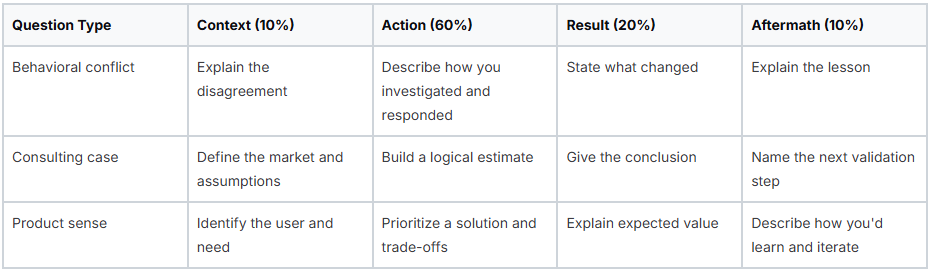
For “Tell me about a disagreement with a coworker,” a strong answer might be: “A coworker and I disagreed about whether to delay a launch for more testing. I asked them to walk me through the failure modes they were seeing, then compared those risks with our launch criteria and customer commitments. We agreed to release a narrower version with monitoring and a rollback plan. The launch proceeded without the highest-risk feature, and the experience taught me to separate disagreement about scope from disagreement about quality.”
For “Estimate the market for electric bicycles in the United States,” begin by defining the market. Segment likely buyers, estimate the number of households or commuters relevant to the use case, state an adoption assumption, and multiply transparently. Then explain which assumption you'd validate first with customer or industry data. The interviewer is watching your structure, not expecting unsupported precision.
For “Design a ride-share feature for elderly users,” identify the user's constraints before proposing features. You might prioritize a simplified booking flow, trusted-contact notifications, accessibility settings, and driver consistency. Explain trade-offs, such as reducing choice to make the experience easier, then define how you'd learn whether the feature helps.
Reframing a difficult experience
Suppose you were pulled off a project. A weak version says, “I was removed because priorities changed, and there wasn't much I could do.” A CARA version says: “The company shifted the project toward a different customer segment, so my original work was no longer the immediate priority. I documented the research, transferred the open decisions to the new lead, and used the freed capacity to improve the team's onboarding guide. The transition reduced confusion for the next phase, and I learned that leadership includes protecting continuity when ownership changes.”
Tag that card leadership and ambiguity. Avoid over-explaining context, apologizing for the result, or ending without a clear outcome. Your answer doesn't need to make every experience sound perfect. It needs to show judgment.
Accessibility, Accommodations, and Cognitive Equity
Requesting an accommodation isn't an admission that you can't perform. It can help the employer evaluate the skill the role requires instead of measuring how well you tolerate unnecessary sensory, communication, or scheduling friction.
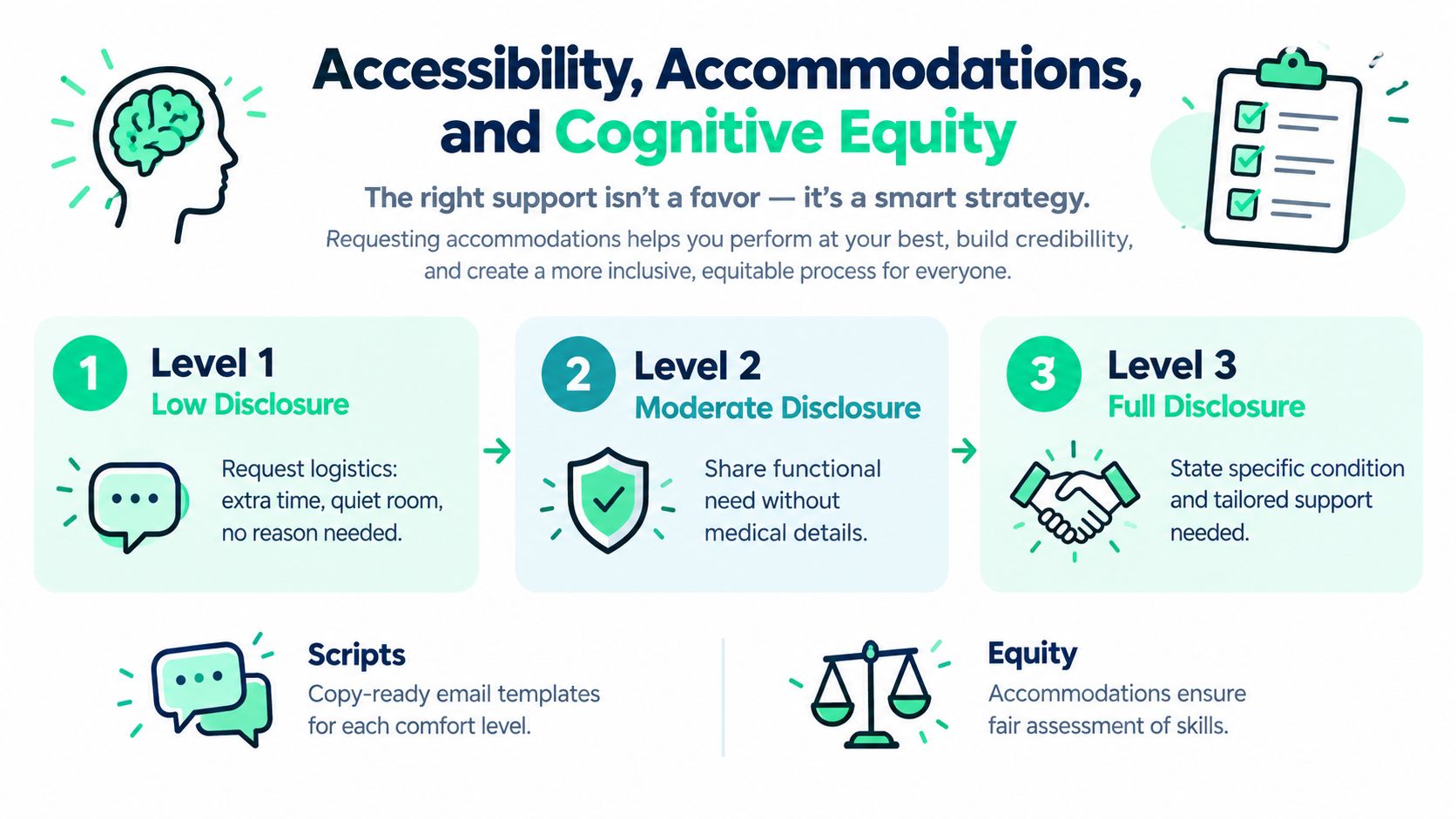
Start with the lowest-disclosure option that meets your need. You can request a printed agenda, a quieter room, a scheduled break between interviews, written instructions for a case exercise, or permission to use a small reference card. These adjustments often improve the process for many candidates, so you can frame them as practical interview conditions rather than personal history.
Scripts for different comfort levels
For a low-disclosure request, write:
“To prepare effectively, could you share the interview schedule in advance and include short breaks between sessions? A printed agenda would also help me keep track of transitions.”
For a functional-need request without medical details:
“I process complex questions best when I can take a brief pause and refer to written prompts. Could I receive the case instructions in writing and have a short reset period between interviews?”
For a formal ADA accommodation request, use direct language:
“I'm requesting a reasonable accommodation for the interview process. I need [specific adjustment] so I can participate fully. Please let me know who should coordinate this request and whether you need any additional documentation.”
You don't have to disclose a diagnosis if you aren't comfortable doing so. You can discuss what helps you communicate, regulate attention, process information, or manage sensory input. A recruiter can tell you what documentation or process applies, but you should ask early enough for the company to make practical arrangements.
Neurodivergent candidates may also request reduced eye contact expectations, written reference supports, a quiet waiting area, or permission to use a stim discreetly. Those supports don't give you an advantage. They reduce artificial barriers so interviewers can assess reasoning, experience, and communication more fairly.
Anxiety can affect candidates across backgrounds. A survey summary from Anxiety.org reported that 92% of U.S. adults felt stressed by at least one part of the interview process, with general anxiety identified as the most common fear at 17%. Build your request around the moment most likely to disrupt you, such as a difficult question, rapid room changes, or unstructured waiting.
Post-Interview Follow-Up and Offer Evaluation
The interview ends when you leave the building, but your evaluation work has just started. Within two hours, write down what happened before conversations blur together. Use one note for each interviewer:
- Role: Who was the person, and what perspective did they represent?
- Question: What did they ask?
- Your answer: What evidence did you provide?
- Signal: Did they clarify, challenge, encourage, or seem concerned?
- Follow-up: What do you still need to verify?
This record helps you distinguish a strong opportunity from the emotional relief of finishing a demanding day.
Thank-you messages with a purpose
Send a concise note when you want to confirm appreciation and interest:
“Thank you for speaking with me today about the [role]. I enjoyed learning how the team approaches [specific topic], and our conversation strengthened my interest in contributing through [relevant skill].”
Use a relationship-building version for a potential teammate:
“I appreciated your perspective on [specific challenge]. The way you described collaboration between [teams] helped me understand how the role operates day to day. I'd be excited to continue the conversation.”
If you missed a question, don't pretend otherwise. Send a brief correction:
“I've been thinking about your question on [topic]. I answered too narrowly in the moment. A fuller answer is [clear answer], because [reason]. I wanted to share the clarification while it was still fresh.”
You can use Qcard's interview thank-you email resource to organize the message, but personalize the final version with a detail from the conversation. Follow the recruiter's stated timeline. If they gave no timeline, send a polite check-in after a reasonable period, then space additional messages rather than sending daily reminders.
Compare the offer, not only the salary
An offer should reflect the whole working arrangement. Rate each factor using your own priorities, then write evidence from the onsite beside the rating.
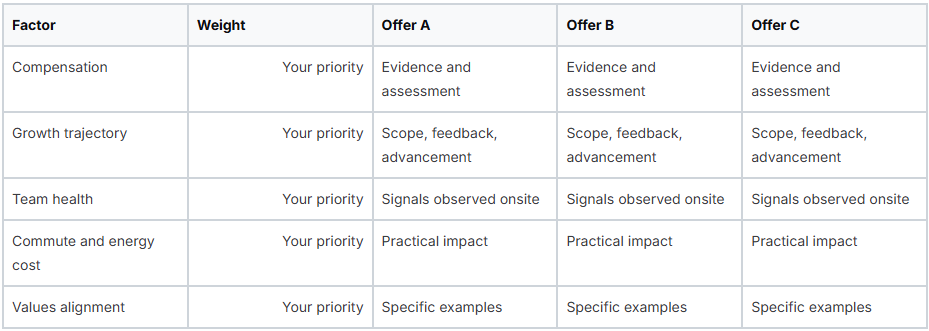
Use a 48-hour rule before accepting, declining, or negotiating when possible. To negotiate, name the factor you're discussing, provide a clear rationale, and ask whether flexibility exists. To decline, thank the recruiter, state that you've decided not to proceed, and avoid criticizing individual interviewers. To accept, confirm the role, start date, reporting line, and written terms so enthusiasm doesn't replace careful review.
Key Takeaways
- Onsite rounds now function as authenticity checkpoints, which changes what you prepare — every major resume claim should be easy to narrate without notes (what the situation was, what you personally did, what changed, what you learned), because interviewers are comparing the person they meet onsite with the candidate they met remotely.
- Different formats measure different things, so stop treating every room as the same test — a hiring manager wants ownership depth, a cross-functional panel wants evidence you can influence without authority, a technical segment wants to watch your reasoning, and a lunch conversation reveals how you engage when the setting feels less scripted.
- CARA beats STAR because the Aftermath section is where judgment shows — keeping context to about 10%, spending 60% on your actions, stating the result plainly, then closing with what you'd do differently turns a story about being pulled off a project from a passive complaint into evidence that you protected continuity when ownership changed.
- Day-of performance depends on physical management, not just content — a totaljobs report found 65% of jobseekers said nerves stopped them from showing their true ability, 26% said they talked too quickly, and 20% said they talked too much, which is why a hallway reset routine, a 30-second pause before technical questions, and a practiced blank-recovery line matter as much as your examples.
- Requesting accommodations is a fairness measure, not a disclosure obligation — start with the lowest-disclosure option that meets your need (a printed agenda, a quieter room, scheduled breaks, written case instructions, a small reference card), frame them as practical interview conditions, and remember you can describe what helps you process information without naming a diagnosis.
If you're preparing for an upcoming onsite interview, use Qcard's resume-grounded memory cues, practice tools, pacing feedback, and interview checklists to rehearse without memorizing a script. Visit Qcard to build a calmer, more authentic preparation routine around the experience you'll need to explain in the room.
Ready to ace your next interview?
Qcard's AI interview copilot helps you prepare with personalized practice and real-time support.
Try Qcard Free