TL;DR
Mock interview coaching replaces monologue rehearsal with a feedback loop: question, answer under constraint, observable critique, revision, and a retry that tests the change. That matters because 93% of Americans report interview anxiety, and job seekers spend over five hours worrying per interview versus roughly three hours preparing. Pick your format based on the bottleneck — AI practice for repeatable drills and consistent scoring, human coaching for interpretation and relational feedback, live sessions for spontaneity, recorded sessions for delivery analysis, behavioral prompts for transferable stories, and role-specific prompts for targeted signals. Prepare by giving the coach your resume and job description, writing down one observable concern rather than "I'm nervous," and building a mixed question set. Good feedback is specific, timely, rubric-based, and critiques the answer rather than the person, with research showing during-interview feedback outperformed post-interview or no feedback. Structure your first week as baseline, review, adjustment, live mock, and debrief — and treat scores as trends, not verdicts.
The night before a final-round interview, you sit at the kitchen table with your resume open, a glass of water nearby, and a list of answers you've rehearsed until the words feel familiar. Then you say one aloud and hear the problem immediately. The example is relevant, but the story wanders. You're speaking too quickly. A filler word appears between nearly every thought. The answer you imagined in your head sounds more confident than the one coming out of your mouth.
That gap can feel personal, but it usually isn't a sign that you're unqualified. Interview anxiety changes how people retrieve information, pace their speech, and interpret pauses. A 2020 survey reported that 93% of Americans experienced anxiety related to job interviews, while respondents said only public speaking made them more nervous. The same survey found that 70% practiced answers out loud and 62% prepared anecdotes ahead of time, showing that rehearsal is already a common response to interview stress (JD Power interview preparation research).
Solo rehearsal helps you remember what you want to say. It can't show you what an interviewer hears. Mock interview coaching adds an observer, a standard, and a feedback loop, turning practice from a monologue into a process of question, answer, feedback, adjustment, and repeat. The difference isn't the number of times you speak. It's whether each attempt gives you useful information for the next one.
What Is Mock Interview Coaching and How Does It Work?
Mock interview coaching is a timed practice interview led by a coach, peer, or AI tool, followed by feedback tied to a clear standard. The sessions can use behavioral questions, technical problems, case prompts, leadership scenarios, or a role-specific mix.
The difference from solo rehearsal is the feedback loop. Practicing alone tells you whether you remember your content. It can't tell you what a listener actually hears — whether the story wanders, whether you reach the result too late, or whether filler words appear at every transition.
The loop has five stages:
- You receive a question.
- You answer under a time or conversational constraint.
- The coach identifies an observable issue.
- You revise the answer or delivery.
- You answer a similar question and test the change.
The number of rounds matters far less than the quality of that loop. Feedback delivered too late blurs the connection between the behavior and its effect. Vague feedback like "sound more confident" gives you nothing to adjust. Specific, timely feedback works like a compass — it points to one change, then lets you check whether you moved in the right direction.
The goal is calibration, not memorization. Memorized answers sound rigid and collapse when an interviewer rephrases a question or asks a follow-up. Calibration teaches you how much context to give, where to state your action, how to explain the result, and when to pause.
The standard should match the question type. Behavioral answers get reviewed for STAR clarity. Technical responses get assessed for assumptions, reasoning, and communication. Case answers get examined for structure, prioritization, and comfort with ambiguity. The subject changes; the feedback architecture stays the same.
Judge any coach or tool by one question: does it help you identify a behavior, correct it, and test the correction?
A Familiar Moment Before the Interview
Maya has prepared carefully for a product marketing interview. She has written out answers to common behavioral questions, highlighted projects on her resume, and practiced her “tell me about yourself” response while walking to work. At home, the answer sounds polished. During a practice call with a friend, she notices that she spends the first minute describing the background and reaches the actual result only at the end.
Her friend also notices that Maya says “kind of” when she isn't sure how to transition, then speeds up when discussing conflict. Maya had never heard those habits because solo practice gave her no outside mirror. She was checking whether she remembered the content, not whether the content was clear to another person.
Anxiety makes that blind spot harder to manage. A 2026 survey summary found that job seekers spend over five hours worrying about an interview versus three hours preparing for each interview, and that nearly three-quarters use AI for interview preparation. The survey covered 756 U.S. job seekers, with a 95% confidence level and a 4% margin of error (2026 job readiness survey summary). Gen Z respondents reported the highest pre-interview worry at 6.1 hours, compared with 3.6 hours for Baby Boomers, suggesting that experience can reduce anxiety over time.
The problem often isn't that you lack an answer. It's that you haven't practiced delivering it while someone else is evaluating it.
Mock interview coaching creates that missing context. A coach, peer, or AI tool asks a question, listens to the response, identifies a specific behavior, and gives you a chance to try again. You learn whether your example answers the question, whether your structure is easy to follow, and whether your delivery supports the point you're making.
That matters for graduates, career switchers, international students, and neurodivergent candidates who may know their experience but struggle to retrieve it smoothly under pressure. The useful question isn't “How many mock interviews should I do?” It's “What information will this next attempt give me, and how will I apply it?”
What Mock Interview Coaching Is and How the Feedback Loop Works
Mock interview coaching is a timed practice interview led by a coach, peer, or AI tool, followed by feedback tied to a clear standard. The session may use behavioral questions, technical problems, case prompts, leadership scenarios, or a role-specific mix.
The difference from solo rehearsal is the feedback loop. Someone or something evaluates your answer as a listener, rather than as the person who already knows what you meant. A defined question set prevents you from choosing only familiar stories, while a review or scoring moment shows what to change in your structure, relevance, delivery, or role fit.
A useful loop has five stages:
- You receive a question.
- You answer under a time or conversational constraint.
- The coach identifies an observable issue.
- You revise the answer or delivery.
- You answer a similar question and test the change.
The number of rounds matters less than the quality of this loop. Feedback delivered too late can blur the connection between the behavior and its effect. Feedback that is vague, such as “sound more confident,” gives you no clear adjustment. Feedback that is specific and timely works like a compass: it points to one change, then lets you check whether you moved in the right direction.
The goal is calibration, not script memorization. Memorized answers can sound rigid and may fail when an interviewer changes the wording or asks a follow-up. Calibration teaches you how much context to provide, where to state your action, how to explain the result, and when to pause.
The standard should match the question type. A behavioral answer may be reviewed for STAR clarity. A technical response may be assessed for assumptions, reasoning, and communication. A case answer may be examined for structure, prioritization, and comfort with ambiguity. The subject changes, while the feedback architecture stays consistent.
The Eztrackr interview preparation guide can support broader preparation around organizing practice and interview materials. Judge any resource by one question: does it help you identify a behavior, correct it, and test the correction?
Encouragement has a place, but “That was a good answer” is incomplete. Strong coaching turns a reaction into an instruction you can apply immediately: “State the decision before explaining the background, then end with the business result.” That instruction gives your next attempt a clear purpose.
Formats You Can Choose Between
The right mock interview format depends on the feedback loop you need. Consider three questions: what must you practice, how quickly do you need evidence of improvement, and whether the obstacle is access, confidence, role knowledge, or delivery. A useful format gives you a clear behavior to test, feedback soon enough to remember the attempt, and another chance to apply the adjustment.
AI and human practice
AI practice is available on demand, so you can repeat one competency without scheduling another session or feeling embarrassed by a rough attempt. It can also apply the same rubric across sessions, which helps you compare changes rather than rely on memory. An AI tool such as Qcard can score STAR answers instantly. The AI interview coach shows how that kind of immediate scoring can support practice, while a human coach may notice a cultural-fit cue, a guarded tone, or a useful follow-up that automated feedback misses.
Human coaching matters when the problem requires interpretation. A coach can ask why you chose an example, test whether the story fits the role, or notice that an answer is technically correct but disconnected from the team's priorities. AI suits repetition and consistency. Human support suits judgment, context, and the small signals that change how an answer is received.
The strongest setup often combines both. Use AI to run several focused attempts, then bring a difficult pattern to a person who can explain what it means and how to change it.
Live and recorded practice
Live sessions test spontaneity. You must listen, decide what matters, and respond without editing yourself. That makes them useful if unexpected follow-ups cause you to freeze or if your structure disappears during conversation.
Recorded sessions provide a different kind of evidence. Replaying an answer lets you inspect details that were invisible while you were speaking. You might see that you look away when describing uncertainty, use filler words before each conclusion, or leave pauses that feel longer to you than they sound to the listener.
Behavioral and role-specific practice
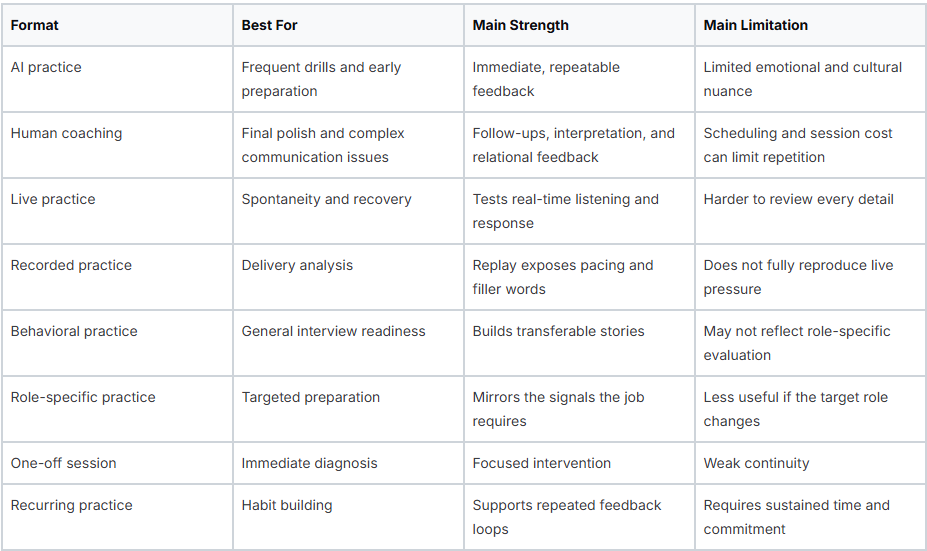
Your combination might be AI drills for repetition, recorded answers for self-review, and one human mock before the interview. Choose the format that produces the feedback you need, rather than treating practice volume as the goal.
How to Prepare for a Mock Session
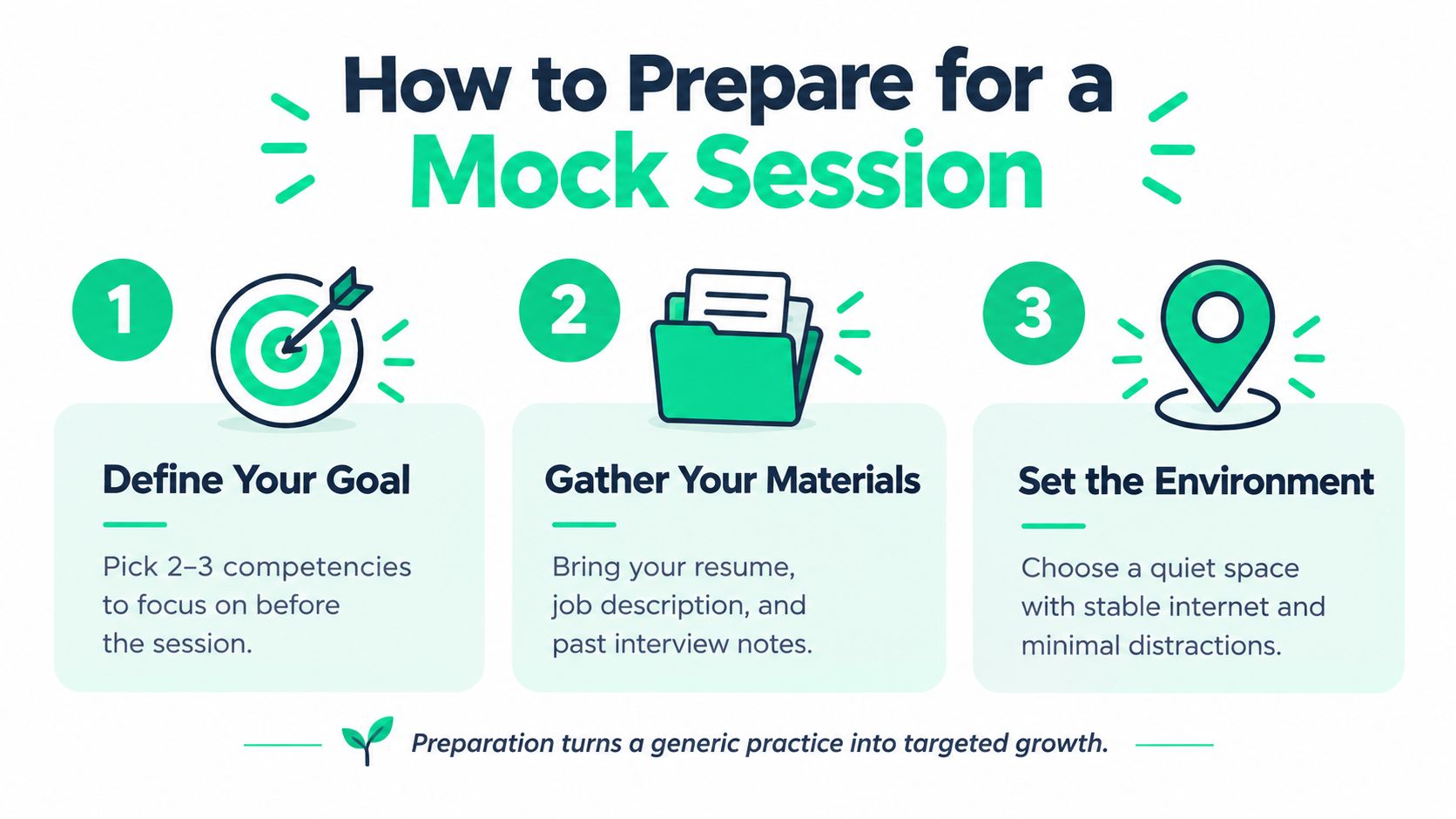
Preparation determines whether a mock session exposes blind spots or just confirms what you already believe. You don't need a complete script. You need enough context for the practice to resemble the interview you're pursuing.
Start with the actual role
Give the coach your resume and the target job description. Highlight the competencies that appear repeatedly, such as stakeholder management, data analysis, customer empathy, or technical leadership. A generic prompt like “Tell me about a challenge” produces generic feedback. A role-grounded prompt might ask how you handled a product launch with conflicting stakeholder priorities.
Write down the concern that makes you most uneasy. “I'm nervous” is real but broad. “I give too much background before answering,” “I freeze when asked about failure,” or “I struggle to explain a career change” gives the coach something observable to test.
Build a compact question set
Mix prompts instead of practicing only the questions you already know:
- Behavioral: “Tell me about a time you changed someone's mind.”
- Technical: “How would you investigate a sudden drop in activation?”
- Role-specific: “How would you prioritize the first month in this position?”
For each question, jot down the experience you might use, not a paragraph to memorize. Your notes should help you retrieve the story while leaving room for natural language.
Remove avoidable friction
Set up the camera at eye level, choose a quiet room, keep water nearby, and place your resume and job description within reach. Check the microphone before the session. These details won't eliminate anxiety, but they prevent a poor connection or uncomfortable setup from becoming confused with a communication problem.
A focused 45-minute session is enough to work on a defined set of behaviors. Keep the scope narrow, take notes immediately, and leave time to retry the most important answer. Rest matters because exhausted practice can teach you to associate interviews with punishment rather than improvement.
The Qcard interview prep guide can help you organize preparation materials and practice priorities before you begin. Treat it as a starting point, then tailor every prompt to the role and the concern you wrote down.
What Good Feedback and Scoring Look Like
Good feedback is specific, timely, and tied to a rubric. “Great answer” describes a reaction. “Your example shows ownership, but the result is unclear because you end with the team's activity instead of the customer outcome” identifies a fix.
Timing changes how well feedback works. Research on simulated interviews found that participants who received feedback during the interview performed better immediately after training than those who received feedback only after the interview or no feedback at all. The proportion of open-ended questions was highest in the during-interview feedback condition, .85 versus .67 versus .56, with p<.001 (simulated interview feedback study).
That finding supports a practical design choice. If you're working on pacing, filler words, response length, or conversational depth, feedback should arrive while the behavior is still easy to recall. A long summary at the end can be useful, but it shouldn't be the only intervention.
Five dimensions worth examining
A serious service should expose the reasoning behind its score. Look for dimensions such as:
- Structure: Does the answer move clearly from situation to action to result?
- Content specificity: Does it include concrete decisions, actions, and consequences?
- Concision: Does it answer fully without burying the main point?
- Confidence signals: Do tone, pace, posture, and language support credibility?
- Role alignment: Does the story demonstrate a capability the job requires?
The feedback tone also needs care. Critique the answer, not the person. Model a possible improvement, then ask the candidate to retry. Research summarized by the British Psychological Society describes a mock interview experiment in which socially anxious participants responded differently to feedback styles. Positive and neutral feedback made anxious interviewees more anxious, while negative feedback improved impression-making in that interview context. The lesson isn't to be harsh. It's to test whether your style helps this candidate change the behavior.
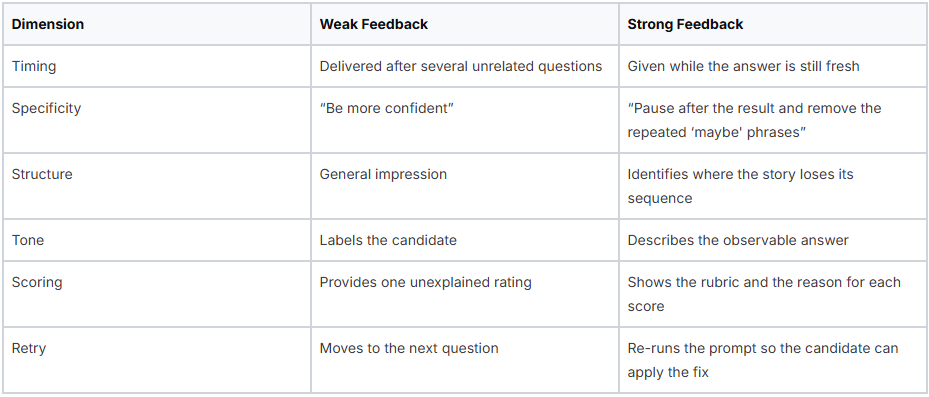
A controlled study on interview training also found that candidates who practiced and then received performance feedback from a counselor achieved higher interview ratings than candidates who only practiced or reviewed their own performance (controlled interview training study). Repetition matters, but repetition plus external calibration is what makes the loop useful.
Choosing the Right Service for You
Choose based on the bottleneck you need to solve. Human coaches excel at reading emotional cues, asking layered follow-ups, and giving relational feedback. AI tools excel at repetition, instant scoring, and removing scheduling friction.
That often makes the choice sequential rather than exclusive. Use AI to drill a story until the structure is stable, then use a human session to test whether the answer sounds credible, natural, and appropriate for the organization. If you're close to an interview and have one recurring issue, a focused human review may be more useful than buying broad access you won't use.
Inspect the service before paying
Ask to see a sample report or a clear description of the scoring rubric. Check whether you can replay sessions, whether the question bank matches your interview type, and whether the tool supports follow-up questions instead of isolated prompts.
You should also ask what happens after a weak score. A number without an explanation doesn't create a correction. A useful system might say that your answer was relevant but too abstract, identify the missing example, and invite you to answer again with a concrete decision and outcome.
Qcard is one example of AI-led practice that sits between solo rehearsal and paid coaching. Its tools include AI-scored practice, mock interviews with follow-up questions, a recording studio, and real-time feedback on pacing, filler words, and answer length. It can fit candidates who want structured repetition before deciding whether they need human support.
If you're comparing paid options, the BAMF guide to measuring the ROI of a coach offers a useful way to think beyond the session price. Track the communication problem you want to change, the evidence that it changed, and whether the improvement transfers to real interviews.
Match the budget to the stage
The infographic below illustrates common trade-offs between flexibility, personalization, and cost. Treat the dollar ranges as visual guidance rather than a universal price list, since providers and coaching levels vary.
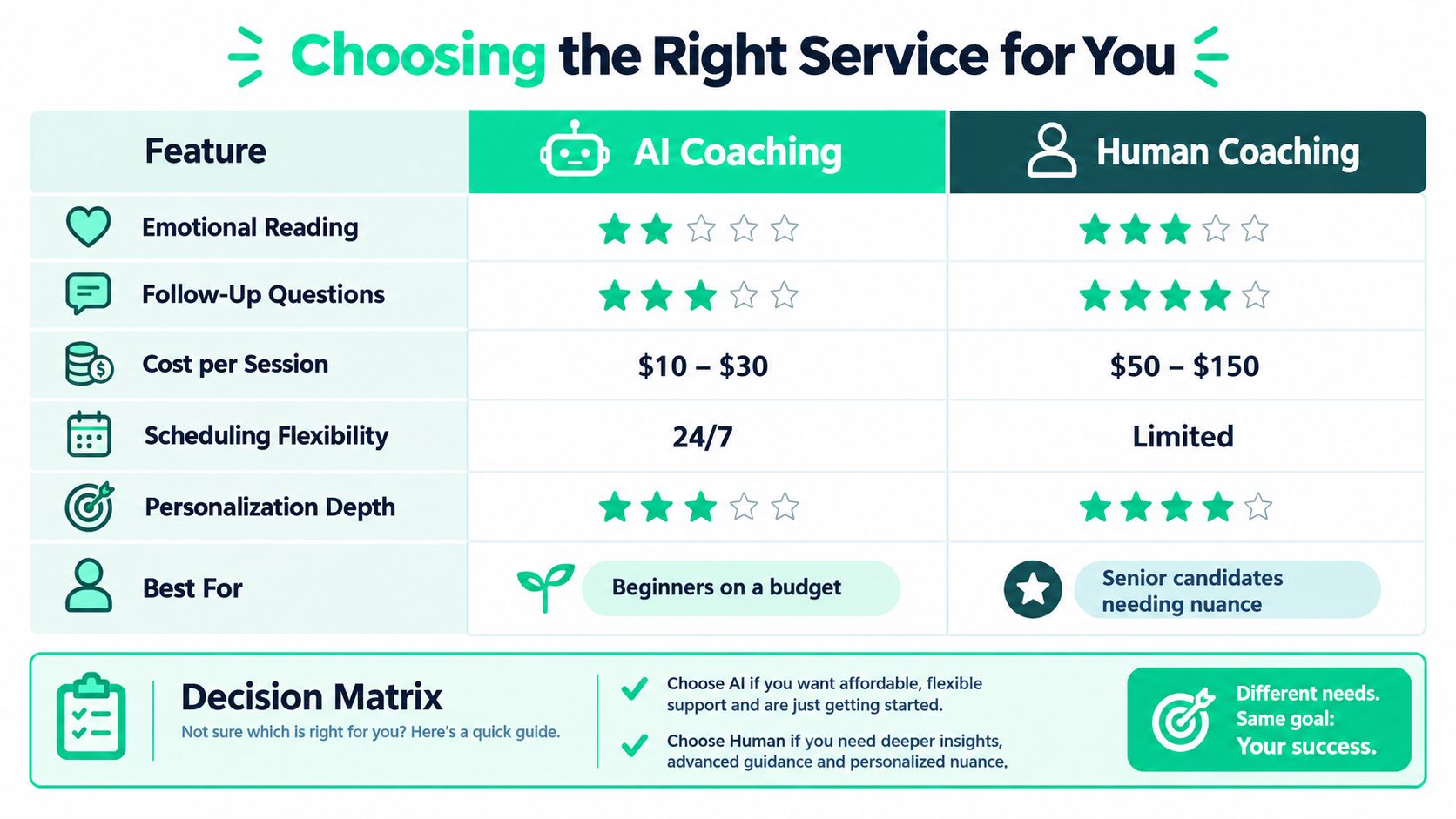
With no budget, record yourself and ask a trusted peer to evaluate one answer against a simple rubric. On a limited budget, use an AI tool for repeated drills and save human coaching for the final review. With more flexibility, combine role-specific simulations, recordings, and a coach who understands the seniority and culture of your target role.
The decision test is straightforward: can the service tell you what to change, help you change it, and show whether the next attempt is better?
Your First Week and the Habits That Stick
A useful first week shouldn't fill every evening with interviews. It should create a small sequence of baseline, feedback, adjustment, and comparison.
On Day 1, record yourself answering three common questions without stopping to edit. On Day 2, replay the recording and mark two issues you can hear or see. On Day 3, retime one answer and write one STAR-style note for a story that needs clearer action or results.
By midweek, schedule one live mock with a coach or peer. Bring the two issues from your recording and ask the reviewer to watch for them. On the following day, revisit the answer that received the clearest criticism, then capture one concrete tweak to carry into the next real interview.
End the week with a short debrief comparing the recorded and live experiences. Did you speak differently when another person was present? Did the AI or recording reveal a delivery habit that the human coach didn't mention? The Qcard thank-you email resource can help you maintain the follow-up habit after a real conversation, but the larger practice is reflection while the experience remains fresh.
Watch for predictable mistakes:
- Booking too many sessions: More practice can become noise if you haven't applied the previous feedback.
- Ignoring body language: Recordings may reveal posture, eye movement, or facial tension that verbal notes miss.
- Treating scores as verdicts: A score is useful as a trend across comparable attempts, not as a judgment of your ability.
- Skipping recovery: Rest days help practice remain sustainable.
- Using one format only: AI, recorded, peer, and human sessions reveal different problems.
After two weeks, ask yourself one question: Are my stories clearer, my pacing calmer, and my specific feedback easier to apply? If the answer is yes, the loop is producing a habit. If not, narrow the target behavior, change the feedback source, or choose a format that better matches the interview you're facing.
Key Takeaways
- Solo rehearsal has a structural blind spot: it confirms whether you remember your content, not whether that content is clear to a listener — which is why a coach, peer, or AI tool that hears the wandering setup, the buried result, or the filler word before every conclusion produces information practice alone never surfaces.
- Feedback timing changes outcomes measurably — research on simulated interviews found participants who received feedback during the session outperformed those who received it only afterward or not at all (open-ended question proportion of .85 vs .67 vs .56, p<.001), so if you're working on pacing, length, or filler words, the critique needs to arrive while the behavior is still fresh.
- Calibration beats memorization because scripts fail on rephrased questions and follow-ups — the goal is learning how much context to provide, where to place your action, how to close with a result, and when to pause, so the answer holds up when the interviewer changes the wording.
- Format should follow the bottleneck, not preference — AI practice gives repeatable drills and one consistent rubric across sessions, human coaching supplies interpretation and relational cues automated feedback misses, recordings expose posture and pacing invisible while speaking, and live sessions test spontaneity; the strongest setup is usually sequential (AI drills first, one human mock before the interview).
- Vet any service before paying by asking what happens after a weak score — a number without an explanation creates no correction, while a useful system names the gap ("relevant but too abstract"), identifies what's missing, and invites you to answer again with a concrete decision and outcome.
Qcard offers AI-scored practice, mock interviews with intelligent follow-ups, recording tools, and real-time coaching for pacing, filler words, and answer length. Use it to turn your next rehearsal into a structured feedback loop, then visit Qcard to explore the interview practice tools.
Ready to ace your next interview?
Qcard's AI interview copilot helps you prepare with personalized practice and real-time support.
Try Qcard Free