Marketing Interviews Questions: 8 Sample Answers for 2026
You can have strong marketing results on your resume and still freeze when an interviewer asks you to explain your career or describe a difficult project. The problem usually isn't a lack of experience. It's that the experience hasn't been shaped into a clear answer with evidence, ownership, and a useful conclusion.
Interviewers listen for specific signals: clarity, measurable results, judgment, communication, and self-awareness. Structured interviews are designed around consistent questions, order, and scoring criteria, which makes evidence more valuable than conversational charm. A 2022 reanalysis found that structured interviews had an operational validity of 0.42 for predicting job performance, compared with 0.40 for job-knowledge tests and 0.31 for cognitive-ability tests, as summarized in this marketing hiring guidance.
The eight marketing interview questions below pair each prompt with what interviewers score, a realistic answer for an early-career or career-switch candidate, and a rehearsal method. Use the examples as patterns, not scripts. Your answer should sound like you, grounded in your own projects, internships, freelance work, volunteer campaigns, or previous career.
1. Tell Me About Yourself
You sit down, the interviewer smiles, and the first question arrives before you have settled in. “Tell me about yourself.” A weak answer starts at childhood, lists tasks, and loses the room. A strong one gives the interviewer a clear reason to keep going.
This question is your positioning statement. The interviewer wants a concise explanation of who you are professionally, what you have done that matters to this role, and why this move makes sense now. Keep it to 60 to 90 seconds. Start with your current or most relevant experience, add one or two concrete achievements, and close with the direction you want to grow in.
Practical rule: Your opening answer should give the interviewer one strong thread to pull on in the next question.
What interviewers score
They score communication, self-awareness, relevance, and impact. They also listen for ownership. Task language makes you sound interchangeable. Outcome language shows judgment and contribution.
Compare these two approaches. “I helped with social media” tells them almost nothing. “I built the content calendar, tested audience segments, and reported engagement trends to improve campaign decisions” gives them work scope, action, and a basis for follow-up.
An early-career answer might sound like this:
“I'm a recent marketing graduate with internship experience at an e-commerce company, where I supported social campaigns and campaign reporting. In that role, I managed the content calendar, tracked performance, and contributed to audience segmentation that improved efficiency. What I enjoy most is turning campaign data into clearer decisions, and that's why I'm applying for a role where I can grow beyond channel execution into broader marketing strategy.”
A career-switch answer should make the bridge obvious:
“I spent several years in financial services project management, leading cross-functional work and keeping complex implementations on track. Over time, I became more interested in how teams understand customer needs and shape products around them, which led me into UX research. Since then, I've built hands-on experience through coursework and research projects, and I'm now targeting marketing roles where customer insight and clear positioning matter.”
How to rehearse it
Write the long version first. Two short paragraphs are enough. Then cut it down until every sentence earns its place.
Use the Qcard interview preparation guide to identify the achievements on your resume that are worth mentioning in an opener. After that, stop polishing sentences and start practicing delivery. Rehearse from bullet cues, not a script, so you can sound natural if the interviewer jumps in early.
A simple method works well. Record yourself once, listen for vague phrases, replace them with specifics, and try again. If you cannot point to ownership, evidence, or a clear next step, the answer is still too soft.

2. Walk Me Through Your Resume
“Tell me about yourself” is a positioning question. “Walk me through your resume” is a career-logic question. The interviewer wants to see how you describe progression, why you made each move, and what you learned from each role.
Don't read every line of your resume. Organize your answer chronologically, but spend the most time on recent and relevant experience. For each position, explain your title, the work you owned, one meaningful result, and why the next step made sense.
What interviewers score
They're assessing coherence, learning orientation, intentionality, and relevance. A non-linear background isn't automatically a problem. An unexplained sequence of roles is harder to trust.
A linear marketing answer could sound like this:
“I started as a Marketing Assistant, executing social campaigns and email marketing. After a year, I moved into a Marketing Coordinator role, where I managed paid social budgets and optimized campaign performance. I then joined a product team to gain more exposure to market research and positioning. In that role, I supported product launches and built a competitor-analysis process. I'm now pursuing product marketing because I'm ready to combine operational execution with broader go-to-market thinking.”
A career-switch answer should name the transferable capability:
“I spent four years in operations at a financial services firm, optimizing processes and managing implementations. I became increasingly interested in how teams use data to make decisions, so I completed a data analytics bootcamp and started freelancing for small companies. I then took a junior analyst contract to gain technical experience and mentorship. I'm now looking for a full-time role where I can combine project discipline with growing SQL and Python skills.”
How to rehearse it
Prepare a three-to-five-minute version first. After that, practice a 60-to-90-second summary for interviews where the question is used as a quick opener. Mark each role with one achievement, one skill gained, and one reason for moving forward. Address gaps or changes briefly instead of waiting for the interviewer to infer the explanation.
The resume interview question guide can help you identify the claims and transitions an interviewer is most likely to probe. Before the interview, create a short prompt for each role, such as “process improvement,” “stakeholder communication,” or “campaign reporting.”
3. Why Do You Want to Work for This Company?
Generic enthusiasm won't carry this answer. “You're a growing company with great opportunities” could describe almost any employer. Strong candidates show that they've investigated the company and can explain why its product, market, team, or values connect to their goals.
Choose two or three concrete details before the interview. These might include a product feature, a recent company initiative, an engineering article, a leadership post, or a customer problem you understand personally.
What interviewers score
They're looking for genuine interest, research depth, role fit, and career direction. The strongest answer connects something specific about the company with evidence from your own experience.
For a product-focused answer:
“I've used your product for the past year, and I was impressed by how it solved a problem I'd struggled with in campaign reporting. I've followed your product updates and noticed the move toward stronger workflow automation. I also read your engineering article about the reporting infrastructure, and it showed the level of technical thinking behind the product. I want to contribute to something I already understand as a user while working on a problem that has real complexity.”
For a values-aligned answer:
“I've researched your commitment to neurodiversity and inclusive hiring, and that resonates with me as someone with ADHD. I've also followed your transparency reporting and investment in underrepresented communities in technology. Beyond those values, I'm interested in the customer problem your platform solves and the way this team connects research, product, and marketing. I'm looking for a place where my work can have a visible effect on users who face barriers I understand personally.”
How to rehearse it
Build an evidence card with three headings: company detail, why it matters, relevant proof from me. Practice answering without listing facts mechanically. The company detail should lead naturally to your experience or motivation.
Avoid making personal disclosure the center of the answer unless you're comfortable doing so. Values alignment can be discussed through your work, volunteering, or professional standards. Use a resume-grounding tool such as Qcard to connect verified achievements to the company's needs, then check that every claim you make is accurate.
4. Describe Your Experience With a Specific Skill or Technology
This question tests whether your stated skill is theoretical, occasional, or operational in practice. Interviewers don't need you to claim expert status. They need an accurate view of what you can do independently, where you've applied it, and what still requires support.
The best answer names the tool, context, scope, and limits. “I know Google Analytics” is weak. “I used Google Analytics and Google Tag Manager to define events, segment users, and build stakeholder dashboards for two websites” is much easier to assess.
What interviewers score
They're evaluating technical accuracy, applied experience, honesty, and learning ability. Be clear about your proficiency level. If you're intermediate, say so and explain what that means in practice.
A technical example:
“I have production experience with Python and SQL across three roles. In my current position, I write Python scripts to automate data-processing tasks, usually using pandas and NumPy. I've also mentored junior analysts on Python fundamentals. I'm comfortable with classes and error handling, but I'd describe myself as intermediate rather than expert. I haven't worked extensively with asyncio or metaprogramming, so those are areas I'm currently developing.”
A marketing analytics answer might sound like this:
“I've worked directly in Google Analytics and set up Google Tag Manager implementations for two websites. I'm comfortable with custom events, user segmentation, and stakeholder dashboards. I've also used Amplitude for product analytics on a mobile app. I haven't worked extensively with raw warehouse data or SQL queries, because my previous role relied mostly on prepared dashboards. I'm interested in this position partly because it would let me deepen that technical analytics experience.”
How to rehearse it
Create three columns in your notes: can do independently, can do with guidance, learning next. Add one real project under each relevant skill. Practice explaining one implementation from beginning to end, including the business reason, your contribution, the result, and any trade-off.
Don't inflate a skill because the job description uses senior language. Over-claiming creates a difficult follow-up. A precise statement about your current level usually builds more trust than a broad claim that collapses under technical questioning.
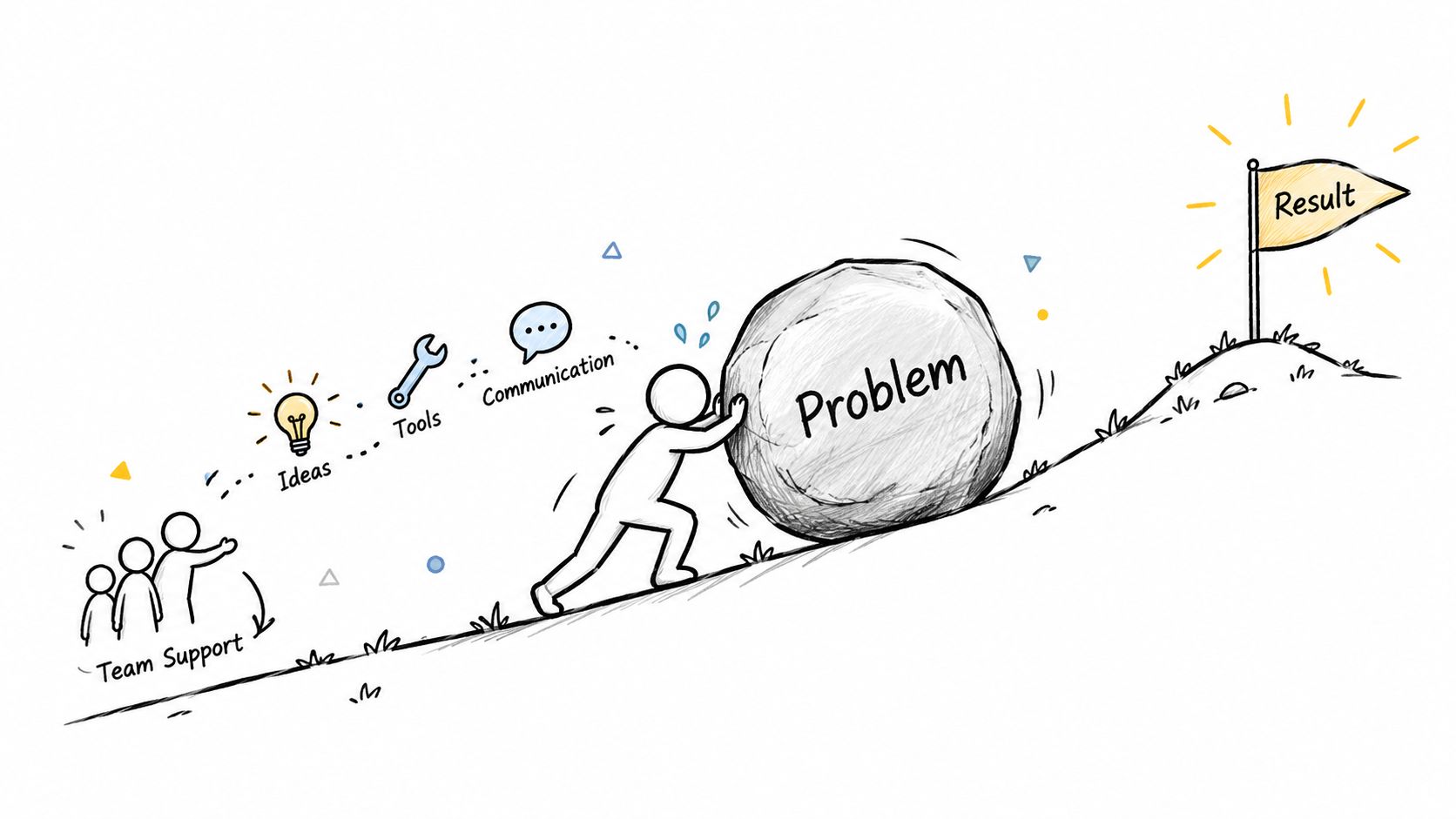
5. Describe a Challenge You Overcame and How You Solved It
Interviewers aren't looking for a story where everything went smoothly. They want to hear how you respond when performance is poor, information is incomplete, or your first idea doesn't work.
Use the STAR structure, Situation, Task, Action, and Result, but give the Action section the most space. The interviewer needs to know what you personally noticed, decided, tested, changed, or communicated.
What interviewers score
They're listening for problem-solving, resilience, ownership, collaboration, and reflection. A good challenge has real consequences, but it doesn't need to be dramatic. An underperforming newsletter, a confusing reporting process, or a difficult stakeholder can all work if your decisions are clear.
An entry-level answer could be:
“During my internship, I noticed our email newsletter had a 12% open rate, which was below the team's expectation. I reviewed previous subject lines and found that most were generic and looked similar. I proposed testing five subject-line formats, documented the results, and created a template guide for future sends. Within two months, open rates improved to 28%. The experience taught me to investigate an underperforming result instead of assuming the channel itself was the problem.”
An international candidate might frame communication as a practical challenge:
“As a non-native English speaker in my first corporate role, I struggled with video calls and technical jargon. I started listening to industry podcasts, created a glossary, and asked my manager for one-to-one coaching. Within three months, I was contributing confidently to client calls and caught a technical error that others had missed. I learned to address a communication gap directly rather than staying quiet and hoping it would disappear.”
How to rehearse it
Prepare three or four challenge stories. For each one, write the initial problem, your responsibility, two or three actions, the outcome, and what you'd do differently now. Practice answering the follow-up “What was your specific contribution?” because that question separates your work from the team's work.
Use the practice interview question library to rehearse the same story against different prompts. Your example should be adaptable, but the facts must stay consistent.
6. Tell Me About a Time You Had to Adapt to Change
Change questions reveal more than whether you can comply with a new plan. They show how you think when previous work loses value, expectations shift, or the available tools change.
Start with the trigger. Was there a company pivot, a new manager, a remote transition, a market change, or a new reporting system? Then explain your initial reaction, followed by the actions that helped you become effective under the new conditions.
What interviewers score
They're assessing flexibility, learning agility, emotional maturity, and proactivity. “I adapted because my manager told me to” is compliance. “I changed my workflow, identified a risk, and helped the team maintain quality” demonstrates judgment.
An early-career answer could be:
“During my internship, the company moved from office-based work to fully remote work. I'd expected to learn through informal contact with my manager, so I was initially concerned that I'd miss context. I started weekly one-to-one calls, created a shared digital workspace, and documented recurring processes. The new structure made me more independent and improved team documentation. When the team later returned to a hybrid model, I kept the documentation process because it worked better than relying on informal conversations.”
A product example might sound like this:
“Six months into my product management role, our CEO changed the product strategy after customer research showed that our initial market was too small. I was frustrated because I'd spent months planning features, but the evidence was strong. I analyzed which existing work applied to the new market and helped the team separate reusable work from work we should stop. The experience changed how I approach strategy. I'm now more willing to release attachment to an initial plan when customer evidence points elsewhere.”
How to rehearse it
Choose one change you actively influenced, not merely endured. Practice naming the old assumption, the new information, your response, and the resulting improvement. Don't pretend you felt no concern. A measured acknowledgment followed by concrete action sounds more credible than instant enthusiasm.
7. What Is Your Greatest Weakness?
This question doesn't reward a clever disguise. “I work too hard” and “I care too much” sound rehearsed because they avoid a real development area. Choose a genuine weakness that isn't central to the role's core requirement, then show how you're addressing it.
Keep the answer to 60 to 90 seconds. Explain when you noticed the issue, why it mattered, what you changed, and how you know you're improving.
What interviewers score
They're looking for self-awareness, humility, accountability, and a practical improvement plan. A weakness without action sounds like an excuse. An action plan without honesty sounds like a performance.
An early-career answer might be:
“Public speaking has been difficult for me. During my first internship, I prepared carefully for a team presentation but still felt anxious while delivering it. I joined Toastmasters and completed a presentation-skills course instead of avoiding speaking opportunities. I've since delivered five client presentations, and I now prepare more efficiently and communicate with less anxiety. This role includes stakeholder updates, so I'm continuing to develop this skill because clear communication affects whether good analysis gets used.”
A career switcher could address a technical gap:
“I don't yet have deep experience with the technical skill this role requires. I've completed a relevant course and contributed to two projects where I used the skill in practice. I expect a learning curve, but I've built a reliable approach of breaking unfamiliar problems into smaller parts, asking focused questions, and documenting what I learn. I'm developing this capability deliberately rather than presenting myself as more advanced than I am.”
How to rehearse it
Score your candidate weaknesses against three tests: Is it real? Is it manageable in this role? Can I show action? Avoid choosing a weakness that directly undermines a core responsibility. For a communication-heavy marketing role, saying you refuse presentations is more damaging than acknowledging that you're still improving executive-level storytelling.
End with current behavior, not a promise. “I now send a concise pre-read before stakeholder presentations” is stronger than “I'll keep working on it.”
8. Why Are You Leaving Your Current Role or Why Did You Leave?
This question can make a good candidate sound defensive. Keep the answer focused on direction, growth, and fit. You don't need to deny real problems, but criticizing a manager or former employer rarely helps the interviewer understand what you'll contribute next.
A strong answer explains what you learned, what has become limited, and what you're moving toward. It should also make clear why this role, rather than any available role, fits that direction.
What interviewers score
They're evaluating motivation, diplomacy, career clarity, and stability. Frequent moves aren't automatically negative, but unexplained moves create uncertainty. Give the interviewer a coherent narrative.
A growth-focused answer:
“I've learned a great deal in my current role and progressed from individual contributor to leading a team of four. I've reached a point where the next management opportunities are limited because the structure above me is stable. I'm interested in this role because it offers the next responsibility I'm ready for, ownership of strategy rather than execution alone. I'm moving toward broader impact, not simply away from a difficult situation.”
A career-switch answer:
“I spent four years in finance, and I became good at the work, but I realized my strongest interest was technology and product development. Rather than stay on a path that didn't motivate me, I made an intentional transition. I've spent the past several months building relevant skills through projects and structured learning, and I'm now ready to commit fully to a technology career. I want to apply my analytical strengths while developing as a technologist.”
A values-based answer can be equally direct:
“I enjoy my team, but I'm looking for an organization whose approach to remote work and inclusion is closer to my values. I've researched your policies and team practices, and they align with the environment where I do my best work. I'm not leaving because of a conflict. I'm looking for a stronger long-term fit.”
How to rehearse it
Write your answer in two columns: what I'm leaving behind and what I'm moving toward. Give most of your spoken time to the second column. If you left under difficult circumstances, acknowledge the facts briefly, take responsibility for your part, and return to the role you want now.
Don't make promises about staying forever. Explain the conditions that help you do strong work and why this opportunity appears to offer them.
Turn These Answers Into a Rehearsal Plan You Can Repeat
Memorizing eight polished responses won't prepare you for a follow-up. Interviewers often change the wording, ask for a deeper example, or move from a general question to a scenario involving budget, attribution, stakeholder disagreement, or an underperforming funnel. You need a story bank that can flex without becoming vague.
Start with three or four verified achievements. Choose one campaign or project that shows measurable impact, one example of problem-solving, one example of collaboration or conflict, and one example of learning or change. For each story, record the situation, your responsibility, the action you took, the result, and the lesson. Keep the facts consistent with your resume and be ready to explain what you personally owned.
Structured interviews work best when questions connect to defined competencies and answers are scored against observable evidence. Guidance from the U.S. Office of Personnel Management on structured interviews emphasizes job-related questions, consistent evaluation, and independent ratings before discussion. You can apply the same logic to preparation. Don't rate yourself on confidence alone. Score whether you identified the problem, explained your contribution, connected actions to outcomes, and reflected on what you learned.
A repeatable practice routine
- Build answer cards: Create one short prompt for each story, such as “email test,” “remote transition,” or “budget decision.” Don't write a complete script.
- Time each response: Practice core answers at 60 to 90 seconds, while keeping a longer version available for resume walkthroughs and follow-up questions.
- Run two mock sessions: Answer each likely question twice, once with a recording and once with a peer or practice interviewer. Compare clarity, evidence, pace, and unnecessary detail.
- Test the follow-ups: Ask, “What did you personally do?”, “Why did you choose that metric?”, “What would you change?”, and “How did you communicate the result?”
- Check the measurement logic: If you discuss analytics, distinguish the business action from the platform configuration. In GA4, an interaction is first collected as an event and then marked as a key event. A corresponding conversion can then be created for consistent measurement in Google Analytics and Google Ads, as explained in Google's GA4 key-event guidance.
- Review ethical boundaries: Keep examples job-related. In the United States, questions about pregnancy, children, childcare, sexual orientation, gender identity, and other protected personal information can be problematic under EEOC guidance. Candidates can redirect an inappropriate question toward availability or job requirements, as described in this EEOC guidance on pre-employment inquiries.
Marketing interviews questions become easier when you stop treating them as a collection of surprises. They're repeated tests of communication, evidence, judgment, adaptability, and learning. Choose the three questions most likely to appear in your target role and rehearse them this week. Then expand your story bank only after those answers sound clear, specific, and natural.
Qcard can generate personalized interview questions from your resume, projects, transitions, gaps, and claims, then provide AI-scored practice through voice or text. Visit Qcard to rehearse marketing interview questions with concise, resume-grounded cues instead of memorized scripts.
Ready to ace your next interview?
Qcard's AI interview copilot helps you prepare with personalized practice and real-time support.
Try Qcard Free