TL;DR
With an hour left, preparation should reduce decisions, not add them. Work through eight steps in order: ground your body with box breathing or a sensory reset, secure your room and tech with a visible backup plan, select three to five resume achievements and turn each into a compact cue (result, contribution, skill match, story trigger), build three STAR examples covering conflict, a challenge, and a mistake at 60 to 90 seconds each, write a 30-second introduction connecting recent experience to this role, prepare three questions and plan to ask two, run a five-minute pacing reset by reading aloud at 60 to 70% of normal speed, then stop preparing. Rapid prep is normal — one 2025 report found 35.8% of candidates spend under an hour — and 86% of job seekers experience blank-page syndrome or freezing from nerves. The goal isn't a perfect performance. It's authentic recall, clear delivery, and enough calm to let the interviewer hear what you can do.
You check your calendar and realize the interview starts in an hour. Your resume is open, your notes are scattered across several tabs, and every possible question suddenly feels urgent. Stop trying to learn everything. The useful last minute interview advice is about removing avoidable friction and making your real experience easier to access under pressure.
Use the next 30 to 60 minutes as a focused interview war room. Regulate your breathing first, secure your room or travel plan, select evidence from your resume, prepare a concise introduction and a few behavioral examples, then rehearse your pacing and questions. You can keep a single-page cue sheet beside you or use a resume-grounded tool such as Qcard to surface memory cues without memorizing scripts. The same plan works for a video call, a technical interview, or an in-person meeting.
Interview anxiety is common, and it can affect performance. One cited survey found that 93% of Americans had experienced interview anxiety, while another study reported 92% of U.S. adults were anxious about job interviews. A meta-analysis also found a corrected correlation of -0.19 between overall interview anxiety and interview performance, as reported in this interview preparation research summary. Your task isn't to become perfectly calm. It's to slow the panic enough to speak clearly.
What Should You Do in the Last Hour Before an Interview?
Stop trying to learn everything. Useful last minute interview advice removes avoidable friction and makes your real experience easier to access under pressure. Treat the next 30 to 60 minutes as a focused war room with eight tasks, in this order:
1. Ground your body first (5 minutes). Box breathing — inhale four, hold four, exhale four, hold four — or the 5-4-3-2-1 sensory method. Anxiety makes familiar information temporarily inaccessible, and the goal isn't calm, it's enough regulation to retrieve what you already know.
2. Secure the environment and technology (10 minutes). Virtual: camera at eye level, light in front of you, quiet background, notifications closed, water outside the frame. Write the backup plan somewhere visible — dial-in number, second browser, second device. In person: confirm route, parking, entry instructions, and plan to arrive 10 to 15 minutes early.
3. Review three to five resume achievements (20 minutes). Don't reread every line. For each achievement, note the result and metric, exactly what you owned, the job requirement it maps to, and a two or three word story cue. Read the page aloud twice. Target 30 to 45 seconds per achievement.
4. Build three flexible STAR examples. One conflict, one challenge, one mistake. Give the most space to your actions and what changed. Target 60 to 90 seconds each. If your resume has no metric, state the qualitative result accurately — never invent a number.
5. Write a 30-second introduction. Three parts: current relevant experience, one achievement proving a useful skill, and why this role. Time it to land between 25 and 35 seconds.
6. Prepare three questions, plan to ask two. Pick ones that reveal priorities, expectations, or decision-making, not anything answered on the careers page.
7. Run a 5-minute voice and pacing reset. Read a paragraph aloud at roughly 60 to 70% of normal speed, pausing between sentences. Your first answer sets the rhythm for the whole conversation.
8. Stop preparing. Don't rewrite the introduction or add new stories once your core evidence is ready.
1. Review Your Resume Core Achievements 30 Minutes Before
Your resume is the fastest route back to your actual experience. Don't reread every line. Select three to five achievements that match the role, then identify the action you took, the problem you faced, and the result you produced.
Choose evidence with concrete details already present on your resume. A career switcher preparing for product management might revisit a cross-functional project that reduced deployment time by 40%, then use that example to answer a question about process improvement. An international student preparing for consulting can mark three client-facing achievements with their existing percentages and timelines, making it easier to answer with specifics instead of broad descriptions.
Build a one-page memory sheet
Write each achievement in a compact format:
- Achievement: State the result and the relevant metric.
- Contribution: Explain exactly what you owned.
- Skill: Connect the example to a requirement in the job description.
- Story cue: Add two or three words that will help you retrieve the full memory.
Read the page aloud twice. Aim to describe each achievement in 30 to 45 seconds, but don't memorize exact sentences. Early-career candidates and neurodivergent candidates can use these cues as permission to pause, glance down, and retrieve a real memory rather than perform a script.
The resume-based interview question practice tool can help you test whether your talking points sound natural and stay tied to your documented experience. Use it to identify which achievements you can explain clearly and which ones still need a simpler cue.
Practical rule: Prepare evidence, not speeches. A metric, an action, and a result will guide a flexible answer better than a paragraph memorized word for word.
Spend the next 10 minutes highlighting your selected achievements, the next 5 minutes mapping them to the job requirements, and the final 5 minutes speaking through them without reading full sentences.
2. Prepare 2 or 3 Strategic Questions About the Role and Company
With only a short time left, choose questions that help you judge the role and show that you listened. Write three options, then plan to ask two. Base each one on the job description, the company's work, or something the interviewer has already mentioned.
Use this quick filter:
- Team challenge: “What problem would you most want this person to help solve first?”
- Success measure: “What would strong performance look like in this role during the early months?”
- Working relationship: “How does the team make decisions when product and technical priorities compete?”
- Learning context: “What helps people grow quickly on this team?”
Select questions that reveal current priorities, expectations, decision-making, or support. Skip anything answered plainly on the careers page. A coding candidate might ask, “What technical debt is the team addressing next, and how do you decide what comes first?” A cybersecurity candidate could ask, “Can you describe a recent incident the team handled and what it changed afterward?”
Spend five minutes checking a recent product update, public announcement, or earnings call when it relates to the position. Bring one detail into your question, then listen to the full answer instead of reciting research. For example, mention a newly announced product and ask how the role would support its next stage.
Use the questions to assess the opportunity, not only to impress the interviewer. Ask what you need to know about the manager, team, expectations, and working style. Candidates also face uncertainty about how interviews are evaluated. One 2025 report found that 63% of job seekers said employers aren't transparent about interview rounds, required projects, or evaluation criteria, as described in this report on neuroinclusive hiring and interview structure. Asking how success is judged can clarify that uncertainty.
Keep the questions beside your resume memory cues. Early-career and neurodivergent candidates can use those cues as prompts, not scripts. Read each question aloud once, keep one backup, and finish this preparation within 10 minutes. Qcard's practice mode can help you rehearse the wording while keeping your delivery conversational.
3. Do a 5-Minute Voice and Pacing Reset
Your first answer often sets the rhythm for the interview. If you start by rushing, you may spend the rest of the conversation trying to catch your breath and organize your thoughts. Use five minutes to move your voice from private thinking mode into clear conversational delivery.
Read a paragraph aloud from the job description, company mission, or a relevant technical article. Pause between sentences. Vary your emphasis so your voice doesn't become flat, and let the final word of each sentence land before starting the next one.
Slow down without sounding unnatural
Don't force an artificial performance voice. Aim for roughly 60 to 70% of your normal speaking speed during the drill, then adjust toward a comfortable conversational pace once the interview begins. A short pause before answering is useful. It gives you time to understand the question and choose the right memory cue.
A coding candidate might read a technical paragraph aloud, emphasizing the problem, decision, and outcome rather than racing through jargon. An international student who tends to speak quickly can use the exercise to articulate each phrase more deliberately, reducing the chance that the interviewer needs to ask for clarification.
HelpGuide recommends slowing and deepening your breathing, recording practice sessions, reducing filler words such as “uh” and “um,” and using a Situation, Action, Result structure based on specific experience in its interviewing techniques and preparation guidance. Record yourself if you can, then replay the clip once. Notice whether you rush the beginning, trail off at the end, or fill pauses unnecessarily.
The AI mock interview practice tool can let you rehearse this reset in a realistic question-and-answer setting, including feedback on pacing and filler words. Use that feedback to choose one delivery control, such as pausing after the question or finishing each sentence before adding context.
Spend three minutes reading aloud and two minutes recording or reviewing your delivery. Complete the exercise before you join the call or leave for the interview.
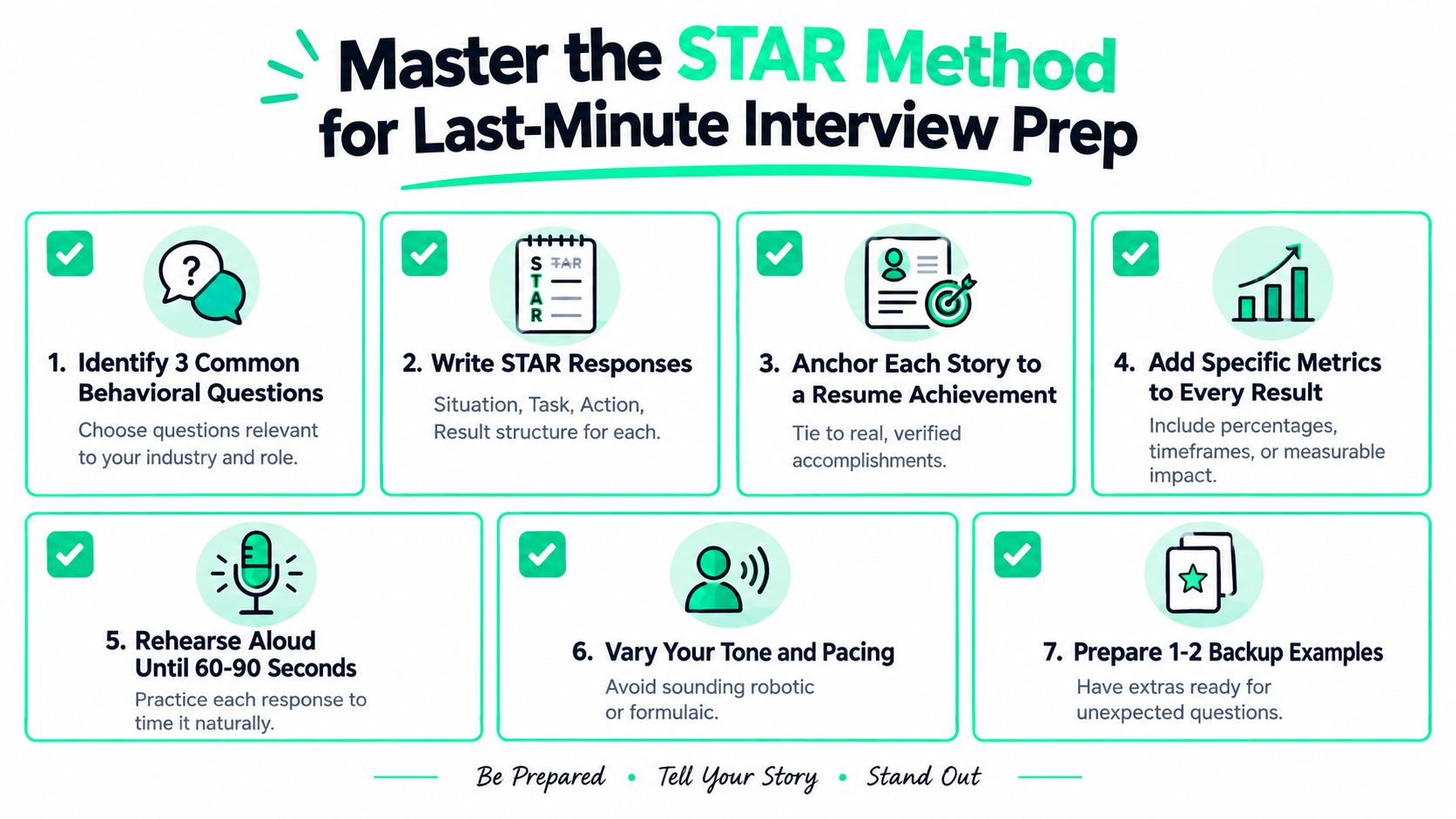
4. Master the STAR Method Briefly for 3 Common Questions
Use STAR to give your memories a clear route under pressure: Situation, Task, Action, and Result. Build three flexible examples from your resume instead of scripting an answer for every possible prompt. This approach works especially well for early-career and neurodivergent candidates, who can use brief memory cues without memorizing a speech.
Select one example for conflict, one for a challenge, and one for a mistake. A banking candidate could use a reconciliation error story for a failure question, explaining the verification checklist they introduced and the documented reduction in errors. A product candidate could describe a disagreement with engineering, show how they brought user data and technical concerns into the discussion, and finish with the agreed MVP decision and documented outcome.
Keep the four-part route short:
- Situation: Set the context in one or two sentences.
- Task: State your responsibility or the obstacle.
- Action: Explain your decisions and specific contribution.
- Result: Describe the outcome, lesson, or measurable change.
Give the most space to your actions and what changed afterward. Aim for 60 to 90 seconds per answer. If your resume has no metric, state the qualitative result accurately. Never create a number to make the story sound stronger. Prepare one or two backup stories so follow-up questions do not force you to repeat one example.
Use the behavioral interview question practice bank to test variations and follow-up prompts. Rehearse each response aloud once, then answer again using only four cue words. The second pass trains recall while preserving a natural delivery.
Name the situation, state your contribution, explain the result, then stop. A clear answer does not need every detail you remember.
Spend 15 minutes creating three outlines, 10 minutes speaking them aloud, and the remaining time checking every claim against your resume. Finish this review before the interview begins.
5. Confirm Technical Setup and Test Backup Plans
Technical failures add stress unrelated to your suitability. Stabilize the setup first, then create a backup you can use without improvising. Open the meeting link early and test the camera, microphone, speakers, screen sharing, and connection.
For example, if background noise appears shortly before the call, move to a quieter room, close unnecessary applications, and test the microphone again. A coding candidate should share the screen, open the required coding environment, and keep a text editor ready if live coding in the platform becomes awkward.
Make the fallback obvious
Write the backup plan where you can see it:
- Connection failure: Keep the interviewer's phone number or dial-in details visible.
- Camera failure: Continue with audio and explain the issue briefly.
- Platform problem: Open the invitation in another browser or on a second device.
- Technical interview issue: Confirm screen sharing and prepare the required editor or workspace.
- Noise problem: Choose a quieter location before the call begins.
Close browser tabs, notifications, and applications you do not need. Put your phone on silent unless it serves as the backup dial-in device. If you use Qcard, test the Full, Mini, or Phone mode that matches your setup. Use memory cues rather than a full script, especially if you are early in your career or process information differently. A visible cue card can preserve recall while leaving your delivery natural.
For an in-person meeting, confirm the address, route, entry instructions, and contact details. The U.S. Bureau of Labor Statistics recommends arriving 10 to 15 minutes early and advises against one-word answers, slang, chewing gum, biting nails, or using your phone during the interview in its employment interviewing guidance.
Finish the equipment test 10 minutes before the call. For an in-person interview, complete the route and arrival check before your final speaking practice.
6. Prepare a 30-Second Professional Introduction
“Tell me about yourself” is an invitation to provide context, not a request for your entire biography. Prepare a short introduction that connects your recent experience to this role and gives the interviewer a reason to ask the next question.
Use three parts: your current or most recent relevant experience, one achievement that proves a useful skill, and your reason for pursuing this opportunity. A career switcher might say, “I spent five years in finance operations, most recently automating compliance workflows that reduced processing time by 60%. I'm moving into product management because I want to build user-facing tools that solve problems I've experienced firsthand, and your platform's approach to [specific feature] interests me.”
A recent graduate could focus on a relevant project or internship. For example, “I recently graduated with a degree in computer science and completed an internship where I built a feature that improved page load time by 35%. I'm interested in this role because it combines performance optimization with the opportunity to work on scalable systems.” Use only achievements and details you can verify from your own background.
Make the introduction a bridge
Don't begin with generic claims such as “I'm a hard worker” or “I'm passionate about technology.” Give the interviewer a clear thread they can follow. Your introduction should make it easy for them to ask about the achievement, the transition, or the reason you chose the company.
The U.S. Department of Labor recommends reviewing your resume and application for real examples of accomplishments, practicing common answers, and preparing a 30 to 60 second summary of your experience and value in its interview tips for job seekers. Keep your version closer to 30 seconds if the interviewer is moving quickly, and allow the conversation to expand naturally.
Write your introduction once, then practice it aloud two or three times. Time it so it stays within 25 to 35 seconds. Record one take in Qcard's practice mode if you want to hear whether it sounds like a conversation or a recitation.
7. Manage Pre-Interview Anxiety With Grounding Techniques
Anxiety can make familiar information feel temporarily inaccessible. One survey reported that 41% of candidates said their biggest interview fear was being unable to answer a difficult question, while related findings reported that 20% worried about looking nervous and 25% found video interviews more stressful than face-to-face interviews in this U.S. job interview statistics report. Use grounding to lower the immediate pressure before you ask your memory to work.
Choose one technique. With box breathing, inhale for four counts, hold for four, exhale for four, and hold for four. With the 5-4-3-2-1 method, identify five things you see, four things you can touch, three things you hear, two things you smell, and one thing you taste.
Give your body a clear instruction
Pair breathing with light movement. Walk around the room, stretch your arms, or roll your shoulders. The aim isn't to erase every nervous feeling. It's to shift attention from catastrophic predictions toward your breath, senses, and immediate surroundings.
A neurodivergent candidate who finds open-ended interviews difficult might use box breathing, then look at a cue card containing “context, action, result.” An international student experiencing social anxiety might use the sensory method to notice the room before the call, then begin with the prepared introduction instead of trying to invent an opening while distressed.
Ask for clarity when you need it. If the interview format is unclear, contact the organizer and request the interview type, number of interviewers, expected stages, or technical requirements. Recent neuroinclusive interviewing guidance supports giving candidates information in advance, including interview format, interviewer count, and alternatives to standard question-and-answer formats.
Practice your chosen technique once during preparation, then use it five to 10 minutes before the interview. If you blank during a question, pause, breathe, and say, “I'd like to take a moment to choose the most relevant example.” That is a professional communication choice, not a failure.

8. Create a Pre-Interview Environment Checklist
Use the first part of your interview war room to remove physical and technical friction. For a virtual meeting, raise the camera to eye level, put the light in front of you, choose a quiet background, and close anything unrelated to the conversation.
A candidate working from home may see a cluttered bedroom, hear traffic, or notice notifications appearing during the call. Move to a plain wall, adjust the light until your face is clear, close unrelated tabs, and place water nearby. Keep your resume and cue sheet within arm's reach but outside the camera frame, so a glance looks composed rather than scripted.
Match the checklist to your setting
Virtual interview
- Camera: Raise it to eye level and check your face framing.
- Lighting: Face a window or lamp, rather than placing bright light behind you.
- Background: Use a clean setting or a tested virtual background.
- Sound: Check for echo, traffic, appliances, and household activity.
- Notes: Put brief memory cues beside the camera, not across the desk. Early-career and neurodivergent candidates can use these cues to recall structure and examples without memorizing a script.
- Water: Keep a glass within reach but outside the frame.
In-person interview
Lay out comfortable professional clothing, confirm the route, check parking or building access, and silence your phone before entering. Arrive early enough to use the bathroom, settle your posture, and review your introduction once. Keep only the prompts you need, because carrying a large stack of notes can increase distraction.
Tell roommates or household members when you will be unavailable. Close unnecessary applications, put your phone away, and remove objects you might fidget with. For a remote interview, complete the room and device check five minutes before joining. For an in-person meeting, check travel and building access five minutes before leaving, then stop making changes. A stable environment protects your attention, leaving the remaining time for delivery and listening.
Use the Plan, Then Stop Preparing
A last-minute interview plan works because it limits the number of decisions you need to make. Start by grounding your body. Secure the environment and technology. Review three to five resume achievements, then rehearse the 30-second introduction and three STAR examples. Reset your voice and pacing, and keep two or three adaptable questions visible.
Your cue sheet should be compact enough to guide you without pulling you into reading. For every story, write a few prompts such as:
- Situation: What was happening?
- Contribution: What did I personally do?
- Result: What changed afterward?
- Pause: What can I say if I need a moment?
This approach is especially useful for early-career candidates, career switchers, international students, and neurodivergent candidates. You don't need to memorize a script to demonstrate competence. You need a reliable way to retrieve genuine experience, explain your contribution, and connect the result to the role.
AI-assisted preparation has become common. A 2026 Adobe survey reported that nearly three-quarters of job seekers use AI for interview preparation, while job seekers spend more than five hours worrying about interviews compared with about three hours actively preparing. The same source reported that 86% experience blank-page syndrome or freezing from nerves, with behavioral questions about failure, weaknesses, and self-advocacy among recurring triggers, according to Adobe's interview and resume preparation research. Use technology to reduce cognitive load, not to replace your own judgment or invent experience.
One 2025 jobseeker report found that 35.8% of candidates spend less than an hour preparing for interviews, which confirms that rapid preparation is a real use case rather than an unusual emergency. A focused war room is more useful than frantic research across every possible topic.
Stop preparing before the interview begins. Don't keep rewriting your introduction, searching for another question, or adding new stories when your core evidence is ready. The objective isn't perfect performance. It's authentic recall, clear communication, attentive listening, and enough calm to let the interviewer hear what you can do.
Use the final minute to breathe, check your posture, and place your cue sheet where you can see it. If you need a moment during the interview, take it. A pause followed by a specific answer is stronger than a rushed response built from panic.
Key Takeaways
- Prepare evidence, not speeches — a metric, an action, and a result will guide a flexible answer far better than a paragraph memorized word for word, which is why a one-page cue sheet with two or three word story triggers outperforms scripts that collapse when an interviewer rephrases the question.
- Grounding comes before content, because anxiety blocks retrieval rather than knowledge — a meta-analysis found a corrected correlation of -0.19 between interview anxiety and performance, and 41% of candidates say their biggest fear is being unable to answer a difficult question, so five minutes of box breathing protects the recall you spent the other 25 minutes preparing.
- Your voice needs a reset, not just your notes — the first answer sets the rhythm for the entire interview, and reading a paragraph aloud at 60 to 70% of normal speed with deliberate pauses moves you out of private thinking mode before the interviewer hears your first sentence.
- Technical failures create stress unrelated to your suitability, so write the fallback where you can see it — the interviewer's phone number, a second browser, a second device, and a plan for camera failure turn a potential panic moment into a 10-second acknowledgment.
- Stop preparing before the interview starts — rapid prep is a real use case (35.8% of candidates spend under an hour), but continuing to rewrite your introduction or add stories past the point your core evidence is ready adds cognitive load instead of confidence, and a pause followed by a specific answer beats a rushed response built from panic.
Qcard offers resume-grounded talking points, AI-scored practice, mock interviews, pacing feedback, and adaptable Full, Mini, and Phone modes for interview preparation. Visit Qcard to turn your achievements into concise memory cues and practice speaking naturally before your next interview.
Ready to ace your next interview?
Qcard's AI interview copilot helps you prepare with personalized practice and real-time support.
Try Qcard Free