Interview Questions on Microservices: Top 10 to Master

TL;DR
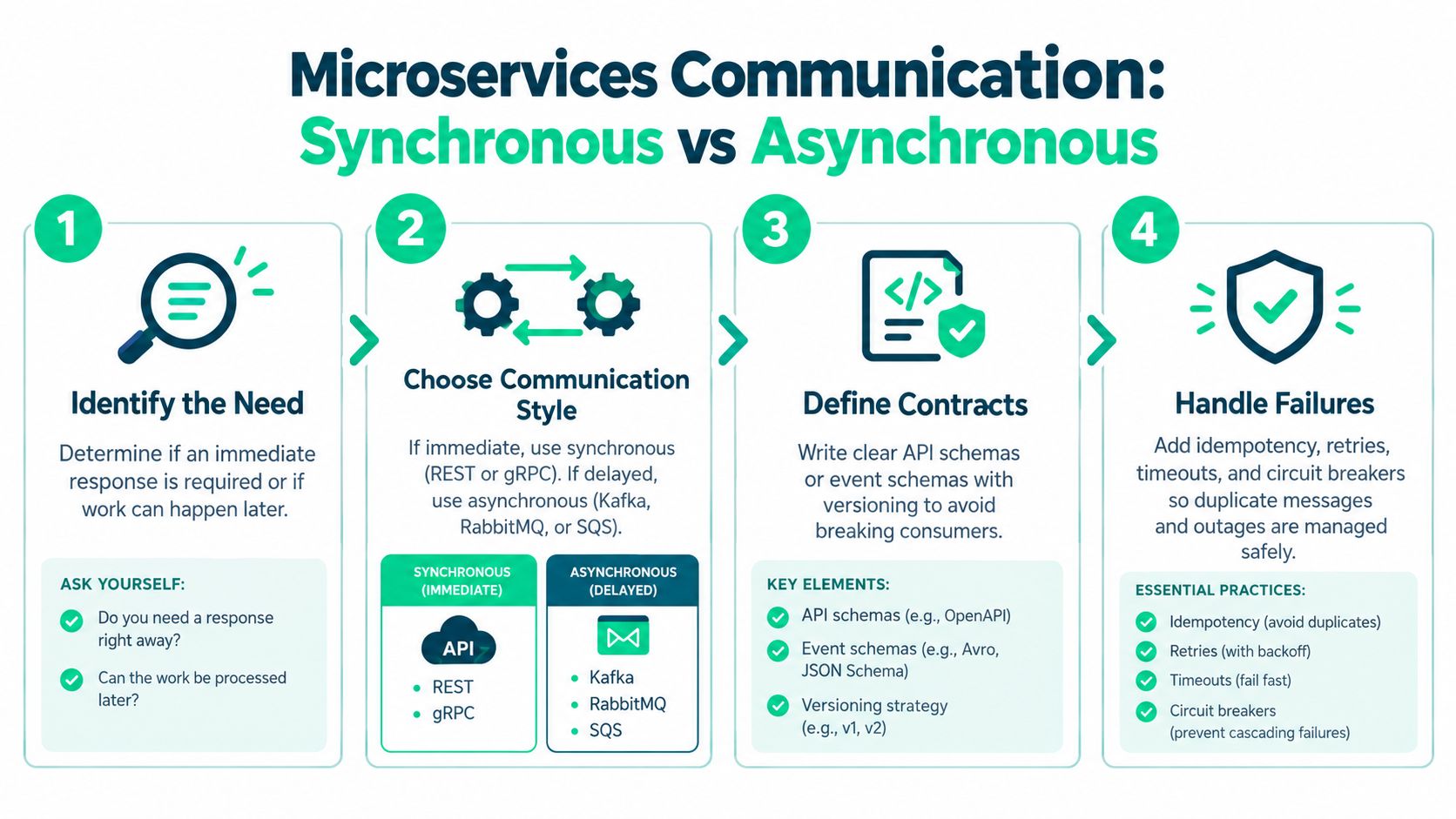
Microservices interviews test operational judgment, not pattern vocabulary — and strong candidates volunteer the trade-off before the interviewer asks for it. The ten questions above span architecture fundamentals, sync versus async communication, sagas and compensating actions, circuit breakers, boundary design, gateways and discovery, data consistency and CAP, observability across services, deployment and rollback, and contract testing. Each one has a predictable second question, which is where memorized answers fail: what the user sees while a breaker is open, what happens when an event arrives twice, where a joined finance report actually runs, how trace context survives an async hop. Prepare one project story per question even if your project was a monolith, structure partial-failure answers the same way every time (assumptions, failure boundary, safe default, user impact, telemetry, rollback), and remember that service count isn’t a quality metric — saying what you’d deliberately leave together often lands better than drawing twelve boxes.
You've got the interview tomorrow, a tab open with fifty definitions, and a sinking feeling that reciting them won't be enough. You're right. Interviewers asking interview questions on microservices aren't testing whether you can define a saga. They're testing whether you've thought about what breaks, what it costs, and when you'd talk a team out of splitting a system at all.
That distinction matters because memorized answers collapse at the first follow-up. You say circuit breaker, they ask what the user sees while it's open. You say eventual consistency, they ask which screen shows stale data and why that's acceptable. Strong candidates volunteer the trade-off before they're pushed, name their assumptions, and explain how they'd recover when a step fails halfway.
The ten questions below work the same way. Each one gives you the core answer, the follow-up you're likely to hear, and the trade-off worth raising yourself. Practice answering out loud, tie each answer to a project you've touched, and keep the contrarian option in play. Sometimes the best answer is a modular monolith, a queue, or leaving two things together until you have evidence they need separate scaling, separate releases, or separate ownership.
What Are the Most Common Microservices Interview Questions?
Interviewers aren’t testing whether you can define a saga. They’re testing whether you’ve thought about what breaks, what it costs, and when you’d talk a team out of splitting a system at all. Memorized answers collapse at the first follow-up — you say circuit breaker, they ask what the user sees while it’s open.
The ten questions that appear most consistently:
- What are microservices vs. a monolith? — Independent deployment and team ownership, at the cost of network failures, distributed data, and more operational work per service. Expect: “When would you start with a monolith instead?”
- How do services communicate, sync vs. async? — Microsoft’s guidance recommends async between internal services and warns that chaining synchronous HTTP during a request lets one unhealthy service block the rest. Expect: “The same event arrives twice — what happens?”
- Distributed transactions and the Saga pattern — Sequential local transactions with compensating actions, not two-phase commit. Expect: choreography vs. orchestration.
- Circuit breaker pattern — Closed, open, half-open. Expect: “How does this differ from retries?”
- How do you draw service boundaries? — Business capabilities and bounded contexts, not technical layers or one service per entity. Expect: “You got a boundary wrong and two services are chatty — now what?”
- API gateways and service discovery — Two separate jobs: edge policy versus which healthy instance gets traffic. Expect: “How does the gateway know an instance is healthy?”
- Data consistency, database-per-service, and CAP — Each service owns its data; cross-service joins disappear. Expect: “Finance needs a joined report — where does it run?”
- Monitoring, tracing, and debugging across services — Metrics show scope, traces show where time went, logs show why. Expect: “How does trace context survive an async hop?”
- Safe deployment and Kubernetes — Readiness vs. liveness probes, canary releases, expand-and-contract schema changes. Expect: “What evidence would make you roll back?”
- Testing and contract testing — The pyramid plus consumer-driven contracts. Expect: “A provider needs a breaking change — how do you ship it?”
The pattern across all ten: volunteer the trade-off before you’re pushed.
1. What are microservices, and how do they differ from a monolithic architecture?
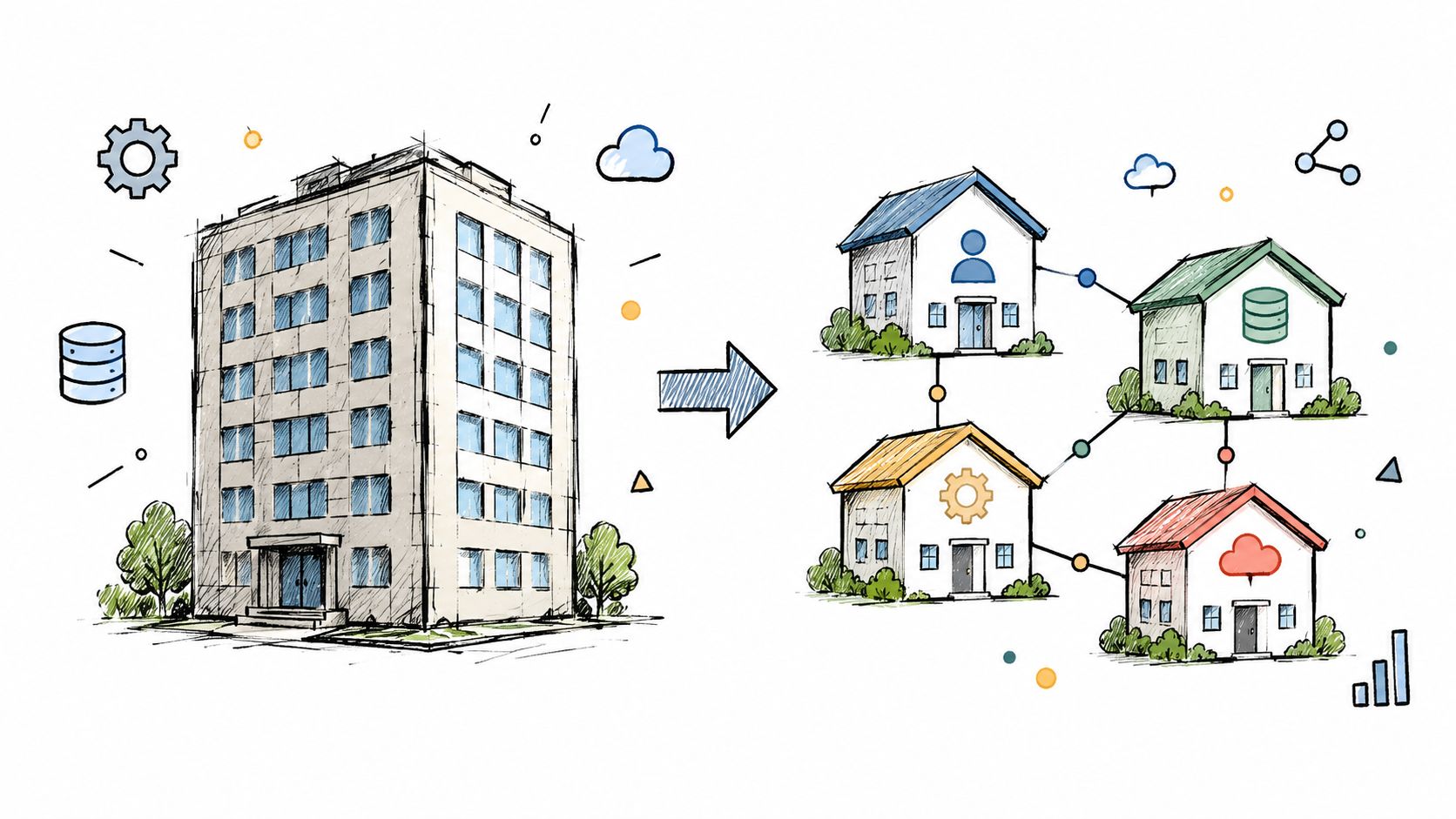
A monolith packages an application as one deployable unit with shared code and usually one database. Microservices split that application into small, independently deployable services organized around business capabilities, each running in its own process and communicating over lightweight mechanisms such as HTTP APIs. That definition was popularized by Martin Fowler and James Lewis in March 2014, after the term was discussed near Venice in May 2011 and appeared on Thoughtworks' Technology Radar in 2012, as Fowler's account of the microservices timeline describes.
Amazon's move toward service-oriented design in the 2000s is often cited as an early influence. Segment is the useful counter-example. It consolidated many microservices in 2018 because operational overhead was slowing a small team down.
- Benefit to name: independent deployment and team ownership without coordinated releases.
- Cost to name: network failures, distributed data, and far more operational work per service.
- Follow-up to expect: when would you start with a monolith instead?
Volunteer that trade-off first. A structured monolith is often right for a small team, and practical microservices guidance supports starting simpler. Use a structured guide to preparing for technical interviews to rehearse that judgment, not just the definition.
2. How do microservices communicate with each other, and when would you choose synchronous versus asynchronous communication?
Start with a concrete order flow instead of listing protocols. The order service can accept an order, publish an OrderCreated event, and return an acknowledgment. Payment, inventory, and shipping then react independently, rather than the order service calling each one synchronously during the original request.
That's the distinction interviewers want. Microsoft's guidance on communication in microservice architectures recommends asynchronous communication between internal services and warns that chaining synchronous HTTP calls during an initial client request makes one unhealthy service block the others. Synchronous REST or gRPC still fits when the user needs an immediate answer, such as checking whether a payment was authorized before showing confirmation.
How to frame the choice
- Synchronous: simpler to reason about, but both services must be healthy at the same moment.
- Asynchronous: brokers such as Kafka, RabbitMQ, or Amazon SQS decouple services in time, at the cost of eventual consistency and harder debugging.
- Follow-up to expect: the same event arrives twice, so what happens?
Answer that before you're asked. Mention an idempotent consumer that stores the event ID or uses a safe state transition, so replaying OrderCreated doesn't create a second order. Uber streaming trip events through Kafka and Netflix combining synchronous APIs with asynchronous pipelines are good real examples to cite briefly.
3. How do you handle distributed transactions across microservices, and what is the Saga pattern?
Each service owns its database, so you can't wrap an order, a payment, and a stock reservation in one ACID transaction. Two-phase commit technically exists, but it holds locks while participants wait for each other, which couples services and hurts availability when one participant is slow or down. Say that plainly, because interviewers are checking whether you'll reach for a distributed transaction that doesn't work in practice.
A saga replaces that single transaction with a sequence of local transactions. Each step commits locally and publishes an event or receives a command for the next step. If a later step fails, earlier steps run compensating actions that address their effects.
Use the travel booking example. Reserve the flight, hotel, and car in separate services. If the car reservation fails, cancel the hotel and flight. In food delivery, a restaurant rejecting an order after payment triggers a refund.
A compensation isn't a rollback. The payment happened, so you issue a refund and make that state visible.
The follow-up is usually choreography versus orchestration. Choreography lets services react to events with no coordinator, which suits simple flows. Orchestration puts one coordinator in charge of the sequence, which makes longer flows with branching and compensation easier to see and debug. Volunteer that distinction and pick one for your example with a reason.
4. What is the circuit breaker pattern, and why is it important in microservices?
Picture a product page that calls a recommendation service on every request. Recommendations slow down, product requests wait on timeouts, threads pile up, and a non-essential widget takes down a page that could have rendered fine without it. That's the cascading failure a circuit breaker prevents.
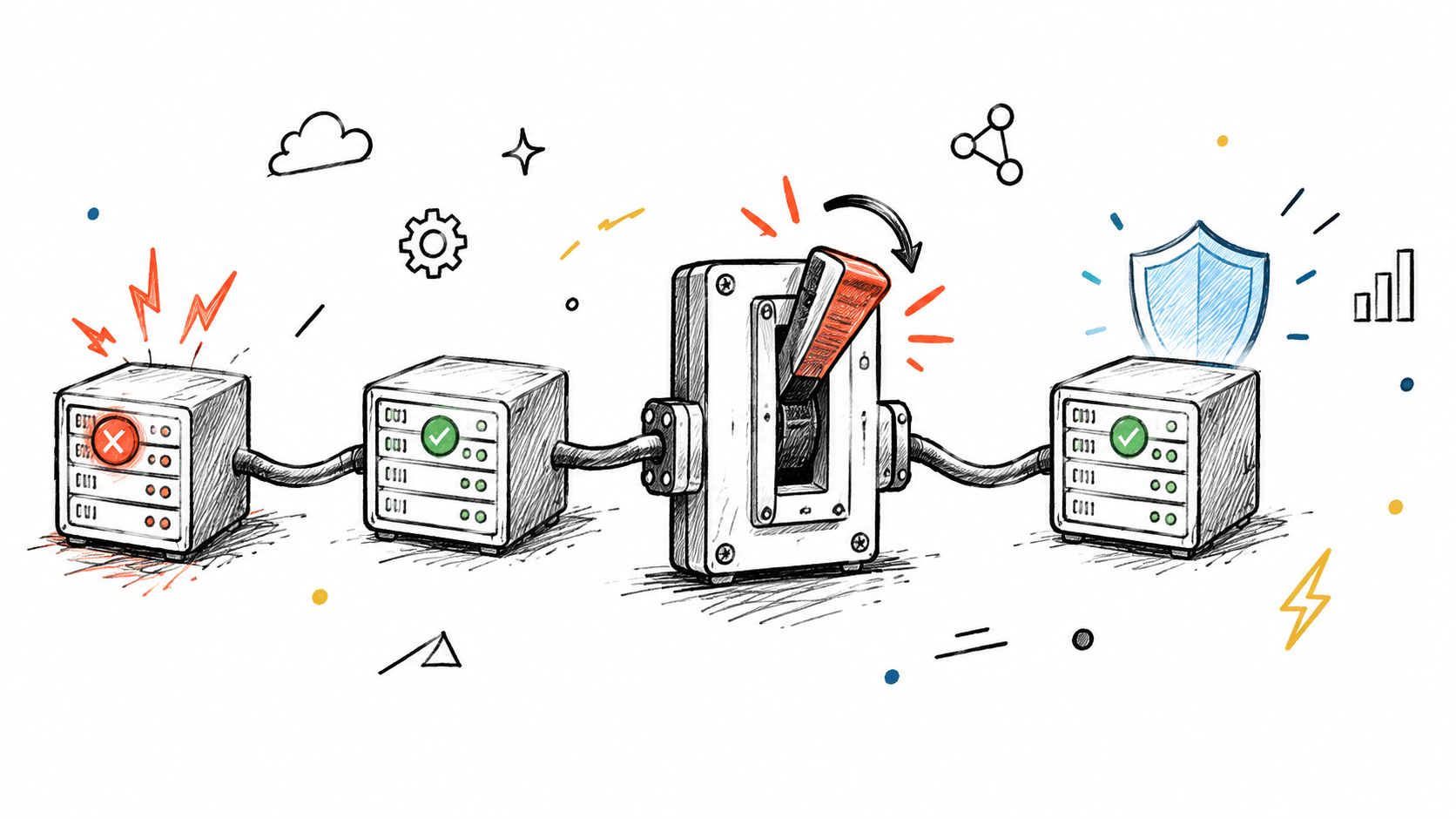
The breaker wraps remote calls and counts failures. Microsoft's overview of microservices design patterns identifies circuit breakers and retries as separate resilience patterns, and a practical setup might allow three attempts with bounded exponential backoff for transient errors before opening the circuit after an error threshold is crossed. While open, calls fail fast or return a fallback. After a cooldown, the half-open state lets limited probe requests through to test recovery.
- Closed: calls pass through and failures are counted.
- Open: calls fail immediately, and the product page renders without recommendations.
- Half-open: a few probes decide whether to close or stay open.
The follow-up is how this differs from retries. Retries handle brief blips. Breakers stop you from adding traffic to a dependency that's already failing. Netflix built Hystrix for this isolation, and Resilience4j is common in Spring services today. Volunteer the fallback and what you'd log, not just the state names.
5. How do you decide where to draw service boundaries?
Boundaries follow business capabilities, not technical layers or database tables. Domain-Driven Design calls these bounded contexts. Product means price and description to a catalog team, but weight and warehouse location to shipping. That change in language is a signal the boundary sits there.
Bad boundaries produce a distributed monolith. You'll recognize it when services always deploy together, call each other in long synchronous chains, or need each other's tables to answer basic requests. Splitting one service per entity, such as a UserService that every feature must call, creates exactly that problem.
Evidence worth volunteering
- Method: event storming with domain experts to find where processes and language change.
- Ownership test: one team can own, deploy, and operate the service without coordinating daily with another team.
- Follow-up to expect: you got a boundary wrong and two services are chatty, so how do you fix it?
Uber's Domain-Oriented Microservice Architecture groups services into domains with clear ownership, and Amazon's small autonomous teams are the classic Conway's Law example. Mention that starting with a modular monolith and extracting later is valid, then practice defending a boundary from your own project using realistic practice interview questions. That restraint signals experience, and it's the point this discussion of when not to split into microservices makes about service count not being a quality metric.
6. What are API gateways and service discovery, and how do they fit into a microservices architecture?
Walk a single request through the system. A mobile app calls one public address. The API gateway authenticates the request, applies rate limiting, and routes it to the right service. Behind the gateway, service discovery answers a different question, which healthy instance of that service should receive traffic right now.
Keeping those two jobs separate is the answer. The gateway handles external traffic and cross-cutting concerns such as routing, authentication, and protocol translation. Service discovery handles a dynamic interior where containers scale, crash, and move to new addresses. Netflix open-sourced Zuul as a gateway and Eureka as a service registry. On Kubernetes, Services and DNS handle discovery, while Ingress controllers such as NGINX or Kong often act as the gateway.
- Gateway mistake to avoid: putting business logic in it until it becomes a new monolith.
- Discovery detail to name: health checks remove unhealthy instances from rotation automatically.
- Follow-up to expect: how does the gateway know an instance is healthy before routing to it?
Volunteer the trade-off. A gateway simplifies life for clients and centralizes edge policy, but it's also a shared component that needs its own scaling and failure plan. If every client needs differently shaped responses, mention that aggregation may belong in a client-specific layer rather than in the gateway.
7. How do you manage data consistency and the database-per-service pattern, and what does the CAP theorem have to do with it?
Database-per-service means each service exclusively owns its data and schema. No other service reads its tables directly. That prevents hidden coupling where one team's migration breaks another team's queries, and it lets each service pick storage that fits its workload.
The cost shows up immediately. Cross-service joins disappear, and a report combining orders and payments needs events feeding a separate read store. Amazon services managing their own stores while reporting runs through separate pipelines is the standard illustration. An e-commerce platform might keep orders in a transactional database and replicate product data into a search optimized store.
Explain CAP in plain language. During a network partition, you choose between refusing requests to stay consistent or continuing to respond with data that may be stale. You can't guarantee both at once while the partition lasts.
- Eventual consistency fits: a product view count or a recommendation list catching up moments later.
- Stronger consistency fits: an account balance checked before a withdrawal, served by the owning service.
- Follow-up to expect: finance needs a joined report, so where does it run?
Volunteer the answer. It runs against a read model built from events, not against production service databases. Naming which data can lag and which can't is worth more than reciting the theorem.
8. How do you monitor, trace, and debug requests that span multiple microservices?
Use the scenario interviewers love. Checkout latency doubled, but host CPU looks normal. Where do you start? Strong candidates start from user impact, pull a slow trace, and follow it service by service instead of opening log files at random.
The scale explains why this matters. In one survey, 61% of stakeholders were using microservices, up from 49% the previous year, 83% of those users ran hundreds or thousands of services, and 97% faced monitoring challenges, with 59% naming lack of unified visibility as the leading issue, according to Broadcom's State of Observability 2022 report. At that service count, checking whether processes are running tells you almost nothing.
The three signals and their jobs
- Metrics: aggregate latency, error rate, throughput, and saturation that show whether a problem is widespread.
- Traces: one request followed across services, showing where time went.
- Logs: detailed context inside the service the trace points to.
A checkout trace carrying one correlation ID through gateway, cart, payment, and inventory might show a 2-second request where payment consumed 1.7 seconds, an example described in research on logs, metrics, and traces in microservices. Uber built Jaeger and Twitter built Zipkin for exactly this debugging. The follow-up is how trace context survives an asynchronous hop. It has to travel in message headers, or the trace ends where the bug begins.
9. How would you deploy and release microservices safely, and what role do containers and Kubernetes play?
Containers package a service with its runtime and dependencies so the artifact tested in CI is the artifact that runs in production. Kubernetes then handles scheduling, scaling, rolling updates, and restarting failed instances. That's the baseline answer, but it's not the part that gets you hired. The release strategy around it is.
Adoption makes this fair game in interviews. A 2024 survey found 42% of organizations already using cloud-native technologies such as containers, microservices, and observability, 32% planning implementation within two years, and 48% of organizations deploying across multiple public clouds using site-reliability-engineering practices, as reported in 451 Alliance's cloud-native adoption survey. So expect questions on probes, autoscaling, and rollback criteria, not just Dockerfiles.
Describe a payment service release end to end. Build and test the image, deploy to staging, canary a small slice of traffic, watch customer-facing SLOs, then roll out or roll back. Netflix open-sourced Kayenta to compare canary and baseline behavior during that decision.
- Readiness probe: can this instance take traffic now, including critical dependencies?
- Liveness probe: is the process alive, with almost no dependency checks?
- Database change: expand and contract, so old and new versions both work during rollout.
Volunteer that retries can amplify an outage and that Kubernetes doesn't automatically make a service resilient. Then connect your pipeline to PushOps deployment automation concepts such as repeatable, automated releases per service. The follow-up is usually what evidence would make you roll back.
10. How do you test microservices, and what is contract testing?
Running the whole system for every change is slow, flaky, and expensive, so testing effort follows a pyramid. Many fast unit tests cover logic inside a service. Fewer integration tests cover databases, brokers, and real HTTP calls. A small number of end-to-end tests cover critical user journeys only.
Contract testing fills the gap the pyramid leaves. It verifies that a consumer and provider agree on an API or message format without deploying both together. In consumer-driven contract testing, the consumer records what it needs, fields, types, and status codes, and the provider's build verifies it can still meet those expectations. Pact is the tool many teams name for this.
Make it concrete. A checkout service depends on a payments service charge request with specific required fields. The contract test fails the payments build if a field is renamed or removed, catching the break before production instead of during checkout.
- Isolation detail: each test owns its data, so tests don't flake because of shared state.
- Trade-off to volunteer: contract tests verify format agreement, not business behavior across the full flow.
- Follow-up to expect: a provider needs a breaking change, so how do you ship it?
Answer with versioning and gradual consumer migration, not coordinated deployment. Coordinated deployment means you've rebuilt the monolith with network calls. Rehearsing these layered follow-ups with an AI interview coach for technical practice helps you practice the second and third question, not just the first.
How to Walk Into the Interview Ready
Rehearse each answer out loud and keep the first pass under two minutes. Interviewers will interrupt with follow-ups, and that's a good sign, so leave room for the conversation instead of delivering a five-minute monologue. If you can't explain a saga without saying the word saga three times, simplify until you can walk through the flight, hotel, and car example in plain language.
Prepare one project story per question, even if the project was a monolith. You can discuss where the module boundaries were, which component you'd extract first, and what evidence would justify it. That kind of answer demonstrates sequencing and restraint, which most question banks underplay. Service count isn't a quality metric, and saying what you'd deliberately leave together often lands better than drawing twelve boxes.
Practice the partial failure scenarios separately, because they're where memorized patterns run out. If authentication is slow, do you fail open or closed, and what does each choice risk? If payment succeeds but order confirmation times out, how do you prevent a duplicate charge? If an event arrives twice, is your consumer idempotent, and which customer-facing feature degrades first while you recover?
Structure those answers the same way every time. State your assumptions, identify the failure boundary, choose the safe default, describe the user impact, name the telemetry you'd check, and explain rollback or reconciliation. That structure connects reliability patterns to business impact and security instead of listing Prometheus, Kafka, or OpenTelemetry as if naming tools were an answer, a gap highlighted in this collection of microservices interview scenarios.
A focused final checklist
- One story each: a boundary decision, a failure you debugged, a release you made safer, and a time simpler was better.
- One trade-off each: consistency versus availability, sync versus async, orchestration versus choreography, retry versus fail fast.
- One number each: latency, error rate, or release frequency from your own work that you can explain without exaggerating.
Tools such as Qcard can keep resume-grounded talking points and those trade-offs at your fingertips during live prep, so you speak from your experience rather than reciting patterns. Use whatever keeps your examples specific and honest. Interviewers can tell the difference between someone who has operated these systems and someone who has only diagrammed them.
Walk in ready to question the architecture itself. Ask what problem the split solves, which team owns what, and how success would be measured. Candidates who discuss when a simpler design is the right call sound like engineers who will protect a production system, not just pass a quiz. That's the impression that turns interview questions on microservices into an offer.
Key Takeaways
- Volunteering the trade-off is what separates operators from diagrammers — naming the fallback and what you’d log before being asked about a circuit breaker, or mentioning idempotent consumers before the duplicate-event follow-up, signals you’ve run these systems rather than read about them.
- Restraint reads as experience, and service count isn’t a quality metric — Segment consolidated many microservices in 2018 because operational overhead was slowing a small team, so naming when a modular monolith, a queue, or leaving two things together is the right call often lands better than enthusiasm for splitting.
- Observability is the area where scale makes the question unavoidable — Broadcom’s State of Observability 2022 found 61% of stakeholders using microservices, 83% of those running hundreds or thousands of services, and 97% facing monitoring challenges with 59% citing lack of unified visibility, which is why “start from user impact, pull a slow trace, follow it service by service” beats opening log files at random.
- A compensation isn’t a rollback, and that distinction gets probed — the payment already happened, so you issue a refund and make that state visible, and picking choreography or orchestration for your specific example with a stated reason is stronger than describing both neutrally.
- Partial-failure scenarios are where prepared patterns run out, so structure them identically every time — state your assumptions, identify the failure boundary, choose the safe default, describe the user impact, name the telemetry you’d check, and explain rollback or reconciliation, because that structure connects reliability patterns to business impact instead of listing Prometheus, Kafka, and OpenTelemetry as if naming tools were an answer.
If you're preparing for a technical loop and want your own project stories, metrics, and trade-offs surfaced as concise cues instead of scripts, Qcard offers AI-scored mock interviews with adaptive follow-ups and real-time, resume-grounded talking points during live interviews. Practice these ten questions against follow-ups based on your actual experience, so your answers sound like your work, not a question bank.
Ready to ace your next interview?
Qcard's AI interview copilot helps you prepare with personalized practice and real-time support.
Try Qcard Free