10 Node.js Interview Questions Candidates Should Know
TL;DR
Node.js interviews test how you think, communicate, and make engineering decisions — not whether you can recite syntax. These ten questions span the real loop: your introduction, company motivation, a challenging project, your learning method, asynchronous JavaScript, RESTful API design, production debugging, testing strategy, team disagreement, and behavioral preparation. Each answer works best with a defined shape and timing target (90–120 seconds for most, 2–3 minutes for STAR stories), real project evidence, and awareness of the likely follow-up. For technical answers, show the reasoning behind the choice: why Promise.all for independent requests, why /habits instead of /getHabits, why critical business logic earns more test attention than boilerplate. For production debugging, the signal is that you gather evidence before acting rather than guessing under pressure. Build a three-stage plan — choose two behavioral and two technical examples, rehearse a repeatable answer shape (summary, evidence, trade-off, takeaway), then run a timed mock with follow-ups. Keep a one-page cue sheet, not a script.
Preparing with the right structure makes Node.js interview questions easier to answer clearly. This roundup covers ten topics across personal introductions, motivation, project experience, asynchronous JavaScript, RESTful API design, testing, production debugging, teamwork, and general interview preparation.
Each item follows the same easy-to-scan pattern:
- Question focus and difficulty tag
- What the interviewer is evaluating
- Concise model-answer direction
- A practical Node.js example
- Likely follow-up questions
- Common pitfalls
- One short practice action
Use the examples as prompts, not scripts. Replace them with verified details from your projects, such as reducing an API response time, adding Jest tests, or diagnosing a failed background job. If you need time, say, “May I take a moment to organize my thoughts?” Brief cue cards, timed practice rounds, and a predictable structure such as situation, action, and result can also reduce interview anxiety.
Clear, truthful examples are stronger than memorized answers.
An optional tool such as Qcard can support resume-grounded memory cues, pacing, filler-word awareness, mock interviews, and question-bank practice. It should support authentic answers, not replace them.
What Are the Most Common Node.js Interview Questions?
Node.js interviews mix behavioral prompts with backend technical depth, and the strongest answers connect specific project evidence to clear reasoning — not memorized definitions. These ten cover the full loop:
- Tell me about yourself — 90–120 seconds: background, your move toward Node.js with one measurable result, then the goal that connects to this role.
- Why do you want to work here? — 60–90 seconds: a concrete company detail (engineering blog, architecture, announcement), the link to your Node.js experience, what you'd contribute.
- Describe a challenging project — 2–3 minutes in STAR form, focused on your decisions rather than the difficulty. "Queries timed out; I added query logging, found missing indexes, and the slowest query dropped from 8 seconds to 200ms."
- How do you learn new technologies? — Trigger, method, application, evaluation. A concrete learning cycle beats claiming you're a fast learner.
- Explain asynchronous JavaScript — Why non-blocking I/O matters, the callbacks → Promises → async/await evolution, then a real example like using Promise.all for independent requests while keeping dependent operations sequential. Distinguish concurrency from parallelism and mention error handling.
- Your experience with RESTful API design — Name the API and its consumers, explain resource paths, HTTP methods, status codes, validation, and pagination, then the reliability or compatibility result. Expect follow-ups on auth, rate limiting, filtering, and CORS.
- Debugging in production — Six steps: scope the impact, gather evidence (logs, metrics, recent deploys), form a hypothesis and reproduce safely, recover via rollback or feature flag, verify error rates and latency, then add tests or alerts. Never guess repeatedly in production.
- Testing and test coverage — Name your tools (Jest, Mocha, Chai, Supertest), describe a tested feature, then show judgment: critical business logic deserves more attention than framework boilerplate, and coverage measures exercised code, not user protection.
- A disagreement with a teammate — Context, conversation, resolution. A strong answer shows self-awareness, not victory.
- General behavioral preparation — Three to five adaptable STAR stories with quantified results and a reflection line.
Use the examples as prompts, not scripts. Swap in verified details from your own projects.
1. Tell Me About Yourself
This opening prompt appears in many Node.js interview questions. It tests whether you can connect your background, technical evidence, and next career goal without giving your full life story.

A clear answer structure
Use a 90–120 second sequence:
- Background: Mention relevant study, work, or projects.
- Focus: Explain your move toward Node.js and name one measurable result.
- Goal: Connect your experience to the role.
A career switcher might say: “I worked four years as a marketing analyst, building acquisition dashboards. I enjoyed the technical problem-solving most, so I completed a Node.js bootcamp and built a real-time notification service for a volunteer project. I now want a backend role where I can combine product understanding with API development.”
Specific evidence sounds more credible than a list of technologies.
Practice with a timer, remove filler words, and avoid apologies. Qcard’s resume-grounded Interview Coach can help monitor pacing and identify repeated “um” or “like.” Use this approach at the interview opening because it establishes confidence and gives the interviewer useful follow-up topics.
2. Why Do You Want to Work Here?
This question appears often in Node.js interview questions. It tests whether you understand the company, role, and team, rather than applying to every employer with the same answer.
A clear answer structure
Use a 60–90 second sequence:
- Company detail: Mention a product feature, engineering blog post, public talk, or recent announcement.
- Connection: Link that detail to your Node.js experience, interests, or values.
- Contribution: Explain what you hope to learn and contribute.
For a fintech company, you might say: “Your API-first architecture interests me because I built Node.js microservices and enjoyed designing clear service boundaries. I also read your post about handling 10 million daily transactions, which matches the reliability problems I want to study. Your mentoring culture appeals to me because I want to grow while contributing through testing and documentation.”
Specific research sounds more genuine than saying you admire the company’s culture.
Before the interview, note two or three concrete reasons from the product, technical stack, mission, or team. Qcard’s resume-grounded Interview Coach can help connect those findings to projects you have completed. Use this approach whenever anxiety makes open-ended answers difficult, because prepared evidence gives your response a clear, predictable shape.
3. Describe a Challenging Project and How You Handled It
This behavioral prompt appears in many Node.js interview questions. It tests problem-solving, communication under pressure, and your ability to learn from setbacks.
A clear answer structure
Use a 2–3 minute STAR sequence:
- Situation: Describe the project and specific obstacle.
- Action: Explain your decisions, tools, and collaboration.
- Result: Give a measurable outcome and lesson.
A junior developer might say: “In my bootcamp capstone, database queries in my Node.js API timed out under load. I added query logging, identified missing indexes, and asked my mentor to review the plan. The slowest query fell from eight seconds to 200 milliseconds. I learned to break unfamiliar problems into smaller tests instead of reacting emotionally.”
Focus on your decisions, not only the difficulty you faced.
Choose examples involving performance, debugging, delivery, or limited resources. Use Qcard’s resume-grounded approach to find accurate metrics, then practice aloud with Interview Coach to keep the story focused. Prepare three or four examples so you can adapt to different Node.js interview questions. This approach helps early-career and career-switching candidates show credibility without overstating their experience.
4. How Do You Approach Learning New Technologies?
This question appears often in Node.js interview questions. It tests whether you can learn independently, judge what deserves deeper study, and apply new tools to real backend problems.
A clear answer structure
Use a four-part sequence:
- Trigger: Describe a specific project or problem that required new knowledge.
- Method: Explain how you used official documentation, courses, or community support.
- Application: Show what you built and how feedback improved it.
- Evaluation: Explain how you decide between broad awareness and deep study.
A bootcamp graduate might say: “I built a habit-tracking REST API and needed real-time updates. I read the MDN WebSockets documentation, compared Socket.io with the native API, then implemented and tested the feature. Code review exposed error-handling gaps, so I revised the design and documented what I learned. I now study fundamentals first, then apply them immediately.”
Concrete learning cycles are stronger than saying you are a fast learner.
Prepare one example for each major technology on your resume. Qcard’s Interview Coach can help identify those technologies and practice concise answers. This approach works especially well for neurodivergent candidates because it turns an open-ended question into a repeatable sequence.
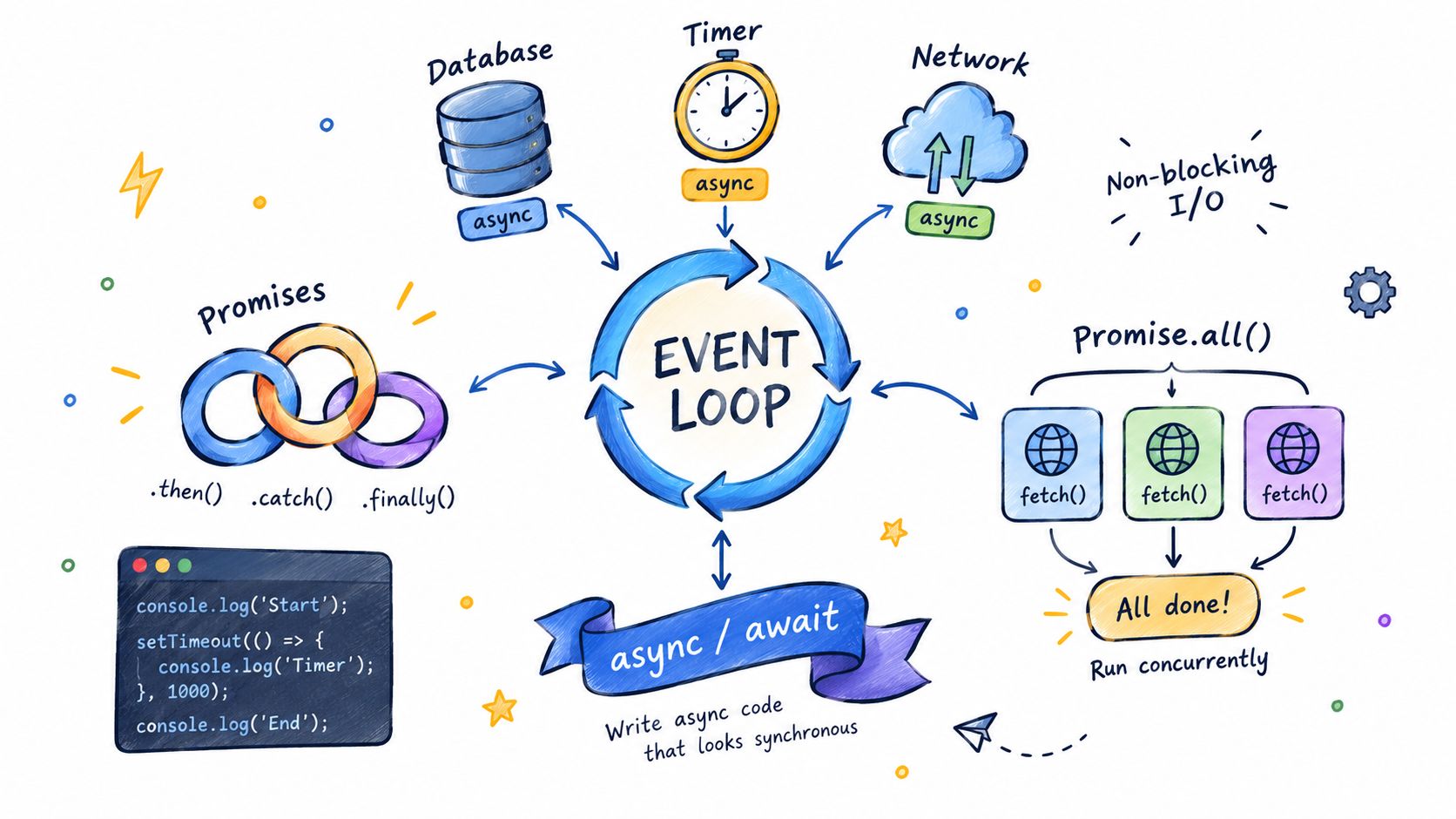
5. Explain Your Understanding of Asynchronous JavaScript and When to Use It
This technical prompt appears in many Node.js interview questions. It tests whether you understand why non-blocking I/O matters, not just how to write async and await.
A clear answer structure
Use a 90–120 second sequence:
- Why: Explain that asynchronous operations let Node.js handle other requests while waiting for databases or APIs.
- Evolution: Contrast callbacks, Promises, and async/await, noting that try/catch often improves readability.
- Example: Describe using Promise.all for independent requests, while keeping dependent operations sequential.
A candidate might say: “For a dashboard, I fetched the profile, posts, and notifications concurrently with Promise.all, reducing load time from three seconds to 1.2. I use async/await by default, but I still consider callbacks or direct Promise chains when appropriate.”
Distinguish concurrency from parallel execution, and mention error handling.
Practice explaining this clearly with structured Node.js interview questions, especially if technical speaking feels stressful.
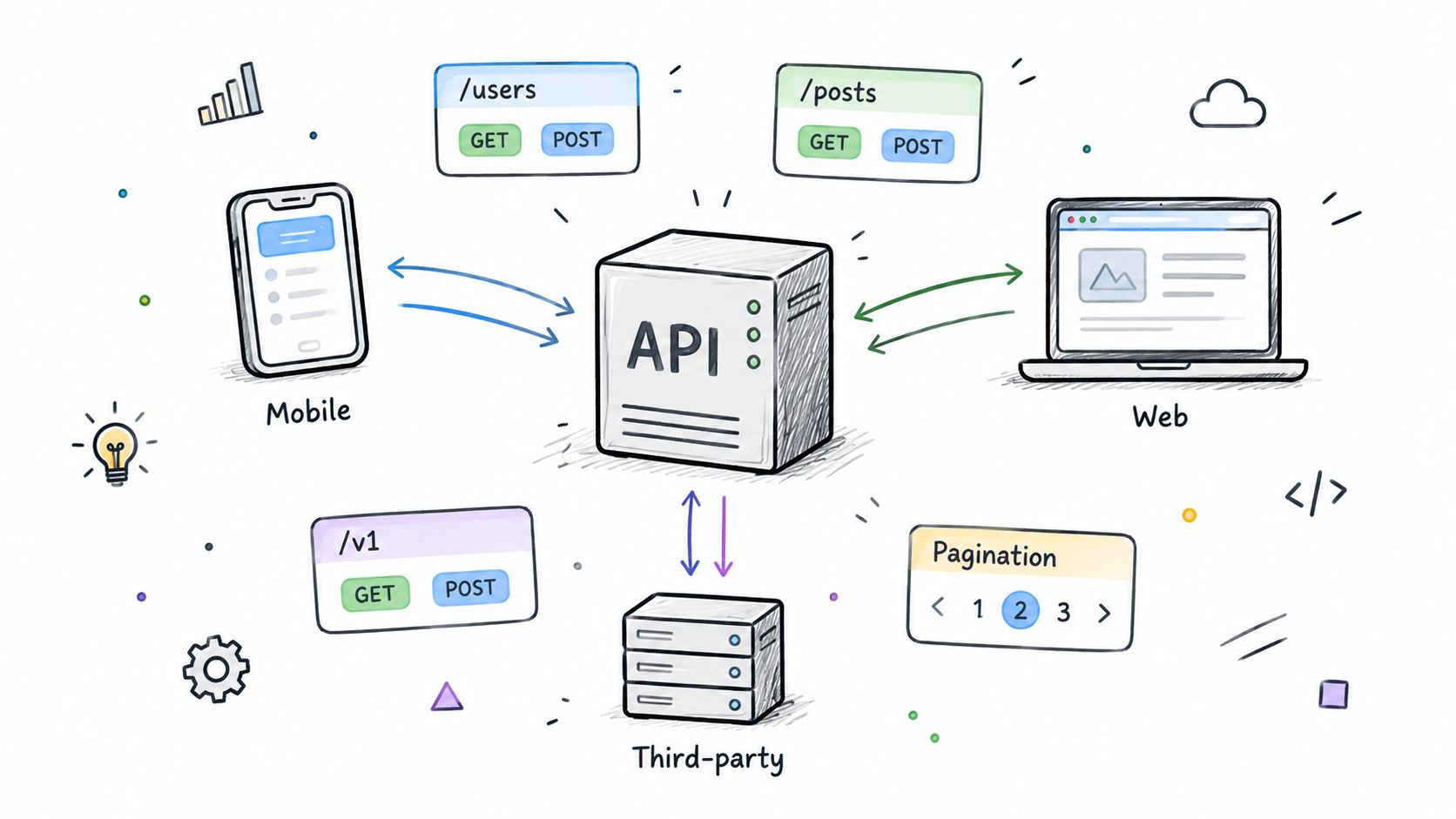
6. What's Your Experience With RESTful API Design?
This question tests whether you can design predictable endpoints, not merely make requests work. Explain how you model resources, choose HTTP methods and status codes, and protect clients from breaking changes.
A clear answer structure
Use a 90–120 second sequence:
- Example: Name an API you built and its consumers.
- Decisions: Explain resource paths, status codes, validation, and pagination.
- Result: Mention reliability, usability, or backward compatibility.
A junior developer might say: “For my habit app, I used /users/:id/habits and nested log resources. GET retrieved data, POST created records with 201, and invalid input returned 400. I initially used /getHabits, then changed it to /habits for a more predictable design.”
Explain why you made each choice, especially versioning and error handling.
Prepare follow-ups about authentication, rate limiting, filtering, sorting, and CORS. Practice API answers with structured interview feedback and use a real project from your resume.
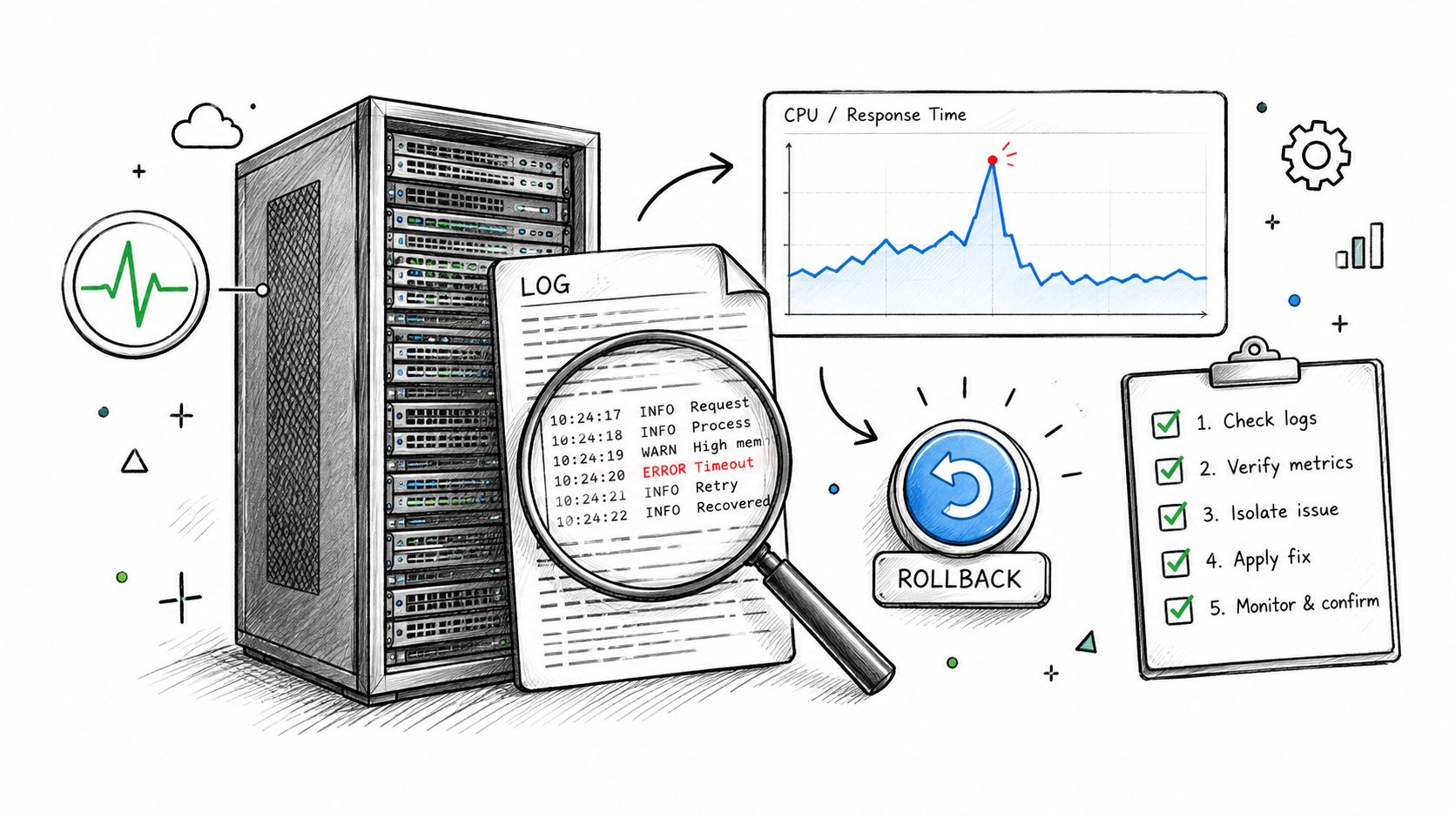
7. How Do You Approach Debugging and Problem-Solving in Production?
This question appears often in Node.js interview questions because it tests judgment under pressure, not just coding ability. Explain how you reduce customer impact while finding evidence before changing anything.
A clear answer structure
Use this six-step sequence:
- Scope: Check affected requests, users, and severity.
- Evidence: Review logs, metrics, recent deployments, and dependency changes.
- Hypothesis: Reproduce the issue safely and test one likely cause.
- Recovery: Choose a rollback, feature-flag change, or small fix.
- Verification: Monitor error rates and latency after deployment.
- Learning: Add tests, alerts, or documentation to prevent repeats.
An experienced example might be: “After response times rose from 100ms to five seconds, I compared Datadog metrics before and after deployment. Query logs showed sequential database calls caused by a removed Promise.all. I deployed the one-line fix, confirmed latency recovered, and added monitoring.”
State clearly that you never guess repeatedly in production. Gather data, reduce risk, then act.
If you lack incident experience, describe a capstone debugging process and mention logging, staged releases, rollback plans, and tests. Qcard can surface relevant projects from your resume for practice.
8. Describe Your Experience With Testing and Test Coverage
This question in Node.js interview questions checks whether you treat testing as part of development, not an afterthought. Explain how unit, integration, and end-to-end tests protect different parts of an application.
A practical answer structure
Use a 90-second sequence:
- Tools: Name tools such as Jest, Mocha, Chai, or Supertest.
- Example: Describe a tested API feature and the defects or refactoring it supported.
- Judgment: Explain why critical business logic deserves more attention than framework boilerplate.
A bootcamp graduate might say: “I use Jest for unit tests and Supertest for API integration tests. I test validation and payment decisions with mocked dependencies, then use a test database for registration flows. After breaking a refactor in an earlier project, I began writing tests alongside features. I focus on meaningful behavior rather than chasing 100% coverage.”
Coverage measures exercised code, not whether users are protected from bad outcomes.
Mention the testing pyramid and trade-offs: fast unit tests, fewer integration tests, and selective end-to-end checks. For broader methodology, review this guide to software testing. Be honest about gaps, then describe the next testing practice you plan to build.
9. Tell Me About a Time You Had Disagreement With a Team Member and How You Resolved It
This behavioral prompt appears in many Node.js interview questions. It tests whether you can explain your position, listen carefully, and choose a solution that supports the product rather than your personal preference.
A clear answer structure
Use a 90–120 second sequence:
- Context: Describe the project and the genuine disagreement.
- Conversation: Explain your reasoning, acknowledge the other viewpoint, and mention the questions you asked.
- Resolution: State the decision, result, and lesson you carried forward.
A bootcamp candidate might say: “I wanted to use a database I had just learned, but my teammate preferred a simpler option because our deadline was close. After reviewing the requirements, I realized I was prioritizing practice over delivery. We chose the simpler database, shipped on time, and I now ask what best serves the product before defending a technical preference.”
A strong answer shows self-awareness, not victory.
Choose a real disagreement, explain why you initially held your view, and describe how listening changed your decision. This approach helps interviewers assess collaboration, especially alongside technical Node.js interview questions. For structured practice and feedback, Qcard’s Interview Coach can help you rehearse the sequence without memorizing every sentence.
10. General Behavioral and Interview Preparation Tips
Behavioral preparation helps you connect real experiences to the skills tested by Node.js interview questions. Use three to five adaptable stories, rather than memorizing answers.
A practical preparation routine
Build each story with STAR:
- Situation and task: Set the context and your responsibility.
- Action: Explain the decisions you made, including technical or teamwork details.
- Result: Quantify time saved, errors reduced, response speed, or delivery impact.
- Reflection: State what you learned or changed afterward.
For example: “A slow API caused timeouts during testing. I profiled the endpoint, added database indexes, and introduced pagination. Median response time fell from 900 ms to 180 ms, and I now profile before guessing at fixes.”
Authentic evidence matters more than reciting a perfect formula.
Practice aloud for 90–180 seconds, record yourself, and note filler words or rushed sections. For conflict questions, describe your mistake and the behavior you changed. Start technical-process answers with one sentence, then add detail if requested.
Before interviews, review this step-by-step interview prep and Node.js interview preparation guide. Prepare questions about onboarding, code review, team communication, and the role’s next steps.
Turn These Questions Into a Focused Practice Plan
Strong answers to Node.js interview questions do more than prove that you know JavaScript syntax. They show how you think, communicate, investigate problems, and make sensible engineering decisions. Your preparation should therefore connect technical knowledge with specific evidence from projects, coursework, internships, freelance work, or open-source contributions.
A practical three-stage plan
- Choose your evidence. Select two behavioral stories and two Node.js technical examples from verified experience. For instance, one story might cover resolving a disagreement about an API change, while a technical example could explain how you handled asynchronous database calls with async and await. Choose examples you can describe accurately, including your own contribution.
- Rehearse a repeatable answer shape. For each example, prepare:
- A one-sentence summary of the situation
- Concise evidence, such as an implementation detail or measurable result
- A trade-off, limitation, or alternative you considered
- A clear takeaway about what you learned
- This structure works for questions about RESTful API design, production debugging, testing, asynchronous JavaScript, and challenging projects. It also keeps answers focused if anxiety makes it difficult to judge how much detail to give.
- Run a timed mock interview. Ask a friend, mentor, or practice tool to give you a mix of behavioral and technical Node.js interview questions. Review your clarity, pacing, filler words, and readiness for follow-ups such as, “What would you change now?” or “How did you verify that fix?”
Keep a one-page cue sheet rather than a script. Record project names, technologies, actions, outcomes, and lessons in short phrases. A neurodivergent-friendly routine may include predictable practice blocks, written prompts, scheduled breaks, and advance requests for reasonable interview accommodations where appropriate.
The goal is not to memorize perfect sentences. It is to explain real work clearly, admit limits without underselling yourself, and show how you learn when you do not know an answer.
Clear, honest explanations of real work are stronger than perfect memorization.
Optional Qcard practice resources can help generate mock questions, provide resume-grounded cues, and support reflection after each session.
Key Takeaways
- Technical answers should explain the why, not just the what — saying you used async/await proves familiarity, while explaining that you ran independent dashboard requests through Promise.all to cut load time from three seconds to 1.2 while keeping dependent calls sequential proves judgment, and the same applies to REST decisions, status codes, and versioning.
- The production debugging question is a judgment test disguised as a technical one — the six-step sequence (scope, evidence, hypothesis, recovery, verification, learning) shows you reduce customer impact before changing anything, and explicitly stating that you don't guess repeatedly in production is a stronger signal than any individual fix you describe.
- Honest limits beat inflated claims, especially on testing — "I focus on meaningful behavior rather than chasing 100% coverage" and naming the testing practice you plan to build next reads as more credible than claiming comprehensive coverage, since coverage measures exercised code rather than whether users are protected.
- Candidates without production incident experience can still answer well by describing a capstone debugging process with logging, staged releases, rollback plans, and tests — the structure of your reasoning is what's being evaluated, which is why career switchers and bootcamp grads who name a real timeout, a real index fix, and a real measured improvement compete effectively.
- Three to five adaptable STAR stories outperform ten memorized scripts — a one-page cue sheet with project names, technologies, actions, outcomes, and lessons in short phrases survives rephrased questions and unexpected follow-ups like "What would you change now?" or "How did you verify that fix?", which is where memorized answers collapse.
Turn your preparation into focused practice with Qcard, using your resume and Node.js experience to rehearse relevant interview questions, follow-ups, and concise answers.
Ready to ace your next interview?
Qcard's AI interview copilot helps you prepare with personalized practice and real-time support.
Try Qcard Free