Your Guide to Modern Interview Prep That Actually Works
Forget everything you think you know about interview prep. The goal isn't to memorize a script of robotic answers. It’s about building a solid, adaptable strategy that lets you show up as your authentic, competent self, even when the pressure is on. This modern approach is all about deep research, powerful storytelling, and smart, structured practice.
Moving Beyond Memorized Answers
Let's be real—the old way of preparing for interviews is broken. Spending hours trying to cram the "perfect" answer for every conceivable question is a recipe for sounding rehearsed and disconnected. Real confidence doesn't come from a script. It comes from knowing your own stories inside and out, so you can naturally weave them into any conversation.
This guide lays out a framework that shifts your focus from recitation to genuine readiness. It’s designed to manage interview anxiety and help you clearly articulate your value, whether you're facing a behavioral deep-dive or a tough technical screen.
The Modern Prep Framework
The interview prep game has changed. Today, the average candidate spends 5 to 10 hours getting ready for a single interview. And it's no surprise that 42% of job seekers are now using AI to get an edge, highlighting the need for better tools in this competitive market.
This modern approach can be broken down into a simple, effective process.
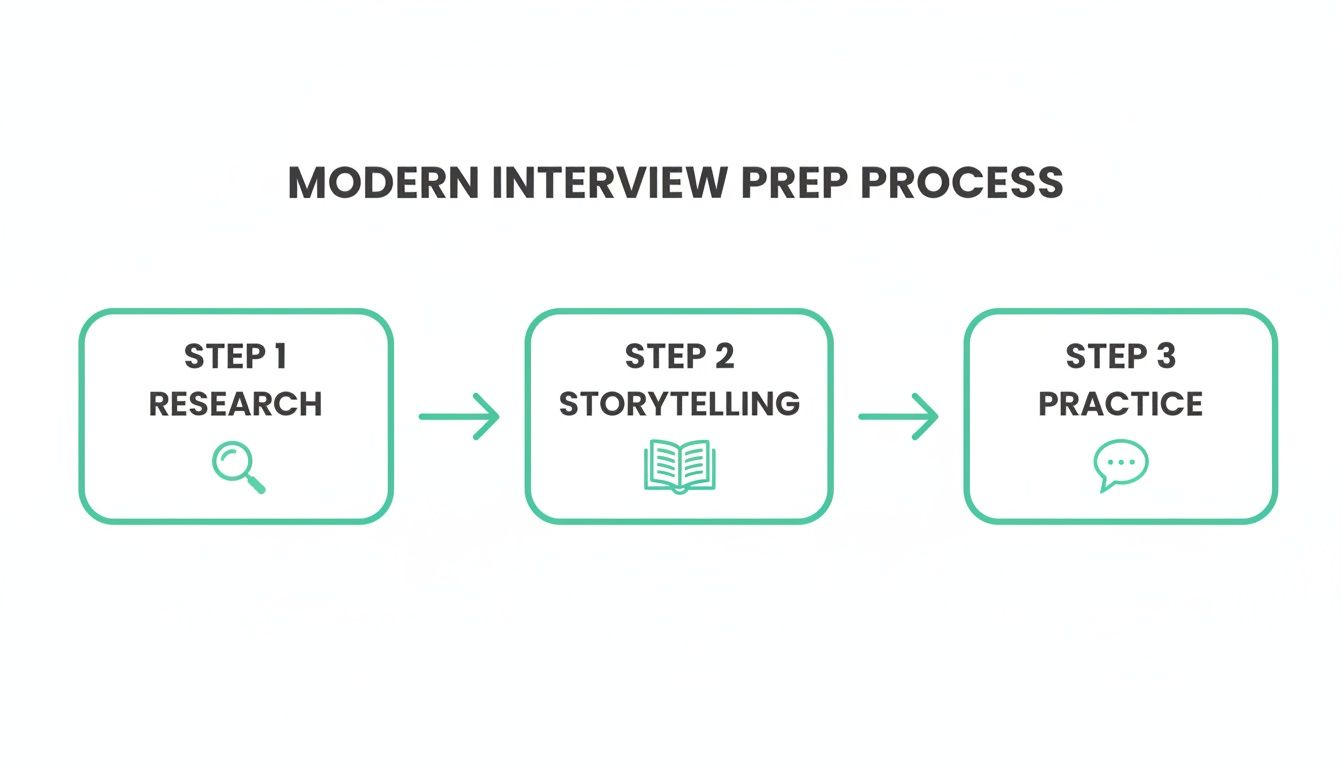
Each stage builds on the one before it, creating a strong foundation for genuine, confident communication. You're not just memorizing; you're internalizing your value.
A Smarter Way to Prepare
A structured approach, especially one supported by cognitive partners, is the key. Instead of trying to juggle every single detail in your head, you can use tools to organize your thoughts and pull up your best examples right when you need them.
The real goal of interview prep isn't to have a perfect answer for everything. It's to build a system that allows you to access your own knowledge and experience, even when you're nervous.
This method transforms stressful prep into a source of genuine confidence. For example, an AI-powered tool like an interview copilot can act as an on-screen guide, offering subtle memory cues pulled directly from your resume. This kind of support helps you recall key metrics and project details without ever breaking the natural flow of the conversation.
Ultimately, this style of preparation ensures you walk into every interview ready to connect, not just recite.
How to Research a Company Like an Insider
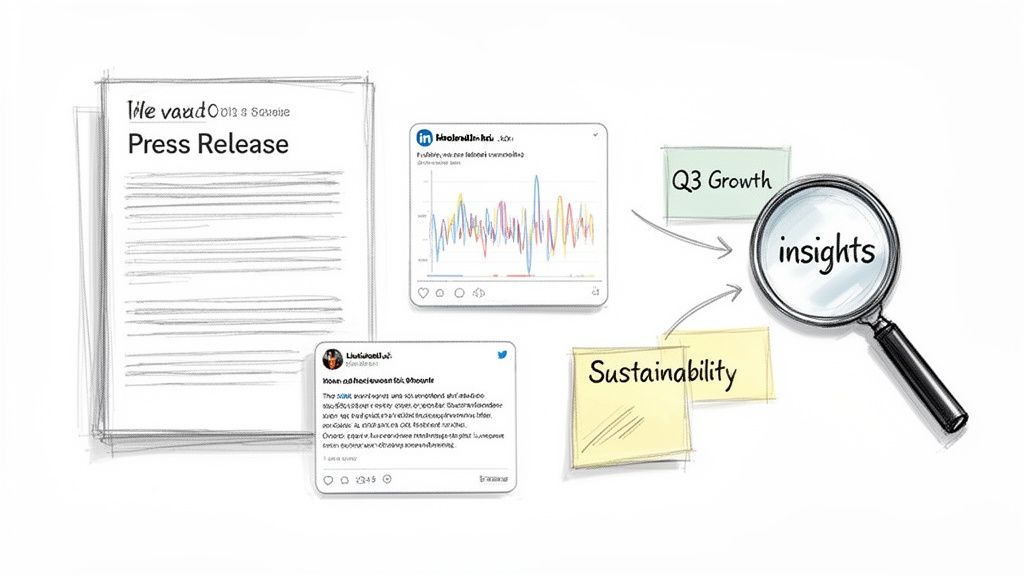
Anyone can glance at a company’s "About Us" page. Frankly, that’s the bare minimum. What really makes a candidate stand out is the ability to connect their own experience to the company's current challenges, opportunities, and strategic goals. It’s about showing them you get where they are right now and where they’re trying to go.
This kind of insight doesn't live on the surface. You have to dig a layer deeper to understand the real conversations happening behind the scenes. This is how you start thinking like a strategist, not just another applicant.
Go Beyond the Company Website
A company’s website is a highly polished marketing tool. It’s designed to look good. To get the real, unfiltered story, you have to go to the sources that investors, journalists, and industry insiders rely on. This is where you find the unvarnished truth about what the company actually prioritizes.
Start by zeroing in on a few key areas:
- Recent Press Releases: Scan for announcements from the last six months. Are they launching new products, entering new markets, or announcing big partnerships? These are direct signals of their strategy in action. For example, a press release about a new data center signals a major investment in infrastructure.
- Quarterly Earnings Calls: For any public company, the investor call transcript is a goldmine. Pay close attention to the questions analysts ask and how the CEO and CFO respond. They will literally state their biggest challenges and wins. If the CEO mentions "supply chain optimization" three times, that's a key priority.
- Key Leadership on Social Media: Follow the hiring manager, the department head, and a few C-suite executives on professional networking sites. Their posts and shares tell you what they think is important, whether it’s a new industry trend or a company project they’re excited about. For instance, if the VP of Engineering shares an article about serverless architecture, it's a strong hint about their technical direction.
The goal isn't just to collect facts; it's about connecting the dots. For example, if you notice the CEO constantly posting about AI efficiency and the latest earnings call mentioned a push to cut operational costs, you've just uncovered a major company priority.
Translate Insights Into Talking Points
Once you have this intel, you need to make it work for you. The next move is to turn those high-level company goals into concrete talking points that showcase your own skills. Don’t just mention what you found—explain how your background is the perfect fit for it.
Let's say you're a project manager, and you find a press release about the company's big new sustainability initiative. Instead of just saying, "I saw your new green initiative," you craft a compelling story.
"I was really impressed by your recent announcement about the company's commitment to sustainability. It reminded me of a project I led last year where I found inefficiencies in our supply chain that ultimately cut material waste by 15% and saved the company $50,000 annually. I'm passionate about finding those kinds of operational wins."
See the difference? This approach proves you’ve done your homework and, more importantly, that you can contribute to their specific goals from day one. It shifts the conversation from what you did in your last job to what you can do for their future.
Organize Your Research for Instant Recall
A massive document full of notes is completely useless in a high-pressure interview. You won't have time to sift through pages of text. The secret is to distill your findings into simple, digestible cues you can access in a split second.
This is where a tool like Qcard can be a game-changer for your prep. Instead of a messy doc, you can build a clean set of on-screen cards with short, powerful prompts.
For example, your deep research can be boiled down into cards like these:
- "Q3 Growth Driver: New enterprise software launch."
- "Competitor X Weakness: Slower customer support response."
- "CEO's Pet Project: Expanding into the European market."
- "Sustainability Goal: Reduce carbon footprint by 20% by 2025."
Having these simple cues on screen empowers you to ask smarter questions and weave your knowledge into the conversation naturally. When the interviewer inevitably asks, "Do you have any questions for us?" you can glance at your "Competitor X Weakness" card and ask:
"I've noticed that a key differentiator in this space is customer support. How does your team approach service excellence to stay ahead of competitors?"
This strategy makes you look less like a candidate who did their homework and more like a future colleague who is already thinking about the business.
From Resume Bullets to Interview-Ready Stories
Your resume is a highlight reel. It tells an interviewer what you did. The interview is your chance to show them how you did it and—most importantly—why it mattered. This is where you transform from a candidate on paper into a three-dimensional problem-solver. The best prep involves turning those static bullet points into memorable stories that bring your experience to life.
Think about it: a line on your resume might say, "Completed project on time." That's fine, but it hides the real story. It doesn’t capture the late-night brainstorming sessions, that one tough conversation with a key stakeholder, or the clever workaround you found to sidestep a roadblock. A good story does.
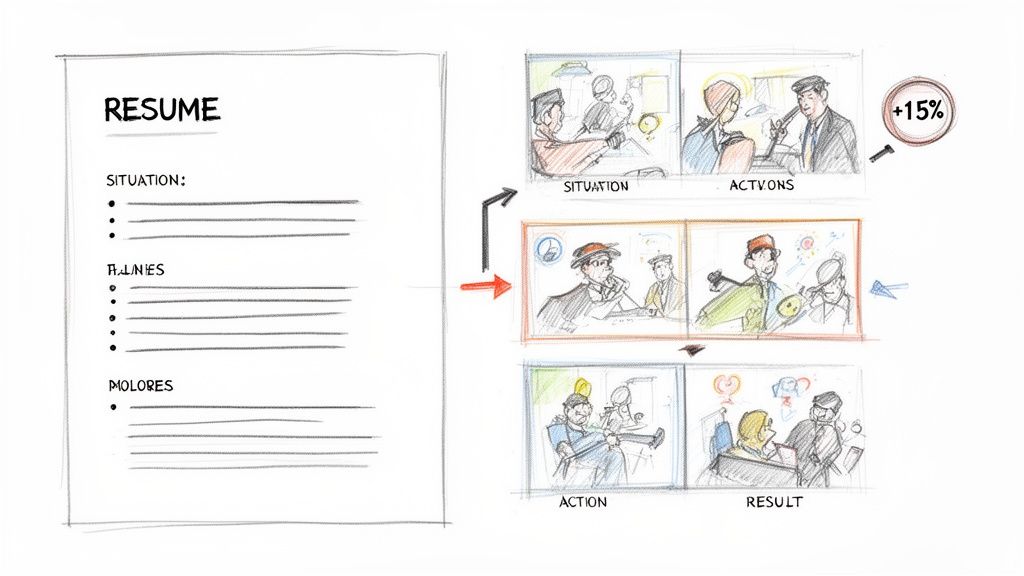
This process is all about grounding your achievements in authentic, detailed accounts. It’s the difference between making a claim and sharing a conviction.
Moving Beyond the Basic STAR Method
Most of us have heard of the STAR method—Situation, Task, Action, Result. It’s a solid starting point for structuring answers, making sure you hit the key parts of an experience. But if you want to stand out, especially for more senior roles, just filling in the blanks isn’t enough. Truly impactful stories add context, reflection, and real-world impact.
Let’s take a bland resume bullet from a project manager—"Managed cross-functional product launch"—and see how it becomes a story of genuine leadership.
- The Resume Bullet: "Managed cross-functional product launch, delivering on time and within budget."
- The Story: "Our product launch was at risk because the marketing and engineering teams had conflicting timelines. My job was to get everyone aligned without pushing our go-live date. I pulled both teams into a workshop and had them map out their critical dependencies on a shared whiteboard. That simple visual exercise exposed a major misunderstanding about an API handoff, which we resolved right there. The result? We launched on schedule and saw 20% higher user adoption in the first month than we had projected, all because marketing finally had the lead time they needed."
See the difference? The story includes conflict and resolution, which is far more engaging and memorable.
Anchor Your Stories with Hard Numbers
Stories are powerful, but stories backed by data are undeniable. Every narrative you prepare should be anchored to a specific, quantifiable outcome. These metrics are the proof that your actions had a real-world effect on the business, moving your contributions from subjective claims to objective facts.
To find these numbers, you’ll have to do some digging. Go back through your past projects and look for evidence of your impact in areas like:
- Efficiency Gains: Did you cut the time it took to complete a process? For instance, did you reduce report generation time from four hours to ten minutes? By what percentage?
- Revenue or Growth: Did your work contribute to a 10% increase in sales or a 5% bump in market share?
- Cost Savings: Did you find an inefficiency that saved the company $25,000? For example, did you renegotiate a vendor contract?
- Customer Metrics: Did you improve customer satisfaction scores or reduce churn? Did your fix improve the CSAT score from 8.5 to 9.2?
A developer’s story gets so much stronger with this kind of detail. Instead of saying they "Improved application performance," they could explain: "I noticed our main dashboard was taking over five seconds to load, which was causing a high user drop-off rate. I profiled the database queries and found a bottleneck in our data aggregation logic. By implementing a caching layer, I slashed the load time to under 800 milliseconds. That directly correlated with a 15% reduction in user session abandonment."
The best stories don't just state the result; they connect a specific action to a meaningful business outcome. This shows you understand the bigger picture and how your technical work drives value.
Create Cues for Instant Recall
In the middle of a high-stakes interview, it’s all too easy for your mind to go blank. You can’t exactly read from a script, but you can use simple prompts to jog your memory. The goal is to create short, powerful cues that instantly bring the full story back to mind.
This is where a tool like Qcard can be a game-changer. You can load your story prompts as on-screen cards, creating a discreet safety net. These aren't scripts; they are high-level reminders tied directly to your verified experience.
For example, your story cues might be as simple as this:
- Client Z Retention: Saved account, fixed API bug, boosted satisfaction 15%.
- AWS Migration: Led team through transition, cut infra costs 30%.
- Scope Creep Issue: Re-negotiated timeline with stakeholder, saved project.
Having these scannable prompts on your screen offloads the mental burden of memorization. This frees up your cognitive energy to focus on what really matters: listening to the interviewer and building a genuine connection, knowing your best stories are always just a glance away.
Practicing for Performance, Not Perfection
Let's get one thing straight: effective practice isn't about memorizing your answers until you can recite them in your sleep.In fact, that’s one of the worst things you can do. Repeating the same answer a dozen times makes you sound robotic and stiff. The real goal is to build mental agility and confidence, so you can think on your feet and let your actual expertise come through.
You're shifting your focus from chasing perfection to preparing for performance. It's a subtle but critical distinction. One path leads to anxiety and a rigid script; the other builds the resilience you need to have a genuine conversation, even under pressure.
Adapting Your Stories for Behavioral Interviews
Behavioral interviews are all about seeing how you handle real-world professional scenarios. The interviewer isn't just listening to what happened; they're trying to understand your judgment, your problem-solving process, and your self-awareness. You’ll never know the exact questions in advance, but you can prepare your core career stories to be flexible enough to handle almost anything.
Start by identifying five to seven of your strongest professional stories. For each one, don't just rehearse a single version. Think about all the different angles. How could you frame it to answer different kinds of questions?
For example, a single project story could be adapted for prompts like:
- “Tell me about a time you had a conflict with a stakeholder.” Here, you’d zero in on the initial disagreement and how you built a bridge to a solution.
- “Describe a complex project you managed from start to finish.” This version would focus on your process—the planning, execution, and final outcome.
- “Give an example of a time you had to influence without authority.” For this, you’d highlight how you built consensus and persuaded team members to get on board.
The trick is to understand the core theme of each story. One might be about resilience, another about strategic thinking, and a third about collaboration. When you hear a question, you can quickly match it to the most relevant theme and adapt your story on the fly.
Thinking Out Loud in Technical Interviews
Whether it's for coding or system design, a technical interview is as much about your communication as your final answer. Interviewers need to see your problem-solving process in action. Just sitting there silently and then presenting a perfect block of code is a huge red flag. You have to learn to articulate your thought process clearly and methodically.
This is a skill that absolutely requires practice. The best way to do it is to narrate every single step you take while solving a problem, from clarifying the initial question to testing your solution.
"Okay, first, I'm going to clarify the constraints. Are we dealing with negative numbers here? What's the expected scale of the input? Great. Given those requirements, my initial thought is to use a hash map to store frequencies. That gets us O(1) average time complexity for lookups. Let me walk you through how that would work..."
This approach does two crucial things. It shows the interviewer that you’re organized and deliberate, and it gives them a chance to offer a hint or gently nudge you back on track if you start heading down the wrong path.
Using AI for Realistic Rehearsal
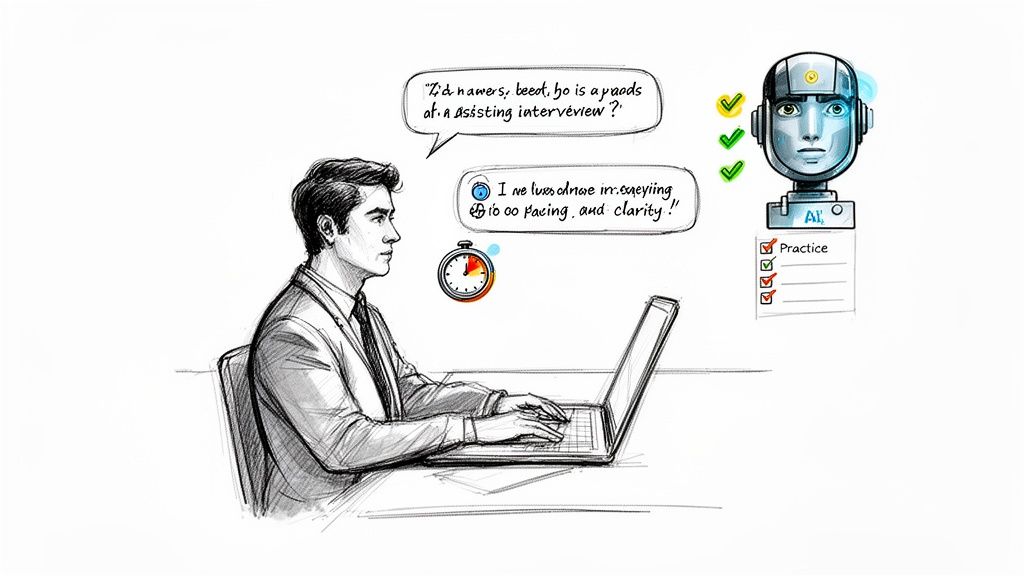
The biggest challenge with practicing by yourself is the lack of real-time pressure and feedback. It's easy to sound brilliant when you're alone in a room, but it’s a whole different ballgame when an interviewer is watching your every move. This is where AI-powered tools can give you a serious edge by simulating a much more realistic environment.
Modern tools can run mock interviews that do more than just read questions from a list. They can throw intelligent, context-aware follow-up questions at you, which is exactly what you need to test how well you think on your feet.
For instance, after you share a story about a successful project, the AI might come back with: "That sounds like a great outcome. What would you have done differently if you had 50% less budget?"
This kind of dynamic questioning forces you to go beyond your prepared script and demonstrate genuine critical thinking. A great way to get started is with a tool like the Qcard AI mock interview feature, which is designed for this kind of intelligent interaction.
These sessions give you invaluable, objective data on things that are nearly impossible to judge on your own:
- Pacing: Are you talking a mile a minute when you get nervous? Or slowing down too much when you're thinking?
- Clarity: Is your explanation actually logical and easy to follow from an outside perspective?
- Filler Words: How often are you leaning on "um," "uh," or "like" as a crutch?
By recording yourself and reviewing the AI-generated feedback, you can pinpoint specific weak spots. Maybe you realize you always rush through the "Result" part of your stories, or you consistently forget to mention key metrics. Armed with that knowledge, you can go back and refine your approach, making sure that when the real interview day comes, your performance is as strong as your preparation.
Show Time: Executing on Interview Day and Nailing the Follow-Up
All the deep research, story crafting, and practice runs have led you right here. On interview day, the goal isn't to cram more information. It’s about setting the stage for a calm, confident performance and leaving a great final impression. This is your execution phase, where a little bit of logistical and mental prep can make a world of difference.
You want to walk into that conversation feeling centered and ready to connect, not just recite answers. A solid day-of plan helps you manage all the little variables, freeing up precious mental energy to focus on what matters: the interviewer and the role.
Your Pre-Interview Checklist
The morning of an interview can feel a little frantic. I’ve found that a simple checklist is the best way to bring order to that chaos, making sure you don't miss the small details that have a surprisingly big impact—especially for virtual interviews. Before you log on, run through a quick pre-flight check to get your space and your mind right.
Your tech and environment should be so well-prepared that you can completely forget about them once the call starts.
- Tech Check: Always open the meeting link 10-15 minutes early. Confirm your camera, microphone, and internet are working perfectly. Nothing rattles your confidence like a last-minute tech scramble.
- Set the Scene: Find a spot with a simple, professional background and good lighting. Just as important, make sure you won’t be interrupted by family, pets, or roommates.
- Kill the Distractions: Close every unnecessary browser tab. Turn off notifications on your computer and phone. The only things on your screen should be the video call itself and any support tools you're using.
With the logistics handled, take a moment for yourself. Simple grounding techniques are incredibly powerful for taming those last-minute nerves. I often recommend a quick 3-minute box breathing exercise: inhale for four counts, hold for four, exhale for four, and hold again for four. It's a simple trick that can calm your nervous system and pull your focus squarely into the present.
Staying Present and Composed
During the interview, your main job is to listen intently and build a genuine connection. That’s almost impossible if your brain is frantically trying to recall every single detail, metric, and story you prepared. The mental load of pure memorization is a huge source of anxiety and can make you seem distracted or robotic.
This is where having a cognitive safety net really pays off. A discreet on-screen tool can act as your co-pilot, offloading the heavy burden of total recall.
The goal isn't to read from a script. It's to have subtle, high-level cues that jog your memory, allowing you to stay present and maintain natural eye contact. This is a powerful support for both neurodivergent and neurotypical candidates.
For example, a tool like Qcard can give you real-time feedback on filler words or quietly display your key talking points. This kind of support system works in the background, giving you the confidence that you won't lose your train of thought. You’re then free to focus on what the interviewer is really asking, read their body language, and have a much more authentic, two-way conversation.
Crafting the Perfect Follow-Up
The interview isn't truly over when you sign off. A prompt, thoughtful thank-you note is the final, crucial step. It reinforces your interest, shows true professionalism, and gives you one last chance to drive home why you’re the best person for the job. And speed matters here—always aim to send your follow-up within 24 hours.
A generic "Thanks for your time" email is a totally wasted opportunity. Your note needs to be personal and specific, referencing a high point from your conversation.
For example, you could say something like:
"I especially enjoyed our conversation about the team's upcoming push into the APAC market. It reminded me of my experience launching a similar initiative in my previous role, and I'm confident I could help navigate that expansion successfully."
That small detail proves you were listening closely and are already thinking about how you can add value. You can even use AI-powered generators to get a personalized first draft. Tools like Qcard’s thank-you note generator can pull key themes from your interview to help you structure a message that's both professional and memorable, ensuring you leave a lasting positive impression.
Answering Your Biggest Interview Prep Questions
Even with the best plan, you're bound to have questions. Getting straight answers to these common sticking points can make all the difference, helping you focus your energy and walk into your interview feeling prepared and confident. Let's dig into some of the questions I hear most often.
How Far in Advance Should I Really Start Preparing?
The short answer? As soon as you land the interview. Ideally, you want to give yourself a solid 3 to 5 days for most roles. If you're going for a senior-level or highly technical position, do yourself a favor and aim for a full week, if not more.
Spreading out your prep is crucial. Here's a timeline that works well:
- First couple of days: Go deep on research. Understand the company, the culture, the role, and the people you'll be talking to.
- Middle days: This is when you build your talking points and actually start practicing your answers out loud.
- The day before: Keep it light. Do a quick review of your notes, but avoid cramming. Your main job is to get into the right headspace.
Trying to cram everything in at the last minute is a recipe for stress and forgetfulness. Spaced repetition—practicing a little bit each day—is scientifically proven to help move information into your long-term memory, so your key stories are there when you need them.
What's the Best Way to Answer "Tell Me About Yourself"?
Think of this as your professional movie trailer, not your autobiography. You’ve got about 90 seconds to hook them. The goal isn't to list every job you've ever had; it's to tell a concise story that connects your experience directly to the job you're interviewing for.
A great approach is the "Present-Past-Future" model. Start with where you are now and a key achievement. Then, briefly touch on past experiences that equipped you for this specific role.
For instance, a software engineer might say, "My recent work scaling the payment system at my last job gave me direct experience with the kind of high-volume transaction challenges you mentioned in the job description."
Finally, pivot to the future by explaining exactly why you're so interested in this opportunity.
How Can I Keep My Cool During a Virtual Interview?
First off, a little bit of anxiety is totally normal. It shows you care. The trick isn't to eliminate it but to manage it. Your best defense is always solid preparation—the more you know your stuff, the more your confidence will naturally build. A few minutes of deep breathing exercises right before the call can also work wonders for calming your nervous system.
During the call itself, this is where cognitive support tools can be a game-changer. Having a discreet on-screen prompter with your key talking points acts as a mental safety net. It takes the pressure off your working memory, which is a massive help for neurodivergent candidates but honestly benefits anyone who gets interview jitters. When you're not scrambling to remember your next point, you can be more present and genuinely engage in the conversation. For a deeper dive, you can explore our detailed guide on the modern prep process.
What Questions Should I Ask Them?
Never, ever say, "No, I don't have any questions." Asking smart, insightful questions is one of the best ways to show you're truly engaged and thinking critically about the role.
Come prepared with 3-5 questions that you couldn't just find on their website. Focus on things that matter to you and demonstrate you're thinking like a future team member.
Here are a few examples to get you started:
- "From your perspective, what does a successful first quarter in this role look like?"
- "How does the team approach giving and receiving feedback, especially on complex projects?"
- "Looking ahead six months, what do you see as the biggest opportunity or challenge for this team?"
Questions like these not only give you crucial information but also frame you as a strategic, forward-thinking candidate.
Ready to turn interview prep from a source of stress into your biggest advantage? Qcard gives you the tools you need—from an AI mock interview partner to a discreet on-screen copilot—to make sure you perform at your absolute best. Start your journey with Qcard today!
Ready to ace your next interview?
Qcard's AI interview copilot helps you prepare with personalized practice and real-time support.
Try Qcard Free