Interview Practice Coach: What It Is and How to Choose One
TL;DR
An interview practice coach runs a feedback loop rather than handing you more questions: define the competency, answer under pressure, score observable evidence, make one or two targeted corrections, then re-attempt. Repetition alone can make you more comfortable rambling — the loop is what converts each attempt into information. Clemson research found candidates who received coaching scored significantly higher in structured situational interviews than those who only practiced, with practice-without-feedback showing little independent improvement. Spacing matters too: a randomized trial of 129 behavioral-health providers found workshop gains had decreased by four-month follow-up, so revisit weak skills under new question variations rather than cramming one strong session. Human coaches bring judgment and can pause when anxiety spikes; AI copilots bring frequency, repeatable scoring, and a record of attempts. Whichever you choose, verify resume grounding, zero-script boundaries, rubric-based scoring, accessibility controls, and privacy practices before paying.
You're halfway through an interview when the question changes shape. You prepared for “Tell me about a difficult project,” but the interviewer asks what you personally did, what failed, and what you'd change. Your answer starts well, then wanders. You remember the result but lose the numbers. A follow-up arrives, and suddenly your experience feels out of reach.
That moment doesn't prove you lack ability. It shows that interview performance is a separate skill from doing the work. An interview practice coach helps you rehearse that skill with realistic questions, evidence from your own experience, and feedback you can apply before the next conversation. If anxiety affects your preparation more broadly, resources such as anxiety support for Penticton residents can offer support beyond interview technique.
What Is an Interview Practice Coach?
An interview practice coach is a structured rehearsal partner - closer to a sports coach or flight simulator than a list of interview tips. It helps you select role-relevant competencies, answer realistic questions, receive criterion-based feedback, and try again.
The distinction matters because interview performance is a separate skill from doing the work. A weak answer usually reflects weak retrieval and structure, not weak professional capability. Someone who resolved a supplier delay and reorganized a tracking process may still describe the team’s problem at length and their own contribution in one sentence — the story is stored as a busy period rather than a sequence of decisions.
The coaching cycle has five steps:
- Define the target — select competencies like problem-solving, stakeholder communication, prioritization, or technical judgment.
- Simulate the pressure — answer a behavioral, technical, case, or follow-up question aloud, ideally under a time constraint.
- Score observable evidence — review structure, relevance, ownership, reasoning, outcome, pacing, and clarity.
- Choose a small correction — fix one or two high-impact issues rather than rewriting everything.
- Re-attempt the answer — improvement should show up as changed behavior, not just understanding of the advice.
What it isn’t: a resume writer (that shapes how experience looks on paper), career counseling (that helps you choose direction), a one-off mock interview without scoring or a second attempt, or a question bank. A question bank helps when you already know what to do with it. Coaching begins when someone — or something — observes your answer and tells you what to change next.
The evidence supports structured practice: OPM’s review found structured interviews use standardized questions, job-related competencies, and consistent scoring, with personnel-assessment evidence putting structured interview scores at roughly 32% of the variance in future job performance versus about 4% for unstructured interviews.
The Moment Every Candidate Knows Too Well
Maya had excellent experience for a project coordinator role. She had resolved a supplier delay, reorganized a tracking process, and helped several teams meet a difficult launch date. On paper, those examples were strong. In the interview, however, she answered the first behavioral question with a long description of the team's problem and only a sentence about her own contribution.
The interviewer asked, “What did you decide to do personally?”
Maya paused. She knew the answer, but the story was stored in her memory as a busy period rather than as a clear sequence of decisions. She talked faster, added background, and finished without explaining the outcome. Afterward, she concluded that she wasn't good at interviews.
That conclusion was too harsh. Maya didn't need a new personality. She needed a way to retrieve relevant evidence under pressure and present it in a form the interviewer could evaluate.
Practical rule: A weak interview answer often reflects weak retrieval and structure, not weak professional capability.
An interview practice coach works on that gap. The coach might ask Maya to identify the situation in one sentence, name the task she owned, explain two decisions, and finish with a measurable result. It might then ask the same question again with a follow-up about conflict or trade-offs. The purpose isn't to make her memorize a speech. It's to help her access a truthful example when the question arrives unexpectedly.
The same pattern appears in technical interviews. A capable developer may solve complex production issues at work but over-explain every possible cause in an interview. A career switcher may have relevant volunteer or academic experience but dismiss it because it doesn't look like a traditional job example. A multilingual candidate may understand the question perfectly yet need extra time to shape an answer in English.
These are learnable behaviors. Targeted rehearsal can make answers clearer, shorter, and more evidence-based without turning them into artificial performances.
What an Interview Practice Coach Actually Does
An interview practice coach is a structured rehearsal partner. It helps you select role-relevant competencies, answer realistic questions, receive criterion-based feedback, and try again. It's closer to a sports coach or a flight simulator than to a document full of interview tips.
A useful coaching cycle looks like this:
- Define the target. Select competencies such as problem-solving, stakeholder communication, prioritization, or technical judgment.
- Simulate the pressure. Answer a behavioral, technical, case, or follow-up question aloud, preferably with a time constraint.
- Score observable evidence. Review structure, relevance, ownership, reasoning, outcome, pacing, and clarity.
- Choose a small correction. Fix one or two high-impact issues rather than rewriting everything.
- Re-attempt the answer. Improvement should appear in changed behavior, not merely in your understanding of the advice.
A review summarized by the U.S. Office of Personnel Management's structured interview guidance found that structured interviews use standardized questions, job-related competencies, consistent scoring rules, and defined evaluation procedures. The review found higher validity, rater reliability, and agreement than in less structured interviews. The same personnel-assessment evidence puts structured interview scores at roughly 32% of the variance in future job performance, compared with about 4% for unstructured interviews.
That doesn't mean every answer needs to sound formal. It means your practice should reflect the way a serious interviewer evaluates evidence.
An interview practice coach isn't necessarily a resume writer. Resume writing shapes how your experience appears on paper. Career counseling may help you choose a direction, understand workplace decisions, or manage a transition. A one-off mock interview can expose you to questions, but without scoring and a second attempt, you may leave with impressions instead of a training plan.
A question bank is useful when you already know what to do with it. Coaching begins when someone, or something, observes your answer and tells you what to change next.
Why Feedback Loops Beat Repetition Every Time
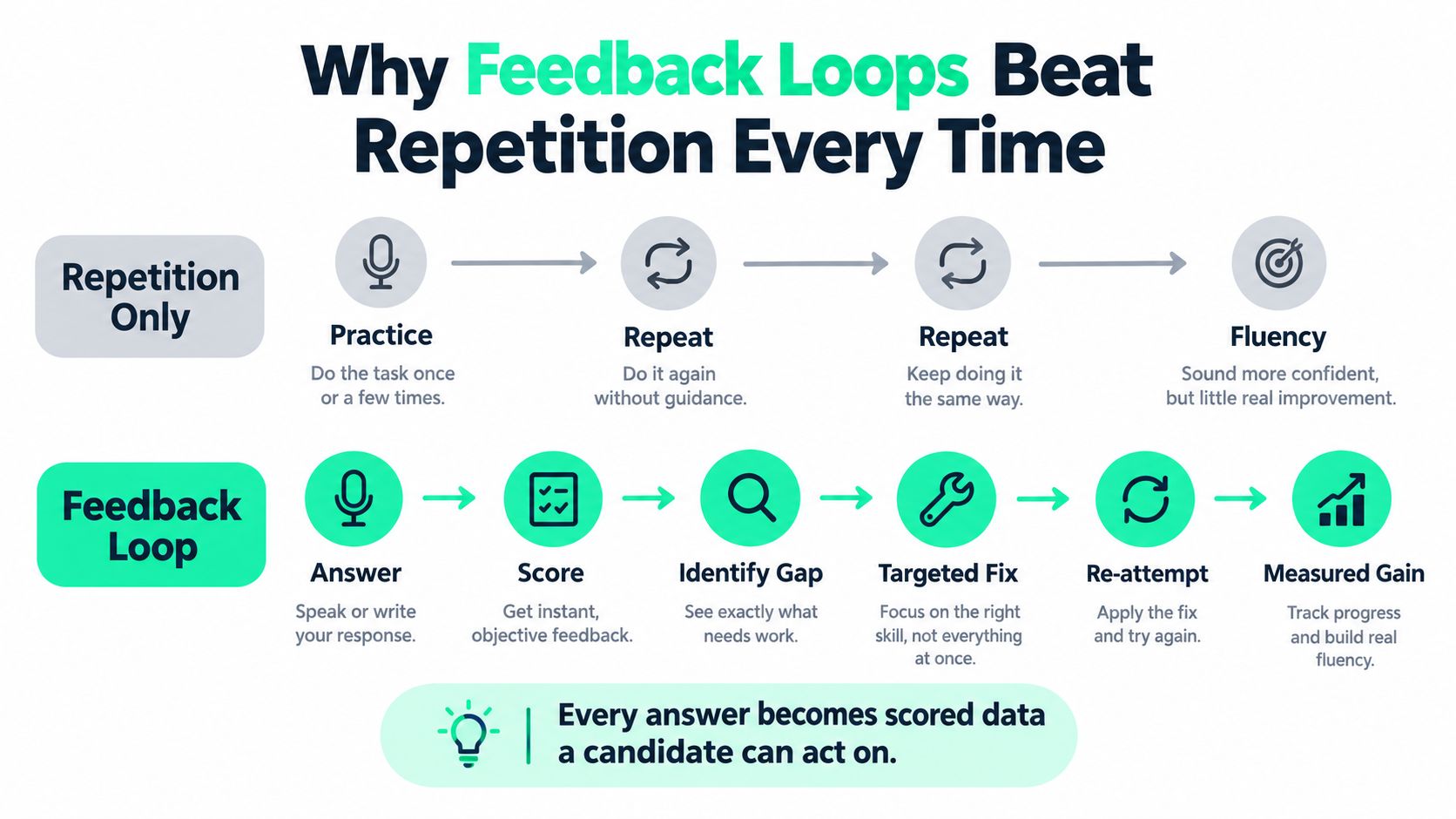
Repeating an answer can make it feel familiar while leaving the original problem untouched. If you ramble through the same story five times, you may become more comfortable rambling. A feedback loop interrupts that pattern by turning each attempt into information.
The sequence is simple: answer, score, identify a gap, make a targeted correction, and answer again. For a behavioral response, the scoring dimensions might include:
- Specificity: Did you name the actual situation rather than describe a general type of problem?
- Ownership: Did the listener understand what you personally decided or delivered?
- Reasoning: Did you explain why you chose that approach?
- Outcome: Did you show what changed and how you know?
- Structure: Could the interviewer follow the answer without reconstructing it?
Suppose your first answer says, “I improved the process and the team became more efficient.” A coach may identify missing ownership and evidence. Your second attempt could explain the bottleneck, the change you introduced, and the measurable result. The point isn't to insert impressive language. It's to replace vague claims with facts you can defend.
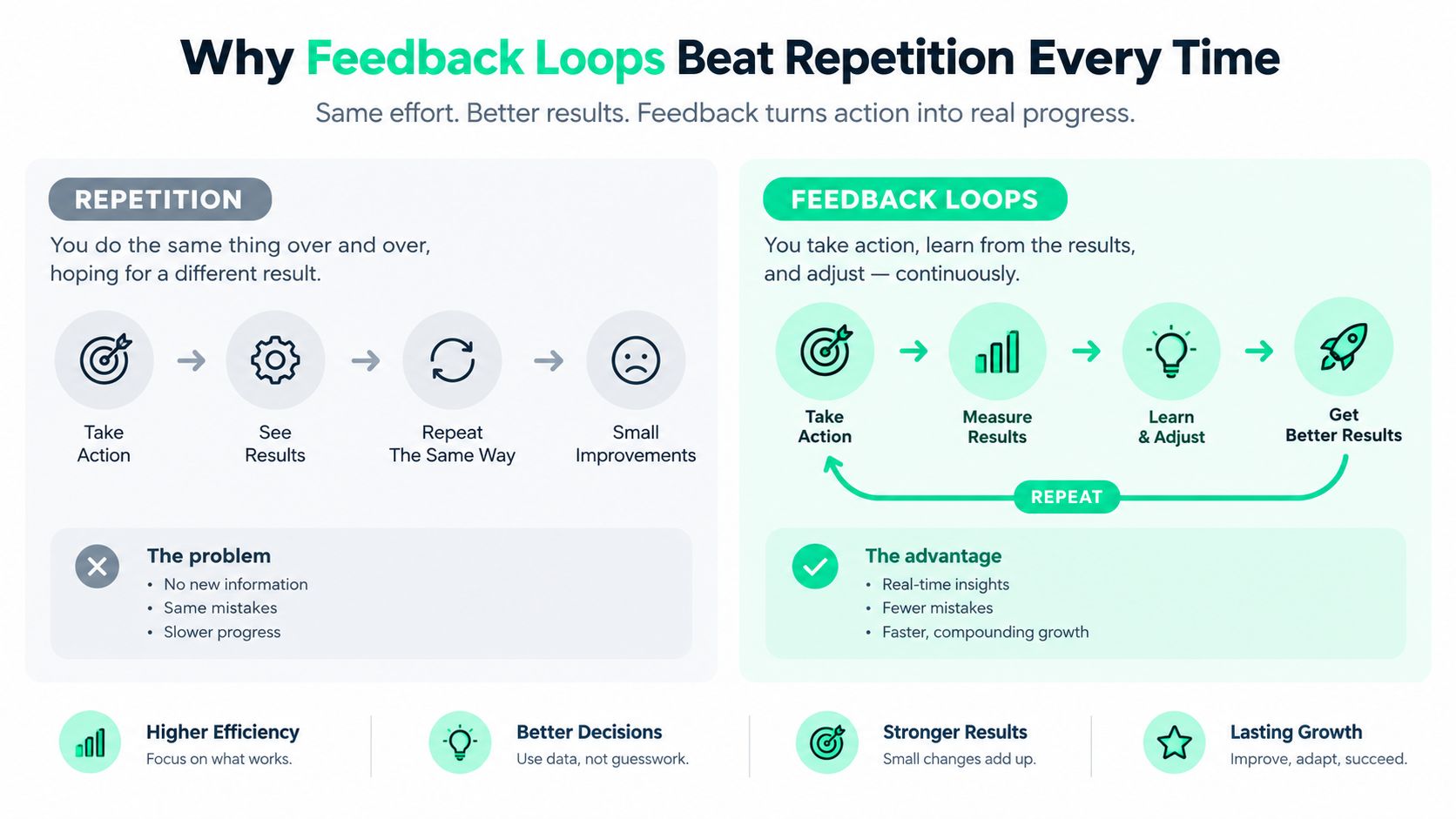
Feedback also needs time between sessions. A randomized controlled trial involving 129 behavioral-health providers found that workshop training increased interviewing skill, but those gains had decreased by the four-month follow-up, as reported in the Cambridge study on motivational interviewing training. The finding illustrates a broader training risk: one strong preparation session can create short-term fluency without durable behavior change.
A better routine revisits weak skills under new questions. If concise framing improves on Monday, test it later with a conflict question, then with a technical explanation. Track whether the behavior survives a different prompt.
Useful measures include:
- filler-word rate
- median response duration
- time-to-first-answer
- rubric score by competency
- whether your answer includes role-specific evidence
You don't need to chase a perfect score. You need a record of what changes, what regresses, and what deserves the next practice session.
Inside a Real Coaching Session
A productive session starts with the role, not with random questions. Imagine a candidate preparing for a customer success position. The coach selects three competencies: handling difficult stakeholders, prioritizing customer needs, and using data to improve retention.
The candidate provides a resume and a few real examples. The coach then asks a behavioral question about an unhappy customer and gives the candidate time to answer without interruption. A second question probes prioritization. A third asks the candidate to interpret a customer trend and recommend action.

The coach scores each answer separately from 1 to 5 across factual specificity, personal ownership, reasoning, outcome measurement, and communication structure. That scale isn't valuable because five is magical. It's valuable because the candidate can see whether the same weakness appears repeatedly.
A worked answer revision
The candidate initially says, “I improved the process and reduced delays.” The coach asks for the specific mechanism and result. The candidate checks their records and revises the answer to: “I cut processing time by 30% across 200 weekly cases.”
That revision is only useful if it remains truthful and connected to the candidate's own contribution. The coach asks the candidate to deliver the full response again, this time under realistic timing. It then checks whether the new evidence sounds natural or whether the candidate is forcing a number into an unrelated story.
The practice interview questions from Qcard can support this kind of rehearsal when you need varied prompts, but questions alone don't create improvement. The candidate must answer, receive a diagnosis, and repeat the delivery.
Why the second attempt matters
A coach may limit feedback to two corrections: make the opening point sooner and explain the individual decision before describing the team's work. Too many suggestions can overload an anxious candidate and make the next response less natural.
The Clemson University dissertation on practice and coaching found that candidates who received coaching achieved significantly higher ratings in structured situational interviews than candidates who only practiced. Gains appeared in communication and content, as well as nonverbal impression-management behavior, while practice without feedback showed little independent improvement.
A serious session ends with a next-action plan. The candidate might record the answer again later, prepare a second example for the same competency, or practice a follow-up that challenges the original decision. That's how a mock interview becomes training rather than theater.
Human Coaches, AI Copilots, and the Hybrid Middle
Human coaches bring judgment, empathy, and the ability to notice when an answer conflicts with the candidate's intention. They can pause a session when anxiety spikes, ask a more useful question, and help a career switcher recognize experience that doesn't fit a conventional job title. Their limitation is availability, cost, and the fact that feedback can vary from one session to another.
AI copilots offer immediate practice and repeatable scoring. They can generate role-specific questions, listen to spoken answers, identify pacing or filler-word patterns, and preserve a record of previous attempts. Their weakness is interpretation. An automated system may misunderstand an accent, overvalue polished phrasing, or treat a communication difference as a performance defect.
Hybrid coaching combines frequent self-paced drills with periodic human review. A candidate might use an AI tool to practice retrieval and answer length, then bring a difficult story, accessibility concern, or career-change narrative to a human coach.
The ethical boundary matters. A memory-cue tool can surface a project name, a decision, or a verified result from your resume. A script tells you exactly what to say. The first supports recall. The second can make your delivery sound borrowed, encourage claims you can't defend, and create problems when the interviewer asks a question your script didn't anticipate.
Gartner reported in 2025 that 52% of candidates believed AI screened their application information, while only 26% trusted AI to evaluate them fairly, and 6% admitted to interview fraud such as impersonation or having another person interview for them, according to Gartner's survey release on AI in hiring.
When comparing options, ask:
- Does the tool keep prompts grounded in your verified experience?
- Does it prohibit verbatim scripting and impersonation?
- Can you control the format, pacing, and accessibility settings?
- Does it explain why an answer needs improvement?
- Can you review recordings, transcripts, or scores privately?
- Does a human have a role when context matters?
Qcard is one example of an AI-backed option. Its AI interview coach uses resume-grounded talking points rather than verbatim scripts and supports practice around pacing, filler words, answer length, and depth. Its stated approach includes encrypted sessions, no audio recording, and multiple layouts for different setups. Treat those features as criteria to verify for yourself, not as a substitute for judgment.
Practice That Respects How Your Brain Actually Works
“Be more confident” isn't a practice plan. It also hides an important question: confident according to which communication standard?
Some candidates think clearly but need more processing time. Some avoid sustained eye contact while listening carefully. Some speak with an accent, use a different rhythm, or experience anxiety that affects speed and recall. A coach should distinguish job-relevant evidence from presentation habits that may reflect a narrow idea of professionalism.
For an anxious candidate, a useful drill might begin with a slow exhalation, feet placed firmly on the floor, and a one-sentence headline before the details. The coach can then measure whether the candidate answers the question, supports the answer with an example, and finishes with an outcome. It can evaluate clarity separately from eye contact, facial expression, or speed.
For a neurodivergent candidate, preparation may include asking whether questions can be provided in advance, requesting a short pause before answering, or discussing an alternative communication format. A 2023 Canadian workplace report found that only 22% of neurodivergent employees said their organization provided tools, training, or supports for day-to-day work activities, as reported in Breaking Down Barriers. The report also identified requested accommodations such as flexibility in work location and schedule, noise-cancelling headphones, assistive technology, and alternative communication methods.
Replace performance rules with evidence checks
Instead of “remove every filler word,” ask whether fillers obscure the meaning. Instead of “maintain eye contact,” ask whether the listener can follow your reasoning. Instead of “answer immediately,” rehearse a professional pause such as, “I'd like to think about the most relevant example.”
Candidates can prepare an accommodation request in plain language:
“I give stronger answers when I have a brief moment to process a complex question. Would it be possible for me to take a short pause before responding?”
Spaced practice helps these routines become available under pressure. A practical guide to spaced repetition scheduling can help you plan revisits instead of cramming everything into one night.
The objective isn't to hide difference. It's to give the interviewer a fair opportunity to hear what you know, what you've done, and how you think.
A Checklist for Evaluating Any Interview Practice Coach
Before paying for a service, test whether it supports improvement rather than merely generating more questions. A credible interview practice coach should make the learning process visible.
Look for these capabilities:
- Spaced reinforcement: The system remembers weak competencies and brings them back under new question variations.
- Rubric-based scoring: It separates structure, relevance, ownership, reasoning, specificity, and outcome instead of giving one vague confidence score.
- Resume grounding: Prompts and cues use your real experience, with a clear way to correct inaccurate details.
- Zero-script boundaries: The provider explains that cues support memory and retrieval, not verbatim answers, impersonation, or hidden assistance.
- Accessible practice: You can adjust timing, format, captions, audio, or processing expectations without being punished for difference.
- Playback and review: You can revisit recordings, transcripts, or notes and compare attempts privately.
- Actionable feedback: Each session ends with one or two changes you can test immediately.
Privacy deserves its own check. Ask what the system stores, whether audio is retained, how transcripts are handled, and whether you can delete your practice data. A tool that claims to be resume-grounded should also explain how it avoids inventing achievements or metrics.
For example, Qcard's described preparation toolkit includes AI-scored practice, mock interviews with follow-up questions, a recording studio, question resources, thank-you email generation, and layouts called Full, Mini, and Phone. Its interview support focuses on high-level, resume-locked cues rather than scripts, with real-time feedback for pacing, filler words, and answer length.
That doesn't make any product suitable for every candidate. Test the workflow with a real story. If the tool invents a result, pushes you toward language you wouldn't use, or can't explain its score, stop and reassess.
Putting It Together in a 30-Day Prep Routine
Start by making your experience retrievable. During days 1 through 7, choose three competencies from the job description and create a one-page evidence sheet with three real examples for each. Record the situation, your responsibility, key decisions, and outcome.
During days 8 through 21, run two timed mock interviews per week. Score each answer against the same rubric and track filler-word rate, median answer length, and time-to-first-answer. Don't fix everything at once. Choose the behavior that most affects whether the interviewer can understand your evidence.
During days 22 through 28, revisit weak behaviors with new question variations. Add a short grounding routine and rehearse one or two accommodation requests if you may need them. Practice answering a follow-up that challenges your decision, because retrieval becomes harder when the conversation moves away from your prepared wording.
Finish days 29 and 30 with a full simulation under realistic conditions. Review the recording, note the strongest evidence, and send the thank-you note the same day. The interview preparation guide from Qcard can help you organize the final preparation materials.
The sentence to remember is simple: practice with feedback, spaced over weeks, and grounded in your real experience. That's what an interview practice coach exists to deliver.
Key Takeaways
- A weak interview answer usually signals weak retrieval and structure rather than weak capability — the fix isn’t a new personality but a way to access a truthful example when the question arrives unexpectedly, which is exactly what a structured rehearsal loop trains.
- Feedback loops beat repetition because repeating an unexamined answer just builds comfort with the original flaw — scoring specificity, ownership, reasoning, outcome, and structure turns each attempt into a diagnosis, and Clemson research found coached candidates outperformed practice-only candidates in structured situational interviews while practice alone showed little independent gain.
- Limit corrections to one or two per session, because too many suggestions overload an anxious candidate and make the next response less natural — “make the point sooner” plus “explain your individual decision before the team’s work” is a usable plan; a full rewrite is not.
- The ethical line between a memory cue and a script is the one to watch — a cue surfaces a project name, decision, or verified result from your resume, while a script makes delivery sound borrowed, encourages claims you can’t defend, and collapses when the interviewer asks something it didn’t anticipate; Gartner’s 2025 survey found only 26% of candidates trusted AI to evaluate them fairly and 6% admitted to interview fraud.
- Replace performance rules with evidence checks, especially for anxious, neurodivergent, and multilingual candidates — instead of “remove every filler word,” ask whether fillers obscure meaning; instead of “maintain eye contact,” ask whether the listener can follow your reasoning; and rehearse a professional pause (“I’d like to think about the most relevant example”) rather than forcing immediate answers.
Qcard offers resume-grounded memory cues, AI-scored practice, mock interviews with follow-up questions, and real-time feedback on pacing, filler words, and answer length without asking you to memorize scripts. Visit Qcard to explore a practice approach that helps you retrieve your own evidence and speak naturally under interview pressure.
Ready to ace your next interview?
Qcard's AI interview copilot helps you prepare with personalized practice and real-time support.
Try Qcard Free