Interview Performance Feedback: Targeted Practice for 2026
TL;DR
Interview performance feedback becomes useful only when you decode it before reacting. Separate the content layer (what you said) from the reception layer (what the interviewer heard) using a two-column debrief written within 30 minutes of the interview. Because most employers share little — 56% of candidates receive no feedback and only 6% get feedback tied to actual assessment criteria — request it within 24 hours by naming one specific moment and asking one narrow question, then follow up on day 7 and redirect on day 14. Sort every comment into content, structure, delivery, or bias-coded buckets, since "your answers were too detailed" and "you lacked leadership" require completely different drills. Convert each comment into a 20-minute targeted practice session: copy, diagnose, design, drill. And when feedback uses vague vocabulary like "culture fit," "presence," or "you didn't feel senior," ask for translation rather than reassurance: "Can you give me an example of what that looked like in the room?" Run it all through a seven-day loop — file, decode, pick one theme, drill on camera, test live, debrief, and request again.
You're sitting in your car after a rejection email, phone face-down, replaying the question you fumbled. You remember the pause, the answer that wandered, and the moment the interviewer stopped taking notes. Then you make the most common mistake: you turn one unclear outcome into a verdict about your ability.
Interview performance feedback isn't a grade. It's a decoding problem. You need to separate what you said from what the interviewer heard, then identify which part weakened your candidacy. That distinction matters because structured interviews are more predictive of later job success than unstructured interviews. A landmark meta-analysis reported predictive validity of .51 for structured interviews versus .38 for unstructured interviews, roughly 34% better prediction of job performance, as summarized in interview feedback examples and structured evaluation guidance.
The method below gives you a way to extract useful signal, challenge vague judgments, and turn one comment into a focused practice session.
What Is Interview Performance Feedback and How Do You Use It?
Interview performance feedback isn't a grade — it's a decoding problem. You need to separate what you said from what the interviewer heard, then identify which part actually weakened your candidacy. That distinction matters because structured interviews predict job performance far better than unstructured ones: a landmark meta-analysis reported predictive validity of .51 for structured interviews versus .38 for unstructured, roughly 34% better prediction.
Start with the two-layer debrief. Within 30 minutes of every interview, write two columns: what I said (the examples, facts, decisions, and outcomes you actually provided) and what likely landed (how the interviewer may have received it). The second column is a hypothesis, not a confession — write several plausible interpretations instead of treating your first fear as fact. Most candidates only improve the content layer by collecting more stories and frameworks, without asking whether the interviewer could quickly recognize the evidence being offered.
Ask for feedback the right way. Employers rarely volunteer useful information — a 2025 global benchmark found 56% of candidates received no feedback, only 6% received feedback tied to actual assessment criteria, and fewer than one in four found it useful, while another report found 84% of rejected candidates never received feedback at all. So don't send "Do you have any feedback?" Send a request within 24 hours that names one specific moment and asks one focused question: "What is one thing that would have made my response in the systems-design round stronger?" Follow up on day 7, and on day 14 close the loop by asking to be redirected to a recruiter or hiring manager.
Sort every comment into four buckets before reacting:
- Content ("your answers were too detailed") — you may have included background but not the decision, action, or result.
- Structure ("we needed more leadership signal") — your ownership may have been buried, or the conclusion appeared too late.
- Delivery ("you seemed nervous") — pacing, pauses, filler words, or vocal energy made your expertise harder to receive.
- Bias-coded ("you weren't the right culture fit") — a subjective preference expressed without identifying job-related behavior.
Then convert one comment into one drill. Copy the feedback exactly, diagnose the behavior behind it, design one targeted exercise, and drill for 20 minutes on camera. "Be more confident" gives you nothing to rehearse. "State the recommendation in the first sentence and support it with one example" gives you a rep you can repeat.
The Car-Parking Lot Moment and What Feedback Really Is
The rejection email says the team “decided to move forward with other candidates.” You read it twice, then search your memory for the failure. Was it the system-design answer? The story about the difficult stakeholder? The question about a mistake? Without useful interview performance feedback, your brain fills the gap with the harshest explanation available.
I've watched candidates do this after otherwise strong interviews. One product candidate told me she had “failed communication” because she paused before answering a product-sense question. When we reconstructed the exchange, the content was solid. She had clarified the user, named a trade-off, and explained how she'd validate the decision. The actual problem was reception. Her answer took too long to reach the recommendation, so the interviewer may have missed the strongest signal.
That's the two-part decoding job:
- Content layer: What did you say? Which examples, facts, decisions, and outcomes did you provide?
- Reception layer: What did the interviewer hear? How did the answer compare with the role's expectations, and what associations might your delivery have triggered?
Most candidates improve only the content layer. They collect more stories, memorize more frameworks, and research more company facts. They don't ask whether the interviewer could quickly recognize the evidence they were offering.
Use two columns while the interview is fresh
Within 30 minutes of every interview, create two notes:
What I said What likely landed
“I improved the handoff process.”
The outcome may have sounded vague because I didn't name the problem, my action, or the result.
“I paused before answering.”
The pause may have been interpreted as uncertainty, even though I was organizing a complex response.
The second column isn't a confession. It's a hypothesis. Write several plausible interpretations instead of treating your first fear as fact.
Then compare your notes with the role requirements. If the position emphasizes influencing without authority, ask whether your answer showed how you changed someone's decision. If it values operational judgment, ask whether you explained the trade-off and the consequence.
Practical rule: Never revise an answer until you've separated the evidence from the interpretation.
You can also audit the signals surrounding an interview. A careful audit social media for recruiters can help you understand what public information may shape first impressions, while a structured preparation workflow such as this interview preparation guide can help you map stories to role competencies. Neither replaces a debrief, but both reduce avoidable uncertainty.
How to Ask for Feedback Without Getting Ghosted
Employers often provide little useful information after an interview. A 2025 global benchmark cited in independent candidate-experience research found that 56% of candidates received no feedback, only 6% received feedback tied to actual assessment criteria, and fewer than one in four found the feedback useful. Another report found 84% of rejected candidates never received feedback at all. Those figures are documented in this candidate feedback research summary.
So don't send, “Do you have any feedback?” That question is easy to ignore and difficult to answer well. Ask for one observable improvement tied to one interview moment.
Make the first request specific
Send the request within 24 hours, while the conversation is still easy to recall. Address the interviewer by name, mention one concrete moment, and ask one focused question.
Subject: Thank you and one interview question
Hi Maya,
Thank you for taking the time to speak with me about the platform role. I appreciated our discussion about the trade-offs between shipping quickly and building for long-term reliability, especially when we discussed service ownership.
I'm working on making my answers more useful in technical discussions. What is one thing that would have made my response in the systems-design round stronger?
Thanks again,
Jordan
The question works because it gives the interviewer a narrow task. It also signals that you're open to improvement without asking them to write a full evaluation.
Follow up without sounding desperate
If you get no response by day 7, send a short follow-up:
Hi Maya,
I wanted to follow up on my note below. If you're able to share one specific improvement from the systems-design discussion, I'd value it and will use it in future interviews.
I understand if company policy limits the feedback you can provide. Thanks again for your time.
Best,
Jordan
On day 14, close the loop and redirect the request:
Hi Maya,
I'm closing the loop on my feedback request. If you're not able to share feedback directly, would you be comfortable pointing me to the recruiter or hiring manager for a brief competency-based note?
Either way, I appreciate the conversation and wish you and the team well.
Best,
Jordan
Some firms have policies against sharing feedback. Treat that policy as process data, not proof that you performed badly. Ask a peer who understands the role to review your two-column debrief, transcript, or remembered answer. A separate academic study found that interviewer feedback was positively related to interview self-efficacy after feedback, which supports asking for targeted comments rather than accepting silence as your only signal.
Decoding What Interviewers Actually Mean
Interview feedback becomes useful when you classify it before reacting. “Your answers were too detailed” and “you lacked leadership” don't identify the same problem, so they shouldn't produce the same practice drill.
Structured interviews use consistent question sets, anchored rating scales, and behavior-based scoring tied to job competencies. That structure improves reliability and helps separate job evidence from personal preference. Research and guidance also indicate that structured methods can reduce race, age, gender, and similarity bias compared with unstructured conversations. The candidate's job is to ask for the same translation from vague feedback.
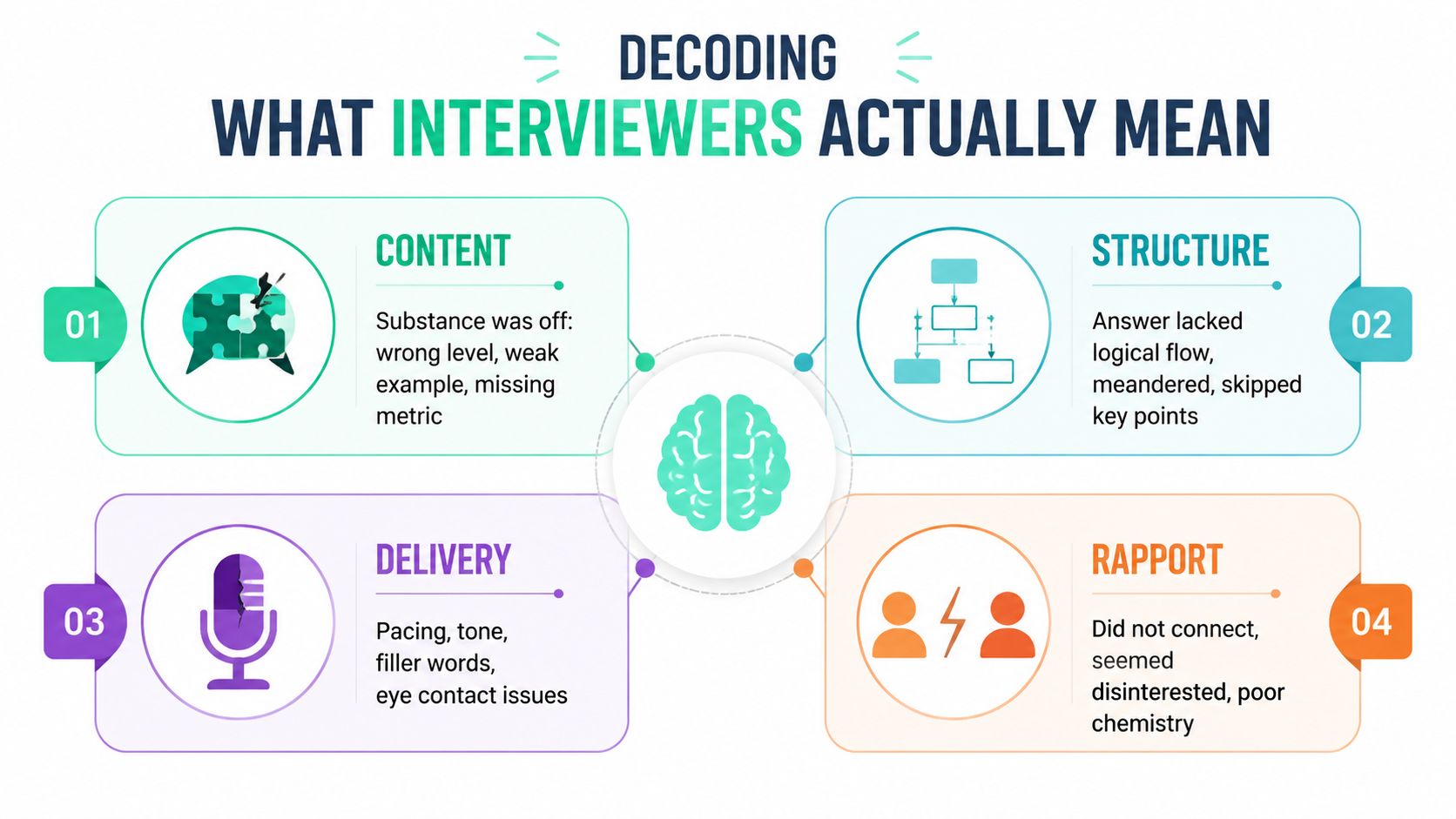
Start with the four buckets
Bucket Example feedback Likely meaning
Content
“Your answers were too detailed.”
You may have included background but not the decision, action, or result the role required.
Structure
“We needed more leadership signal.”
The answer may have buried your ownership or failed to show how you influenced others.
Delivery
“You seemed nervous.”
Pacing, pauses, filler words, eye contact, or vocal energy may have made your expertise harder to receive.
Bias-coded
“You weren't the right culture fit.”
The interviewer may be expressing a subjective preference without identifying job-related behavior.
Content feedback asks, “Was the substance relevant and sufficiently developed?” If the answer was technically correct but lacked a concrete example, build a better example. If the interviewer says, “We needed more leadership signal,” find the moment where you made the call, aligned people, or accepted responsibility.
Structure feedback concerns the path through the answer. “Too detailed” may mean the conclusion appeared too late. Try opening with the result, then give only the context needed to understand it.
Delivery is different from competence. A candidate can know the material and still speak too quickly, pause under cognitive load, or use filler words while searching for precise language. Tools that analyze customer calls use similar distinctions between what was communicated and how the conversation sounded. For interview practice, record yourself and review pacing, answer length, and interruptions separately from content quality. A focused AI interview coach can also help identify delivery patterns during practice.
Bias-coded feedback requires a question, not automatic acceptance. “Culture fit,” “presence,” and “polish” can describe an actual interaction, but they can also hide similarity bias or discomfort with a candidate's accent, age, communication style, or neurodivergent presentation. Ask: “Which observable behavior led you to that assessment, and which role requirement did it affect?” If the interviewer can't answer, don't convert the phrase into a permanent identity label.
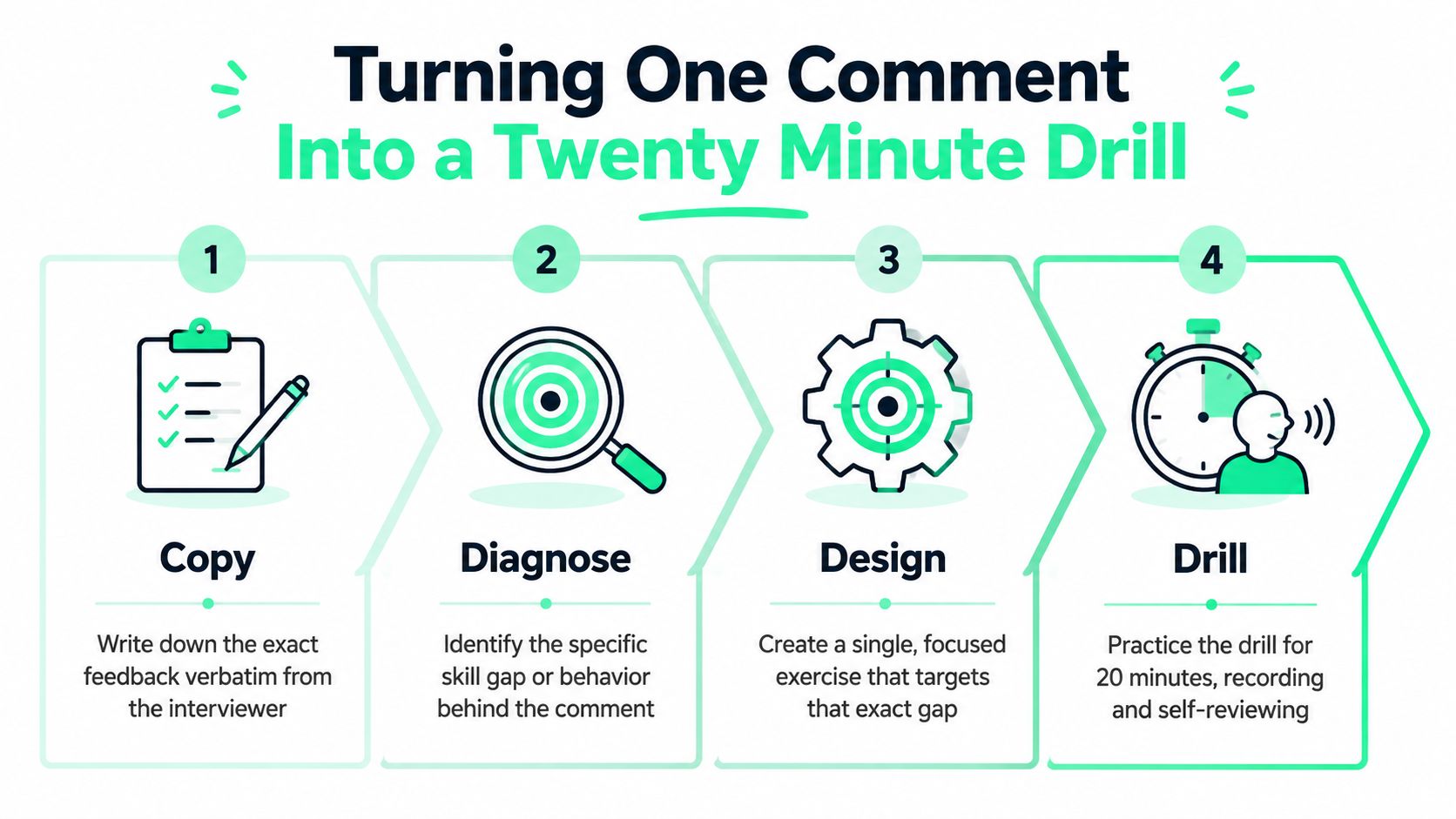
Turning One Comment Into a Twenty Minute Drill
Vague self-improvement creates vague practice. “Be more confident” gives you nothing to rehearse, while “state the recommendation in the first sentence and support it with one example” gives you a rep you can repeat.
Use four moves:
- Copy: Write the feedback exactly as you received it.
- Diagnose: Identify the behavior behind the comment.
- Design: Choose one exercise that targets that behavior.
- Drill: Practice for 20 minutes, then review the recording.
“Too vague” becomes a specificity drill
Copy the comment: “Your answer was too vague.”
Diagnose it by underlining every sentence that lacks a concrete actor, action, decision, or outcome. Then choose one behavioral question, such as “Tell me about a time you fixed a broken process.”
For the first five minutes, write a STAR outline with one sentence for the situation, one for the task, several for your actions, and one for the result. For the next 10 minutes, rehearse the answer with a 90-second timer. Ask a friend to score specificity on a 1 to 5 scale, using only this question: “Could you tell exactly what this candidate did?”
Use the final five minutes to replace abstract phrases. Change “I improved collaboration” to “I created a shared intake process so support and engineering could agree on priority before work entered the sprint.”
Failure mode: You're still describing what “we” did instead of what you personally decided, changed, or delivered.
“Weak closing” becomes a question bank
Copy the comment: “Your closing was weak.”
Diagnose whether you ran out of time, asked generic questions, or failed to connect your interest to the role. Write five closing questions, then speak each one aloud twice:
- “What would make this hire successful in the first part of the role?”
- “Which challenge needs the most attention from the person who joins?”
- “Where does this team need stronger collaboration today?”
- “What evidence would show that the person in this role is creating value?”
- “Is there anything in my background you'd like me to clarify?”
Failure mode: Your questions sound interchangeable and don't reveal that you listened to the discussion.
“Spoke too fast” becomes a deliberate slow-tell
Copy the comment: “You spoke too fast.”
Diagnose the trigger. Did your pace increase during technical explanations, follow-up questions, or moments of uncertainty? Find a reference clip at 160 words per minute, then record yourself answering one common question at that pace.
Spend five minutes reading the clip aloud, five minutes answering with a deliberate pause after each major point, and five minutes reviewing the recording. Use the final five minutes to repeat the answer while keeping the same pace without sounding artificially slow.
Failure mode: You slow every sentence equally, creating a flat performance instead of slowing at transitions and high-value points.
For more focused repetition, use a practice interview questions tool to generate one question around the behavior you're correcting. One comment, one drill, one review. That's how feedback becomes behavior.
Feedback Through a Different Lens
The sentence “your answers felt rehearsed” sounds precise, but it isn't. It describes the interviewer's impression, not the behavior that produced it. The same sentence can point to different causes for different candidates.
A neurodivergent candidate may be managing sensory overload, masking fatigue, or relying on a prepared structure to keep thoughts organized. An international candidate may be translating idioms or navigating a rhythm that differs from the interviewer's expectations. A career switcher may have relevant stories but lack the domain vocabulary that makes those stories feel textured.
Candidate Type Likely Real Meaning Ask the Interviewer
Neurodivergent candidate
A scripted structure may have helped manage cognitive load, while pauses or reduced spontaneity were interpreted as artificial.
“Did my pauses feel rushed, or was there a specific answer where the content seemed disconnected from the question?”
International candidate
Translated idioms, non-native rhythm, or memorized phrasing may have sounded less natural to the interviewer.
“Which phrase or answer sounded memorized, so I can understand how it landed in English?”
Career switcher
The story may have followed a prepared structure but lacked the role-specific detail that signals practical experience.
“Which part of my example needed more detail to show how I'd apply that experience in this role?”
The point isn't to dismiss every criticism as bias. It's to stop treating delivery symptoms as proof of weak content. A pause can indicate careful thinking, anxiety, translation, or overload. Filler words can appear when someone is retrieving a precise example. A flat tone can reflect concentration rather than disinterest.
Ask for translation, not reassurance
A useful follow-up asks the interviewer to identify the moment and the observable behavior. “Was there a specific answer where this impression came through?” is stronger than “Did you dislike my communication style?” The first question can produce evidence. The second invites another opinion.
Guidance for neurodivergent candidates also emphasizes timely, specific, actionable, accommodation-aware communication. If an adjustment would help you demonstrate the role's actual competencies, ask what interview format or communication support is available before the next round. You're not asking for a lower standard. You're asking for a fair chance to show the relevant standard.
Phrases That Should Make You Pause
Some interview feedback sounds professional because it uses familiar vocabulary. That doesn't make it useful. “Culture fit” can mean job-related collaboration concerns, but it can also mean “you didn't resemble the people already here.” “Presence” can mean a presentation needed clearer structure, or it can reward extraversion and penalize a quieter style.
Structured rubrics exist partly to force interviewers away from these impressions and toward observable evidence. When feedback isn't tied to a competency, treat it as an incomplete translation.
Decode the phrase before you accept it
- “Culture fit.” This may mask similarity preference or protected-characteristic bias. Ask: “Which work behavior or role expectation did you feel was missing?”
- “Not enough presence.” This often rewards visible confidence and extraversion rather than judgment. Ask: “Did you notice a specific issue with decision-making, stakeholder influence, or presentation?”
- “You didn't feel senior.” This can conceal age, accent, or status assumptions. Ask: “Which senior-level behavior did you want to see, and where did my answer fall short?”
- “Communication style.” This may refer to structure and clarity, but it can also become a neurodivergent masking penalty. Ask: “Was the issue answer organization, pacing, vocabulary, or something else observable?”
- “We went with someone whose experience is closer.” This may be a shorthand for internal hiring priorities or a genuine domain gap. Ask: “Which experience would have changed the assessment for this role?”
Don't argue with the interviewer's conclusion in the moment. Ask them to convert it into something you can inspect. A candidate who receives vague language needs a refusal skill, not a swallowing skill.
“I want to make sure I'm not misreading this. Can you give me an example of what that looked like in the room?”
That sentence is calm, professional, and revealing. A helpful interviewer will name a moment, answer, or behavior. Someone covering an unsupported impression will often repeat the original phrase.
Your Seven Day Feedback Loop
A single mock interview feels productive because it creates a clear before-and-after moment. It usually isn't enough. Interview behavior changes when you repeat a targeted action, review what happened, and adjust the next attempt.
The better system is a seven-day feedback loop. It keeps rejection from becoming a dead end and prevents preparation from turning into endless, unfocused rehearsal.
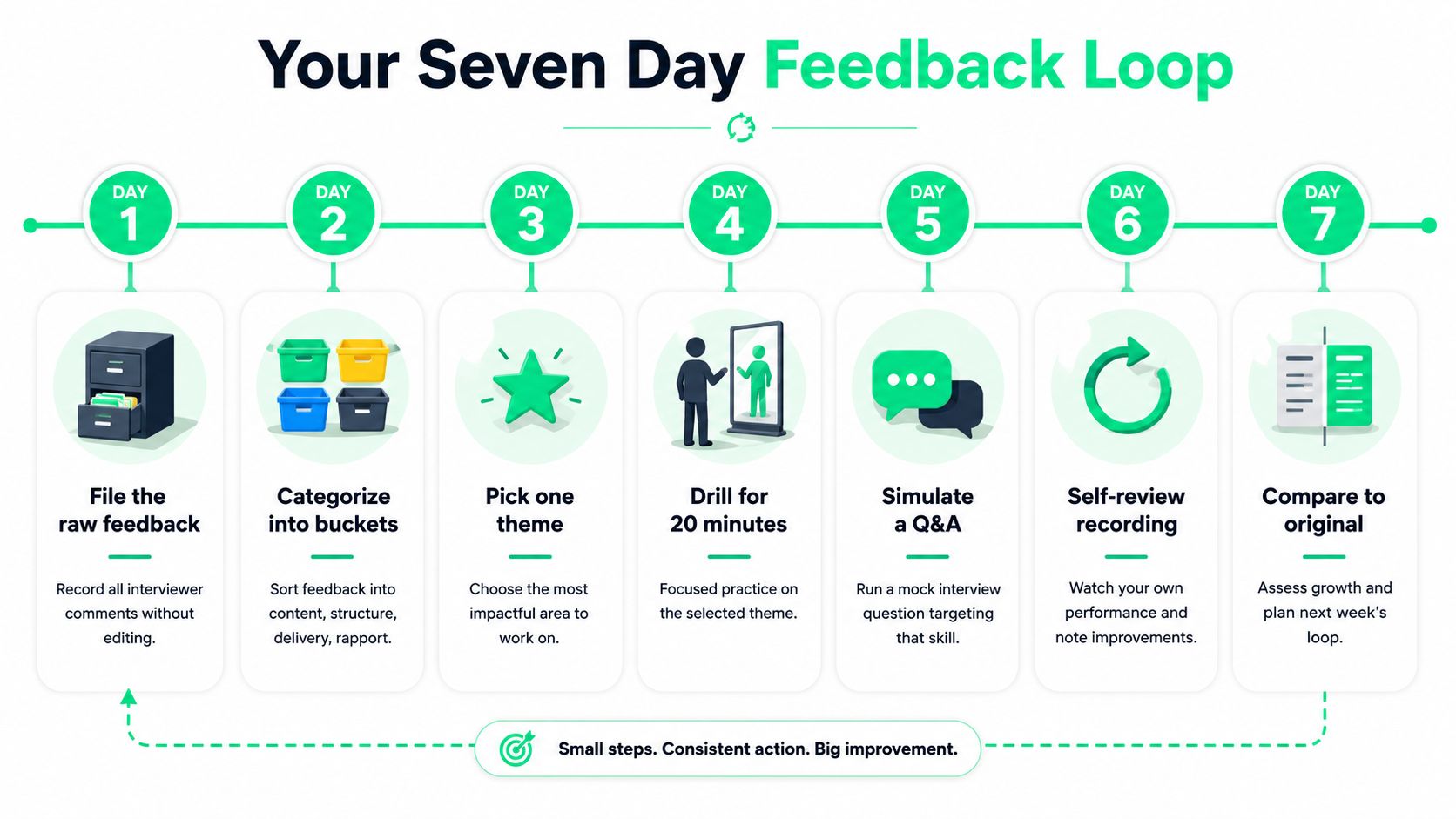
Print this weekly plan
Day 1, file the raw feedback. Put every interviewer comment, remembered question, and self-observation into one note. Don't edit the wording yet.
Day 2, decode the comments. Sort each item into content, structure, delivery, or bias-coded feedback. If one comment fits more than one bucket, record both possibilities.
Day 3, pick one theme. Choose the issue most likely to affect the next interview. Don't try to fix your stories, pacing, confidence, closing, and technical depth at once.
Day 4, run the drill twice on camera. Use the 20-minute process above. Watch the recording with the sound on, then watch again while focusing only on answer structure or delivery.
Day 5, book the next real interview or simulation. Give the skill a live target. Practice without pressure is useful, but pressure reveals whether the change is available when you need it.
Day 6, debrief immediately. Recreate the two columns. Identify whether the chosen behavior improved and what new issue appeared.
Day 7, send the next feedback request. Ask one interviewer, recruiter, peer, or coach for one competency-based observation. Keep the request narrow enough to answer.
Start tomorrow with a phone note called Feedback Inbox. Every comment from every interview goes there the same day, including comments you disagree with. Later, you can test each one against the role requirement and the observable evidence.
The loop matters because feedback has no value until it changes your next answer. File it, decode it, drill it, test it, and ask again.
Key Takeaways
- Interview performance feedback is a decoding problem, not a verdict — the core work is separating the content layer (what you actually said) from the reception layer (what the interviewer heard), because most candidates improve only the content layer by collecting more stories and frameworks without ever asking whether the interviewer could quickly recognize the evidence being offered.
- Vague requests get ghosted, specific ones get answered — with 56% of candidates receiving no feedback and only 6% receiving feedback tied to real assessment criteria, "Do you have any feedback?" is easy to ignore, while a request sent within 24 hours that names one concrete moment and asks one focused question gives the interviewer a narrow, answerable task.
- The four-bucket sort determines your practice plan — content feedback means the substance lacked a decision or result, structure feedback means your conclusion arrived too late or your ownership was buried, delivery feedback is about pacing and filler words rather than competence, and bias-coded feedback ("culture fit," "presence," "you didn't feel senior") requires a translation question before you accept it as fact.
- Delivery symptoms are not proof of weak content, especially for neurodivergent, international, and career-switching candidates — a pause can indicate careful thinking, anxiety, translation, or cognitive overload, and "your answers felt rehearsed" describes the interviewer's impression rather than the behavior that produced it, which is why the right follow-up is "Was there a specific answer where this impression came through?"
- One comment plus one 20-minute drill beats a full mock interview — copy the feedback verbatim, diagnose the behavior behind it, design a single targeted exercise (a specificity drill for "too vague," a question bank for "weak closing," a paced re-record for "spoke too fast"), then run a seven-day loop that files, decodes, drills on camera, tests live, and requests the next piece of feedback.
Qcard offers AI-scored practice, mock interviews with follow-up questions, and feedback on structure, specificity, pacing, filler words, answer length, and depth. Use Qcard to turn your next interview performance feedback into a focused rehearsal plan, then bring the improved answer into the room.
Ready to ace your next interview?
Qcard's AI interview copilot helps you prepare with personalized practice and real-time support.
Try Qcard Free