Interview Communication Skills That Get You Hired
TL;DR
Interview communication skills are a trainable system, not a personality trait — and the data shows why they decide outcomes: 65% of jobseekers say nerves stop them from showing their true ability, 30% lose their train of thought, and 26% talk too quickly. Build four layers. Use STAR for behavioral questions with the Action section carrying the most space, or POW (Problem, Option, Outcome) when STAR feels too formal. Control pacing with a reset breath, a two-second pause after the question, and a sentence-landing drill. Reduce fillers by replacing them with silent pauses and signposts rather than trying to eliminate every "um" — research found success rates drop as disfluencies rise, particularly past 1.28% of words spoken. Adapt to the format: behavioral needs relevance, technical needs narrated checkpoints, and AI-led asynchronous interviews need camera-specific habits and cue words near the lens. Underneath all of it, use resume-grounded cue phrases instead of memorized scripts, prepare 3 to 5 flexible stories, and practice one behavior at a time with recorded review.
A 2017 UK survey found that 65% of jobseekers said nerves stopped them from showing their true ability in interviews, while 30% lost their train of thought and 26% talked too quickly. Only 10% said they had no interview-related issue.
That changes how you should think about interview preparation. You may know the answer, have the right experience, and understand the role, yet still sound uncertain because your pace, structure, or recall collapses under pressure. Interview communication skills aren't a personality trait reserved for naturally confident speakers. They're a trainable system for organizing thoughts, controlling delivery, adapting to the format, and making your real ability easy to hear.
What Are Interview Communication Skills and How Do You Build Them?
Interview communication skills are a trainable system for organizing thoughts, controlling delivery, adapting to the format, and making your real ability easy to hear — not a personality trait reserved for naturally confident speakers.
The problem is measurable. A 2017 UK survey found 65% of jobseekers said nerves stopped them from showing their true ability, 30% lost their train of thought, 26% talked too quickly, and only 10% reported no interview-related issue. Classic employment interview research identified appropriateness of content, fluency of speech, and composure as major contributors to favorable hiring judgments.
Build the skill across four layers:
1. Answer architecture. Use STAR (Situation, Task, Action, Result) for behavioral questions, with an optional Evaluation step. Give the Action section the most space, because that's where judgment and ownership show. Replace "we improved the process" with "I compared the recurring requests, proposed a new workflow, and coordinated the review." For technical, product, or problem-solving questions, POW (Problem, Option, Outcome) often sounds more conversational. Keep the framework in your head, not in your wording — use natural openings like "The issue came up when…" instead of "The situation was…"
2. Pacing and breath control. Structure controls the order of your ideas; pacing controls whether the interviewer can absorb them. Take a reset breath before answering. Practice a two-second pause after the interviewer finishes the question. Use a "sentence landing" drill — speak one idea, pause, and let the final word finish instead of attaching "so…" or "and…" to keep going.
3. Filler reduction through replacement, not elimination. Research on filler words in job interviews found success rates drop as disfluencies increase, particularly once fillers exceed 1.28% of words spoken. Don't try to remove every "um" — target the moments where fillers cluster at the start of answers or between key points. Replace them with silent pauses and signposts like "first," "next," and "for example," which give your brain a retrieval path.
4. Format-specific adjustments. Behavioral rounds need relevance and reflection. Technical rounds need narrated reasoning in checkpoints ("I'll start by clarifying the expected input and output… the trade-off is Y, so I'd test this edge case"). AI-led and asynchronous video interviews need camera habits — look at the lens for your key point, keep answers in visible sections, and place three cue words near the camera.
The practical rule: don't train yourself to sound confident. Train yourself to make the next point easy to understand.
Why Interview Communication Skills Decide the Outcome
A strong example can still fail to show your ability if the explanation loses its shape. The interviewer asks what you personally did, your working memory fills with the story, and the answer begins with, “So, basically, there was this project...” You rush through the background, omit the result, and close with, “I think it went well.”
That response does not prove you lack experience. It shows that several tasks competed for attention at once: recalling events, selecting relevant details, monitoring your tone, reading the interviewer's reaction, and managing anxiety. Without a repeatable communication system, preparation remains knowledge you cannot reliably access under pressure.
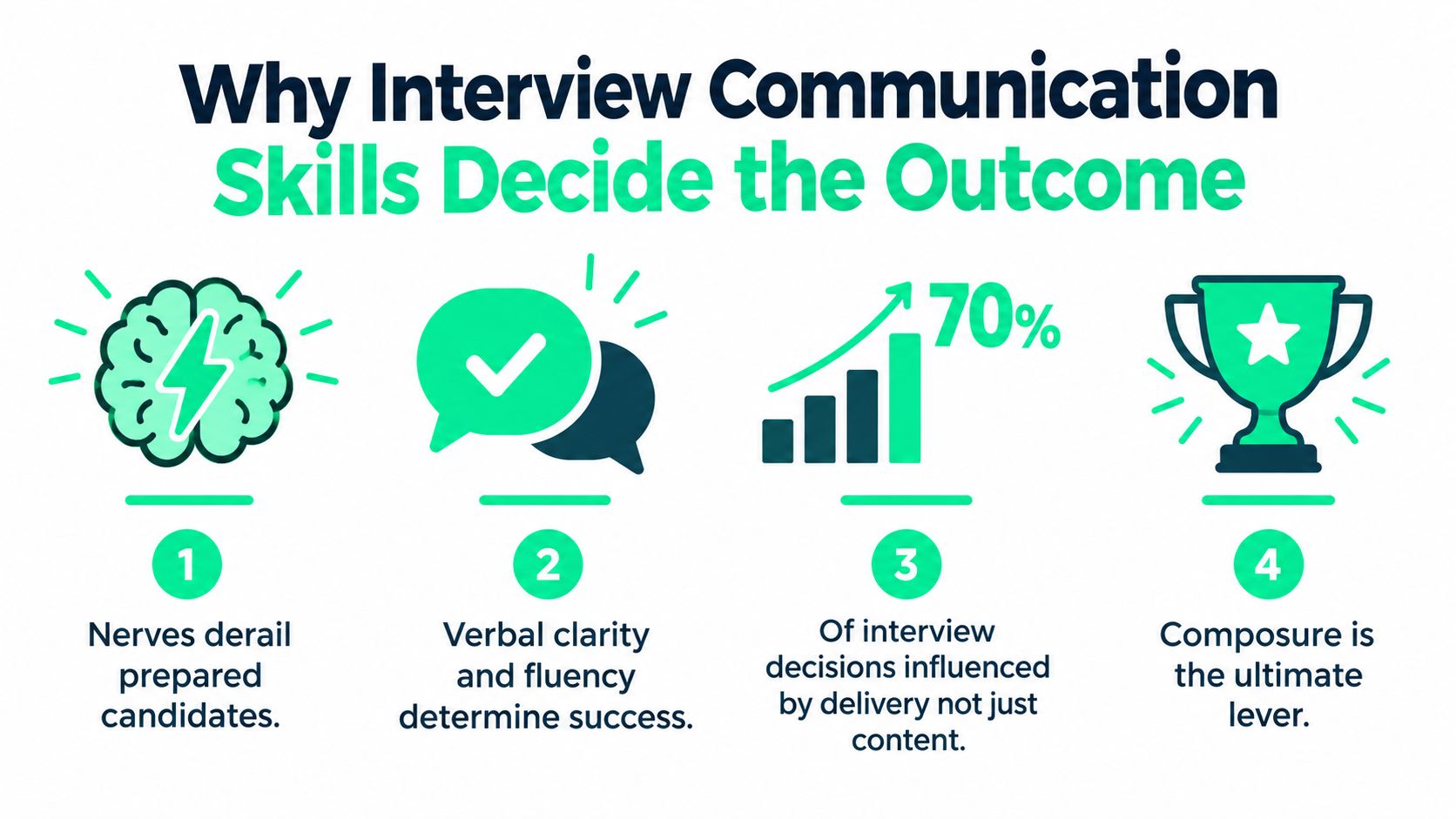
The survey figures show the problem clearly: 41% of respondents felt anxious during interviews, 47% described interviews as nervous or extremely nervous, and 55% said their biggest worry was not knowing the answers. These findings point to a practical distinction. Interviewers assess your knowledge, but they also assess whether you can make that knowledge understandable while the situation is demanding.
Delivery changes how content is received
Classic employment interview research identified appropriateness of content, fluency of speech, and composure as major contributors to favorable employment judgments. The literature also connects verbal and nonverbal communication with interviewer evaluations, while later academic work treats communication skills as a regular part of interview assessment and relates them to hireability. (Review the employment interview communication research)
You do not need to sound like a television presenter. Your answer needs to let the interviewer track your thinking. A brief pause can show control. A direct opening can establish relevance. A clear result can show ownership.
Practical rule: Do not train yourself to sound confident. Train yourself to make the next point easy to understand.
This approach helps neurodivergent candidates, career changers, international students, and high-anxiety speakers because it replaces vague confidence advice with observable actions. Use memory cues, answer architecture, pacing drills, and format-specific adjustments. A practical interview preparation guide can help turn preparation into repeatable prompts rather than a script.
Communication also needs to work across behavioral, technical, and AI-led interviews. In each format, practice the same core sequence: identify the question, state the point, explain the evidence, and finish with the outcome or next step. The wording changes, but the system reduces the amount you must hold in your head.
Structured interviews provide a measurable reason to practice. A retrospective study of behavioral interviews found strong inter-rater reliability, with ICC1,1 = 0.749, and predictive validity for later licensing performance, with ROC area = 0.685, p = 0.034. (The behavioral interview study is available through PubMed) Your performance is not judged randomly. Interviewers can consistently observe how you explain decisions, evidence, and outcomes.
Structuring Answers That Sound Natural and Complete
A strong answer has a clear shape before you refine its wording. That shape keeps the main point visible, limits unnecessary context, and gives the interviewer a clear outcome to remember.
For behavioral questions, use STAR, meaning Situation, Task, Action, and Result. Jobs.ac.uk advises selecting relevant details, avoiding information that does not support the answer, and adding an optional Evaluation step to explain what you would change next time. (See the Jobs.ac.uk STAR guidance)
Build the answer around your decisions
Give each part a defined purpose:
- Situation: Provide only the context needed to understand the problem. “Our customer support team was receiving repeated questions about the same setup issue.”
- Task: State your responsibility. “I was responsible for reducing confusion without changing the product.”
- Action: Describe what you did and why, in order. “I reviewed the questions, grouped recurring issues, and created a short setup guide with the product team.”
- Result: Explain what changed. Use a verified metric if you have one. Otherwise, describe an observable outcome without inventing a number. “Customers had a clearer first step, and support agents used the guide during onboarding.”
- Evaluation: Add a brief reflection. “Next time, I would involve support earlier so the guide reflects the language customers already use.”
Give the Action section the most space. It shows judgment and ownership. Replace “we improved the process” with “I compared the recurring requests, proposed a new workflow, and coordinated the review.” Collaboration still matters, but “we” should not hide your specific contribution.
Use POW when STAR feels too formal
For technical, product, or problem-solving questions, POW, meaning Problem, Option, Outcome, often sounds more conversational.
For a question about disagreement with a teammate:
- Problem: “We disagreed about whether to delay a release because the testing evidence was incomplete.”
- Option: “I suggested separating launch-critical tests from lower-risk improvements, then reviewing the evidence together.”
- Outcome: “We agreed on a narrower release plan and documented the remaining risks.”
One story can support several questions if you change the emphasis. For teamwork, explain how you aligned responsibilities. For conflict, focus on how you handled the disagreement. For problem-solving, show how you compared options and reached a decision.
Keep the framework in your head, not in your spoken wording. Avoid starting every answer with “The situation was...” Use natural openings such as “The issue came up when...” or “My responsibility was...” The structure remains clear without making you sound rehearsed.
The National Careers Service recommends short, conversational STAR examples, including examples from work, home, or volunteering. Prepare 3 to 5 adaptable stories from different areas of your experience, then practise answering follow-up questions about each one. A practice interview question library can help you check whether each story fits more than one competency.
Follow-up questions test precision. If the interviewer asks, “What was your specific role?” answer the missing part rather than repeating the full story: “I owned the analysis and presented the recommendation. My manager approved the final implementation.” A complete answer gives the listener the context, your contribution, the outcome, and the lesson. It does not need to be long.
Pacing Breath Control and Filler Word Reduction
Structure controls the order of your ideas. Pacing controls whether the interviewer can absorb them. Many anxious candidates don't need more content. They need a reliable way to slow the first sentence, breathe between ideas, and tolerate a short silence.
Start with the reset breath. Before answering, inhale gently, exhale, and take a brief pause. You don't need dramatic breathing exercises during the interview. The goal is to stop the automatic launch into a rushed answer.

Replace fillers with deliberate transitions
Research on filler words in job interviews found that success rates drop as disfluencies increase, particularly once fillers exceed 1.28% of words spoken. (The BYU materials discuss filler words and interview outcomes) You don't need to eliminate every “um” or “like.” Trying to remove every filler can make you tense and unnatural. Focus on the moments where fillers appear repeatedly at the start of answers or between key points.
Use this drill:
- Choose one common interview question.
- Record your answer aloud.
- Notice each “um,” “like,” “you know,” or repeated restart.
- Record the answer again, replacing each filler with a silent pause.
- Add simple signposts such as “first,” “next,” and “for example.”
The signposts give your brain a retrieval path. They also help the listener track the answer. A transition like “The first issue was...” is clearer than several filler words while you search for the next idea.
A University of British Columbia and Cal Poly-linked study reported that interviewees who avoided filler words were rated as more professional and competent. (Cal Poly's summary discusses the interview communication findings) Rehearse aloud, not only in your head, because silent preparation doesn't reveal whether you rush, mumble, or use fillers to hold the floor.
Measure the behavior, not your confidence
Ask a practice partner to track three things: whether you answered the question directly, whether your pace changed under pressure, and whether your fillers clustered around specific topics. You may find that technical questions trigger long silences while personal questions trigger rushed speech. Each pattern needs a different intervention.
Try a “sentence landing” drill. Speak one idea, pause, and let the final word finish instead of attaching “so...” or “and...” to keep going. Then practice a two-second pause after the interviewer finishes asking the question. This pause feels longer to you than it sounds to the listener.
A tool with voice feedback can make this review easier. Use AI mock interview practice to review delivery, then confirm the feedback by listening to your recording yourself. Automated feedback can identify patterns, but your judgment still matters because an answer must sound appropriate for the role and conversation.
Adapting Your Communication for Different Interview Formats
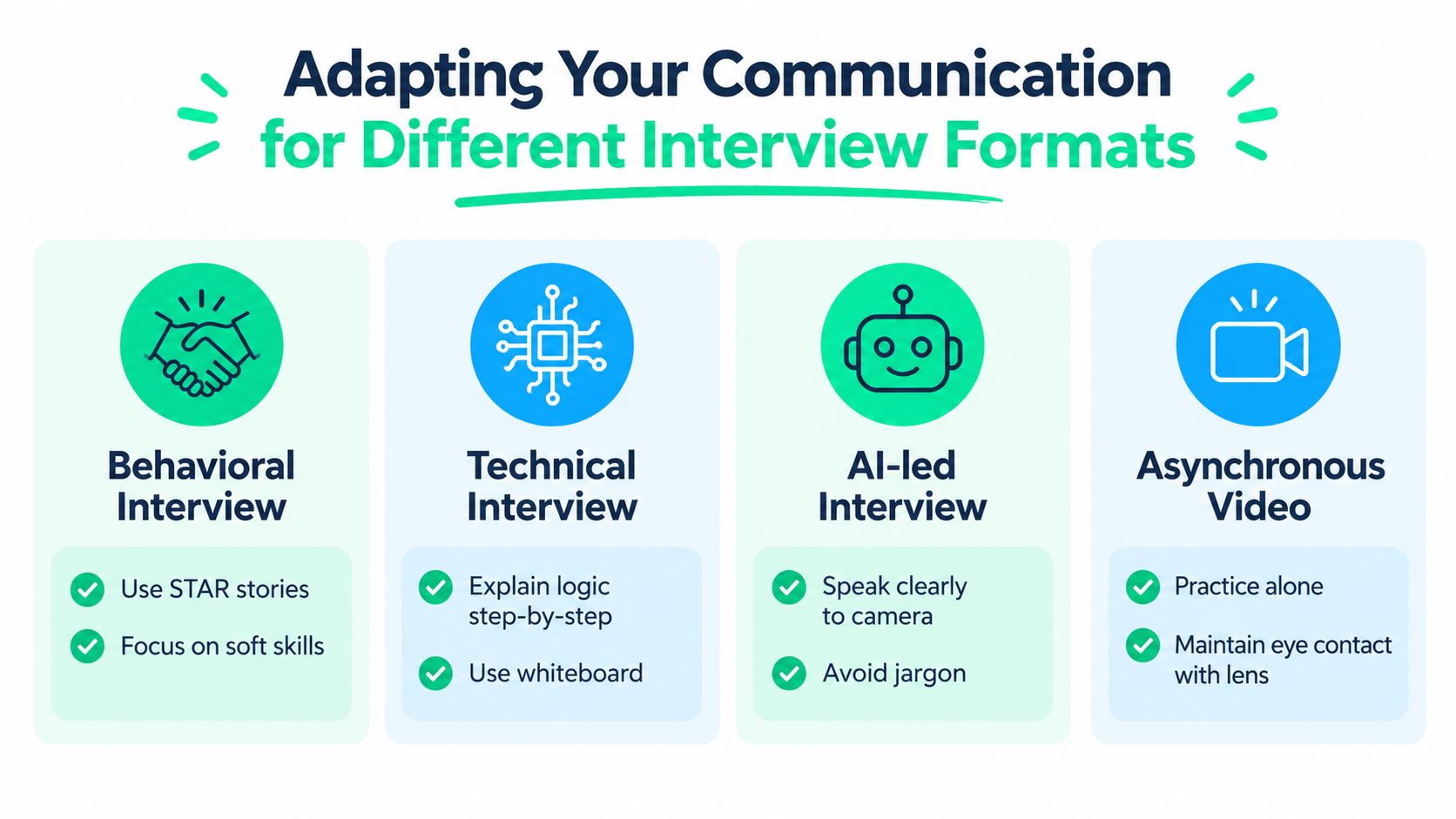
One communication style won't work equally well in every interview. A behavioral conversation rewards a relevant story. A technical round needs visible reasoning. An AI-led asynchronous interview adds timing, camera, and self-monitoring demands that can make a familiar answer feel unfamiliar.
Behavioral interviews need relevance and reflection
In a behavioral interview, the interviewer wants evidence of how you acted in a real situation. Lead with the context, move quickly to your choices, and finish with the result. Eye contact and warmth help, but they can't rescue an answer that never identifies your role.
A useful opening is: “I handled a similar issue when...” Then give the story. If the interviewer asks about conflict, don't turn the answer into a general philosophy about teamwork. Describe the disagreement, what you said or did, and what changed.
Technical interviews need narrated reasoning
In a technical interview, silence can be misread because the interviewer can't see your internal process. Talk through your assumptions and decision points without narrating every tiny thought.
Try this sequence:
- “I'll start by clarifying the expected input and output.”
- “My first approach is X because it keeps the solution simple.”
- “The trade-off is Y, so I'd test this edge case.”
- “I'd revise the approach if the constraint changes.”
For coding, product, cybersecurity, or case questions, communication isn't decoration around the solution. It shows how you investigate uncertainty, respond to new information, and explain trade-offs. Speak in checkpoints, then pause so the interviewer can redirect you.
AI-led and asynchronous interviews need camera-specific habits
In asynchronous video interviews, you don't receive the same conversational feedback as you do in a live discussion. You may not see a nod, hear a follow-up, or know whether your answer is landing. Recent mixed-methods research found that higher interview anxiety lowered self-rated performance, while observer-rated performance didn't change in the same way. It also found lower satisfaction with self-expression in AI-led asynchronous video interviews than in synchronous video interviews. (Read the mixed-methods research on interview formats)
That difference matters. You may feel that a recorded answer was poor even when an observer sees competent communication. Review the recording for concrete behaviors instead of trusting the anxious after-feeling.
Look at the camera lens when delivering the key point, keep your answer in visible sections, and avoid unexplained jargon. Before recording, place three cue words near the camera, such as “context, decision, result.” Don't write a full script. A script can make your gaze and rhythm sound unnatural, while short cues preserve a conversational response.
Memory Cues Metrics and Neurodivergent Friendly Tactics
Strong structure only helps when you can retrieve the relevant experience under pressure. Memorizing complete answers creates another failure point. If one sentence disappears, the rest of the script can disappear with it.
Build a resume-grounded cue system. For each major achievement, write one compact line with the challenge, your action, the result, and one concrete detail you can discuss safely. Use phrases rather than paragraphs:
- “Onboarding confusion, reviewed support themes, created guide, clearer handoff.”
- “Release disagreement, separated critical tests, aligned risk decision.”
- “Team deadline, clarified ownership, checked progress, delivered agreed work.”
Attach verified resume metrics to the cue. If you cannot recall a figure confidently, do not guess. Say, “I don't want to misstate the exact number, but the outcome was...” Then describe the result accurately.
Create flexible stories instead of rigid answers
Prepare 3 to 5 stories from different parts of your experience. Include work, study, volunteering, or personal projects when they show relevant behavior. Label each story with several possible uses, such as teamwork, problem-solving, conflict, learning, or leadership.
Practice shifting the emphasis while keeping the facts stable. One project can demonstrate problem-solving through your diagnosis, teamwork through your collaboration, or learning through the adjustment you made afterward. This flexibility helps across behavioral questions without forcing you to memorize separate answers.
For neurodivergent and high-anxiety candidates, lower the memory demand before adding time pressure or difficult follow-ups. Use the same practice environment, present one question at a time, and keep a visible cue card containing keywords only. Voice transcription can show how your spoken answer differs from the version you formed mentally, especially when you lose the sequence or omit the result.
A study of autistic adults found that anxiety can directly impair communication and responding during employment-seeking and can lead people to withdraw from interviews. (Read the study on autistic adults and employment-seeking anxiety) The issue is not only appearing nervous. Anxiety can interfere with producing a response.
Useful accommodation: If a format or communication demand creates a barrier, ask what adjustments are available rather than treating the difficulty as a personal failure.
Keep a recovery phrase ready when your thoughts scatter: “Let me organize that clearly.” Then name the two points you will cover. You can also ask, “Could I take a moment to think about the best example?” A short, explicit pause protects accuracy better than filling silence with increasingly disconnected sentences.
Your Practice Plan for Measurable Improvement
Practice works best when it isolates one behavior at a time. Repeating full interviews without reviewing your delivery can reinforce rushing, filler words, or vague endings. Build short sessions around evidence you can observe.
Use a weekly cycle
Start by selecting one behavioral story and one technical or role-specific question. Write cue words, answer aloud, and record the response. Review the recording for directness, structure, pace, fillers, and whether you clearly stated your personal contribution.
During another session, complete a mock interview with follow-up questions. Ask the partner not only whether the answer was good, but also:
- Directness: Did the first sentence answer the question?
- Structure: Could you identify the context, action, and outcome?
- Pacing: Did I rush when describing the difficult part?
- Recall: Did I use specific, verified details?
- Recovery: What happened when I lost my train of thought?
Use AI-scored practice as another feedback source, particularly for answer length, filler patterns, and articulation. Treat the score as a prompt for review, not as a final judgment. Your aim is consistent communication across different questions, not a perfect performance in one recording.
Keep a simple progress log
After each practice block, record the question, the cue words, the main issue, and the next drill. Track observable behaviors such as filler count, approximate answer length, and whether you paused before responding. Don't turn the log into another source of anxiety. One clear improvement is more useful than a long list of flaws.
Finish preparation with practical details. Save your strongest cue set where you can review it before the interview, test your camera and microphone, and prepare a concise thank-you note that refers to a real point from the conversation. On interview day, choose one story and one delivery drill rather than trying to remember every piece of advice.
You don't need to transform your personality to communicate well. You need a system that helps your preparation survive pressure, supports your natural speaking style, and makes your achievements clear.
Key Takeaways
- Communication failure in interviews is a working memory problem, not a knowledge problem — recalling events, selecting details, monitoring tone, reading the interviewer, and managing anxiety all compete for attention at once, which is why a repeatable system beats vague advice to "be confident" and why 65% of jobseekers report nerves preventing them from showing their true ability.
- Give the Action section the most space in every STAR answer, because that's where judgment and ownership become visible — "I compared the recurring requests, proposed a new workflow, and coordinated the review" tells an interviewer what you decided, while "we improved the process" hides your specific contribution behind the team's.
- Replace fillers rather than eliminating them — research found interview success rates drop as disfluencies increase, particularly once fillers exceed 1.28% of words spoken, but trying to remove every "um" makes candidates tense and unnatural, so the effective drill is recording an answer, marking where fillers cluster, and re-recording with silent pauses and signposts like "first," "next," and "for example."
- Each interview format demands a different delivery adjustment — behavioral rounds reward a relevant story with a clear personal role, technical rounds require narrated reasoning in checkpoints because silence gets misread as being stuck, and asynchronous AI-led interviews add camera and self-monitoring demands, with research finding lower satisfaction with self-expression in AI-led asynchronous formats than in synchronous video.
- Cue phrases beat memorized answers because a script has a single point of failure — "Onboarding confusion, reviewed support themes, created guide, clearer handoff" survives pressure while a memorized paragraph collapses if one sentence disappears, and for neurodivergent and high-anxiety candidates, a visible keyword-only cue card plus a practiced recovery phrase ("Let me organize that clearly") protects accuracy better than filling silence with disconnected sentences.
Qcard offers resume-grounded talking points, AI-scored practice, mock interviews with follow-up questions, and voice delivery feedback for pacing, filler words, and answer length. Visit Qcard to practice your interview communication skills with concise cues instead of memorized scripts.
Ready to ace your next interview?
Qcard's AI interview copilot helps you prepare with personalized practice and real-time support.
Try Qcard Free