Internship Interview Preparation: Your Complete Guide
TL;DR
Effective internship interview preparation targets recall under pressure, not polish. Spend the first 48 hours on triage and listening — confirm logistics, build a single prep document, scan the company for three specific things, and mark up the job posting before writing a single answer. Then cluster the posting into 3 or 4 repeated competencies and map real evidence to each, using class projects, part-time work, clubs, and volunteering when you don't have direct internship experience. Build 6 to 8 reusable STAR stories tagged by competency with the Action section carrying roughly 60% of each answer, and stress-test them by having someone prompt the same story five different ways. Run mock interviews with a tight loop: answer under time, record, transcribe the weak minute, retry only that minute. Manage the last 18 hours as a protocol — hard stop at 10 p.m., box breathing, two answers said aloud in the morning, no cramming within three hours. Prepare recovery scripts ("Give me ten seconds to think about the most useful example") so blanking isn't catastrophic, and finish with a five-question debrief that turns one interview into signal for the next.
The recruiter email lands, and your body reacts before your brain does. Excitement. Relief. Then that quick drop in your stomach when you realize the interview is real, scheduled, and close enough to make every unfinished thought feel loud.
Most candidates waste the next few days answering the wrong question. They ask, “What should I say?” too early. The better question is, “What will I still be able to recall clearly when I'm nervous, interrupted, or running out of time?” That's the center of good internship interview preparation.
If you've ever sounded polished in practice and scattered in the interview, you already know the gap that matters. Practiced answers are useless if you can't retrieve them under pressure. Remembered answers win. That's especially true for neurodivergent candidates, international students, and anyone who loses verbal precision when stress hits. You do not need more scripts. You need a prep system that survives adrenaline.
How Do You Prepare for an Internship Interview?
Most candidates ask "What should I say?" too early. The better question is "What will I still be able to recall clearly when I'm nervous, interrupted, or running out of time?" Practiced answers are useless if you can't retrieve them under pressure — remembered answers win.
Work through four phases:
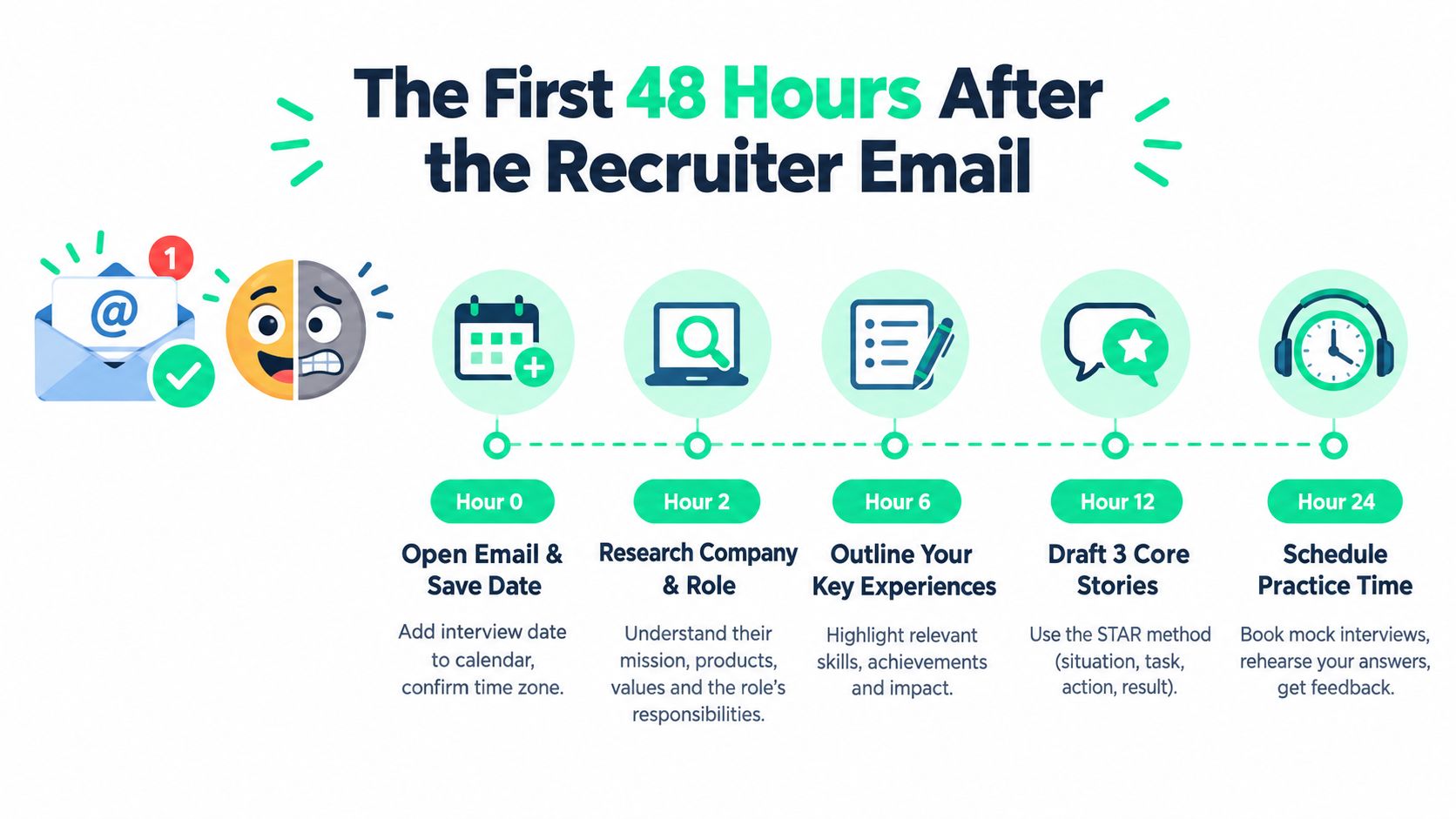
Phase 1 — The first 48 hours: triage, not performance. In hour zero, confirm the role, date, time zone, format, interviewer names, and round type. Ask the recruiter anything unclear now rather than waiting. Build one document with four headers: interview details, role priorities (copied language from the posting), evidence bank (projects, classes, jobs, clubs, volunteering), and open questions. Between hours 4 and 8, scan the company for three things only: what they're building, who might interview you, and what interns typically touch. By hour 24, mark up the posting — circle repeated verbs, underline tools, highlight phrases like "cross-functional," "analyze," or "own deliverables." By hour 48, gather raw material only. No scripts.
Phase 2 — Reverse-engineer the posting into evidence. Don't treat every line as equal. Cluster repeated ideas into 3 or 4 real competencies: "partnering," "stakeholders," and "cross-functional communication" is one competency, not three. Then attach specific evidence to each. Weak: "I'm collaborative and analytical." Strong: "In a class project with a community partner, I helped design a survey, analyzed the responses, and presented findings to both my team and the partner organization — my role was translating results into recommendations they could use." You're not proving you've had the exact internship. You're proving you've already demonstrated the underlying skill.
Phase 3 — Build 6 to 8 reusable STAR stories. Tag each by competency: ownership, conflict, ambiguity, failure, leadership, problem-solving. Use MIT's rough split — 20% Situation, 10% Task, 60% Action, 10% Result — because most candidates do the opposite and burn two minutes on backstory. Aim for roughly 30 seconds of setup, 90 seconds of action, 30 seconds of result. Stress-test each story by having a friend prompt it five different ways; if you can reshape it cleanly each time, it's reusable.
Phase 4 — Run mock interviews with a real feedback loop. Answer once under time pressure, record it, transcribe the one minute that felt off, mark where clarity dropped, then retry only that minute. That beats redoing an entire interview badly five times.
The First 48 Hours After the Recruiter Email
The first mistake is opening a notes app and drafting answers immediately. That's how candidates end up sounding rehearsed and strangely off-target. They prepared output before they understood the audience.
Start with triage, not performance
In hour zero, handle logistics. Confirm the role, date, time zone, format, interviewer names, and whether the round is behavioral, technical, panel, or recorded. If anything is unclear, ask the recruiter now. Don't “wait and see.” Uncertainty burns mental energy you'll need later.
Then create one document with four headers:
- Interview details: names, titles, date, platform, and format
- Role priorities: copied language from the posting
- Evidence bank: projects, classes, jobs, clubs, volunteering
- Open questions: what you still need to learn
That document becomes your prep home base.
Use the next day to listen before you speak
Between hours 4 and 8, scan the company. Not endlessly. Just enough to answer three useful questions.
- What are they building right now: Look at product pages, recent announcements, and anything public that shows what matters operationally.
- Who might interview you: Review LinkedIn profiles if you have names. Notice function, seniority, and likely concerns.
- What do interns usually touch: Search for intern posts, team pages, or project descriptions that reveal the level of ownership.
By hour 24, print or duplicate the job posting and mark it aggressively. Circle repeated verbs. Underline tools. Highlight phrases that signal expectations like “cross-functional,” “analyze,” “communicate findings,” or “own deliverables.”
Practical rule: If you start rehearsing before you've highlighted the posting, you're probably memorizing answers to questions they won't ask.
By hours 36 to 48, gather raw material only. No scripts. Pull bullet points from your resume. Add class projects, group work, part-time jobs, volunteering, and anything that proves judgment, ownership, teamwork, or technical ability. If you don't have direct internship experience, you stop apologizing for that and start converting nearby experience into usable evidence.
A lot of candidates already practice aloud. A 2020 U.S. survey found that 70% of job candidates practice their responses out loud and 62% prepare anecdotes ahead of time to reduce nerves, according to this interview-prep summary. The point isn't that rehearsal is optional. It's that rehearsal works better after you've done the listening phase.
Your 48-hour checkpoint
At the end of two days, you should have these three things:
- Notes, not scripts
- A marked-up job posting
- Three hypotheses about what the hiring manager cares about
An example hypothesis set might look like this:
- They need someone who can explain messy work clearly.
- They care more about collaboration than raw technical depth.
- They want proof that I can learn quickly with limited supervision.
That's enough to move into answer-building. Before that, you're guessing.
Reverse-Engineering the Job Posting Into Resume Evidence
Most job postings look longer than they are. Beneath the corporate phrasing, they usually ask for a small set of repeated competencies. Your job is to find those patterns and attach evidence the interviewer can remember.
Current guidance on internship prep keeps stressing the same point: candidates often over-focus on rehearsing generic answers when they should identify the exact role requirements, map evidence from their resume, and then practice real answers out loud. It also highlights a missed question many students have: how to prepare when they don't have direct internship experience. That gap matters because coursework, projects, volunteering, and part-time work often contain the evidence you need, as discussed in this interview-prep analysis.
Find the 3 to 4 competencies that actually matter
Don't treat every line in the posting as equal. That's how candidates end up with 12 weak examples and no memorable answer.
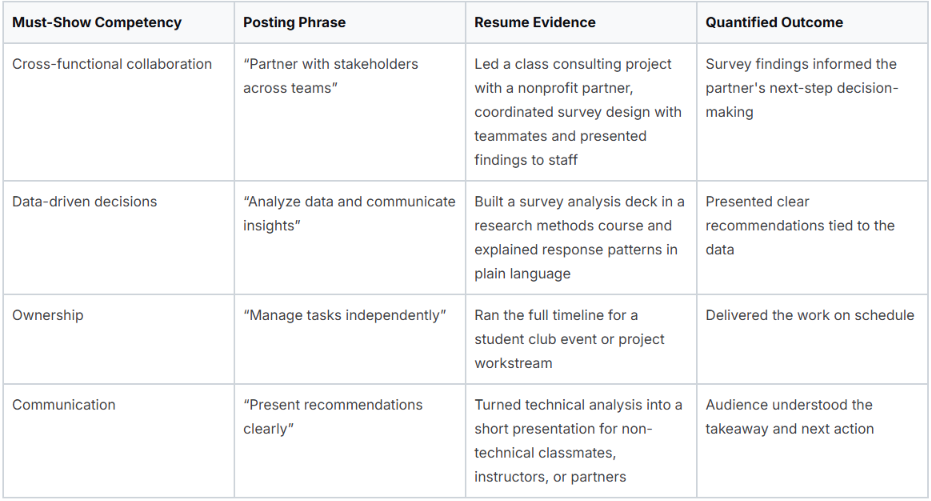
Instead, cluster repeated ideas. If a posting mentions “partnering,” “stakeholders,” and “cross-functional communication,” that's one competency. If it mentions “analyze,” “insights,” and “data-driven decisions,” that's another.
A simple mapping exercise helps. If you want extra practice turning resume bullets into likely interview prompts, this guide to resume-based interview questions is a useful companion.
Job Posting to Resume Evidence Mapping
 A worked example that actually sounds credible
Say the posting emphasizes cross-functional collaboration and data-driven decisions. A weak answer says, “I'm collaborative and analytical.”
A better answer says: “In a class project with a community partner, I helped design a survey, analyzed the responses, and presented the findings to both my team and the partner organization. My role was translating the results into recommendations the partner could use, not just summarizing the numbers.”
That works because it connects behavior to evidence. It's also easier to recall under pressure than a vague personality claim.
The best interview evidence is specific enough to picture and short enough to retell.
Flag gaps too. If one must-show competency has no strong example, build a fresh story from adjacent material. Use a difficult group project, a volunteer commitment, a retail shift, a lab, a capstone, or a campus role. The interview doesn't require prestige. It requires proof.
Building Reusable Stories With the STAR Backbone
Don't memorize answers to individual questions. Build a small library of stories you can bend without breaking. That's what survives pressure.
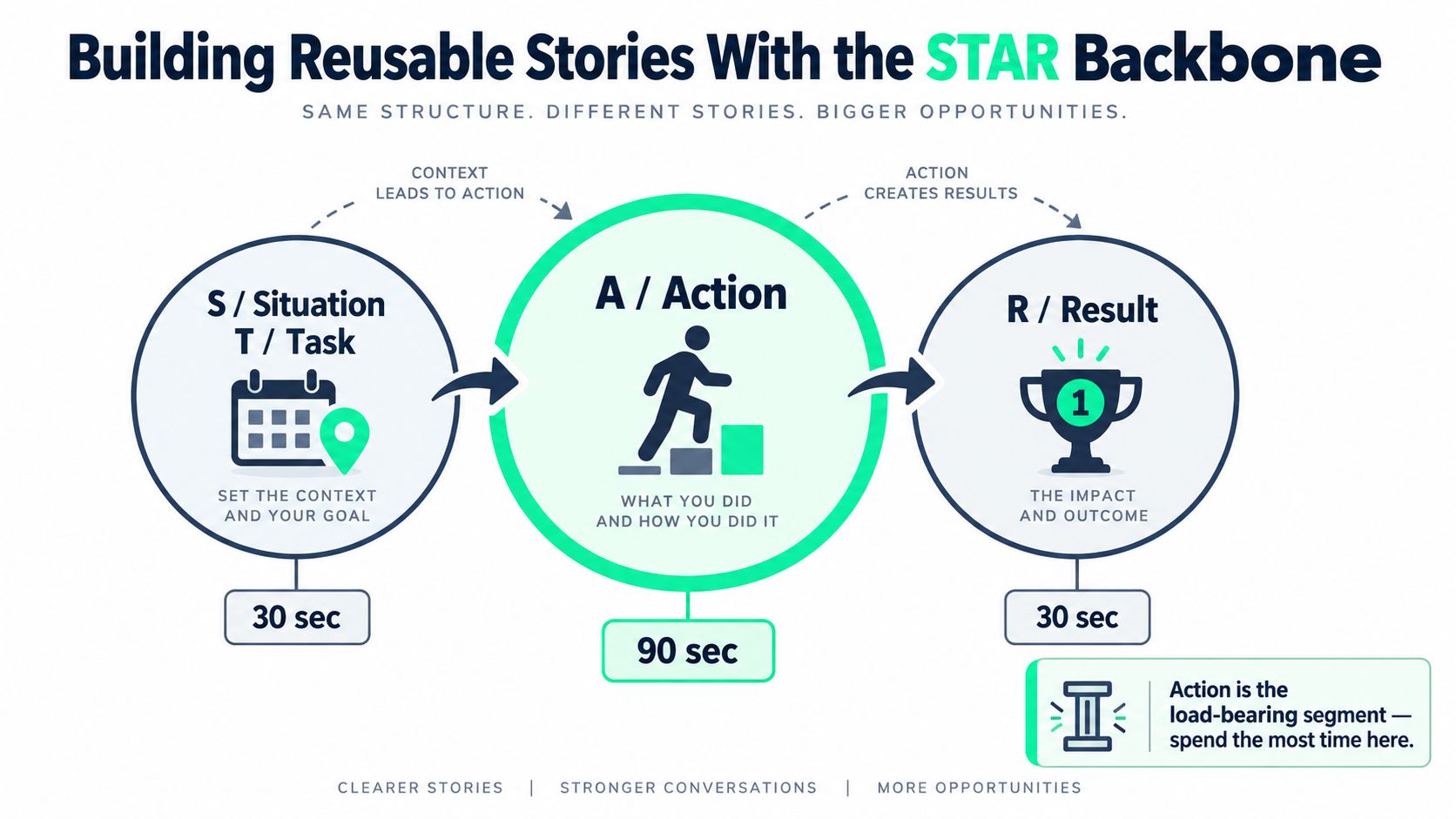
The STAR method still works because it gives your memory a spine: Situation, Task, Action, Result. One university career guide suggests a rough split of 20% Situation, 10% Task, 60% Action, and 10% Result, with the Action section carrying most of the answer, as outlined in MIT's STAR method guide. That ratio matters because most candidates do the opposite. They spend forever setting up the backstory and rush through what they did.
Build stories, not scripts
A strong internship interview preparation target is 6 to 8 reusable stories. That lines up with guidance recommending 8 STAR or extended-STAR stories and a 30 to 60 second plain-English explanation for every technical answer in this internship interview workflow. You don't need one story per question. You need a handful that can answer multiple prompts.
Tag each story by competency:
- Ownership: finished something with limited oversight
- Conflict: handled disagreement without drama
- Ambiguity: moved forward without complete instructions
- Failure: recovered, adjusted, learned
- Leadership: influenced people without relying on title
- Problem-solving: diagnosed and fixed something messy
One team project can answer “Tell me about a challenge,” “Describe a time you led,” “How do you handle disagreement?” and “Tell me about a time you had to adapt.”
Use rough time budgets
For a typical behavioral answer, aim for something like this:
- Situation and Task: about 30 seconds combined
- Action: about 90 seconds
- Result: about 30 seconds
That's not a script. It's a pacing guardrail. If your context takes two minutes, your answer is already fading from the listener's memory.
Here's the difference.
Weak version: “In my sophomore year we had this class, and the professor assigned groups, and there were four of us, and the deadline changed, and everyone was busy…”
Better version: “In a product strategy class, my team had to present a recommendation to an external reviewer after our timeline was shortened. I took ownership of re-scoping the work, assigning deliverables, and tightening the final presentation.”
Now the listener knows where they are. You can spend the time on what you did.
Stress-test each story for recall
Ask a friend to prompt the same story five different ways:
- Tell me about a time you led.
- Tell me about a conflict.
- Tell me about a time you had to prioritize.
- Tell me about a mistake.
- Tell me about a time you influenced others.
If you can still retrieve the same core story and reshape it cleanly, it's reusable. If not, you memorized wording instead of structure.
Running Mock Interviews That Actually Improve You
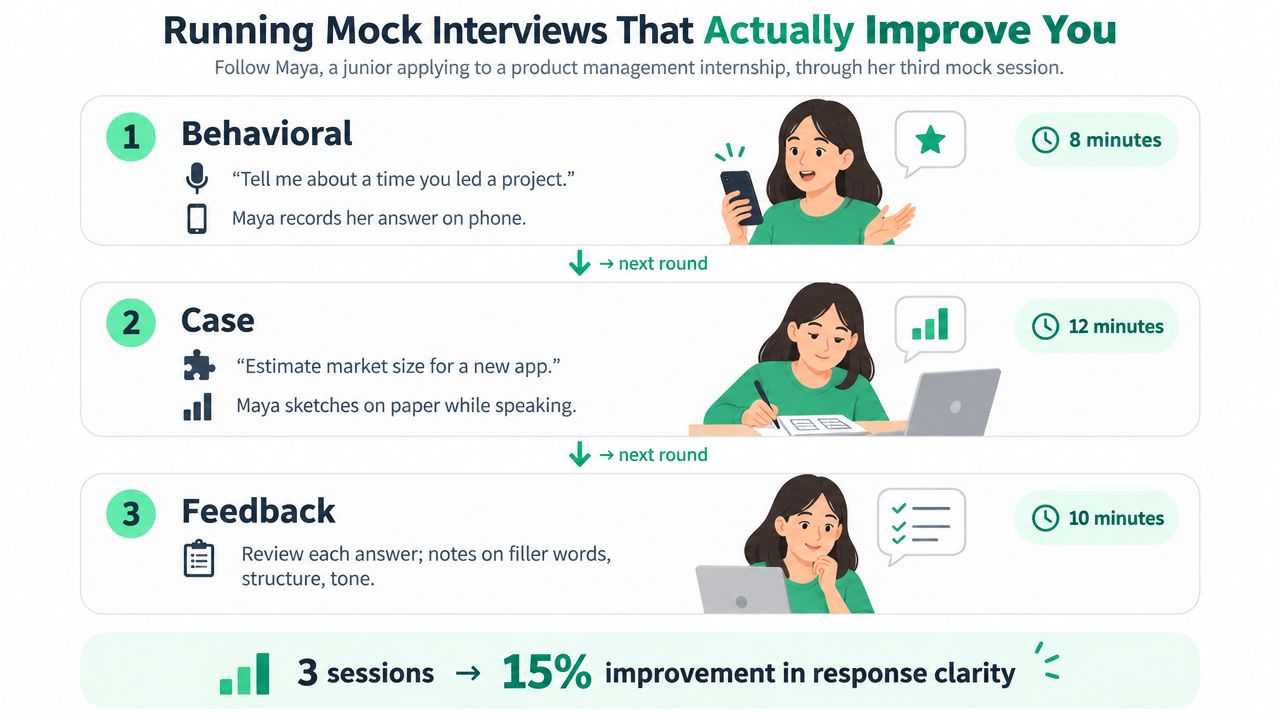
Maya is a junior applying for a product management internship. By her third mock interview, she's tired of vague feedback like “You did fine” and “Try to sound more confident.” Neither helps. So she changes the format.
What Maya changes on the third attempt
She runs three rounds in one sitting. One behavioral answer. One technical or case-style prompt. One cold pitch of herself and why she wants the role. She records every round on her phone and keeps each answer timed.
Her friend uses a two-column page:

What actually breaks under pressure
In the behavioral round, Maya forgets the Result. Her story ends after the Action because her brain treats “what happened next” as optional when she's stressed.
In the case round, her filler words spike the second she switches from framework to recommendation. In the cold pitch, she starts strong, then becomes generic at the exact moment she should be connecting herself to the company.
This is why generic “practice more” advice falls flat. Practice what? Under what conditions? With what feedback loop?
A widely recommended tactic is to practice questions out loud, record yourself, and do mock interviews under timed conditions with a friend or career center. The same guidance suggests dressing as if it's the actual interview and debriefing afterward, as described in this stress-and-anxiety interview guide.
The loop that works
Use this sequence:
- Answer once under time pressure
- Record it
- Transcribe one minute that felt off
- Mark where clarity dropped
- Retry only that minute
That's much more effective than redoing the entire interview badly five times.
For tools, keep it simple. Your phone camera works. Zoom recording works. A friend works. If you want AI-generated role-specific practice and scored mock interviews, Qcard's mock interview tool is one option. The useful feature in any tool is the same: it should help you compare what you meant to say with what you said.
Don't use mock interviews as a memorization drill. Use them to shorten the distance between intention and delivery.
Mock interviews are not a substitute for company research. They're not a personality test either. They're where you catch memory failure before a conversation exposes it.
Managing Anxiety the Night Before and the Morning Of
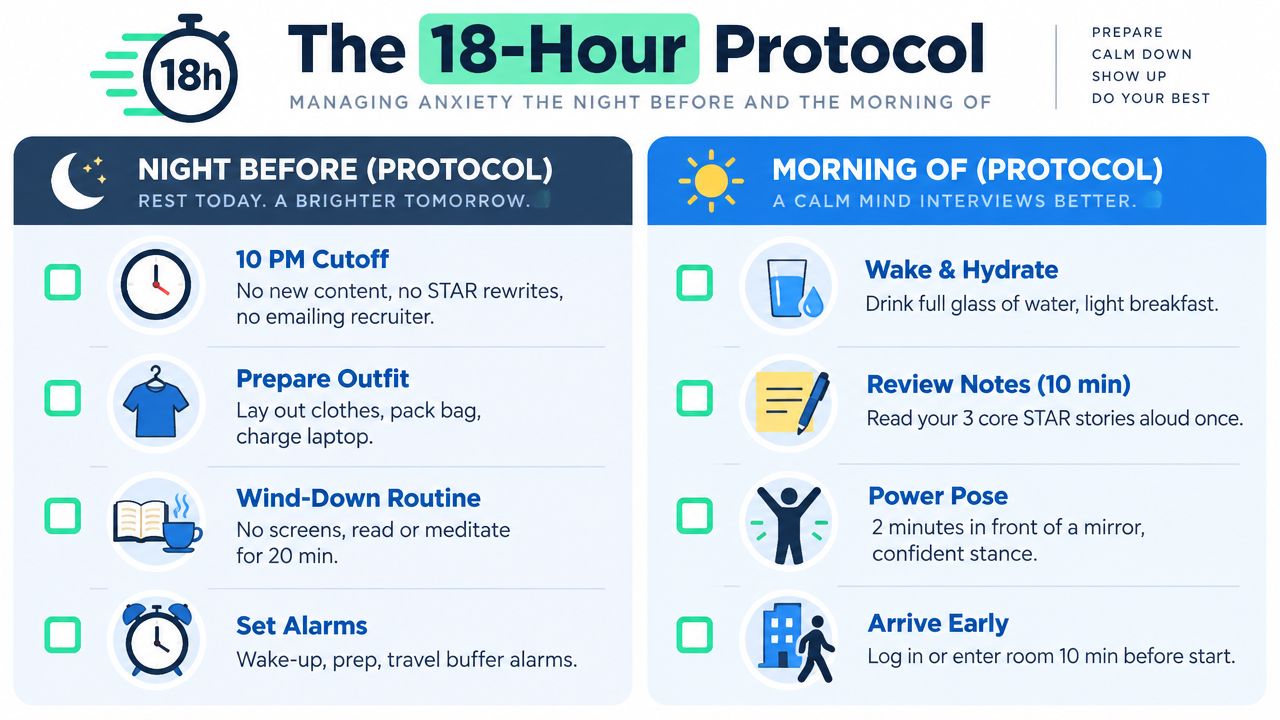
Treat the last 18 hours like a protocol. Mood is unreliable. Protocol is better.
The night before needs a hard stop
Set a cutoff at 10 p.m. No new stories. No rewriting your resume. No sending the recruiter one more email because you suddenly remembered a tiny question. Late-night tweaking makes candidates feel busy, not ready.
Instead, do practical setup:
- Lay out clothes: make the morning boring
- Charge everything: laptop, headphones, phone
- Open the platform: Zoom, Google Meet, Teams, HireVue, whatever they use
- Place support items nearby: water, notepad, pen, a familiar snack if that helps regulate you
For virtual interviews, current guidance puts more weight on delivery mechanics than many students expect. Testing camera, mic, and internet, recording yourself to catch filler words and pacing, and preparing for panel or recorded formats now matter as part of the skill itself. That's one reason “I thought school prepared me” can be misleading, as explored in this internship interview resource.
Use recovery scripts before you need them
Anxiety gets louder when your brain thinks blanking out would be catastrophic. It isn't, if you have language ready.
Try these:
- Explicit pause: “Give me ten seconds to think about the most useful example.”
- Bridge sentence: “The closest version of that I can point to is…”
- Redirect: “I want to answer that well, so let me pull from a slightly different project.”
Those phrases buy time without sounding evasive. They also protect recall. A lot of candidates panic because they think pauses look weak. They don't. Rambling looks weak.
The morning protocol
University career guidance recommends box breathing as a reset: inhale for 4 seconds, hold for 4, exhale for 4, hold for 4, and repeat until calmer. The same guidance also recommends sleep, avoiding known anxiety triggers like excess caffeine or sugar, and visualizing yourself answering confidently in the interview room, according to McMaster's interview nerves guide.
Use that with a simple morning sequence:
- Eat something steady: enough to avoid a blood sugar crash
- Move your body: even a short walk helps discharge nervous energy
- Say two answers aloud: not ten, just two
- Pick one anchor phrase: “Slow is clear,” or “Answer the question in front of me”
Calm doesn't always arrive before the interview. Sometimes clarity comes first, and calm catches up later.
Staying Natural Under Pressure for Neurodivergent and International Candidates
“Just be yourself” is lazy advice. Under interview stress, a lot of people can't access a relaxed version of themselves on command. The better instruction is this: be your clearest self.
That distinction matters. Neurodivergent candidates often spend extra cognitive effort managing eye contact, tone, pacing, sensory input, or masking habits. International candidates may be translating, code-switching, or searching for the most precise English phrasing while trying to recall a STAR story. Generic authenticity advice ignores all of that.
Replace high-friction demands with workable substitutes
If eye contact makes your recall worse, stop forcing textbook eye contact. In virtual interviews, look at the camera lens at key moments or focus near the interviewer's collar in person. That still reads as engaged.
If fully spontaneous delivery makes you lose the thread, use a one-sentence outline card beside your screen or notebook. Not a script. A cue like this:
- project name
- challenge
- what I changed
- result
- lesson
That's enough to trigger memory without trapping you in exact wording.
If fast pivots throw you off, use practiced transition lines:
- “Let me organize that in a quick example.”
- “I'll answer that through a project that shows how I work.”
- “The clearest example from my experience is this.”
Those phrases buy processing time. They keep you sounding deliberate instead of lost.
Clarity matters more than native smoothness
Interviewers care whether they can follow you. They do not need you to sound like a native speaker from a polished corporate training video.
If accent or vocabulary retrieval worries you, rehearse key role-specific terms aloud for two days before the interview. Not silently. Aloud. The point isn't performance. The point is reducing retrieval lag when you need words like “stakeholder alignment,” “regression,” “user research,” or “prioritization” under pressure.
One more thing. Don't confuse identity-level masking with normal performance anxiety. They're different. Performance anxiety says, “I'm nervous today.” Masking says, “I'm spending half my mental energy acting like a different kind of person.” Internship interview preparation should reduce that burden, not increase it.
Use supports that preserve your real voice. The goal isn't a persona. It's a controlled version of your actual communication style that remains intact when stress rises.
Your Day-Of Checklist and Closing Ritual
The day of the interview should feel narrow and procedural. If you're making fresh decisions every half hour, you've already made it harder than it needs to be.
Two hours before the interview
Clear your browser tabs. Disable notifications. Silence your phone and put it out of reach. Set up a backup device and a hotspot if you're interviewing virtually. Then do a short audio and video test on the same platform the company uses.
Keep the setup plain:
- Lighting: face a window or front light
- Background: neutral and still
- Camera frame: head and shoulders, not too low
- Water: within reach, not off-screen
- Notes: one page only, with cues not scripts
Dress in layers that fit the company's tone. A camera-ready top matters. Comfort matters too. If your clothes distract you, they'll steal attention from recall.
Protect your energy, don't cram it away
If your interview is at noon, stop studying by 9 a.m. Cramming close to the start often causes verbal interference. You don't sound fresher. You sound overpacked.
Use the remaining time for regulation:
- Eat lightly but enough
- Take a short walk or stretch
- Read your cue sheet once
- Say your opener out loud once
- Log in early
A 2026 interview-prep summary reported that candidates typically spend 5 to 10 hours preparing for interviews, 54% research the company, 42% use AI tools during preparation, and 70% of hiring managers were said to view being unprepared as a common mistake, according to this interview preparation statistics roundup. The practical takeaway is simple. Do the prep early so the day-of can stay calm.
The closing ritual after the interview
Most candidates either overanalyze immediately or avoid thinking about it at all. Neither helps. Use the same debrief every time.
Write down:
- What questions I got
- Where I answered clearly
- Where I went blank or rambled
- What example I wish I had used
- One fix before the next interview
Then send a thank-you note while the conversation is still fresh. If you need help with structure and wording, this guide to interview thank-you emails can speed that up.
A closing ritual protects your mental bandwidth. It turns one interview into signal for the next one. That's how you improve across a season instead of treating every interview like an isolated emotional event.
The best internship interview preparation doesn't make you sound rehearsed. It makes you retrievable. When the question changes, the interviewer interrupts, the platform lags, or your heart rate jumps, you can still find the right example and say it plainly. That's the standard worth training for.
Key Takeaways
- The first 48 hours should be listening, not drafting — candidates who open a notes app and start writing answers immediately end up sounding rehearsed and off-target because they prepared output before understanding the audience, while marking up the posting first reveals which 3 or 4 competencies actually repeat.
- You don't need internship experience to have interview evidence — class projects, group work, part-time jobs, volunteering, labs, and campus roles all contain proof of ownership, collaboration, and problem-solving, and the shift that matters is converting nearby experience into usable evidence instead of apologizing for the gap.
- Six to eight reusable stories beat one answer per question — tagging stories by competency (ownership, conflict, ambiguity, failure, leadership, problem-solving) means a single team project can answer "tell me about a challenge," "describe a time you led," "how do you handle disagreement," and "tell me about a time you adapted."
- The Action section is where answers are won, and most candidates get the ratio backwards — MIT's guidance of roughly 60% on Action means about 30 seconds of setup, 90 seconds of what you did, and 30 seconds of result, because a two-minute backstory fades from the listener's memory before your contribution arrives.
- "Just be yourself" is lazy advice for candidates managing extra cognitive load — the better standard is "be your clearest self," which means replacing high-friction demands with workable substitutes: looking at the camera lens at key moments instead of forcing textbook eye contact, using a five-cue outline card instead of a script, and rehearsing role-specific vocabulary aloud to reduce retrieval lag.
Qcard helps with the exact problem this article is really about: remembering what matters when stress scrambles recall. It gives you resume-grounded talking points, mock interview practice, and real-time cues designed to keep you clear without turning you into a script reader. If you want a prep system that supports authentic delivery under pressure, visit Qcard.
Ready to ace your next interview?
Qcard's AI interview copilot helps you prepare with personalized practice and real-time support.
Try Qcard Free