How to Stop Rambling in Interviews and Give Concise Answers
TL;DR
Rambling isn't one problem — it's three, and the fix depends on which one is yours. Memory retrieval failure needs short cue anchors instead of rehearsed scripts. Cognitive overload needs a relevance filter ("does this explain the challenge, prove my action, or clarify the result?"). Pacing and anxiety need pauses and regulation, not more preparation. Interviews run on short conversational turns, not monologues: analysis of interview transcripts found candidates held the floor a median 53.2% of the time with a median uninterrupted stretch of 2.1 minutes. Use STAR with Action carrying the largest share (MIT suggests roughly 20/10/60/10) and keep behavioral answers around 1 to 2 minutes. Take a deliberate pause before answering rather than opening with fillers — research found 388 filler-word occurrences in real interviews, and filler rates around 12 per minute significantly harmed listener perceptions across most evaluation categories. Practice with 90-second timed rehearsals, record yourself, and fix one thing per attempt. Use cue cards with fragments, not paragraphs. Then end with a clear takeaway and let the interviewer ask for more.
You finish answering a straightforward interview question and realize you've been talking for several minutes. The interviewer's notes have stopped moving. Their eyes shift toward the clock, or they interrupt with a polite, “So, what was the outcome?” You know the material, but your answer has buried the point under context, side details, and nervous filler.
Learning how to stop rambling in interviews isn't about becoming a naturally concise person overnight. It's about identifying what breaks down under pressure, then using the right fix for that specific failure. Some candidates lose their place because they can't retrieve the next detail. Others overload themselves by trying to explain everything. Others know exactly what they want to say but rush, pause awkwardly, or fill silence with “um” and “you know.”
How Do You Stop Rambling in Interviews?
"Be concise" is weak advice if you don't know why your answers expand. The same outward behavior — long, unfocused answers — comes from three different problems, and each one needs a different fix.
Step 1 — Diagnose your actual failure mode.
- Memory retrieval failure: You start with a clear example, then lose the next step, so you repeat earlier information or narrate your thinking aloud. The fix is a retrieval cue, not more script rehearsal — three anchors like "customer escalation, prioritization, resolution."
- Cognitive overload: You include every relevant fact because you're afraid of being misunderstood. The fix is a relevance filter: "Does this detail explain the challenge, prove my action, or clarify the result?" If not, leave it out.
- Pacing and anxiety: You know the answer but rush, restart sentences, or keep talking because stopping feels uncomfortable. The fix is pauses and physiological regulation, not more content.
Step 2 — Use a framework so you're not making decisions while speaking. For behavioral questions, STAR gives you the sequence. MIT's guidance suggests roughly 20% Situation, 10% Task, 60% Action, 10% Result, with answers landing around 1 to 2 minutes. One sentence on the situation, one on your responsibility, two or three decisions you personally made, then the outcome or lesson. For technical questions, lead with the answer, then the reasoning, then trade-offs. For consulting questions, state your hypothesis, name the analysis, explain what evidence would change your view.
Step 3 — Pace it like a conversation with handoffs. Take a brief pause before answering — "Let me think about that for a moment" is more credible than several fillers while you search for a direction. A deliberate 3-to-4-second pause helps you reset if you feel yourself wandering. And if you drift mid-answer, use a clean reset: "The main point is…" or "To answer your question directly…"
Step 4 — Check in instead of guessing. "Have I answered your question, or would you like me to go deeper on one part?" That single sentence protects both completeness and time.
Before you speak, remember three cues: point, proof, pause.
Why Rambling Hurts Your Interview Performance
A candidate once described a difficult project by explaining the company's history, the team structure, the original project brief, several meetings, and every obstacle that appeared along the way. The actual achievement, resolving the problem and improving the process, appeared near the end. The content was strong. The answer was not.
Rambling creates a credibility problem because the interviewer has to work to find your contribution. A long answer can make careful preparation sound like uncertainty, and detailed knowledge can come across as poor judgment if you don't show which details matter. The interviewer may also have a set of questions to cover, so an unfocused response reduces the time available to demonstrate other strengths.

A useful benchmark comes from a large analysis of interview transcripts. Candidates held the floor for a median of 53.2% of the conversation, while interviewers held it for 46.8%, and the median uninterrupted candidate speaking stretch was 2.1 minutes. Interviewers' median uninterrupted stretch was 1.9 minutes. Candidates also spoke at a median rate of 159 words per minute, compared with 172 words per minute for interviewers, according to Metaview's interview talk-time analysis.
That doesn't mean every answer must end at a rigid time limit. It does show that interviews usually work through short conversational turns, not extended monologues. A concise answer gives the interviewer a clear point, evidence that supports it, and a natural opening to ask for more detail.
Practical rule: Brevity isn't about hiding information. It's about respecting the interviewer's attention enough to lead with what matters.
Diagnosing Why You Ramble Under Pressure
“Be concise” is weak advice if you don't know what causes your answers to expand. The same outward behavior can come from very different problems, and each problem needs a different intervention.
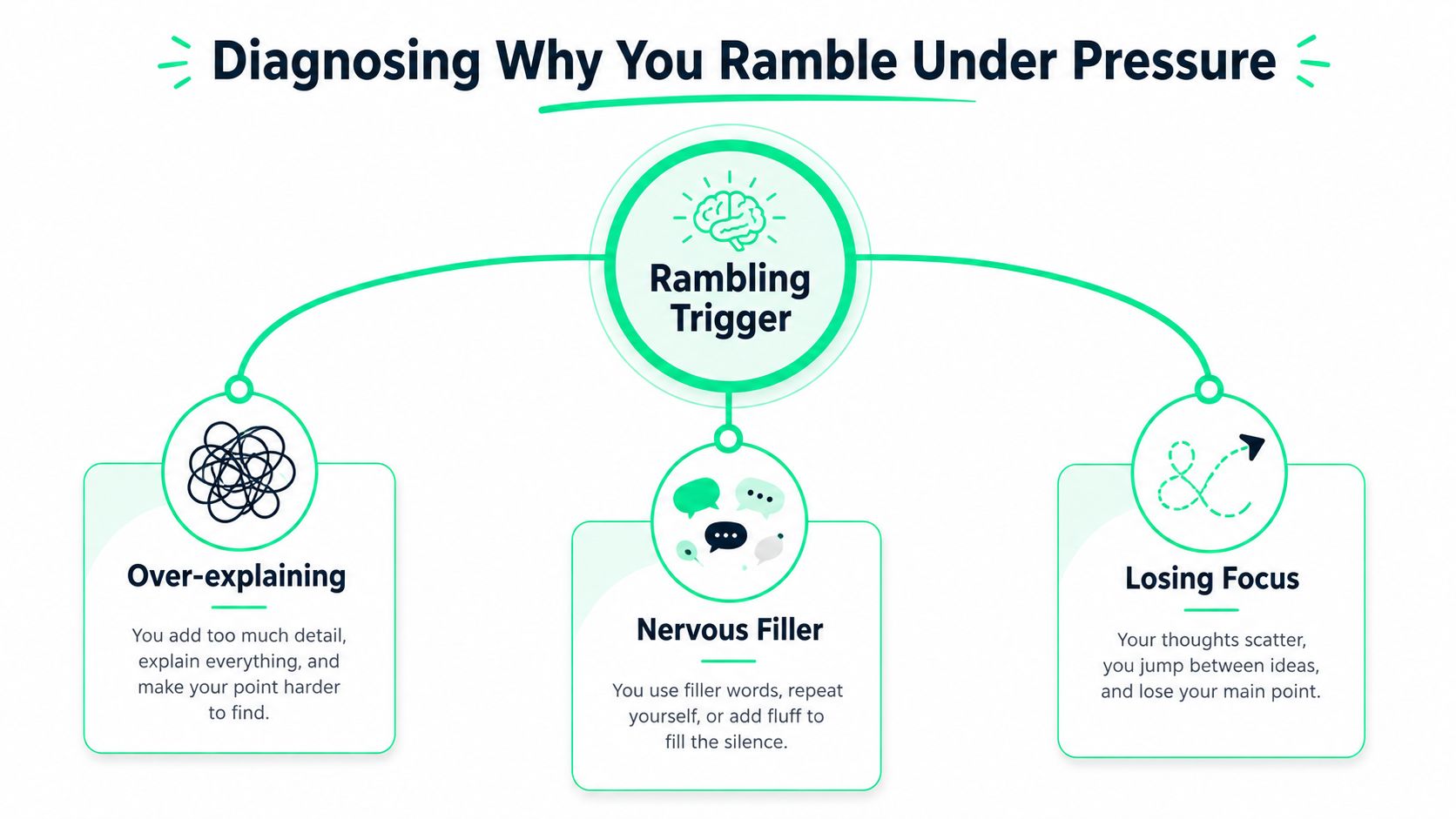
Memory retrieval failure
You begin with a clear example, then lose the next step. To recover, you repeat earlier information, add unrelated details, or narrate your thinking aloud. This often sounds like, “There were a few things involved,” followed by a search through your memory.
The fix is a retrieval cue, not more rehearsal of a complete script. Remember three anchors, such as problem, action, result. A small note reading “customer escalation, prioritization, resolution” can help you find the path without forcing you to memorize every sentence.
Cognitive overload
You're trying to include every relevant fact because you're afraid the interviewer will misunderstand or think you omitted something. The answer becomes a data dump. Detail orientation is useful, but interview answers require selection, not complete documentation.
Use a decision filter: “Does this detail explain the challenge, prove my action, or clarify the result?” If it does none of those, leave it out unless the interviewer asks.
Pacing and anxiety
You know the answer, but pressure changes delivery. You speak quickly, fill silence, restart sentences, or keep talking because stopping feels uncomfortable. Research on real interviews recorded 388 filler-word occurrences, including 299 hesitation gambits, and experimental work found that higher use of fillers and discourse markers reduced perceptions of professionalism and personal credibility, as summarized in the interview filler-word research.
A related study found that anxiety is highest immediately before speaking and decreases only after the interview ends. That pattern explains why a prepared candidate may still ramble at the exact moment an answer begins. If your main symptom is filler-heavy delivery, work on pauses and physiological regulation. If it's lost structure, use memory cues. If it's excessive context, impose a relevance filter.
Building Concise Answers With Structured Frameworks
A framework works because it removes decisions while you're speaking. For behavioral questions, STAR gives you a reliable sequence: Situation, Task, Action, Result. University career guidance supports keeping the answer around 1 to 2 minutes, with Action taking the largest share. MIT's guidance suggests approximately 20% Situation, 10% Task, 60% Action, and 10% Result, while Northwestern's career guidance also makes Action the longest component.
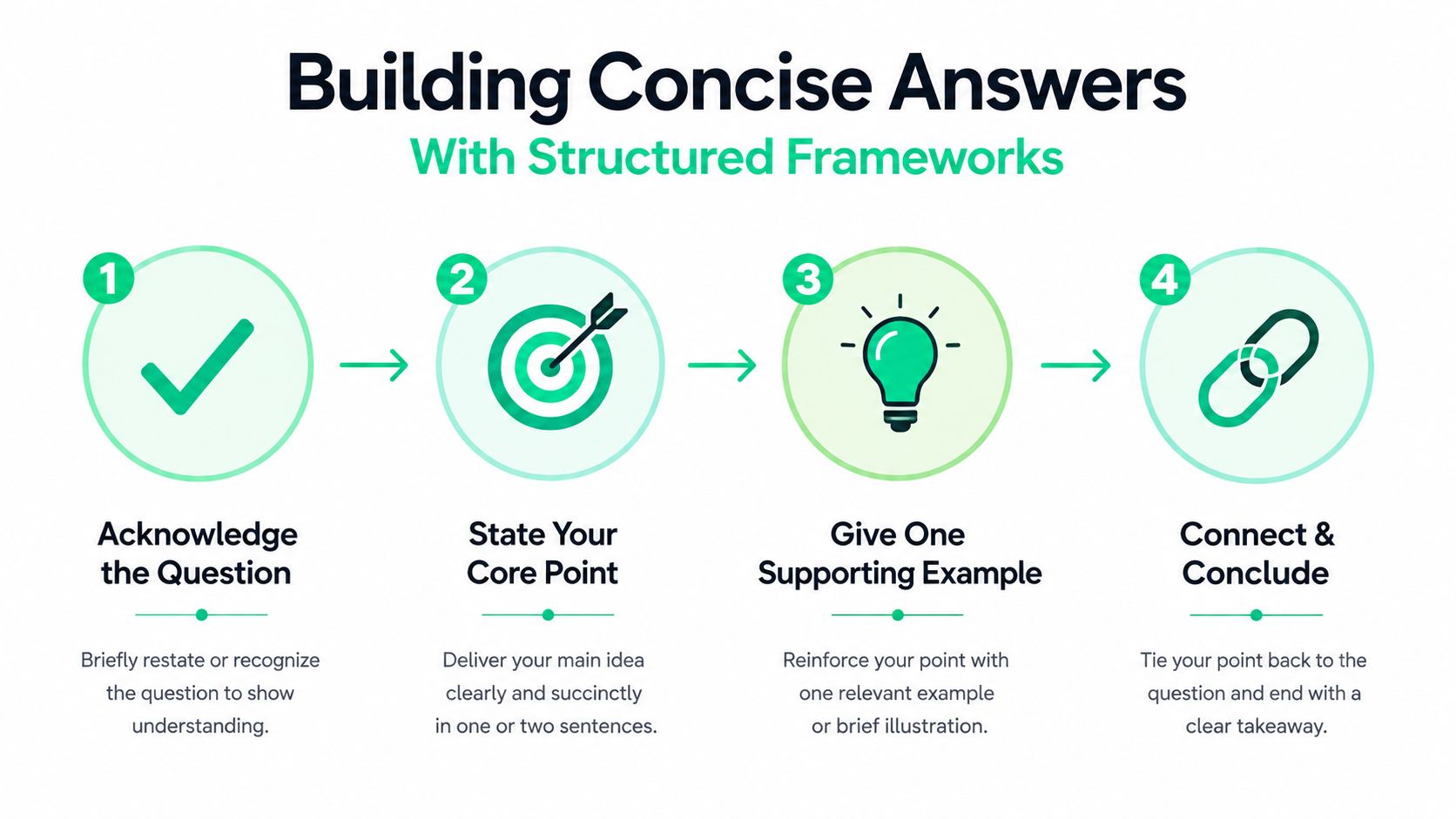
Use this compact architecture:
- Situation: Give one sentence establishing the problem.
- Task: State your responsibility or objective in one short sentence.
- Action: Describe two or three decisions you personally made.
- Result: Close with the outcome, lesson, or business implication.
Consider the difference between these openings:
“At my previous company, there were a lot of changes happening. The team had grown, and different people were handling requests in different ways. We had several systems, and people had different preferences, so it became difficult to know what was urgent…”
That answer may contain useful context, but it delays the point. A tighter version sounds like this:
“Our support queue was becoming inconsistent as the team grew, so I was asked to improve prioritization. I reviewed the recurring request types, created a triage guide, and introduced a shared escalation process. The team responded more consistently, and I learned how much clarity improves performance during rapid growth.”
The second answer gives the interviewer a complete story without narrating every meeting or background condition. If you want more practice with this structure, use this interview preparation guide to organize examples around your own experience.
For technical questions, lead with the answer before the explanation. Say, “I'd use a queue because the requirement is first-in, first-out,” then explain the trade-off and implementation details. For consulting questions, state your hypothesis, identify the analysis you'd run, and explain what evidence would change your view. The framework changes with the question, but the principle stays constant: answer first, support second, stop when the question is answered.
Pacing Pausing and Reading the Room
Even a well-structured answer can sound rambling if you deliver it at one unbroken speed. Treat the interview as a conversation with handoffs. Finish one idea, pause, and let the interviewer decide whether the answer needs more depth.
Take a brief pause before answering. You can say, “Let me think about that for a moment,” while you identify your structure. This is more credible than beginning with several filler words while searching for a direction. A pause signals that you're choosing your answer rather than losing control of it.
If you notice yourself drifting midway through a response, use a reset:
- Stop cleanly: “The main point is…”
- Return to the question: “To answer your question directly…”
- Compress the ending: “The result was…”
- Invite direction: “Would you like more detail on the process or the outcome?”
A deliberate pause of 3 to 4 seconds can help you reset when you feel yourself wandering, and a practical script is, “Let me think about that for a moment,” before continuing, based on interview pause guidance.
Don't replace every filler with a long silent gap. One interview study found mean total pause duration in answers was 3.8 seconds, with pauses ranging from 0.1 to 35 seconds. Longer pauses significantly increased the likelihood of a non-narrative response, which can indicate that the speaker has lost the answer's structure. A separate controlled speech-perception study found that filler sounds at rates such as 12 per minute significantly harmed listener perceptions across most evaluation categories, as discussed in research on delayed interview responses.
Your interviewer's behavior supplies useful feedback. If they interrupt, look at the clock, or appear disengaged, don't compete for control. Finish the current sentence and check in:
“Have I answered your question, or would you like me to go deeper on one part?”
That sentence protects both completeness and time. It also turns the interviewer into a collaborator rather than forcing you to guess how much detail they want.
Practice Drills Memory Cues and Support Tools That Keep You on Track
Concise answers become easier when you practice retrieval, not just reading polished responses. A script can sound excellent on paper and disappear under pressure. Your preparation should simulate the act of remembering, organizing, and speaking with incomplete certainty.
Start with a 90-second rehearsal. Choose one behavioral question, answer aloud, and stop when the timer ends. Record yourself, then review three things: where the answer lost its point, which fillers appeared, and whether your result was clear. Don't try to improve every weakness at once. Pick one target for the next attempt, such as replacing “um” with a pause or cutting the backstory to one sentence.
Use cue cards with fragments, not paragraphs. A useful card might contain:
- Challenge: delayed onboarding handoffs
- Action: mapped workflow, clarified ownership, added check-in
- Result: faster escalation, clearer accountability
- Lesson: simple ownership rules prevent repeated confusion
These cues support memory without making you sound memorized. They're particularly helpful if you experience retrieval delays, language-processing pauses, attention shifts, or anxiety when several details compete for working memory. The aim is not to hide those differences. It's to reduce unnecessary cognitive load so your real experience comes through.
Build a question bank around themes rather than trying to prepare a unique speech for every possible prompt. One example can often support questions about conflict, ownership, failure, leadership, prioritization, or problem-solving. Practicing with common interview questions helps you reuse the same experience flexibly while changing the emphasis for each question.
Tools can support this process when they provide cues rather than scripts. Qcard offers resume-grounded talking points, real-time feedback on pacing, filler words, and answer length, plus practice and mock-interview workflows. Used correctly, that kind of support reminds you of verified achievements without supplying a sentence-by-sentence performance. Before an interview, decide what information you need available, such as metrics, project names, or action verbs, and keep the cue set small enough to scan quickly.
Staying Concise and Confident When It Counts
The goal isn't to make every answer short. The goal is to make every answer complete enough for the question and easy for the interviewer to follow. A simple behavioral story may need only a compact STAR response, while a technical or consulting question may require assumptions, reasoning, and trade-offs.
Use this decision rule:
- Behavioral question: Lead with the situation, emphasize your actions, and finish with the result or lesson.
- Technical question: Give the proposed answer, explain the reasoning, then address trade-offs or edge cases.
- Clarifying question: Answer directly first, then add context only if it changes the interpretation.
- Complex question: State your structure before expanding, and pause between major parts.
You can end almost any response with a clear takeaway: “The main lesson was that ownership needed to be explicit,” or “That's why I'd choose the queue despite the extra coordination.” Then invite follow-up instead of adding more information automatically. A mock interview tool can help you practice this stopping point with realistic follow-up questions.
Before you speak, remember three cues: point, proof, pause. State the point, provide the proof, and pause. If the interviewer wants more, they'll ask.
Give the answer they can use, not every detail you remember.
Qcard provides resume-grounded memory cues, practice interviews, and delivery feedback for pacing, filler words, and answer length, helping you stay authentic without memorizing scripts. Visit Qcard to practice concise answers and keep your real achievements clear when interview pressure rises.
Key Takeaways
- Rambling has three distinct causes and each needs a different fix — memory retrieval failure calls for short cue anchors rather than more script rehearsal, cognitive overload calls for a relevance filter that cuts any detail not explaining the challenge or proving the action, and pacing anxiety calls for deliberate pauses and physiological regulation, which is why generic "be concise" advice rarely changes anything.
- Interviews operate as short conversational turns, not monologues — transcript analysis found candidates held the floor for a median 53.2% of the conversation with a median uninterrupted stretch of 2.1 minutes, which means a concise answer that gives a clear point plus supporting evidence and then stops creates a natural opening for the interviewer to ask for exactly the detail they want.
- Structure removes decisions while you're speaking, which is why frameworks work under pressure — STAR with Action as the longest component (MIT suggests approximately 20% Situation, 10% Task, 60% Action, 10% Result) keeps behavioral answers around 1 to 2 minutes, while technical questions should lead with the answer before the explanation and consulting questions should open with the hypothesis.
- A deliberate pause is more credible than filler, but silence has limits too — saying "Let me think about that for a moment" signals you're choosing your answer rather than losing control, and a 3-to-4-second reset helps mid-answer, while research found mean pause duration of 3.8 seconds in interview answers and that longer pauses significantly increased the likelihood of a non-narrative response, meaning the speaker had lost the structure.
- Practice retrieval, not recitation — a 90-second timed rehearsal with recording, reviewing only three things (where the answer lost its point, which fillers appeared, whether the result was clear), and fixing one target per attempt builds the skill that scripts can't, and cue cards with fragments ("Challenge: delayed onboarding handoffs / Action: mapped workflow, clarified ownership / Result: faster escalation") reduce cognitive load without making you sound memorized, which matters especially for candidates managing retrieval delays, language-processing pauses, or attention shifts.
Ready to ace your next interview?
Qcard's AI interview copilot helps you prepare with personalized practice and real-time support.
Try Qcard Free