How to Start a Job Search That Actually Gets Interviews
TL;DR
Starting a job search well means building a repeatable system rather than waiting for confidence or a perfect application. Your first week: choose two or three related role families and write a one-sentence role hypothesis, build a master resume you can tailor in under 30 minutes, source through a weekly mix of boards, networking, and direct outreach, and begin 15-minute daily interview drills before any invitation arrives. The evidence supports the mixed approach — long-run data found direct employer contact accounted for about two-thirds of job searches, while comparative analysis attributes up to 74.5% of successful job hunts to direct and personal contact. Expect a campaign, not a lucky break: a 2026 survey found an average of 16.6 applications producing just 2.8 interview invitations, which means silence isn't proof you're unqualified. Use a tracker where every entry has a concrete next action, follow up 5 to 7 business days after applying with one additional touch a week later, and protect your energy with a defined start time and stopping point rather than searching continuously.
You've opened a dozen tabs, saved several job postings, and still haven't applied to anything. One role seems too junior, another asks for experience you don't have, and the “perfect” application keeps getting postponed because you're trying to make it flawless. That paralysis is common, especially when you're starting your first search, changing careers, or managing anxiety around rejection.
The solution isn't another motivational speech. You need a repeatable job-search system that turns uncertainty into small decisions. Research has long shown that effective searches use several channels at once, including direct employer contact, personal connections, job boards, and agencies. One labor-market study found unemployed people used 2.8 search methods on average during a spell of unemployment, while long-run data from 1976 to 2011 found direct employer contact accounted for about two-thirds of job searches. The historical evidence is clear: one channel rarely carries the whole search. The foundational job-search research supports a mixed approach.
Expect a campaign, not a single lucky application. Recent research found unemployed workers spent around 9.2 hours per week searching and sent 8.5 applications in the last four weeks. A 2026 survey reported an average of 16.6 applications in a person's last search but only 2.8 interview invitations, which means rejection or silence isn't proof that you're unqualified. It's part of a low-feedback process. The New York Fed research makes the practical implication unavoidable: build volume, keep improving, and don't judge your prospects by one response.
Your first week has four jobs: choose a workable target, prepare reusable materials, source opportunities through multiple channels, and begin interview practice before invitations arrive.
How Do You Start a Job Search?
Your first week has four jobs: choose a workable target, prepare reusable materials, source opportunities through multiple channels, and begin interview practice before invitations arrive. The reason to build a system rather than chase one perfect application is that job searching is a low-feedback process — recent research found unemployed workers spent around 9.2 hours per week searching and sent 8.5 applications in the last four weeks, while a 2026 survey reported an average of 16.6 applications producing only 2.8 interview invitations.
Step 1 — Write a role hypothesis, not a wish. Choose two or three related role families and test them against real postings. A single sentence works: "I'm targeting entry-level operations and project coordination roles where I can use organization, communication, and spreadsheet skills to support teams and improve workflows." Then score each posting with three questions: Can I explain why my experience relates to the core work? Can I meet the genuine must-haves? Can I tailor my resume without pretending to be someone else?
Step 2 — Build a master resume you tailor from. Keep one complete, accurate inventory of projects, tools, coursework, volunteer work, and achievements, organized by role family. Then create focused versions. A 2026 survey found 68% of job seekers spend less than 30 minutes tailoring, so use a fast checklist: rewrite the summary, match three to five accurate keywords, reorder bullets so the most relevant evidence comes first, and make the target title obvious.
Step 3 — Source through multiple channels, not just boards. Long-run data from 1976 to 2011 found direct employer contact accounted for about two-thirds of job searches, and comparative analysis reports direct contact plus personal contacts accounted for up to 74.5% of job hunters finding work, versus 8.2% for job fairs. Run a weekly mix: boards for targeted volume, networking conversations, and direct outreach to selected employers.
Step 4 — Track applications with a next action attached. Record role, company, date applied, contact, follow-up date, status, and — most importantly — one concrete next step. "Wait" creates anxiety; "follow up Tuesday" creates a task. Send a first follow-up 5 to 7 business days after applying, and a second about a week later with a genuine reason to re-engage.
Step 5 — Start interview practice on day one. Use a 15-minute daily drill: five minutes on "tell me about yourself," five minutes explaining one project, five minutes reviewing the recording and noting one improvement.
Introduction to Starting Your Job Search Without the Overwhelm
Start with a small operating rhythm. On the first day, write down the kinds of work you could reasonably pursue. On the second, create a master resume. On the third, identify openings and people to contact. On the fourth, submit a small batch of thoughtful applications. By the end of the week, you should have evidence of progress, not a perfect career plan.
A job search becomes overwhelming when every task feels equally urgent. You're trying to decide what role you want, rewrite your resume, research companies, send messages, prepare for interviews, and interpret silence all at once. Separate those decisions. Give each one a home in your week.
Practical rule: Don't wait to feel confident before starting. Confidence usually arrives after you've created a few useful repetitions.
For an early-career candidate, a reasonable first target might include a customer-success coordinator role, an operations assistant role, and a junior project coordinator role. Those roles can share transferable skills, such as organizing information, communicating with stakeholders, solving routine problems, and managing deadlines. A career switcher might target marketing operations, content coordination, and sales enablement instead of applying randomly to every “marketing” opening.
Use a simple weekly rhythm:
- One planning block: Review your target roles and remove poor-fit postings.
- Several sourcing blocks: Check boards, contact people, and research employers.
- Several application blocks: Tailor and submit applications that meet your criteria.
- A short practice block: Rehearse answers from your actual experience.
- One review block: Record what worked and change one part of the process.
This structure matters for anxious and neurodivergent candidates because it reduces the number of decisions you must make in the moment. You don't need to search endlessly. You need a defined start time, a defined stopping point, and a visible next action.
The current entry-level market also requires flexibility. Recent reporting on the Class of 2025 found graduates began searching an average of 6.4 months before graduation, and 42% of job-seeking graduates broadened their company and industry options because of economic anxiety. A separate survey cited by CNBC found only 30% of spring 2025 bachelor's graduates reported landing a full-time job in their field. NACE's reporting on the Class of 2025 shows why a broad but coherent target is more rational than waiting for one narrow title.
Clarify Your Goals and Target Roles Before You Apply
Don't begin with “I'll apply to anything.” That approach feels flexible, but it creates poor applications and constant doubt. Choose two or three related role families, then test them against real postings.
Write a role hypothesis
Use one sentence:
“I'm targeting entry-level operations and project coordination roles where I can use organization, communication, and spreadsheet skills to support teams and improve workflows.”
A role hypothesis isn't a permanent identity. It's a working theory you can test. Search for postings using the actual language employers use, then look for repeated responsibilities. If operations postings repeatedly mention scheduling, documentation, process tracking, and stakeholder communication, you've found a useful skill pattern.
A recent graduate with campus event experience could test these options:
- Program coordinator
- Operations assistant
- Customer-success coordinator
A former retail supervisor might test:
- Account coordinator
- Sales operations assistant
- Office or people-operations coordinator
The titles differ, but the underlying capabilities may overlap. That's how you broaden without becoming vague.
Separate requirements from preferences
Create two lists. Your must-haves might include location, work authorization, schedule, minimum compensation needs, accessibility requirements, or a role that uses a particular skill. Your nice-to-haves might include a specific industry, company size, title, or software tool.
Then score each posting with three questions:
- Can I explain why my experience relates to the core work?
- Can I meet the genuine must-have requirements?
- Can I tailor my resume without pretending to be someone else?
If the answer is yes to all three, apply. If the role looks interesting but you can't connect your experience to its main responsibilities, save it for research rather than forcing an application.
A broader search isn't a failed search. It's a way to create more opportunities while keeping your story consistent.
Use real postings as your curriculum
Save several relevant postings and highlight repeated keywords. You're not copying them into your resume. You're learning the market's vocabulary and identifying which skills to develop next.
For example, if you want junior data roles but lack direct work experience, look for recurring expectations such as Excel, SQL, reporting, documentation, and communicating findings. Your initial target might include reporting coordinator and operations analyst roles while you build stronger technical evidence.

Build Resume and LinkedIn Assets You Can Tailor Quickly
Your resume shouldn't be rebuilt from a blank page for every application. Create a master resume that contains your complete, accurate inventory of projects, responsibilities, tools, coursework, volunteer work, and achievements. Then create focused versions from that source.
Start with evidence, not adjectives. Replace “helped with social media” with a description of what you did, such as “planned weekly posts, coordinated approvals, and reviewed engagement feedback.” If you have verified measurements, include them. If you don't, describe the scope and result without inventing numbers.
Build the master document
Organize your material by role family. A customer-success version might emphasize issue resolution, client communication, onboarding, and documentation. An operations version might emphasize scheduling, process improvement, reporting, and cross-team coordination. A project-coordination version might emphasize timelines, meeting notes, risk tracking, and follow-through.
Keep a private archive of bullets you don't use in the current version. That archive prevents you from deleting useful evidence just because it isn't relevant to one posting.
Tailoring doesn't need to consume your day. A 2026 survey found 68% of job seekers spend less than 30 minutes tailoring a resume, including 36% who spend under 15 minutes. The Jobnique survey supports a fast, deliberate checklist:
- Rewrite the summary: Name the target role and the most relevant capabilities.
- Match three to five keywords: Use terms that accurately describe your experience.
- Reorder bullets: Put the evidence closest to the employer's main need first.
- Check the title: Make the target role obvious to a recruiter scanning quickly.
The point isn't to make the resume look different. The point is to make relevance easier to see.
Make LinkedIn support your search
Your LinkedIn headline should communicate direction and evidence. “Recent graduate seeking opportunities” tells people what you want but not what you can contribute. “Entry-Level Operations Coordinator | Process Documentation, Scheduling, and Excel Reporting” gives a clearer reason to contact you.
Your About section can follow a three-part structure:
- What you've worked on.
- What strengths you bring.
- What roles you're pursuing.
For example: “I've coordinated student programs, maintained project documentation, and supported teams with scheduling and follow-through. I'm strongest when work requires organization, clear communication, and careful attention to detail. I'm pursuing entry-level operations and project-coordination roles.”
Ask former supervisors, professors, classmates, and colleagues for specific recommendations or introductions. Send a personal message rather than a broadcast. “I'm exploring operations coordinator roles and noticed your team works on process improvement. Would you be open to sharing how someone early in their career can build relevant experience?” is easier to answer than “Can you help me find a job?”
For resume-grounded practice questions, you can also use Qcard's resume interview questions as one preparation resource.
Find Opportunities Through Boards Networking and Direct Outreach
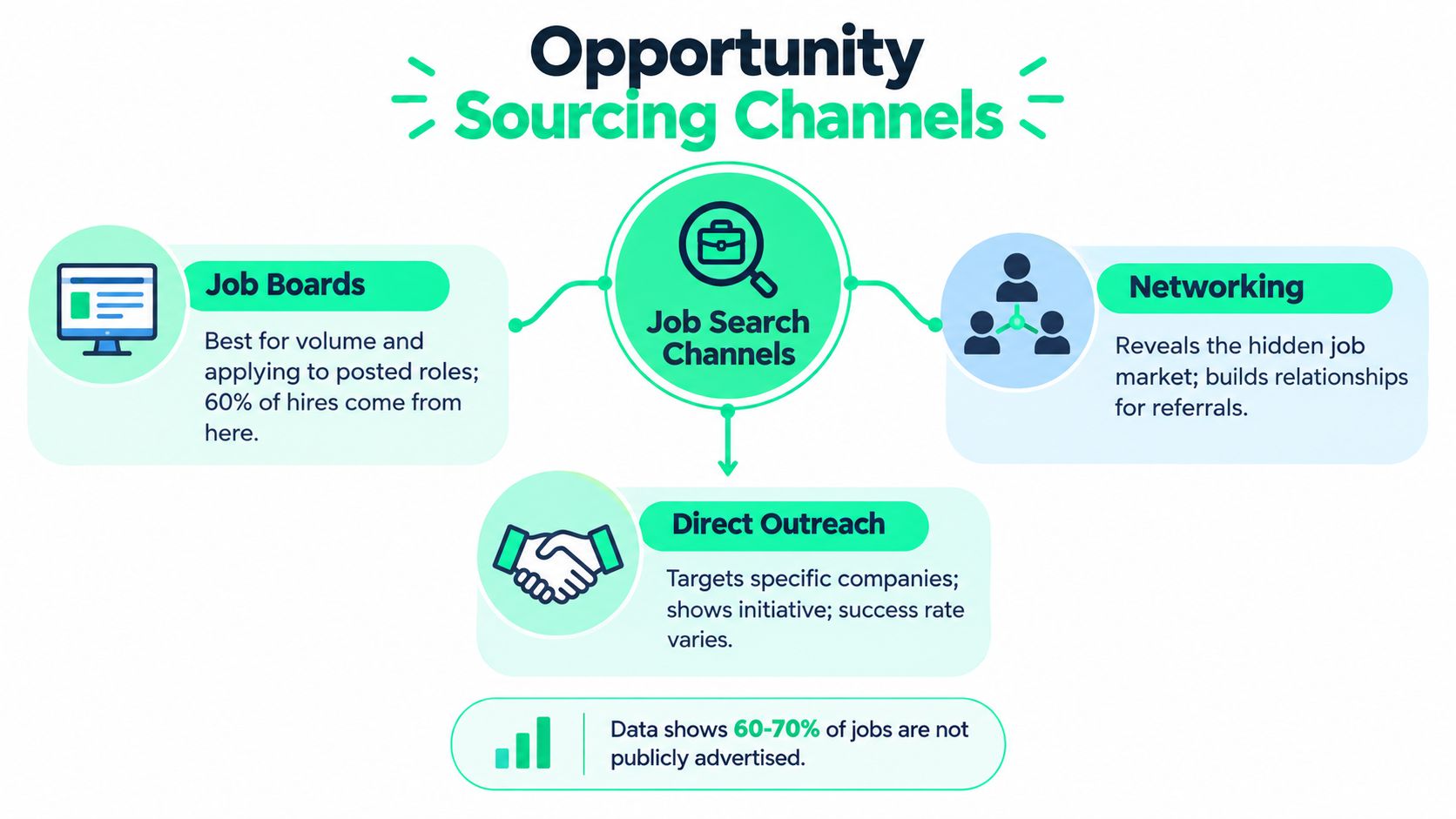
Job boards are useful, but they shouldn't become your entire search. Statistics Canada found unemployed job seekers used an average of 1.8 search methods. The most common methods included looking at job ads at 53.6%, contacting employers directly at 50.3%, and placing or answering ads at 33.9%. The Statistics Canada table supports a practical mix rather than a board-only routine.
Use boards for targeted volume
Set alerts on LinkedIn, Indeed, company career pages, and specialist boards relevant to your field. Don't scroll indefinitely. Search using your target titles, scan the first responsibilities, and decide quickly whether the posting passes your filter.
Apply when you meet the core requirements and can explain your fit. Save the posting, record the closing date, and identify one person connected to the team if possible. That small research step turns a passive application into a more informed one.
Avoid spending an hour perfecting an application for a role that doesn't match your target. Your time should support several channels.
Turn networking into conversations
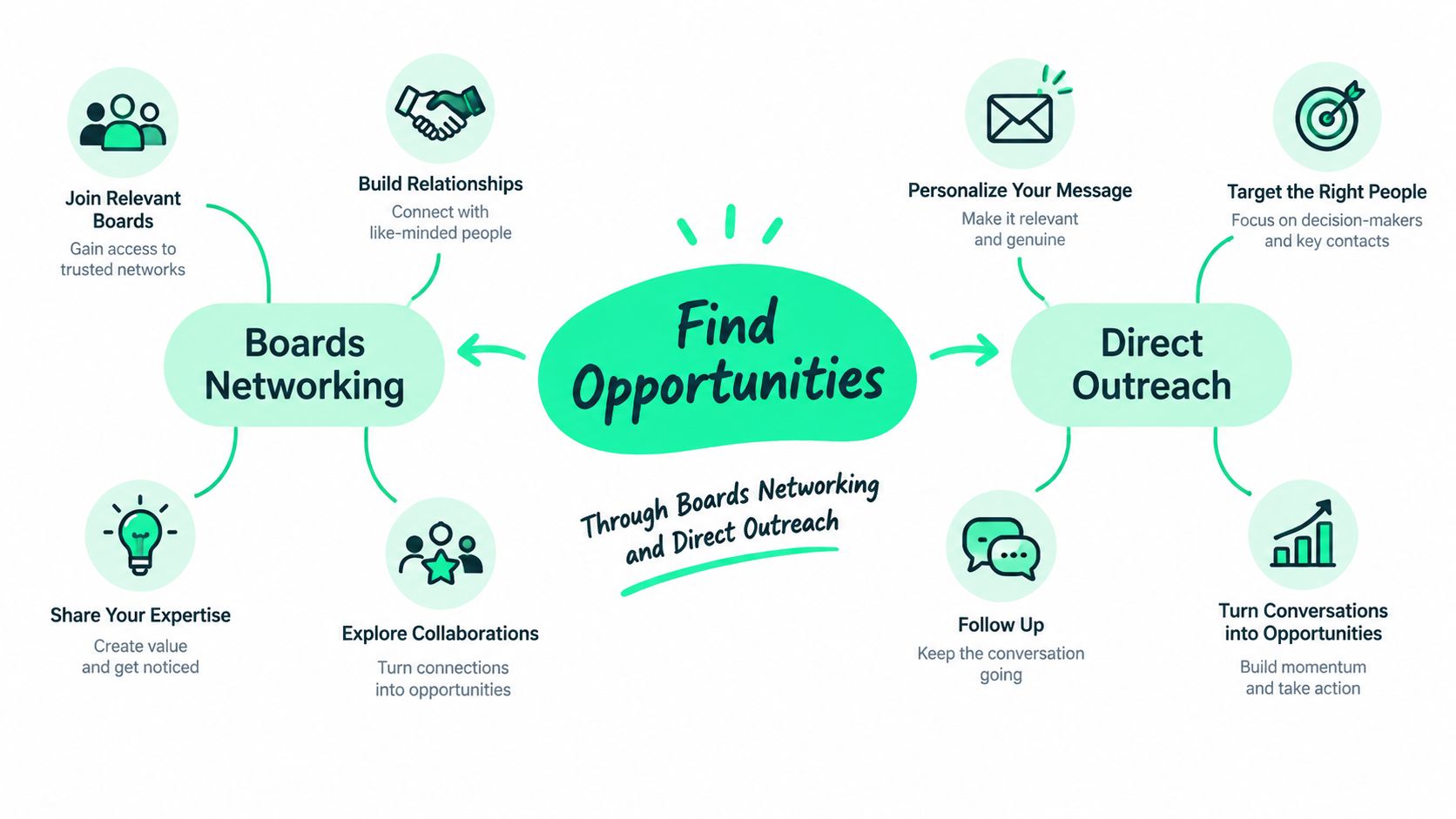
Networking isn't asking strangers for jobs. It's learning how work gets done and who hires for it. Start with people you already know, including former classmates, relatives, professors, volunteer contacts, and previous coworkers.
A useful message might read:
“Hi Maya, I'm exploring junior operations roles after working on event coordination and administrative projects. I noticed you moved from customer support into operations. Would you be open to a short conversation about the skills that helped you make that transition?”
Ask about their path, team needs, and advice for someone entering the field. Don't force a referral in the first message. If the conversation goes well and a suitable opening appears, you can ask whether they'd feel comfortable referring you.
Contact employers directly
Direct outreach works best when it's specific. Choose a company, identify a relevant team, and explain why your background connects to its work. A concise note to a hiring manager might say:
“Hello Jordan, I'm applying for the operations coordinator opening because my experience with scheduling, documentation, and cross-team communication matches the role's priorities. I've attached my application and would be glad to share a concise example of how I've organized a complex project.”
Comparative career-search evidence reports that direct employer contact and personal contacts accounted for up to 74.5% of job hunters finding work, while job fairs accounted for 8.2% and professional-journal advertisements for 8.3%. The comparative job-search analysis explains why personal contact deserves more attention than endless low-context applications.
Use a weekly mix:
- Boards: Find relevant posted openings and submit targeted applications.
- Networking: Start conversations with people in your target functions.
- Direct outreach: Contact selected employers before or alongside applications.
You can also use Qcard's career resources to support the preparation side of this process, but don't let tools replace conversations with real people.
Organize Applications Track Outreach and Follow Up on Time
A tracker won't get you hired, but it will stop your search from becoming a blur of open tabs and unanswered emails. Use a spreadsheet, Notion, Airtable, or a simple notebook. Choose the tool you'll open.
Record these fields:
- Role and company: Include the exact title and employer.
- Date applied: Record the submission date immediately.
- Contact: Add the recruiter, hiring manager, referral, or connection.
- Follow-up date: Set the next action before closing the posting.
- Status: Use clear labels such as saved, applied, contacted, interview, rejected, or closed.
- Next step: Write one action, such as “send portfolio,” “prepare project example,” or “move on.”
The next action matters most. “Wait” creates anxiety because it gives your brain nothing concrete to do. “Follow up Tuesday” or “prepare a customer-conflict story” creates a manageable task.
Follow up without guessing
If a posting doesn't give a deadline, send your first follow-up 5 to 7 business days after applying, then a second message about one week later if there's still no response. JobWizard's timing guidance supports this two-touch approach.
A first follow-up can be brief:
“Hello Priya, I'm following up on my application for the operations coordinator role submitted last Monday. I remain interested because the position combines process documentation and team coordination, which align with my experience. Please let me know if I can provide anything else.”
If you send a second note, add a reason to re-engage, such as a newly completed project, relevant work sample, or meaningful connection to the team. Don't send repeated “just checking in” messages indefinitely. After the second attempt, redirect your energy.
When the posting includes a deadline, wait one to two days after the deadline before contacting the hiring manager. MyPerfectResume's follow-up advice recommends avoiding the final review window. If the deadline is Friday, contact them Monday or Tuesday rather than sending a note while the employer is still collecting applications.
Keep outreach records separate from application records if that makes the tracker easier to use. A contact who gives advice today may become a referral later, so note what you discussed and when it would be appropriate to reconnect.

Prepare Early Stay Steady and Launch Your Search With Confidence
Interview preparation belongs at the beginning, not after an invitation arrives. Early practice lowers the shock of hearing your own voice, reveals which experiences you've forgotten, and gives you time to build concise answers from real evidence.
Use a 15-minute daily drill:
- Spend five minutes answering “Tell me about yourself” for one target role.
- Spend five minutes explaining one project, challenge, or accomplishment.
- Spend five minutes reviewing the recording and noting one improvement.
Keep the answers grounded in your resume. Practice a clear situation, the action you took, and the result you can verify. If you're neurodivergent or anxious, add pacing cues such as “pause,” “main point,” and “example” to your notes. These cues help you recover without memorizing a script.
A recent academic study on employment anxiety reported low self-confidence and concern about employment prospects among students entering the labor market. The Frontiers study reinforces why structure matters. Your routine should protect your energy, not demand that you perform confidence all day.
Use a firm stopping point. Search during a planned block, then close the tabs and do something unrelated. Review results once a week instead of checking email continuously. If applications receive no response, change one variable, such as targeting, resume emphasis, outreach, or interview practice, rather than concluding that you're hopeless.
Your first-week checklist is simple:
- Choose two or three role families.
- Write must-have and nice-to-have criteria.
- Build one accurate master resume.
- Create a focused LinkedIn headline and About section.
- Save relevant postings and identify contacts.
- Submit targeted applications.
- Schedule follow-ups.
- Practice one resume-grounded answer each day.
For a structured practice routine and interview preparation support, explore Qcard's interview prep guide. Start with one role family and one application block today. You don't need certainty before you move, you need a system that gives you the next move.
Key Takeaways
- A broad but coherent target beats both paralysis and randomness — choosing two or three related role families and testing them against real postings creates more opportunities while keeping your story consistent, which matters in a market where NACE reporting found 42% of job-seeking Class of 2025 graduates broadened their company and industry options.
- One channel rarely carries a search — long-run data from 1976 to 2011 found direct employer contact accounted for roughly two-thirds of job searches, and comparative analysis reports direct plus personal contact accounted for up to 74.5% of job hunters finding work versus 8.2% for job fairs, which is why a board-only routine underperforms a weekly mix.
- Tailoring should take minutes, not hours — a 2026 survey found 68% of job seekers spend under 30 minutes per resume (36% spend under 15), and the goal isn't to make the resume look different but to make relevance easier to see through a rewritten summary, three to five accurate keywords, and reordered bullets.
- Every tracker entry needs a next action, because "wait" is what turns a search into anxiety — recording a concrete step ("follow up Tuesday," "prepare a customer-conflict story," "move on") gives your brain something to do, and the two-touch follow-up rhythm (5 to 7 business days, then one week later with a genuine reason) prevents both silence and over-messaging.
- Interview practice belongs at the start, not after an invitation — a 15-minute daily drill grounded in your actual resume reveals which experiences you've forgotten and builds concise answers early, and for anxious or neurodivergent candidates, pacing cues like "pause," "main point," and "example" support recovery without requiring a memorized script.
Qcard offers resume-grounded interview questions, mock practice, concise talking points, and feedback on pacing, filler words, and answer length for candidates who want structured preparation without memorized scripts. Visit Qcard to build a calmer, more consistent interview routine alongside your job search.
Ready to ace your next interview?
Qcard's AI interview copilot helps you prepare with personalized practice and real-time support.
Try Qcard Free