TL;DR
Concision is a trained response, not a personality type — and the goal is strategic reduction, not flawless fluency. Research found 5 disfluencies per minute doesn't significantly damage perceived effectiveness, while 12 filler sounds per minute clearly does. Structure the answer before you speak using PREP (Point, Reason, Example, Point), then apply a headline-first rule: answer in one sentence, add one or two supporting facts, stop. Find your personal filler pattern by recording yourself and noting what appears at openings, direction changes, evidence searches, and commitment moments — then replace verbal padding with silent planning. Trim live by cutting phrases that announce intention instead of stating the idea ("I just wanted to say" → "My recommendation is"). Control pacing with breath, letting each breath carry one idea, targeting 140 to 170 words per minute in practice. Rehearse with three or four memory cues — problem, action, result, lesson — rather than memorized scripts, since missing one sentence in a script can take the rest with it.
Speaking 4% to 5% of your words as fillers is normal, but reaching 12 filler sounds per minute, about 8% of speech, can damage how competent you appear. The fix isn't perfect fluency. It's strategic reduction, clear structure, and the ability to pause when pressure makes you want to over-explain.
You know the moment. An interviewer asks, “Tell me about a time you solved a difficult problem,” and you answer before your thoughts have formed. You start with “I think,” add “sort of,” explain the background, correct yourself, and keep talking long after your strongest evidence has landed. The interviewer is still polite, but their attention has moved elsewhere.
Speaking concisely means making your value easy to find. You need enough context to make the answer complete, but not so much that your achievement disappears inside the explanation. The following methods show how to speak more concisely when anxiety, unfamiliar questions, or evaluation pressure makes every pause feel dangerous.
How Do You Speak More Concisely?
Speaking concisely isn't about eliminating every hesitation — it's about making your value easy to find. You need enough context for the answer to be complete, but not so much that your achievement disappears inside the explanation.
The target is realistic. A 2024 experimental study in the Journal of Applied Behavior Analysis found that 5 disfluencies per minute did not significantly harm perceived effectiveness, while the damage became clear at 12 filler sounds per minute (about 8% of speech). Aim for control, not mechanical perfection.
Use five moves:
1. Decide the point before you speak. If you haven't chosen what matters, your mouth narrates the decision-making process in real time. Pause, breathe once, and identify the result you want remembered.
2. Use PREP — Point, Reason, Example, Point. State your answer immediately, give the main reason (not every reason), offer one specific example, then close by sharpening the conclusion. Don't add a second example unless asked.
3. Apply the headline-first rule. Answer in one sentence, add one or two supporting facts, then stop. Replace "I just wanted to say that, in my opinion, I think one of the things I was able to do was sort of help the team communicate better" with "I improved team coordination by creating a single project status system."
4. Find your filler pattern rather than banning all fillers. Record yourself and note what appears when you start speaking ("I think," "basically," "so"), change direction ("I mean"), search for evidence ("um," "like"), or avoid commitment ("sort of," "maybe," "I guess"). Fix one pattern at a time.
5. Convert breath into structure. Let each breath carry one complete idea: state the claim, pause, give the reason, pause, offer the example, stop. Academic guidance on delivery recommends a conversational pace of 140 to 170 words per minute, with silent pauses preferred over verbal fillers — use that range in practice, not as a live monitor.
The rule underneath all five: state your conclusion, give the evidence that proves it, and stop.
The High-Stakes Cost of Verbal Clutter
An interviewer asks you to describe a difficult project. Under pressure, you begin with the company's history, explain the team structure, add caveats about what you “sort of” contributed, and reach the result minutes later. Your knowledge is sound. Your answer makes the interviewer hunt for the achievement.
That hunt creates risk. Employers assess judgment through how you select and organize information, not only through the information itself. Qualifiers, corrections, and side explanations can hide your expertise, especially when anxiety or unfamiliar evaluation settings makes silence feel unsafe. Neurodivergent and anxious candidates need a method for managing that pressure, not generic advice to eliminate every “um.”
A 2024 experimental study in the Journal of Applied Behavior Analysis found that increased speech disfluencies worsened audience perceptions across most dimensions, with the effect especially noticeable at 12 filler sounds per minute. It also found that 5 disfluencies per minute did not significantly harm perceived effectiveness. Aim for control and clarity, not mechanical perfection. (The study in the Journal of Applied Behavior Analysis)
Practical rule: State your conclusion, give the evidence that proves it, and stop.
Use this Fluidwave guide to speaking clearly to strengthen articulation, then rehearse the pressure pattern itself. Before answering, take one quiet breath, identify the result you want remembered, and speak from that point. A deliberate pause signals control. It does not weaken your answer.
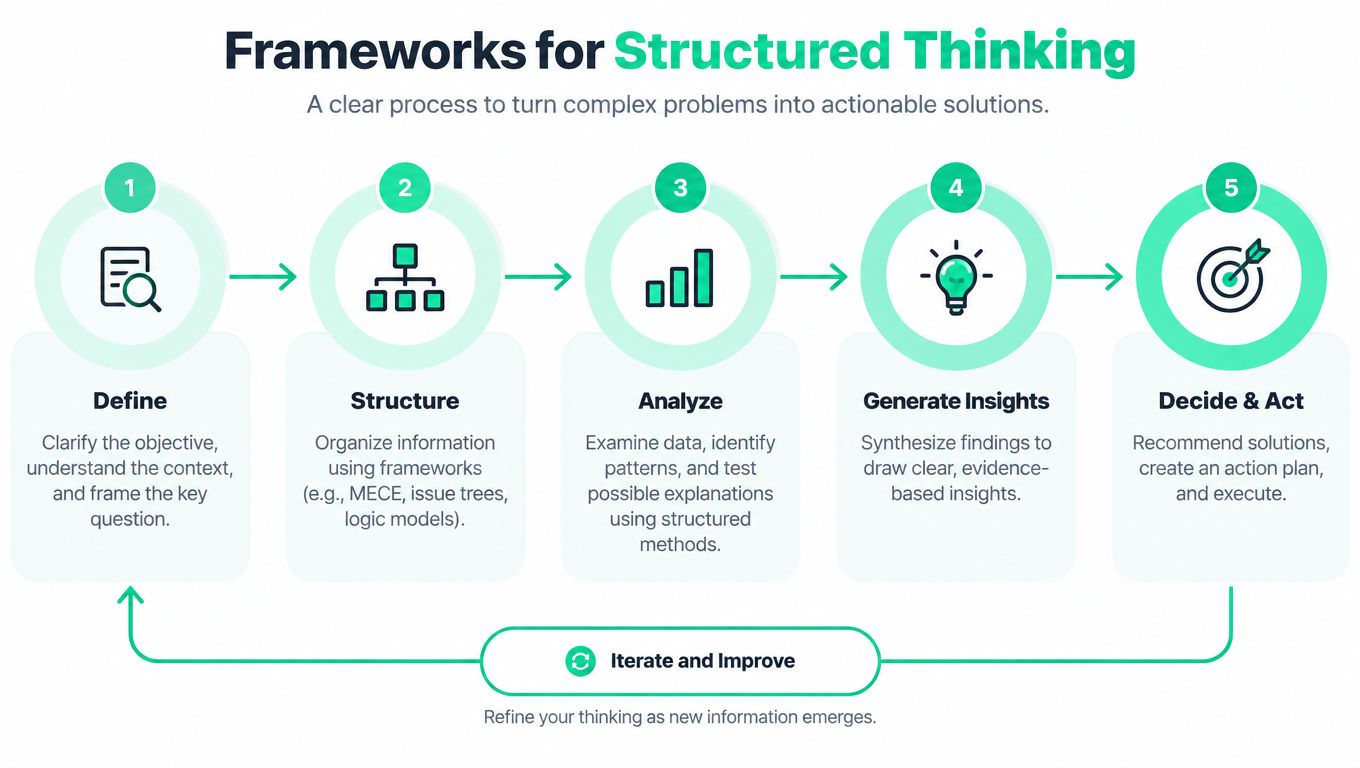
Frameworks for Structured Thinking
Concision starts before speaking. If you haven't decided what matters, your mouth will narrate the decision-making process in real time. Use a structure that forces you to choose the point before you provide the explanation.
Use PREP for direct answers
The PREP framework means Point, Reason, Example, Point. It works particularly well for interview questions, meeting updates, and recommendations because it gives the listener an immediate answer and a defined ending. Guidance on concise communication identifies PREP as a way to prevent rambling by organizing a message around those four elements. (PREP communication framework)
Use it like this:
- Point: State your answer or recommendation immediately.
- Reason: Give the main reason, not every reason.
- Example: Offer one specific situation, action, or result.
- Point: Close by restating the conclusion in sharper terms.
Example:
“I'm strongest when a project lacks structure. I create a clear operating plan before the team starts execution. In my last role, I turned a vague launch request into a prioritized workstream with owners and deadlines. That structure helped the team move from uncertainty to action.”
Don't add a second example unless the interviewer asks for more. PREP gives you a complete answer without encouraging you to keep searching for extra proof.
Build presentations from the body outward
Wharton's communication guidance recommends starting with the body of a message, then creating the introduction and conclusion around it. Its concise introduction includes an attention grabber, ethos, purpose, and roadmap. (Wharton communication guidance)
For an interview answer, adapt that sequence:
- Attention grabber: Lead with the result or central claim.
- Ethos: Establish your role or relevant responsibility.
- Purpose: Explain what you did and why.
- Roadmap: Preview the one or two points you'll cover.
Before an interview, use the Qcard interview prep guide to turn broad experiences into compact answer maps. Write the body first. Once you know the action and result, you can remove background that doesn't help the listener understand either one.
Understanding and Reducing Filler Words
You are answering an interview question, your mind is racing, and every pause feels exposed. That pressure can produce “um,” “like,” or “you know” before you have chosen a clear point. Filler words do not indicate low ability or poor preparation. They are common in spontaneous speech, and the Cambridge English Corpus discussion of fillers explains how they can support planning.
The problem starts when fillers replace structure. “Um” can give you a moment to retrieve an idea. “I just wanted to say,” “kind of,” and “you know” usually soften the sentence without adding meaning. Under evaluation pressure, that extra padding makes your answer harder to follow and can weaken your commitment.
Find your personal pattern
Do not try to remove every hesitation at once. Record answers to common interview questions and identify the words that appear when you:
- Start speaking: Notice openings such as “I think,” “basically,” or “so.”
- Change direction: Listen for “I mean” and repeated corrections.
- Search for evidence: Identify clusters of “um,” “like,” or “you know.”
- Avoid commitment: Watch for “sort of,” “maybe,” or “I guess.”
Start with qualitative awareness rather than self-criticism. If “I think” appears before every recommendation, begin with the recommendation. If “like” appears while you search for an example, pause, select one example, and continue.
Replace verbal padding with silent planning
A silent pause separates thinking from speaking. When a question arrives, close your mouth, breathe once, and choose your first sentence. For anxious or neurodivergent candidates, this small routine creates a predictable response cue instead of demanding instant fluency. Listeners generally hear a brief pause as thoughtfulness, not failure.
As established in the earlier study on speech disfluencies, a low but nonzero level of hesitation did not automatically damage perceived effectiveness, while frequent disfluencies had a clearer negative effect. Aim for fewer fillers, not flawless speech.
Use this replacement drill:
- Ask yourself a practice question.
- Pause before answering.
- State the conclusion first.
- Allow silence while selecting the next idea.
- Remove any phrase that added no meaning.
Silence is part of a controlled answer. Repeated verbal padding shows that you need a clearer permission to pause and think.
Editing Heuristics for Real-Time Speech
Under interview pressure, a fast answer can sound crowded rather than concise. You may know the point, yet anxiety or neurodivergent processing demands more time to select words and organize evidence. Control the sequence instead of trying to sound instantly fluent. Research on speech rate indicates that faster speakers can convey less information per word or syntactic unit. (Research on speech rate and information density)
Use a headline-first rule. Answer the question in one sentence, add one or two supporting facts, then stop. Give the listener a clear point to evaluate. If more detail matters, they can ask.
Replace this opening:
“I just wanted to say that, in my opinion, I think one of the things I was able to do was sort of help the team communicate better.”
With this:
“I improved team coordination by creating a single project status system.”
Then explain the method and result:
“I introduced a shared update format and clarified ownership, so each team member knew what needed attention before the weekly meeting.”
Trim while you talk
Treat each answer as a live draft. Delete phrases that announce your intention instead of stating your idea. Brevity guidance from Writing Commons supports removing openings such as “I just wanted to say” and moving directly to the point.
Use these substitutions:
- “I just wanted to say…” becomes “My recommendation is…”
- “In my opinion, I think…” becomes “I recommend…”
- “The reason why is because…” becomes “The reason is…”
- “What I would say is…” becomes the answer itself.
- “There were a lot of different factors…” becomes the factor that changed the outcome.
A controlled study of message brevity found that shortening social-media messages by about 30% to 40% increased success on average. Apply the lesson selectively. Draft the full answer, then remove repeated ideas, redundant clauses, and weak qualifiers while keeping the context needed for comprehension. (Study on message brevity)

Pacing and Breath Control
Under interview pressure, anxious candidates often speed up to escape the discomfort. That choice makes answers harder to follow and leaves less time to select evidence, regulate breathing, or recognize that the question has already been answered.
As noted earlier in the discussion of speech-rate research, faster delivery does not automatically make an answer more concise. Slow down at structural points instead of dragging every sentence. Pause after the claim, the reason, and the example so the listener can track your thinking.
Use this rhythm:
“My recommendation is X.”
Pause.
“The reason is Y.”
Pause.
“For example, I did Z.”
Stop.
Academic guidance on fillers and delivery recommends a conversational pace of 140 to 170 words per minute, with silent pauses preferred over verbal fillers. (Guidance on fillers and speech delivery) Use that range during practice. Do not monitor it during every interview answer, especially if tracking your speed increases anxiety or disrupts your thinking.
Convert breath into structure
Before answering, breathe low and steadily rather than taking shallow chest breaths. Let each breath mark one complete idea. Speak through the idea, pause, inhale, and begin the next. Candidates with anxiety or neurodivergent communication patterns can rehearse this sequence until it becomes a reliable physical cue under evaluation pressure.
Consider two responses to “Why should we hire you?”
Rushed version: “I think I'd be a good fit because I've worked on a lot of different projects and I'm really adaptable and I've had to learn quickly, especially in my last role where things were changing all the time and I was basically doing a lot of different things.”
Controlled version: “You should hire me because I adapt quickly without losing organization. In my last role, priorities changed frequently, so I created a simple task system that kept urgent work visible. I bring flexibility with structure.”
The second answer is shorter because each breath carries one job. Record several responses, then review the pauses, breath placement, and sentence length using this guide to voice over scripting and recording. Practice until deliberate pauses feel normal rather than like evidence that you are struggling.
Interview Ready - Before and After Examples
Comparing drafted and edited answers makes the impact of concision immediate and measurable. Start with a response shaped by evaluation pressure. Then identify the point, the action, and the evidence. Cut background details that do not change the listener's understanding.
Example one, solving a difficult problem
Before:
“There was this project where we had a deadline, and it was a little complicated because different people had different ideas about what needed to happen, and I was involved in coordinating some of it. I think what I ended up doing was trying to get everyone aligned, although there were a few challenges along the way, and eventually we managed to get it done.”
After:
“I resolved a project delay by aligning the team around one delivery plan. I gathered the conflicting requirements, identified the critical path, and assigned clear owners. The team then completed the work without further confusion.”
The edited answer works because it names the problem, action, and result in that order. It states the candidate's contribution directly, so the interviewer does not have to reconstruct it from a long story.
Example two, describing a weakness
Before:
“I can sometimes be a perfectionist, which is something I've been working on, and I know it can be challenging because I want things to be right, but I've learned over time that you have to balance that with deadlines.”
After:
“I used to spend too long refining work that already met the requirement. I now agree on a definition of done before I start and schedule a review point instead of making endless edits. That keeps quality high without delaying delivery.”
The revised version names a real behavior and shows how the candidate changed it. It avoids relying on a vague personality label or explaining the weakness longer than necessary.

Practice with cues, not scripts
Memorizing complete answers creates another failure point. Miss one sentence and the rest may disappear. Use three or four memory cues instead: problem, action, result, lesson. These prompts preserve your structure while leaving room to respond naturally, which matters when anxiety or neurodivergent communication patterns make rigid recall harder.
Practice with a Qcard mock interview, or record yourself on a phone and review one behavior at a time. Check first whether the answer starts with the point. Then confirm that the example proves it. Finally, stop after the conclusion instead of adding a nervous appendix.
Using Qcard for Concise Practice
Under evaluation pressure, candidates often speak before their thoughts are organized. They repeat information to reassure themselves, add background that the question did not require, or keep talking because the first answer feels incomplete. Neurodivergent candidates, international students, and career switchers may also be managing content recall and unfamiliar communication expectations at the same time.
Reduce the decisions you make while speaking. Prepare cues from your verified experience, choose the main point before answering, and practice a deliberate pause. This approach supports clear thinking without forcing you into a memorized script.
Build a repeatable pressure routine
Use the same routine during every practice session:
- Choose one message: Decide what the interviewer should remember.
- Select one proof point: Pick the strongest relevant action or result.
- Use a cue card: Write keywords, not paragraphs.
- Pause first: Breathe before your opening sentence.
- Stop deliberately: End after the result or lesson.
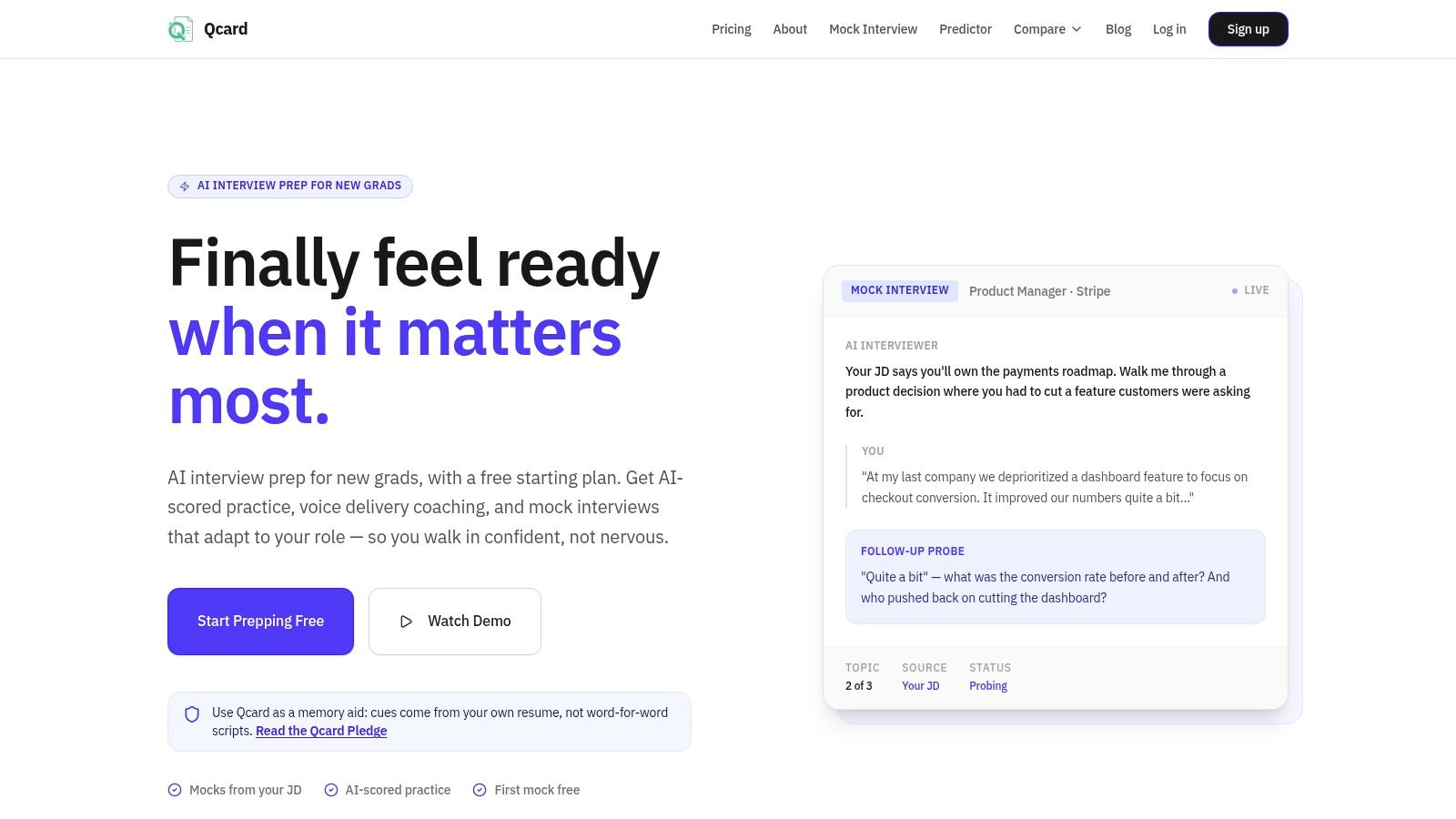
Qcard is an AI-powered interview copilot that surfaces resume-grounded talking points as concise memory cues rather than full scripts. Its Interview Coach provides live signals for pace, filler words, answer length, and depth score. Review the Qcard AI Interview Coach to turn concise speaking into a measurable practice habit.
Research on AI-supported public-speaking practice reported lower filler-word use and anxiety levels falling by 15.3% to 34.4% in a 2026 study. (Research on AI-supported public-speaking practice) Use that evidence practically: rehearse the conditions that trigger rambling, then apply the same structure in conversations with real people.
Concision is a trained response, not a personality type. Practice one answer, remove one unnecessary phrase, insert one intentional pause, and review the recording. Repeat until your structure remains available when pressure rises.
Key Takeaways
- The target is strategic reduction, not perfect fluency — a 2024 study in the Journal of Applied Behavior Analysis found 5 disfluencies per minute didn't significantly harm perceived effectiveness while 12 per minute clearly did, which means chasing zero hesitations wastes effort that belongs on structure.
- Fillers become a problem only when they replace structure — "um" can legitimately buy retrieval time, but "I just wanted to say," "kind of," and "you know" soften sentences without adding meaning, so the fix is finding your specific pattern (openings, direction changes, evidence searches, commitment avoidance) and correcting one at a time rather than policing every syllable.
- Speaking faster doesn't make you more concise — research on speech rate indicates faster speakers convey less information per word or syntactic unit, so the effective move is slowing at structural points (after the claim, the reason, and the example) rather than dragging every sentence.
- Trim phrases that announce your intention instead of stating your idea — "I just wanted to say…" becomes "My recommendation is…", "In my opinion, I think…" becomes "I recommend…", and "What I would say is…" becomes the answer itself, with a brevity study finding that shortening messages by roughly 30% to 40% increased success on average.
- Memory cues beat memorized scripts because scripts have a single point of failure — four prompts (problem, action, result, lesson) preserve structure while leaving room for natural language, which matters most for anxious and neurodivergent candidates whose rigid recall breaks down under evaluation pressure.
Qcard provides resume-grounded memory cues and live feedback on pace, filler words, answer length, and depth, helping you practice concise answers without memorizing scripts. Visit Qcard to build a pressure-ready speaking routine before your next interview.
Ready to ace your next interview?
Qcard's AI interview copilot helps you prepare with personalized practice and real-time support.
Try Qcard Free