How to Prevent AI Hallucinations: A Practical Guide

TL;DR
Preventing AI hallucinations requires layered controls rather than a single prompt fix, because a model can produce fluent text even when the underlying fact is missing or stale. Research on learning-theory limits argues hallucinations can't be fully eliminated in general-purpose LLMs, so the goal is reducing frequency and impact. Start by diagnosing the actual cause — missing knowledge, pattern-completion pressure, fluency-favoring decoding, or ambiguous instructions — since each needs a different fix. Then layer defenses: scope control, RAG grounding over a vetted corpus, structured prompts that require citations and permit refusal, conservative decoding with constrained generation for schemas, claim-level output validation, and escalation paths for high-impact cases. Structured prompting shows measurable effects (one 2025 survey reported 38.3% hallucinations for vague prompts versus 18.1% with Chain-of-Thought), and corpus quality matters enormously — a clinical study found general Google-search reference data had an odds ratio of 9.4 for hallucinations versus a domain-specific source. Finally, build a labeled evaluation set from real requests and track unsupported-claim rate, citation accuracy, and refusal precision rather than latency alone.
A support bot answers a customer's refund question in seconds. The response sounds polished, cites a policy section, and gives a confident deadline. Then someone checks the knowledge base and discovers that the policy section never existed. The bot didn't retrieve a bad document. It filled an evidence gap with plausible language.
That failure is the practical meaning of an AI hallucination. The model produces content that sounds authoritative but isn't supported by reality, a source, or the user's supplied context. For a casual brainstorming tool, that may be inconvenient. For a customer service assistant, legal workflow, medical application, financial process, or internal reporting system, it can create operational, reputational, and compliance risk.
The right question isn't only how to prevent AI hallucinations at the prompt level. It's how to design a system that narrows what the model can answer, supplies reliable evidence, detects unsupported claims, and routes uncertain cases safely. The strongest production setups treat prevention as a layered control loop, not a single instruction.
How Do You Prevent AI Hallucinations?
You prevent AI hallucinations by designing a layered system — not by writing one clever instruction. A language model is built to generate likely sequences of text, which means it can produce a fluent answer even when the requested fact is missing, ambiguous, stale, or outside its reliable knowledge. That makes hallucination a failure mode requiring containment, not a defect with a permanent patch. A 2024 analysis of hallucinations and learning-theory limits argued that hallucinations can't be eliminated entirely when large language models are used as general problem solvers, because these systems can't learn all computable functions.
The practical rule: never make the model the only component responsible for knowing whether an answer is true.
A dependable architecture combines seven defenses, each covering a different failure surface:
- Scope control — Limit the assistant to a defined domain, task, and source boundary.
- Evidence grounding — Retrieve approved documents, records, or tool results before generation.
- Prompt structure — Require explicit evidence use, clear refusal behavior, and predictable output.
- Decoding control — Reduce creative sampling when the task requires factual consistency.
- Output validation — Check citations, claims, formats, and contradictions before delivery.
- Escalation — Route uncertain or high-impact requests to a reviewer, specialist model, or deterministic tool.
- Measurement — Track failures continuously and re-test after model, prompt, retrieval, or corpus changes.
Diagnose before you fix. Most production failures trace to four causes: missing, stale, or conflicting knowledge; pressure to complete a pattern (asking for "three reasons" when the record contains one); decoding that favors fluency over evidence; and ambiguous instructions that compress uncertainty into definitive statements. A retrieval problem won't be fixed by changing temperature, and an ambiguous request won't become safe because the model has more parameters.
Define success precisely. It doesn't mean the assistant always answers or never refuses. It means the system gives supported answers when evidence exists, states when evidence is insufficient, and prevents high-risk unsupported claims from reaching users.
Why AI Hallucinations Are a Risk Problem, Not a Bug
A language model is built to generate likely sequences of text. It can produce a fluent answer even when the requested fact is missing, ambiguous, stale, or outside its reliable knowledge. That makes hallucination less like a software defect with one permanent patch and more like a failure mode that needs containment.
A foundational 2024 analysis of hallucinations and learning-theory limits argued that hallucinations can't be eliminated entirely when large language models are used as general problem solvers. The underlying reason is that these systems can't learn all computable functions. Operationally, that changes the success criterion: you're trying to reduce the frequency and impact of unsupported outputs, not promise perfect factuality from the model alone.
Practical rule: Never make the model the only component responsible for knowing whether an answer is true.
A dependable architecture usually combines several defenses:
- Scope control: Limit the assistant to a defined domain, task, and source boundary.
- Evidence grounding: Retrieve approved documents, records, or tool results before generation.
- Prompt structure: Require explicit evidence use, clear refusal behavior, and predictable output.
- Decoding control: Reduce creative sampling when the task requires factual consistency.
- Output validation: Check citations, claims, formats, and contradictions before delivery.
- Escalation: Send uncertain or high-impact requests to a reviewer, specialist model, or deterministic tool.
- Measurement: Track failures continuously and re-test after model, prompt, retrieval, or corpus changes.
A better model can reduce errors, but it won't compensate for an untrusted corpus or missing refusal path. RAG can provide evidence, but poor retrieval can surface irrelevant passages. A strict system message can discourage guessing, but it can't verify every generated claim. The controls work together because each one covers a different failure surface.
Success also needs a precise definition. It doesn't mean the assistant always answers, always sounds confident, or never refuses. It means the system gives supported answers when evidence exists, states when evidence is insufficient, and prevents high-risk unsupported claims from reaching users.
The Four Real Causes Behind Most Hallucinations
Most production failures fall into four overlapping causes. Identifying the dominant cause matters because a retrieval problem won't be fixed by changing temperature, and an ambiguous request won't become safe merely because the model has more parameters.
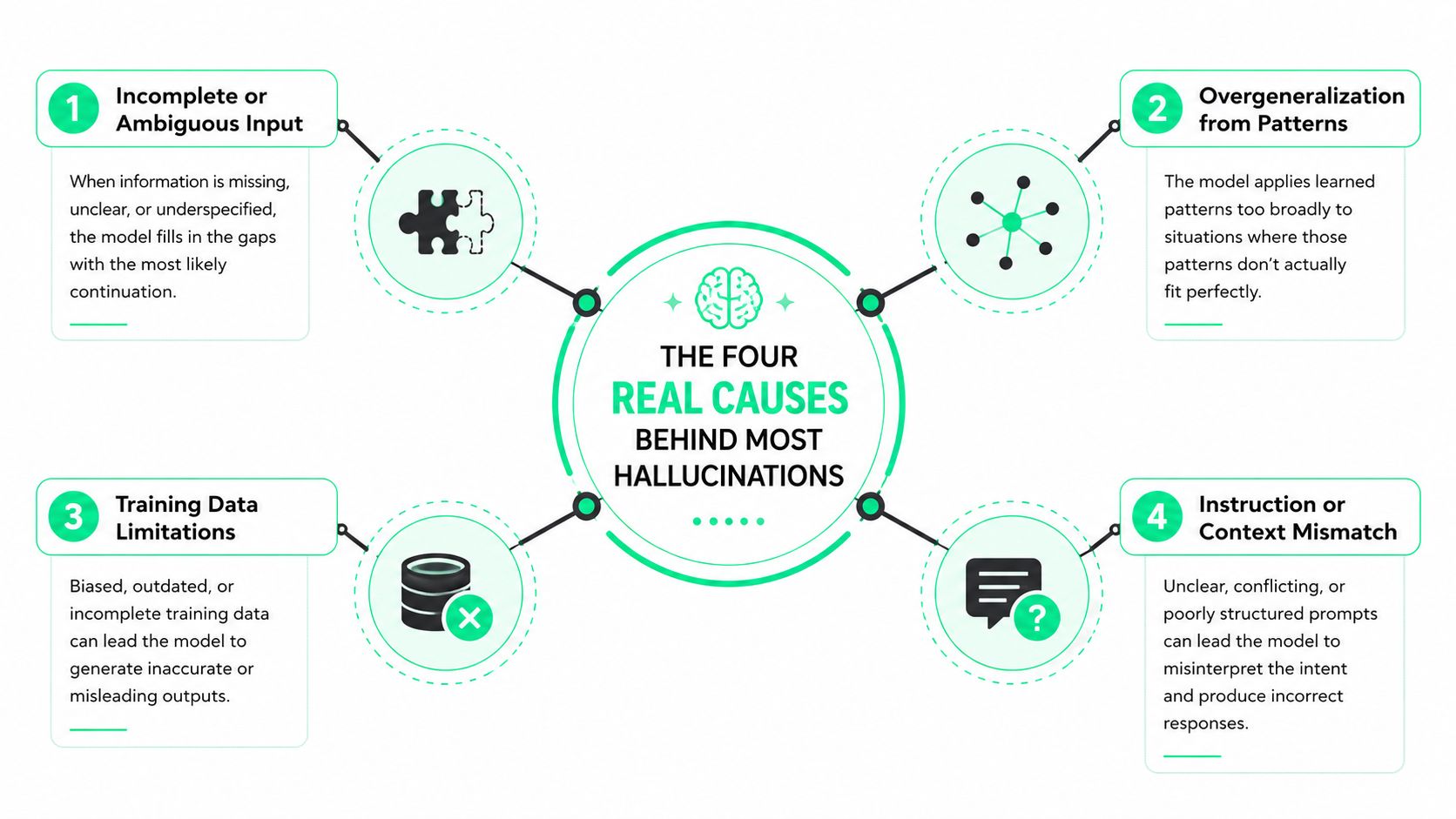
Missing, stale, or conflicting knowledge
A legal assistant asked to identify a clause may have seen many contracts during training, but that doesn't mean it has access to the current contract or the correct jurisdictional language. If the relevant material wasn't in its context, the model may assemble a clause that resembles familiar legal prose without corresponding to a real provision.
The same pattern appears in coding. A copilot asked for a method from a private library may invent a function name because the package documentation isn't available. The output looks syntactically credible, yet the method doesn't exist in the installed version.
The direct mitigation is fresh, authoritative grounding. Supply the current contract, documentation, schema, or policy rather than expecting parametric memory to contain it.
Pressure to complete the pattern
Models often receive a request that implies a complete answer. “List the three reasons this customer was rejected” pressures the system to provide three reasons even when the case record contains only one. The model fills the empty slots with plausible explanations.
This is especially dangerous when a required format contains fields the evidence doesn't support. A schema can improve consistency, but it can also encourage invented values unless the system allows null, “unknown,” or refusal states.
Decoding that favors fluency
Sampling choices influence how much variation the model can introduce. Creative settings can be useful for ideation, but they create more room for unsupported details in fact-heavy tasks. A fluent paragraph can hide a weak factual basis because language quality and evidence quality are different properties.
The direct mitigation is conservative decoding, constrained generation, and tool use for calculations or exact lookups.
Ambiguous instructions and compressed context
A request such as “summarize the meeting and explain the decision” leaves several questions unanswered. Which meeting? Which decision? Should the assistant separate confirmed decisions from open discussion? Should it infer motives?
A summarizer may compress uncertainty into a definitive statement, turning “the team discussed postponing the launch” into “the team postponed the launch.” The mitigation is to clarify scope, label uncertainty, and require the model to distinguish explicit statements from inference.
Treat each failure as a diagnosis:
- If the evidence exists but wasn't retrieved, improve indexing, chunking, filtering, or reranking.
- If evidence is absent, add refusal or clarification behavior.
- If the model misreads supplied evidence, add claim-level validation and better formatting.
- If outputs vary unnecessarily, adjust decoding or use constrained generation.
Prompt and System Message Design That Actually Reduces Errors
Prompting is the cheapest reliability layer, but it's also the easiest to overestimate. A vague request such as “Answer the customer's question accurately” gives the model no operational definition of accuracy, no source boundary, and no instruction for missing information.
A structured version is more useful:
Answer using only the policy excerpts supplied in the context. For every factual claim, include the supporting document identifier. If the context doesn't answer the question, say “I don't have enough information to answer” and ask for the missing detail. Don't infer policy terms, dates, eligibility rules, or exceptions.
That instruction creates four behaviors worth testing: source restriction, traceability, refusal, and clarification. It still doesn't prove the response is correct, but it reduces opportunities for improvisation.
Patterns that earn their place
Use prompts to make the model's job narrower and its output easier to inspect.
- Define the evidence boundary: “Use only the retrieved passages below.”
- Separate fact from inference: Require labels such as supported, uncertain, and not found.
- Require citations: Ask the model to attach a document ID or passage reference to each factual claim.
- Permit refusal: State exactly what to say when no passage supports the answer.
- Use structured output: A JSON schema can require fields for answer, evidence, and needs_review.
- Break complex work into stages: Retrieve, extract, compare, then draft. Don't ask for one opaque leap.
For example, a research assistant can first return the relevant passages and extracted claims. A second call can draft an answer only from those claims. A final validator can flag statements that lack a matching passage. The sequence makes inspection easier than asking one call to search, reason, cite, and publish.
Chain-of-Thought prompting has also shown measurable effects in evaluated settings. A 2025 survey and analysis reported hallucinations of 38.3% for vague prompts and 18.1% with Chain-of-Thought prompting in the reviewed evaluation context. The same source reported model-dependent results, with GPT-4 below 5% in evaluated samples, compared with roughly 20% to 25% for LLaMA 2 and DeepSeek.
Those figures shouldn't become a universal performance promise. Prompt behavior depends on the model, task, context, evaluator, and decoding configuration. A 2025 review on prompt-based mitigation likewise describes structured prompting as useful in prompt-sensitive scenarios while noting that intrinsic model limitations remain.
A practical system message can be adapted for support, research, or coding:
You are a domain-limited assistant. Use only supplied evidence and approved tools. Do not create citations, API methods, policy terms, figures, or names that aren't present in the evidence. For unsupported requests, state that the information is unavailable. Return the requested schema and attach evidence references to factual fields. Escalate high-impact or ambiguous cases.
Prompt design is also useful when building structured practice tools, including Qcard's interview practice experience, where the assistant's usefulness depends on keeping generated guidance tied to the candidate's supplied material. The rule remains simple: prompt for disciplined behavior, then verify the result elsewhere.
Grounding Outputs With Retrieval and Verified Sources
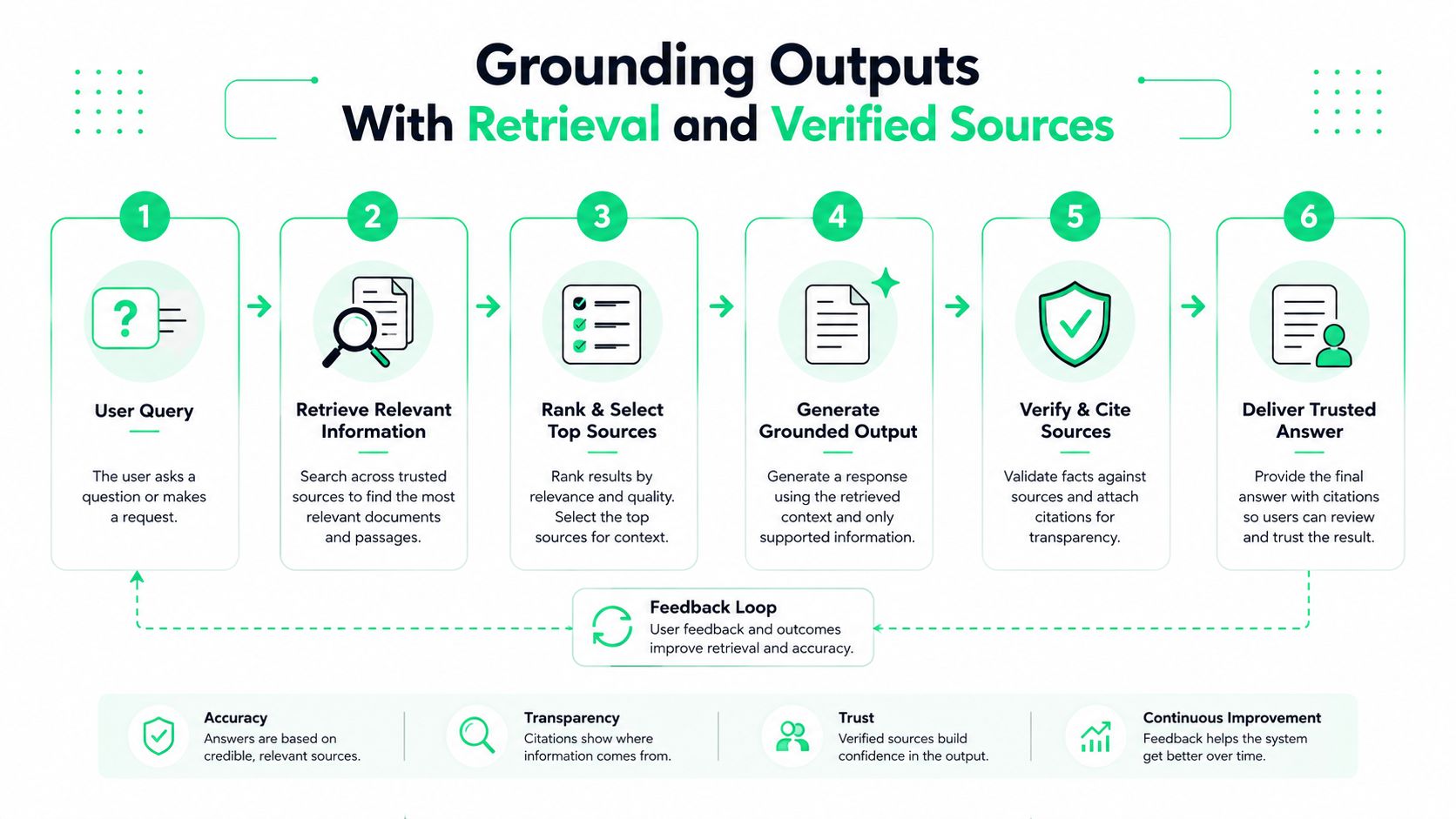
Retrieval-augmented generation, or RAG, changes the model's task from recalling an answer to composing an answer from supplied evidence. Grounding is only real when each material claim can be traced to a retrieved passage, record, or tool response that the system can identify.
A production pipeline should make that traceability explicit:
- Retrieve candidate passages from an approved corpus.
- Filter or rerank them for relevance and authority.
- Give the selected evidence to the generator.
- Require claims to stay within that evidence.
- Score groundedness or hallucination risk.
- Reject, revise, or escalate unsupported responses.
Retrieval quality determines grounding quality
A vector database doesn't automatically create reliable context. If chunks are too broad, the model may receive distracting material. If they're too narrow, it may miss definitions, exceptions, or surrounding conditions. Preserve headings, document identity, dates, access permissions, and relationships between sections so the generator can interpret passages correctly.
Use metadata filters before semantic search when the domain allows them. A support assistant might filter by product, region, policy status, and effective date. A coding assistant might filter by package version and repository. Reranking can then prioritize passages that answer the exact question rather than merely sharing vocabulary.
The corpus should be trusted by design. General web search can introduce outdated pages, scraped content, contradictory advice, and citations that look authoritative but aren't. A clinical RAG study found that cancer-specific information sources produced fewer hallucinations than general search. In that study, general Google-search-based reference data had an odds ratio of 9.4 for hallucinations versus the cancer-specific source, while a conventional non-RAG chatbot had an odds ratio of 16.1, as reported in the PubMed-indexed clinical RAG study.
The lesson isn't “add RAG.” It's use RAG over a vetted, domain-appropriate corpus and make unsupported answers fail safely. The same study reported that RAG improved the system's willingness to acknowledge missing information, which is valuable when the alternative is confident invention.
Make evidence a hard constraint
Tell the generator that retrieved text is the complete evidence boundary. Then validate the output against it. If a response says a refund applies after a specific period, the validator should locate that period in the retrieved passage, not merely confirm that the sentence sounds plausible.
The RAGTruth corpus paper describes nearly 18,000 naturally generated RAG responses annotated at both case and word level. That word-level perspective matters because a response can be mostly correct while one unsupported date, name, or qualification changes its meaning.
Common failure cases include retrieving the wrong policy version, citing a source that wasn't in context, blending two contradictory documents, and answering beyond the evidence. Add source freshness checks, document status filters, citation validation, and a refusal branch before treating a grounded answer as safe.
Decoding Settings, Fine-Tuning, and Alignment Controls
Decoding controls affect how readily a model explores alternatives. For factual support, extraction, classification, and policy responses, start with conservative sampling rather than creative variation. A lower temperature generally makes output more deterministic, while top-p limits the token distribution considered during sampling.
There isn't one universal setting that guarantees factuality. Test configurations on your own labeled prompts, and keep the model, prompt, retrieval context, and evaluator fixed while comparing them. For JSON, SQL, function calls, and other structured outputs, prefer constrained decoding or provider-supported schema enforcement where available.
A practical escalation path
Start with the least expensive intervention:
- Use low-variance decoding for fact-heavy routes.
- Use deterministic or constrained generation for schemas and tool calls.
- Route calculations to a calculator, code interpreter, or database.
- Add retrieval before changing model weights.
- Fine-tune only when repeated examples reveal a stable behavioral gap.
A model shouldn't calculate a financial result in prose if a deterministic tool can perform the arithmetic. It shouldn't invent an API method when a documentation lookup or compiler check can confirm the available interface. Tool boundaries reduce the amount of factual work delegated to free-form generation.
Fine-tuning can help when the desired behavior is consistent and the team has high-quality examples. Training examples should show supported answers, precise citations, explicit uncertainty, and clean refusals. Poor examples can teach the opposite behavior, such as filling every field, citing vaguely, or sounding confident despite missing evidence.
Preference optimization, including DPO or RLHF-style alignment, can push a model toward abstention and evidence use. It can also introduce trade-offs. A model tuned to refuse aggressively may frustrate users even when evidence is available, while a model tuned heavily for helpfulness may continue answering beyond its sources. Evaluate both unsupported-claim rate and refusal quality, not just whether the assistant responds.
The useful default is straightforward: conservative decoding, schema constraints, retrieval, and deterministic tools first. Fine-tuning becomes worthwhile when prompt and retrieval controls are stable but the model still mishandles a recurring domain pattern.
Verification Layers and Human-in-the-Loop Workflows
A generated answer can be fluent, grounded in part, and still unsafe because one clause exceeds the evidence. Verification should therefore operate at claim level where possible, not only at whole-response level.
Reference-free evaluators can help identify unsupported content. Recent benchmark work discusses tools and approaches including LLM-as-a-Judge, Prometheus, Lynx, HHEM, and TLM, while RAG hallucination detection research describes how evaluators can flag unsupported content even when it sounds coherent. The same work points to manually annotated RAG responses and lightweight fine-tuned detectors as practical options for production pipelines.
Build a pass, revise, or escalate path
A useful workflow doesn't ask a verifier for a vague confidence score and then blindly trust it. It assigns concrete outcomes:
- Pass: Every material claim has supporting evidence and the response meets format and policy checks.
- Revise: The answer contains unsupported or weakly grounded content that can be removed or rewritten.
- Escalate: The request is high impact, ambiguous, contradictory, or outside the approved domain.
Citation validation should confirm that each cited identifier exists in the retrieved corpus and supports the nearby claim. Contradiction checks should compare claims with authoritative records rather than asking another model whether the prose “feels right.”
Self-consistency can expose unstable answers by generating multiple candidate responses and comparing their claims. Agreement isn't proof, because models can repeat the same mistake, but disagreement is a useful escalation signal. Use it as one input alongside retrieval support and domain rules.
Human review works best when the reviewer receives the question, draft, evidence passages, flagged claims, and reason for escalation in one screen. Don't send a person a raw transcript and ask them to reconstruct the entire investigation. Route only the cases that need judgment, such as an unsupported legal interpretation or a customer-specific exception.
Detection research also highlights signals such as weak semantic grounding, over-reliance on shortest reasoning paths, and attention patterns that can indicate hallucination risk. A 2026 survey on hallucination mitigation frames mitigation as changes that help models produce accurate, contextually consistent responses and discusses monitoring or filtering these kinds of signals before output reaches users.
For a workflow that needs structured preparation and review around real user-provided information, Qcard's application is an example of a product route built around constrained, user-specific context. The broader engineering principle is portable: the system should expose the evidence behind an answer and make uncertainty actionable instead of hiding it behind polished prose.
Evaluation, Metrics, and Production Monitoring
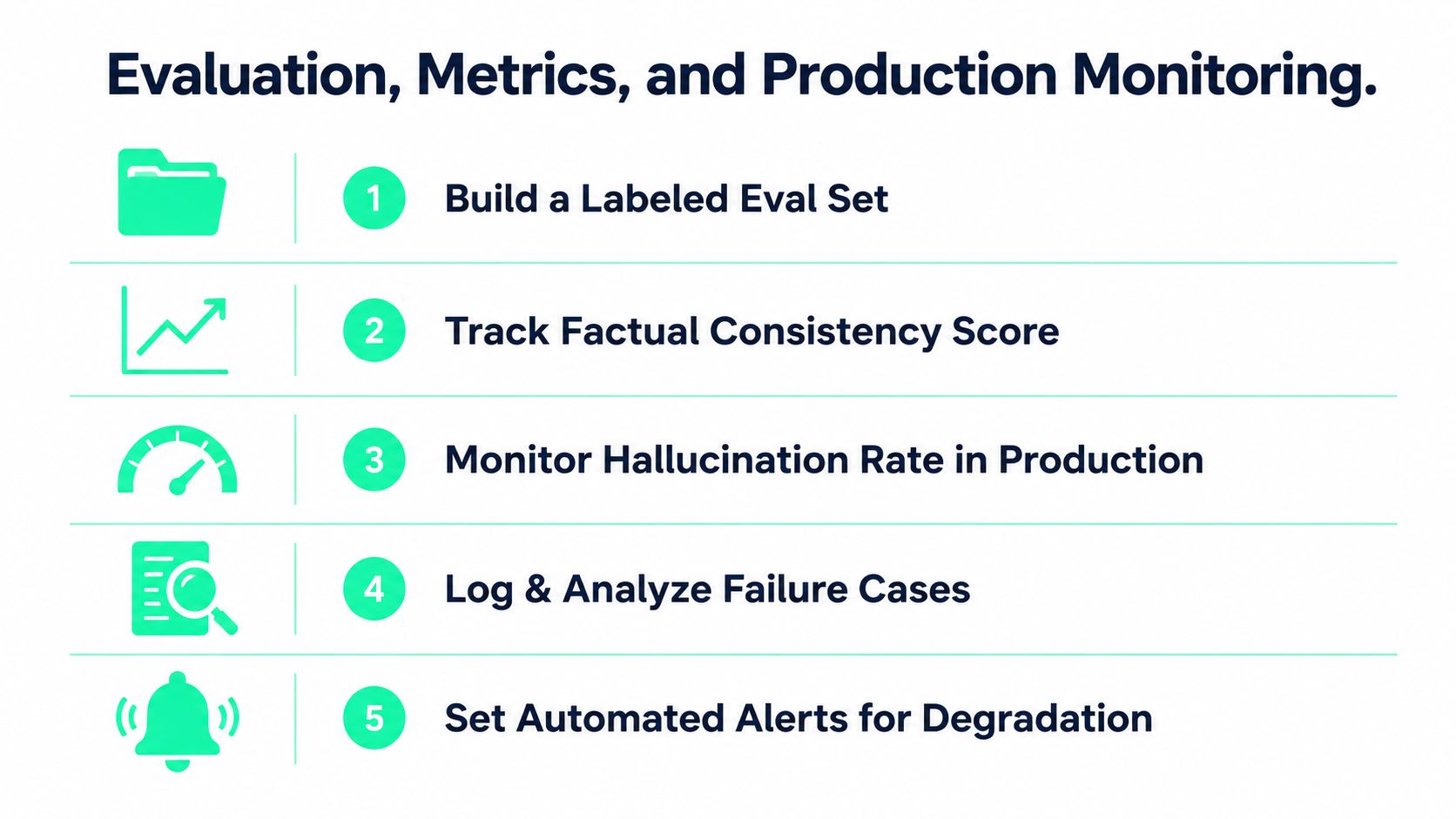
A production assistant can pass latency checks while inventing a policy exception, citing the wrong passage, or omitting a qualification that changes the decision. Prevention starts with a labeled evaluation set built from real requests, not a dashboard of traffic and response time.
Include supported questions, unanswerable questions, ambiguous requests, conflicting-document cases, and adversarial wording. Label the expected answer, acceptable refusal, supporting evidence, and high-risk claims. This set becomes the baseline for every later comparison.
Track metrics tied to user harm:
- Unsupported-claim rate: How often does the response assert something the evidence does not support?
- Citation accuracy: Does each citation exist and justify its associated claim?
- Refusal precision: Does the assistant refuse when evidence is missing without refusing supported questions?
- Response-level failure rate: How often does a response contain any material hallucination?
- Word-level failure rate: Which terms, dates, names, or qualifiers fail grounding checks?
Response-level scores show the size of the problem. Word-level labels help locate the faulty claim, so engineers can distinguish a retrieval miss from a single unsupported qualifier. The RAGTruth work cited earlier is useful for this granularity; do not treat every sentence in a partially correct answer as equally wrong.
Use concrete change triggers for regression testing. Re-run the suite after an embedding-model upgrade, after adding a new source-document type, or after changing the reranker. Compare unsupported-claim rate and refusal precision with the last known-good version. Log the question, retrieved passages, generated answer, validator results, route decision, and final user outcome. Redact sensitive content while retaining enough context to reproduce the failure.
Set operational limits before rollout. If unsupported claims exceed the tolerance approved for the use case, pause deployment, send more traffic to the prior version, or disable the affected capability. A customer-support assistant and a system handling regulated decisions should not share the same threshold.
The production loop is short:
- Collect samples and reviewer labels.
- Compare current metrics with the last known-good version.
- Group failures by retrieval miss, stale source, ambiguity, or generation drift.
- Fix the narrowest responsible layer.
- Re-run the labeled suite and selected production cases.
- Deploy gradually with degradation alerts.
Key Takeaways
- Hallucination is a containment problem, not a bug with a permanent patch — a 2024 learning-theory analysis argued hallucinations can't be eliminated entirely in general-purpose LLMs, which shifts the success criterion from "guarantee factuality" to "reduce frequency and impact through layered controls," and means the model should never be the only component responsible for knowing whether an answer is true.
- Diagnosing the dominant cause matters more than applying every fix at once — missing evidence needs fresh authoritative grounding, pattern-completion pressure needs null and "unknown" states in your schema, fluency-favoring decoding needs conservative sampling and tool use, and ambiguous instructions need explicit scope plus labels separating supported claims from inference.
- Retrieval quality determines grounding quality, and corpus trust is the biggest lever — a clinical RAG study found general Google-search-based reference data carried an odds ratio of 9.4 for hallucinations versus a cancer-specific source (and 16.1 for a conventional non-RAG chatbot), which means the lesson is not "add RAG" but "use RAG over a vetted, domain-appropriate corpus and make unsupported answers fail safely."
- Structured prompting is the cheapest reliability layer but the easiest to overestimate — one 2025 survey reported 38.3% hallucinations for vague prompts versus 18.1% with Chain-of-Thought prompting, yet the same research notes intrinsic model limitations remain, so prompts should define the evidence boundary, require citations, permit explicit refusal, and break complex work into retrieve-extract-compare-draft stages that are easier to inspect.
- Verification should operate at claim level, not response level — a response can be mostly correct while one unsupported date, name, or qualifier changes its meaning, which is why the RAGTruth corpus annotates nearly 18,000 RAG responses at both case and word level, and why production workflows need concrete pass/revise/escalate outcomes with citation validation rather than a vague confidence score you blindly trust.
For further guidance on grounded, user-specific assistance, review Qcard's AI and interview resources. Qcard also offers resume-grounded interview support that maps questions to a candidate's verified experience, with practice, feedback, and real-time coaching features. This provides a concrete example of constraining generation to user-specific evidence rather than producing unrestricted scripts.
Ready to ace your next interview?
Qcard's AI interview copilot helps you prepare with personalized practice and real-time support.
Try Qcard Free