How to Prepare for an Interview for a Job in 2026
TL;DR
Preparing for a job interview means building a repeatable system, not memorizing perfect answers — because a memorized script stops fitting the moment an interviewer rephrases the question. Start with a self-audit to identify your single biggest failure point (memory, structure, pacing, role fit, or pressure). Read the job description as a scoring guide, mark repeated verbs, and build a one-page competency sheet. Convert your resume into 6 to 10 flexible STAR stories weighted toward Action (MIT suggests 20/10/60/10), each tagged by trait and reduced to a short cue line. Then practice on a rehearsal ladder: cue words aloud, recorded without notes, follow-up interruptions from a partner, and a final rep in the exact format you'll face. Keep a pressure toolkit — a single cue page, deliberate pause phrases, and a plain recovery line. Make interview day boring by settling logistics the night before. Afterward, send a specific thank-you within 24 hours and run a fifteen-minute debrief: keep, repair, add. Each interview makes the next one cheaper to prepare for.
You're three minutes into the interview when the question arrives: “Tell me about a time you handled failure.” You know the answer. You lived it, solved part of it, and learned from it. Yet your mind goes blank, your sentences get longer, and you leave the call wishing you'd sounded like the capable person on your resume.
That experience doesn't mean you're unqualified. It usually means your preparation focused on collecting answers instead of building a system you can use under pressure. Learning how to prepare for an interview for a job means creating researched talking points, flexible stories, realistic rehearsal conditions, and simple cues that keep your memory working when nerves interfere.
How Do You Prepare for an Interview for a Job?
Most preparation fails because it collects answers instead of building a system you can use under pressure. Candidates search for "best answers," memorize polished scripts, and then improvise from panic the moment an interviewer phrases a question slightly differently. Effective preparation means researched talking points, flexible stories, realistic rehearsal, and cues that keep your memory working when nerves interfere.
Step 1 — Run a blunt self-audit. Identify the failure point costing you most: memory (you know your examples but lose access to them), structure (details without a clear beginning, middle, and result), pacing (rushing or over-explaining), role fit (can't connect experience to this job), or pressure (can't answer when interrupted). Pick one weakness. Don't fix everything at once.
Step 2 — Read the job description as a scoring guide. Mark repeated verbs — coordinate, analyze, prioritize, troubleshoot, influence — and turn them into a competency map. A bullet like "comfortable working cross-functionally" points to specific likely questions. Build a one-page sheet with the role's responsibilities, implied competencies, what the company does, two reasons the role interests you, three experience prompts, and two questions to ask.
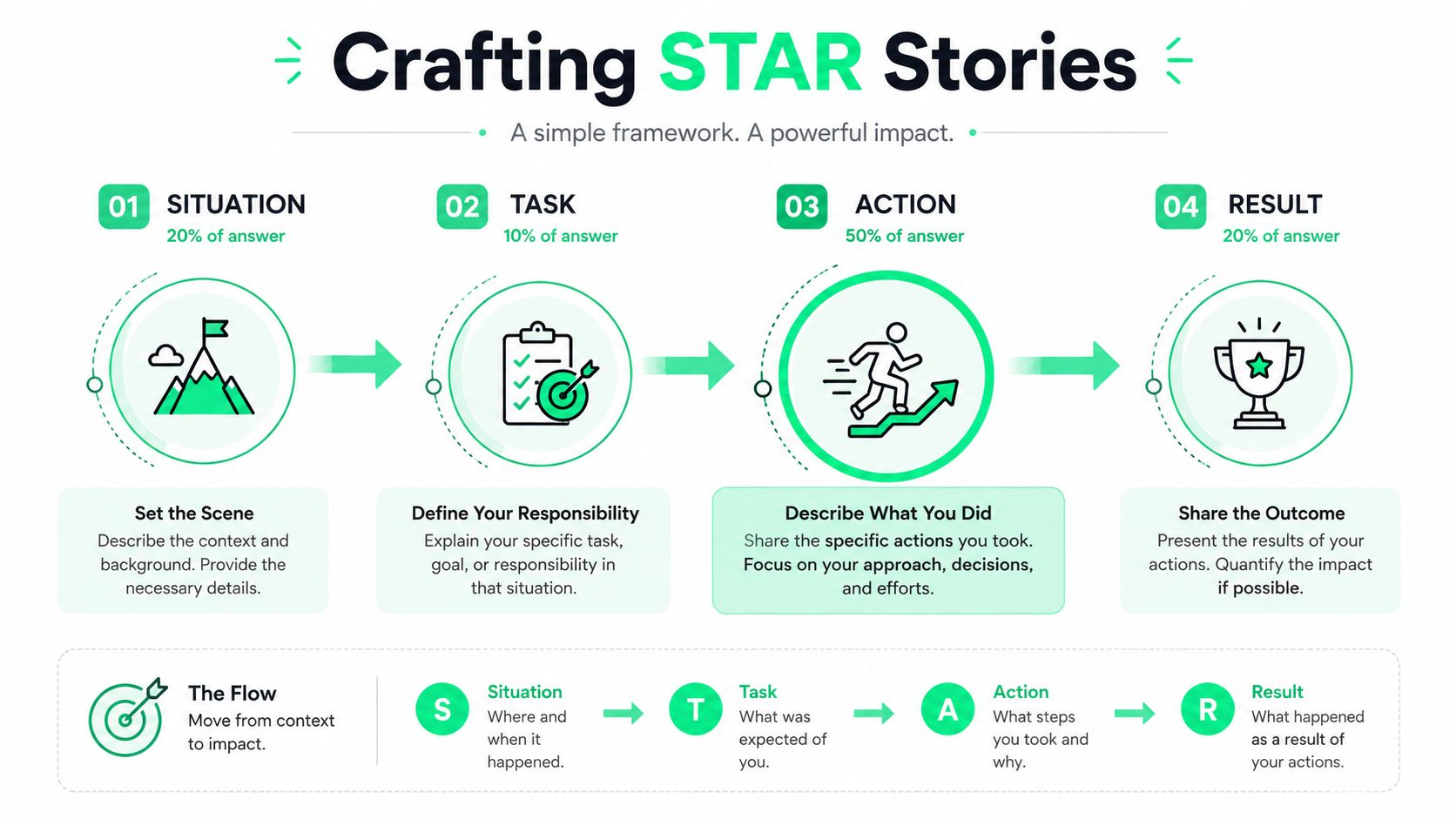
Step 3 — Turn your resume into 6 to 10 STAR stories. MIT's guidance suggests roughly 20% Situation, 10% Task, 60% Action, 10% Result. Tag each story by trait (leadership, problem-solving, teamwork, communication, adaptability) and write a short cue line — "late project integration" or "customer complaint resolved" — instead of a script. Pull from internships, class projects, volunteering, freelance work, and family responsibilities.
Step 4 — Practice on a rehearsal ladder. Reading at your desk trains recognition, not retrieval. Speak from cue words, record yourself without notes, then have someone interrupt with follow-ups ("What did you personally do?"). Finish by copying the actual format — same platform, camera position, lighting.
Step 5 — Build a pressure toolkit. Keep one page beside your screen with story titles, competency tags, metrics, and questions. Prepare deliberate pauses: "That's a good question, let me think for a second." If you lose the thread, recover plainly and continue — don't restart.
Why Interview Prep Feels Harder Than It Should
Anxious candidates often prepare in the least useful order. They search for “best answers,” copy polished scripts, and read them until the wording feels familiar. Then an interviewer asks a slightly different question, the memorized sentence no longer fits, and the candidate starts improvising from panic.
“Just be confident” doesn't solve that problem. Confidence usually follows evidence, repetition, and a clear recovery plan. Interviewers also don't need theatrical polish. They need to understand what you did, why you did it, and what happened afterward.
The selection funnel makes casual preparation a poor strategy. Only about 4 to 6 candidates out of roughly 250 resumes typically reach the interview stage for a single opening, and applicants average about one interview invitation for every six applications, according to reported interview-selection benchmarks. Those figures are a reminder that reaching the conversation is valuable, but it also means you may need a repeatable preparation process rather than a fresh cram session for every opportunity.
Start with a blunt self-audit
Before doing more research, identify the failure point that costs you the most:
- Memory: Do you know your examples but lose access to them when someone asks an open-ended question?
- Structure: Do your answers contain useful details but lack a clear beginning, middle, and result?
- Pacing: Do you rush, over-explain, or stop before giving enough evidence?
- Role fit: Can you explain why your experience matches this particular job?
- Pressure: Can you answer aloud when someone interrupts, follows up, or stays silent?
Choose one primary weakness. Don't try to fix everything at once. Your preparation should reduce the specific cognitive load that causes you to freeze, not give you more material to memorize.
Practical rule: Prepare prompts, not scripts. A short cue such as “missed deadline, owned it, reset workflow, delivered recovery” is easier to use naturally than a paragraph you must reproduce perfectly.
Researching the Company and the Role
Research should produce usable interview material, not a folder full of copied webpages. Set aside a focused evening and work in two passes: understand what the role demands, then gather enough company context to connect your experience to those demands.
Read the job description as a scoring guide
Start with the responsibilities and required skills. Mark repeated verbs and behaviors such as coordinate, analyze, prioritize, present, troubleshoot, influence, or improve. Turn those words into a competency map.
For example, a bullet that says “comfortable working cross-functionally” probably points to questions such as:
- “Tell me about a time you worked with people from another team.”
- “How did you handle conflicting priorities?”
- “What did you do when a stakeholder disagreed with your approach?”
Your research note shouldn't say only “I'm a team player.” Write something usable: “Cross-functional example, student event project, marketing wanted speed, operations needed approval, created shared checklist, avoided last-minute changes.” That note gives you a direction without forcing a fixed speech.
Aim to identify the competencies that appear most important, then attach at least one experience or question to each. You're looking for the employer's likely evaluation criteria, not every possible interview question.
Gather targeted company context
Review the company's product or service, mission, recent announcements, customers, and the team connected to the role. If the interviewer's name is available, learn their function and professional background, but don't turn this into surveillance or an exhaustive research project.
Your one-page preparation sheet should contain:
- The role's central responsibilities.
- The competencies implied by the description.
- A short explanation of what the company does.
- Two reasons the role interests you.
- Three experience prompts linked to the job.
- Two questions you'll ask at the end.
Good questions reveal how the job works. Ask, “What would you want the person in this role to improve first?” or “Which team relationships matter most for success here?” Avoid questions answered clearly on the company's homepage.
71% of candidates research the company before an interview, 44% practice common questions, and candidates typically spend 5 to 10 hours preparing, while 90% of hiring managers believe interview preparation is a key factor in candidate success, according to interview-preparation survey reporting. Use that as a practical standard: research the employer, rehearse likely questions, and spend your time producing notes you can use.
Turning Your Resume Into STAR Stories
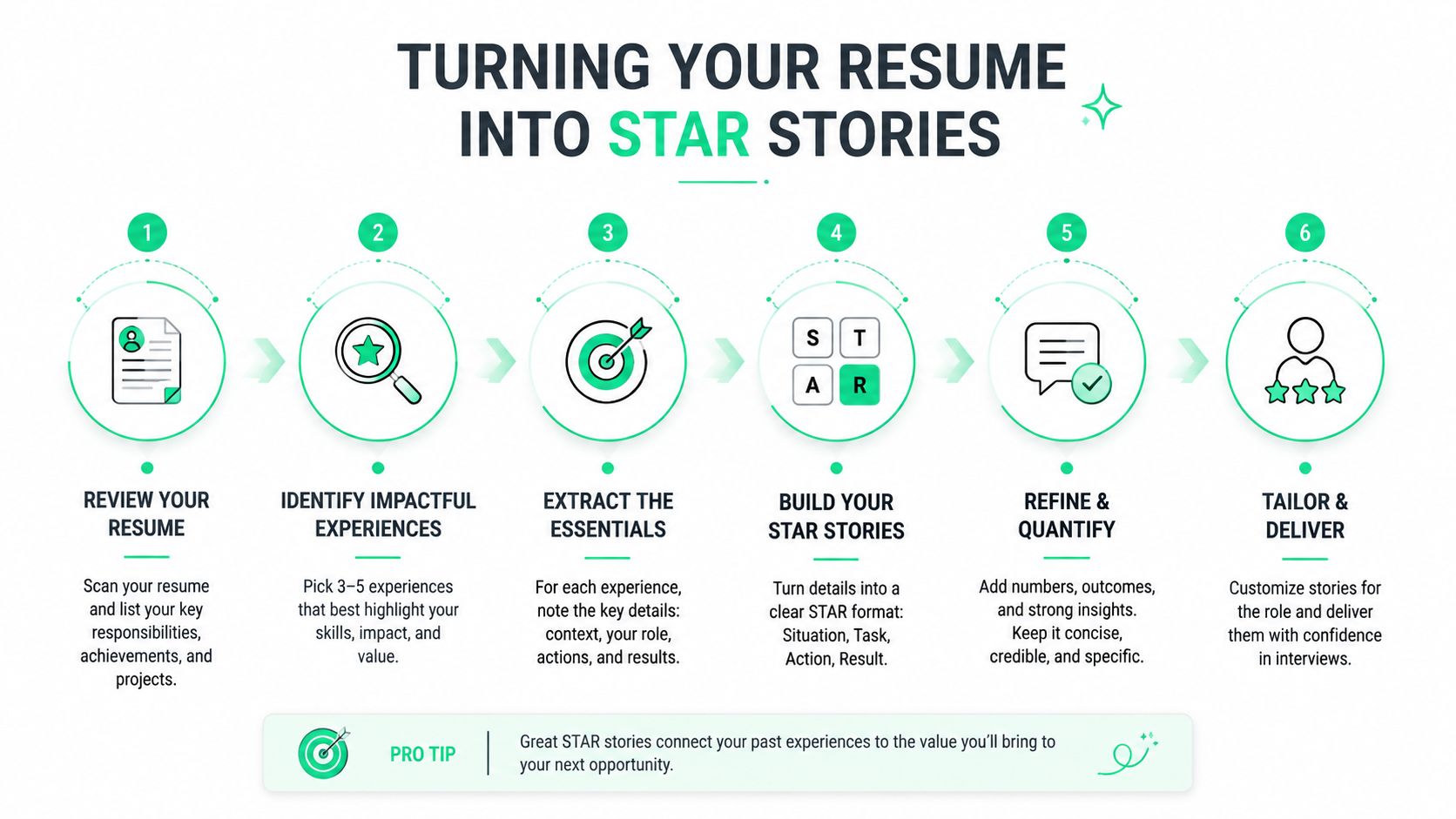
Your resume makes claims. Interview answers need proof. Build that proof before the interview by turning your strongest experiences into flexible STAR stories. This system also helps when memory blanks or speaking in a second language make spontaneous answers harder.
STAR means Situation, Task, Action, and Result. Keep the setup short, then give most of your time to your decisions, actions, and judgment. A useful structure is 20% Situation, 10% Task, 60% Action, and 10% Result, as outlined in MIT's STAR-method guidance. Use the proportions as a guide, not a script.
Build the story bank before matching questions
Pull examples from internships, part-time work, class projects, volunteering, family responsibilities, freelance work, and side projects. Early-career candidates often dismiss unpaid or academic experience. Don't. Interviewers assess behavior, judgment, ownership, and learning, not only job titles.
Create 6 to 10 core stories, then tag each one by the trait it demonstrates:
- Leadership: You organized people, made a decision, or took ownership.
- Problem-solving: You diagnosed an issue and chose a workable response.
- Teamwork: You handled disagreement, coordination, or shared accountability.
- Communication: You clarified a complex point for a person or group.
- Adaptability: You changed your approach when circumstances shifted.
Add concrete outcomes wherever you can. An outcome could be a completed deliverable, a resolved conflict, an easier process, positive feedback, or a lesson that changed your next decision. Without a formal metric, describe what someone could observe. “The team submitted the work on time” is stronger than “The project went well.”
Six to ten stories give you enough breadth to match common behavioral prompts without memorizing complete scripts. Prepare a short cue line for each story, such as “late project integration” or “customer complaint resolved.” Those prompts support retrieval while leaving room to speak naturally.
Work through a failure answer
Question: “Tell me about a time you failed.”
Situation: “During a class project, I agreed to combine everyone's research into one presentation. I underestimated the editing time and waited too long to reconcile different formats.”
Task: “I was responsible for producing the final deck and making sure the group could present a consistent argument.”
Action: “When I saw the problem, I told the group what had gone wrong instead of trying to fix everything alone. I separated essential content from optional material, assigned owners to the missing sections, and created a shared outline with a firm review point. For later projects, I scheduled an early integration pass before the final deadline.”
Result: “We delivered the presentation on time, but the first draft was weaker than it should have been. I learned that coordination belongs in the work from the start, not only in final editing.”
That answer works because it shows ownership without hiding the failure. It gives the interviewer a specific response and a behavior change. Rehearse the sequence with short prompts, then say it in your own words. For more resume-grounded practice, use these resume interview questions to identify prompts that connect with your experience.
Practicing Under Real Interview Pressure
Reading answers at your desk is not interview practice. It trains recognition, not retrieval. In a real conversation, you must listen, choose an example, organize it, speak clearly, and respond to follow-up questions while your body is signaling danger.
Open-ended prompts deserve special attention because they give your anxious brain too many possible directions. Drill “Tell me about yourself,” “What is your greatest weakness?”, and “Tell me about a time you failed.” Don't polish them without speaking. Say them aloud.
Use a rehearsal ladder
Start with low pressure. Speak from your cue words while looking at the wall, then record yourself answering without notes. Listen for the point where you start explaining background instead of your actions.
Next, ask a friend to interrupt with follow-ups such as “What did you personally do?” or “What would you change?” If friends make you more self-conscious, use a mock-interview tool that can generate follow-up questions and give delivery feedback. A tool such as Qcard's AI mock interview can support role-specific practice without requiring you to perform in front of another person immediately.
Finish by copying the actual format. For a video interview, use the same platform, camera position, lighting, background, and headphones. For a panel, practice looking at the person who asked the question, then including the others as you answer. For a technical or case interview, rehearse explaining your reasoning aloud rather than only reaching the right conclusion.
Measure sharpness, not performance theater
After each rehearsal, note:
- Did you answer the actual question?
- Did you name your personal actions?
- Did the result appear clearly?
- Did you give enough detail without narrating every event?
- Could you find the story again from one short cue?
Your answer should sound conversational, not recited. If you lose your place, don't restart from the beginning. Pause, state the next useful point, and continue. That recovery is part of the skill you're building.
Managing Anxiety, Brain Fog, and Cognitive Load
Some candidates don't need more confidence. They need fewer things to hold in working memory at once.
This matters for neurodivergent candidates, international students speaking in a second language, early-career applicants, and anyone whose thoughts become inaccessible under evaluation. Independent research indicates that social anxiety can harm participation more than actual performance in evaluative interviews, so a candidate may speak less even when they understand the work; research on interview participation and anxiety also supports using practice with feedback to reduce anxiety.
Build a pressure toolkit
Prepare a single page, not a script. Put story titles, competency tags, key metrics, and two questions at the bottom. For the failure story above, the cue might read: “Group presentation, delayed integration, owned gap, shared outline, delivered on time, changed planning.”
Keep the page beside your screen for a virtual interview, or ask whether you may bring brief notes for an in-person conversation. Most interviewers won't object to a small notebook used for reminders, especially if you continue making eye contact and engaging naturally.
Use deliberate pauses. Try these phrases:
- “That's a good question. Let me think for a second.”
- “I have an example that fits. I'll start with the context.”
- “I want to make sure I answer the part about my role.”
- “Could you repeat the last part of the question?”
These aren't signs of weakness. They give your brain time to retrieve information and show the interviewer that you care about answering accurately.
Reduce speed before reducing content
Rushed speech often creates a second problem: you hear yourself rambling, become more anxious, and rush further. Put both feet on the floor, exhale before answering, and use a sentence that announces your structure: “I'll give you the situation, what I did, and the outcome.”
If you lose the thread, recover plainly: “I'm going to restart that more clearly.” Then give the action and result. You don't need to apologize repeatedly or disclose every symptom of anxiety.
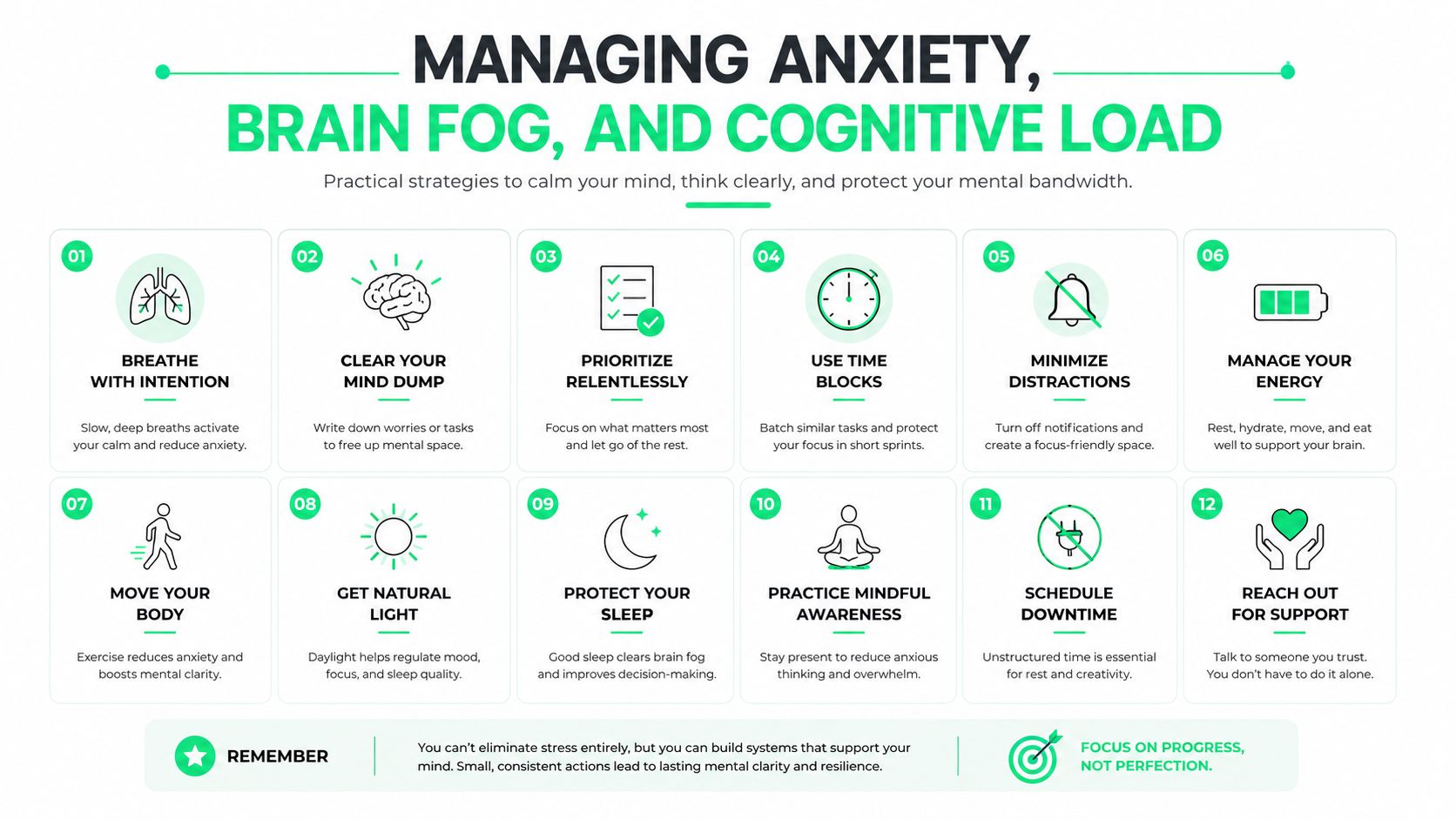
Before the call, remove avoidable choices. Put water within reach, close unrelated tabs, silence notifications, and place your resume and cue card where you can find them instantly. The aim isn't to eliminate anxiety. It's to stop anxiety from using all your attention.
Your Interview Day Checklist
Interview day should be boring. Boring is good. Every logistical decision you settle beforehand leaves more mental capacity for listening and answering.
The night before
Confirm the interview time, format, interviewer names, location, route, or meeting link. For a virtual interview, open the platform, verify your camera and microphone, check your lighting, and make sure the background is clean and distraction-free. Keep a backup phone number or contact method available in case the connection fails.
Lay out clothing that fits the setting and feels comfortable. Print extra resume copies for an in-person meeting, prepare a notebook and pen, and place water where you can reach it without interrupting the conversation. Put your one-page cue sheet with those materials.
The morning running order
Use this sequence:
- Confirm the essentials: Recheck the link, address, interviewer name, and contact details.
- Remove friction: Charge your devices, close unnecessary applications, and silence notifications.
- Review lightly: Read your role competencies, story titles, and questions. Don't attempt to learn new answers.
- Settle your body: Eat something familiar, drink water, and take a short walk or stretch.
- Arrive ready: For an in-person interview, plan your route and arrive with enough time to handle reception and unexpected delays. For a video interview, sit down before the scheduled start and test the setup again.
- Keep essentials visible: Resume, notebook, water, cue card, and contact information should be easy to reach.
The first five minutes
Before joining or walking in, relax your shoulders and place both feet on the floor. Read only three prompts: your professional headline, your strongest role-related story, and the question you most want to ask them.
When the interview starts, listen fully before answering. If the opening question is “Tell me about yourself,” give a concise professional path: where you are now, what experience connects you to the role, and what you want to contribute next. Don't begin with your entire life story.
If technology fails, stay practical. Rejoin the call, use the backup contact method, and say, “I'm having a connection issue, but I'm working on it now.” A calm recovery communicates useful information about how you handle disruption.
Following Up After the Interview
The interview isn't finished when the call ends. While the conversation is fresh, write down the questions you answered well, the ones that caused trouble, the interviewer's names, the team's priorities, and any details you promised to send. This turns one interview into preparation material for the next one.
Send a specific thank-you message
Send a brief note within 24 hours, and make it personal to the conversation. Don't write a generic paragraph about being grateful for the opportunity. Mention one point they raised, connect it to your experience, and reinforce your interest.
Use this structure:
Subject: Thank you for the [role] conversation
Hi [name],
Thank you for discussing the [role] position. I especially appreciated learning about [specific project, challenge, or team priority]. My experience with [relevant example] would help me contribute to that work, particularly by [specific contribution].
Please let me know if I can provide any additional information. I'm interested in the opportunity and enjoyed speaking with you.
Best,
[your name]
You can use Qcard's interview thank-you email resource to help turn your notes into a focused message, then edit it so the final email sounds like you.
Handle the waiting period deliberately
If the interviewer gave you a decision timeline, wait until that timeline has passed before checking in. Then send a short note:
“Hi [name], I'm checking in on the [role] process. You mentioned [timeline], and I remain interested after learning more about [specific topic]. Please let me know if there's any further information I can provide.”
Don't send daily messages. Keep applying elsewhere while you wait, because one interview outcome shouldn't control your entire search.
Run a fifteen-minute debrief
Write three notes:
- Keep: The answer or story that landed clearly.
- Repair: The question where you rambled, froze, or lacked evidence.
- Add: The new cue, metric, or story detail you'll prepare next.
Then update your story bank. If you struggled to explain a group project, add a clearer Action section. If “greatest weakness” made you freeze, create a short answer that names a real development area and the behavior you're using to improve it.
Your weekly rhythm is simple: research the role, select relevant stories, rehearse aloud under increasing pressure, use your cognitive-load toolkit, complete the logistics checklist, and debrief afterward. Each interview makes the next one cheaper to prepare for because your stories, cues, and recovery phrases improve instead of disappearing with the application.
The most important takeaway: Don't memorize perfect answers. Build a small bank of true stories, practice retrieving them under pressure, and give yourself simple cues that let you speak naturally.
Build your first three STAR stories tonight, using one example from work or study, one teamwork example, and one setback or mistake. Say each story aloud from brief prompts, then save the improved cues for your next application.
Key Takeaways
- Prepare prompts, not scripts — a cue like "missed deadline, owned it, reset workflow, delivered recovery" is easier to use naturally than a paragraph you have to reproduce perfectly, and it survives the moment an interviewer asks a slightly different version of the question you rehearsed.
- Self-auditing your dominant failure point beats adding more material — memory, structure, pacing, role fit, and pressure are five different problems with five different fixes, and trying to solve all of them at once increases the cognitive load that causes freezing in the first place.
- Reading answers at your desk trains recognition, not retrieval — a real interview requires listening, selecting an example, organizing it, speaking clearly, and handling follow-ups simultaneously, which is why the rehearsal ladder (cue words aloud → recorded without notes → partner interruptions → exact format) is what actually builds the skill.
- Six to ten tagged STAR stories cover most behavioral prompts without memorization — pull from internships, class projects, volunteering, and freelance work rather than dismissing unpaid or academic experience, and add observable outcomes ("the team submitted the work on time") when you don't have a formal metric.
- Deliberate pauses and plain recovery lines are skills, not weaknesses — "Let me think for a second," "Could you repeat the last part?", and "I'm going to restart that more clearly" give your brain retrieval time and signal that you care about answering accurately, which matters most for neurodivergent candidates, second-language speakers, and anyone whose thoughts become inaccessible under evaluation.
Qcard offers resume-grounded talking points, mock interviews, AI-scored practice, and delivery coaching for candidates who need support with memory, pacing, and answer length without relying on scripts. Visit Qcard to practice realistic interview questions and keep your preparation tied to your real experience.
Ready to ace your next interview?
Qcard's AI interview copilot helps you prepare with personalized practice and real-time support.
Try Qcard Free