How to Prepare for a Job Interview: A Practical Guide
TL;DR
Preparing for a job interview means building a staged rehearsal workflow rather than memorizing polished answers — because over-scripted responses break the moment an interviewer changes the wording, and reading notes trains your eyes rather than your speaking ability. Decode the job description into three competency buckets using repeated verbs, then write one talking point per bucket. Convert resume bullets into flexible STAR stories with verified metrics, targeting 90 seconds per answer. Run a five-part mock loop three times across a week: prep window, live simulation, immediate scoring on structure and specificity and pacing, a ten-minute debrief with one concrete fix, and a re-recorded second attempt. Treat anxiety as a familiarity problem — research shows preparation satisfaction improves self-efficacy and reduces interview anxiety, and advance access to questions reduced anticipatory anxiety in a study of 1,219 participants. Handle logistics the day before, use a one-page cue sheet, and send a specific thank-you within four hours. Follow a two-week calendar, and adapt it for ADHD (timed sprints), autistic candidates (request format details), and non-native speakers (pre-load transitions, not scripts).
You've got the interview invite. Your resume already proves you can do the work, but that doesn't guarantee you'll explain it clearly when someone asks, “Tell me about a difficult project.” Many qualified candidates prepare by rereading notes, memorizing polished answers, and hoping confidence appears on the day. It usually doesn't.
The better approach is to treat preparation as a staged rehearsal workflow. You research the role, extract evidence from your experience, practice retrieving it under pressure, simulate the format, and refine your delivery. Anxiety often falls as a byproduct because the interview stops feeling unfamiliar.
How Do You Prepare for a Job Interview?
Treat preparation as a staged rehearsal workflow, not a reading exercise. Most routines fail because candidates rehearse answers instead of delivery — reading a list of common questions improves recognition, but it doesn't guarantee you'll retrieve the right example, organize it quickly, and speak naturally while someone evaluates you. A 2025 survey of more than 10,000 respondents found only 32% of job seekers felt adequately prepared, and roughly a quarter spent under an hour preparing.
Step 1 — Decode the role, don't collect facts. Read the job description like a hiring manager. Separate must-haves from nice-to-haves, then cluster repeated verbs (build, scale, lead, analyze, partner, own) into three competency buckets. Write one talking point per bucket that connects your past work to the employer's likely concern. Your research is complete when you can explain why your strongest three stories matter to this employer.
Step 2 — Convert resume bullets into STAR stories. A bullet like "Led a migration project" is a starting point, not a conclusion. Ask what constraint made it difficult, what you personally owned, what you did that wasn't routine, what changed, and which verified metric proves it. Target roughly 90 seconds per answer, built from a headline, four STAR cues, and one likely follow-up.
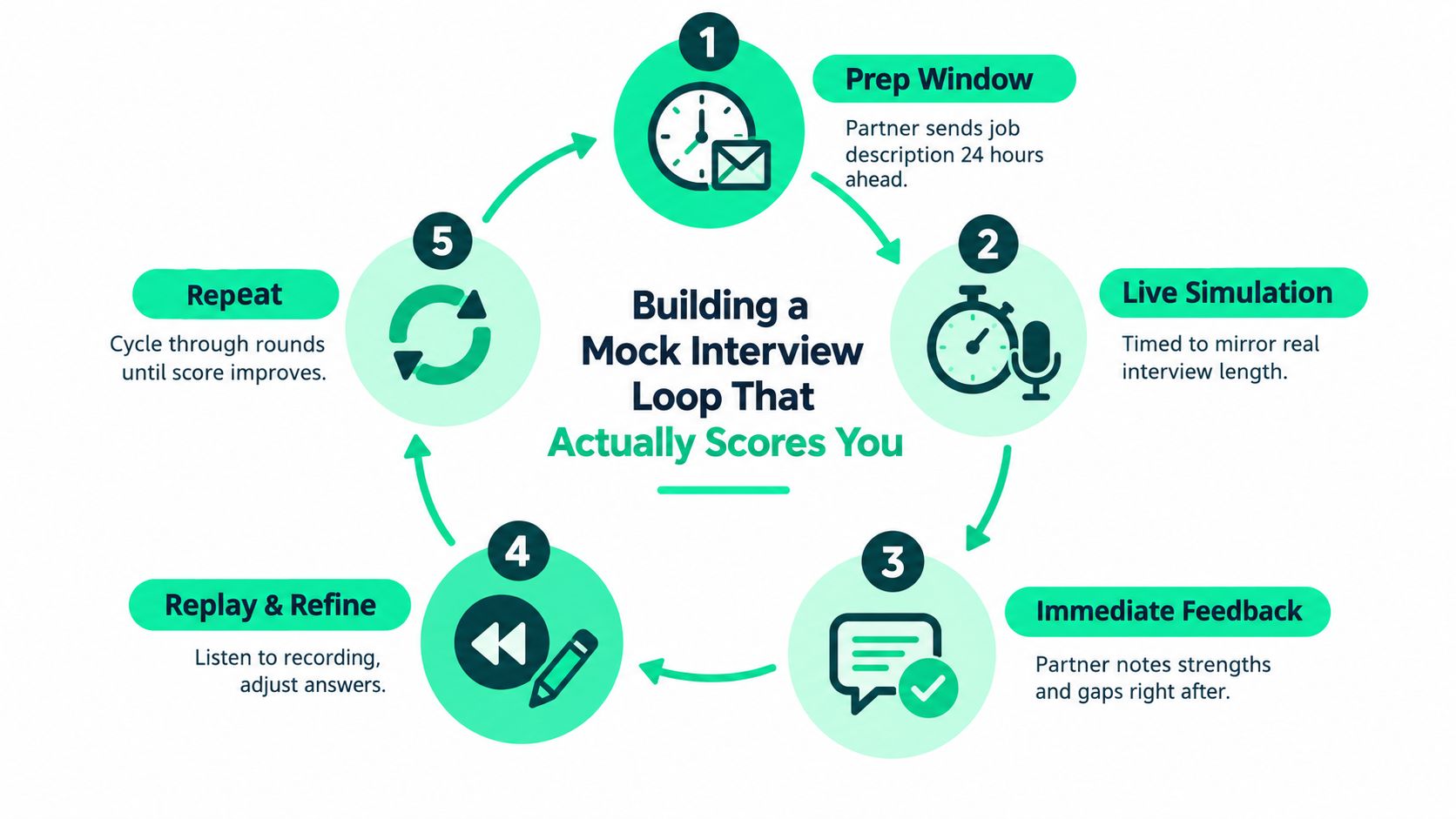
Step 3 — Run a scored mock loop. Use a five-part cycle: send the job description 24 hours ahead, run a live simulation matching the real format, score answer structure, specificity, pacing, and coachability with notes tied to exact moments, hold a ten-minute debrief naming two strengths and one concrete fix, then re-record the same answer immediately. Run it three times across a week rather than cramming ten rounds in one night.
Step 4 — Treat anxiety as a rehearsal problem. A meta-analysis found a negative relationship between interview anxiety and performance (about -0.19), and 92% of U.S. adults report interview anxiety — so nerves aren't evidence you're unqualified. Use a 90-second breathing reset, a practiced opening sentence, a deliberate pause before behavioral answers, and a stable posture anchor.
Step 5 — Close the loop. Prepare logistics the day before, use a one-page cue sheet with three STAR headlines, and send a specific thank-you within four hours.
Why Most Interview Prep Fails Before You Walk In
A senior candidate once entered an interview with eight years of strong results behind her. She knew every detail of a major project on her resume. When the interviewer asked her to describe it, she froze, gave scattered background, and never reached the decision she had made or the result she had delivered.
Her problem wasn't a lack of experience. She had rehearsed answers instead of delivery.
That distinction explains why many preparation routines feel productive but fail in the room. Reading a list of common questions can improve recognition. It doesn't guarantee that you'll retrieve the right example, organize it quickly, and speak naturally while someone evaluates you.
The three preparation traps
Over-scripted answers sound impressive in private and brittle in conversation. Once the interviewer changes the wording, adds a follow-up, or asks for more detail, the memorized sequence breaks.
Zero pressure exposure leaves you unprepared for silence, interruptions, eye contact, technical glitches, or the simple pressure of being watched. You need practice that recreates those conditions.
Reading notes as practice trains your eyes, not your speaking ability. Interviewers assess what you can communicate aloud, not what you can recognize on a page.
Practical rule: If your preparation never makes you uncomfortable, it probably isn't testing the skill the interview requires.
A strong workflow begins with role research, turns your resume into flexible story cues, and uses timed mock interviews to expose weak spots. The objective isn't to memorize perfect wording. It's to make your experience easy to retrieve and easy for the interviewer to understand.
Candidates who want a broader overview of answer structure, role alignment, and interview behavior can also review how to succeed in tech interviews. Use that kind of resource for principles, then do the harder work of adapting those principles to the specific role in front of you.
Researching the Role and Decoding What They Actually Want
Start with the job description, but don't read it like a candidate looking for keywords. Read it like a hiring manager deciding whether someone can solve the team's problems.
Extract the hiring signals
Read every line and separate requirements into two groups:
- Must-haves: Skills, responsibilities, and outcomes the employer repeats or places near the top.
- Nice-to-haves: Experience that could strengthen your candidacy but probably won't decide the interview alone.
- Repeated verbs: Words such as build, scale, lead, analyze, partner, improve, or own. These verbs reveal how the company expects you to operate.
Cluster repeated verbs into three competency buckets. For example, a product role might reveal execution, cross-functional partnership, and customer judgment. A technical role might point to system design, delivery, and communication with nontechnical stakeholders.
Then create one talking point for each bucket. Don't write a speech. Write a cue that connects your past work to the employer's likely concern:
- “I've led delivery when requirements changed late, and I kept stakeholders aligned through written decision records.”
- “I've partnered with design and engineering to turn customer feedback into scoped product improvements.”
- “I use adoption and support signals to decide whether a launch solved the underlying user problem.”
Research the hiring manager's recent posts, talks, or public work. Look for the problems they discuss, the language they use, and the outcomes they appear to value. If the company publishes quarterly updates, review its last two updates and note changes in priorities, products, customers, or operating pressures.
Let the interview loop shape your answer bank
If the company shares its interview stages, map your stories to each stage. A recruiter screen needs a clear career narrative. A hiring manager conversation needs evidence of ownership and judgment. A panel may test collaboration, technical depth, or communication from different angles.
Track these signals before you practice:
- Panel composition: Adjust your vocabulary and level of detail to the people in the room.
- Tools mentioned: Prepare examples that show how you used relevant systems, not just that you know their names.
- Growth stage: A scaling company may probe ambiguity and ownership, while a mature organization may focus more heavily on process and stakeholder coordination.
Don't treat every application as a generic exercise. Customize for each job by matching your evidence to the role's repeated needs. Your research is complete when you can explain why your strongest three stories matter to this employer, not when you've collected a pile of company facts.
Turning Your Resume Into STAR Stories With Real Metrics
Your resume is already a story bank. The mistake is treating each bullet as a conclusion instead of a starting point.
The STAR framework gives you a reliable structure: Situation, Task, Action, Result. Keep the situation brief, clarify what you owned, spend the most time on the actions you took, and finish with a measurable or meaningful result whenever you have one. The STAR story approach is useful because it prevents answers from becoming lists of responsibilities.
Take a resume bullet such as “Led a migration project.” That line doesn't yet show judgment. Expand it by asking:
- What constraint made the migration difficult?
- What responsibility belonged specifically to you?
- What did you do that wasn't obvious or routine?
- What changed after your work?
- Which metric proves the result?
A spoken answer might begin: “Our team needed to move a customer-facing service while avoiding disruption during a busy release period.” Then explain your task, the sequencing decisions you made, how you coordinated testing and communication, and the result recorded in your project materials. Don't invent a metric. If the outcome was improved reliability, faster releases, fewer support escalations, or a completed launch, state the verified result clearly.
Resume Bullet to STAR Story Conversion
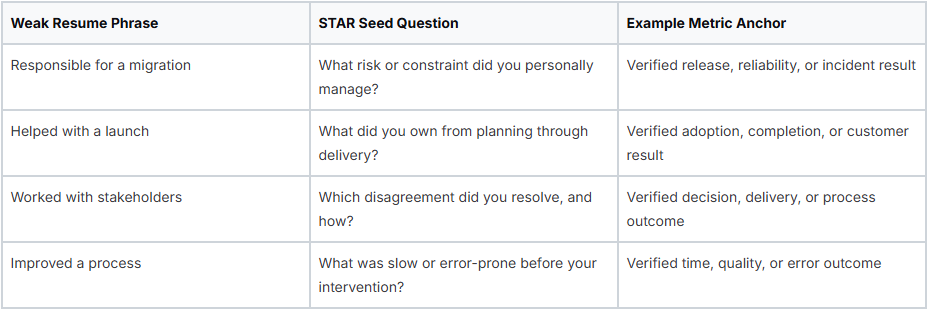
Aim for answers that can be delivered in roughly 90 seconds, but don't force every story into identical wording. Build a flexible outline with a headline, four STAR cues, and one likely follow-up. Your practice should test whether you can tell the story without reading it.
Use resume interview questions to turn additional resume bullets into prompts, then audit your personal story bank. Cover leadership, conflict, failure, technical depth, and collaboration. You need enough range to answer different behavioral questions without forcing the same example into every conversation.
The interviewer doesn't need your entire project history. They need to understand the decision you made, the work you personally did, and what changed because of it.
Building a Mock Interview Loop That Actually Scores You
A mock interview should produce evidence, not reassurance. “That sounded good” is pleasant feedback and almost useless. You need a repeatable loop that shows whether your answer structure, specificity, pacing, and coachability are improving.
Run the five-part loop
- Prep window: Have a partner send the job description 24 hours ahead. This gives you enough context to prepare without turning the session into an improvised conversation.
- Live simulation: Match the interview format and length as closely as possible. Use a video call for a video interview and include the same type of technical or behavioral prompts.
- Immediate scoring: Have your partner score answer structure, specificity, pacing, and signals of coachability. Ask for notes tied to exact moments, not general impressions.
- Ten-minute debrief: Name two strengths and one concrete fix. “Be more confident” isn't a fix. “State your individual decision before describing the team's work” is.
- Re-record round: Answer the same question again immediately. Compare the second version with the first to test whether the feedback changed your delivery.
Your partner should interrupt only if you run past 90 seconds on a behavioral question. Otherwise, let the answer finish. Interrupting too early can hide the very pacing or structure problem you're trying to observe.
Make the loop work alone
Use your phone camera, a rubric sheet, and the actual job description. Record your answer, score it on the four axes, and write the exact sentence where you became vague, repetitive, or overly technical. Then record the same answer again with one change.
Run the loop three times across a week instead of cramming ten rounds into one night. Spaced repetition builds retrieval fluency more effectively than a single burst of volume because you have to reconstruct the story again after a gap.
After each round, log the question, story used, answer length, filler words, missed result, follow-up difficulty, and next adjustment. By the third round, patterns should be visible. If every answer loses focus during the result, your problem isn't confidence. Your story endings need work.
You can also use AI mock interview practice to generate follow-up questions and review recorded answers, but keep the scoring criteria tied to the actual role. A generic score won't tell you whether your evidence fits this hiring team.
Calming Nerves Through Rehearsal, Not Pep Talks
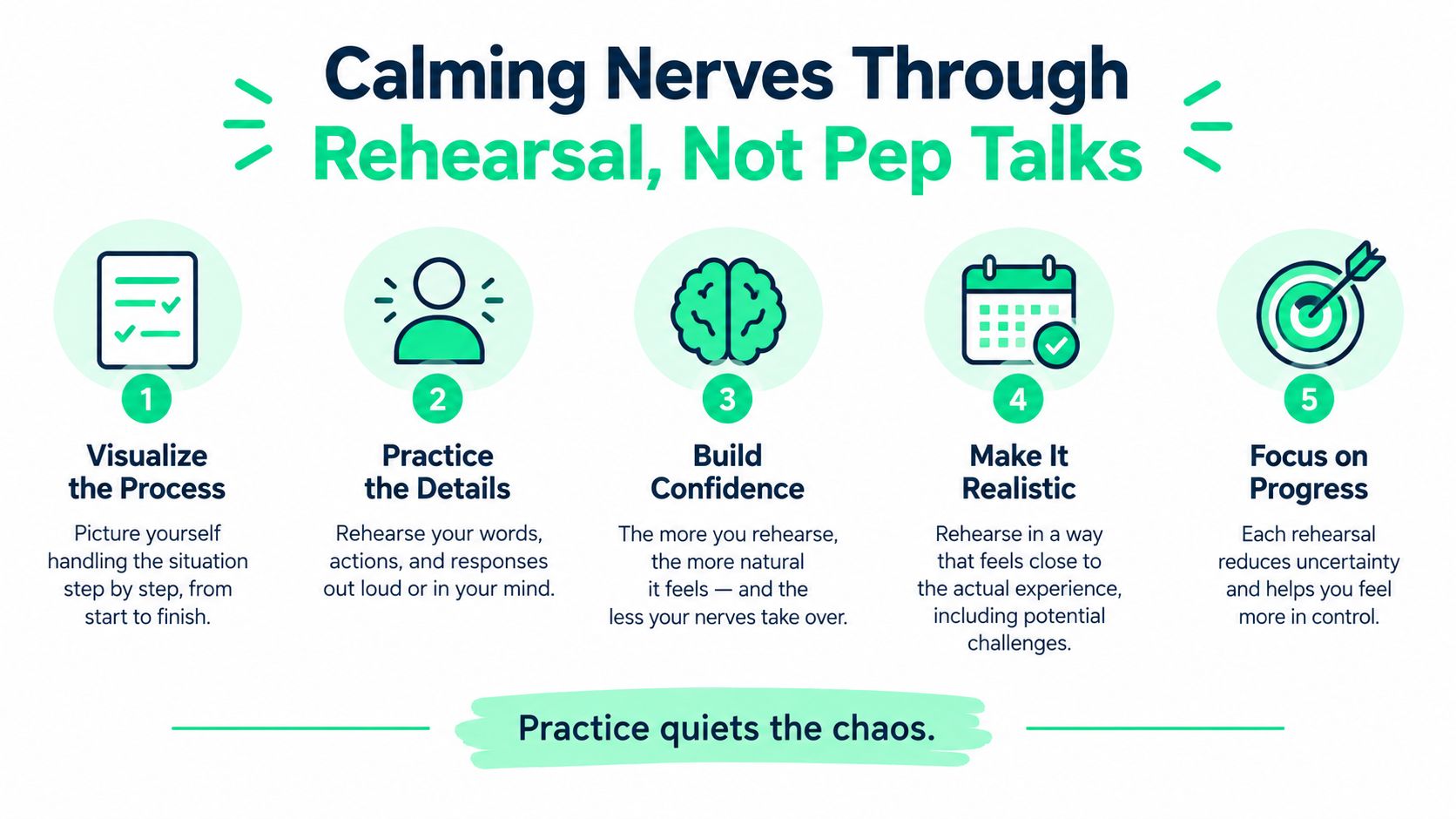
Anxiety is usually a rehearsal problem before it's a mindset problem. A psychology meta-analysis found a negative relationship between interview anxiety and performance, with a correlation of about -0.19 (NovoResume's summary). The same summary cites a survey in which 92% of U.S. adults reported feeling anxious about job interviews, so nervousness isn't evidence that you're unqualified.
The useful response isn't another affirmation. It's greater familiarity with the tasks that trigger uncertainty.
Replace vague fear with physical and verbal cues
Use these tactics in sequence:
- Reset your breathing: Take a deliberate 90-second box-breathing reset when you sit down. The purpose is to slow your first response, not eliminate every feeling.
- Practice the opening sentence: Prepare a natural first line for “Tell me about yourself” so the first ten seconds don't require improvisation.
- Pause before behavioral answers: Take one beat before responding. That pause makes your pacing look intentional and gives you time to retrieve the right story.
- Anchor your posture: Keep both feet flat and your notes flat on the table. A stable physical position reduces unnecessary movement and gives you a repeatable starting point.
A 2024 study of remote interview anxiety found that preparation satisfaction improved self-efficacy and reduced interview anxiety, while practice-interview participation significantly mediated performance outcome (the study in SAGE Journals). That finding supports realistic rehearsal, especially for candidates who know their experience but lose access to it under pressure.
Use language that buys thinking time
You don't need to answer instantly. Say, “That's a useful question, let me think for a moment.” Then identify the relevant competency and choose the story that proves it.
For remote interviews, practice the exact platform, camera position, microphone, and answer format. Experimental research with 1,219 participants found that advance access to questions and unlimited retakes independently reduced anticipatory anxiety in asynchronous video interviews (ERIC's research record). The preparation lesson is direct: rehearse the medium, not just the message.
End with one slow exhale before you leave or disconnect. It won't change the interview result, but it stops you from rushing through the final exchange and helps you leave the conversation composed.
Logistics, Pacing, and Follow-Up Templates That Close the Loop
Treat logistics as part of your performance. A late arrival, unstable connection, missing resume, or scattered notes consumes attention you need for judgment and communication.
Prepare the environment
Complete this checklist before interview day:
- Outfit: Choose it early and wear something that won't require adjustment during the conversation.
- Route or test call: Check the route or run the technology test 30 minutes early.
- Water: Keep it within reach, but don't let it become a distraction.
- Resume copies: Bring printed copies when the interview is in person.
- One-page cheat sheet: Include three STAR headlines and one question for the interviewer. Use cues, not scripts.
Use pacing rules that make your answers easy to follow. Aim for 90-second behavioral answers and about two minutes for technical walkthroughs. Close by connecting your answer to the role or asking a forward-looking question such as, “What would you want the person in this role to improve first?”
Send a thank-you email within four hours. Mention one specific topic discussed and reinforce one capability that connects your experience to that topic. Edit every template so it reflects the conversation. Recruiters notice generic notes quickly.
Follow-Up Email Timing and Purpose
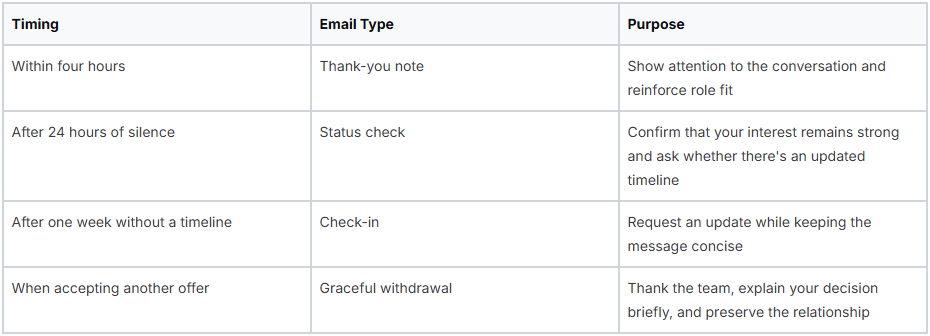
A 24-hour follow-up can say: “Thank you for speaking with me about the role. I enjoyed discussing [specific topic], and our conversation reinforced how my experience with [specific capability] could support the team. I'm still very interested and would welcome any update on next steps.”
For a one-week check-in, write: “I wanted to follow up on our conversation about [role]. I remain interested after learning more about [specific priority]. If the timeline has changed, I'd appreciate any update you can share.”
If you accept another offer: “Thank you for the time you and the team invested in speaking with me. I've accepted another opportunity, so I need to withdraw from the process. I appreciated learning about [specific topic] and hope we can stay in touch.”
For additional follow-up structure, use this interview thank-you email guidance, then rewrite the language in your own voice.
A Two-Week Prep Plan and Answers for Neurodivergent and International Candidates
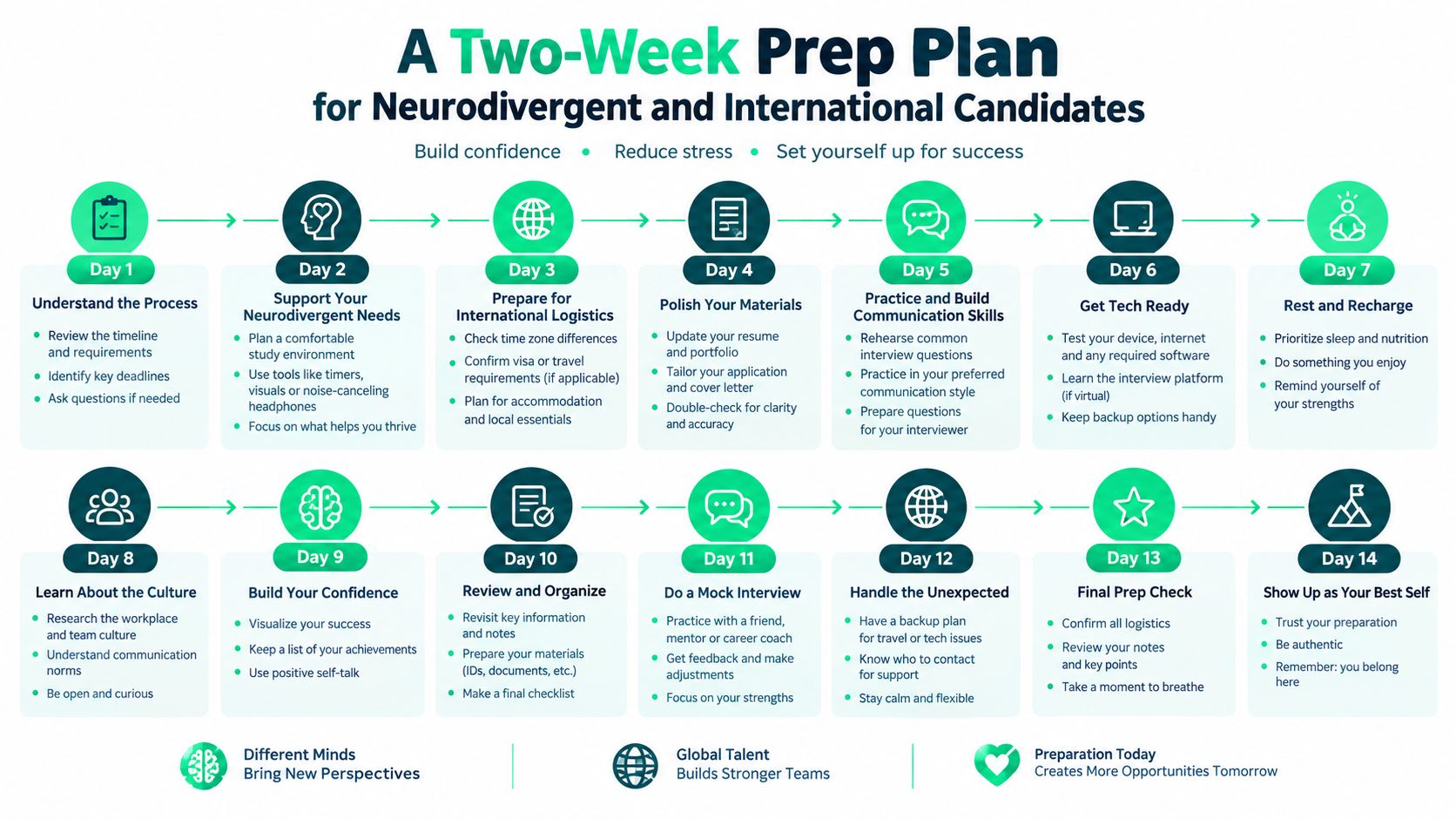
A practical calendar turns preparation into manageable repetitions.
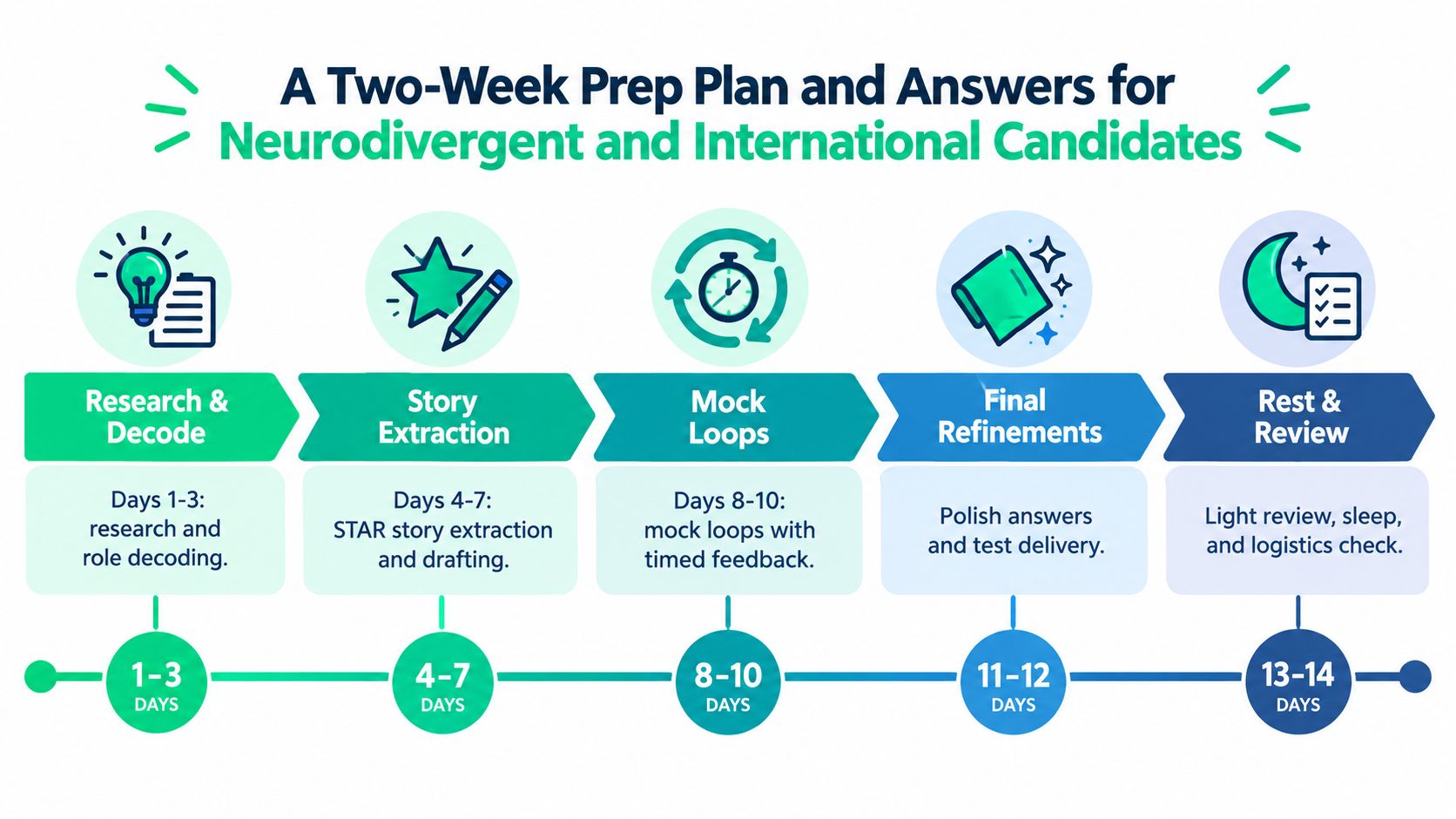
- Days 1–3: Research the company, decode the job description, identify the interview loop, and create three role-specific talking points.
- Days 4–7: Extract STAR stories from your resume and draft flexible cues for leadership, conflict, failure, technical depth, and collaboration.
- Days 8–10: Run mock loops with timed answers, feedback, re-recording, and a written adjustment after each session.
- Days 11–12: Test the route or technology, rehearse your opening and pauses, prepare your cheat sheet, and confirm interview logistics.
- Day 13: Rest, review visual cues, and complete a light run-through without cramming.
- Day 14: Execute the interview, record your observations afterward, and send the follow-up.
Adjust the calendar for processing and language needs
For ADHD candidates: Replace open-ended study blocks with timed sprints. Put one task on the calendar, ask a partner to check completion, and stop when the sprint ends. External accountability is more useful than waiting for sustained motivation.
For autistic candidates: Ask about the interview format in advance. You can request the types of questions, whether the interview includes a practical task, or whether written instructions are available. This reduces ambiguity and lets you rehearse the actual processing demands.
For non-native English speakers: Pre-load useful answer phrases without memorizing complete scripts. Practice transitions such as “The decision I owned was,” “The constraint was,” and “The result was.” These cues support fluency while leaving the details authentic.
For international applicants: Prepare a concise explanation of visa timelines and credential equivalencies. State the facts directly, then return to your value: “My credential is equivalent to the requirement, and my work authorization timeline is [specific detail]. The relevant experience I bring is [evidence].” Don't lead with uncertainty or apologize for your background.
Neurodivergent candidates face concrete barriers that ordinary interview advice often ignores. A UK survey reported that 37% of neurodivergent job seekers panicked because question structures were overly complicated, while 26% struggled with long applications and 23% with timed tasks (JobIntel's survey summary). Ask for clarity where you need it, practice under realistic constraints, and measure improvement by retrieval and communication, not by how polished your notes look.
A 2025 survey of more than 10,000 respondents found that only 32% of job seekers felt adequately prepared for interviews, while another 2025 report said roughly a quarter spent less than an hour preparing (India Employer Forum's summary). If your current routine consists of reading answers the night before, change it today. Build the stories, run the simulations, and track the fixes.
Key Takeaways
- Most interview prep fails for a specific reason: candidates rehearse answers instead of delivery — the three traps are over-scripted answers that break under follow-ups, zero pressure exposure that leaves you unready for silence and interruptions, and reading notes as practice, which trains recognition rather than the spoken communication interviewers actually assess.
- Research is complete when you can connect three stories to this employer's problems, not when you've collected company facts — clustering the job description's repeated verbs into competency buckets (execution, cross-functional partnership, customer judgment) turns generic prep into targeted evidence.
- A mock interview should produce evidence, not reassurance — "that sounded good" is almost useless, while scoring answer structure, specificity, pacing, and coachability with feedback tied to exact moments ("state your individual decision before describing the team's work") gives you something to fix in the immediate re-record round.
- Anxiety is usually a rehearsal problem before it's a mindset problem — 92% of U.S. adults report interview anxiety, and research found that preparation satisfaction improved self-efficacy while practice-interview participation mediated performance outcomes, which is why rehearsing the medium (platform, camera, microphone) matters as much as rehearsing the message.
- Neurodivergent and international candidates face concrete barriers that generic advice ignores — a UK survey found 37% of neurodivergent job seekers panicked because question structures were overly complicated, 26% struggled with long applications, and 23% with timed tasks, so requesting format details in advance, using timed sprints instead of open-ended study blocks, and stating visa or credential facts directly before returning to your value are practical adjustments rather than concessions.
Qcard supports this preparation model with resume-grounded talking points, AI-scored practice, mock interviews with follow-up questions, and voice delivery feedback for pacing, filler words, and answer length. Visit Qcard to turn your interview preparation into structured rehearsal instead of script memorization.
Ready to ace your next interview?
Qcard's AI interview copilot helps you prepare with personalized practice and real-time support.
Try Qcard Free