How to Prepare an Interview for a Job: A Complete Guide
TL;DR
Preparing for a job interview means building retrieval, not memorization — scripts crack under an unexpected follow-up, while short recall cues survive it. Link three things: what the employer needs, a real example from your background, and a keyword cue that brings it back. Start by mapping the job description's recurring verbs and nouns to matching achievements, writing triggers like "handoff, assumptions, evidence list, review" instead of full paragraphs. Build 8 to 10 STAR stories tagged with multiple competencies so one story can answer several questions, and time answers to 1.5 to 2 minutes with the heaviest weight on Action. Run at least three timed mock sessions with a partner asking questions in random order and interrupting with follow-ups, logging three specific adjustments after each. Then remove environmental friction: camera at eye level, light in front, backup contact ready, sensory audit completed, cue sheet only. Follow the two-week countdown — research, then evidence, then recall testing, then logistics — and don't cram new material the night before, since over-rehearsal makes answers sound robotic while poor sleep reduces recall.
You've spent the evening studying the company's website, memorizing polished answers, and rewriting your introduction. Then the interviewer asks, “Can you tell me about a time you changed someone's mind?” Your carefully prepared script disappears, your answer starts wandering, and a simple follow-up feels impossible to retrieve.
That experience doesn't mean you're unqualified. It usually means your preparation stored information without building a reliable way to retrieve it under pressure. Learning how to prepare an interview for a job means preparing your memory, pacing, environment, and evidence, not just collecting likely questions.
How Do You Prepare for an Interview for a Job?
Most preparation fails for a structural reason: it stores information without building a reliable way to retrieve it under pressure. You can know a company's products, values, and leadership team and still freeze when asked to connect that knowledge to a convincing answer. Preparing well means preparing your memory, pacing, environment, and evidence — not just collecting likely questions.
Reliable preparation links three elements: a job requirement (what the employer needs this role to accomplish), a personal example (a real situation from work, study, volunteering, or another responsibility), and a recall cue (a short phrase that brings the example back without a full script).
The four-part system:
1. Map the role's language to your experience. Read the job description twice — once for meaning, then again to mark recurring verbs and nouns like "cross-functional," "stakeholder management," and "prioritization." Group them into themes (execution, thinking, relationships, ownership), then build a mapping document connecting each keyword to a matching achievement. Write memory triggers, not paragraphs: "survey dashboard, conflicting priorities, recommended new workflow."
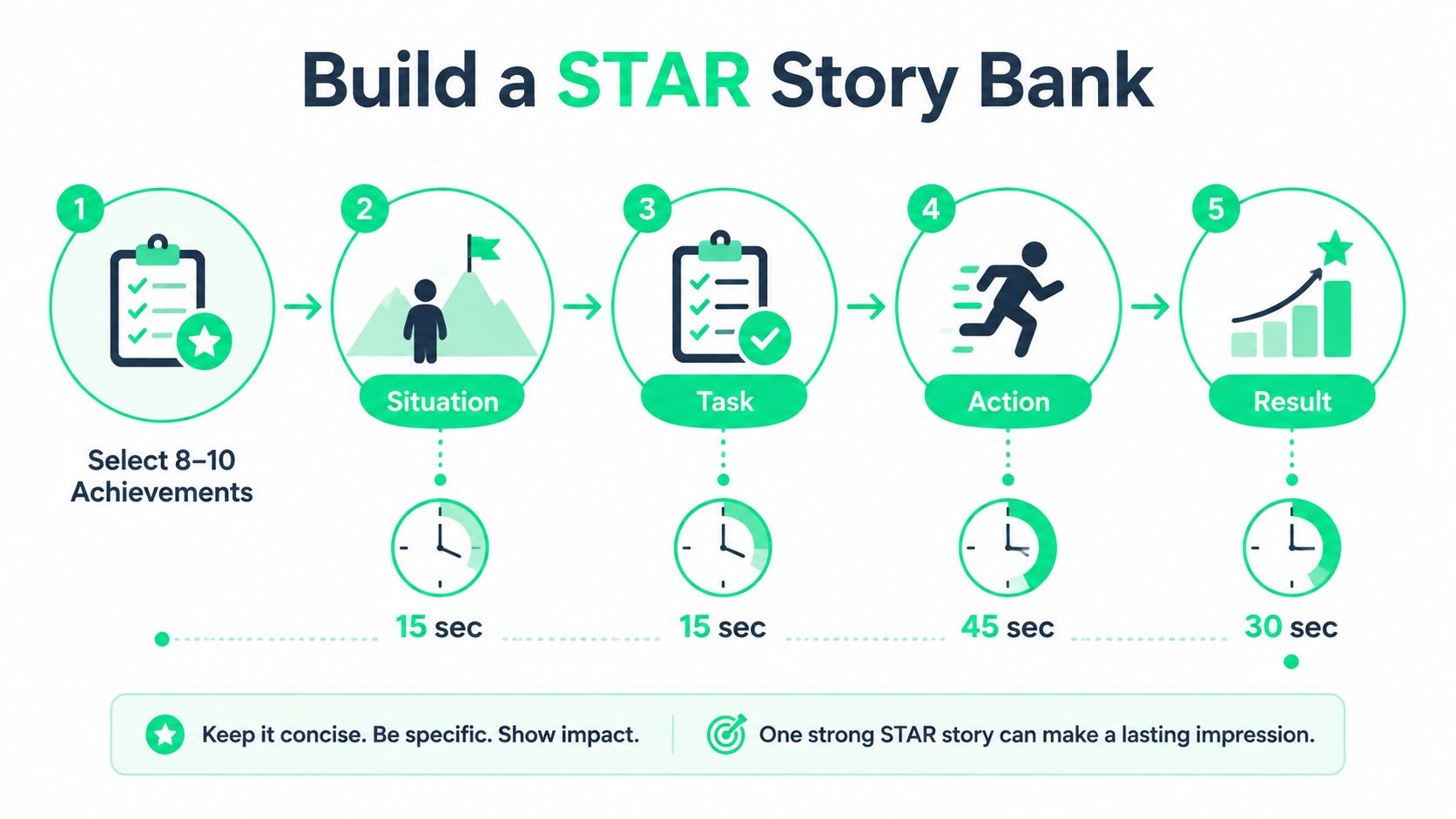
2. Build a flexible STAR story bank. Choose 8 to 10 real achievements covering conflict, ownership, failure, tight deadlines, cross-functional work, learning something new, incomplete information, difficult feedback, and supporting someone. Tag each story with multiple keywords so one example can answer several questions. Use a compact rhythm: 15 seconds on Situation and Task, 45 seconds on Action, 30 seconds on Result — roughly a 90-second answer.
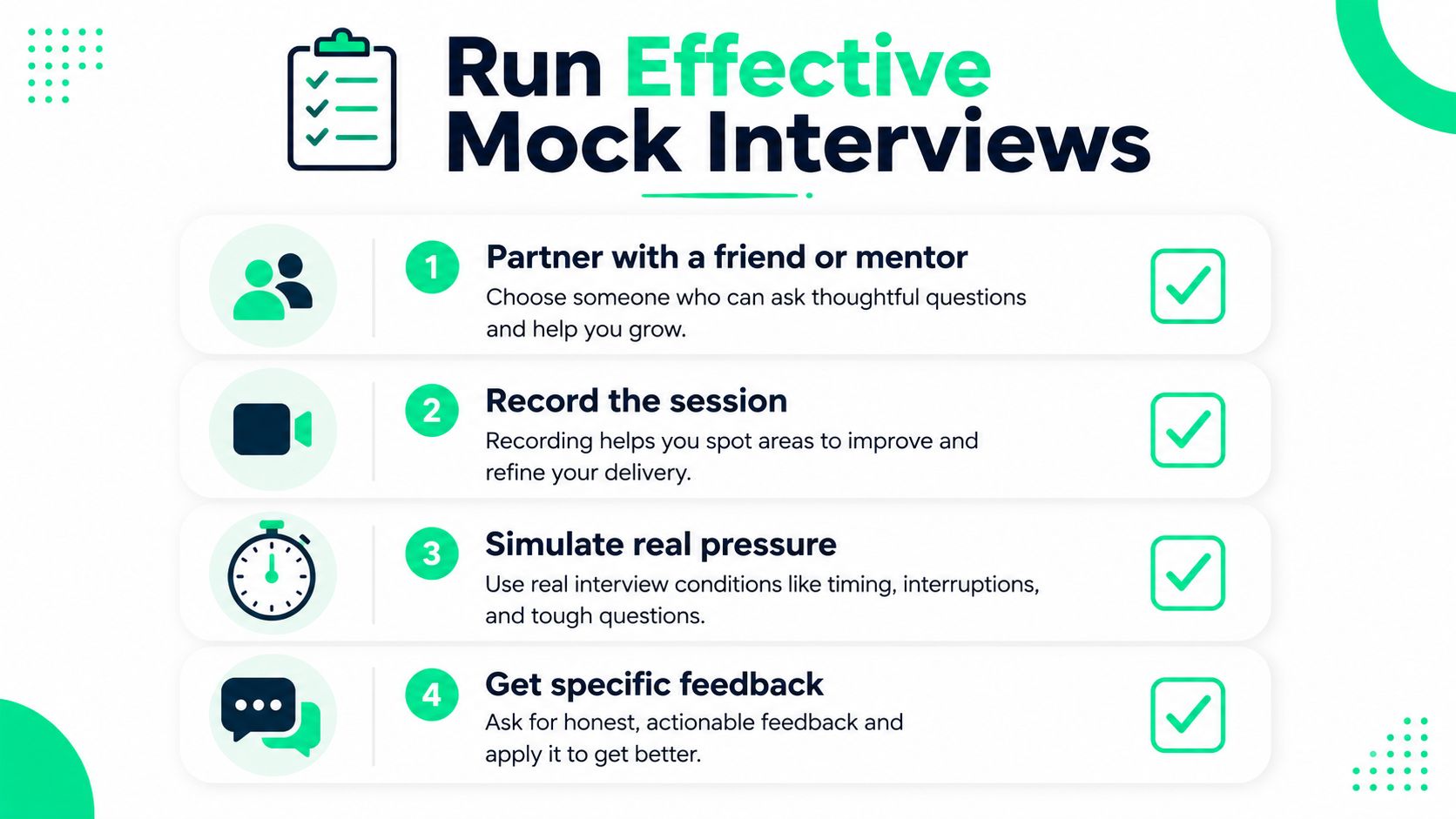
3. Rehearse retrieval in realistic conditions. Record yourself first to catch filler words and rambling openings. Then add a live partner asking questions in random order with real follow-ups ("What did you personally do?" "Why that approach?"). Random order matters because an interviewer won't follow your preferred memory path. Practice in the clothes, platform, and setup you'll actually use.
4. Protect the conditions that help you think. Complete video setup checks 30 minutes ahead. Run a sensory audit the night before — noise, lighting, clothing texture, temperature, food and water, notes location. Prepare transition phrases like "Let me take a moment to choose the clearest example."
Why Most Interview Preparation Fails Under Pressure
A candidate may know the company's products, values, leadership team, and recent announcements, then freeze when asked to connect that knowledge to a convincing answer. Familiarity with facts does not guarantee recall while someone is watching, listening, and adding follow-up questions.
Under pressure, attention narrows. You may concentrate so hard on sounding impressive that you lose the question's real demand. A memorized paragraph also leaves little room for variation. You put in the work. The issue is structural: a script cracks under an unexpected follow-up.
Reliable preparation links three elements:
- A job requirement: What the employer needs this role to accomplish.
- A personal example: A real situation from work, study, volunteering, or another responsibility.
- A recall cue: A short phrase or keyword that brings the example back without requiring a full script.
A 2024 survey cited by Zirtual found that 90% of hiring managers believe interview preparation is a key factor in candidate success, while candidates typically spend 5-10 hours preparing (interview preparation statistics from Zirtual). The source identifies company research, common-question practice, mock interviews, and specific examples as preparation methods. Their value increases when they operate as one retrieval system instead of disconnected tasks.
Practical rule: Prepare the route to your answer, not every word you might say.
A graduate with only academic project experience can tag one group-project story with “collaboration,” “deadline,” “conflict,” and “communication.” A career switcher can use a customer escalation from a previous industry to show judgment, stakeholder management, and problem-solving. The facts remain authentic, while the recall cue changes with the question.
Short cues also support pacing. After hearing a question, pause long enough to identify the requirement, select the matching cue, and then tell the story. That sequence is easier to retrieve than a polished paragraph, and it gives candidates who need extra processing time a workable structure without forcing instant performance.
Structured interviews reward concrete evidence. Research summarized by NovoResume's interview statistics overview describes how structured behavioral formats use observable past behavior to support more consistent evaluation. Specific examples therefore serve the candidate better than broad claims such as “I'm a strong team player.”
The system used throughout this guide has four parts: map the role's language to your experience, build a flexible story bank, rehearse retrieval in realistic conditions, and protect the conditions that help you think clearly. Anxiety may still appear, but it no longer has to direct the conversation.
Research the Company and Map Keywords to Your Experience
Company research should give you usable talking points, not trivia you hope the interviewer mentions. Begin with the job description. It shows how the employer defines the work, priorities, and behaviors expected in the role.
Start with the role language
Read the description once for its overall meaning. On the second pass, mark recurring verbs and nouns such as “cross-functional,” “data-driven,” “stakeholder management,” “prioritization,” “customer research,” and “process improvement.” Verbs indicate what you may need to do. Nouns point to the skills, systems, and relationships involved.
Group those terms into themes:
- Execution: Deliver, coordinate, launch, improve, manage.
- Thinking: Analyze, evaluate, research, forecast, solve.
- Relationships: Influence, collaborate, present, negotiate, support.
- Ownership: Lead, prioritize, decide, communicate, learn.
Then review the company's recent public material, including its website, press releases, product or service pages, blog posts, and leadership interviews. Look for repeated priorities such as expansion, reliability, customer experience, responsible innovation, or operational efficiency. You do not need to memorize every announcement. You need enough context to explain why this role matters and where your experience fits.
Build a mapping document that works as a mental index:
Job Description Keyword Your Matching Achievement
Cross-functional collaboration
Coordinated a university project across research, design, and presentation responsibilities
Data-driven decisions
Used survey findings or performance data to recommend a change
Stakeholder management
Adjusted a project after gathering feedback from a client, tutor, customer, or team lead
Tight deadlines
Completed a major deliverable while managing competing academic, work, or personal commitments
Process improvement
Reworked a repeatable task to reduce confusion, duplication, or delays
The right-hand column should hold memory triggers, not polished paragraphs. Write “survey dashboard, conflicting priorities, recommended new workflow,” rather than scripting the entire response. Compact cues are easier to retrieve under pressure and leave room for natural language.
Translate culture into evidence
Cultural signals matter when you connect them to something you have done. If the company emphasizes remote collaboration, prepare an example of communicating clearly without constant face-to-face contact. If it highlights innovation, choose a story in which you tested an approach, learned from an imperfect result, or introduced a useful improvement.
Avoid repeating the company's values as decoration. “I'm aligned with innovation” gives the interviewer little to assess. “In a group project, I replaced a confusing manual process with a shared tracking system and adjusted it after feedback” provides observable behavior.
Research can also reduce uncertainty, which supports recall when anxiety rises. Preparation data has found that company research is common among interview candidates (company research and interview preparation data). Make each discovery earn its place by linking it to a specific story, question, or reason you want the role.
Build a STAR Story Bank From Your Real Achievements
The STAR method gives your memory a dependable shape: Situation, Task, Action, Result. It prevents two common problems, spending too long on background and failing to explain what you personally did.
Use a compact speaking rhythm:
- Situation and Task, 15 seconds: Establish the context and your responsibility.
- Action, 45 seconds: Explain the decisions, steps, communication, and adjustments you made.
- Result, 30 seconds: State what changed, what you learned, and the measurable or meaningful outcome.
That timing creates a response of about 90 seconds. The MIT STAR method guide offers a related proportion-based approach, with the greatest emphasis placed on Action. The principle is more important than perfect timing. The interviewer needs to hear your contribution, not a long history of the project.
Select stories before questions
Choose 8-10 real achievements that can cover several competencies. Include a mix of experiences:
- A disagreement you helped resolve.
- A project where you took ownership.
- A failure, mistake, or disappointing result you recovered from.
- A tight deadline with competing priorities.
- A cross-team or cross-functional collaboration.
- A time you learned a new tool or process.
- A problem you solved with incomplete information.
- A situation where you received difficult feedback.
- A customer, classmate, colleague, or stakeholder you supported.
- A result you're proud to explain in detail.
Students can use coursework, societies, volunteering, internships, and part-time work. International students can draw on experiences from another country and then explain the transferable behavior clearly. Career switchers should resist apologizing for a different background. The story bank's job is to translate previous experience into the employer's language.
Tag each story with several keywords from your mapping document. A “difficult group project” might carry the tags “conflict,” “stakeholder management,” “communication,” “deadline,” and “leadership.” That story can answer multiple questions without becoming a rehearsed universal answer.
Make the evidence specific
Weak answer: “I worked on a team project, and we had some communication issues. I helped everyone stay organized, and the project went well.”
Stronger answer: “In a student consulting project, our research and presentation teams were working from different assumptions. I owned the handoff between them, created a shared evidence list, and scheduled a short review before the final draft. That resolved duplicate work and gave us a consistent recommendation for the presentation. I learned that a clear shared reference point can prevent a disagreement from becoming a deadline problem.”
The stronger version gives the interviewer a situation, responsibility, action, and result. If you have a genuine metric, use it. If you don't, describe the meaningful outcome accurately rather than inventing precision.
Practice retrieval in a random order. Ask yourself “conflict,” “leadership,” or “failure,” then select a tagged story. Don't always rehearse story one, story two, and story three. Shuffling forces your mind to find the right example from a cue, which is closer to what happens in a real conversation.
You can also use a practice interview question bank to vary prompts and identify which stories still feel difficult to retrieve. Record a short keyword cue for each story, such as “handoff, assumptions, evidence list, review.” Those four words should reveal the structure without forcing you to recite a script.
Run Mock Interviews That Simulate Real Conditions
A solo rehearsal leaves you unable to hear your own filler words. Reading a question and forming an answer in your head tests recognition, not retrieval under pressure. Speaking aloud reveals whether your opening is clear, whether the story loses focus, and whether the result arrives before the interviewer loses the thread.
Begin with a short recording on your phone, laptop, or another recording tool. Answer common questions aloud, then review the playback for filler words, rambling openings, and unsupported claims. Correct one issue at a time. Repeat the answer with one deliberate adjustment, so you can tell whether the change improved recall and pacing.
Add unpredictability
The next stage needs another person. Ask a friend, mentor, classmate, or former colleague to run a live session with questions in random order. Give them permission to interrupt with realistic follow-ups:
- “What did you personally do?”
- “Why did you choose that approach?”
- “What would you change now?”
- “How did the other person respond?”
- “What was the result?”
Random order prevents reliance on a temporary script. An interviewer will not follow your preferred memory path. Your task is to recognize the cue, retrieve a tagged story, establish context quickly, and keep the action section focused. If anxiety or neurodivergent processing makes rapid switching difficult, ask the practice partner to pause briefly after each question, then reduce that pause in later sessions.
Time behavioral answers to 1.5-2 minutes, consistent with practical guidance from Homans AI's STAR preparation resource. Finishing too quickly can mean you skipped the action or result. Running long usually means the background contains details that do not help the interviewer understand your decision. Keep a visible cue sheet with keywords, not full sentences.
Recreate the setting
Practice at a desk in the clothes you expect to wear. Use the same video platform, headset, camera, and lighting arrangement planned for interview day. Technical candidates should explain their reasoning aloud during coding, case, or problem-solving practice. For a phone interview, practice staying expressive without eye contact or visual feedback.
Repeat the cycle at least three times during the week before the interview. After each session, record three specific adjustments in a preparation journal:
- One content gap to clarify.
- One delivery issue to change.
- One recall cue that worked or needs revision.
The University of Southern Indiana interview mastery guide recommends building a story bank across 3-4 days and spending another 3-4 days on live practice and feedback. That division leaves time to test answers under pressure instead of spending the full preparation period writing them.
Reduce notes after every session. By the final practice, keep only a short cue sheet visible. For extra question variety, Qcard's mock interview tool can generate questions, follow-ups, and feedback for different interview formats.
Day-of Logistics and Strategies for Neurodivergent Candidates
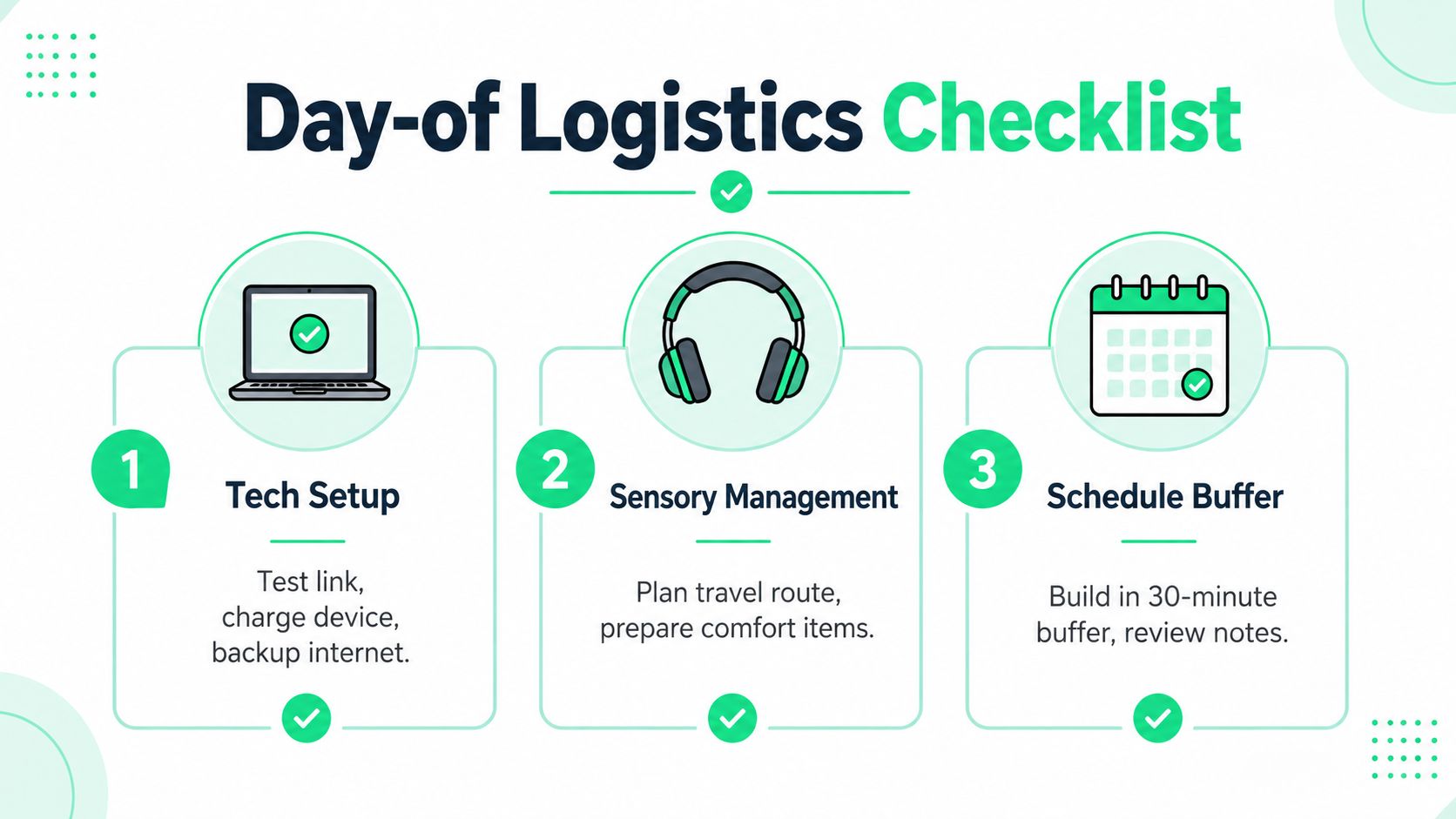
Interview performance depends partly on conditions unrelated to competence. A dead laptop battery, harsh lighting, a noisy waiting room, or an unexpected schedule change can consume the attention required for listening and recall. Remove avoidable variables before the conversation begins, then reserve your mental energy for retrieving the right example.
Match the setup to the format
For a video interview, complete the setup check 30 minutes before the call:
- Camera angle: Place the camera near eye level so your face is visible without looking sharply down or up.
- Lighting position: Put the main light in front of you or slightly to the side, not directly behind you.
- Background framing: Keep the visible area uncluttered and remove movement that could distract you or the interviewer.
- Audio sequence: Check the microphone, headphones, speaker output, and connection by joining the platform's test environment or a private call.
- Access details: Open the invitation link and keep a backup contact method available.
For a phone interview, use a quiet room with your printed resume, water, and a notepad containing keyword triggers. Avoid writing full answers. A cue such as “customer complaint, escalation, options, resolution” gives your memory a route into the story while keeping your attention on the caller.
For an in-person meeting, plan the route and identify the building entrance before leaving. Bring the materials you need, arrive with enough time to settle, and use a short grounding routine before entering. The National Careers Service STAR guidance recommends concise examples from work, volunteering, or home life, with enough clarity to handle follow-up questions.
Protect processing and sensory capacity
Neurodivergent candidates and anxious candidates may benefit from asking for the interview format in advance, requesting written instructions, or asking whether a quiet room is available. Accommodation requests do not need to disclose more personal information than necessary. State what support helps you demonstrate your skills, such as receiving logistical details in writing or having a moment to process complex questions.
Prepare short transition phrases:
- “Let me take a moment to choose the clearest example.”
- “I'd like to separate the situation from the action I took.”
- “Could you repeat the final part of the question?”
- “I have an example from a project that shows that.”
These phrases create processing time without pretending you understood a question you did not hear clearly. Concise bullet-point memory aids are usually more flexible than full scripts. Neurodiversity-focused guidance from NeuroHire Network also emphasizes requesting the format ahead of time, reducing sensory load, and using practical supports such as written instructions and discreet sensory tools.
Run a sensory audit the night before. Check noise, lighting, clothing texture, room temperature, travel uncertainty, food and water access, and the location of your notes. If box breathing helps you regulate, use a steady pattern before the interview and between questions. Nervousness may still appear, but a prepared environment keeps it from crowding out working memory.
Follow-Up Templates That Reinforce Your Talking Points
A follow-up message should help the interviewer remember the evidence you shared. Send it within 24 hours for most roles, or within 12 hours when the hiring process is moving quickly. Write each message separately, even if several people attended the same interview.
Use four parts:
- Mention a specific point the interviewer raised.
- Reinforce your strongest relevant example and include a genuine metric when one was discussed.
- Add a brief clarification if you missed an important detail.
- Close with interest and a clear next step.
Scenario Strategic Focus Key Element Send Within
Strong rapport conversation
Continue the specific connection
Reference the shared topic and role fit
24 hours
Technically rigorous panel
Reinforce evidence and reasoning
Clarify one technical decision or result
24 hours
Stumbled on a key question
Correct without overexplaining
Add the missing example in a concise paragraph
12-24 hours
For a strong conversation:
Thank you for discussing the team's approach to [specific priority]. I especially enjoyed connecting that priority to my experience with [specific example], where I [action] and achieved [accurate result]. I'm even more interested in the opportunity and would welcome the chance to continue the conversation.
For a technical panel, replace general enthusiasm with one useful clarification:
Thank you for the thoughtful discussion about [technical topic]. After reflecting on the question about [issue], I wanted to add that my approach would be to [concise reasoning]. My experience with [relevant project] taught me to [relevant lesson], and I'd be glad to explain that approach further.
If you stumbled, don't send an apology essay:
Thank you for the conversation about [topic]. I realized afterward that I didn't fully explain my experience with [skill]. In that situation, I [action] and [result or lesson]. I appreciated the opportunity to clarify it and remain very interested in the role.
For more examples and structure, use this interview thank-you email guide. Avoid rehashing your resume, using language that feels unlike you, or sending identical messages to every interviewer. If you haven't heard back after the timeline they gave you, send one polite check-in that refers to the role and asks whether there's an updated decision schedule.
Your Complete Interview Preparation Timeline
A countdown works best when it protects memory and pacing, rather than turning preparation into an information hunt. Keep the sequence consistent: understand the role, build evidence, test recall, then reduce environmental friction. Adjust the timing to your schedule, but preserve that order.
Two weeks to ten days before
Research the company, interviewers, and role priorities. Mark the job description's keywords, then connect each important term to an experience you can explain. Write a short question list about the team, measures of success, and the work the role will own.
Nine to six days before
Choose 8-10 STAR stories and tag each with the competencies it demonstrates. Reduce every story to cue words, not a script. Practice a 15-second Situation and Task opening, then make the Action section show your decisions, judgment, and contribution rather than only the team's activity.
Five to three days before
Complete at least three timed mock sessions. Record yourself, review the playback, and add randomized follow-ups so recall does not depend on receiving questions in a familiar order. After each session, log three improvements. Keep shortening your notes until a few prompts can bring back the structure, evidence, and result.
Two days to one day before
Prepare a one-page talking-point sheet. Confirm the format, route, clothing, camera, microphone, lighting, room, and backup contact method. Complete a sensory audit: identify possible noise, brightness, temperature, seating, or transition problems, then set up reasonable adjustments. Test the technology and interview environment 24 hours beforehand.
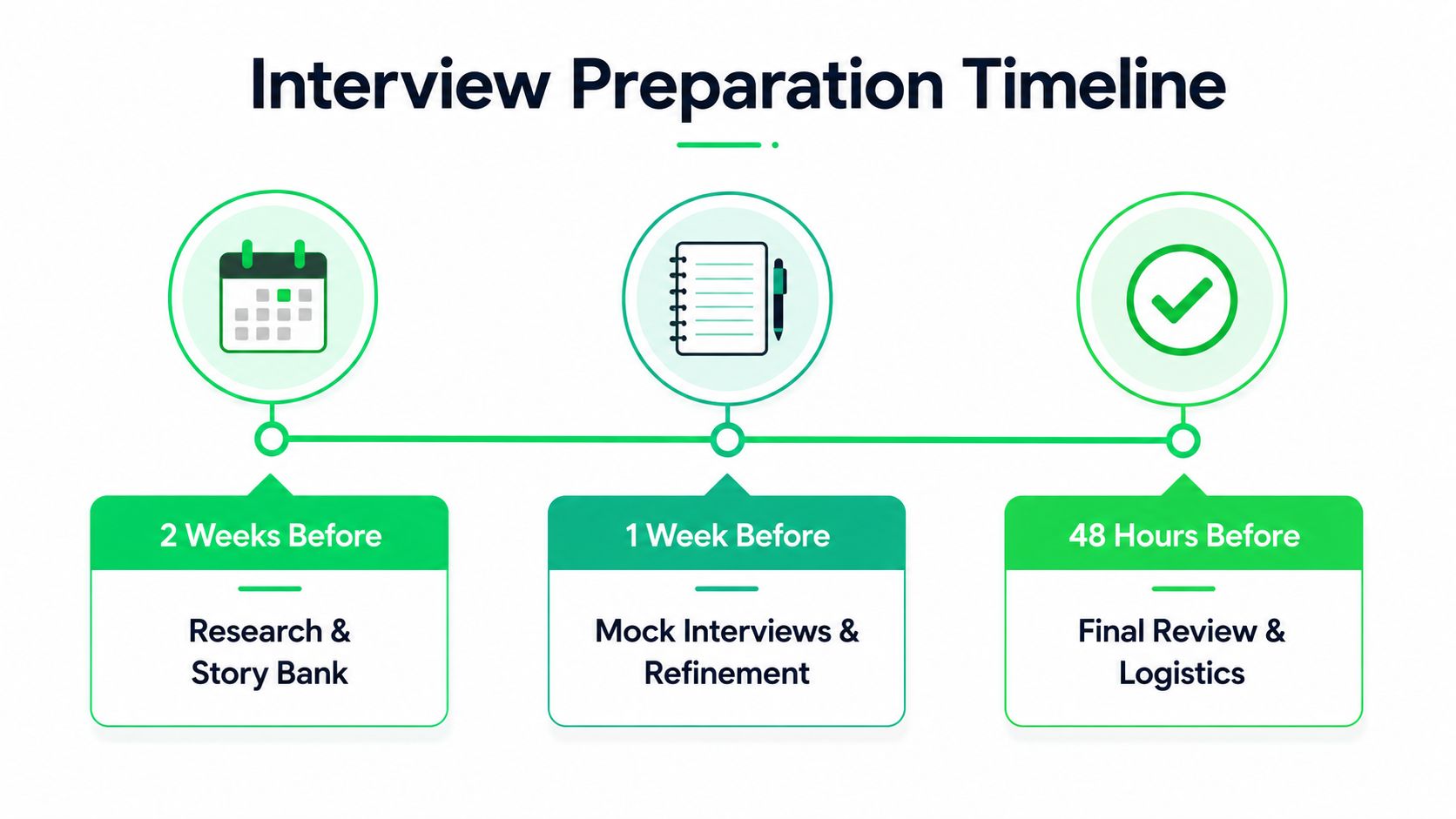
Do not cram new material the night before. Over-rehearsal can make answers sound robotic, while poor sleep, insufficient food, or dehydration reduces attention and recall. On the morning, review only the cue sheet, say one or two answers aloud to warm up, and use your grounding routine. Bring retrieval-ready prompts, not competing paragraphs.
A 2025 survey cited by Indian Employer Forum found that only 32% of more than 10,000 respondents felt adequately prepared for interviews (2025 interview readiness findings). That finding supports preparation that addresses blanking out, pacing, sensory friction, and confidence alongside knowledge gaps.
Key Takeaways
- Preparation fails structurally, not from lack of effort — familiarity with company facts doesn't guarantee recall while someone is watching and adding follow-ups, which is why the goal should be preparing the route to your answer rather than every word you might say.
- Keyword mapping turns research into usable evidence — marking the job description's recurring verbs and nouns, grouping them into execution, thinking, relationships, and ownership themes, then pairing each with a compact memory trigger gives you a mental index instead of a pile of facts you hope the interviewer mentions.
- Tagging stories with multiple competencies is what makes a small story bank cover a large question range — a single difficult group project can carry the tags "conflict," "stakeholder management," "communication," "deadline," and "leadership," which lets it answer several questions without becoming a rehearsed universal answer.
- Practicing questions in random order is the difference between recognition and retrieval — rehearsing story one, story two, story three trains a sequence an interviewer will never follow, while shuffling forces you to recognize a cue and select the right example, which is exactly what happens in a real conversation.
- Environmental and sensory preparation protects working memory, which matters especially for neurodivergent and anxious candidates — a dead battery, harsh lighting, or a noisy room consumes the attention you need for recall, and prepared transition phrases ("Could you repeat the final part of the question?") create processing time without pretending you understood something you didn't.
Qcard supports concise, resume-grounded talking points, practice, follow-up handling, pacing, and feedback. Visit Qcard to build a flexible routine around experiences you can explain clearly.
Ready to ace your next interview?
Qcard's AI interview copilot helps you prepare with personalized practice and real-time support.
Try Qcard Free