How to Get Prepare for a Job Interview Without Scripts
TL;DR
The best way to prepare for a job interview is zero-script: build resume-locked cues, not memorized answers, because one unexpected follow-up breaks a script while a cue-based answer survives rewording. Start with a role-to-resume audit — mark each requirement, find your evidence, name your contribution, capture the outcome, and note what you didn't own. Build 8 to 10 STAR stories mapped to multiple question types, with roughly 60% of each answer on Action and a two-minute target. Then practice aloud on a two-week rhythm: week one builds the material, week two drills delivery from cues with recordings and follow-up questions. Use real results only — "the team adopted the new tracker for future projects" beats a fabricated efficiency percentage. Expect to spend 5 to 10 hours total, and note that candidates who rehearsed specifically for virtual formats saw 30% higher callback rates. Finally, remove day-of uncertainty: confirm logistics early, request accommodations as soon as possible, keep cues near the camera, and pause deliberately rather than filling silence with filler words.
You've got an interview on the calendar, your resume is open in another tab, and your mind has decided to forget every useful example you've ever lived through. You read advice telling you to “be confident,” then try to memorize polished answers that sound unlike anything you'd say.
That approach creates brain fog. The better answer to how to get prepared for a job interview is to build resume-locked talking points, practice them aloud, and use short memory cues instead of scripts. You'll know what you want to say without forcing yourself to remember every sentence.
How Do You Get Prepared for a Job Interview?
The answer isn't memorizing polished answers — it's building resume-locked talking points, practicing them aloud, and using short memory cues instead of scripts. Memorized answers fail because one unexpected follow-up changes the wording and the next line disappears. A cue-based answer survives variation because you remember the event, your decisions, and the result, not a fragile paragraph.
The stakes are real: 92% of U.S. adults feel anxious about job interviews, and UK jobseeker research found 65% said nerves prevented them from showing their true ability. Meanwhile, a 2024 survey found 90% of hiring managers consider interview preparation a key factor in candidate success, with candidates who rehearsed specifically for virtual formats receiving callbacks at a 30% higher rate.
Follow four steps across roughly 5 to 10 hours:
1. Run a role-to-resume audit. Read the job description twice — once for context, once with a pen. Extract repeated responsibilities, tools, and outcomes. For each major requirement, mark it, find the evidence in your resume or coursework, name your personal contribution, capture the outcome, and add a limitation so you don't overclaim under follow-up. A bullet like "supported a customer onboarding project" becomes: "new customer process, clarified requirements, created tracking document, coordinated two internal teams, reduced confusion during handoff."
2. Build 8 to 10 reusable STAR stories. Map each to two or three likely question types. Give the Action section roughly 60% of the answer — MIT and government interview guidance both place it at 60% to 70%. Weak: "The team had a communication issue, so I helped improve collaboration." Strong: "I created one shared decision log, scheduled a short review before each handoff, and flagged unresolved questions instead of letting them travel downstream." Target about two minutes per story with a timer.
3. Practice aloud on a two-week rhythm. Week one builds the material — draft stories, say them aloud, trim context, mark where you sound vague. Week two trains delivery — answer from cues only, run the same story against four different prompts, record several runs, and listen for filler words, long introductions, and endings that fade out. Run mocks that include follow-ups: "What did you personally do?" "Why that approach?" "What would you do differently?"
4. Remove day-of uncertainty. Confirm time, location, contact, and format in advance. Arrive 10 to 15 minutes early, or for video, open the setup early and place cues near the camera. When you lose the thread, say "Let me organize that clearly" and continue rather than apologizing repeatedly.
Why Preparation Beats Memorization Every Time
Preparation matters because nerves can interfere with recall, pacing, and clarity, even when you're qualified. A widely cited survey found that 92% of U.S. adults feel anxious about job interviews, while 17% identified general nervousness as their biggest fear. Earlier UK jobseeker research found that 65% said nerves prevented them from showing their true ability, and 55% said not knowing the answers was their biggest interview worry. These figures are summarized in interview anxiety research from Anxiety.org.
That's why memorized answers often fail. One unexpected follow-up changes the wording, and the candidate loses the next line. A cue-based answer survives variation because you remember the event, your decisions, and the result, not a fragile paragraph.
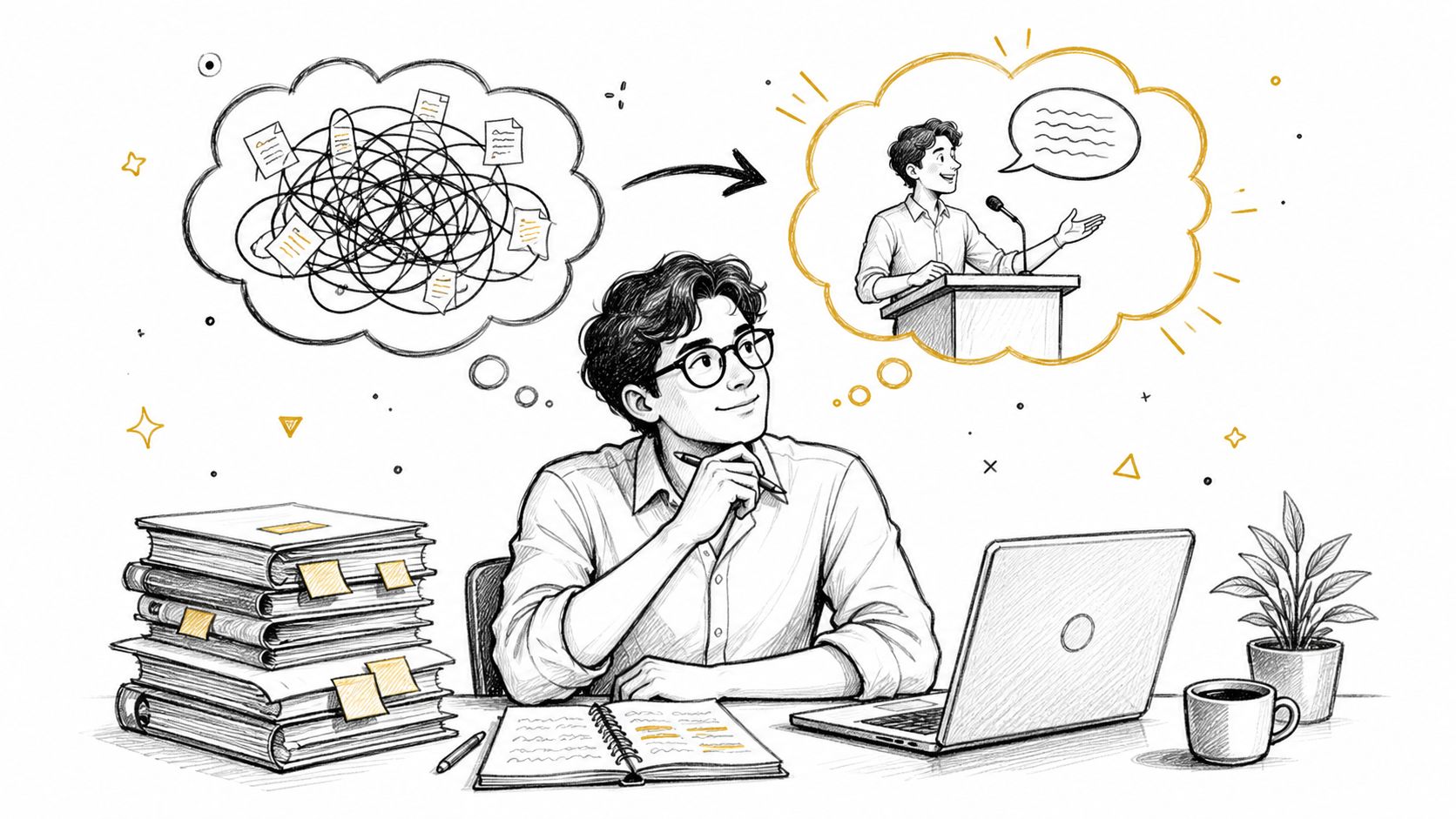
A 2024 survey reported that 90% of hiring managers consider interview preparation a key factor in candidate success. The same research found that candidates who rehearsed for virtual interviews by practicing on camera, improving lighting, and preparing a clean background received callback offers at a 30% higher rate than candidates who didn't tailor preparation to the format. You can review the survey details in Zirtual's interview statistics resource.
You don't need to spend every waking hour preparing. Candidates generally spend 5–10 hours reviewing their resume, researching the company, and practicing answers, according to that same source. The useful work is concentrated:
- Company research: Understand what the organization does, what the role supports, and what problems the team appears to be solving.
- Question rehearsal: Prepare stories and talking points, not fixed speeches.
- Format practice: Rehearse on camera for video interviews, test your setup, and practice answering while looking toward the camera.
Practical rule: Prepare the ideas, order, and evidence. Never memorize the exact wording.
The system in this guide is simple. First, connect the job description to proof already present in your resume. Then build a bank of concise STAR stories, map each story to several question types, and practice aloud with recordings and follow-ups. Finally, remove day-of uncertainty and use memory prompts that help you speak naturally.
This method works for graduates who lack extensive experience, career switchers translating experience into a new field, international candidates managing a second-language interview, and neurodivergent candidates who need lower cognitive load. You aren't trying to perform a personality. You're making your real experience easier to retrieve under pressure.
For a useful foundation, keep this interview preparation guide beside your resume while you build your plan.
Research the Role and Ground Your Talking Points in Your Resume
Generic research produces generic answers. Your preparation should create a direct line from the employer's requirements to evidence you can explain clearly.
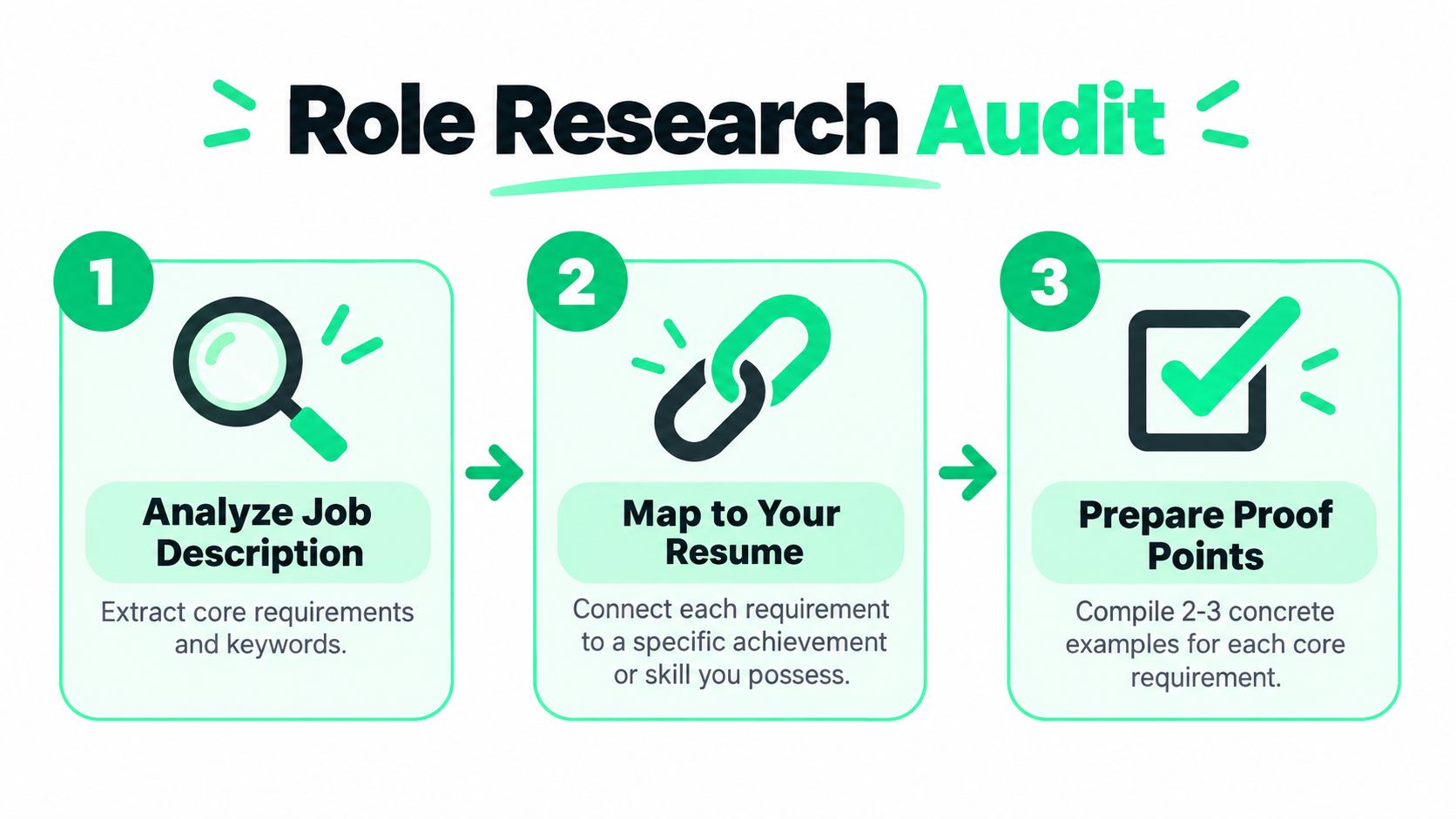
Start with the job description. Read it once for context, then read it again with a pen or document open. Extract the repeated responsibilities, tools, behaviors, and outcomes. If the posting emphasizes stakeholder communication, project ownership, analysis, customer support, or risk management, treat those as signals about the interview topics you're likely to face.
Turn requirements into proof
For each major requirement, find something you did. Use your resume, application answers, portfolio, coursework, volunteer work, internships, or previous employment. Don't invent a closer match. A credible adjacent example is stronger than an inflated claim.
Use this audit:
- Mark the requirement. Write the exact skill or responsibility in your notes.
- Find the evidence. Identify the resume bullet, project, or experience that supports it.
- Name your contribution. Clarify what you personally decided, built, changed, analyzed, or delivered.
- Capture the outcome. Use a real result when your materials contain one. If not, describe the meaningful outcome without manufacturing a figure.
- Add a limitation. Note what you didn't own, so you won't accidentally overclaim during follow-up questions.
For example, a resume bullet that says you “supported a customer onboarding project” is not yet an interview answer. Your notes might say: “new customer process, clarified requirements, created tracking document, coordinated with two internal teams, reduced confusion during handoff.” Those cues give you a truthful route into a story.
Research the company without disappearing into it
Learn the company's product or service, customers, recent priorities, and the team's likely context. Focus on information that changes how you'll answer. A technology company may care about scale and reliability. A nonprofit may focus on mission, resourcefulness, and community impact. A bank may test judgment, accuracy, and risk awareness.
Research your interviewers only enough to understand their roles and likely perspective. Don't collect trivia. Your preparation should help you ask better questions and frame relevant examples, not create a false sense of familiarity.
Lock down the practical details
The U.S. Department of Labor's interview tips recommend confirming the time, location, point of contact, and whether there will be one or multiple interviewers. Do this before the day of the interview.
Prepare a clean folder with:
- Resume copies: Bring a few printed copies for an in-person interview.
- Writing materials: Pack a pen and notepad.
- Logistics: Save the address, meeting link, contact name, interview format, and expected participants.
- Evidence notes: Keep a short, discreet page of story cues, not scripts.
Your final research document should be short enough to scan quickly. If it becomes a giant company dossier, you've stopped preparing and started avoiding practice.
Build Concise STAR Stories That Stay Under Two Minutes
Your story bank is the heart of zero-script preparation. Build 8–10 reusable STAR stories, then map each one to 2–3 likely question types, as recommended in MIT Career Advising's STAR method guidance.
Choose stories that demonstrate different competencies:
- Solving a difficult problem
- Managing competing priorities
- Handling disagreement
- Taking initiative
- Learning something quickly
- Recovering from a mistake
- Working with a difficult stakeholder
- Improving a process
- Leading without formal authority
- Delivering a meaningful result
You don't need a separate story for every possible question. One strong example about resolving a project conflict might answer questions about disagreement, communication, teamwork, judgment, or influence.
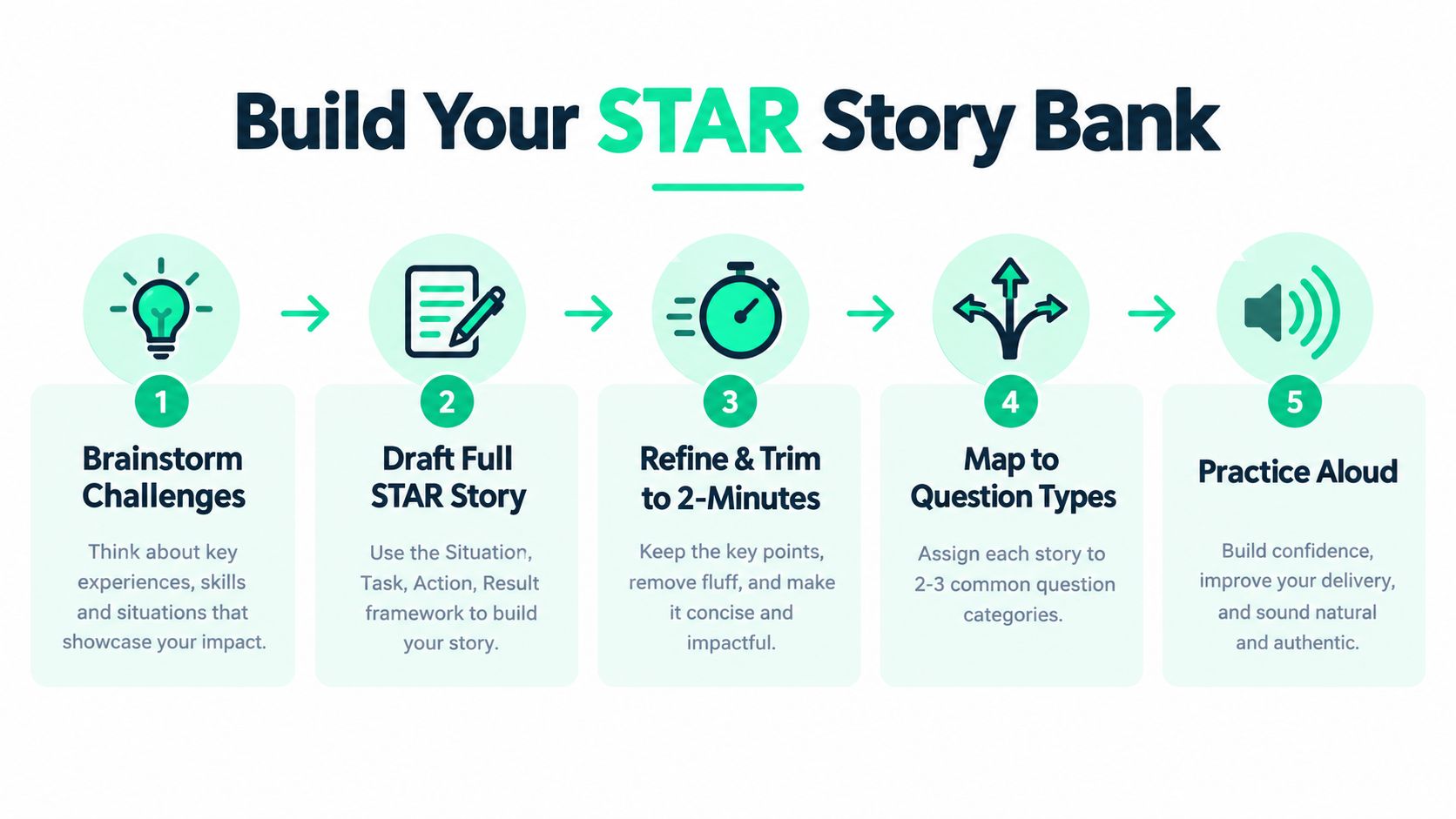
Write the full version first
Draft each story using four parts:
- Situation: Give only the context needed to understand the problem.
- Task: Explain your responsibility or objective.
- Action: Describe what you personally did, in sequence.
- Result: State what changed, what you learned, or what outcome followed.
The Action section deserves the most space. MIT Career Advising recommends allocating roughly 60% of the answer to Action, with the remaining attention divided among Situation, Task, and Result. Government interview guidance also places the Action portion at about 60–70% of the response, as described in this STAR pacing guidance.
Weak answer: “The team had a communication issue, so I helped improve collaboration.”
Stronger answer: “The design and engineering teams were working from different requirement documents. I created one shared decision log, scheduled a short review before each handoff, and flagged unresolved questions instead of letting them travel downstream. That gave the team one reference point and made the handoff easier to manage.”
The second answer gives the interviewer something to evaluate. It shows your judgment and your behavior.
Add real results, never decorative metrics
Use numbers when they're already supported by your resume or records. If you improved a process, explain the actual change. If you helped a customer, describe the outcome. If the result was relational, such as gaining stakeholder agreement or preventing a repeat issue, say that plainly.
Don't add invented percentages because they sound impressive. “The team adopted the new tracker for future projects” is more trustworthy than a fabricated efficiency claim.
Use a two-minute target
Rehearse until the core version lands in about 2 minutes, using a timer. This isn't a demand that every answer must be identical in length. It's a guardrail against wandering.
Your cue card should contain fragments such as:
“Launch delay, unclear ownership, interviewed stakeholders, built decision log, weekly review, handoff stabilized.”
Those prompts are enough to restore the sequence without forcing you into a script. Practice common interview questions by answering from cues, then vary the wording each time.
Prepare the deceptively simple questions
For “Tell me about yourself,” use a professional arc:
- What you're doing now or most recently.
- The experience that shaped your relevant strengths.
- Why this role is the logical next step.
For “What's your greatest weakness?”, choose a genuine development area and explain the system you use to improve it. Avoid presenting a disguised strength, such as claiming you care too much. For “Why are you leaving your current job?”, stay factual, respectful, and forward-looking. Explain what you're seeking rather than criticizing a former employer.
These questions create anxiety because they sound open-ended. Your cues should give you a beginning, middle, and end while leaving the words flexible.
Practice Aloud With Mocks and Recordings That Reveal Blind Spots
Silent review creates false confidence. You can recognize an answer on a page and still struggle to say it clearly when someone asks the question.
Use a two-week rhythm. The practical benchmark described in behavioral interview preparation guidance is to spend the first week building your stories, the second week drilling them aloud on a timer, then use the remaining preparation time for mock interviews.
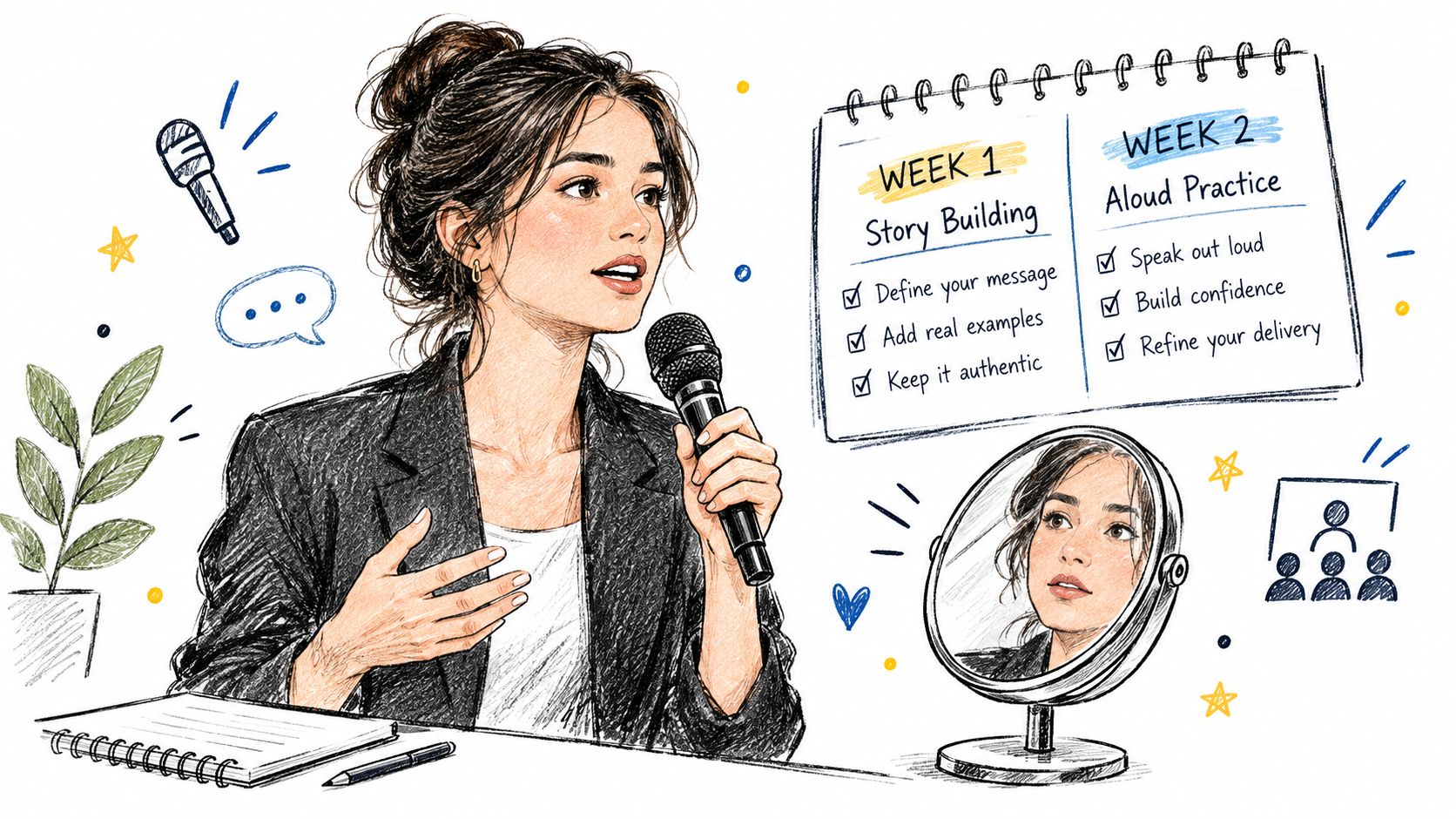
Week one builds the material
During the first week, complete the role and resume audit, draft your story bank, and identify backup examples. A strong bank can contain 5–8 STAR examples tied to core competencies, with one or two backup examples per competency, according to government interview preparation guidance.
Don't polish every story forever. Draft it, say it aloud, trim the context, and mark the moments where you sound vague. Your job is to make the experience retrievable.
Week two trains delivery
In the second week, answer questions aloud with a timer. Start with the story cue only. Then practice the same story against different prompts.
For example, take a story about fixing a process and answer:
- “Tell me about a time you improved efficiency.”
- “Describe a problem you solved without being asked.”
- “Tell me about a time you had to influence others.”
- “Give an example of learning from a mistake.”
The facts stay stable. The opening and emphasis change.
Record several practice runs. Listen for filler words, long introductions, repeated points, weak personal attribution, and endings that fade out. Recording exposes habits you can't reliably hear while concentrating on the content.
The recording isn't judging your personality. It's showing you where the interviewer may lose the thread.
Use mocks that include follow-ups
A mock interview shouldn't stop after your first answer. Ask the practice partner to follow up with:
- “What did you personally do?”
- “Why did you choose that approach?”
- “What was the result?”
- “What would you do differently?”
- “How did others respond?”
If you practice alone, pause after each answer and generate one skeptical follow-up. The goal is not to predict the exact question. It's to become comfortable extending a truthful story.
Structured interviews have stronger predictive value than improvised conversations. Sackett and colleagues reported a validity coefficient of about 0.42 for structured interviews, as summarized in behavioral interview preparation research. That supports a disciplined approach, but structure doesn't mean robotic delivery. It means you repeatedly practice the evidence the employer needs to assess.
For a guided routine, an AI mock interview tool can provide questions, follow-ups, and feedback without requiring you to coordinate another person's schedule.
Master Day Of Logistics and Calm Your Nerves Authentically
Anxiety grows in empty space. Remove avoidable uncertainty before the interview, then give yourself permission to pause during it.
The U.S. Department of Energy's interview module recommends arriving 10–15 minutes early, dressing conservatively, and knowing everything on your resume in detail. For a video interview, translate “arrive early” into opening the meeting setup in advance, checking your camera and microphone, and placing your notes where they won't pull your eyes away from the screen.
Clarify the format and support you need
Ask early whether the interview is by phone, video, in person, or panel format. If you need an accommodation, request it as soon as possible rather than hoping the difficulty will disappear on the day.
Neurodivergent-friendly preparation may include advance sharing of questions, asking the interviewer to present one question at a time, using written prompts, allowing extra processing time, choosing a quieter space, or permitting personal notes. Guidance from the NeuroHire Network emphasizes that preparation should reduce sensory and cognitive overload, not merely teach a generic answer format.
These adjustments don't make your answers less authentic. They make it easier for the interviewer to hear the abilities you already have.
Control the first ten seconds of each answer
When a question lands, take a brief pause. Repeat a key part of the question if you need a moment: “The example that best shows how I handled competing priorities was…” Then use your cue sequence.
If you lose the thread, don't panic or apologize repeatedly. Say, “Let me organize that clearly,” glance at your note if appropriate, and continue. A short pause looks more thoughtful than a rushed stream of filler words.
For Zoom or Google Meet, keep your resume and cue sheet near the camera, not hidden in another window. For phone interviews, use larger written prompts because you won't have visual contact to support attention. Keep water nearby, silence notifications, and remove anything from the desk that invites fidgeting.
Your target isn't perfect fluency. It's clear answers, accurate ownership, and a pace that lets the interviewer follow your reasoning.
Stay Confident and Authentic With Smart Support After Practice
The zero-script method works because it respects how memory behaves under pressure. You remember a project, conflict, decision, or result more reliably than you remember a paragraph you wrote late at night.
Your final preparation sheet should contain only low-latency prompts:
- Story label: “Client escalation.”
- Situation cue: “Missed handoff, unclear owner.”
- Action cues: “Clarified scope, set review, documented decision.”
- Result cue: “Agreement restored, repeat issue prevented.”
- Follow-up cue: “What I'd change, earlier escalation.”
That's enough structure to support natural speech without putting words in your mouth. It also protects credibility because every prompt stays tied to your verified experience.
Use feedback to improve one behavior at a time. If your answers ramble, set a shorter opening cue. If your Action section is thin, add the decisions you made. If you forget results, place the outcome at the top of the note. If you speak too quickly, mark “pause” after Situation and before Result.
After the interview, write down the questions you remember, the stories you used, and the follow-ups that exposed gaps. Send a specific thank-you note that refers to the conversation rather than copying a generic template. If you don't receive an offer, you can ask for feedback, although recent reporting found that only 10.7% of unsuccessful interviews requested detailed feedback, according to reporting on interview anxiety and feedback.
You don't need to become a flawless performer. You need a repeatable way to retrieve true examples, explain your contribution, and stay present when the wording changes. Build the cues, speak aloud, record the blind spots, and let your preparation make your real capabilities easier to hear.
Key Takeaways
- Memorization fails under pressure while cues survive it — 92% of U.S. adults report interview anxiety and 65% of UK jobseekers said nerves stopped them from showing their true ability, which is why remembering the event, your decisions, and the result works better than reciting a paragraph that collapses the moment an interviewer rephrases the question.
- The role-to-resume audit is the step most candidates skip — marking each requirement, locating real evidence, naming your specific contribution, capturing the outcome, and noting what you didn't own gives you truthful routes into stories and protects you from overclaiming when follow-up questions arrive.
- Give the Action section about 60% of every STAR answer, because that's where judgment shows — "I created one shared decision log, scheduled a review before each handoff, and flagged unresolved questions" gives an interviewer something to evaluate, while "I helped improve collaboration" gives them nothing.
- Practice aloud on a two-week rhythm rather than reviewing silently — week one drafts and trims the stories, week two drills them from cues against varied prompts with recordings and skeptical follow-ups ("What did you personally do?" "What would you do differently?"), because silent review creates false confidence and hides rambling, weak attribution, and fading endings.
- Real results beat decorative metrics — "the team adopted the new tracker for future projects" is more trustworthy than an invented percentage, and the same honesty principle applies to accommodations: requesting advance questions, one question at a time, written prompts, or extra processing time reduces cognitive load without making your answers less authentic.
Qcard provides resume-grounded memory cues, AI-scored practice, mock interviews with intelligent follow-ups, and delivery coaching for pacing, filler words, and answer length. Visit Qcard to practice without scripts and prepare answers that still sound like you.
Ready to ace your next interview?
Qcard's AI interview copilot helps you prepare with personalized practice and real-time support.
Try Qcard Free