How to Explain Resume Gaps Confidently and Get Hired
TL;DR
Explaining a resume gap well means being brief, factual, and future-focused — not building a defense. Use the three-part cue: reason, activity, readiness, delivered in 30 to 60 seconds. Gaps are normal (more than half of job seekers have had at least a one-month gap, and the share with no gaps fell from 57% in 2020 to 48% in 2025), so the interview isn't about proving you never had one. That said, length matters: ResumeGo's field experiment found callback rates of over 11% with no gaps, 10% with one- or two-year gaps, and steep drops to 4.6%, 3.7%, and 3.1% for three-, four-, and five-year gaps — with the sharpest fall between two and three years. Longer gaps aren't fatal; they just require a sharper story. On the resume, show years instead of months where it helps, consider a skills-based format for longer breaks, and add a compact Career Break entry with real activities. Protect your privacy: you owe a truthful professional answer, not your full medical, family, or immigration history. If pressed, say you'd rather keep the personal side brief and redirect to the skills you kept building. Practice out loud at 30, 45, and 60 seconds to find where you ramble.
You're staring at a blank interview prep doc, trying to decide whether to say “I took time off” or “I was caregiving,” and every version sounds either too vague or too personal. That's the core problem with how to explain resume gaps. Most candidates don't need a perfect story, they need a clean, believable one that doesn't invite more questions than necessary.
The good news is that employers already see gaps everywhere. A 2025 AARP analysis found that more than half of job seekers had at least a one-month gap, 1 in 4 had a gap of at least 12 months, and the share with no career gaps fell from 57% in 2020 to 48% in 2025 (AARP analysis). A separate LinkedIn survey of 23,000 global workers found that nearly two-thirds had taken some sort of career break (AARP analysis). That means the interview isn't about proving you never had a gap. It's about proving you can explain it cleanly and move on.
How Do You Explain Resume Gaps?
The answer is shorter than most candidates expect: name the reason in one sentence, add one line of proof, and pivot to readiness. Keep the whole thing to 30 to 60 seconds. Employers aren't hunting for a confession — they're listening for whether you can explain the gap without rambling, whether you did anything useful with the time, and whether you're ready to work now.
Gaps are also far more common than candidates assume. A 2025 AARP analysis found that more than half of job seekers had at least a one-month gap, 1 in 4 had a gap of at least 12 months, and the share with no career gaps fell from 57% in 2020 to 48% in 2025. A LinkedIn survey of 23,000 global workers found nearly two-thirds had taken some sort of career break.
Use the three-part memory cue: reason, activity, readiness.
Don't memorize a speech — memorize that sequence. Ask yourself three questions to build it: What happened (use the simplest truthful label)? What did I do during the gap (list only resume-credible activity)? What am I ready for now (end on return, not regret)?
Scripts for the most common reasons:
- Layoff: "My role ended in a restructure, and I used the time to sharpen my job-search focus and stay current. I'm ready to step back in and contribute quickly."
- Caregiving: "I took time for caregiving, stayed organized through that period, and kept my skills active where I could. I'm ready to bring that discipline into this role."
- Health: "I dealt with a health issue, handled it responsibly, and I'm fully focused on returning to work now."
- Study or travel: "I stepped away to study and gain perspective, and that time gave me stronger judgment and better direction."
- Career pivot: "I made a deliberate move toward this field, built the skills I needed, and I'm ready to apply them in a more targeted way."
Format the resume so the timeline reads cleanly. Show only years instead of months when that makes the timeline cleaner, consider a functional or skill-based format for longer gaps, and add a short Career Break entry with compact bullets when you have real activities to list — a certification, volunteering, freelance work, or upskilling. Keep any written explanation to one or two lines.
When more than one reason applies, lead with the one that explains the longest stretch of time, or the one that best connects to the role you want now.
Why Resume Gaps Are Normal and What Hiring Managers Actually Hear

The person across the table is usually not hunting for a confession. They're listening for three things, whether you can explain the gap without rambling, whether you did anything useful with the time, and whether you're ready to work now. If you sound organized, they relax. If you sound apologetic and scattered, they start wondering what else is fuzzy.
That's why the right response is never a long defense. It's a short bridge from the break to your current value. The most useful mindset is simple, explain the gap in one or two sentences, then pivot to evidence of skills, output, and readiness.
Practical rule: treat the gap like a bridge, not a courtroom. State the fact, add one useful detail, then move straight to why you fit the role.
The hiring manager doesn't need your whole life story. They need a reason to stop worrying about the timeline and start paying attention to the candidate in front of them. That shift matters because the market has already normalized discontinuity more than most job seekers realize, which is exactly why the answer should be brief, factual, and future-focused.
Assess Your Gap and Choose Your Honest Story Angle
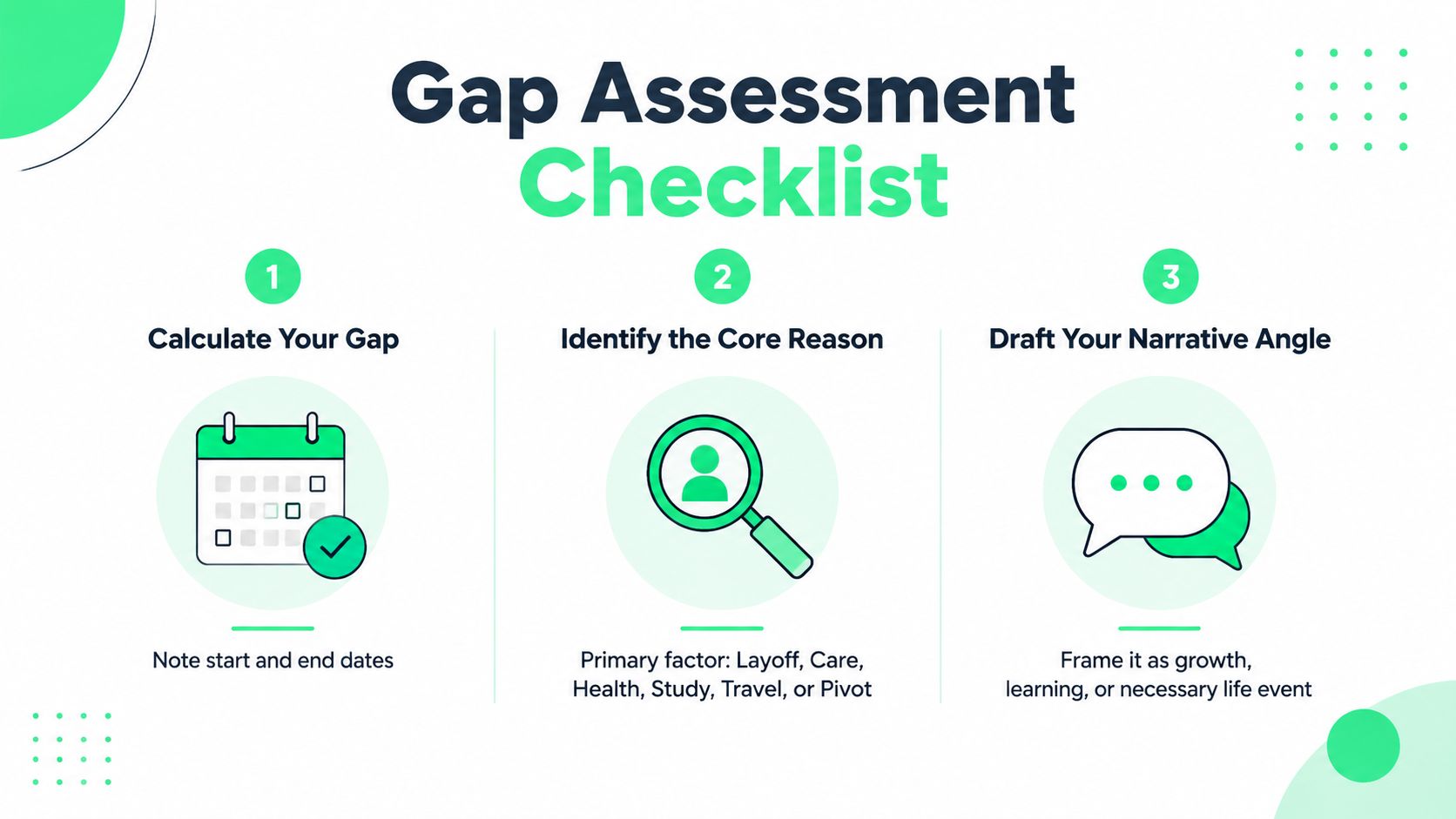
Start with the dates, not the emotion. Write the month and year you left, then the month and year you returned, or the month you expect to return if you are still searching. That gives you the actual length of the gap, and that number matters because employer reaction changes as the gap gets longer.
Analysts at ResumeGo ran a field experiment and found that resumes with no gaps had a callback rate of more than 11%, resumes with one- or two-year gaps were at 10%, and resumes with three-, four-, and five-year gaps dropped to 4.6%, 3.7%, and 3.1% respectively (ResumeGo field experiment). The steepest drop came when the gap moved from 2 years to 3 years, where callback rates fell from 9.8% to 4.6%, a 53.1% decrease. Long gaps are not fatal. They do mean your story needs to be sharper and more deliberate.
Pick one honest angle
Choose the angle that best fits the reason you were out. If the break was for caregiving, say caregiving. If it was health, say health. If you studied, freelanced, traveled, volunteered, or managed a transition, name the actual thing. Do not stuff the answer with every detail from that period.
Use a simple decision rule when more than one reason applies. Lead with the reason that explains the longest stretch of time, or the reason that best connects to the role you want now. If you were caregiving and also took a certification course, the caregiving explains the gap, and the certification shows you stayed active. If you left for burnout, recover, then re-entered through contract work, the return-to-work path matters more than the burnout detail. Pick the thread that lets the listener follow the timeline in one pass.
A clean way to sort this out is to ask three questions:
- What happened? Use the simplest truthful label.
- What did I do during the gap? List only resume-credible activity.
- What am I ready for now? End on return, not regret.
That gives you a memory cue you can use under pressure. One line for the reason, one line for proof, one line for readiness. If your mind goes blank in an interview, fall back to that sequence and keep moving.
A purpose statement built from those three parts becomes your anchor. For example, “I paused work for caregiving, kept my skills active through a certification, and I'm ready to bring that organization back into a full-time role.” Use the same core idea in your resume and in the interview. Keep the truth steady, keep the wording tight, and leave out the clutter that does nothing for your candidacy.
How to Format Your Resume to Frame Gaps Honestly
Most candidates overthink the story and underthink the page. Good formatting can make a gap feel like part of a coherent timeline instead of a flashing warning sign. Bad formatting does the opposite, because it invites the reader to do detective work.
One simple move is to omit months and show only years for shorter periods when that makes the timeline cleaner. Another is to use a functional or skill-based format if the gap is longer, especially when you want the resume to lead with capabilities instead of chronology. Guidance also recommends adding a short Career Break or professional sabbatical entry when you have real activities to list, such as certifications, volunteering, freelance work, or upskilling (TalentAnywhere guidance).
Keep any explanation on the page to one or two lines. The resume should make the gap visible enough to be honest, but not so prominent that it becomes the headline.
If you want a clean reference point for interview prep tied to your timeline, use this resume and interview question guide to pressure-test whether your wording sounds grounded or evasive. The goal is simple. Your resume should answer the date question without turning into a memoir.
Use structured proof, not clutter
Put the strongest evidence near the gap entry. If you earned a certification, completed a course, freelanced, or volunteered, list those items in compact bullets. Don't bury them in a paragraph. Scannable proof reads as confidence, while dense explanation reads as self-consciousness.
A sensible entry might look like this in plain language, not as a drama:
- Career Break, 2023
- Completed Excel certification
- Volunteered in operations support for a local nonprofit
- Returned ready for analyst work
That's enough. It tells the truth and keeps the reader moving.
Interview Scripts for Every Common Reason and How to Pivot with STAR
The cleanest interview answer uses a one-sentence, future-focused format and stays inside 30–60 seconds (Selfdriven Careers). That means you briefly name the reason, mention anything relevant you did during the break, and then pivot to why you're ready now. If you can say it without speed-walking through your own life, you're doing it right.
Use the same memory cue every time, reason, activity, readiness. Don't memorize a speech. Memorize that sequence.
A few examples, written the way a real person would say them:
- Layoff: “My role ended in a restructure, and I used the time to sharpen my job-search focus and stay current. I'm ready to step back in and contribute quickly.”
- Caregiving: “I took time for caregiving, stayed organized through that period, and kept my skills active where I could. I'm ready to bring that discipline into this role.”
- Health: “I dealt with a health issue, handled it responsibly, and I'm fully focused on returning to work now.”
- Study or travel: “I stepped away to study and gain perspective, and that time gave me stronger judgment and better direction. I'm now looking for a role where I can apply that focus.”
- Career pivot: “I made a deliberate move toward this field, built the skills I needed, and I'm ready to apply them in a more targeted way.”
If the interviewer asks a follow-up, answer only the part they asked. Don't volunteer extra detail because you feel pressure to prove yourself. That's where people overshare.
Use STAR when they push deeper
If the conversation turns behavioral, shift into Situation, Task, Action, Result. For a gap question, the “result” doesn't have to be a metric. It can be a readiness statement, a completed certification, a stronger routine, or a clearer career direction. That structure keeps you from spiraling into a ramble.
A good version sounds like this: “I paused work for caregiving, used that time to finish a project-management course, and I'm now prepared to use those organization and communication skills in this role.” That's not polished corporate speech. It's calm, specific, and easy to follow.
If you want a practice tool that can generate interview prompts from your actual resume, including the gap itself, Qcard's mock interview tool is one option to rehearse the answer out loud before the conversation.
What to Say What to Skip and How to Stay Private
A lot of advice gets this wrong. It tells candidates to “be honest” and then leaves them stranded when honesty collides with privacy. You do not owe an interviewer every detail of your layoff, burnout, health history, disability, immigration delay, or family situation. You owe them a truthful, professional answer that lets them evaluate your readiness.
Professional guidance from the National Careers Service says applicants should concentrate on transferable skills gained during the gap and what they learned from the experience, rather than dwelling on the absence itself (National Careers Service). That's the standard. Skills first, personal detail second, if ever.
What to say
Use short, factual language.
- Layoffs: “The role ended because of a restructure, and I've used the time to stay current and target my next role carefully.”
- Burnout or health: “I took time to handle a personal issue responsibly, and I'm ready for a stable return now.”
- Immigration or relocation: “My work timeline was affected by relocation logistics, and I'm now fully set up to work.”
- Caregiving: “I handled family responsibilities during that period and kept my skills active through learning and part-time work.”
What to skip
Skip the emotional backstory. Skip blame. Skip apologizing for being human. Skip anything that sounds like a justification tour. If you sound defensive, the interviewer starts listening for weakness instead of capability.
The safest boundary is this, one or two lines, then pivot. If the interviewer presses for private detail, you can say, “I'd rather keep the personal side brief, but I'm happy to talk about the skills I kept building during that time.” That protects your privacy without sounding evasive.
Decision rule: if the detail doesn't help them assess your ability to do the job, leave it out.
That rule matters even more for anxious, neurodivergent, and international candidates, because rambling often happens when people try to pre-answer every possible objection. Don't do that. Answer the question you got, then stop.
Practice Your Delivery So You Sound Calm and Confident
A strong answer falls apart fast if you sound rushed, defensive, or like you are reciting lines you barely understand. Your goal is simple, a delivery that sounds steady when your mind blanks and specific enough that the interviewer trusts it.
Use a timed drill. Say your gap answer out loud for 30 seconds, then for 45 seconds, then for 60 seconds. That range forces you to cut filler and find the one point that matters most. It also shows you exactly where you ramble, repeat yourself, or explain too much.
Build the answer around a few fixed cues you can remember under pressure:
- Start with the reason.
- Add one activity or skill.
- End with readiness.
That sequence matches the three-part structure used in strong gap explanations and maps cleanly to Situation–Task–Action–Result (ResumeFast). If the wording keeps slipping, stop trying to memorize a paragraph. Use memory cues tied to your own resume, like “caregiving, course, ready” or “layoff, project, now.” Those cues are easier to recall under pressure than polished sentences.
Keep your voice steady
Slow down a little. Pause after the reason. Pause again before the pivot. That tells the interviewer you are in control, not scrambling for the right words. If you hear yourself apologizing, cut the sentence and restart with something shorter.
One clean line can carry the whole answer, and you should know it cold before the interview. “I took time away for caregiving, used that period to complete a certification, and I'm ready to bring that experience into this role.” That tone works because it is calm, direct, and complete.
Key Takeaways
- The winning structure is reason, activity, readiness — delivered in 30 to 60 seconds — because hiring managers are listening for three things only: whether you can explain the gap without rambling, whether you did anything useful with the time, and whether you're ready to work now, so treating the gap like a bridge rather than a courtroom is the mindset that keeps answers short and credible.
- Gap length changes the stakes, which is why longer breaks need sharper stories — ResumeGo's field experiment showed callback rates dropping from over 11% with no gaps to 10% at one to two years, then falling to 4.6% at three years, 3.7% at four, and 3.1% at five, with the steepest single drop (a 53.1% decrease) coming between the two-year and three-year mark.
- Formatting does work the story can't — showing years instead of months for shorter periods, using a functional or skills-based format for longer breaks, and adding a compact Career Break entry with real bullets (certification, volunteering, freelance work) makes the gap visible enough to be honest without letting it become the headline.
- Privacy and honesty are not in conflict — you owe a truthful, professional answer, not your full health, family, or immigration history, and the safest boundary is one or two lines followed by a pivot, with a ready line for anyone who presses: "I'd rather keep the personal side brief, but I'm happy to talk about the skills I kept building during that time."
- Oversharing is the most common failure mode, especially for anxious, neurodivergent, and international candidates trying to pre-answer every possible objection — the fix is a timed drill (say the answer at 30, 45, and 60 seconds to find where you ramble), short memory cues tied to your own resume ("caregiving, course, ready" or "layoff, project, now"), and the discipline to answer only the part the interviewer actually asked.
For structured practice, use Qcard's mock interview tool, which can generate follow-up questions based on your actual resume. It helps you rehearse the hard part, staying brief when the interviewer pushes, and redirecting back to skills instead of drifting into a long explanation.
Ready to ace your next interview?
Qcard's AI interview copilot helps you prepare with personalized practice and real-time support.
Try Qcard Free