Discover how to answer tell me about yourself with expert guidance
Alright, let's reframe how you think about "Tell me about yourself." It's not just a casual icebreaker. It’s your opening move, a chance to pitch your professional story in a way that connects your past directly to the job you’re interviewing for. Think of it as the trailer for your career—it has to be compelling enough to make them want to see the whole movie.
Why Your First Answer Is Your Most Important
Let's get one thing straight: "Tell me about yourself" is the entire first act of your interview. It’s not just a warm-up. This is where you establish your confidence, frame your narrative, and set the tone for the rest of the conversation. In today's job market, a strong first impression isn't a nice-to-have; it's how you stay top-of-mind with a busy hiring manager.
This question gives you the rare opportunity to control the narrative right from the start. Instead of just reacting to questions, you get to proactively steer the conversation toward your biggest wins and show how they line up with what the company actually needs. A sharp, well-prepared answer shows you’ve done your homework and you know exactly why you're a great fit.
The Modern Hiring Gauntlet
The job search has turned into an endurance sport. Hiring timelines are getting longer and longer, which means every single interaction you have matters more. One recent analysis of over 1.6 million applications found that the average time to get a first job offer has ballooned from 57 days to a staggering 83 days—a 46% increase in just a year. You can dive deeper into these job search trends to see what this means for your strategy.
Your answer isn't just you reading your resume out loud. It's a strategic preview of the value you can deliver. A compelling story gives the interviewer the exact highlights they need to advocate for you behind the scenes.
Setting the Stage for Success
Ultimately, a great "Tell me about yourself" response does several jobs at once:
- It shows you're prepared: A structured, thoughtful answer proves you respect the interviewer's time and take this opportunity seriously.
- It showcases your communication skills: This is your first and best chance to prove you can be clear, concise, and engaging.
- It establishes immediate relevance: You connect the dots between your background and the problems they need solved, right from the get-go.
Wing it, and you risk rambling, sounding unfocused, or completely missing the chance to showcase your best stuff. But if you nail this answer, you turn a simple opening question into your most powerful strategic tool. It’s how you stand out when the hiring process feels like it's dragging on forever.
A Simple Framework for a Powerful Answer
When an interviewer says, "Tell me about yourself," the worst thing you can do is just walk them through your resume chronologically. It’s a guaranteed way to make their eyes glaze over. Instead of just winging it, what you need is a simple, reliable structure that lets you tell a compelling story.
The most effective method I’ve seen and used is the Present-Past-Future framework. Think of it less as a script and more as a mental roadmap. It helps you hit all the crucial points without getting sidetracked, ensuring your answer sounds natural and confident, not rehearsed.
This isn't just about making a good first impression; it's about framing your entire story to lead the interviewer to one conclusion: you're the right person for this job.
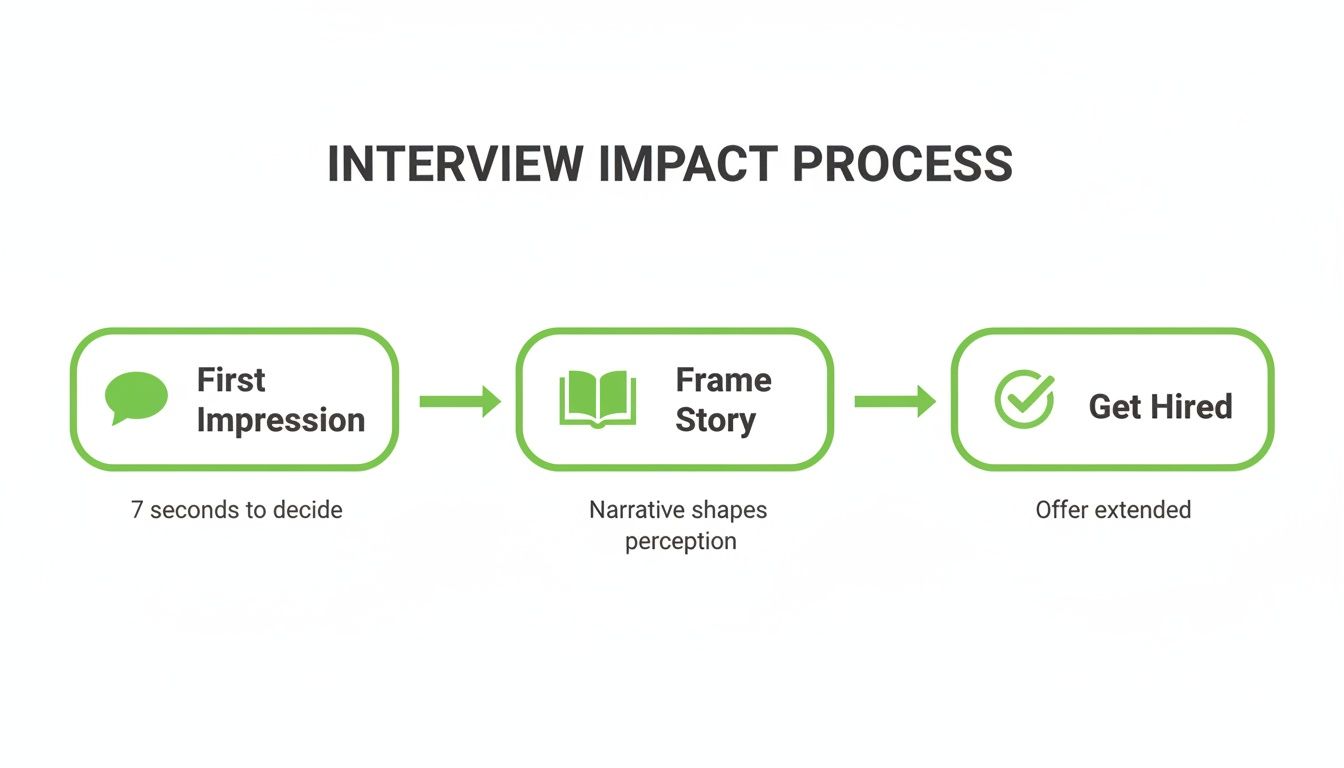
As you can see, a strong story is the bridge between that first handshake and the job offer.
Start with the Present
Kick things off with a tight, professional snapshot of who you are right now. This is your "here and now." Start with your current title and company, but immediately follow it up with a significant, high-impact accomplishment that’s relevant to the job you’re interviewing for.
This is the headline of your personal story. For example, a software engineer might say, "Right now, I'm a Senior Software Engineer at FinTech Corp. I just led the project to build our new risk engine, which is now protecting over $50 million in weekly transactions."
That opener is strong. It immediately shows your current level of responsibility and proves you deliver real, tangible results. The interviewer has a clear and impressive picture from the get-go.
Connect with the Past
Now, you need to build a bridge from your past to your present. Briefly touch on one or two previous roles or key projects that gave you the specific skills needed for this opportunity. Don't just list every job you've ever had. Be strategic.
Pick experiences that directly build the narrative you're creating.
For instance, our software engineer could continue with: "Before FinTech Corp, I was at a large social media company where my main focus was scaling data pipelines. That experience was crucial—it taught me how to build incredibly robust, planet-scale systems, which I know is a core requirement for this role." This isn't just a history lesson; it’s a direct link between past experience and the company's current needs.
Conclude with the Future
This is the most critical part. It’s the hook that connects your entire story to the company you're talking to. This is where you answer the unspoken question: "Why are you here?"
Your "Future" statement needs to do two things:
- Show your motivation: Express genuine excitement about the company’s mission, product, or the specific challenges of the role.
- Align your goals with theirs: Explain how your ambitions and skills will directly help them succeed.
A great closing sounds something like this: "I’ve been following your work in decentralized finance for a while, so I was really excited when this position opened up. I believe my experience in both risk management and scalable infrastructure is exactly what you need to build the next generation of your platform, and I'm eager to be a part of that."
This final move transforms your answer from a simple introduction into a compelling pitch. It proves you aren’t just looking for any job—you want this job, at this company, for a good reason.
Let's quickly recap how this simple framework gives your answer a clear, logical, and powerful flow.
The Present-Past-Future Framework at a Glance
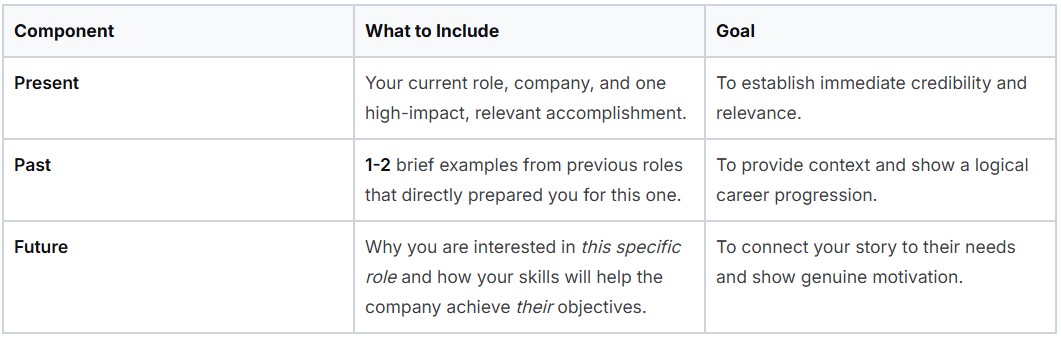
By sticking to this Present-Past-Future model, you create a narrative that’s easy to follow and hard to forget. It helps you keep your answer concise—aim for around 90 seconds—and ensures every word you say reinforces why you're the ideal candidate.
Tailoring Your Story to the Role
A generic, one-size-fits-all answer to "tell me about yourself" is a huge missed opportunity. While the Present-Past-Future framework gives you a solid foundation, the real magic happens when you customize your story to reflect the specific industry, company, and role you're targeting. This is how you move from being just another qualified candidate to the obvious choice for the job.
Think of the job description as your cheat sheet. It’s literally a list of problems the company needs to solve. Your job is to connect the dots between their problems and your accomplishments, using the language and metrics they actually care about.
Deconstructing the Job Description
Before you even think about crafting your answer, you need to break down the job posting into its core components. Scour it for keywords, recurring themes, and the underlying needs.
- Key Responsibilities: What are the actual day-to-day tasks and expectations?
- Required Skills: What technical abilities or soft skills are they explicitly asking for?
- Company Mission: What is the company’s bigger purpose? How do they see themselves?
Once you have this list, scan your resume for achievements that directly map to these points. This targeted approach ensures every part of your story feels relevant and impactful. For instance, if a company is struggling to find the right talent, your tailored answer immediately signals that you understand their pain points. It's a real problem out there; a recent report found that 76% of employers globally are having difficulty filling open roles. Companies are desperately searching for candidates who can clearly articulate their value. You can dive deeper into the current hiring reality check from Social Talent.
Crafting Industry-Specific Narratives
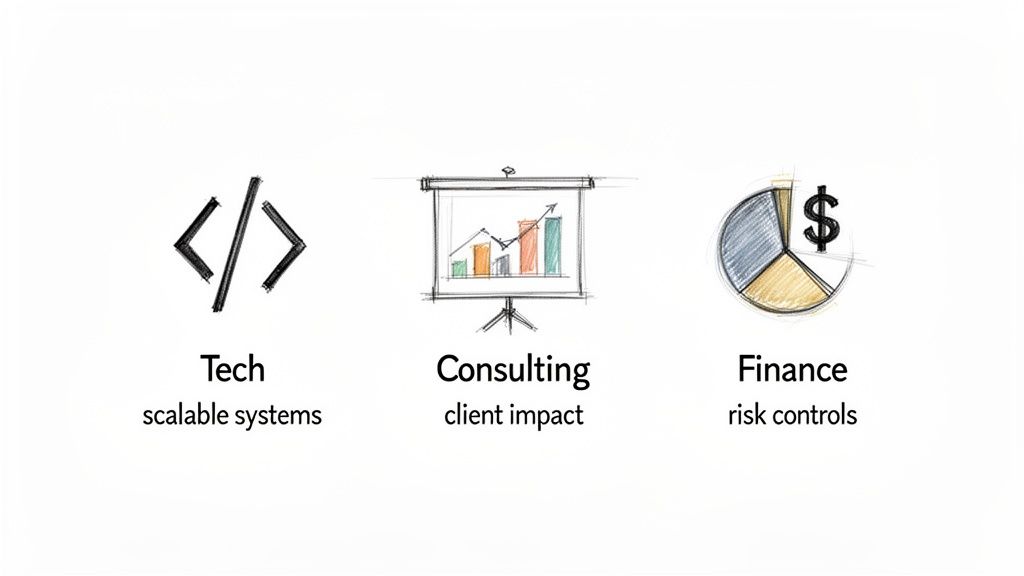
Different fields have entirely different priorities. A story that absolutely wows a tech recruiter might fall completely flat with a consulting partner. Let’s look at how to adapt your answer for a few key industries.
The Tech Answer: Focus on Scale and Impact
In technology, interviewers want to hear about building, scaling, and shipping. They care about your ability to handle complexity and deliver tangible results. Your answer should be grounded in specific projects and, most importantly, quantifiable outcomes.
Example for a Senior Software Engineer Role:
"Currently, I'm a Senior Software Engineer at FinTech Corp, where I've been focused on fraud prevention. I recently led the development of a new risk policy engine from the ground up for our global payroll product, a system that now protects tens of millions of dollars in transactions weekly.
Before this, I spent over three years at a major social media company working on video metrics. There, my main challenge was ensuring the accuracy and scalability of our data pipelines for the entire platform. That experience taught me how to build incredibly robust, planet-scale systems, which I know is a key need for this role.
I've been following your work on real-time data processing, and I was excited to see this position open up. I believe my background in both building high-stakes financial systems and scaling infrastructure is the right combination to help you build out your next-generation platform."
This answer lands perfectly because it's packed with industry-specific keywords like "fraud prevention," "policy engine," "scalability," and "data pipelines." The metric—tens of millions of dollars—provides concrete proof of impact.
The Consulting Answer: Emphasize Client Outcomes
In consulting, the focus shifts squarely to client impact and problem-solving. Your story needs to demonstrate that you can quickly understand a client's business, analyze complex problems, and deliver actionable recommendations that drive real results.
Example for a Strategy Consultant Role:
"I'm currently a Consultant at a boutique firm, where I specialize in go-to-market strategy for enterprise SaaS companies. In my latest project, I led a workstream for a client looking to enter the European market. My analysis identified a key underserved customer segment, and the strategy we developed is projected to generate $15 million in new ARR over the next two years.
Before this, I worked in corporate strategy for a large tech company. That role gave me a deep appreciation for the internal complexities of executing on a global scale, which has been invaluable when advising my clients on realistic implementation plans.
I'm drawn to this opportunity because your firm has a strong reputation in the industrial sector, an area I'm keen to develop. I'm excited by the prospect of applying my GTM framework to help major industrial clients navigate their digital transformation, and I'm confident my background will allow me to start delivering value from day one."
Notice the shift in language? It’s all about "client," "strategy," "analysis," and "projected revenue." The focus is completely external, on the value delivered to someone else.
Key Takeaway: Your goal is to speak the same language as your interviewer. Mirroring the terminology and priorities of their industry shows you’re an insider who already understands what matters most.
The Finance Answer: Highlight Risk and Precision
In the world of finance, precision, risk management, and regulatory awareness are everything. Your answer should convey a sense of meticulousness and a deep understanding of the financial landscape. Vague statements just won’t cut it here; you need to show you’re comfortable with hard numbers and fine details.
Example for a Financial Analyst Role:
"I'm a Financial Analyst on the FP&A team at a major retail corporation, where I'm responsible for forecasting and budget management for our e-commerce division, which represents over $500 million in annual revenue. I recently built a new variance analysis model that improved our forecast accuracy by 15%, allowing us to reallocate capital to higher-growth initiatives more effectively.
Previously, I was an analyst at a smaller firm where I first learned the fundamentals of financial modeling and stakeholder reporting. That experience gave me a solid foundation in the core technical skills needed to manage the complexities of a large, publicly-traded company.
I’m particularly interested in this role because of your company’s expansion into international markets. I’m eager to apply my analytical skills to a more complex global environment and contribute to navigating the unique financial challenges that come with that scale."
This answer is effective because it’s built on a foundation of hard data: $500 million in revenue, 15% improvement in accuracy. It demonstrates a clear understanding of financial processes like FP&A, forecasting, and variance analysis. By mastering how to answer tell me about yourself with this level of specificity, you prove you're already fluent in the language of finance.
Delivering Your Pitch with Confidence
You’ve got a perfectly structured story. Great. But that’s only half the battle. If you sound hesitant, rushed, or anxious when you tell it, even the most compelling narrative will fall completely flat. This is where we shift from prep work to performance. It’s time to focus on the practical skills that make sure your answer actually lands with the impact it deserves.
A confident delivery isn't just about showing off good communication skills. It tells the interviewer you’re comfortable under pressure and speaking from a place of real experience, not just reciting a script you found online.

Practice So It Feels Natural, Not Rehearsed
Let’s be clear: the goal here is not to memorize your answer word-for-word. Memorization is a trap. It almost always sounds robotic, and if you forget a single word, the whole thing can fall apart. Instead, you want to internalize the key talking points from your Present-Past-Future framework.
Think of yourself as a jazz musician. You know the melody inside and out, but you can still improvise and make it your own. Your talking points are the melody; your delivery is the improvisation that makes it feel alive.
A fantastic way to get started is to just record yourself on your phone. Fire up the voice memo app, answer the "tell me about yourself" question out loud, and then play it back. When you listen, don't judge the content—focus only on how you sound.
- Pacing: Are you talking a mile a minute? Rushing is a classic sign of nerves. You want a deliberate, conversational pace that gives the interviewer time to actually process what you're saying.
- Tone: Do you sound genuinely interested, or are you delivering a flat, monotonous report? Let your vocal tone show your enthusiasm for the role.
- Filler Words: How many times did you say "um," "uh," "like," or "you know"? A few are totally fine and human, but too many can make you sound like you don't know what you're talking about.
This kind of self-assessment is surprisingly powerful. You get to hear yourself exactly as an interviewer would, which gives you immediate, concrete feedback for your next practice run.
Managing Nerves and Projecting Confidence
Look, interview anxiety is real and completely normal. The trick isn't to eliminate it but to channel that nervous energy into focus instead of letting it take over. This is where all your prep work really pays off.
When you have that clear structure in your head, you take a huge weight off your shoulders. You’re not scrambling to figure out what to say, which frees up your brain to focus on how you're saying it. This is where a tool like Qcard can be a lifesaver. It gives you subtle, resume-grounded cues to keep you on track without you having to stare at a script, helping you stay natural even when the pressure is on.
Your body language speaks volumes, even over a video call. Sit up straight, look at the camera (not just your own face on the screen), and use hand gestures like you would in a normal conversation. These small physical tweaks make a huge difference in how confident you appear—and feel.
Reading the Room in Real Time
The best answers are adaptable. This is supposed to be a dialogue, not a monologue you perform at someone. From the moment you start speaking, pay close attention to the interviewer's non-verbal cues.
- Are they engaged? If they're nodding along and making eye contact, you're in a good rhythm. Keep going.
- Are they distracted? If you see them glancing at another screen or looking bored, it’s probably a sign to wrap up your current point and move on.
- Are they in a hurry? If the interviewer mentions they have a packed schedule, be ready to pivot to a more concise, 60-second version of your story.
Knowing how to answer this question also means knowing when to stop talking. Aim for a target length of around 90 seconds. That’s the sweet spot—enough time to cover your framework without making the interviewer's eyes glaze over. Practicing with a timer will help you develop an internal clock for what 90 seconds feels like, so you can hit that mark naturally when it counts.
The Stumbles and Saves: Common Mistakes to Sidestep
Even the most seasoned professionals can trip over "tell me about yourself." It seems so simple, but that’s what makes it tricky. Knowing the common pitfalls is the first step to nailing your answer and making a great first impression. Get this part wrong, and you could spend the rest of the interview trying to recover.
This isn’t just about dodging a bullet; it’s about making an immediate connection. Think about it: a whopping 41.2% of candidates bail on job applications because they feel disconnected. Your introduction is your first, best chance to create that connection, making the interviewer lean in and want to hear more. For more on this, check out these insights on global hiring trends from Recruitee.
The First Mistake: The Endless Ramble
We've all seen it. Nerves kick in, and suddenly you're on a verbal road trip with no map. This happens when you haven’t prepared a clear structure for your answer. You end up meandering through your career history, hoping a relevant point eventually emerges. By then, you’ve lost your audience.
- Don't do this: "Well, I started out in marketing, but that wasn't for me, so I jumped into a coding bootcamp. My first job was at this little startup, it was wild, we wore a lot of hats. Then I moved to a big corporation, which was a huge culture shock, and I worked on some different projects there..."
- Do this instead: "I'm a Software Engineer at a SaaS company, where I just helped ship a feature that boosted user retention by 10%. I broke into tech through a coding bootcamp, cut my teeth at a fast-paced startup, and then learned to build highly scalable systems at a larger firm. I'm really excited to bring that blend of scrappiness and structure to solve the unique problems here in fintech."
The Second Mistake: The Resume Read-Aloud
Your interviewer has your resume. They've probably already read it. The last thing they need is for you to give them a live, line-by-line reading. It’s a missed opportunity to inject personality and connect the dots in a way your resume can’t.
Your answer should be the story behind the resume, not the resume itself. This is your chance to add color, context, and a clear narrative that a piece of paper simply can't provide.
Instead of just stating a job title and your dates of employment, talk about the impact you had. Frame it around what you learned and accomplished, and how that experience tees you up perfectly for this role. That’s how you turn a summary into a compelling pitch.
The Third Mistake: Sounding Like a Robot
Practice is essential, but memorizing a script is a death sentence for rapport. When you deliver your answer word-for-word, you sound stiff and inauthentic. It makes it impossible for the interviewer to connect with you on a human level. Honestly, it can even make them wonder if you're getting help from a teleprompter or an AI tool.
- Don't do this: Delivering a flawless, monotone paragraph with zero natural pauses or changes in your tone.
- Do this instead: Know your key talking points—your Present, Past, and Future—inside and out. But let the words flow naturally in the moment. A few "ums" or a brief pause to gather your thoughts is totally fine. It shows you're a real person, not a chatbot. Aim for polished, not perfect.
The Fourth Mistake: TMI (Too Much Information)
Remember, this is a professional introduction, not a therapy session. Steer clear of your life story, personal hobbies, or family drama unless it's directly and obviously relevant to the job you’re interviewing for. Sharing too much can come across as unprofessional and shows a lack of judgment.
Keep your story tight and focused. Every sentence should be working to answer one underlying question: why are you the right person with the right experience to solve this company's problems?
Answering the Tough Questions
Even with the best preparation, you'll still run into tricky situations. Thinking through these common curveballs ahead of time will help you stay cool and confident when they come up. Let's walk through some of the questions I hear most often from candidates.
How Long Should My Answer Be?
Aim for the sweet spot: between 90 and 120 seconds.
That's enough time to tell a compelling story—your Present, Past, and Future—without the interviewer's eyes glazing over. Go much shorter, and you risk sounding unprepared. Go longer, and you're just monologuing.
Of course, read the room. For a quick phone screen with a recruiter, you might want to keep it closer to 60-90 seconds. But if you're in a final round with the hiring manager, stretching it out a bit to provide more depth is perfectly fine. The real trick is to time yourself during practice so you can nail that two-minute mark without even thinking about it.
What if My Career Path Is All Over the Place?
A non-linear career path isn't a liability; it's a story waiting to be told. Your job is to connect the dots for the interviewer, showing them how your unique journey has made you the perfect, well-rounded candidate for this specific role.
Whatever you do, don't apologize for it. Own your story. Focus on the transferable skills and unique perspectives you picked up along the way.
- Adaptability is your superpower. Frame your jumps between industries as proof that you learn incredibly fast.
- Highlight your unique toolkit. Show how that "unrelated" job in marketing gave you communication skills that other data analysts just don't have.
This is where your "Future" statement really shines. It's the grand finale that ties everything together, showing that every move was a deliberate step on the path that led you right here.
A varied background often signals creativity and resilience. Your job is to build a narrative that showcases this, proving your journey gives you an edge that a more traditional candidate might not have.
Should I Mention My Hobbies?
My advice is almost always no. Keep it professional.
The interviewer wants to know if you can solve their company's problems, and the fact that you're an avid rock climber probably doesn't help answer that question. Stick to your career story to keep the conversation focused on what matters.
The only exception? If your hobby is directly and powerfully relevant to the job. If you’re interviewing for a developer advocate role and run a popular coding blog, mention it! If you’re up for a project manager position and you organize large-scale community fundraisers for fun, that's worth a brief mention. Even then, tie it directly back to a professional skill.
How Do I Answer This for an Internal Role?
When you're interviewing for a promotion or a move to another team, don't assume they know what you do. The interviewer might be from a completely different part of the business and have zero context for your biggest wins. You still have to sell yourself.
The key is to frame your answer around your growth within the company and the immediate impact you can make.
- Present: Start with your current role, but highlight a key accomplishment they probably don't know about.
- Past: Talk about previous projects at the company that specifically groomed you for the challenges of this new role.
- Future: Explain how your deep institutional knowledge means you'll deliver value faster than any external hire. Show them you can hit the ground running on day one.
When you're in the hot seat, it's easy to forget your best stories or the specific metrics that prove your impact. Qcard is an AI copilot designed to give you subtle, resume-grounded talking points in real-time. It helps you pull up your best examples and data points right when you need them, so you can sound confident and authentic, never scripted. Learn more at https://qcardai.com.
Powered by the Outrank tool
Ready to ace your next interview?
Qcard's AI interview copilot helps you prepare with personalized practice and real-time support.
Try Qcard Free