How to Answer Technical Interview Questions with Confidence
TL;DR
Answering technical interview questions well is about structure, not brilliance — because interviewers are evaluating correctness, reasoning, communication, and trade-off awareness simultaneously, under time pressure and incomplete information. Use one five-stage frame everywhere: restate the problem, offer an approach before executing, explain trade-offs, narrate while you work, and verify with edge cases and complexity. Then adapt it by round type — coding needs a clear time budget (clarify, approach, code, test, optimize), system design needs scope-then-architecture-then-bottlenecks-then-trade-offs across a 25-minute pacing map, debugging needs reproduce-isolate-hypothesize-fix-verify with falsifiable hypotheses, and behavioral answers need STAR with roughly 60% of the time on Action. Structure matters because structured interviews score around 0.42 validity versus 0.19 for unstructured, meaning a scorable response beats an impressive monologue. Prepare a recovery script for stalls, replace weak verbs like "helped with" with "I traced" and "I rolled back," and practice in 25-minute timed loops targeting roughly 60% thinking aloud, 25% coding, and 15% verification.
You hear the technical prompt, open your editor, and suddenly the room feels much quieter than it did a moment ago. Your palms tighten, the blank screen looks hostile, and a short pause starts to feel like proof that you don't know enough. You may understand the underlying concept perfectly well, yet struggle to explain it while someone evaluates every assumption, keystroke, and hesitation.
That pressure is normal, but it doesn't have to control the interview. Learning how to answer technical interview questions means preparing more than algorithms. You need repeatable structures, deliberate pacing, clear narration, practical trade-off language, and a practice loop that makes those behaviors available when anxiety narrows your attention.
How Do You Answer Technical Interview Questions?
Answering technical interview questions well requires more than knowing algorithms — it requires repeatable structures, deliberate pacing, clear narration, and trade-off language that stays available when anxiety narrows your attention. And that pressure is measurable: a 2015 meta-analysis found a moderate negative relationship between interview anxiety and performance (correlation of about -0.19), while a separate study on job interview anxiety reported an overall multiple correlation of -0.34 with interviewer-rated performance.
Use one five-stage frame for every technical prompt:
- Restate the problem and expose assumptions — Confirm inputs, outputs, duplicates, ordering, mutation, and constraints before touching code.
- Offer an approach before executing it — Name the brute-force solution, then state the optimization you expect to use.
- Explain the relevant trade-offs — Time, space, consistency, cost, or failure implications.
- Execute while narrating decisions — Only narrate choices that help the listener follow your logic.
- Verify with examples, edge cases, and complexity — Test a normal case, a duplicate, a boundary value, and an input with no valid answer.
Adapt the frame to the round type. Coding rounds need clarification, approach, implementation, testing, and optimization — with a working budget of 1–2 minutes clarifying, 1 minute on approach, 15–20 minutes coding, 3–5 minutes testing, and 2 minutes optimizing. System design needs scope, architecture sketch, deep dives on two or three bottlenecks, then explicit trade-offs and failure handling. Debugging needs a narrative arc: reproduce, isolate, hypothesize, fix, verify — with each hypothesis stated so it can be disproved. Behavioral answers need STAR with the Action section carrying the most weight.
Have a recovery script ready. When your mind stalls, say: "Let me restate the requirement, check the constraints, and work through a small example before I choose an approach." That buys thinking time without sounding evasive and moves you from self-evaluation back to problem-solving.
Ask about AI tools up front. If they're permitted, treat AI output like a junior teammate's suggestion — explain the prompt, inspect the code, test assumptions, and name what you changed. One survey summary reported that 66% of hiring teams rank catching and fixing AI mistakes as a top signal, while 56% prioritize trade-off explanation.
The Moment Every Candidate Dreads
The interviewer finishes the prompt and waits. You consider three possible approaches, reject two too quickly, and start typing before you've confirmed what the input means. Twenty seconds pass. You fill the silence with “um,” “so,” and “I guess,” then commit to a solution you haven't tested mentally.
That sequence creates several predictable problems:
- Blank-page panic: You treat the absence of an immediate idea as evidence that you can't solve the problem.
- Premature commitment: You choose a data structure before clarifying constraints or expected output.
- Silence anxiety: You assume the interviewer's quietness means you're failing, even when they're giving you space to reason.
- Filler-word drift: You speak continuously to hide uncertainty, making your thinking harder to follow.
Interview anxiety has a measurable relationship with performance. A 2015 meta-analysis found a moderate negative relationship between interview anxiety and interview performance, with an overall correlation of about -0.19 in its review of employment interview anxiety. A separate study on measuring job interview anxiety reported an overall multiple correlation of -0.34 with interviewer-rated performance, also discussed in that source. The practical meaning is straightforward. Knowing the material isn't enough if stress disrupts your working memory, pacing, or verbal organization.
Practical rule: A pause is only a problem when you leave the interviewer without a map of what you're doing next.
Use a simple recovery script when your mind stalls: “Let me restate the requirement, check the constraints, and work through a small example before I choose an approach.” That sentence buys thinking time without sounding evasive. It also moves you from self-evaluation back to problem-solving.
Narration replaces the uncomfortable vacuum. Say, “I'm going to start with the straightforward approach, then I'll look for a way to reduce repeated work.” If you need a behavioral structure, concise guidance on organizing personal answers is available in these StoryCV answer framework tips. The same principle applies here, keep the listener oriented.
The rest of your preparation should target these failure modes directly. Frameworks replace panic, narration replaces unexplained silence, pacing prevents rushed decisions, and practice loops turn useful phrases into automatic habits. You should leave your next screen or onsite knowing exactly how to open, when to check in, and how to recover if the first idea isn't the right one.
Why Structured Answers Win Every Round
Technical interviews aren't private demonstrations of brilliance. They're assessments conducted under limited time, incomplete information, and imperfect human attention. Interviewers are usually trying to evaluate several signals at once, including correctness, reasoning, communication, and awareness of trade-offs.
Structured interviews became important in personnel selection because standardization improves consistency and reduces noise from interviewer bias. Guidance from the Society for Industrial and Organizational Psychology on structured interviews describes a consistent process using the same questions, scoring rubric, and evaluation method across candidates. The U.S. Office of Personnel Management guidance summarized in this structured interview overview likewise connects structure with greater interviewer agreement. The same source cites a 2022 meta-analysis update reporting validity around 0.42 for structured interviews versus 0.19 for unstructured interviews. Those values don't mean a format guarantees a hiring decision, but they do explain why a scorable response is more useful than an impressive monologue.
A reliable technical frame looks like this:
- Restate the problem and expose assumptions.
- Offer an approach before executing it.
- Explain the relevant trade-offs.
- Execute while narrating decisions.
- Verify with examples, edge cases, and complexity.
The frame works because each stage gives the interviewer a clear evaluation point. It also reduces your own cognitive load. You don't have to invent the shape of the answer while solving the problem.
Behavioral answers need context, responsibility, action, and outcome. For a broader preparation workflow, Qcard's interview prep guide can help you organize question practice around repeatable answer patterns.
Answering Coding Questions Out Loud
A coding round rewards correct implementation, but silent correctness is difficult to assess. Your interviewer needs to see how you interpret the problem, select a data structure, respond to edge cases, and recover when the first path doesn't work.
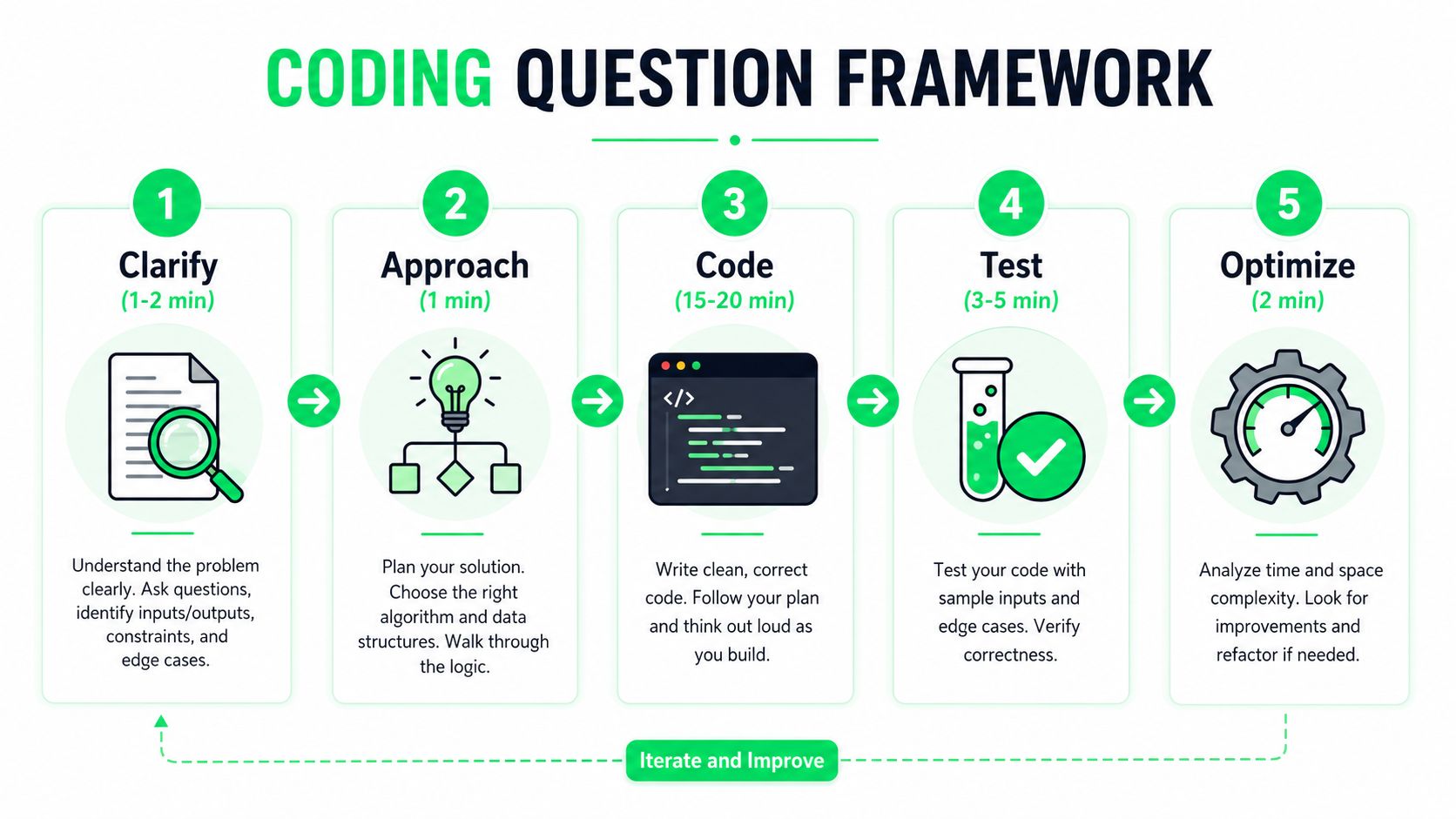
Use this time budget as a starting point:
- Clarify, 1 to 2 minutes: Confirm inputs, outputs, duplicates, ordering, mutation, and constraints.
- Approach, 1 minute: Describe the simple solution, then state the optimization you expect to use.
- Code, 15 to 20 minutes: Implement in small, explainable pieces.
- Test, 3 to 5 minutes: Walk through a normal case and edge cases.
- Optimize, 2 minutes: State complexity and identify any remaining improvements.
A worked example with two sum and duplicates
Suppose the prompt asks you to return the indices of two values whose sum equals a target, with duplicate values allowed. Start by saying:
“I want to confirm that I can return any valid pair, that indices should be distinct, and that duplicates are valid when they occur at different positions. I'll assume there may be no solution unless you tell me otherwise.”
Then outline the approach:
“A brute-force solution checks every pair. I can do better with a hash map that stores a value's index as I scan. For the current value, I'll calculate its complement. If the complement is already present, I have a pair. Otherwise, I'll store the current value and index.”
That explanation exposes the key decision before code appears. It also handles duplicates naturally. If the target requires two copies of the same value, the first copy is stored and the second copy finds it.
While coding, narrate only decisions that help the listener:
- “I'm checking the map before inserting the current value, so a value can't match the same index.”
- “I'll return immediately when I find a valid pair because the prompt allows any pair.”
- “If no pair exists, I'll return the agreed empty result.”
Before testing, state complexity directly: “The scan is linear in the number of values, and the map uses linear additional space.” Then walk through a normal input, a duplicate pair, a negative value, and an input with no valid answer.
What to say when the path breaks
Don't spiral if your first approach fails. Use this sequence:
- Re-read the exact requirement.
- Draw a small input by hand.
- Describe the brute-force method.
- Identify the repeated work.
- Replace that repeated work with a data structure or invariant.
- Check the revised plan with the interviewer.
Useful phrases include:
- “I see a possible issue with that assumption. I'm going to test it against a smaller example.”
- “The straightforward version is clear. I'm looking for the repeated operation that limits its performance.”
- “Before I change the code, I want to state the invariant this loop should preserve.”
- “Does this direction match the level of detail you want, or should I continue into the implementation?”
Keep the interviewer oriented after each milestone. A short check-in isn't a request for permission to think. It's evidence that you can collaborate while solving. You can find additional prompts for practicing this style in Qcard's technical interview question set.
System Design Answers That Show Senior Judgment
System design interviews expose how you make decisions when requirements conflict. A diagram full of familiar components won't demonstrate senior judgment if you haven't explained what the system must guarantee, where it will fail, or why one trade-off is acceptable.
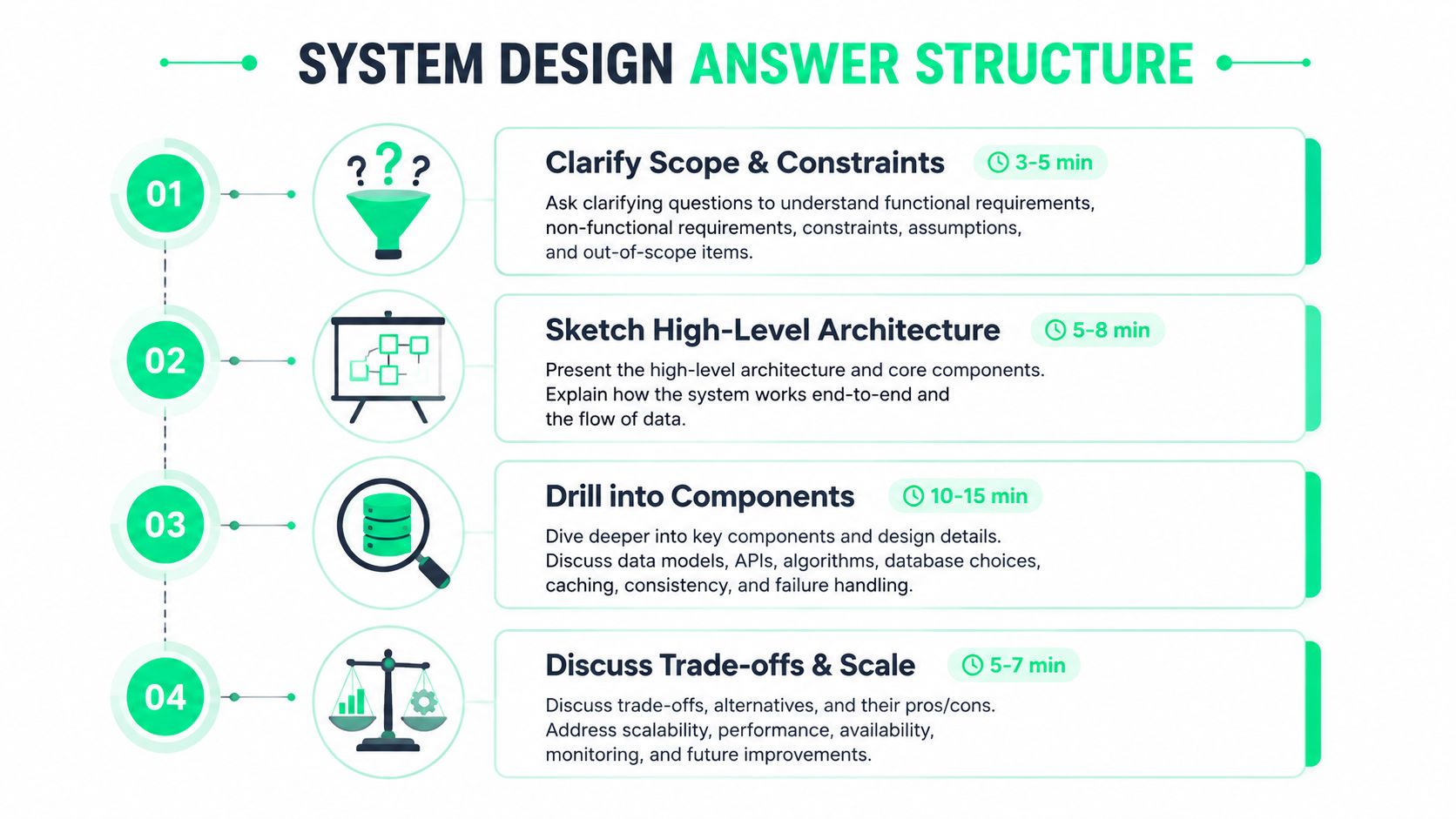
Use four stages:
- Clarify scope and constraints.
- Sketch the high-level architecture.
- Drill into the critical bottlenecks.
- Close with explicit trade-offs and failure handling.
For a URL shortener, begin with questions about who creates links, who resolves them, whether links expire, what latency matters, how redirects are tracked, and what abuse controls are required. Don't invent operational assumptions. Say which ones you're making and invite correction.
A practical 25-minute pacing map looks like this:
- Minutes 0 to 4: Requirements, traffic shape, read and write behavior, durability, and privacy.
- Minutes 4 to 9: API boundaries and the first architecture sketch.
- Minutes 9 to 19: Identifier generation, storage, caching, redirects, analytics, and failure modes.
- Minutes 19 to 25: Bottlenecks, alternatives, monitoring, and explicit trade-offs.
Put the architecture on the board before the details
Draw the request path first. A client sends a create request to an API, the service generates a short identifier, durable storage maps that identifier to the destination, and a redirect service reads the mapping. Add a cache only after explaining the access pattern it addresses. Add an analytics path separately so redirect latency doesn't depend on synchronous event processing.
Then choose two or three areas for depth. For this example, those might be identifier collisions, hot links, and analytics durability. You don't need to name every possible component. You need to show that you can identify the parts most likely to affect reliability and scale.
Use sentences that make trade-offs visible:
“I'm choosing consistency over availability here because creating two different destinations for the same identifier would be more damaging than briefly rejecting a create request.”
“This design will break when write volume exceeds the capacity of the identifier store, so I'd partition generation and storage, monitor rejection rates, and provide a controlled fallback.”
The prompt may not provide enough information for a literal threshold. In that case, don't manufacture one. Describe the boundary qualitatively, state what measurement would reveal it, and explain how the design would evolve.
Senior answers also include failure behavior. What happens if the cache is unavailable? If analytics falls behind? If the destination changes while an old value remains cached? A clear answer distinguishes user-facing correctness from secondary features, then assigns each a suitable consistency and recovery strategy.
Behavioral and Situational Answers With Real Metrics
Technical candidates often underprepare for behavioral questions because they seem less concrete. That's a mistake. Your story gives the interviewer evidence about ownership, judgment, communication, and impact, especially when you connect the story to the role.
Use STAR, Situation, Task, Action, Result. A useful delivery split is 10 seconds for Situation, 15 seconds for Task, 90 seconds for Action, and 45 seconds for Result. MIT's career guidance presents a similar emphasis, assigning approximately 20% to Situation, 10% to Task, 60% to Action, and 10% to Result, while emphasizing quantifiable outcomes when possible in its STAR method guidance. Northwestern's career office gives another version, 15% Situation, 10% Task, 50% Action, and 25% Result, with the Action section remaining the longest in its STAR approach.
Those splits aren't competing laws. They point to the same behavior: compress context, spend most of the answer on what you personally did, and make the outcome easy to evaluate.
A production outage example
“During a production release, error rates increased after a change to request validation. My task was to restore service quickly while identifying whether the release or an upstream dependency caused the failure. I compared the failing requests with successful ones, added a targeted reproduction using the affected payload shape, and traced the request path through the validation layer. The logs showed that a newly introduced rule rejected a legitimate optional field. I rolled back the rule, added a regression test for the payload, and reviewed the change with the release owner before reintroducing a narrower validation check. That reduced MTTR from 42 to 11 minutes across six incidents.”
That sample works because it names the person's responsibility, gives a sequence of actions, and finishes with a measurable result. The 42-to-11-minute reduction across six incidents comes from the example specified for this interview scenario, not from a general performance claim.
Weak verbs hide ownership. “Helped with the outage” tells the interviewer almost nothing. “Worked on improving reliability” leaves the action and result undefined. Replace them with “I traced,” “I compared,” “I rolled back,” “I added,” and “I verified.”
Weak Phrasing Strong Phrasing
“I helped fix the outage.”
“I isolated the validation rule, rolled it back, and added a regression test.”
“We improved the pipeline.”
“I replaced the repeated query with a batched retrieval path and verified the change against production-like data.”
“I worked with another team.”
“I aligned the API contract with the service owner, documented the failure mode, and agreed on an ownership boundary.”
“The project went well.”
“The change reduced MTTR from 42 to 11 minutes across six incidents.”
Prepare by pulling five metrics from your resume, timing a STAR delivery, and rehearsing one bridge sentence that connects each story to the job description. An example bridge is: “That experience is relevant here because this role requires ownership during ambiguous production failures.”
Debugging and AI-Assisted Interview Scenarios
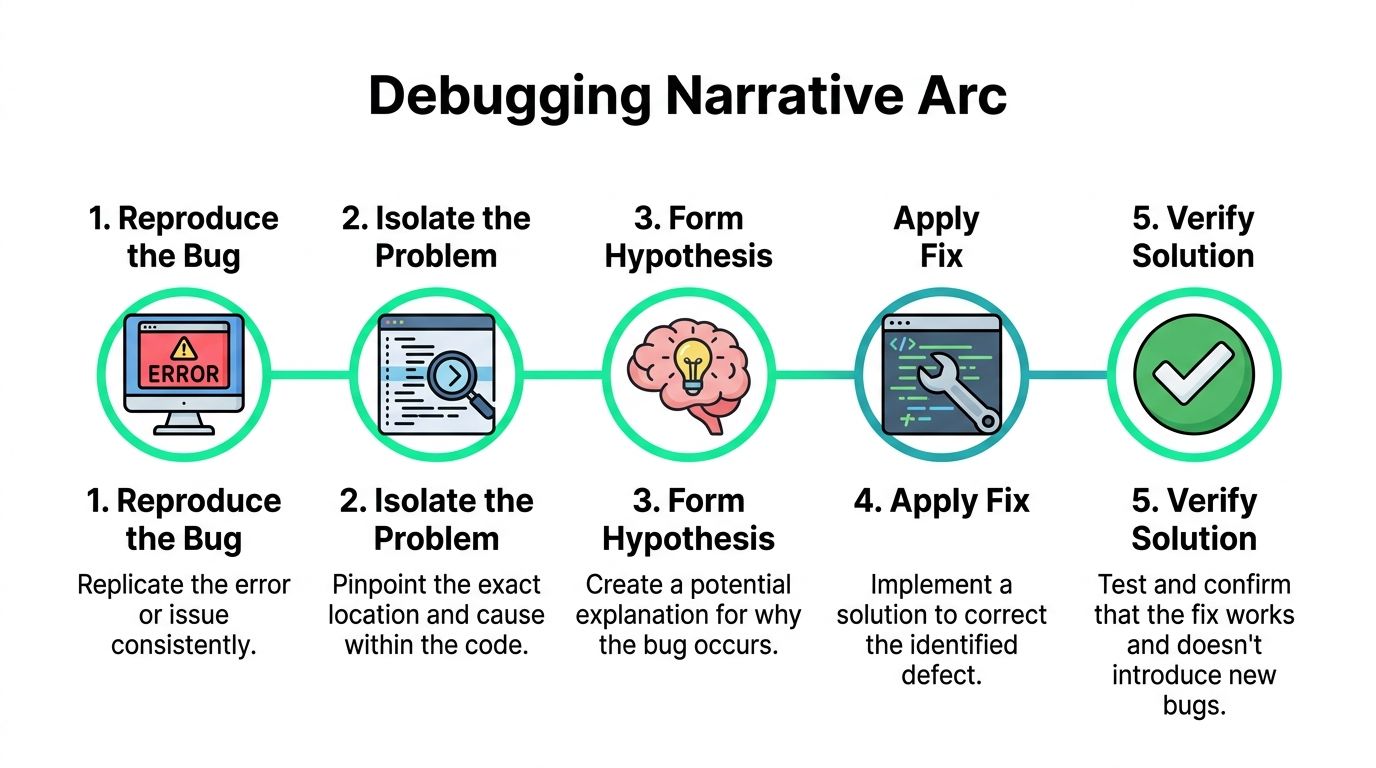
A debugging interview is a test of investigation discipline. The strongest candidates don't guess a fix and defend it. They move through a narrative arc: reproduce, isolate, hypothesize, fix, verify.
Suppose the interviewer gives you a failing test where a request returns an empty result even though the database contains a matching record. Start with reproduction: “I'll run the failing case exactly as provided and capture the input, returned value, and relevant logs.” Then isolate the boundary. Is the record absent from the query result, filtered after retrieval, or transformed incorrectly before the response?
Form each hypothesis so it can be disproved. “If the query is using the wrong tenant identifier, the database log should show a mismatch between the request context and the query parameter.” That log line disambiguates a data-access problem from a response-mapping problem. If the identifier matches, move to the next boundary instead of changing several things at once.
Working with AI without surrendering ownership
AI-assisted interviews change what you must make visible. Some companies may allow tools such as Copilot, Cursor, or Claude, while others redesign interviews around live collaboration. Recent coverage describes this shift toward practical assessment and reasoning under constraints, including a survey summary reporting that 66% of hiring teams rank catching and fixing AI mistakes as a top signal, while 56% prioritize trade-off explanation in its 2026 interview coverage. Treat those figures as reported by that source, not as a universal rule for every employer.
Ask at the start: “Which tools are permitted, and should I narrate prompts and verification as I use them?” If AI is allowed, treat its output like a junior teammate's suggestion. Explain the prompt, inspect the generated code, test assumptions, and identify what you changed.
Say: “The tool suggests a retry loop. I'm checking whether retries could amplify load, whether the operation is idempotent, and whether the error is transient before accepting that approach.”
If you don't know the answer, don't bluff. Use: “I don't know the root cause yet, but here's how I'd narrow this down in the next ten minutes.” Then name the first observable, the next experiment, and the result that would change your direction.
Finish by separating a quick patch from a durable fix: “I can restore service with a guarded fallback, but I'd still investigate the underlying failure, add monitoring for the condition, and create a regression test. I'm choosing the patch first because user impact is active, then I'll address the root cause once the system is stable.” You can rehearse this type of exchange with Qcard's AI mock interview practice, especially when follow-up questions expose gaps in your reasoning.
Practice Loop and Final Pacing Checklist
Confidence comes from a repeatable feedback loop, not from waiting until you feel ready. Pick a past question, set a 25-minute timer, and answer as if the interviewer were present. Narrate your decisions, apply the appropriate structure, and record the moments where you skipped a trade-off, rushed a conclusion, or stopped before verification.
Use this loop:
- Pick a past question: Rotate among coding, system design, debugging, and behavioral prompts.
- Set the timer: Create enough pressure to expose pacing problems without turning practice into punishment.
- Narrate and structure: Keep the listener informed while applying the frame for that round.
- Debrief and re-record: Write down the missed line, then deliver the answer again with tighter sequencing.
For a technical response, aim for roughly 60% thinking aloud, 25% coding or diagramming, and 15% verification and edge cases as a practice target. This isn't a hiring statistic. It's a rehearsal constraint designed to prevent silent implementation from taking over the answer.
A short anxiety routine
Before the interview, use two minutes of box breathing. Keep a small note beside your screen with the framework in plain language, such as “Clarify, approach, execute, test.” Begin with a deliberately slow first sentence: “I'll restate the requirement, confirm the constraints, and then outline an approach.” That opening prevents the common rush from carrying through the entire response.
Tailor your question bank to the role. Re-read the job description, then map two recent projects to each likely category. A system design answer should reference a real decision from your experience when relevant. A behavioral answer should connect your action to the role's responsibilities rather than relying on a generic success story.
Audio review can reveal filler words and rushed transitions that silent review misses. If you want to edit or inspect practice recordings, a practical ClearAudio guide to podcast tools can help you choose a workflow without turning preparation into a production project.
The final 24-hour check
- Environment: Confirm your editor, whiteboard, camera, microphone, and permitted tools.
- Food and water: Prepare a snack and water so hunger doesn't add avoidable strain.
- Question selection: Choose a focused set that matches the role instead of cramming unrelated topics.
- Mock partner: Schedule one realistic practice conversation with follow-ups.
- Notes: Capture what surprised you immediately afterward, including missed assumptions and useful interviewer signals.
Your objective isn't to eliminate anxiety. It's to make anxiety less influential by giving yourself a practiced first sentence, a visible structure, and a recovery path when the prompt is unfamiliar.
Key Takeaways
- Silent correctness is hard to evaluate, which is why narration is a scored behavior rather than a nicety — the interviewer needs to see how you interpret the problem, select a data structure, respond to edge cases, and recover when the first path fails, so a pause is only a problem when you leave the interviewer without a map of what you're doing next.
- One reusable five-stage frame (restate, approach, trade-offs, execute, verify) reduces your own cognitive load because you're not inventing the shape of the answer while solving the problem — and it gives the interviewer a clear evaluation point at every stage, which matters given that structured interviews score around 0.42 validity versus 0.19 for unstructured formats.
- The four predictable failure modes each have a specific fix — blank-page panic is solved by a practiced opening sentence, premature commitment by clarifying constraints before choosing a data structure, silence anxiety by narrating your next step rather than filling air, and filler-word drift by stating decisions instead of speaking continuously to hide uncertainty.
- Weak verbs hide ownership in behavioral answers and are the fastest thing to fix — "I helped fix the outage" tells an interviewer almost nothing, while "I isolated the validation rule, rolled it back, and added a regression test" names the decision, the action, and the durable change, and closing with a real figure (like reducing MTTR from 42 to 11 minutes across six incidents) makes the outcome easy to evaluate.
- AI-assisted rounds shift what you must make visible, not whether you own the answer — asking which tools are permitted at the start, narrating your prompt and verification steps, and explicitly separating a quick patch from a durable fix ("I'll restore service with a guarded fallback, then investigate the root cause and add monitoring") demonstrates exactly the judgment employers say they're now screening for.
Qcard provides resume-grounded talking points, AI-scored practice, mock interviews with follow-up questions, and coaching for pacing, filler words, and answer length without turning your experience into a script. Visit Qcard to practice coding, system design, debugging, and behavioral responses with concise cues that help you explain your real work clearly.
Ready to ace your next interview?
Qcard's AI interview copilot helps you prepare with personalized practice and real-time support.
Try Qcard Free