How to Answer Salary Expectations and Get Paid What You're Worth

To answer the salary expectations question, you need a strategy rooted in solid data. The best way forward is to research the market rate for your specific role, location, and experience level. Then, when the time comes, you confidently state a salary range, not a single number. This approach communicates your value, proves you've done your homework, and keeps the door open for a healthy negotiation.
Why the Salary Question Trips Up Even the Best Candidates
Let's be real for a moment. That instant the interviewer leans in and asks, "So, what are your salary expectations?" can feel like a trap. Your heart rate picks up, your palms get a little sweaty, and your mind might just go blank. You're definitely not alone in this. A recent survey found that while 63.4% of people look for new jobs to get paid more, it's the one topic that causes the most anxiety in an interview.
This is especially true for neurodivergent professionals or anyone who gets nervous under pressure. The demand to pull a "perfect" number out of thin air can trigger brain fog, making all that careful research you did vanish. It feels less like a conversation and more like a high-stakes test where one wrong answer could cost you the job or thousands of dollars.
Reframing the Question
So, why do hiring managers even ask this? It’s almost never to trick you. They’re usually trying to do two things:
- Check the Budget: Every position has a budget. They need to make sure your expectations align with what they can realistically offer before everyone invests more time.
- Gauge Your Self-Worth: Your answer tells them a lot about how you value your own skills. It shows if you understand your industry and have a solid grasp of your professional worth.
Instead of seeing it as a trap, think of this as your first real chance to demonstrate your value. A well-prepared answer shows you're a confident professional who does their due diligence—exactly the kind of person they want to hire.
The key isn't just naming a number; it's about showing you understand your worth in the current market. This question transforms from a moment of stress into a chance to start the salary conversation on your terms.
This guide will give you the tools to handle this moment with calm and confidence. We’ll focus on building the skills you need to turn this dreaded question into a professional strength.
You'll learn how to dig into the data to build a salary range you can stand behind. We'll walk through different strategies for when to share your number, when to deflect, and how to communicate effectively. Most importantly, you'll start thinking like a negotiator, ready to advocate for what you're worth, calmly and with conviction.
Building Your Data-Backed Salary Range
Walking into a salary negotiation cold is a recipe for disaster. The confidence to state your worth doesn't just appear out of thin air; it’s built on a foundation of solid, undeniable data. Guessing what you should be paid almost always leads to underselling yourself. The real power comes from knowing your market value, inside and out.
This isn't about plugging a job title into a single salary calculator and calling it a day. It's about becoming a mini-expert on what someone with your skills, in your city, at your level, is actually earning. The goal is to pull data from a few different places to create a benchmark you can truly stand behind. Think of it as triangulating your position—each data point gets you closer to an accurate, defensible number.
Gathering Your Salary Intelligence
Okay, time to put on your investigator hat. Your first move is to collect evidence from a few trusted sources to build a strong case for the compensation you deserve.
I always recommend starting with a blend of broad and specialized platforms:
- The Big Aggregators: Websites like Glassdoor and Salary.com are your starting line. They cast a wide net, pulling in user-submitted data for thousands of roles. They’re great for getting a general feel for the market.
- Niche, Industry-Specific Sites: This is where you get the good stuff. If you're in tech, Levels.fyi is non-negotiable. It gives you incredibly detailed compensation breakdowns, including base, bonus, and stock. Similar sites exist for other fields, so a quick search for "[your industry] salary data" can unearth some real gems.
- Real Human Beings: Data is great, but it lacks context. Don't skip this step. Chat with mentors, trusted former colleagues, or recruiters who specialize in your field. For example, you could send a LinkedIn message to a former manager saying, "Hi [Name], hope you're well. I'm currently exploring new Senior Marketing roles and trying to get a sense of the market. Would you be open to a quick chat about current compensation trends you're seeing?"
Here's the most important part: you have to get specific. A "Marketing Manager" in New York City working for a 5,000-person tech giant earns a totally different salary than one in Austin at a 50-person startup. Always, always filter your research by location, company size, and years of experience. The more granular you get, the more accurate your numbers will be.
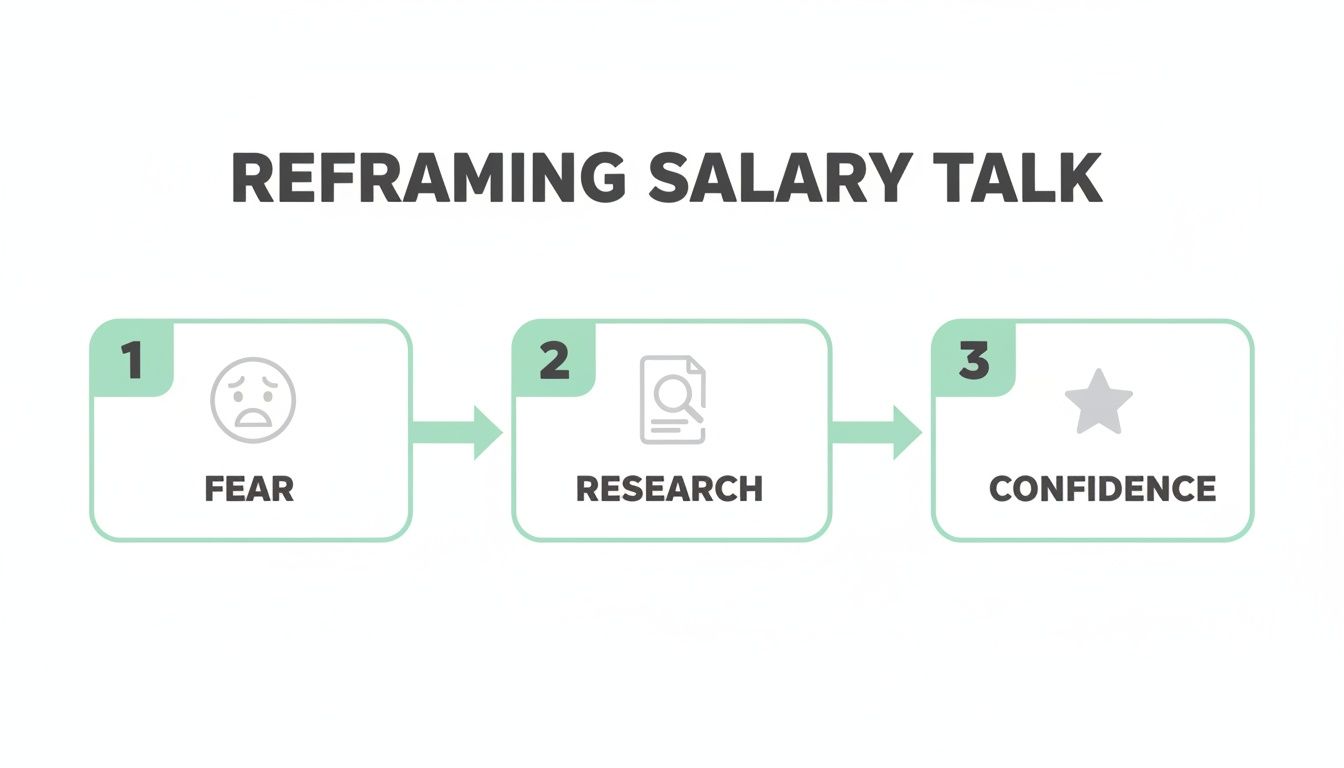
This whole process is about turning that initial feeling of dread into a sense of control. The research is what gets you there.
Creating Your Personal Salary Cheat Sheet
Now, let's pull all that intel together. Open up a simple spreadsheet or a document and create what I call a "salary cheat sheet." This is your single source of truth, the document you can glance at to feel prepared.
For example, if you’re a mid-level UX Designer in Chicago, your research might result in a cheat sheet with these notes:
- Glassdoor: $95,000 - $115,000 average for my level/city.
- Levels.fyi: Similar tech companies are paying a $105,000 - $125,000 base.
- Recent Industry Report: Found an article mentioning a 5% spike in demand for UX skills this year.
Based on this, you can confidently establish a well-supported range of $110,000 to $125,000. You’re not just picking a number you want; you’re presenting a number the market supports. Documenting your sources means you can explain why you’re asking for it, if needed.
Your cheat sheet isn’t just a list of numbers. It’s a documented, evidence-based case for your professional value. It shifts your request from a hopeful "ask" to a factual statement.
Finally, add a layer of broader economic context. Knowing what's happening with salary trends gives you an extra edge. For example, a recent WorldatWork survey shows that U.S. companies are projecting average salary increase budgets of 3.6% for 2026. That's a slight dip from 3.7% in 2025, but it shows that steady growth is still the norm.
You can weave this into your conversation with a line like, "Given that market data shows merit budgets trending around 3.6-3.7%, and considering my specific contributions, I'm targeting a range that reflects that growth and my value." See how that sounds? You’re replacing fear with facts, and that’s how you walk into these conversations with genuine confidence.
Choosing Your Strategy: Deflect, Defer, or Declare

Alright, you've done your homework and have a solid, data-backed salary range. That's fantastic. But knowing your numbers is just one piece of the puzzle—how you deliver them is what really seals the deal.
There's no single magic phrase that works every time. Instead, think of it as having three core moves in your playbook: politely postponing (Deflect and Defer), or confidently stating your worth (Declare a Range). Which one you pick really depends on where you are in the interview process, how much you know about the role, and frankly, what feels right for you.
Let’s get into the when and how of each approach.
The "Deflect and Defer" Strategy
This is your go-to move in the early rounds, especially during that initial phone screen. Right now, you have the least leverage. The recruiter barely knows you, and you don’t yet have a crystal-clear picture of the job’s true scope or the benefits package.
Throwing out a number at this stage is risky. Go too high, and you might get screened out. Go too low, and you've left money on the table before you've even started. The goal here is to skillfully pivot the conversation back to the role itself or, even better, get them to show their cards first.
Here are a couple of actionable examples of what to say:
- To pivot back to the role, you can say: "That's a great question. At this point, I'm focused on learning more about the role and the team to see if we're a strong mutual fit. I'm confident that if we both feel this is the right opportunity, we can agree on a salary that's fair and competitive."
- To ask for their range first, try this: "I'm open to discussing compensation. To make sure we're on the same page, could you share the approved salary range for this position?"
This strategy buys you time. With every interview stage you pass, your value in their eyes grows, which gives you a much stronger hand to play when the salary conversation comes back around.
The "Declare a Range" Strategy
Once you're deeper in the process—talking to the hiring manager or in final rounds—and you have a solid grasp of the expectations, it's time to state your number. This is where all your research shines. You're not just picking a number out of thin air; you're presenting a calculated assessment of your market value.
The secret here is to anchor high. In any negotiation, the first number mentioned sets a psychological benchmark for the entire discussion. Because of this, the bottom of your range should be a number you’d genuinely be happy to accept, not just one you’d grudgingly settle for.
Keep your range tight and realistic, typically spanning about 10% to 15%. A wide range like $90,000 - $120,000 can signal that you're unsure. A more focused range, like $105,000 - $120,000, shows you’ve done your homework.
Here’s an example for a project manager with a track record of delivering complex projects on time and under budget: "Based on my research into the market for this level of responsibility and my experience leading projects that boosted team efficiency by over 15%, I'm seeking a base salary in the $115,000 to $130,000 range. Of course, I'm flexible and interested in learning about the total compensation package."
By tying your salary expectations directly to your specific skills and accomplishments, you're not just asking for money. You're framing it as an investment in the value you bring to the company.
So, Which Tactic Is Right for You?
Choosing your move comes down to a gut check based on timing, information, and your own comfort level.
Here’s a simple way to think about it:
- Early Stage (Screening Call): Almost always Deflect and Defer. You need more information. Your goal is to get to the next round, not set your salary in stone.
- Mid-to-Late Stage (Hiring Manager Interview): This is a judgment call. If you feel you have a great handle on the role, you can Declare a Range. If you're still a bit unsure, try one last deflect to get their budget. Be prepared to declare if they press you.
- Final/Offer Stage: The time for deferring is over. You must be ready to Declare. The conversation is now explicitly about compensation, and avoiding it will make you seem indecisive.
Ultimately, the best strategy is the one you can deliver with confidence. Whether you deflect, defer, or declare, your preparation ensures you’re ready to steer the conversation in your favor.
Putting It All Together: What to Actually Say
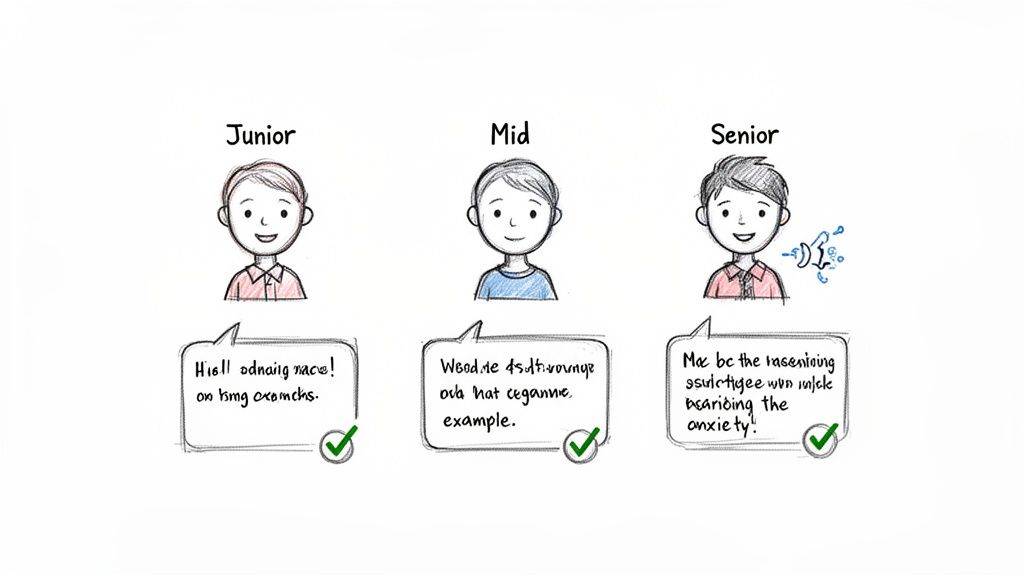
Knowing your numbers is half the battle. The other half is delivering your answer calmly and confidently when you're put on the spot.
A great response isn’t just about the number; it’s about the delivery. You want to acknowledge the question, show you're still excited about the job, and then state your researched position without apology.
Let’s get practical. Here are a few scripts you can adapt, whether you’re just starting out or you’re a seasoned pro who knows exactly what you’re worth.
For a Junior Developer (or Anyone New to a Field)
When you're early in your career, your answer should show your potential and drive. You don't have a long list of achievements yet, so you'll lean on your skills, training, and solid research.
Here’s a simple, effective example: "Thank you for asking. Based on my research for junior developer roles here in Austin, and considering my skills in Python and React from my recent certification, I’m looking for a salary in the $75,000 to $85,000 range. I’m really excited about the opportunity to contribute here and am confident we can find a number that works for both of us."
This works because it proves you did your homework on local rates. It also ties your request to specific, valuable skills (Python and React), showing you understand what matters for the role. Crucially, it ends on a collaborative, flexible note.
For a Mid-Level Project Manager (with a Proven Track Record)
At this stage, your experience is your biggest asset. Your answer should be anchored to tangible results you’ve delivered. You're not just asking for a salary; you're framing it as an investment in proven success.
Here is an example of this approach: "That's a great question. Given my five years of experience managing agile projects, plus a track record of delivering complex initiatives 15% under budget, my salary expectation is in the $110,000 to $125,000 range. This aligns with the market rate for this level of responsibility and the value I know I can bring to your product launch this year."
See how that immediately connects the numbers to a hard metric? Mentioning that you saved a past employer 15% makes your requested salary feel less like a cost and more like a smart investment. It’s much harder to argue with proven value.
For a Senior Consultant (The Confident Expert)
As a senior professional, you can be much more direct. Your extensive and specialized experience is your leverage, so your tone should be confident and matter-of-fact. You’ve earned the right to state your value clearly.
Here’s an example of how a senior expert might handle it: "Based on my decade of experience in this niche and leading successful digital transformations for enterprise clients, my salary requirement is $180,000. I’m definitely interested in learning more about the full compensation package, especially the bonus structure, but that is the base figure that aligns with my expertise."
This answer is direct. It uses a single number, not a range, which is a power move best suited for senior-level roles where your market value is well-defined. It signals that you know your worth and expect to be compensated for it.
Tips for Anxious and Neurodivergent Candidates
If interviews make your heart race, don't try to memorize a complicated speech. The goal is to simplify, not over-prepare. Focus on a few core talking points you can recall under stress.
- Have an "Anchor Phrase." This is your go-to opener. It can be as simple as, "Thanks for bringing that up. Based on my research..." Having this ready prevents that deer-in-the-headlights moment.
- Know Your Numbers Cold. Practice saying your salary range out loud until it feels normal. For virtual interviews, you can even put your range on a sticky note just off-camera.
- Keep It Short and Sweet. A concise answer sounds confident. Aim for two or three sentences. State your range, offer a brief justification (like "based on my experience"), and signal you're open to talking more.
Think of it this way: having a few pre-rehearsed talking points is like a cognitive lifeline in a high-stress situation. It frees up mental energy so your authentic confidence can shine through.
Staying informed about broader compensation trends also adds a layer of credibility. For instance, knowing that total salary increase budgets in the U.S. are hovering around 3.5%, according to a recent Mercer survey, shows you're aware of the bigger economic picture. Weaving in tidbits like this can subtly reinforce that your ask is both reasonable and well-researched.
Handling Follow-Up Questions and Navigating the Offer
Your initial answer to the salary question is just the opening move. The real conversation often kicks off with the recruiter’s follow-up, and this is where your preparation and poise are truly put to the test.
So you've given your researched range. Then comes the classic test from the recruiter: "Is that number flexible?" Take a breath. This isn't an attack on your value; it's a standard part of the script.
The goal here isn't to immediately drop your number. Instead, your best bet is to respond with a bit of calm curiosity. You want to reiterate your interest while gently holding your ground.
For instance, you could say something like, "I'm confident that the range I provided reflects my skills and the current market rate for this role. That said, my main focus is finding the right long-term fit, so I’m definitely open to learning more about the total compensation package you have in mind." This signals flexibility without immediately caving on your base salary.
When They Say It's Over Budget
Another common hurdle is the direct challenge: "That's a bit higher than our budgeted range." Again, don't take this as a hard no. It's an invitation to a real negotiation. This is your moment to ask for more information.
Resist the urge to get defensive. Instead, open the door to a more transparent discussion.
A really solid, professional way to respond is with an actionable question like this: "I appreciate you sharing that. To help me understand the full picture, could you tell me more about the range you have budgeted for the position? Knowing more about the benefits and any performance bonuses would be very helpful."
This response is effective for a few reasons. It keeps the tone collaborative, gently puts the ball back in their court, and smartly reminds them that base salary is only one piece of the puzzle. By shifting the focus to the total compensation package, you give yourself more room to find a win-win.
From Conversation to Concrete Offer
Once you’ve skillfully navigated the back-and-forth, the formal offer is next. Whether it comes through on the phone or in an email, your first step is to thank them sincerely. Your second, and most important, step is to not accept it on the spot.
Always ask for the offer in writing and request a day or two to review everything. This is a completely standard and expected professional practice.
Now, it’s time to really dig in. Look beyond that big base salary number and evaluate every single component:
- Bonuses: Is it a guaranteed bonus or tied to performance? Try to find out what the average payouts have been for this role over the last couple of years.
- Equity: If they're offering stock options or RSUs, what's the vesting schedule? What percentage of the company are you actually being offered?
- Benefits: This is huge. Get the details on health insurance (premiums, deductibles), retirement matching programs, and paid time off. A stellar benefits package can easily be worth thousands of dollars.
- Professional Development: Does the company have a budget for courses, certifications, or industry conferences? This is an investment in your growth.
With a clear picture of the offer's total value, you can compare it against your research and your personal financial needs. If there’s a gap, you're now in a fantastic position to build a thoughtful, data-backed counteroffer.
Framing Your Counteroffer Professionally
Whether you decide to counter over the phone or in an email, the approach is the same. You want to be polite, appreciative, and firm, grounding your request in the same solid research you used to build your initial range.
Always start by restating your excitement for the role and the company. Then, clearly state your counterproposal.
Here’s an example email or script you can adapt: "Thank you so much again for the offer! I'm incredibly excited about the possibility of joining the team and contributing to the upcoming product launch. After reviewing the total compensation package, I'd like to propose a base salary of $125,000. Based on my research, this figure better aligns with the market rate for my level of experience and the results I know I can deliver. I'm really eager to make this work and hope we can find a number that's a great fit for both of us."
This kind of response works because it’s appreciative, directly connects your ask to your value, and keeps the conversation positive. It shows you not only know how to state your salary expectations but can follow through with a professional and confident negotiation.
Navigating Those Tricky Salary Questions
Even with perfect preparation, you'll run into odd situations that can throw you for a loop. Let's walk through some of the most common curveballs and how you can handle them with confidence.
What If an Online Application Forces Me to Enter a Number?
You know the one—that dreaded mandatory field for "desired salary." It feels like a trap. Before you panic and type in your carefully researched range, try entering "0" or "1". Some application tracking systems are surprisingly simple and will accept this, letting you punt the conversation to a real human.
If that little trick doesn't work, the system will demand a real number. Your best bet here is to enter a figure at the very top of your researched range, or maybe even a little higher. Recruiters use this field to filter candidates, and if you aim too low, you've just handicapped your negotiation before it even starts. Think of it as setting a high anchor right out of the gate.
How Do I Answer If I Know I’m Currently Underpaid?
This is where you need to draw a hard line between your past and your future. Never, ever disclose your current salary, especially if you know it’s below market rate. Frankly, what you made before is irrelevant to the value you'll bring to this new company.
Your answer should be entirely focused on the market rate for the role you’re interviewing for, not your old job.
Shift the conversation forward with an actionable phrase like this: "I’m focused on the market rate for this type of role and the value I can bring to the team. Based on my research for this level of responsibility, I'm targeting a range of $X to $Y."
This response expertly sidesteps the question about your past salary and anchors the discussion where it belongs: on your worth in this new context. It shows you’re a professional who has done their homework.
Should I Ever Give a Single Number Instead of a Range?
For almost everyone, a well-researched range is the way to go. It signals that you're flexible and open to a discussion, which is exactly what a negotiation is. Giving a single, flat number creates a simple "yes" or "no" situation, and that's a risky game to play.
You're essentially setting yourself up for one of two bad outcomes:
- You aim too high: The recruiter might screen you out immediately without ever talking to you about the role's full scope.
- You aim too low: You could leave a huge amount of money on the table and never even know it.
The only real exception is for very senior executives or highly specialized experts who know their precise market value and have a non-negotiable "walk-away" number. For the rest of us, a strategic range is the smarter, safer play.
What if the Recruiter Says My Range Is Too High?
First, don't panic. This isn't a rejection; it's the start of the real negotiation. How you handle this moment says a lot about your professional poise. Instead of getting defensive, get curious.
A calm, inquisitive response works wonders. For example, you could ask: "Thanks for sharing that. Could you tell me a bit more about the budgeted range for this position?"
This question does a few powerful things at once. It puts the ball back in their court, gets you the critical information you need (their budget), and shows that you’re collaborative, not confrontational. From there, you can see if there’s a gap you can bridge or if the role just isn’t the right financial fit.
What is the biggest mistake people make when answering "What are your salary expectations?"
The most common mistake is giving a single number early in the process without doing market research. This either prices you out of the role or leaves money on the table. Instead, prepare a data-backed range and use a strategy to deflect the question until you have more leverage and information.
Should I give a number first, or ask the interviewer for their budget first?
In the early stages, it is almost always better to politely deflect and ask for their budget first. You can say, "Could you share the approved salary range for this position?" This prevents you from anchoring too low. Later in the process, when you have more leverage, confidently declaring your researched range is the stronger move.
How do I research what salary I should actually ask for?
Build a data-backed range by triangulating information from multiple sources. Use broad aggregators like Glassdoor for a baseline, niche sites like Levels.fyi for detailed compensation breakdowns, and real human intelligence from mentors or recruiters in your field. Always filter by your specific location, years of experience, and company size.
What is the right way to state a salary range?
Keep your range tight, ideally a 10-15% spread. The bottom of your range should be a number you would genuinely be happy to accept. State your range confidently and briefly justify it by connecting it to your specific skills and the market data you gathered, not just what you "want."
How can I stay calm and avoid brain fog when asked this question under pressure?
Preparation builds confidence. Create a personal "salary cheat sheet" document with your researched numbers and sources. Practice your delivery aloud using rehearsal tools. Reframe the question in your mind: it is not a trap, but your first opportunity to demonstrate that you understand your professional value and have done your homework.
When you're in the hot seat, it can be tough to recall all your talking points and key numbers. Qcard acts as a real-time interview copilot, giving you memory cues from your own resume exactly when you need them. You can stay calm and authentic, making sure you communicate your full value without missing a beat. Find out more at https://qcardai.com.
Ready to ace your next interview?
Qcard's AI interview copilot helps you prepare with personalized practice and real-time support.
Try Qcard Free