Nailing an interview isn’t about having a perfect, memorized script for every possible question. It’s about learning how to tell a good story—your story. This guide is your framework for doing just that, starting with how to figure out what an interviewer is really asking you.
Forget the generic advice. Let's build the kind of confidence that helps you create compelling, authentic answers that actually connect with the person on the other side of the table.
The Foundation of a Memorable Interview Answer
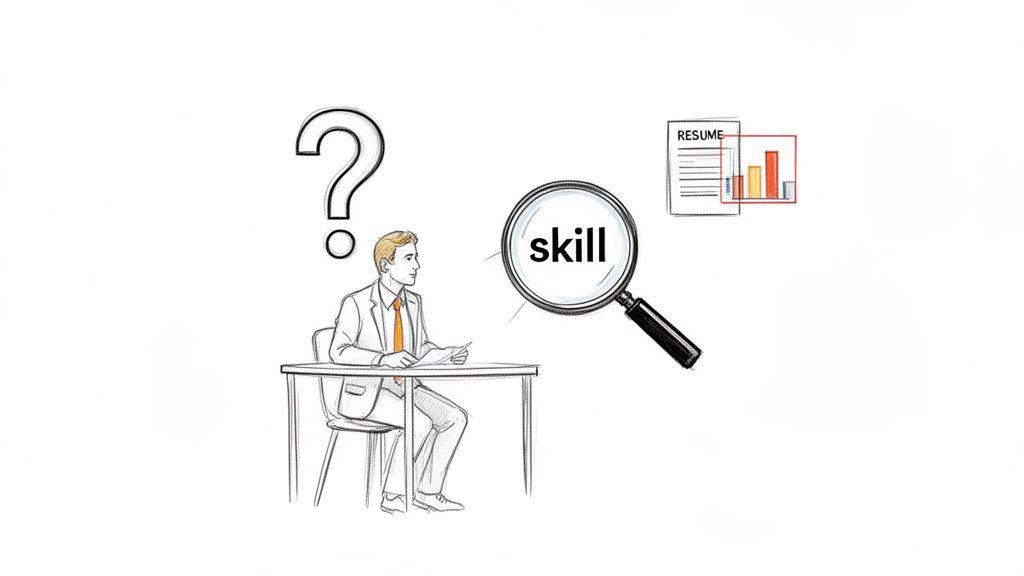
The secret to a great interview is having a reliable system, not a flawless pre-written answer. Think of it as building a mental blueprint that you can adapt to any question thrown your way, whether it's the classic "Tell me about yourself" or a tricky behavioral scenario. This mindset frees you from the pressure of rote memorization and lets you be your authentic self.
Instead of trying to predict every question, focus your energy on deeply understanding your own professional journey and the value you bring. Your resume is just a list of facts; your interview answers are the stories that breathe life into them. Your real job in an interview is to connect the dots for the hiring manager—show them not just what you did, but how you did it and the impact it made.
Decoding What the Interviewer Really Wants to Know
Every single question an interviewer asks is designed to test something, but it's rarely a test of your memory. When they say, "Tell me about a time you faced a tight deadline," they don't actually care about the story of you being busy. They're digging for something much deeper.
What they're really asking is:
- How do you handle yourself under pressure?
- Are you good at prioritizing when everything feels urgent?
- Do you speak up when you hit a roadblock?
- Can you find creative ways to get things done without letting quality slip?
Getting this hidden layer is the first, most crucial step. Before you even start forming a response, take a beat and ask yourself, "What specific skill are they trying to gauge here?" This quick mental check is your key to picking the most powerful and relevant story from your career.
A great interview answer is a direct response to the unspoken question. It demonstrates a core competency using a real-world example, proving you have the skills the role demands.
The Shift to Hybrid Hiring and Digital Presence
The job market today has amplified the need for this kind of clear, impactful communication. According to the International Labour Organization, a whopping 63% of employers worldwide now use hybrid hiring models. This has fueled a 52% jump in demand for online mock interviews as people scramble to get comfortable on camera. The Asia-Pacific region alone makes up nearly 40% of that market. You can explore more about these market trends and their impact on hiring.
What does this mean for you? It means your ability to tell a compelling story over a video call—without the help of in-person body language—is more critical than ever. A structured, story-based approach ensures your achievements don't get lost in digital translation. It allows you to showcase your problem-solving skills and professional poise, no matter the format.
By mastering this foundation, you build the muscle memory to perform with confidence, turning every question into a new opportunity to prove you're the right person for the job.
Here’s a quick-reference table to keep these core ideas in mind. Think of it as your cheat sheet for building powerful answers.
Your Interview Answer Blueprint at a Glance
This table summarizes the core components for crafting a successful interview answer, from preparation to delivery.
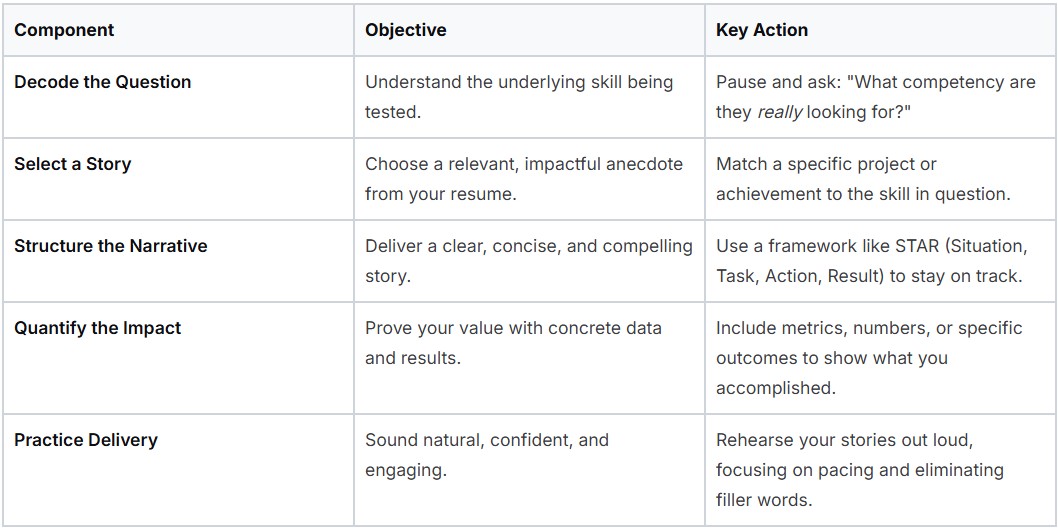
With this blueprint, you're not just answering questions—you're strategically demonstrating your value and building a genuine connection with your interviewer.
Building Your Arsenal of Resume-Grounded Stories
Your resume gets you in the door, but it doesn't tell the whole story. Those bullet points list your accomplishments, sure, but they can't capture the real grit, clever thinking, and resilience it took to get there. That’s your job in the interview.
To really nail your answers, you need to bring those bullet points to life. This means moving past just what you did and digging into the how and why. Think of it as building a personal portfolio of career highlights, each one a solid piece of evidence showing you’re the right person for the job.
Map Your Experiences to the Job Description
First things first: the job description is your cheat sheet. It’s a detailed breakdown of exactly what the company is looking for. Before you start prepping stories, you need to dissect it. Go through with a highlighter and pull out the key skills and requirements.
You’re looking for phrases like:
- "Proven ability to manage cross-functional projects"
- "Experience with proactive threat mitigation"
- "Strong problem-solving and analytical skills"
- "Demonstrated leadership in a team environment"
With this list in hand, your goal is to match each requirement with a specific moment from your career. This isn't just about finding a "teamwork" example; it's about connecting a real project where you collaborated effectively directly to their need for a cross-functional player. This process ensures every story you tell is relevant and lands with impact.
Create Your Personal Story Bank
Now for the fun part: building your arsenal. A story bank is simply a collection of your go-to professional anecdotes. You don’t need dozens, just five to eight really solid, versatile stories that you know cold.
The idea isn’t to memorize a script. It's about having a flexible set of narratives you can adapt on the spot. A single project can often be viewed from multiple angles. For example, that tricky software launch could be your go-to story for:
- Problem-Solving: Remember when you had to debug that critical, last-minute bug?
- Collaboration: How did you sync up with marketing and sales to get the messaging right?
- Leadership: What about that time you had to rally the team when morale was sinking?
Thinking about your experiences this way gives you incredible flexibility. You’ll be prepared for a huge range of questions without feeling like you have to prep a unique answer for every single one.
Your story bank is your strategic advantage. It turns interview prep from a stressful guessing game into a confident exercise in selecting the perfect evidence to prove your capabilities.
Quantify Everything You Can
Stories create connection, but numbers make your impact undeniable. The single best way to take an answer from "good" to "unforgettable" is to back it up with hard data. "I improved efficiency" is okay, but it’s vague and easy to forget. Numbers, on the other hand, stick.
Go back through your resume and your story bank and ask yourself some tough questions for every accomplishment:
- By what percentage did I boost revenue or cut costs?
- How many hours of manual work did I save the team each week?
- Did I move the needle on a key metric like user engagement or system uptime? By how much?
Even if you don't have perfect data, a well-reasoned estimate is still incredibly powerful. Saying you "streamlined the reporting process, saving the team an estimated 10-15 hours per month" is worlds better than just saying you made things faster. These figures are concrete proof of your value and show you think like a business owner—and every hiring manager wants that.
Giving Your Stories a Winning Structure
So, you’ve mined your resume for all those great stories. Fantastic. But even the best story can get lost in the telling if you just ramble on. This is where structure becomes your secret weapon. A simple framework can transform a decent anecdote into a powerful, memorable answer that sticks with the interviewer long after you’ve left the room.
The go-to framework for this, and for good reason, is the STAR method. It’s a simple, logical way to break down your experience into four key parts: Situation, Task, Action, and Result. Think of it as a roadmap for your story that ensures you hit all the important stops without getting sidetracked.
Making the STAR Method Your Own
STAR isn't just a box-ticking exercise; it’s a storytelling guide. Each piece has a specific role, and learning how to flow smoothly from one to the next is what separates a good answer from a great one.
- Situation: First, set the scene. Give just enough context for the story to make sense. This should be lightning-fast—one or two sentences, tops.
- Task: Next, what was your mission? State clearly what your goal or responsibility was. What problem were you actually trying to solve?
- Action: Now we get to the heart of it. Detail the specific steps you took to get things done. Always use "I" statements here. They want to know what you did, not what the team did.
- Result: End with a punch. What was the outcome? Use hard numbers, metrics, or tangible business benefits to show the positive impact of your work.
The real magic of the STAR method happens in the 'Action' and 'Result.' The Situation and Task are just the setup. The Action demonstrates your skills, and the Result proves your value.
This kind of structured thinking is absolutely critical when the pressure is on. Whether you're in a high-stakes tech interview at Google or a complex case study at McKinsey, clarity is king. And the data backs this up. A U.S. Department of Labor report found that a whopping 58% of candidates now practice with AI-powered tools, which has led to a 46% improvement in their overall interview performance. You can dig into more stats on interview preparation tools if you're curious.
Let’s See It in Action: A Real-World Example
Okay, let's make this real. The interviewer hits you with, "Tell me about a time you had to handle a difficult stakeholder."
A weak answer sounds something like this: "Yeah, I had this one PM who kept changing his mind. It was annoying, but we got it done." It's vague, unprofessional, and shows zero ownership.
Now, let's re-run that through the STAR framework:
- Situation: "On my last project, we were two weeks from launching a major new feature when a key marketing stakeholder requested a significant design change that wasn't in the original plan."
- Task: "My job was to figure out how this request would affect our launch date. I needed to either get the stakeholder to agree to the original plan or find a compromise that wouldn't throw our entire release off schedule."
- Action: "I immediately set up a meeting. I didn't just state my opinion; I came prepared with data on our team's current progress and showed exactly how the change would cause a three-week delay. Then, I proposed a two-phase solution: we launch as planned, and then we'd roll out their design updates in the very next sprint, just two weeks later."
- Result: "The stakeholder loved the idea and agreed. We launched on time and saw a 15% increase in user engagement in the first month. We then delivered the new design two weeks later, which kept the relationship strong and the project moving forward."
See the difference? It’s specific, it shows proactivity and problem-solving, and it closes with a killer metric. You've told a complete, compelling story in about 90 seconds.
This is the end goal of the process shown here—turning raw experiences into polished, high-impact answers.
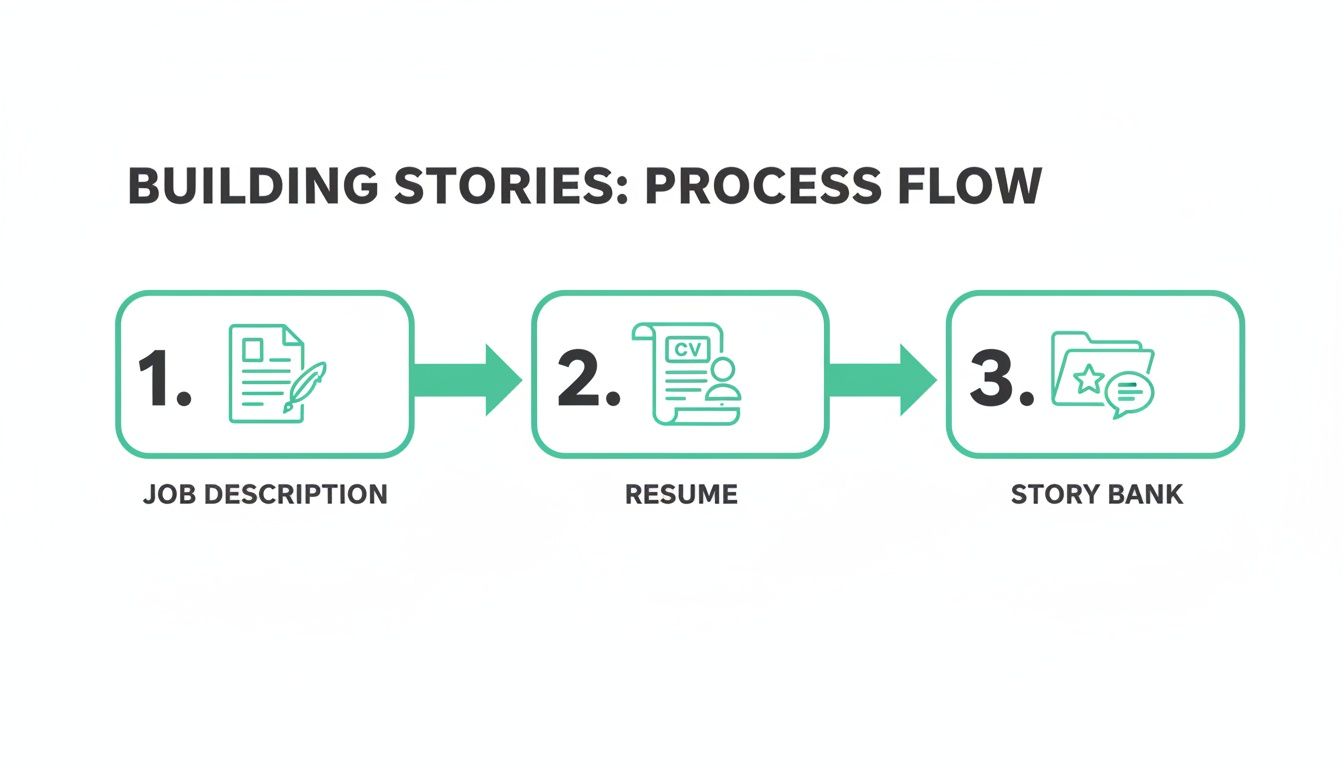
The big takeaway is that your best answers don’t come out of thin air. They’re built by connecting what the company needs (found in the job description) with what you’ve already done (your resume), and then packaging it into a story that sells.
Using Subtle Cues to Nail Your Delivery
Even with the best preparation, interview nerves are real. You might blank on a key detail or forget that crucial number you wanted to share. This is where a little backup can make all the difference.
Digital tools like Qcard can act as your safety net by displaying subtle memory cues on your screen. This isn't about reading from a script—that always comes across as stiff and unnatural. Instead, it’s a simple prompt that jogs your memory, reminding you to mention that "15% increase in engagement" or the specific name of the software you used.
This kind of support helps you sound confident and natural, ensuring you hit every important point without sounding like you've memorized a speech.
Navigating Technical and Specialized Interviews
While behavioral interviews focus on your past experiences, technical interviews are all about what you can do right now. The game changes here. It’s less about telling a great story and more about showing your work, live and under pressure.
Whether you're facing a whiteboard coding challenge, a product teardown, or a consulting case study, the goal is always the same: they want to see how you think. Getting the "right" answer is often secondary to demonstrating your problem-solving process, your ability to articulate trade-offs, and how you navigate ambiguity when a perfect solution isn't obvious.
Mastering the Coding Interview
When you’re hit with a tough coding problem, silence is your worst enemy. The biggest mistake I see candidates make is to clam up and immediately start typing. Don't do that. Instead, treat it like you and the interviewer are a team trying to crack a problem together.
Your first step? Ask clarifying questions. Really dig into the constraints, edge cases, and expected inputs/outputs. This shows you’re deliberate and not just jumping to conclusions. Once you start coding, talk them through your logic.
- Verbalize your approach: "I'm thinking of using a hash map here to get O(1) lookup time. The alternative is a nested loop, but that would be O(n^2), which is probably too slow if the input is large."
- Discuss trade-offs openly: Acknowledge when you're choosing a solution that's faster but uses more memory, or vice versa. This shows senior-level thinking.
- Narrate when you're stuck: If you hit a roadblock, say it. Explain what you're thinking and what you've tried. This gives the interviewer a window into your process and a chance to nudge you in the right direction.
This play-by-play isn't just filler—it’s how you prove your technical communication skills are as strong as your coding chops.
Deconstructing Product and Case Interviews
For product and consulting interviews, your framework is everything. These scenarios are built to test how you structure your thoughts around messy, real-world business problems. No one expects you to have a perfect answer up your sleeve.
What they do expect is a logical breakdown. If you get a product sense question like, "How would you improve Google Maps?" don't just start listing features. Begin with the user. Who are they? What are their biggest frustrations? Then, you can tie those user needs back to clear business goals.
The key to a strong case interview performance is not having all the answers, but having a clear, structured way of finding them. Your ability to communicate your framework is what sets you apart.
The same goes for a consulting case. You need to explicitly state your plan of attack. Are you using a profitability framework? A market entry model? Articulating your structure upfront shows the interviewer you can impose order on chaos, which is the core of the job.
The Power of Preparation and Confidence
Let's be real: confidence in these high-stakes situations comes from one thing—preparation. Answering tough technical questions is a skill you build through practice. And it's a competitive landscape out there. The global Interview Preparation Tool Market was valued at a whopping USD 2.5 billion in 2023 and is on track to hit USD 6.3 billion by 2031.
That growth is fueled by fierce competition in tech and consulting, where these specialized interviews are the gatekeepers. You can discover more insights about these market trends on Verified Market Research.
This trend reveals something important: top candidates are actively looking for an edge. Using memory cues or a quick checklist to remember key frameworks and formulas can make all the difference. Imagine a subtle prompt reminding you of Porter's Five Forces during a case study—it can keep you grounded without breaking your flow. This isn't about cheating the system; it's about using smart tools to make sure the knowledge you worked so hard to gain is there when you need it most.
Perfecting Your Delivery and Overcoming Nerves
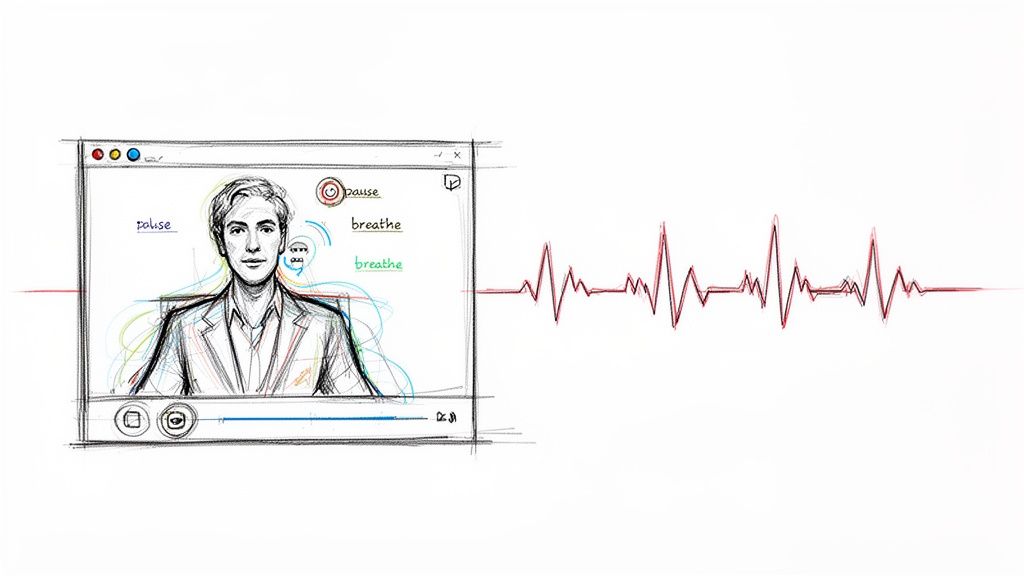
You can have the most brilliant stories and perfectly structured answers, but if your delivery is shaky, the message gets lost. What you say is only half the battle; how you say it makes the real impression. Nerves, filler words, and awkward pacing can sabotage even the most qualified candidate.
Mastering your delivery is all about projecting a calm confidence that makes the interviewer trust not just your skills, but you as a person. The good news? This isn't an innate talent. It's a skill you can build through conscious practice, turning interview anxiety into a focused, professional presence.
Taming the Filler Words
Filler words like "um," "ah," "like," and "you know" are absolute confidence killers. They creep in when our brain is searching for the next thought, but all the interviewer hears is hesitation and a lack of polish.
Getting rid of them is one of the quickest ways to sound more authoritative.
The first step is simply awareness. Most of us don't even realize how often we say "um." Recording yourself during practice sessions can be an eye-opening—and okay, slightly cringey—experience. Listen back and just count the verbal crutches.
The secret to replacing them isn't to find a better word. It's to get comfortable with silence.
"The most powerful tool in communication is the strategic pause. It gives you a moment to gather your thoughts and makes what you say next sound more deliberate and impactful."
Instead of filling the space with "uh," just pause. Take a breath. This tiny change makes you sound thoughtful, not nervous, and it gives your words a sense of weight.
Mastering Your Pace and Presence
When we get nervous, our breathing gets shallow and we start talking a mile a minute. This rush of words can make you seem anxious and difficult to follow, which is a perfect recipe for an interviewer to tune out. Consciously slowing down is a total game-changer.
Focus on enunciating each word. It might feel painfully slow in your own head, but to your audience, it will likely sound perfectly paced and confident. This is especially critical in virtual interviews, where audio lag can turn a fast talker into an unintelligible blur.
And don't forget, your non-verbal communication is just as important, even on a video call.
- Maintain Eye Contact: Look at your camera, not at the interviewer’s face on the screen. It feels a bit weird at first, but it creates the illusion of direct eye contact and builds rapport.
- Sit Up Straight: Good posture projects confidence and literally helps you breathe more deeply, which is a natural nerve-calmer.
- Use Gestures Naturally: Don't be afraid to use your hands to emphasize a point like you would in a normal conversation. It keeps you from looking stiff and makes you appear more engaged.
These physical tweaks send powerful signals to your brain that you're in control, helping to dial down anxiety from the outside in.
Strategies for Neurodivergent Candidates
Interviews can throw up unique hurdles for neurodivergent individuals, especially when it comes to managing working memory or navigating social cues under pressure. The goal isn’t to mask your natural communication style but to support it, so your true skills can shine.
Discreet on-screen prompts can be an incredibly powerful tool. For instance, a tool like Qcard can display high-level memory cues, helping you recall key project details or metrics without breaking your flow. This isn't about reading a script; it’s about having a cognitive safety net that cuts through the brain fog and lets you stay present.
This kind of support helps level the playing field, letting you focus on showing what you know instead of battling internal distractions. It ensures you know how to answer interview questions in a way that feels both authentic and confident.
The Power of Real-Time Feedback
Practice is good. Practicing with feedback is so much better. This is where technology can give you a serious edge by acting as a real-time interview coach.
Imagine getting instant feedback as you practice:
- Pacing: An alert pops up if you're speaking too fast.
- Filler Word Count: A live tally of "ums" and "ahs" builds your awareness in the moment.
- Answer Length: A gentle nudge tells you when you're starting to ramble.
This data-driven practice helps you build the muscle memory for a polished delivery. By spotting and correcting these little habits before the big day, you walk in with a communication style that’s ready to make a strong, positive impression.
Navigating Those Awkward Interview Moments
Even with the best preparation, a few classic questions can still throw you for a loop. Getting comfortable with these tricky spots is what separates a good interview from a great one. It’s that final layer of polish that builds real, unshakable confidence.
Let's walk through some of the most common questions I hear from candidates and break down how to handle them with poise. Think of this as fine-tuning your game plan so you’re truly ready for anything.
What’s the Best Way to Answer, "Tell Me About Yourself"?
First, let’s be clear: this is not your cue to narrate your life story or read your resume out loud. It’s a test. They want to see if you can articulate your value, and do it concisely. I've found the most effective formula is Present-Past-Future.
- Present: Kick things off with your current role. Mention a key achievement that directly relates to the job you're going for.
- Past: Briefly connect the dots. Touch on a couple of past experiences that gave you the skills you're using now—again, keeping it relevant.
- Future: Bring it home by explaining why this role and why this company. Show them you've thought this through and explain how your skills will help them hit their goals.
Try to keep your answer around 90 seconds. That’s the sweet spot—long enough to make an impact, but short enough to keep them engaged and encourage them to ask for more.
How Should I Handle a Question I Don’t Know the Answer To?
Whatever you do, don't fake it. Seriously. An experienced interviewer can spot a made-up answer from a mile away, and your credibility will evaporate on the spot. Honesty is your best bet here.
The trick is to pivot from "I don't know" to "Here's how I would figure it out." Turn the question into an opportunity to showcase your problem-solving skills.
A solid response might sound something like, "That's a great question. I haven't run into that exact scenario before, but here's how I'd approach it..." Then, just walk them through your thought process. This demonstrates critical thinking and how you operate under pressure—qualities every manager is looking for.
How Long Should My Answers to Behavioral Questions Be?
You're aiming for a balance here. The sweet spot for most behavioral answers is somewhere between one and two minutes.
If you're under 60 seconds, you risk sounding superficial or like you don't have enough experience to draw from. But if you start pushing past the three-minute mark, you're almost guaranteed to see their eyes glaze over.
This is where practicing with the STAR method really pays off. It gives your stories a natural beginning, middle, and end, which helps you stay on track and avoid rambling. Time yourself a few times so you get a feel for the rhythm.
Answering interview questions is all about quality over quantity. A powerful, two-minute story with a clear result will always beat a five-minute ramble.
Is It Okay to Bring Notes Into an Interview?
Yes, absolutely. In fact, it often looks good. Bringing a few bullet points with key metrics or project names shows you're organized and came prepared. This is especially true for virtual interviews.
The key is to use them as quick reference points, not a script. You have to maintain natural eye contact and a conversational flow. Reading from a page just looks awkward.
This is where a discreet on-screen tool can be a game-changer. It can pop up your talking points so you can recall specific data without ever breaking eye contact or fumbling with papers. It helps you stay seamless and professional, reinforcing that you’re prepared and confident.
Ready to walk into your next interview knowing you'll never blank on a crucial detail? Qcard is your AI interview copilot, giving you discreet, resume-grounded memory cues right on your screen. You can practice with real-time feedback on your pacing and filler words, and face any question—behavioral or technical—with your best stories and metrics ready to go. See how it works at https://qcardai.com.
Ready to ace your next interview?
Qcard's AI interview copilot helps you prepare with personalized practice and real-time support.
Try Qcard Free