How to Answer Consulting Interview Questions with Confidence
TL;DR
Answering consulting interview questions well means building flexible structure rather than memorizing frameworks, because the interviewer is testing whether you can think when the script breaks. Build a custom issue tree in 60–90 seconds: restate the objective as a decision, name two or three drivers, add sub-questions, prioritize one branch with a reason, and MECE-check it. Follow the seven-step case flow using timing blocks as pacing cues, write equations before calculating, and narrate your math. When interrupted, stop, answer directly, and reconnect to your tree. Close with the recommendation first, plus reasons, risks, and a next step. For fit questions, use STAR with about 60% on Action and build cue cards (context, pressure, move, proof, lesson) instead of scripts. Practice matters because research found 71.2% of candidates rated weak on MECE quality and 75.4% weak on quantitative analysis — and case performance can account for roughly 80% of first-round scoring. Isolate one skill at a time, then combine them under interruption.
You're halfway through a consulting interview when the interviewer changes the question. Your carefully rehearsed framework no longer fits, the numbers on the page blur, and you start filling the silence with “basically” and “maybe.” The problem isn't that you lack intelligence. You've prepared an answer for a script, while the interviewer is testing whether you can think when the script breaks.
Learning how to answer consulting interview questions means building a response that can move. You need a custom structure, evidence from your own experience, visible reasoning, and a delivery style that stays calm when someone interrupts. The strongest candidates don't sound memorized. They make the next useful thought easy to follow.
How Do You Answer Consulting Interview Questions?
Build a response that can move. Consulting interviews reward structure over scripts because case interviews were created to observe thinking in action — McKinsey leaders began asking candidates to solve client problems on the spot in the 1960s specifically to test structured thinking, poise, and persuasion under pressure. A memorized framework hides exactly what interviewers need to evaluate: communication, business judgment, quantitative reasoning, and composure.
Step 1 — Build a custom issue tree in 60–90 seconds. Rewrite the client's question as a decision ("Should the client change pricing, reduce costs, or pursue another intervention?"), confirm the objective, name two or three decision drivers that determine the answer, add relevant sub-questions, prioritize one branch and say why, then run a MECE check — mutually exclusive, collectively exhaustive, parallel, actionable, prioritized. Don't force a market-entry tree onto a profitability problem.
Step 2 — Navigate the seven-step case flow with pacing cues. For a 30-minute case: roughly 2 minutes to open, 1–2 to clarify, 2–3 to structure, 1–2 to present, 10–12 for quantitative work, 8–10 for qualitative questions, and 1–2 for the recommendation. Listen for the client, problem, decision maker, and objective. Write the equation before calculating, say what each number represents, and sanity-check the result.
Step 3 — Recover cleanly when redirected. If the interviewer interrupts, stop — don't finish the paragraph you rehearsed. Answer the new question directly, summarize the implication, and reconnect to the tree.
Step 4 — End with the answer first. A strong close gives the recommendation, two or three supporting reasons, the key risks, and the next step. A recommendation becomes stronger when you show what would change your mind.
Step 5 — Answer fit questions with STAR weighted toward Action. Roughly 15% Situation, 10% Task, 60% Action, 15% Result. Keep the setup to two or three sentences and spend the answer on decisions — the conversations you initiated, the options you considered, the sequence you chose.
Why Consulting Interviews Reward Structure Over Scripts
The interviewer gives you a profitability problem. You recognize the case type, reach for a familiar framework, and begin listing market, competition, customers, and capabilities. Within a few sentences, the structure feels detached from the client's actual question. You're covering categories, but you aren't showing judgment.
That distinction matters because case interviews were created to observe thinking in action. The method became a defining consulting selection tool in the 1960s, when McKinsey leaders asked candidates to solve client problems on the spot to test structured thinking, poise, and persuasion under pressure. By the late 1970s, McKinsey offices were already using case-style interviews broadly, and the format later spread across major consulting firms worldwide. Today, a typical case lasts 30 to 60 minutes and tests communication, business judgment, and quantitative reasoning, as documented in this history of the modern consulting interview.
The funnel makes mediocre communication expensive. Public estimates indicate that McKinsey, BCG, and Bain each receive roughly 200,000 or more applications a year, with only about 2,000 offers at each firm, implying acceptance near or below 1%. A separate estimate places McKinsey above 1 million applications annually, with 10–15% reaching first-round interviews and roughly 2,300 offers, or approximately 0.23% of applicants, according to this overview of MBB recruiting. You don't need to recite those figures in an interview. You do need to understand the standard you're entering.

What the interviewer can actually evaluate
A memorized framework hides the information that matters most:
- Communication: Can you make the important point clear without forcing the interviewer to reconstruct it?
- Business judgment: Can you prioritize the branch most likely to affect the client's decision?
- Quantitative reasoning: Can you set up the math, check the result, and explain what it means?
- Composure: Can you absorb new information without abandoning your logic?
That's why polished scripts often fail. They encourage candidates to speak before confirming the objective, treat every branch as equally important, and keep going after the interviewer has redirected the discussion. A flexible issue tree gives you a map, not a speech.
Your resume should work the same way. Instead of memorizing a full behavioral answer, attach a short cue to each meaningful experience: the challenge, your decision, the evidence, and the result. That cue lets you reconstruct a natural answer without inventing details or sounding rehearsed. If you're also developing a consulting practice, the same principle applies to communicating your expertise publicly. Resources on how to win more clients with branding can help you present a consistent professional point of view without turning your communication into a template.
Practical rule: Lead with the conclusion you can defend, then show the structure and evidence behind it.
Use the consulting interview preparation guide to organize your preparation, but don't confuse preparation materials with interview language. Your job isn't to prove that you know a framework name. It's to help the interviewer see how you decide what matters.
Build a Custom Issue Tree Before You Solve
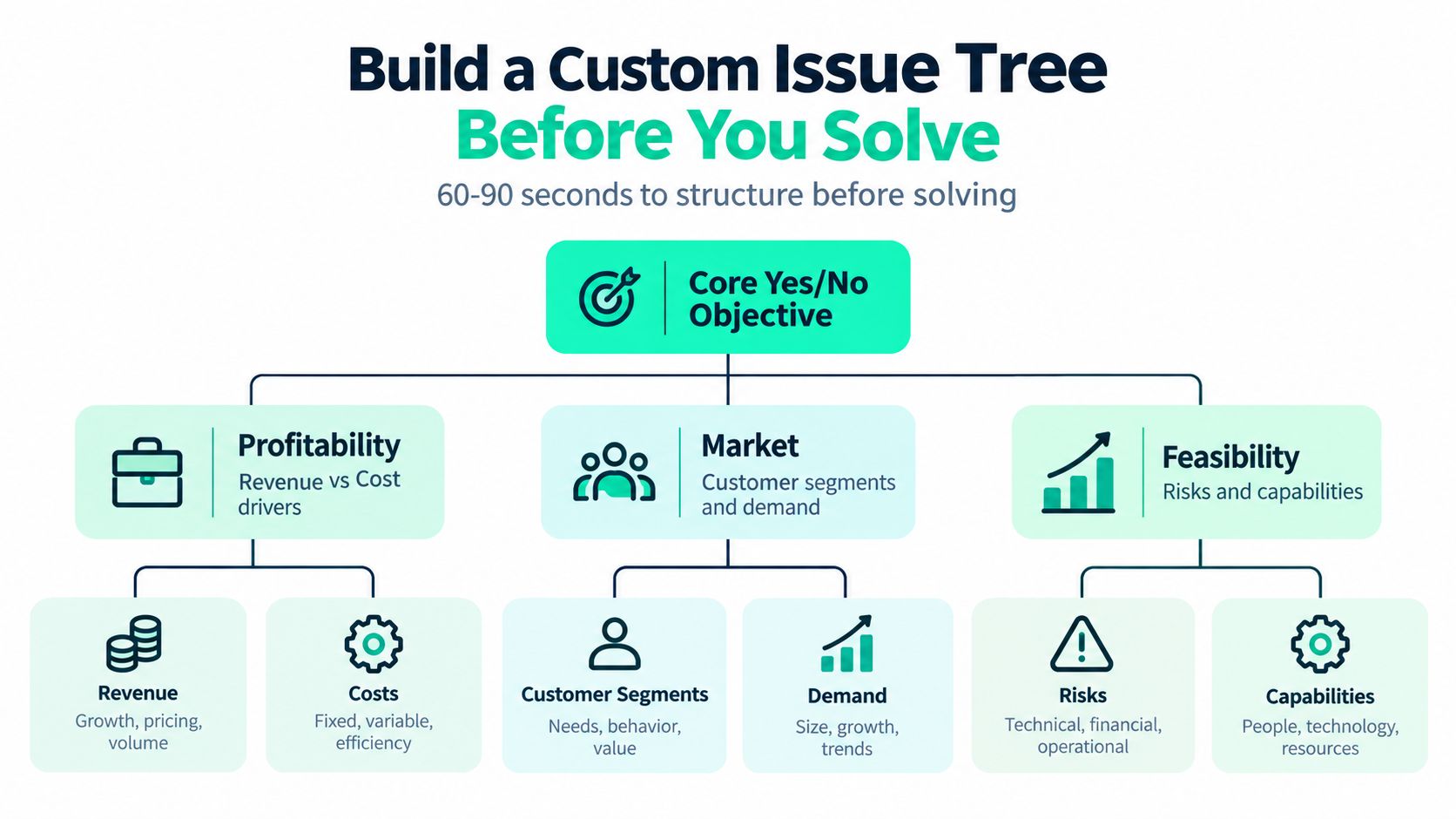
The first useful structure usually takes 60–90 seconds to build. That window is long enough to understand the decision and short enough to prevent overthinking. The issue-tree guidance from CasingLab recommends starting with the yes-or-no objective, identifying two or three decision drivers, adding industry-specific sub-questions, and telling the interviewer your structure before solving.
Start by rewriting the client's question as a decision. “Why are profits down?” is diagnostic. “Should the client change its pricing, reduce costs, or pursue another intervention to restore profitability?” is closer to the decision you need to support. Then ask what must be true for a recommendation to work.
A practical build sequence
- Confirm the objective. Ask whether the client wants to recover profit, grow revenue, protect market share, enter a market, or choose among investment options. These goals can lead to different analyses.
- Name two or three decision drivers. Choose branches that determine the answer, not every factor that could theoretically matter.
- Add relevant sub-questions. A retail case may require customer segments and channels. An industrial case may require capacity, input costs, and operational constraints.
- Prioritize one branch. State why you'll begin there, based on the facts already provided.
- Check the tree. Make sure the branches don't overlap and that, together, they cover the decision.
Profit decline example
Suppose the client's profits have fallen. A useful opening might be:
“I'd like to understand whether the decline is driven by revenue, costs, or both. On revenue, I'll examine price and volume, then segment volume by the products, customers, or channels most relevant to this business. On costs, I'll separate fixed from variable costs and identify the largest changes. I'll start with the branch suggested by the information we have, then test the other branch if needed.”
That structure is more useful than announcing a “profitability framework.” It shows the interviewer how you'll investigate the problem. If revenue is flat, don't continue discussing pricing and customer demand as if they're equally important. Move toward costs, ask whether fixed or variable costs changed, and then examine the largest driver.
The trade-off is breadth versus prioritization. A tree that misses a major branch is dangerous, but a tree with every possible branch is unusable under pressure. The interviewer doesn't award points for a long inventory. They want to see whether you can identify the two or three questions most likely to change the recommendation.
Use this MECE check before you begin:
- Mutually exclusive: Could the same evidence appear in two branches?
- Collectively exhaustive: Would the branches cover the decision if the initial hypothesis proved wrong?
- Parallel: Are the branches at a similar level of detail?
- Actionable: Can each branch produce information that changes what the client should do?
- Prioritized: Can you explain why one branch deserves attention first?
Don't force a market-entry tree onto a profitability problem. Frameworks are useful as raw material, but the final issue tree should belong to the client's question.
How to Navigate the Timed Case Interview Flow
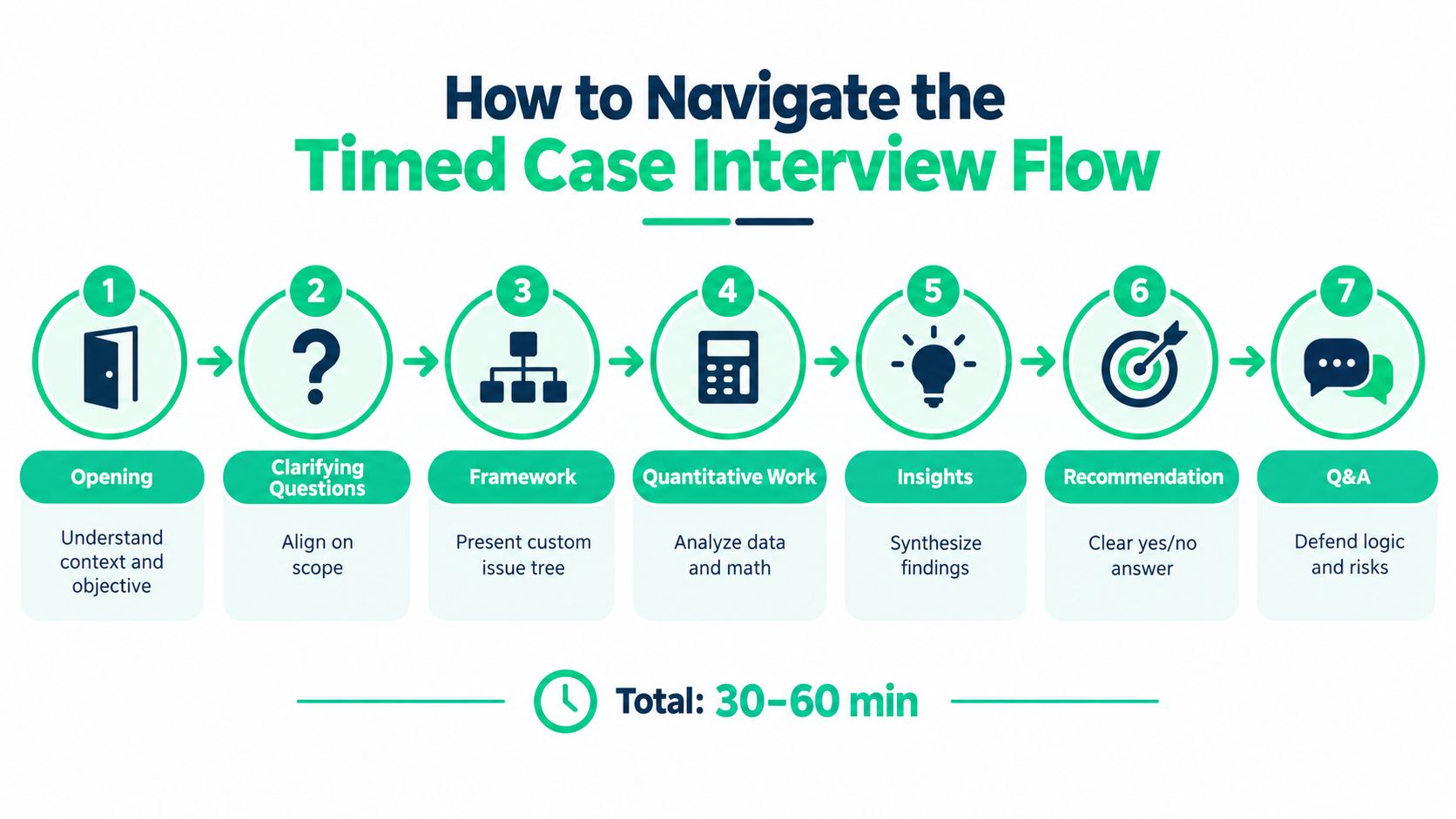
A case interview commonly follows a timed seven-step flow: opening, clarifying questions, building a framework, presenting the framework, solving quantitative problems, answering qualitative questions, and delivering the recommendation. For a 30-minute case, one neutral guide suggests approximate blocks of 2 minutes to open, 1–2 minutes to clarify, 2–3 minutes to structure, 1–2 minutes to present, 10–12 minutes for quantitative work, 8–10 minutes for qualitative questions, and 1–2 minutes for the recommendation, as outlined in this case interview timing guide.
Treat those blocks as pacing cues, not a stopwatch you must obey.
Opening and clarification
Listen for four items: the client, the problem, the decision maker, and the objective. Then summarize the case in one sentence. If the interviewer says sales are declining, ask whether the desired outcome is revenue growth, profit recovery, or another target. Clarifying questions should establish the foundation of the case, not begin solving it.
For example:
“Let me confirm the objective. The client wants to understand why sales have declined and decide how to reverse that decline. Should I prioritize revenue recovery, profitability, or both?”
That question narrows the work without guessing. After the answer, ask only for information that affects your structure, such as geography, time period, customer scope, or relevant constraints.
Structure, analysis, and redirection
Present your issue tree in plain language. Then state an initial hypothesis, but keep it provisional:
“My initial hypothesis is that lower volume may be the main driver, possibly due to customer switching or channel performance. I'll test that against price and product mix before moving to costs or operational constraints.”
During quantitative work, write the equation before calculating. Say what each number represents, calculate out loud, and sanity-check the result. The interviewer is assessing your reasoning, not just the final arithmetic.
If the interviewer interrupts, stop. Don't finish the paragraph you rehearsed. Answer the new question directly, summarize the implication, and reconnect to the tree:
“That result suggests the decline is concentrated in one customer segment. I'll update my hypothesis and examine whether the segment lost demand or whether our price became less competitive.”
The practice case question library can help you rehearse this kind of movement. Practice being redirected deliberately. Ask a partner to interrupt after your structure, introduce new data during the math, or challenge your first hypothesis.
Recommendation
End with the answer first. A strong close includes the recommendation, two or three supporting reasons, key risks, and the next step.
“I recommend focusing first on the declining customer segment rather than changing prices across the business. The evidence indicates that volume loss is concentrated there, the broader portfolio remains stable, and a targeted response limits unnecessary margin risk. I'd validate the recommendation by testing the segment's switching reasons and competitor pricing before implementation.”
That answer is concise without pretending uncertainty doesn't exist. If a limitation matters, name it. A recommendation becomes stronger when you show what would change your mind.
Answer Behavioral Questions With STAR and Proof of Impact
Case performance isn't the only place candidates lose clarity. Behavioral answers often fail because the candidate describes an entire project instead of showing what they personally decided and did. “We improved collaboration” is a conclusion without proof. The interviewer needs to know what happened, what you owned, and what changed afterward.
Use STAR, Situation, Task, Action, Result, as a compression tool rather than a script. One fit interview guide recommends allocating about 15% of the response to Situation, 10% to Task, 60% to Action, and 15% to Result.

Keep the setup short
Situation should take two or three sentences. Give the setting, the tension, and the relevant constraint. Task should take one or two sentences and state your responsibility.
For a leadership question, a compressed opening might sound like this:
“During a cross-functional launch, two teams disagreed about whether to prioritize speed or additional testing. I was responsible for coordinating the launch plan and resolving the disagreement without losing the deadline.”
That's enough context. Don't explain the company's full history, every stakeholder, or every meeting before reaching your role.
Spend the answer on decisions
The Action section deserves most of your time because it demonstrates judgment. Explain the conversations you initiated, the options you considered, and the sequence you chose.
A stronger version might continue:
“I interviewed each team lead separately to isolate the disagreement, then compared the risks against the launch requirements. I proposed dividing the work into a release-critical path and a follow-up testing path, assigned owners to both, and documented the decision in a shared plan. When one team objected that the split created extra work, I showed which checks were required before launch and which could be completed afterward. I then scheduled a short review with both leads so they could challenge the plan before we communicated it more broadly.”
Notice what's missing. There's no generic statement that you're a “natural leader.” The actions prove leadership through decisions and conversations.
Close with evidence and reflection
Result should include an outcome and what you learned. Use a metric when you can recall it accurately, such as turnaround time, cost saved, adoption, or completion status. Don't manufacture precision. If the result isn't numeric, describe the observable change and explain the lesson.
Proof of impact: Describe the change your action caused, then explain how the experience changed your judgment.
Build memory cues from your resume using four prompts:
- Challenge: What was at risk?
- Ownership: What did you personally control?
- Decision: What choice required judgment?
- Evidence: What changed, and what did you learn?
For “Tell me about a failure,” don't sanitize the story until it becomes harmless. Choose a real decision, explain the signal you missed, show the correction, and state the process you changed. Consultants are expected to learn from imperfect information. A credible reflection is more persuasive than a flawless story.
Speak Clearly Under Pressure With Memory Cues and Pacing
Anxiety creates a specific problem: you know what happened, but you can't retrieve the full story in the order you practiced. Scripts make that worse because forgetting one sentence can make the entire answer collapse. Resume-grounded memory cues give you several entry points.
Create a cue card for each experience, but keep it as a set of prompts rather than prose:
- Context: product launch, team conflict, analytical project
- Pressure: deadline, disagreement, missing data
- Move: the decision you made
- Proof: metric, outcome, stakeholder response
- Lesson: what you'd repeat or change
When an interviewer asks an unexpected behavioral question, pick the experience with the closest pressure and rebuild the answer around the prompt. This approach protects authenticity because you're recalling verified events instead of searching for a memorized performance.
Control the first sentence
Your first sentence should orient the listener. Pause briefly, then answer directly. “Yes, one example was…” sounds more confident than a long preamble about how difficult the question is.
Use a simple pacing pattern:
- Answer: Give the headline.
- Structure: Name the two or three parts you'll cover.
- Evidence: Explain the specific actions and result.
- Close: State the lesson or relevance.
If you notice filler words, don't try to eliminate every “um” instantly. That usually makes speech stiffer. Replace the filler with a silent pause, a breath, or a signpost such as “The key decision was…” Record practice answers and mark where fillers appear, especially before numbers, transitions, and conclusions.
Make recall easier for different candidates
International students often need to manage translation, technical vocabulary, and cultural expectations at the same time. Prepare the business nouns and verbs you'll need, but don't translate a complete script. Practice saying the same experience in a concise version and a fuller version so you can adapt to the interviewer's follow-up.
Neurodivergent candidates may benefit from visible structure, predictable cue categories, and explicit permission to pause. A note that says “conflict, decision, result” is easier to use live than a paragraph. Candidates with brain fog can also practice with voice transcription during Zoom or Google Meet sessions, then review whether their answer was too long, too fast, or difficult to follow.
A live coaching tool such as Qcard can surface high-level, resume-grounded talking points, provide voice transcription, and flag pacing, filler words, and answer length during practice. Use it as a cue system, not a script generator. The standard remains the same: your answer must come from your real experience and your own judgment.
Practice System That Fixes Weak Structure and Math
More cases won't automatically make you better. If you repeat the same weak opening, broad issue tree, or silent math process, you're rehearsing the breakdown. A useful practice system isolates one skill at a time, then combines the skills under interruption.
Recent case-interview research reported that 71.2% of candidates were rated weak or very weak on MECE quality, 75.4% were weak or very weak on quantitative analysis, and 39.2% of interviews required a prompt somewhere in the session, according to the 2026 CaseTutor study report. Treat those findings as a warning about practice priorities, not as a reason to memorize more frameworks.
A focused routine
Start with short structure drills. Take a case prompt, write the yes-or-no objective, create two or three branches, and explain your prioritization aloud. Then do a separate math drill where you define the equation, calculate without hiding your steps, and state the business implication in one sentence.
After that, run complete cases with a partner. Ask the partner to interrupt, change the objective, or challenge your hypothesis. Your recovery should follow a repeatable sequence: acknowledge the new information, update the branch, explain what changed, and proceed.
Review recordings for three issues:
- Structure: Did the branches answer the actual decision?
- Math: Did you label assumptions and interpret the result?
- Delivery: Did your pace, fillers, and conclusion make the logic easy to follow?
Use Qcard's AI mock interview practice as one additional way to rehearse follow-ups, answer pacing, and structured responses. Combine automated feedback with human mocks because a person can challenge your judgment and notice conversational habits that a score may not capture.
The Hacking the Case Interview guide estimates that roughly 40–50% of candidates pass first-round cases, 20–30% pass final-round cases, and 8–15% of all candidates entering the process receive an offer. A separate benchmark cited in the same guide estimates that case performance can account for about 80% of first-round pass-or-fail scoring and around 50% of second-round scoring. The implication is practical: your resume may earn the interview, but unsupported recommendations and weak structure can still end it.
Before interview day, confirm that you can:
- restate the objective without changing it
- build a custom tree in 60–90 seconds
- prioritize one branch and explain why
- do math out loud without rushing
- recover when the interviewer redirects you
- deliver a recommendation first, with evidence and risks
- answer fit questions from resume cues rather than scripts
Key Takeaways
- Scripts fail because they hide the four things interviewers can actually evaluate — communication, business judgment, quantitative reasoning, and composure — which is why a memorized framework encourages you to speak before confirming the objective, treat every branch as equally important, and keep going after the interviewer has redirected you.
- A custom issue tree beats a named framework every time — announcing "I'll use a profitability framework" tells the interviewer nothing, while explaining that you'll separate revenue into price and volume, segment volume by the products and channels relevant to this business, then split costs into fixed and variable shows exactly how you'll investigate the client's actual question.
- Practice priorities should follow the evidence on where candidates fail — a 2026 study found 71.2% rated weak or very weak on MECE quality, 75.4% weak or very weak on quantitative analysis, and 39.2% of interviews required a prompt, which means more case volume won't help if you keep rehearsing the same weak opening and silent math.
- Behavioral answers lose points by describing projects instead of decisions — "we improved collaboration" is a conclusion without proof, while explaining that you interviewed each team lead separately, compared risks against launch requirements, split the work into release-critical and follow-up paths, and scheduled a review before broader communication proves leadership through actions rather than claiming it.
- Memory cues protect you when anxiety blocks retrieval — a cue card with five prompts (context, pressure, move, proof, lesson) gives you multiple entry points into a real experience, while a script collapses if you forget one sentence, which matters especially for international students managing translation alongside content and neurodivergent candidates who benefit from visible structure and explicit permission to pause.
Qcard helps candidates prepare consulting answers with resume-grounded talking points, AI-scored practice, intelligent follow-ups, recording review, and coaching for pacing, filler words, and answer length. Visit Qcard to practice flexible issue trees and behavioral responses while keeping your answers authentic, specific, and tied to your verified experience.
Ready to ace your next interview?
Qcard's AI interview copilot helps you prepare with personalized practice and real-time support.
Try Qcard Free