How to Answer Behavioral Interview Questions with No Experience
TL;DR
Behavioral questions test behavior, not job titles — a widely cited meta-analysis reports structured behavioral interviews at .51 predictive validity versus .38 for unstructured, which is why employers ask for real examples rather than credentials. Your evidence can come from a capstone, volunteer role, student society, part-time job, caregiving, hackathon, or personal project. Run a twenty-minute audit of the last three years, collect moments involving pressure, disagreement, deadlines, constraints, or recovery, then tag each with two competencies. Use an adapted STAR split for early-career candidates: 25% Situation and Task, 50% Action, 15% Result, 10% Learning. Keep one event per answer, and make your personal verbs visible — reviewed, removed, divided, created, combined. Default to a transfer story; use a hypothetical only when you truly can't evidence the competency, and ground it in adjacent real behavior. Practice with four drills: build the bank, compress to 90 seconds, rehearse interruptions without restarting, and attach a recall cue to each story. Prepare recovery phrases for blanking, rambling, or picking the wrong example.
You're sitting in an interview, the recruiter asks, “Tell me about a time you handled conflict,” and your mind goes blank. You haven't held a full-time role, so every example in your head feels too small: a group assignment, a club event, a volunteer shift, a side project. You're tempted to say, “I don't really have experience, but…”
Don't say that. The problem isn't that you have no evidence. The problem is that you're framing ordinary evidence as disqualified evidence. Here's how to answer behavioral interview questions with no experience by selecting real situations, structuring them tightly, and making your personal contribution impossible to miss.
How Do You Answer Behavioral Interview Questions with No Experience?
The problem isn't that you have no evidence — it's that you're framing ordinary evidence as disqualified evidence. Behavioral questions aren't résumé quizzes. They test how you've behaved when something had to get done, someone disagreed with you, a deadline moved closer, or your first plan failed. A group assignment, volunteer shift, club event, or side project all qualify.
Start by knowing what's actually being tested. Most behavioral questions are variations on three capabilities: collaboration (can you coordinate with people and keep a group moving?), problem-solving (can you diagnose an issue and adapt when your first approach fails?), and follow-through (can you take ownership and communicate when the plan changes?). The setting matters less than the pattern.
Mine transferable stories. Give yourself twenty minutes and scan the last three years for moments involving pressure, uncertainty, disagreement, responsibility, or consequence — group projects where roles broke down, deadlines with too little time, conflicting stakeholders, resource constraints, learning moments, and recovery moments. Then tag each story with two competencies and write down what you personally did. "We redesigned the presentation" is weak. "I split the research into three sections, created a shared rubric, and asked each teammate to review one" gives the interviewer something to assess.
Use an adapted STAR allocation. For early-career candidates: 25% Situation and Task, 50% Action, 15% Result, 10% Learning. Context stays short; your decisions occupy the center. Aim for a bank of roughly 6 to 10 reusable stories mapped to two competencies each.
Default to a transfer story, use hypotheticals rarely. Before choosing, ask three questions: Does the example name a specific moment? Can you name a result or consequence? Did you act, rather than observe? If yes to all three, tell the story. Only use a hypothetical when the prompt names a competency you genuinely can't evidence — and anchor it in a smaller real behavior.
Never open with "I don't really have experience, but…" Start with the situation that proves the relevant behavior.
Why No Experience Does Not Mean No Answer
Behavioral questions aren't résumé quizzes. They're tests of how you've behaved when something had to get done, someone disagreed with you, a deadline moved closer, or your first plan failed. A hiring manager asking, “Tell me about a time you worked under pressure” doesn't require a previous corporate job. They require a real situation that reveals how you respond.
Behavioral interviewing has a long research-backed history. A widely cited summary of Schmidt and Hunter's meta-analysis of 85 years of personnel-selection data reports predictive validity of .51 for structured behavioral interviews versus .38 for unstructured interviews in the Indeed overview of behavioral interview questions. The useful point for an early-career candidate is straightforward: employers are looking for evidence of behavior, not impressive job titles.
Your evidence can come from a capstone, a volunteer role, a student society, a part-time job, caregiving, a hackathon, or a personal project. Berkeley HR also advises interviewers to ask the same work-related questions of candidates to reduce legal risk, so prompts such as “Tell me about a time when…” are designed to invite actual examples, not polished hypotheticals. School and extracurricular situations count when they describe something that really happened.
The three buckets interviewers keep testing
Most behavioral questions are variations on three capabilities:
- Collaboration: Can you coordinate with people, handle disagreement, and keep a group moving?
- Problem-solving: Can you diagnose an issue, choose an approach, and adapt when the first approach fails?
- Follow-through: Can you take ownership, meet a commitment, and communicate when the plan changes?
The specific setting matters less than the pattern. A club budget dispute can demonstrate stakeholder management. A difficult group assignment can demonstrate conflict resolution. Organizing travel for several people can demonstrate prioritization and contingency planning.
The rule: Don't apologize for your background before answering. Start with the situation that proves the relevant behavior.
Use a transfer story unless you genuinely can't produce a real example. That recommendation is also central to a practical interview preparation guide from Qcard, which treats the candidate's verified experiences as the source material rather than encouraging invented scripts. Your lack of formal experience is a framing problem, not a content problem.
Mining Transferable Stories From School, Volunteering, and Side Projects
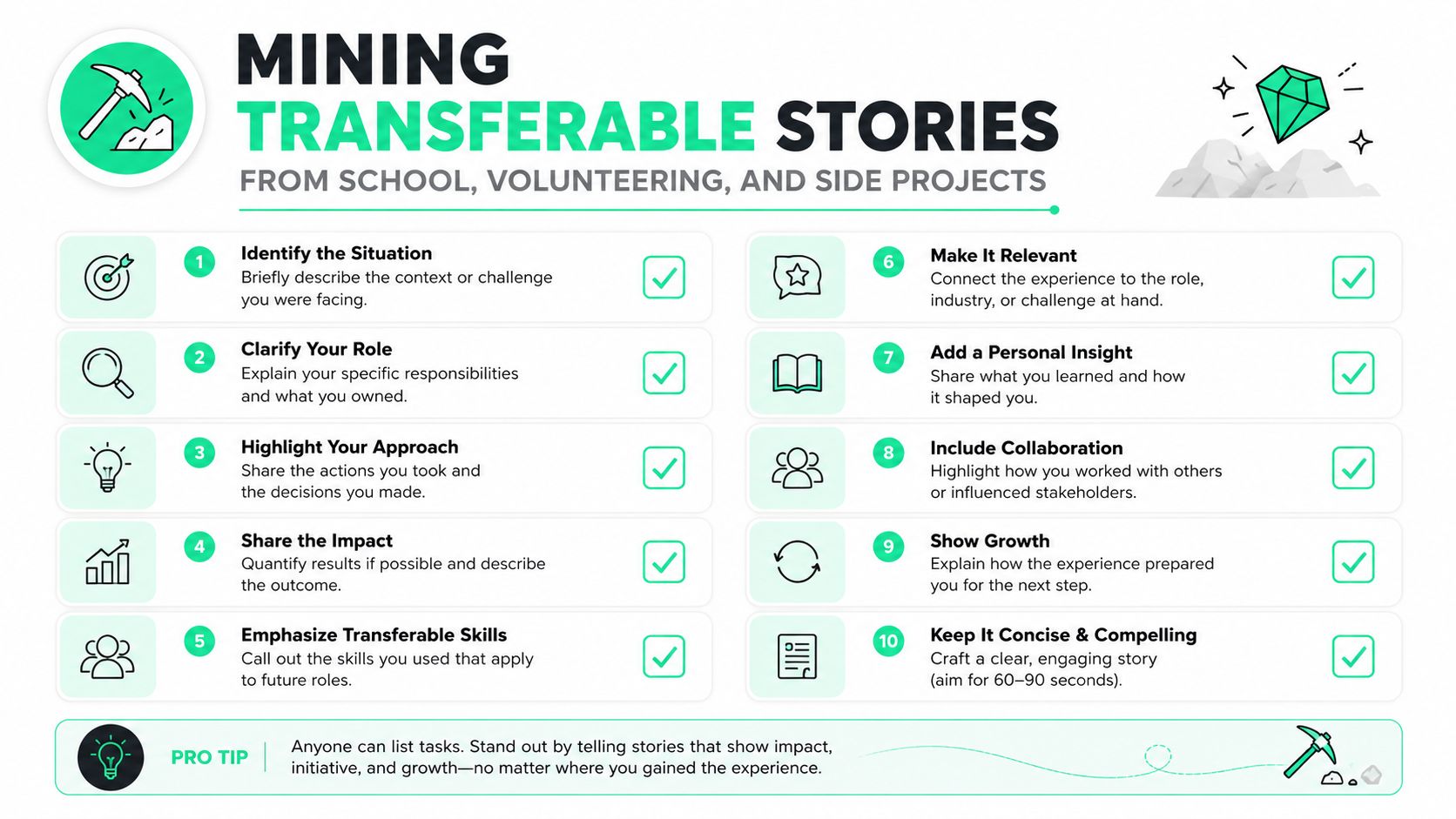
Stop searching your memory for “professional” experiences. Search for moments when there was pressure, uncertainty, disagreement, responsibility, or a consequence. The setting is only the wrapper. The behavior inside it is what the interviewer can evaluate.
Use a short audit before you write anything. Give yourself twenty minutes and scan the last three years of your life. Don't judge the stories while collecting them.
Build the raw list first
Write down every moment that fits one of these prompts:
- Group projects: When did roles break down, a teammate disappear, or the scope become unrealistic?
- Deadline pressure: When did you have too little time, incomplete information, or competing commitments?
- Conflicting stakeholders: When did two people want different outcomes, standards, or methods?
- Resource constraints: When did you lack money, equipment, data, authority, or expertise?
- Learning moments: When did you have to learn a tool, subject, process, or skill quickly?
- Recovery moments: When did you miss something, make an error, receive criticism, or need to repair a result?
Look beyond paid work. Include a campus club, volunteer shift, caregiving responsibility, student-run agency, Discord community, online course, side hustle, hackathon, portfolio project, or capstone. A personal project can reveal ownership more clearly than a routine job because you may have chosen the goal, built the process, and handled the consequences yourself.
Tag each story by what it proves
Now assign competencies to each situation. One story may demonstrate teamwork and prioritization. Another may show conflict management and learning from failure. Keep the tags practical:
- Teamwork
- Conflict
- Ownership
- Prioritization
- Communication
- Adaptability
- Learning quickly
- Resilience
- Attention to detail
- Decision-making
Write the candidate's personal actions beside each tag. “We redesigned the presentation” is weak. “I split the research into three sections, created a shared rubric, and asked each teammate to review one section” gives the interviewer something to assess.
Keep the consequence visible
A story without a consequence feels like a classroom anecdote. Record what changed: the team submitted on time, the event reached its attendance goal, the group resolved the disagreement, the client approved the revised brief, or you changed your process for future work.
Don't inflate small outcomes. “We finished the presentation before the deadline” is valid if the question concerns follow-through. The MIT STAR method guide recommends preparing a reusable bank of 6 stories mapped to 2 competencies each, while other preparation guidance recommends a bank of 8 to 10 reusable stories. You don't need a perfect collection. You need enough real material to avoid forcing one story into every question.
The Adapted STAR Method Built for Early-Career Candidates
A behavioral answer can fail even when the experience is relevant. A student describes the assignment, a volunteer explains the event, and a project team receives most of the attention. The interviewer then hears almost nothing about the candidate's judgment. Use STAR as a decision record, not a script: establish the problem quickly, show the choices you made, state the consequence, and finish with the rule you would reuse.
For early-career candidates, use 25 percent to Situation and Task, 50 percent to Action, 15 percent to Result, and 10 percent to Learning. This allocation keeps limited experience from becoming an excuse for vague answers. MIT's guidance uses 20 percent Situation, 10 percent Task, 60 percent Action, and 10 percent Result, while Northwestern's guidance uses 15 percent Situation, 10 percent Task, 50 percent Action, and 25 percent Result. The exact split matters less than the priority: context stays short, and your decisions occupy the center.
What weak answers sound like
Prompt: “Tell me about a time you worked under a tight deadline.”
Weak answer:
“In one of my classes, we had a group presentation that was difficult because everyone was busy. We had a lot of research to do, and the deadline came up quickly. We worked together and managed to finish it. It was stressful, but it taught me that teamwork is important.”
The setting is present, but the evidence is missing. The interviewer cannot tell what the candidate owned, which choice changed the situation, or what happened afterward. “We worked together” hides the behavior being assessed.
Strong answer:
“In a four-person marketing project, our research section was incomplete three days before the presentation, and two teammates were unavailable. I reviewed the assignment criteria, removed a low-value section, divided the remaining research into clear tasks, and created a shared checklist with review times. I completed the competitor analysis, combined the sources, and asked one teammate to challenge the recommendations before we submitted. We delivered the presentation on time and received positive feedback for a clear, focused argument. I learned to reduce scope early instead of trying to protect every part of an unrealistic plan.”
The stronger answer gives the interviewer a sequence to evaluate: reviewed, removed, divided, created, completed, combined, and asked. It also reports a credible consequence without pretending a class project produced a corporate transformation.
Weak versus strong STAR plus learning answer
Component Weak Answer Strong Answer
Situation
“We had a difficult class project.”
“Our research section was incomplete three days before a four-person presentation.”
Task
“We had to finish everything.”
“I needed to help the team submit a focused, credible presentation despite missing research and reduced availability.”
Action
“We worked together.”
“I reviewed the criteria, cut a low-value section, divided the research, built a checklist, completed the competitor analysis, and requested a challenge review.”
Result
“We finished successfully.”
“We delivered on time and received positive feedback for a clear, focused argument.”
Learning
“Teamwork matters.”
“I now reduce scope early when a plan becomes unrealistic.”
Use one event per answer. For detailed guidance on adapting STAR answers for candidates with no experience, keep the story narrow enough to recall under pressure. Three half-stories do not make a candidate sound experienced. One concrete situation, visible decisions, a consequence, and a usable lesson give the interviewer something real to assess.
When to Use a Transfer Story Versus a Hypothetical Answer
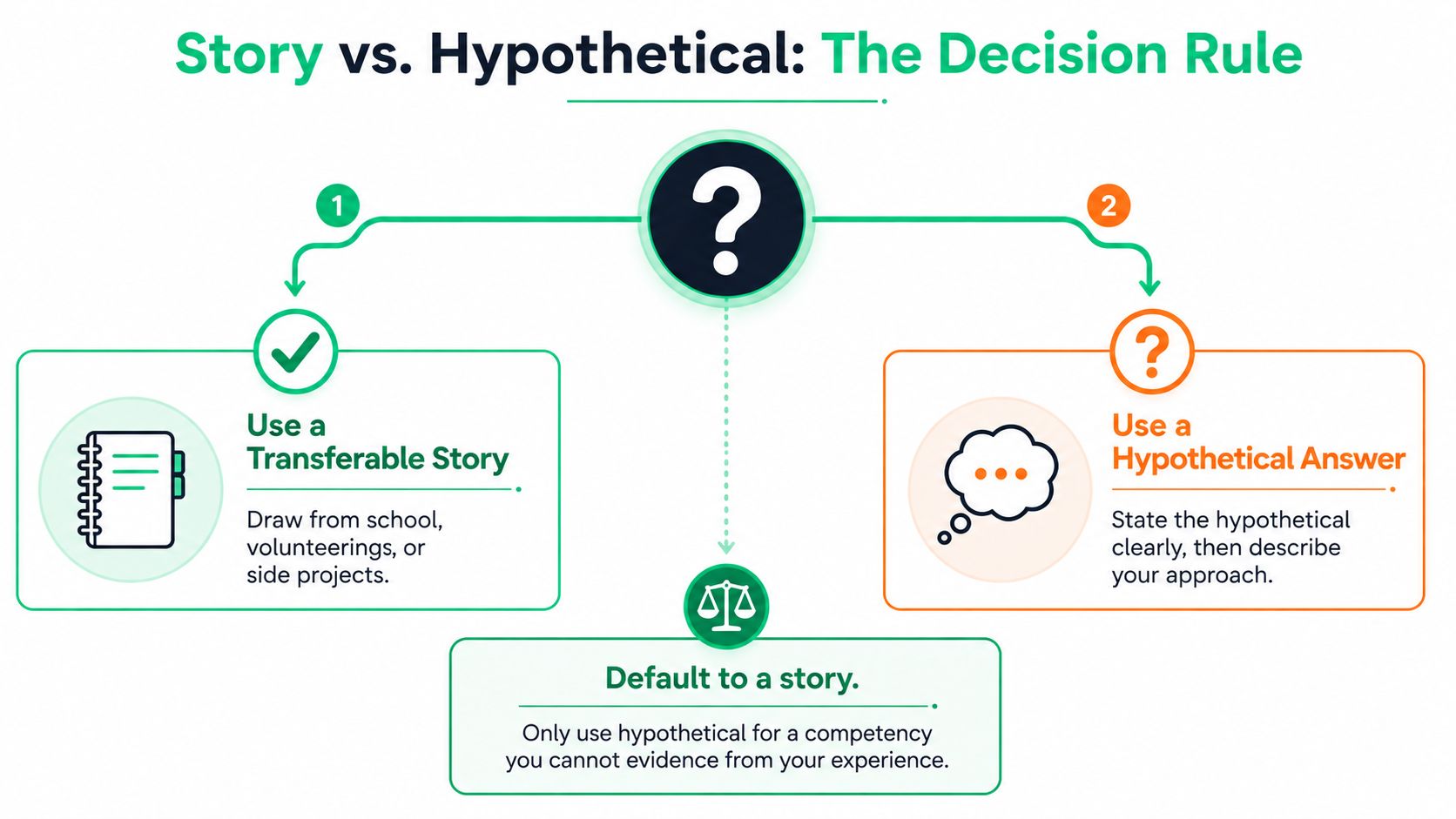
Use this decision rule:
Default to a transfer story. Use a hypothetical only when the prompt names a competency you genuinely can't evidence, then anchor the hypothetical in a smaller real behavior.
Before choosing a story, ask three questions:
- Does the example name a specific moment?
- Can you name a result or consequence?
- Did you act, rather than merely observe?
If the answer is yes to all three, tell the story. If you can answer yes to two, strengthen the missing piece. If you can't identify a real action, use a hypothetical carefully and connect it to adjacent evidence.
The same prompt answered two ways
Prompt: “How would you handle a customer escalation?”
Transfer version
“In a group capstone, one teammate became frustrated because the research direction kept changing. I met with them privately, summarized the concern, and proposed a shared rubric for deciding which sources and recommendations met the assignment requirements. We used the rubric to settle the disagreement and completed the final analysis without reopening the same argument. In a customer setting, I'd use the same approach by clarifying the concern, defining the decision criteria, and confirming the next step.”
Hypothetical version with grounding
“I haven't handled a customer escalation in a formal support role, so I'd first acknowledge the customer's concern, clarify the desired outcome, and separate what I could resolve from what required escalation. I'd document the issue, give a specific follow-up point, and communicate any constraint clearly. My closest experience is resolving a methodology disagreement in a capstone by creating a shared rubric, which taught me to replace competing opinions with explicit criteria.”
The second answer is acceptable because it acknowledges the gap once, gives a coherent approach, and grounds that approach in real behavior. A hypothetical without the final connection sounds like intent, and early-career candidates don't receive much credit for intent alone.
Use the decision guidance for answering when you have no direct experience as a filter, not as permission to invent workplace stories. Never claim you handled a customer escalation if you handled a team disagreement. Translate the skill accurately.
Sample Answers for the Most Common Behavioral Prompts
The fastest way to improve is to compare the answer you'd normally give with an answer that exposes decisions. The examples below use academic and student-run settings, but you should replace them with your own verified details.
Teamwork
Prompt: “Tell me about a time you worked on a team.”
Weak version:
“I worked on a group project where we had to make a presentation. Everyone had different schedules, but we communicated and finished it. I'm a good team player because I helped wherever I could.”
The trap is vague teamwork language. There's no broken process, personal ownership, or result.
Strong version:
“In a four-person capstone, our roles broke down during the week because two teammates were completing overlapping research while another section had no owner. I reviewed the deliverables, proposed a smaller scope, reassigned the uncovered section, and created a shared checklist with a midweek review. We submitted the project on time with every required section covered. I learned that teamwork improves when responsibilities are visible, not merely agreed to in a meeting.”
Conflict
Prompt: “Describe a conflict with a teammate.”
Weak version:
“A teammate and I disagreed about our research method, but we talked it through and found a compromise. The project went well, and I learned that communication is important.”
This hides the disagreement and makes “compromise” do all the work.
Strong version:
“A teammate and I disagreed about whether our research should rely on interviews or published data. I wrote down the criteria we both cared about, including relevance, reliability, and the time available, then proposed a shared scoring rubric instead of debating preferences. We scored both approaches, combined them where the evidence supported it, and completed the analysis without further conflict. I learned to turn a personal disagreement into a decision process the group can inspect.”
Failure
Prompt: “Tell me about a failure.”
Weak version:
“I missed a deadline once because I had too much work. I apologized and finished the assignment. Since then, I've managed my time better.”
This answer minimizes the failure and offers no changed behavior.
Strong version:
“At a student-run agency, I missed the internal deadline for a client brief because I underestimated the time needed to review the source material. I told the project lead as soon as I recognized the risk, delivered the missing sections in a revised sequence, and asked another teammate to review the final brief before it went out. We recovered the deliverable and sent the client a complete version after the team's review window had been compressed. I now break research-heavy work into checkpoints and flag schedule risk before the deadline is at risk.”
Notice the pattern. Each strong answer uses one sentence for context, two for action, one for the result, and one for learning. Practice your own versions with behavioral interview questions and guided practice, but don't memorize polished paragraphs. Memorize the sequence of events and the verbs that describe your contribution.
Practice Drills That Reduce Brain Fog and Filler Words
Reading about STAR will not make answers easier to retrieve. Practice must force you to choose a story, state your contribution, and finish under mild pressure. Use a one-week routine that turns each experience into a small set of recall cues.
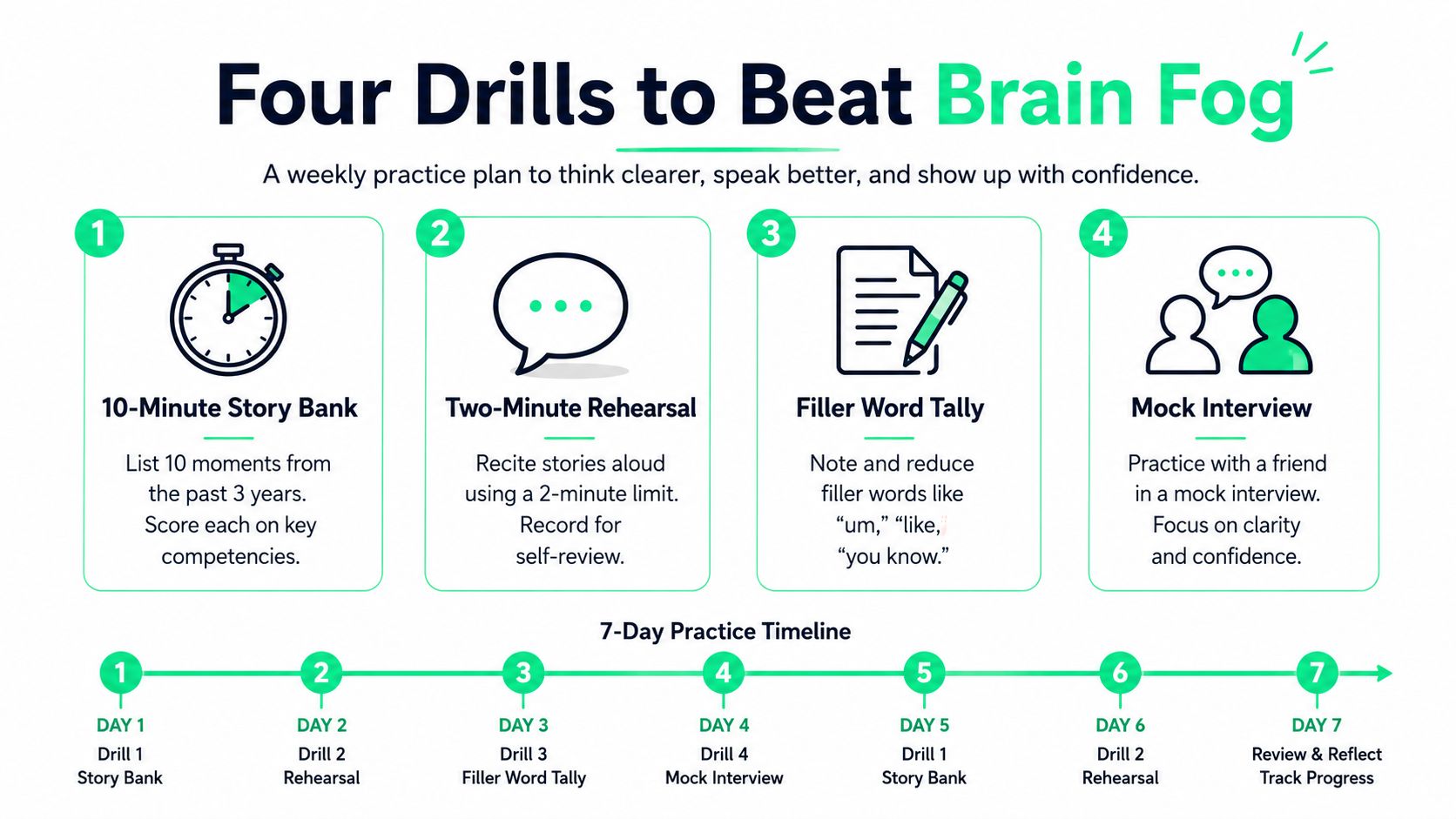
Drill one, build the story bank
Set a ten-minute timer. List ten moments from the last three years, including coursework, volunteering, student organizations, jobs, and side projects. Rate each story for competency coverage, clear personal action, and a visible result. Keep the top five, then connect each to two competencies where possible.
Do not write scripts. Record five cue words for every story:
- The pressure
- Your responsibility
- The first decision
- The key action
- The result or lesson
That sequence gives you a usable answer without forcing you to memorize paragraphs.
Drill two, compress the answer
Set a visible 90-second timer and answer one prompt aloud. Stop when the timer ends. Review whether Situation and Task took space away from Action, then repeat the story with less background and sharper verbs.
Record yourself with your phone or use a practice platform. The goal is fast retrieval, not a polished performance. For extra repetition, use Qcard's mock interview AI to rehearse behavioral follow-ups and structured responses.
Drill three, rehearse interruptions
Ask a friend to interrupt you halfway through with questions such as, “What did you personally do?” or “What happened next?” Answer the interruption, return to your sequence, and finish with the result. Do not restart from the beginning.
Real interviews switch topics and probe vague claims. This drill exposes whether you know your contribution or have memorized general statements.
Drill four, attach a recall cue
Assign each story one image, color, or song. A red folder can cue the missed-deadline story, while a campus auditorium can cue the conflict story. For a question about failure, conflict, or prioritization, retrieve the cue first, then the five-word sequence.
Cut filler with a deliberate pause. Replace “like,” “basically,” and “to be honest” with a silent beat of one count before your next sentence. A controlled pause sounds prepared. Filler makes your answer sound unfinished.
Accessibility Tips and Quick-Reference Recovery Phrases
Interview performance depends on retrieval and pacing, not just the quality of your experiences. If anxiety, neurodivergence, language processing, or rapid question switching affects recall, reduce the cognitive load before the interview instead of blaming yourself afterward.
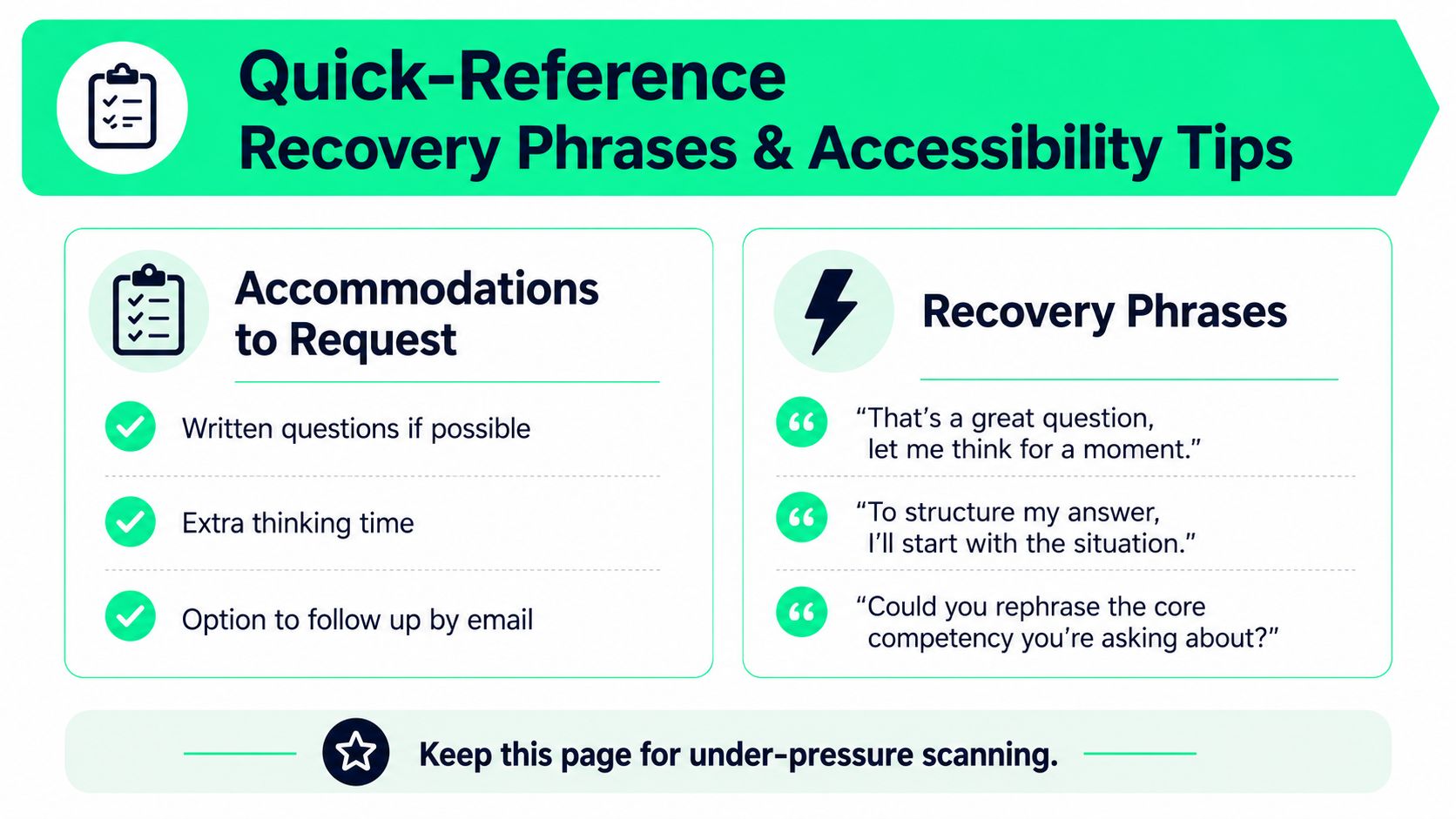
Request practical accommodations in advance where available:
- Written prompts: Ask whether questions can be provided in writing or displayed during the interview.
- Thinking time: Request a short pause before answering complex behavioral questions.
- Clarification: Ask the interviewer to restate the competency or narrow a broad prompt.
- Follow-up communication: Ask whether you can clarify an answer by email when the process allows it.
Use these recovery phrases exactly when needed:
- Blanking on a story: “I want to give you a real example. Let me take a moment to identify the closest one.”
- Giving too much context: “I want to restart with the outcome first, then walk you through the situation.”
- Rambling: “The key action I took was this. I reviewed the options, chose one, and then followed up.”
- Choosing the wrong example: “That example doesn't address the competency as directly as I'd like. I'm going to switch to a better one.”
- Oversharing: “The personal details aren't necessary here. The relevant point is the decision I made and what changed afterward.”
- Needing clarification: “Could you rephrase the core competency you're asking about?”
Ground yourself physically before restarting. Put both feet on the floor, exhale slowly, look at one fixed point, and use the next sentence as your entry point. Don't fill the silence while searching.
Your one-page pre-interview checklist
Prepare this before the call:
- Three starred stories with their five-word recall cues
- Two hypothetical approaches for competencies you can't evidence directly
- One printed decision rule, default to a transfer story
- Water nearby
- A written note of any disclosed accommodations
- The job description with the three most relevant competencies marked
You don't need a perfect career history. You need a reliable way to retrieve real evidence, explain your actions, and recover when your first answer isn't clean.
Key Takeaways
- Lack of formal experience is a framing problem, not a content problem — behavioral questions test collaboration, problem-solving, and follow-through, and a club budget dispute can demonstrate stakeholder management just as well as a corporate example, which is why opening with "I don't really have experience, but…" disqualifies evidence the interviewer would have accepted.
- The most common failure is hiding behind "we" — "we worked together and finished it" tells the interviewer nothing about your judgment, while a sequence of personal verbs ("I reviewed the criteria, cut a low-value section, divided the research, built a checklist, completed the competitor analysis") gives them something concrete to evaluate.
- Early-career answers need a different STAR balance — 25% Situation and Task, 50% Action, 15% Result, 10% Learning keeps limited experience from becoming an excuse for vague answers, and ending with a reusable rule ("I now reduce scope early when a plan becomes unrealistic") is stronger than a slogan like "teamwork matters."
- Transfer stories beat hypotheticals almost every time, and honesty about the translation matters — never claim you handled a customer escalation if you handled a team disagreement, but do explain how the same approach applies, since a hypothetical without a real behavioral anchor sounds like intent, and early-career candidates get little credit for intent alone.
- Retrieval, not story quality, is what breaks under pressure — five-word cue sequences (the pressure, your responsibility, the first decision, the key action, the result or lesson), 90-second timed drills, interruption practice that forces you to resume rather than restart, and prepared recovery phrases ("Let me take a moment to identify the closest one") reduce cognitive load for anxious, neurodivergent, and second-language candidates without turning answers into scripts.
Qcard helps candidates practice behavioral questions with STAR prompts, surface concise talking points from verified résumé experience, and rehearse pacing, filler words, follow-ups, and answer length without turning responses into scripts. If brain fog is the problem, use its structured practice and real-time memory cues to prepare, then visit Qcard to see how it fits your interview routine.
Ready to ace your next interview?
Qcard's AI interview copilot helps you prepare with personalized practice and real-time support.
Try Qcard Free