TL;DR
Strong behavioral interview answers run 60 to 90 seconds, about 150 to 200 spoken words, with 2 minutes as the upper limit. The real rule is allocation: roughly 15% Situation, 10% Task, 60% Action, and 15% Result, so your decisions and impact aren't buried under background. Length flexes by context: about 45 seconds for a quick screen, 90 seconds for a standard answer, and up to 2 minutes only when a follow-up invites more depth. When the interviewer asks "What did you do next?", expand that part instead of restarting the story. Pacing varies by format: signpost clearly on the phone, leave a beat for latency on video, and read nods and posture in person. Practice one real story at three lengths, record it, and check three things: length, balance (did Action get the most time?), and clarity (can a listener name your contribution?). Use short cue words instead of memorized scripts so delivery stays natural under pressure.
Strong behavioral interview answers usually land in 60–90 seconds, or about 150–200 spoken words, and they generally shouldn't run past 2 minutes. That window gives you enough time to explain the situation, show what you did, and finish with a clear result without losing focus.
You may already know the feeling. The interviewer asks, “Tell me about a time you handled a conflict,” and you begin with the department, the project history, three meetings that happened before the conflict, and every detail you can remember. A minute passes. Then another. You're still explaining the background, while the most important part, your decisions and impact, remains buried.
The problem usually isn't that you lack a good story. It's that you're measuring the answer as one block of time instead of deciding how much time each part deserves. Behavioral questions reward focused evidence, not a complete transcript of everything that happened.
How Long Should Behavioral Interview Answers Be?
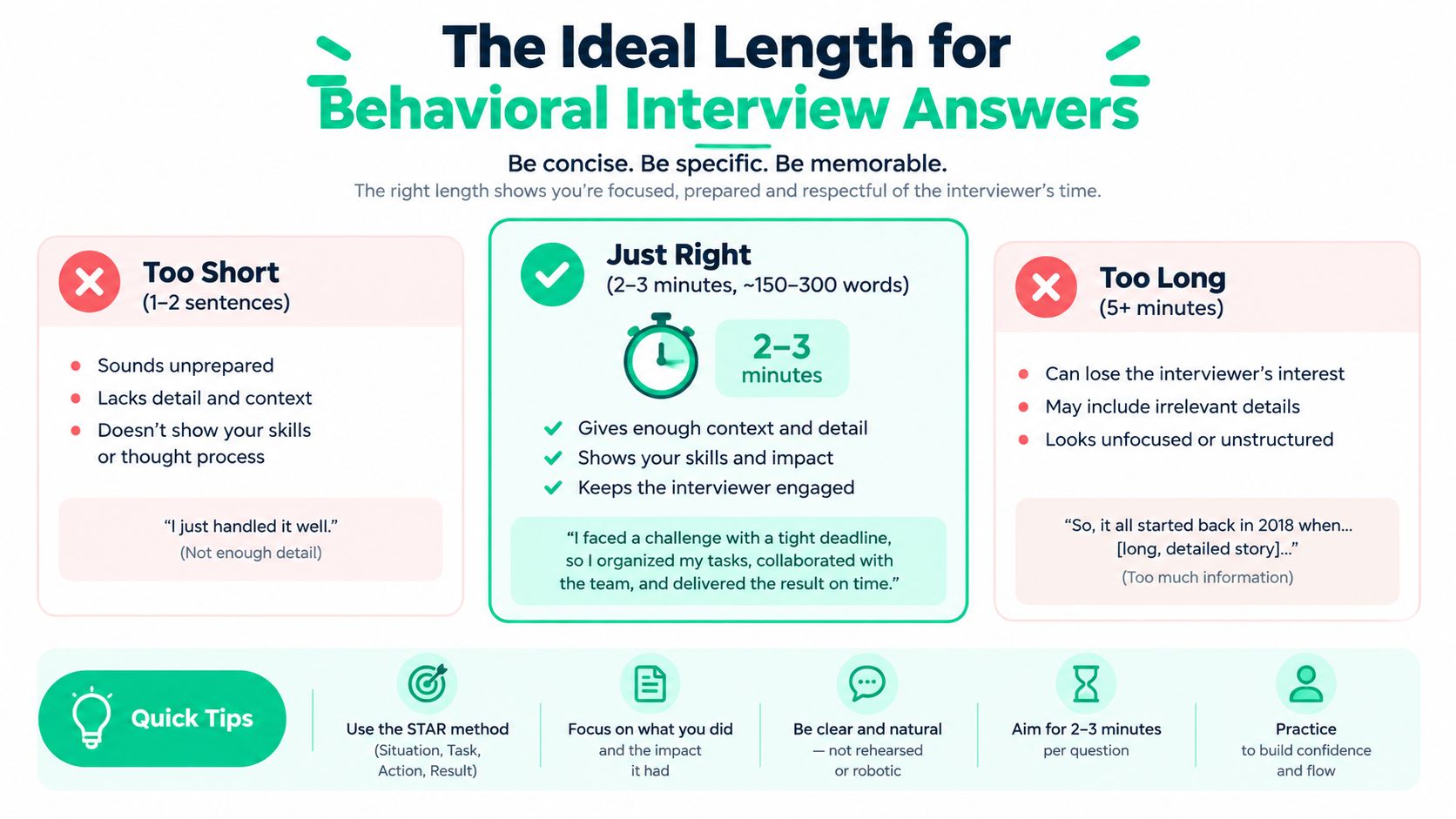
Aim for 60 to 90 seconds, roughly 150 to 200 spoken words, and treat 2 minutes as a practical ceiling. That window is long enough to explain the situation, show what you did, and land a clear result without losing the interviewer's attention.
The allocation matters more than the stopwatch. Split your time like this:
- Situation: ~15% (what was happening, one or two sentences)
- Task: ~10% (what you were responsible for)
- Action: ~60% (your decisions, trade-offs, and collaboration)
- Result: ~15% (what changed, plus a short lesson if it strengthens the example)
On a 2-minute budget, that's about 18 seconds for Situation, 12 for Task, 72 for Action, and 18 for Result. Action gets the most room because it's where interviewers evaluate your judgment.
Adjust length to the question and format:
- Quick screen or simple prompt: about 45 seconds (90–110 words). Minimum context, then action and outcome.
- Standard behavioral question: about 90 seconds (150–200 words). Add diagnosis and one adjustment you made.
- Deep follow-up: up to 2 minutes (250–300 words). Add trade-offs, stakeholder alignment, and reflection, but never unrelated history.
Quick self-check: record one answer at your natural pace and listen for when the result arrives. If it comes late, compress the setup. If a listener can't identify your personal contribution, add one concrete decision before closing.
"Introduction Why Answer Length Makes or Breaks Your Interview"
The interviewer asks, “Tell me about a time you handled a conflict.” You begin with the department, the project history, and several meetings that came before the disagreement. A minute passes, then another. Your decisions and impact are still waiting to be heard.
The problem is rarely a lack of experience. It is usually a timing problem. Treating the answer as one block encourages too much background, while a timed STAR structure directs attention to the evidence the interviewer needs.
A useful benchmark is 60–90 seconds, or roughly 150–200 spoken words, with an upper boundary of 2 minutes, according to guidance on behavioral answer length. Use the shorter end for a direct question or quick follow-up. Use more time only when a complex example requires additional evidence.
Instead of chasing 90 seconds exactly, plan the allocation: roughly 15% for Situation, 10% for Task, 60% for Action, and 15% for Result. The proportions matter more than the stopwatch because Action shows your judgment, and Result shows the effect of your work.
Why interviewers notice timing
Interviewers compare your example with the role's requirements. They listen for ownership, communication, judgment, problem-solving, and results. If context takes most of the answer, they may hear too little about the choices you made.
Length also affects confidence. Without a clear stopping point, candidates often add details to reassure themselves. Anxiety produces more explanation, the explanation stretches the answer, and the longer answer creates more anxiety.
Practical rule: Give one complete example with a clear result. Do not try to prove your entire career through one response.
A focused answer is easier to remember. It creates a simple sequence: problem, responsibility, action, outcome. Extra names, projects, and side decisions can crowd out your contribution.
What good length sounds like
A strong response sounds conversational, not rushed. Take a brief pause, state the situation in a sentence or two, and give the largest share of your time to what you did. A short story works like a guided tour. The interviewer should reach the important room, your actions and result, without walking through every hallway first.
Timing anxiety is common among early-career candidates, career switchers, international students, and neurodivergent professionals who may need a moment to organize their thoughts. Memorizing a perfect script is less useful than rehearsing a flexible structure. Practice deciding which details support your evidence, then give those details enough time to be heard.
"The Ideal Length for Behavioral Interview Answers Explained"
A response can reach the expected time and still feel incomplete. The better question is how much time each STAR component receives. At a conversational pace of roughly 125–150 words per minute, 90 seconds is about 190–225 words, while 2 minutes is about 250–300 words. Use those figures as a planning guide, not a script.
The practical 150–200-word range works because pauses, emphasis, and speaking speed change the total. More useful than counting every word is dividing the answer so Action and Result receive the largest share. A short setup gives the listener the map. Your decisions show your contribution, and the outcome shows why those decisions mattered.
Think in story beats
A behavioral answer has a beginning, middle, and ending:
- Beginning: Give the relevant situation and your responsibility in a few clear sentences.
- Middle: Spend most of your time on the actions you took, including key decisions, trade-offs, and collaboration.
- Ending: State the result, then add what you learned or changed when that reflection supports the example.
For a roughly 90-second response, picture a quick guided tour. The Situation and Task point out the location and challenge. Action walks the interviewer through the important rooms, while Result brings them to the destination. If the tour spends too long in the lobby, the interviewer may never see what you did.
Why the 2-minute boundary matters
The STAR method guidance from Extern supports 60–90 seconds as a practical range and cautions that answers extending beyond about 2 minutes can become over-detailed. Crossing that boundary is a prompt to check whether each sentence adds evidence or just records your thoughts aloud.
Cut sentences one at a time. If the story still makes sense and the result remains clear, that sentence was probably expendable. If removing it hides the reason behind your decision, keep the idea and shorten another detail.
Record one answer at your natural pace. Listen for the moment the result arrives. If it comes late, compress the setup. If the interviewer cannot yet understand your role, add one concrete action or decision before ending.
"Why Behavioral Answer Length Varies by Question and Format"
The benchmark is a guide, not a rigid rule. A question asking about a simple workplace disagreement may need less explanation than one asking about a major failure, an ambiguous project, or a decision involving several stakeholders. The right length depends on how much context the interviewer needs to understand the difficulty and your contribution.
A short screening interview often benefits from a compact example that quickly establishes relevance. In a later interview, the interviewer may invite more detail because they're testing judgment, reflection, or leadership scope. A follow-up such as “What did you do next?” is a signal to expand the part they're evaluating, not an invitation to restart the story from the beginning.
Adjust for the question
Use the prompt to decide where your time belongs:
- Simple prompt: Give the minimum context, then identify the action and outcome.
- Complex prompt: Add only the background needed to explain the constraints or competing priorities.
- Failure question: Include your response, correction, and learning rather than defending every original decision.
- Leadership question: Clarify who needed alignment and how you influenced the decision.
- Teamwork question: Separate your contribution from the group's overall work.
Seniority can change the kind of evidence that matters, but it doesn't remove the need for focus. A leadership answer may involve broader scope and more stakeholders, while an entry-level answer may center on initiative, learning, or reliable execution. Neither should become a career history.

Read the interview format
Phone interviews remove visual feedback, so signposting becomes more valuable. Video interviews add potential pauses and connection delays, which means you may need to leave a beat before assuming the interviewer has finished speaking. In person, you can often use facial expression and posture to judge whether more context is welcome.
Don't respond to every format by speaking faster. Use clear transitions such as “The key action I took was…” or “The result was…” These phrases help the interviewer follow your answer and help you remember where you are in the story.
"How to Structure Behavioral Answers With STAR and Time Cues"
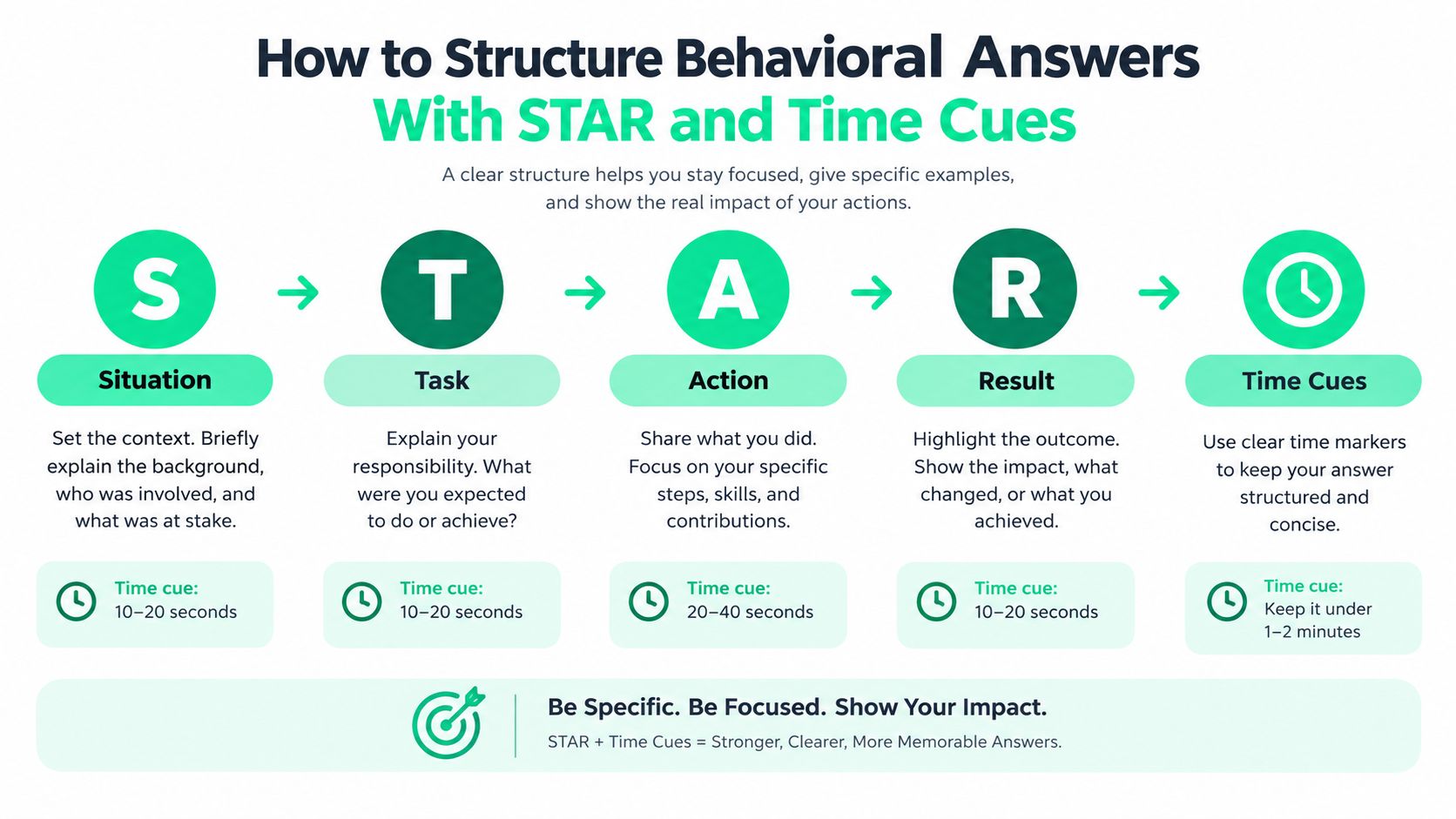
STAR stands for Situation, Task, Action, and Result. The framework works best when it organizes your thinking without forcing every answer into identical wording. The central timing principle is simple: context should support the evidence, not compete with it.
A practical 2-minute budget from this STAR timing breakdown assigns about 15% to Situation, 10% to Task, 60% to Action, and 15% to Result. In seconds, that's approximately 18 seconds for Situation, 12 seconds for Task, 72 seconds for Action, and 18 seconds for Result.
Keep Situation and Task compact
Situation answers one question: what was happening? Give the setting, the challenge, and the relevant constraint. Task explains what you were responsible for.
For example:
“Our customer support team was receiving repeated complaints about delayed escalations during a product rollout. I was responsible for finding the cause and proposing a process the team could use immediately.”
That setup gives the interviewer enough orientation. It doesn't require a long description of the rollout, every team involved, or the history of the support process unless those details affect your decisions.
Put the weight on Action
Action should receive the largest share because it shows how you think and work. Explain the sequence of decisions, not just a list of activities. Use “I” when describing your contribution, even if the project involved a team.
A useful action sequence is:
- Identify the obstacle or competing priority.
- Explain the decision you made.
- Describe how you communicated or collaborated.
- Show how you adjusted when new information appeared.
- Connect the action to the outcome.
For a shorter answer, choose the two or three actions that best demonstrate judgment. For a fuller answer, add the trade-off or stakeholder reaction that makes the decision meaningful.
Candidates who want a structured rehearsal routine can use Qcard's interview preparation guide to organize resume-grounded examples before practicing aloud.
Finish with Result and reflection
Result should answer, “What changed?” State the outcome plainly, then add a short reflection if it strengthens the example. Interview Studio's STAR masterclass offers another budget: Situation at 15–20 seconds, Task at 10–15 seconds, Action at 50–70 seconds, Result at 15–25 seconds, plus a 10–15-second “So What” reflection, for a total of 100–145 seconds.
These budgets aren't competing laws. They show the same priority from different angles: keep the setup brief, give Action room, and close with evidence. If you're preparing a standard 90-second response, use the proportions as a guide rather than trying to force every component into a precise second.
"Behavioral Interview Answer Examples at Different Lengths"
Consider one story: you noticed that new volunteers at a community event were missing important shift information, so you redesigned the handoff process. The same experience can answer different prompts, but the amount of detail should change with the interviewer's needs.
Short version for a quick screen
Approximate length: 45 seconds, about 90–110 spoken words.
“At a community event, new volunteers were missing shift updates because information was spread across several messages. I was responsible for improving the handoff. I created one shared schedule, added clear ownership for updates, and asked returning volunteers to confirm the process with new arrivals. The team had fewer questions during the event, and the coordinator continued using the schedule for later events. The experience taught me to fix the information flow, not just remind people to read messages.”
This version works when the interviewer asks for a quick example or when time is limited. It includes the challenge, responsibility, actions, result, and learning. It doesn't explain every conversation or describe the original messages in detail.
Medium version for the standard response
Approximate length: 90 seconds, about 150–200 spoken words.
“At a community event, new volunteers were missing shift updates because information was spread across several messages and people weren't sure which version was current. I was asked to improve the handoff before the next event. I first spoke with the coordinator and two returning volunteers to identify where the confusion began. Then I created one shared schedule with shift times, contact details, and a clear owner for changes. I also added a short check-in process so returning volunteers could walk new arrivals through the schedule at the start of each shift. During the next event, I watched for questions and adjusted the labels when volunteers confused arrival time with start time. The coordinator reported that the handoff felt smoother, and the team kept using the schedule afterward. I learned that a simple system with visible ownership can prevent repeated communication problems better than sending more reminders.”
This answer adds diagnostic work and an adjustment. Those details strengthen the Action section because they show how you identified the problem and responded to what you observed.
Long version for a deeper follow-up
Approximate length: 2 minutes, about 250–300 spoken words.
The long version could add the competing needs behind the redesign, explain why you chose a shared schedule rather than another message, describe how you gained agreement from the coordinator, and include the reflection that you later applied the same handoff principle elsewhere. It shouldn't add unrelated history.
A useful expansion might sound like this:
“The coordinator initially preferred sending one final group message because it seemed faster, but I explained that the issue wasn't a lack of reminders. Volunteers had no single place to verify changes. I proposed a shared schedule and asked the coordinator to approve the ownership model before I built it. That conversation mattered because the process would fail again if nobody maintained it. After the event, I reviewed the questions volunteers asked and changed the schedule labels so the next group could distinguish arrival time from shift start time more easily.”
Practice changing the same story with Qcard's behavioral interview question practice. Start with the short version, develop the 90-second version, and expand only when a follow-up calls for it.
"Pacing Tips for In Person Phone and Video Interviews"
Timing becomes easier when you control delivery, not just content. Nervous candidates often accelerate through the Situation and Task, then keep talking because they haven't decided how to finish. A calm opening and a deliberate transition into Action can make the same answer sound more confident without changing the story.
Use pauses as punctuation
Before answering, take a quiet breath. After stating the situation, pause briefly before explaining your responsibility. Small pauses help the interviewer process information and give you a moment to choose the next point.
Use signposts to create audible structure:
- “The challenge was…”
- “My responsibility was…”
- “The first decision I made was…”
- “The result was…”
Don't turn these into a script. Treat them as memory cues that keep your answer moving toward Action and Result.
Adapt to each setting
In person, look for signs that the interviewer understands. If they nod while you give the setup, move forward. If they lean in during the decision point, give that moment enough space.
On the phone, verbal clarity matters more because the interviewer can't see your expression or gestures. Use names sparingly, distinguish people by role, and avoid long sentences with several clauses.
On video, latency can make interruptions awkward. After the interviewer finishes, leave a short beat before speaking. If you're asked a follow-up, answer that specific question first instead of repeating the full STAR story.
Qcard's AI mock interview tool can provide a setting for practicing spoken answers and responding to follow-up questions. Whether you use that tool, a phone recorder, or a practice partner, review whether your pauses feel intentional rather than rushed.
Breathe before the story, pause after the setup, and slow down when you reach the decision that shows your judgment.
If you notice yourself speeding up, lower your rate by shortening sentences. Don't stretch every word. A sentence such as “I compared both options, identified the risk, and recommended the simpler rollout” is easier to deliver clearly than a long explanation with several subordinate points.
"Practice Techniques and Support for Every Candidate"
You build timing through repetition with feedback, not by reading a script in your head. Start with one behavioral question and one real experience from your resume. Write only the Situation, Task, Action, and Result as short prompts, then answer aloud while using a timer.
Record the response and review three things:
- Length: Did you finish within your intended range?
- Balance: Did Action receive more attention than background?
- Clarity: Could a listener identify your contribution and result?
Candidates who experience brain fog or anxiety may benefit from smaller memory cues. International candidates can also use cue words to support fluent delivery without memorizing unnatural sentences. A cue such as “conflict, options, decision, outcome” preserves the story while leaving room for authentic language.
Practice at different lengths. Give the same answer briefly, then develop it into a fuller response when a partner asks for more detail. This teaches flexibility, which is more useful than trying to reproduce one perfect version.
You can also ask a practice partner to interrupt with realistic follow-ups such as “Why did you choose that approach?” or “What would you do differently?” The interruption helps you learn to expand one component without restarting the entire answer.
If filler words or rushing are persistent concerns, seek feedback on the exact moment they appear. Replace vague advice such as “be concise” with a specific adjustment: shorten the setup, pause before Action, or state the result earlier. That turns timing into a skill you can practice rather than a personality judgment.
"Conclusion Your Next Steps to Confident Timed Answers"
So, how long should behavioral interview answers be? Aim for 60–90 seconds, roughly 150–200 spoken words, and treat 2 minutes as a practical ceiling. The deeper rule is allocation: keep Situation and Task focused, spend most of the answer on Action, and close with a specific Result.
For your next practice session, choose one real story, write four STAR cues, record a 90-second version, and listen for whether your decisions appear early enough. Then create a shorter version for a quick screen and a fuller version for a follow-up. You don't need perfect timing. You need a clear example that sounds like you and makes your contribution easy to remember.
Key Takeaways
- The benchmark is 60 to 90 seconds, roughly 150 to 200 spoken words, with 2 minutes as the ceiling. Past that point, answers tend to become over-detailed, so crossing it should prompt a check on whether each sentence adds evidence or just records your thoughts aloud.
- Proportion beats precision. A 15/10/60/15 STAR split keeps the setup short and gives Action most of the time, because that's where interviewers see your judgment, while Result shows why your decisions mattered. Hitting 90 seconds exactly matters far less than getting that balance right.
- One story should exist at three lengths. A 45-second version for quick screens, a 90-second version for standard questions, and a 2-minute version for follow-ups teach flexibility, which is more useful than memorizing one perfect answer that breaks when the question changes.
- Answer the follow-up, don't restart the story. "What did you do next?" or "Why that approach?" signals the interviewer wants depth on one part, so expand that component directly rather than repeating the full STAR sequence.
- Pace with pauses and signposts, not speed. Breathe before answering, pause after the setup, and use cues like "My responsibility was…" and "The result was…" to create audible structure. On phone calls, signposting replaces visual feedback; on video, a short beat prevents talking over lag.
Qcard helps candidates practice behavioral answers with resume-grounded talking points, AI-scored practice, mock interviews, and coaching on pacing, filler words, and answer length. Visit Qcard to practice a timed STAR response and build concise memory cues that support natural delivery without scripting.
Ready to ace your next interview?
Qcard's AI interview copilot helps you prepare with personalized practice and real-time support.
Try Qcard Free