8 Group Interview Tips to Stand Out as a Team Player
TL;DR
Group interviews test whether you can contribute distinctly while helping a discussion move forward — not whether you can dominate it. Prepare four or five flexible, resume-grounded stories with real metrics, then adapt them by shifting emphasis rather than memorizing separate speeches. Time your entries using a three-count pause, acknowledge the previous speaker, and add an angle the group hasn't covered. Keep answers to 30 to 60 seconds using situation, one action, one result, then stop and let the panel ask follow-ups. Ask one or two sharp role-specific questions rather than forcing all three you prepared. Manage cognitive load with pause phrases, one-word cue notes, and a focus on what you control — especially valuable for neurodivergent, anxious, and second-language candidates facing rapid turn-taking. Build rapport during introductions and reference other candidates by name. Then send a specific follow-up within 24 hours that names one real moment from the discussion. Measure success by actions you executed, not by comparison with the room.
Several candidates are answering the same question, one person keeps taking the floor, and the clock is moving faster than anyone expected. You may feel pressure to speak more often, speak louder, or interrupt before someone else uses the point you wanted to make.
That approach usually misses what a group interview is designed to reveal. Strong performance depends less on claiming the most airtime and more on preparing credible evidence, listening visibly, adding a distinct perspective, and helping the discussion move forward. Employers often use structured group formats to observe teamwork, communication, leadership, listening, and concise problem-solving under consistent conditions. Employer guidance on group interviews recommends explaining the format in advance, using structured questions, and debriefing promptly, while panel-interview guidance emphasizes defined competencies, interviewer roles, and independent scoring.
These eight group interview tips will help you prepare resume-grounded stories, time your contributions, ask sharper questions, manage anxiety and cognitive load, participate inclusively, perform well online or in person, and follow up with substance. You'll also find mini-scripts and practice drills you can use before the interview.
What Are the Best Group Interview Tips?
Group interviews reward preparation and judgment, not volume. Employers use structured group formats to observe teamwork, communication, leadership, listening, and concise problem-solving under consistent conditions — which means the candidate who claims the most airtime often performs worst. Here are the eight tips that matter:
1. Prepare resume-grounded talking points. Build four or five stories covering problem-solving, teamwork, leadership, ambiguity, feedback, and disagreement. Memorize the structure, facts, and lesson — not a speech. Replace "I'm good at problem-solving" with "I reduced bug-resolution time by 40% by implementing a triage system, freeing up 8 hours per week."
2. Time your interjections strategically. Speaking immediately after every answer looks reactive; waiting too long makes your preparation invisible. Count to three after someone finishes, then acknowledge and add a distinct angle: "That's a great point about stakeholder communication. I had a similar challenge when I coordinated a product launch, and a shared decision log kept disagreements from resurfacing."
3. Ask role-specific follow-up questions. Prepare three, use one or two. Ask what strong performance looks like in the first major project, which teams the role influences most, or what problem the panel most wants solved. If another candidate asks something similar, build on it rather than repeating it.
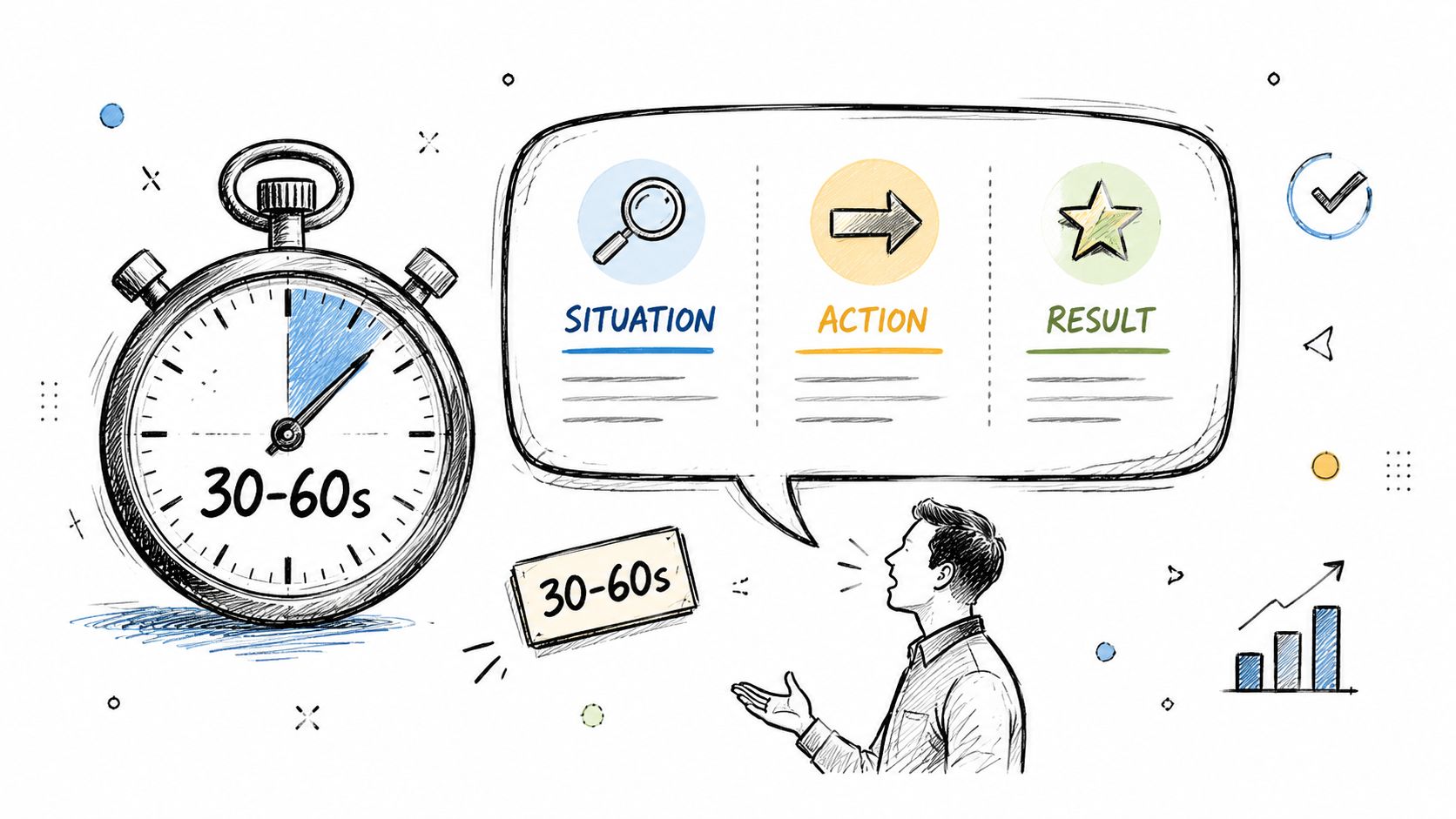
4. Keep answers structured and short. Use situation, one key action, one specific result, then connect to the role and stop. Long answers consume time that belongs to other candidates and make your main point harder to find.
5. Acknowledge others without diminishing yourself. Credit the useful point briefly, then add evidence the panel hasn't heard. "I appreciate that focus on structure. My startup experience required faster decisions with incomplete information."
6. Manage cognitive load by controlling what you can. You control your examples, listening, timing, and pace — not other candidates or panel energy. Use pause phrases, one-word note cues ("triage," "launch," "feedback"), and grounding techniques.
7. Build rapport early. Test your setup 10 minutes early for virtual sessions, listen during introductions, note candidates' names, and reference them later: "Building on Priya's point about customer handoffs..."
8. Follow up with substance within 24 hours. Reference one specific question or business problem, connect one piece of evidence, and keep it under 150 words.
1. Prepare Resume-Grounded Talking Points and Behavioral Examples
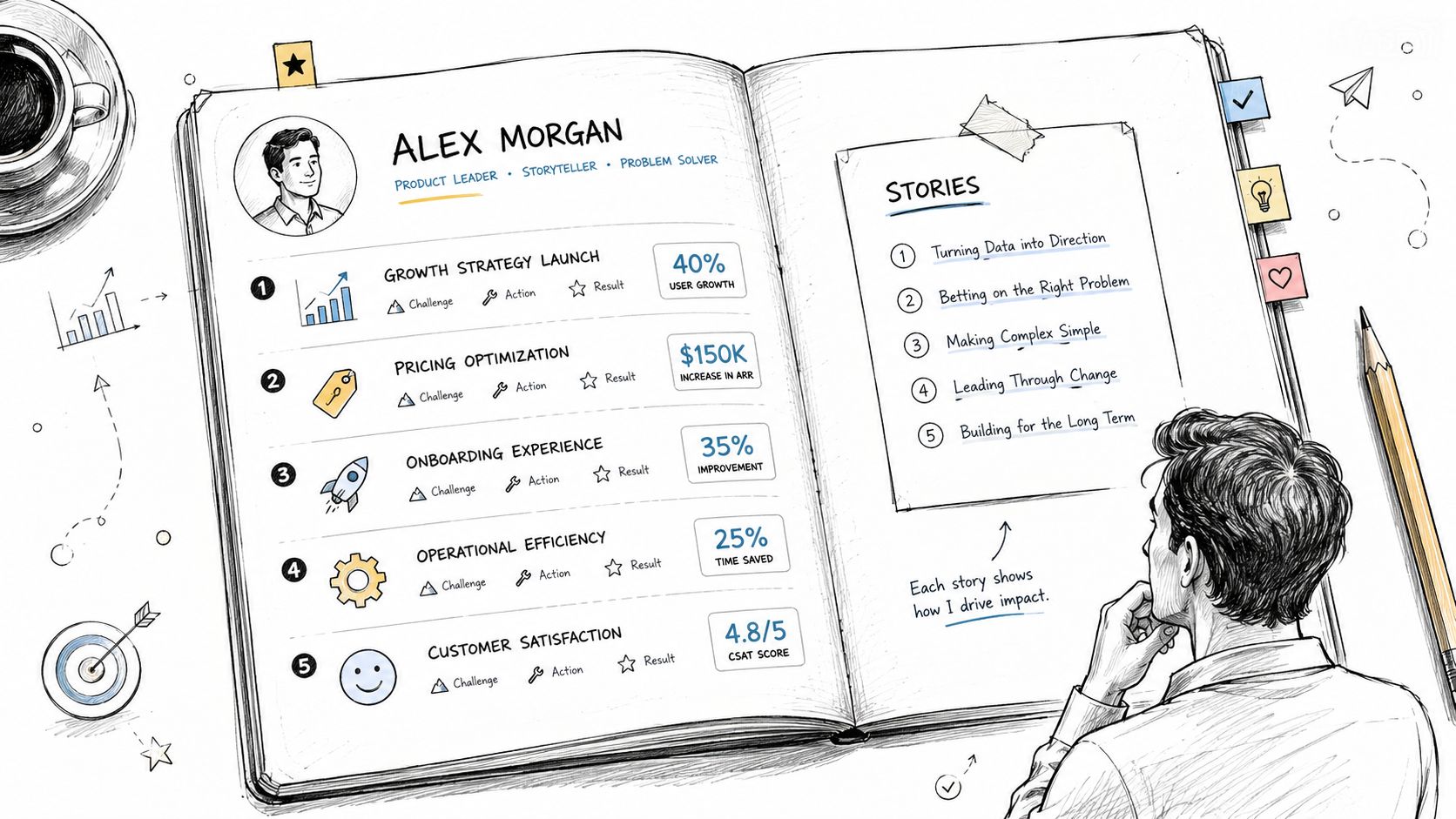
A group interview gives you little time to search your memory. Prepare several concrete accomplishments from your resume before you enter the room, then turn each one into a short, adaptable story. Your notes should cover problem-solving, teamwork, leadership, ambiguity, feedback, and handling disagreement.
Avoid memorizing polished speeches. Memorize the structure, the facts, and the lesson. A useful story includes the situation, the action you personally took, and the result or insight that followed.
For example, replace “I'm good at problem-solving” with a verified accomplishment such as: “I reduced our team's bug-resolution time by 40% by implementing a triage system, which freed up 8 hours per week for new feature development.” Replace “I led a project” with evidence: “I managed a cross-functional initiative for three clients that increased retention by 25% and generated $150K in additional revenue.” Those examples are useful because they show the competency instead of naming it.
Build flexible story versions
Prepare four or five examples in three or four sentences each. You can adapt one story to several questions by changing the emphasis.
A leadership version might be:
“I was asked to lead a cross-team initiative without prior management experience. I mapped dependencies, held weekly check-ins, and secured buy-in from three department heads. We delivered on time, and the initiative became a template for future projects.”
A disagreement version could focus on judgment rather than conflict: “Our designer and I disagreed on a new feature's user flow. I suggested testing both approaches with five users, and the data supported the designer's version. I learned to prioritize evidence over ego.”
Write down timelines, team size, metrics, and your specific contribution. Then practice retrieving each story under mild time pressure. Review your resume and examples 30 minutes before the interview to prime your memory. A structured resume interview question guide can also help you connect likely questions to evidence you've already verified.
2. Master the Art of Strategic Listening and Interjection Timing
A group interview rewards candidates who can identify when the conversation needs a new contribution. Speaking immediately after every answer can make you look reactive. Waiting so long that nobody hears your perspective can make your preparation invisible.
During the opening part of the session, observe the group's pace. Is the discussion fast and competitive? Are candidates giving long answers? Does the interviewer invite people by name, or expect volunteers? You don't need to copy the loudest person. You need to find a way to enter clearly without disrupting the exchange.
When another candidate finishes describing a project-management challenge, try: “That's a great point about stakeholder communication. I had a similar challenge when I coordinated a product launch, and I found that a shared decision log kept disagreements from resurfacing.” You acknowledge the contribution, then add a distinct example.
If several candidates have already answered a conflict question, wait for a natural pause and say: “I noticed everyone mentioned communication first, which is essential. In my case, I also found that clarifying decision ownership prevented the conflict from returning.” That adds a new dimension instead of repeating the same advice.
Use a deliberate pause
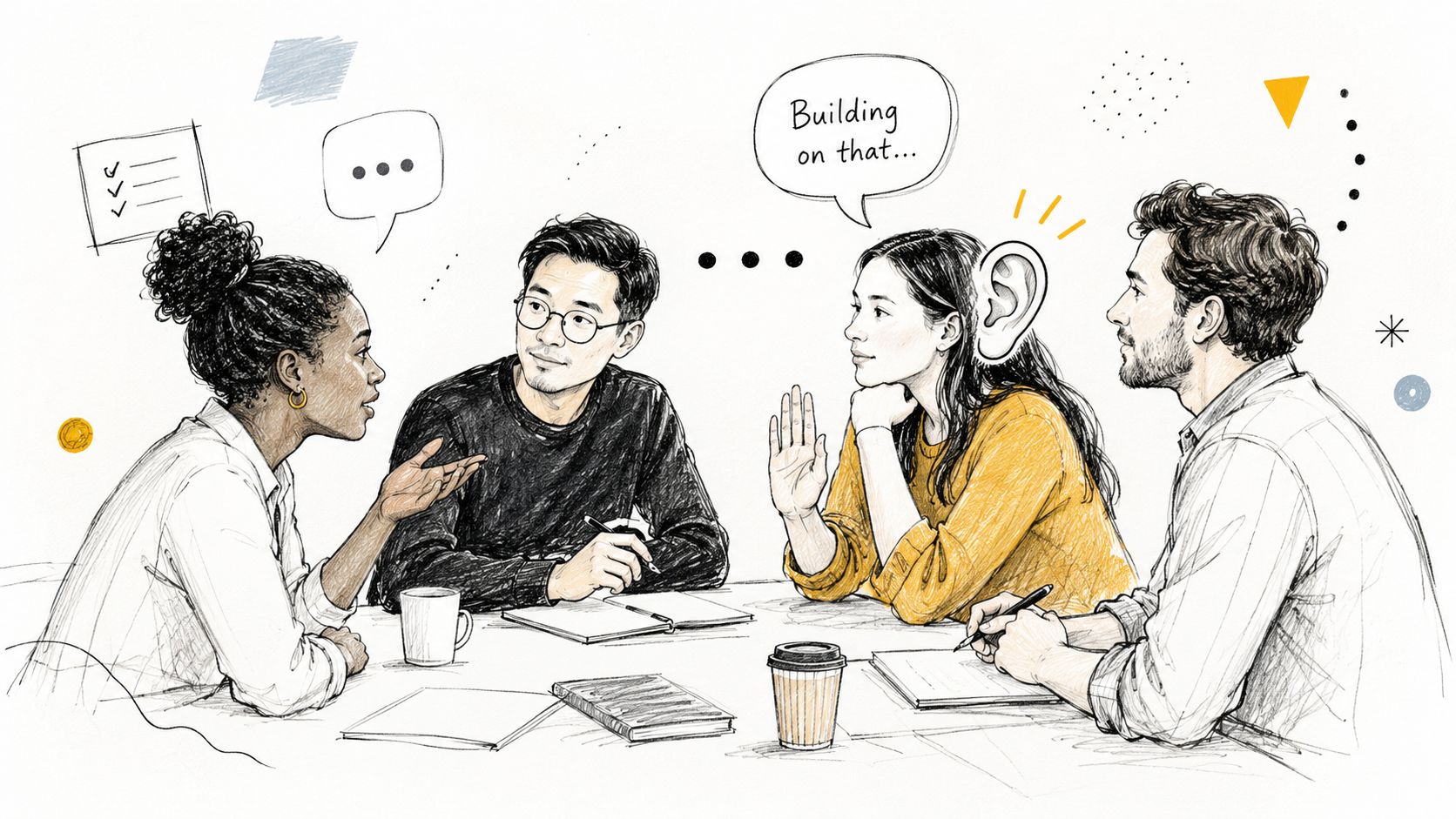
Count to three after someone finishes. The pause filters impulsive comments and gives you time to decide whether you're adding evidence, synthesis, or a useful alternative.
- Acknowledge the point: Use “Building on that...” or “That reminds me of...”
- Add a different angle: Introduce a result, method, risk, or lesson the group hasn't covered.
- Exit cleanly: Stop once the point is complete instead of extending it to reclaim attention.
Practice listening for exactly 60 seconds without planning your response. In a mock session, ask a friend to interrupt your preparation deliberately, then rehearse entering with “I'd like to add one practical example.” Mock interview practice with AI feedback can help you review whether your timing sounds engaged, repetitive, or overly dominant.
3. Differentiate Yourself by Asking Thoughtful, Role-Specific Follow-Up Questions
A panel asks whether you understand the work, not just whether you researched the company. Use your questions to connect the role description with the decisions, constraints, and relationships behind the role.
For a position that combines technical delivery and cross-functional work, ask: “I noticed this role combines technical delivery with collaboration across teams. How do you balance those responsibilities, and which collaboration challenge needs the most attention right now?” The question shows that you read the requirements and want to understand how the team operates.
Company research should sharpen the question. Rather than asking about values in general, refer to a product launch, market direction, customer group, or operational priority you reviewed: “Your recent expansion into this market suggests a new growth priority. Which skills will matter most for new hires supporting that transition?”
Prepare three questions, then select one or two during the discussion. The interviewers may already answer some of them, and forcing every prepared question can make the exchange feel scripted. Keep the rest focused on the role, team, expectations, business context, and current problems.
Use a question that gives the panel something specific to answer:
- Clarify success: “What would strong performance look like during the first major project?”
- Explore collaboration: “Which teams does this role need to influence most often?”
- Understand priorities: “What problem would you most like the person in this role to help solve?”
In a group setting, timing also matters. If another candidate asks a similar question, build on it instead of repeating it: “That's useful context. How does that priority affect the first project this person would own?” Address the relevant interviewer, then include the panel with your eye contact.
Keep benefits, compensation, work-from-home arrangements, and leave policies for the appropriate stage unless the panel raises them. Phrase curiosity without putting anyone on the defensive: “I'm curious how the team handles...” A focused interview preparation guide can help turn company research into questions that show business awareness.
4. Use Structured, Concise Answers That Respect Group Time Constraints
Long answers create a hidden cost in a group interview. They consume time that belongs to other candidates, make your main point harder to find, and can cause interviewers to remember the length rather than the evidence.
Use a simple three-part structure. Acknowledge the question, give one concrete example with one important outcome, and connect the lesson to the role. For “Tell us about a time you worked across teams,” you might say:
“At my previous company, I led a data-integration project involving three departments on a tight timeline. I established weekly check-ins and a shared tracker, which reduced misalignment by 80%. That experience taught me to make ownership visible early, and I'd bring that approach to cross-functional work here.”
The exact wording should come from your real experience. Don't borrow metrics you can't defend, and don't add several outcomes when one is enough.
Practice stopping with confidence
Use a timer to build a feel for concise answers. Practice the rule of three: situation, one key action, one specific result. When you've made the connection to the role, stop. Interviewers can ask a follow-up if they want more depth.
A strong motivation answer might sound like this: “I've followed the company's work in this area, and I'm drawn to the mission. In my last role, I saw how this type of work affected customer outcomes. I'd like to apply that experience where improving this part of the product is a priority.”
Pause instead of filling silence with “um” or “you know.” Don't trail off with “Does that answer your question?” End with a complete sentence and let the interviewer decide whether to continue.
Practical rule: Give the group your strongest evidence first. Extra detail is useful only when it clarifies your decision, action, or result.
Concise answers don't mean shallow answers. They show that you can prioritize information when several people need access to the same limited time.
5. Demonstrate Awareness of Others' Strengths Without Diminishing Your Own Contribution
A group interview rewards candidates who build on useful ideas while making their own evidence visible. Listen for the point that moves the discussion forward, acknowledge it briefly, then add a related example, qualification, or practical next step.
If another candidate discusses Agile sprint planning, you could say: “Your point about sprint planning is useful. In my Agile work, involving customer support early helped us identify adoption risks before release. That added an operational check to the planning process.” You have credited the contribution and supplied evidence the panel has not heard.
Different backgrounds can complement one another. If a candidate describes a structured consulting approach, try: “I appreciate that focus on structure. My startup experience required faster decisions with incomplete information. I would bring adaptability alongside the discipline you described.” The comparison works because it identifies a difference without turning either approach into the winner.
Keep the acknowledgment proportionate. Sarcasm, inflated praise, and automatic agreement can sound calculated. Say what you observed, then state your contribution:
- “I appreciated how you framed that. I'd add one consideration from my experience.”
- “That's a strong point about stakeholder alignment. My example shows another part of the same challenge.”
- “I agree with the priority. I'd sequence the work differently because…”
Your nonverbal behavior should include both the candidate and the panel. Begin by looking at the person whose idea you are acknowledging, then shift your gaze across the interviewers with brief pauses as you develop your point. Finish by focusing on the person who asked the question. A university guide to group and panel interviews recommends this eye-contact pattern, which supports collaboration without making your answer a performance for one person.
Use a short reset if the discussion moves quickly: “I'd like to build on that point,” or “I have a related example.” These phrases signal an intention to contribute rather than interrupt. In practice, rehearse with a partner who makes a strong argument. Acknowledge the value, connect it to your experience, and add something useful without beginning with “but.”
6. Manage Anxiety and Cognitive Load by Focusing on What You Can Control
A candidate finishes a polished answer, another speaks over the next question, and an interviewer's neutral expression triggers doubt. Group interviews create several distractions at once, but each reaction does not require an immediate interpretation.
Use a simple control check. You can prepare examples, listen carefully, choose when to contribute, speak calmly, and ask for clarification. You cannot control another candidate's experience, the panel's energy, or how many opportunities the group creates.
Turn comparison into an action cue. Instead of asking, “What if someone else has more experience than me?” use, “I have three concrete examples ready, and I'll explain the strongest one clearly.” If an interviewer appears unimpressed, tell yourself, “That answer is complete. My next response will be more specific.”
Reduce processing pressure
Rapid turn-taking, social comparison, and informal cues can increase the mental load of a group interview. This matters particularly for neurodivergent candidates, anxious candidates, and international candidates working in a second language. Research indexed by PsycNet on neurodivergent interview experiences highlights how standard interview processes can create undue stress and anxiety.
Prepare supports that reduce the need for forced spontaneity:
- Take a brief pause: “Let me think of the clearest example.”
- Ask for precision: “Would you like me to focus on the conflict or the outcome?”
- Use a note cue: Write one word for each story, such as “triage,” “launch,” or “feedback.”
- Ground physically: If anxiety spikes, name three things you hear, three things you see, and three things you feel.
Before answering, take three deep breaths and choose one task, such as identifying the question's priority. Afterward, record what you executed well rather than ranking yourself against other candidates. Limiting the information you monitor makes participation clearer and more consistent.
7. Build Rapport Early by Being Genuinely Present and Respectful
Rapport begins before your first substantive answer. Arrive early, listen during introductions, and treat the other candidates as people you may eventually work with rather than obstacles to overcome.
For a virtual interview, test your camera and microphone 10 minutes early. Sit upright with the camera at eye height, look toward the lens when you answer, and glance at the participant window when others speak. If the interviewer finishes explaining the process, you might say, “Thanks for the clear overview. I'm looking forward to hearing everyone's perspectives.”
In person, look directly at each candidate during introductions, nod when they share their background, and include both the interviewer and the group when it's your turn. These actions are simple, but they establish that you can stay engaged when you aren't speaking.
Make presence visible without overperforming
Nonverbal behavior should support attention, not replace substance. Nod or smile naturally, take brief notes during other answers, and use candidates' names when you catch them during introductions. Avoid exaggerated reactions, constant smiling, or staring at the camera so intensely that you stop listening.
Virtual eye contact requires judgment. Aim to look at the interviewer about 60% to 70% of the time and glance at peers occasionally, as the planned guidance recommends, while prioritizing natural attention over mechanically tracking a target. The group should see that you're following the conversation, not waiting for your next opening.
If another candidate makes a thoughtful observation, note a keyword. Later, you can say, “Building on Priya's point about customer handoffs...” That creates continuity and demonstrates that you were present from the beginning.
“The strongest rapport usually comes from making other people feel heard, not from trying to become the most memorable person in the room.”
8. Follow Up Strategically After the Interview to Reinforce Your Presence
A generic thank-you note rarely adds much after a group interview. A specific follow-up can remind the team that you listened, connect your experience to a stated challenge, and clarify a point you didn't express fully.
Send the message within 24 hours while the discussion is fresh. Keep it concise, proofread it carefully, and mention a particular question, comment, or business problem. For example:
“Thank you for today's conversation. I was particularly interested in your discussion of the team's scaling challenge. In my previous role, I helped address a similar issue by documenting ownership across teams and introducing regular decision reviews. I'd welcome the opportunity to discuss how that experience could support your roadmap.”
If you rushed an answer, you can address the gap without apologizing at length: “Reflecting on your question about cross-functional collaboration, I wish I'd included one additional detail. I learned that defining decision ownership early prevented repeated delays, and I think that lesson is relevant to the product workflow you described.”
Make the note personal and useful
Address the hiring manager or interviewers by name when you have them. If several people participated, send individualized notes when possible. If one group message is more appropriate, address each person and include a relevant detail from the discussion.
Keep the email to three or four short paragraphs, preferably under 150 words. Don't restate your entire resume or try to correct every imperfect answer. Choose one moment that shows you were attentive, one piece of evidence that supports your fit, and one clear expression of interest.
The follow-up should sound like the same person who participated in the interview, not a marketing campaign. Specificity, restraint, and accurate detail will do more for your credibility than elaborate praise.
Leave Them With Evidence of How You Work
A group interview becomes easier to manage when you treat it as a repeatable performance rather than an unpredictable contest. Prepare four or five evidence-based stories from your resume, then adapt them to the competencies the employer names. If the panel is assessing collaboration, show how you worked with people, made decisions, handled disagreement, or improved a shared result. If it's assessing leadership, explain how you created direction and earned cooperation, even if you didn't hold a formal management title.
Rehearse answers that fit within 30 to 60 seconds. Use a timer, but don't memorize every word. Practice entering a conversation with “Building on that...” and exiting with a complete sentence. Ask a friend to play a dominant candidate so you can rehearse waiting for a pause, asking for space, or introducing a concise alternative without sounding defensive.
Before the interview, write a short control list. It might include your three strongest stories, one question about the role, one grounding technique, and a reminder to look across the group when answering. During the session, measure success by actions you can execute: listening, contributing evidence, making space for others, and connecting your answer to the role.
Immediately afterward, write down one specific follow-up point. Record the interviewer's challenge, a team priority, or a question you answered too briefly. That note gives you material for a focused message and helps you improve without turning the review into a comparison exercise.
You don't need to outtalk the group. You need to make distinct contributions, support productive discussion, and communicate your value authentically. Qcard can serve as an optional preparation and real-time support tool by providing resume-grounded cues, pacing practice, cognitive-load support, mock interview feedback, and help drafting a specific follow-up. Used appropriately, it should support your verified experience rather than replace your judgment or turn your answers into scripts.
Key Takeaways
- Airtime is the wrong target — group interviews are structured to observe teamwork, listening, and concise problem-solving, which means the candidate who acknowledges a peer's point and then adds a distinct example outperforms the one who speaks most often or interrupts to claim a point first.
- A three-count pause before entering the conversation is the single most practical timing tool — it filters impulsive comments and forces a decision about whether you're adding evidence, synthesis, or a useful alternative, and phrases like "Building on that..." or "I'd like to add one practical example" signal contribution rather than interruption.
- Concise doesn't mean shallow — giving your strongest evidence first in a 30-to-60-second answer (situation, one key action, one specific result, connection to the role) shows you can prioritize information when several people share limited time, while trailing off with "Does that answer your question?" undercuts an otherwise strong response.
- Acknowledging another candidate works only when it's proportionate and adds something new — inflated praise and automatic agreement sound calculated, while "I appreciated how you framed that. I'd add one consideration from my experience" credits the point and supplies evidence the panel hasn't heard.
- Cognitive-load supports matter most in group formats because rapid turn-taking and social comparison compound the pressure — one-word note cues, a prepared pause line ("Let me think of the clearest example"), a clarifying question ("Would you like me to focus on the conflict or the outcome?"), and grounding techniques help neurodivergent, anxious, and second-language candidates participate consistently without forced spontaneity.
Qcard offers resume-grounded memory cues, mock interview practice, pacing feedback, and thank-you email support that can help you prepare for group interviews without memorizing scripts. Visit Qcard to practice concise answers, manage cognitive load, and keep your real achievements available when the conversation moves quickly.
Ready to ace your next interview?
Qcard's AI interview copilot helps you prepare with personalized practice and real-time support.
Try Qcard Free