Good Filler Words: 7 Interview Phrases That Buy Time
TL;DR
Good filler words are deliberate transitions that create structure, not verbal padding. Research shows roughly 5–6% of spontaneous speech contains disfluency and speakers average about 4.2 fillers per minute, so zero-filler delivery isn’t the target — a 2024 experiment comparing 0, 2, 5, and 12 disfluencies per minute found perceived effectiveness declined most clearly at the highest rate, while 5 per minute did not adversely affect it. The seven phrases above each do a specific job: buying retrieval time, forcing the answer before the context, opening a behavioral story, framing a constraint, landing a result, clarifying an ambiguous question, and closing with a changed behavior. Each one fails the same way — through repetition, or when it becomes a resting place instead of a bridge. Record one behavioral answer, mark every hesitation by location (opening, context, metric, transition, follow-up), then change only the most disruptive pattern on the next attempt.
“Filler Is Not Always the Enemy.” Most candidates are told to delete every “um” and “like,” yet a long, silent stall can feel more uncertain than a short, well-chosen phrase. Research on spontaneous speech estimates that roughly 5–6% of words can contain some form of disfluency, while a separate estimate places English fillers at about 2.5% of spoken words. Speech research on disfluency supports a more practical view: occasional hesitation is normal, but repeated, poorly placed fillers can obscure your point.
This list separates useful transitions that buy you thinking time and keep answers organized from habits that weaken your credibility. The same phrase can help at the start of a difficult answer and hurt when repeated after every sentence. If your opening answer tends to wander, start with these expert tips for the opening interview question, then practice the phrases below in realistic answers.
What Are Good Filler Words to Use in an Interview?
Filler isn’t always the enemy. Research on spontaneous speech estimates roughly 5–6% of words contain some form of disfluency, with a separate estimate placing English fillers at about 2.5% of spoken words. Occasional hesitation is normal — repeated, poorly placed fillers are what obscure your point.
The difference between a good filler and a harmful one is function. These seven transitions buy you thinking time and give the interviewer structure:
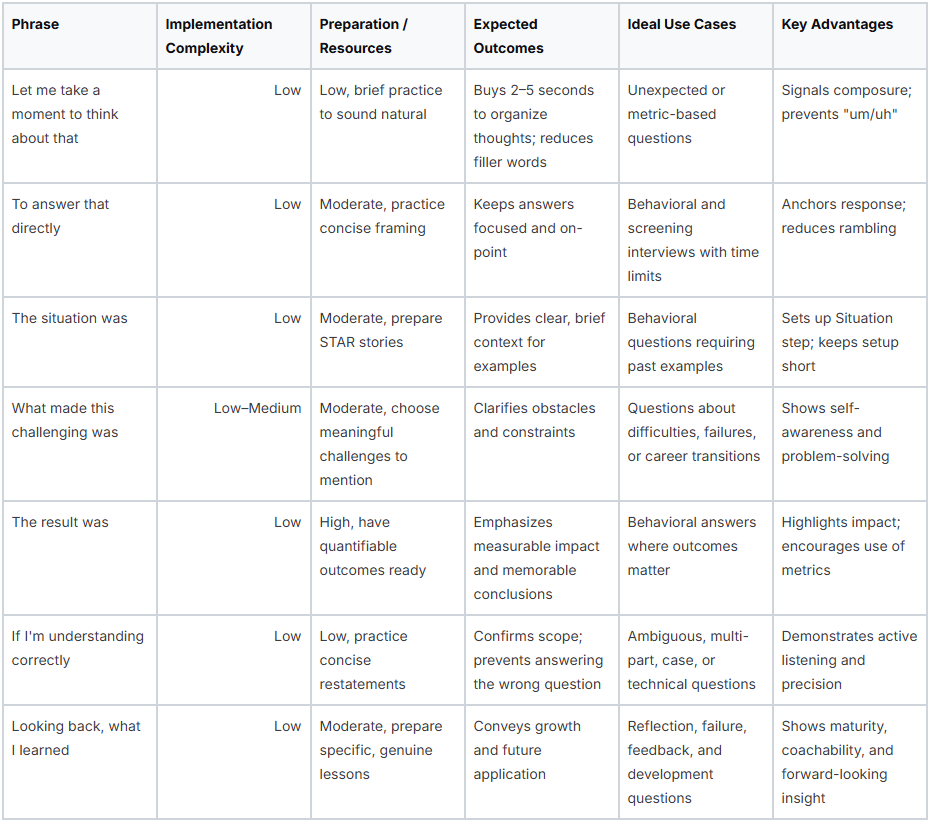
- “Let me take a moment to think about that” — Signals you’re choosing a relevant answer rather than grabbing the first one. Say it once, breathe, and begin. It weakens if you repeat it or use it on a simple question.
- “To answer that directly” — Prevents burying the answer under background. The “yes” arrives first, then one example proves it. Answer first, evidence second, connection last.
- “The situation was” — Signals a real example rather than a general opinion. Keep the setup to one or two sentences; context earns its place only when it makes your action easier to judge.
- “What made this challenging was” — Use it when the obstacle explains your judgment. Name the constraint in one sentence, then show the choice you made, then the skill that choice revealed.
- “The result was” — Keeps behavioral answers from trailing off. Use a verified metric only if you can explain how it was measured; otherwise state what changed and who adopted it.
- “If I’m understanding correctly” — A clarification tool, not decoration. Use it when a question is broad or multi-part. It sounds fussy before a simple question like “Why this role?”
- “Looking back, what I learned” — Works as a pivot, not a slogan. Name the lesson, state the behavior you changed, connect it to the role. One or two sentences, then stop.
Placement matters: one conversational study found fillers appeared at the beginning of an utterance in 63% of cases, which makes the opening moment the highest-value thing to rehearse.
1. Let me take a moment to think about that
A short thinking phrase can sound more composed than a string of “um” and “uh.” It tells the interviewer you're choosing a relevant answer instead of grabbing the first example that comes to mind. That matters when a question asks for a specific metric, a difficult failure, or a resume detail you need to retrieve accurately.
Practical rule: Say the phrase once, breathe, and begin. Don't use it as a runway for more hesitation.
Consider this exchange:
Interviewer: “Tell me about a time you missed a deadline.”
Candidate: “Let me take a moment to think about that. The project I'm thinking of was our Q3 reporting migration.”
The phrase works because the candidate follows it with a concrete situation. It also works when the answer requires a precise detail:
Interviewer: “How did you measure success in your internship?”
Candidate: “Let me take a moment to think about that. I tracked three metrics, and the most important was the reduction in turnaround time.”
The wording becomes weak when you repeat it, trail off, or use it for a simple question you already understand. It can also sound rehearsed if your voice rises at the end as though you're asking permission to answer.
Make the pause intentional
Practice this phrase during Qcard's mock interview practice, using resume-grounded memory cues rather than a word-for-word script. Your aim isn't to eliminate every pause. In one conversational study, speakers produced an average of 4.2 fillers per minute, with substantial variation between individuals. The study's findings also found that fillers appeared at the beginning of an utterance in 63% of cases, making the opening moment especially useful to rehearse.
Before speaking, take one breath and form the first clause inwardly. Then answer. If you need more time than the phrase provides, give a direct structure, such as, "I'll use a project example and explain what changed."

2. To answer that directly
This phrase keeps you from burying the answer under background. Candidates often begin with a company history, a long explanation of their responsibilities, or every related project they've handled. The interviewer asked one question. Give the answer first, then earn the right to add context.
Interviewer: “Are you comfortable working with cross-functional teams?”
Candidate: “To answer that directly, yes. In my last role, I coordinated with design, engineering, and sales on a six-week launch.”
The phrase helps because “yes” arrives immediately. The example then proves the claim without turning the response into a catalogue of experience. It's particularly useful in screening interviews, where a focused answer makes your communication easier to assess.
Use it to control scope
For a career-motivation question, the same structure works:
Interviewer: “Why did you choose data analytics over marketing?”
Candidate: “To answer that directly, I was drawn to the problem-solving side. Analyzing campaign data showed me where my interest was strongest.”
Avoid using this transition before every answer. Repetition makes it sound like a verbal template, and a phrase designed to create clarity can start to feel evasive if the answer remains vague.
A strong pattern is:
- Answer first: State your position in one sentence.
- Evidence second: Give one relevant example.
- Connection last: Explain why the example matters to the role.
Qcard's AI Interview Coach can help identify answers that run long while you practice this sequence. The useful feedback isn't “sound perfect.” It's knowing whether your framing phrase leads to a clear answer or merely delays one.
3. The situation was
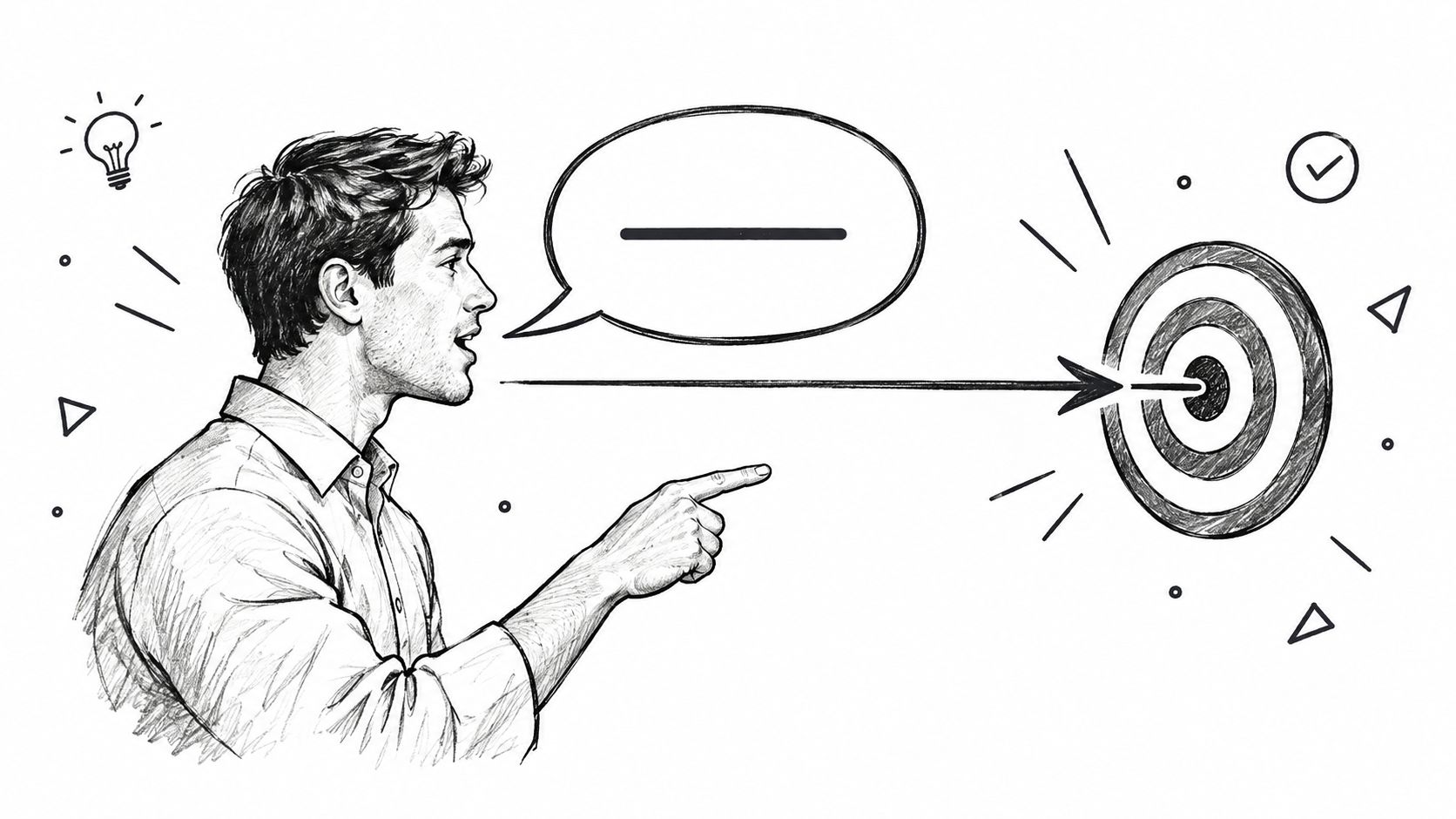
Behavioral answers need a starting point. “The situation was” signals that you're moving into a real example rather than offering a general opinion. It gives the interviewer the context needed to understand your actions, without forcing you to narrate your entire work history.
Interviewer: “Describe a time you had to handle conflict on a team.”
Candidate: “The situation was a disagreement between two team leads about our release schedule two weeks before launch.”
That opening works because it identifies the people involved, the issue, and why timing mattered. It creates a clean bridge to the candidate's actions. A second example might sound like this:
Interviewer: “Tell me about a time you learned a new tool quickly.”
Candidate: “The situation was that my team switched to a new analytics platform mid-project, and I was the only person who had used it before.”
Keep context smaller than action
The phrase becomes a problem when it introduces a long history lesson. Behavioral interviewers usually need enough context to understand the decision, then they need to hear what you did. Keep the setup to one or two sentences and move into your response quickly.
“Context earns its place only when it makes your action easier to judge.”
Prepare several adaptable STAR stories through Qcard's practice interview questions, but don't memorize complete scripts. Store the people, problem, action, and result as memory cues. That approach helps you recall exact context without inventing details under pressure.
A useful story might begin with the situation, name the constraint, and then move straight to ownership: “The situation was a disagreement between two team leads about our release schedule two weeks before launch. I collected the unresolved dependencies and proposed a decision meeting with a shared timeline.”

4. What made this challenging was
“What made this challenging was” sits in a different place from “The situation was.” It is the right choice when the obstacle itself matters more than the background. Use it when the difficulty explains your judgment, not when you just want to stretch the setup.
A weak version sounds padded: “What made this challenging was that the deadline was tight and the team was busy.” A stronger version names the pressure, then moves on: “What made this challenging was that we had to reconcile three inconsistent data sources before the client review, so I verified the numbers first and built the dashboard from the clean set.” The difference is simple. The first version reports inconvenience. The second shows a decision under pressure.
That matters for interviewers. They are listening for how you handled strain, uncertainty, or a gap in experience. If you spend too long describing the obstacle, the answer starts to feel like a complaint. If you keep the challenge to one sentence, it becomes a setup for the work that followed.
A career switcher can use the phrase to name a real gap without sounding apologetic:
Candidate: “What made this challenging was that I had no prior experience with SQL. I spent two weekends on a structured course and then rebuilt our weekly report.”
That works because the challenge stays brief and the response carries the weight. The phrase backfires when it becomes a resting place. Once the problem is clear, the answer needs motion.
The strongest answers usually follow this pattern: state the constraint, then show the choice you made, then show the skill that choice revealed. A candidate might say, “What made this challenging was that two managers wanted different release dates, so I mapped the dependencies and called a short decision meeting.” That version does more than name difficulty. It shows prioritization, communication, and calm under pressure.
5. The result was
A behavioral answer often loses force at the end. The candidate explains the situation, lists a few actions, and then stops with “That was the project.” “The result was” keeps the answer moving and tells the interviewer to listen for what changed.
Use a verified metric when you have one.
Candidate: “The result was a 22 percent reduction in onboarding time for new hires, and the operations team used that process for the next two cohorts.”
That version leads with the outcome, then shows who adopted it. Another strong ending names the customer or team effect directly.
Candidate: “The result was that our team closed the quarter with zero escalated customer complaints, and my process became the template for the support group.”
Make the outcome defensible
A number only helps if you can explain how it was measured. Interviewers may ask what period you compared, what counted as success, or what you personally changed. Leave out the metric if you cannot support it. A clear operational result is better than a figure you cannot defend.
This phrase also works without a percentage or time saving. State what changed for the customer, team, or process, then say who adopted it or what shifted afterward. If you cannot say who adopted it or what changed for the customer, the metric is decoration.
Write your two or three strongest metrics on one card and rehearse retrieving them, not reciting them. Then stop. Do not dilute a strong result with unrelated commentary, an apology, or a second story.
6. If I'm understanding correctly
This is a clarification phrase, not a decorative filler. Use it when a question is broad, contains multiple parts, or could reasonably have more than one interpretation. Answering the wrong question for two minutes is far worse than spending a few seconds confirming the target.
Interviewer: “How would you improve our onboarding flow?”
Candidate: “If I'm understanding correctly, you'd like to focus on reducing drop-off in the first week. Is that the main goal?”
The candidate has restated the problem and asked one focused question. That shows listening and gives the interviewer an easy way to correct the frame.
Don't clarify what's already clear
For a technical scenario, the phrase can separate immediate response from long-term prevention:
Interviewer: “Walk me through how you'd handle a database outage.”
Candidate: “If I'm understanding correctly, you want to know my immediate response and how I'd communicate it. Should I also cover the long-term fix?”
That's useful because the scope is uncertain. It would sound fussy before a simple question such as “Why are you interested in this role?”
After clarification, provide a structure. You might say, “I'll cover the immediate response, stakeholder communication, and prevention.” Qcard's mock interviews can help you practice asking for precision without sounding hesitant.
Research on fillers supports this distinction between useful planning cues and empty repetition. Filled pauses can signal cognitive processing and help a speaker hold the turn, while repeated clusters can distract from the answer. Stanford's discussion of filler words describes “uh” as tending to precede shorter delays and “um” as potentially signaling a longer retrieval effort. The practical lesson is simple: clarify when the question needs clarification, then answer decisively.
7. Looking back, what I learned
This phrase should do more than wrap up an answer. It works when you need to show that you noticed a pattern, changed how you operate, and carried that lesson into later work. It backfires when it turns into a vague moral at the end of a strong example.
Use it as a pivot, not a slogan.
Candidate: “Looking back, what I learned is that I should flag scope changes in writing as soon as they happen. I now confirm every change request by email before starting work.”
That second sentence matters because it shows a new habit, not a polished takeaway. The same logic applies in a presentation answer: “Looking back, what I learned from that presentation is that a shorter slide deck with one clear recommendation works better than a detailed one with no conclusion.”
Reflections land best when they are specific. “I learned to never give up” sounds noble, but it gives the interviewer nothing concrete to evaluate. State the behavior you changed, then show how you use it now.
A useful ending usually has three parts. First, name the lesson. Second, state the change. Third, connect it to similar work in the role.
Keep that close. One or two sentences is enough. After that, stop. If you keep talking, the reflection stops sounding thoughtful and starts sounding like a recovery attempt.
Research on interview-style answers found that higher filler use reduced perceived professional and personal credibility, regardless of the speaker's gender. The listener study supports focusing on repeated, dense fillers instead of treating every brief hesitation as a major flaw. A short pause before the lesson is fine. A chain of “um,” “like,” and “you know” is the habit to replace.
7-Point Filler Phrase Comparison
Practice the Pause Until It Feels Natural
Choose two transitions from this list, rehearse them in three mock answers, and record yourself once a day for a week. Check whether the pauses replace “um” and “like” without sounding rehearsed. Don't judge the recording only by the number of fillers. Listen for placement, answer structure, and whether the phrase helps the interviewer follow your reasoning.
A controlled amount of disfluency isn't automatically damaging. A 2024 experiment compared speeches with 0, 2, 5, or 12 disfluencies per minute and found that perceived effectiveness declined most clearly at the highest tested rate. The study found that 5 disfluencies per minute did not adversely affect perceived effectiveness, which supports an optimization target rather than a zero-filler demand. The experimental findings are useful because they separate natural hesitation from distracting repetition.
Qcard's Interview Coach tracks filler words during live practice, alongside pacing and answer length. It can help you notice whether “um” appears mainly before metrics, whether “like” clusters during difficult follow-ups, or whether your opening needs a prepared first sentence. Use that information to replace the pattern with a breath, a silent pause, or one of the deliberate transitions above.
Fairness matters here. Speech planning varies across languages, neurotypes, personalities, and levels of anxiety. A candidate shouldn't have to imitate one narrow version of professional English to demonstrate reasoning, listening, relevance, and self-correction. A brief pause can be more authentic and cognitively manageable than forcing a replacement phrase into every gap.
The best practice routine is specific. Record one behavioral answer, mark every hesitation, and label its location: opening, context, metric, transition, or follow-up. In the next attempt, change only the most disruptive pattern. If your answer is clear and your pauses are controlled, you're improving the communication that interviewers need to evaluate.
Key Takeaways
- Zero fillers is the wrong target, and research supports an optimization standard instead — a 2024 experiment found 5 disfluencies per minute did not adversely affect perceived effectiveness while 12 per minute clearly did, which means the work is replacing repeated, dense clusters rather than policing every brief hesitation.
- The opening moment is where rehearsal pays most, since one conversational study found fillers appeared at the start of an utterance in 63% of cases — preparing a deliberate first clause or a single thinking phrase converts the highest-frequency hesitation point into structure.
- Every phrase on this list fails the same way: through repetition or by becoming a resting place — “to answer that directly” before every answer reads as a verbal template, “what made this challenging was” stretched past one sentence turns into a complaint, and “looking back, what I learned” without a named behavior change becomes a slogan.
- Metrics only help when they’re defensible — interviewers may ask what period you compared, what counted as success, and what you personally changed, so a clear operational result (“the operations team used that process for the next two cohorts”) beats a percentage you can’t support, and a number without an adopter or customer effect is decoration.
- Fairness belongs in this conversation, because speech planning varies across languages, neurotypes, personality, and anxiety levels — a brief pause is often more authentic and cognitively manageable than forcing a replacement phrase into every gap, and candidates shouldn’t have to imitate one narrow version of professional English to demonstrate reasoning and self-correction.
For broader practice, these tips for better communication can help you work on pacing and clarity beyond interviews. Qcard can then provide a focused environment for resume-grounded answers, mock follow-ups, recording, and feedback on filler words.
Qcard helps you practice interview answers with concise, resume-grounded cues instead of rigid scripts. Its Interview Coach tracks filler words, pacing, and answer length, helping you replace distracting repetition with deliberate pauses and clear transitions. Visit Qcard to practice the phrases that let your real experience come through naturally.
Ready to ace your next interview?
Qcard's AI interview copilot helps you prepare with personalized practice and real-time support.
Try Qcard Free