How to Write First Time Job Resumes That Actually Get Read
TL;DR
First time job resumes fail when they read like a biography instead of a screening tool. With a typical opening attracting 250 applications, only about 2% reaching interviews, and recruiters spending 6 to 8 seconds on the first scan, relevance has to be visible in the top third of the page. Use a one-page structure: contact info, a three-line summary naming the target role plus one strength and one proof point, education, honest job-specific skills, then a relevant experience section built from internships, projects, volunteer work, and campus roles formatted like real jobs. Beat ATS by mining the posting for exact phrases and distributing them across the summary, bullets, and skills — not dumping them in one keyword graveyard — while keeping a single-column layout with standard headings and no graphics. Tailor the same project differently by industry: tech wants toolset and implementation, consulting wants structured analysis and stakeholder communication, finance wants accuracy and reporting consistency, cybersecurity wants risk, controls, and documentation. Turn class projects into bullets using action + scope + metric + result. Then convert your four strongest bullets into short memory cues for interviews, because short cues beat long scripts when the room gets tense.
You're staring at a blank document, trying to write a first resume from almost nothing, and every draft looks either too empty or too fake. That's the trap. Most first time job resumes fail because candidates treat them like a biography instead of a screening tool, then wonder why nothing comes back.
A better resume does three jobs at once. It gets past ATS filters, it gives a recruiter something real to scan in seconds, and it gives you memory anchors for interviews so you're not trying to invent stories under pressure. If you build it correctly, the page becomes both a gatekeeper document and a cheat sheet for your own answers.
How Do You Write a First Time Job Resume?
A first time job resume has to do three jobs at once: get past ATS filters, give a recruiter something real to scan in seconds, and give you memory anchors for the interview so you're not inventing stories under pressure. Most first resumes fail because candidates treat them like a biography instead of a screening tool.
The numbers explain the urgency. A typical job opening attracts about 250 applications, only 4 to 6 candidates usually reach the interview stage (roughly 2%), and recruiters spend just 6 to 8 seconds on an initial scan — with one benchmark putting the average first glance at 7.4 seconds.
Use this one-page section order:
1. Contact information. Name, phone, professional email, city and state, and a LinkedIn profile if it's complete. Skip the full street address.
2. Professional summary (three lines). Name the target role, one strength, and one proof point. For example: "Computer science graduate targeting entry-level support roles. Strong in troubleshooting, documentation, and team communication. Built a student help desk project that improved response tracking for a campus organization."
3. Education. School, degree, graduation date, and relevant coursework only if it helps the job. Include GPA and honors only when they strengthen your case.
4. Skills. Honest and job-specific, not bloated. Group by category if needed — software, communication, technical tools.
5. Relevant experience. This is where first time resumes differ. Without formal jobs, use internships, projects, volunteer work, extracurricular leadership, or campus roles — formatted like real experience entries with an organization, dates, and bullets.
Three rules that determine whether it works:
- Relevance has to be visible in the top third of the page. If the job is customer support and your resume opens with generic club leadership and a vague objective, the reader still doesn't know why you belong there.
- Machine-readable formatting matters. Single column, standard headings, plain bullets — no tables, text boxes, icons, or graphics that confuse parsing.
- Every line must justify its space. If a bullet doesn't show skill, scope, or evidence, it's dead weight. And if an experience doesn't help you answer "why this job?", cut it.
For bullets built from class projects or volunteer work, use the pattern action + scope + metric + result. "Helped organize a campus event" says almost nothing. "Coordinated a campus event for a 6-person team, managed volunteer scheduling, and helped deliver a program that ran on time" shows scope and responsibility.
Why Most First Time Job Resumes Disappear Before Anyone Reads Them
A lot of first-time applicants think the problem is experience. It's usually the resume. A graduate sends a generic document into a pool where a typical job opening attracts about 250 applications, and only 4 to 6 candidates usually make it to interview stage, which works out to roughly 2% for a standard opening. On top of that, recruiters spend only 6 to 8 seconds on an initial scan, with one benchmark putting the average first glance at 7.4 seconds (resume statistics benchmark).
That means the resume has to earn attention fast. It can't wander through a life story, and it can't hide the point in dense paragraphs. It has to say, almost immediately, “This person fits the role.”
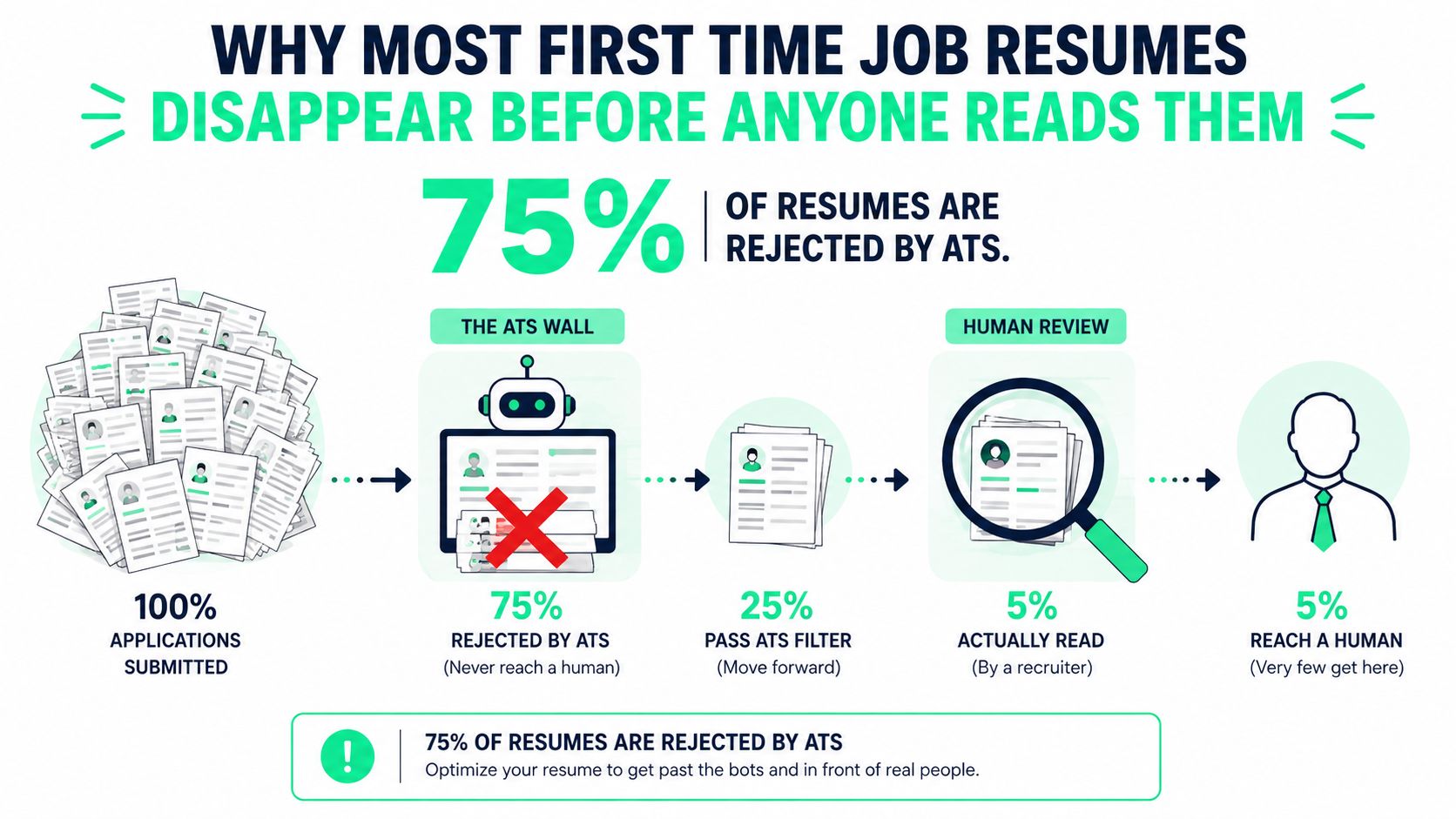
What those numbers mean in practice
The first consequence is blunt. Relevance has to be visible in the top third of the page. If the job is for customer support and your resume opens with generic club leadership and a vague objective, the reader still hasn't learned why you belong there.
The second consequence is technical. Machine-readable formatting matters because many resumes are filtered before a recruiter even sees them. Clean headings, simple bullets, and plain text structure beat decorative layouts every time.
The third consequence is about discipline. Every line has to justify its space. If a bullet doesn't show skill, scope, or evidence, it's dead weight.
A first resume should be a targeted one-page artifact, not a scrapbook.
That's the right frame for the rest of the page. The goal isn't to document everything you've ever done. It's to give a recruiter and an ATS parser exactly what they need, fast.
The One-Page Blueprint for First Time Job Resumes
Use one page. Not because one page is magical, but because early-career resumes usually don't have enough verified material to justify more. A cleaner page also keeps the scan easy, which matters when a recruiter is deciding whether to keep reading.
Start with contact information at the top. Include your name, phone number, professional email, city and state, and a LinkedIn profile if it's complete. Skip the full street address, since city and state are enough for most applications and keep the header cleaner.
Put the most useful sections in this order
Your next block should be a professional summary or a short objective. Keep it to three lines. Name the target role, one strength, and one proof point.
For example, write: “Computer science graduate targeting entry-level support roles. Strong in troubleshooting, documentation, and team communication. Built a student help desk project that improved response tracking for a campus organization.” That structure works because it tells the reader who you are, what role you want, and why you're credible.
Next comes education. Put your school, degree, graduation date, and relevant coursework only if it helps the job. If your GPA is strong and relevant, include it. If it isn't, leave it off. The same goes for honors. Use them only when they help.
Then list skills. Keep it honest and job-specific, not bloated. Group them by category if needed, such as software, communication, and technical tools. If you need a build tool while drafting, Qcard's resume app can help you review the structure before you submit.
Finally, build a relevant experience section. First time job resumes differ from traditional ones in this section. If you don't have formal jobs, use internships, projects, volunteer work, extracurricular leadership, or campus roles. Format them like experience entries with an organization, dates, and bullets.
If an experience doesn't help you answer “why this job?”, cut it.
That rule keeps the page tight. A first resume should show evidence, not inventory.
Beating the ATS Without Sounding Like a Robot
ATS systems don't reward creativity. They reward match quality and clean structure. If you want first round screening to work in your favor, the resume has to look like the job post speaks.
Start by mining the job description. Highlight the exact nouns and phrases in the requirements and responsibilities. If the posting says “customer onboarding,” use “customer onboarding,” not “client welcome” or “user setup” unless the wording naturally fits. The same goes for tools, methods, and certifications. Exact phrasing matters because the parser is looking for alignment, not your personal synonym bank.
Place keywords where they can actually be found
Distribute those phrases across the summary, bullet points, and skills section. Don't dump them into one keyword graveyard. A recruiter can tell when a candidate has stuffed a resume with terms that don't fit the story.
Keep the layout simple. Single column. Standard section headings. Plain bullets. No tables, text boxes, headers, footers, icons, or graphics that can confuse parsing. If a design element makes the resume look pretty but harder to read, remove it.
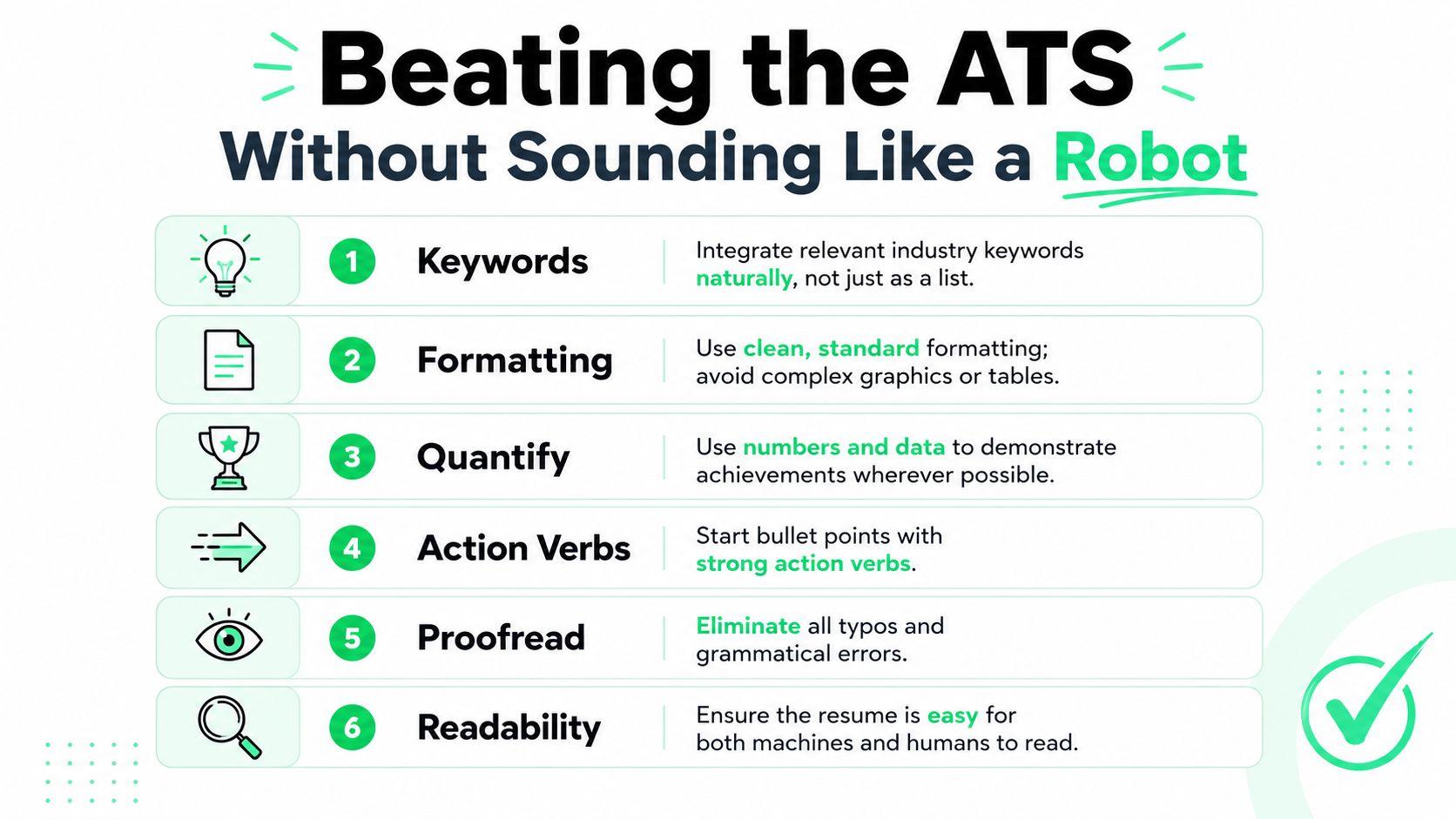
A few concrete rules make this easier:
- Read the posting twice. Pull out repeated phrases under “requirements” and “responsibilities.”
- Mirror the language naturally. Reuse the same terminology where it fits your real experience.
- Put the strongest matches near the top. The summary and first bullets matter more than the bottom of the page.
- Keep bullets simple. One idea per bullet. One action per bullet.
- Proofread ruthlessly. A typo can make the resume look unfinished.
- Check readability on screen. If you can't scan it in a few seconds, neither can a recruiter.
The point isn't to game the system. It's to make your real experience legible. A polished resume should read like a human wrote it, but still give the software enough structure to pass it through.
Tailoring Your Resume for Tech, Consulting, Finance, and Cybersecurity
One project can support four different stories, but only if you translate it correctly. Most first time job resumes fail here because the candidate uses one generic bullet for every industry. That makes the resume forgettable.
Take a university capstone that analyzed a campus service process. For tech, you'd emphasize the toolset and implementation detail. For consulting, you'd stress structured analysis and stakeholder communication. For finance, accuracy and throughput matter more. For cybersecurity, the angle shifts toward risk, controls, and compliance awareness.
Tech
Write something like, “Built a Python dashboard that tracked service requests and reduced manual status checks for a student team.” If you used GitHub, SQL, Power BI, JavaScript, or cloud tools, name them where truthful. Tech recruiters care that you can ship something and speak the stack.
Consulting
Frame the same work as, “Analyzed service bottlenecks, summarized findings for campus stakeholders, and helped align the team on a revised process.” That version says you can think clearly, organize ambiguity, and present findings without rambling. That's what hiring managers in advisory roles listen for.
Finance
Use language like, “Reconciled project records, maintained accurate tracking of submissions, and improved reporting consistency across the team.” If Excel, SQL, budgeting, or spreadsheet modeling were part of the work, put them in the bullet or skills section. Finance teams want precision, clean records, and reliable output.
Cybersecurity
Recast it as, “Reviewed access issues in the process, documented control gaps, and worked with teammates to improve how sensitive information was handled.” Use words like access, controls, exposure, logging, verification, and incident awareness only when they're truthful. Cybersecurity reviewers are looking for habits of caution and systems thinking.
The mistake is not lacking “the right kind of experience.” The mistake is failing to narrate the same experience through the lens of the role. Build one master resume, then create targeted versions for each lane.
Turning Class Projects and Volunteer Work Into Proof Points
If you've never had a formal job, your raw material still exists. It just isn't labeled as work experience. The trick is to turn class projects, volunteer work, club leadership, tutoring, and part-time tasks into bullets that sound credible without sounding inflated.
Use this pattern: action + scope + metric + result. You're not trying to sound corporate. You're trying to show what you did, how big it was, and what changed because of it.
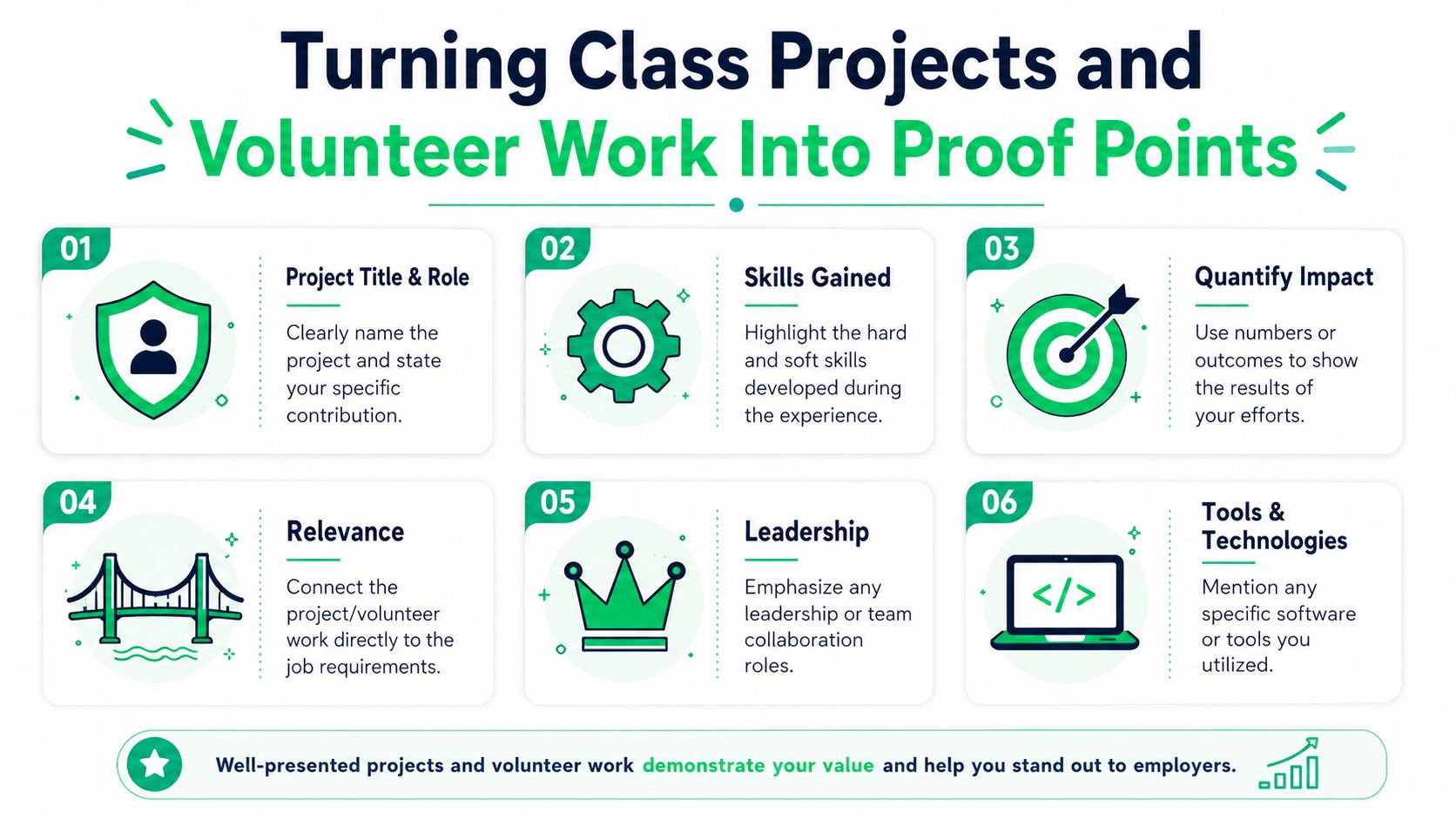
A weak bullet says, “Helped organize a campus event.” That tells me almost nothing. A stronger version says, “Coordinated a campus event for a 6-person team, managed volunteer scheduling, and helped deliver a program that ran on time.” That's better because it shows scope and responsibility.
Another weak bullet says, “Tutored classmates in math.” A better one says, “Tutored first-year students in algebra concepts, created weekly review sheets, and helped the group stay prepared for exams.” That gives the reader a clearer picture of your contribution and your habits.
The best proof points usually live in ordinary experiences, not dramatic ones.
Use a simple filter before adding anything. Keep an experience if it helps prove a job skill. Cut it if it's repetitive, unrelated, or impossible to explain accurately in one line. A resume gets stronger when you remove filler, not when you inflate the page.
Also, be selective with informal experience. Not every club meeting or errand belongs on the page. Include the role if it gave you ownership, taught you a tool, or produced a result you can explain in an interview. If it doesn't, leave it out.
Resume-Grounded Memory Cues for Calmer Interviews
A resume should help you get the interview, but it should also help you survive it. That's where a lot of anxious candidates get stuck. They memorize answers, then freeze when the interviewer asks for a real example and the script doesn't fit.
That approach is especially rough for neurodivergent candidates, international students, and career switchers. Scripted answers drain attention and make it harder to stay natural. A better method is to turn your resume into memory cues, so you can pull honest details live instead of trying to recite rehearsed lines.
Use the resume as your recall map
Pick the four strongest bullets on the page. For each one, extract the metric, the challenge, and the lesson. Then rehearse a short story arc, not a script. If you know the shape of the story, you can answer behavior questions without sounding robotic.
For example, if a bullet says you coordinated a team project, your cue might be: “team of five, deadline pressure, organized handoffs, finished on time.” That's enough to answer a question about leadership, conflict, or prioritization. You don't need a word-for-word monologue.
This is also where a live interview copilot can help. Qcard's resume interview questions tool uses your own resume to generate prompts grounded in what you did, which reduces the pressure to invent polished-sounding stories on the spot.
The point is not to become less prepared. It's to become less overloaded. When the resume already contains the key facts, your job in the interview is to retrieve them, connect them, and speak plainly.
Short memory cues beat long scripts when the room gets tense.
That matters in behavioral interviews, technical screens, consulting case follow-ups, and banking conversations. The resume becomes the anchor, and the interview becomes a conversation about real evidence instead of a performance.
Common Mistakes That Still Sink First Time Job Resumes
The fastest way to waste a good application is to leave obvious errors on the page. Recruiters spot them quickly, and ATS systems don't care about your intent.
Here are the biggest problems I still see:
- Generic objective statements: Replace “seeking an opportunity to grow” with a role-specific summary that names the job and one strength.
- Vague skill dumps: Don't list every app you've ever touched. Keep only the skills that match the posting.
- Missing dates: Add clear start and end dates for education, internships, projects, and volunteer work.
- Fabricated or stretched credentials: Leave off anything you can't defend in an interview. It's not worth the risk.
- Inconsistent formatting: Use the same tense, spacing, and bullet style throughout.
- Decorative graphics and broken links: Clean up any visual clutter and make sure LinkedIn or portfolio links work. If you need a polished follow-up after applying, Qcard's thank-you email tool can help you stay organized after the interview.
Overlong bullets are another problem. If a bullet needs three lines, cut it down or split it. A recruiter won't reward a wall of text just because it contains effort. They want clarity.
Before you submit, run one final check. Scan the page for dates, role matches, and formatting consistency. Then ask one simple question, “Can I defend every line out loud?” If the answer is no, fix the line.
Key Takeaways
- The math forces discipline, not padding — a typical opening draws about 250 applications with only 4 to 6 candidates reaching interviews (roughly 2%), and recruiters spend 6 to 8 seconds on the first scan, which means relevance must appear in the top third of the page and every line has to earn its space by showing skill, scope, or evidence.
- Lack of experience is rarely the real problem — the real problem is failing to narrate existing experience through the lens of the role, since one capstone project can support four different stories: toolset and implementation for tech, structured analysis and stakeholder communication for consulting, accuracy and reporting consistency for finance, and risk, controls, and documentation for cybersecurity.
- The action + scope + metric + result pattern is what turns ordinary experience into credible proof — "tutored classmates in math" tells a recruiter nothing, while "tutored first-year students in algebra concepts, created weekly review sheets, and helped the group stay prepared for exams" shows contribution and working habits without inflating anything.
- ATS optimization means mirroring the posting's exact language, not gaming the system — reuse the employer's specific nouns and phrases ("customer onboarding," not "client welcome") where they truthfully fit, distribute them across the summary, bullets, and skills rather than clustering them in one section, and keep the layout single-column with standard headings so the parser can read it.
- Your resume should double as your interview recall map — pick the four strongest bullets, extract the metric, challenge, and lesson from each, and rehearse a short story arc instead of a script, because a cue like "team of five, deadline pressure, organized handoffs, finished on time" can answer questions about leadership, conflict, or prioritization, which matters especially for neurodivergent candidates, international students, and career switchers who lose fluency when scripted answers don't fit the actual question.
If you want a resume that gets through the screen and helps you speak with confidence later, build it from your real evidence, not guesswork. Qcard helps candidates turn a resume into interview-ready memory cues, spot ATS weak points, and prepare with questions grounded in actual experience. Visit Qcard and use it to tighten your first resume before the next application goes out.
Ready to ace your next interview?
Qcard's AI interview copilot helps you prepare with personalized practice and real-time support.
Try Qcard Free