
Finance Interview Questions and Answers: 10 Picks
TL;DR
Finance interviews test whether you can explain a technical idea, apply it to a real business situation, acknowledge uncertainty, and communicate the conclusion clearly — definitions alone won't carry the conversation. The ten questions above span financial statements, financial health assessment, cost savings, DCF, modeling, LBOs, forecasting, stakeholder conflict, resume-grounded retrieval, and role-specific themes. The recurring standard across all of them: anchor every answer in a company, project, or transaction from your actual experience, quantify outcomes only when the result is verified, and state the effort and trade-off involved rather than presenting a clean success. Role changes the emphasis — banking needs speed, accounting fluency, and valuation discipline; FP&A needs driver logic and variance explanation for non-finance stakeholders; credit needs liquidity and downside cases; quant needs probabilistic reasoning. Build an answer bank of memory cues, not polished paragraphs: opening conclusion, project used, key assumption, verified result, and the follow-up most likely to expose a weak point. Then rehearse in layers — concise version, expanded reasoning, then a follow-up that changes the facts.
You know what EBITDA means, can explain working capital, and have reviewed the company's investor materials. Then the interviewer asks you to apply the concept to a real decision, defend an assumption, or calculate an answer while watching the clock. Definitions alone won't carry the conversation.
Strong finance interview questions and answers connect technical fluency, commercial judgment, and clear communication. The answer should sound like something you could explain to a colleague, not a paragraph memorized from a question bank. That matters in a selective hiring process, where finance recruiting data indicates that only about 3% of applicants reach interviews and roughly 27% of interviewees receive offers (financial-services recruitment data).
The ten questions below cover statements, financial health, cost savings, valuation, modeling, LBOs, forecasting, stakeholder management, resume-grounded practice, and role-specific expectations. Each one includes a concise framework, a practical scenario, likely follow-ups, and a short prompt you can answer aloud. Use the structure as a memory cue, not a script.
What Are the Most Common Finance Interview Questions and Answers?
Strong finance answers connect technical fluency, commercial judgment, and clear communication — they should sound like something you'd explain to a colleague, not a paragraph memorized from a question bank. That matters in a selective process where finance recruiting data indicates only about 3% of applicants reach interviews and roughly 27% of interviewees receive offers.
The ten questions that appear most consistently:
1. Walk me through your understanding of financial statements. Explain the income statement first, link its result to equity on the balance sheet, then move through working capital, debt, fixed assets, and cash. Close by explaining why profit isn't the same as cash.
2. How would you evaluate a company's financial health? Don't list every ratio. Choose a small set matching the business model, then explain the trend and reason behind each: liquidity, financial structure, profitability, cash flow, and context.
3. Explain a time you identified a cost-saving opportunity and implemented it. A behavioral question disguised as a finance exercise. Use problem, analysis, action, result — and show the trade-off you checked, not just the saving.
4. What is DCF analysis and when would you use it? Forecast operating performance, convert to free cash flow, estimate terminal value, discount using WACC, then stress-test assumptions. A DCF is only as reliable as its inputs.
5. Describe your financial modeling experience and tools. "I built a linked three-statement model with operating drivers, debt schedules, sensitivity tables, and documented assumptions" beats "I'm advanced in Excel."
6. Walk me through an LBO and its value creation drivers. Start with the transaction, not the acronym — entry value, financing structure, then the return path through EBITDA growth, margin expansion, debt paydown, and exit multiple. Make downside risk visible.
7. How do you build and validate a financial forecast? Start with business drivers, not a convenient growth percentage. Build base, downside, and upside cases, then close the learning loop through variance review.
8. Tell me about delivering bad news or managing stakeholder conflict. Bring correct data, understand operational context, separate the person from the problem, and arrive with an action plan.
9. Build resume-grounded story retrieval. Link each example to a specific bullet, project name, timeframe, your role, and the verified result.
10. Know the themes for your specific role. Banking weights valuation and transaction mechanics; FP&A weights driver-based forecasting and variance; quant roles weight probability and statistics.
1. Walk Me Through Your Understanding of Financial Statements
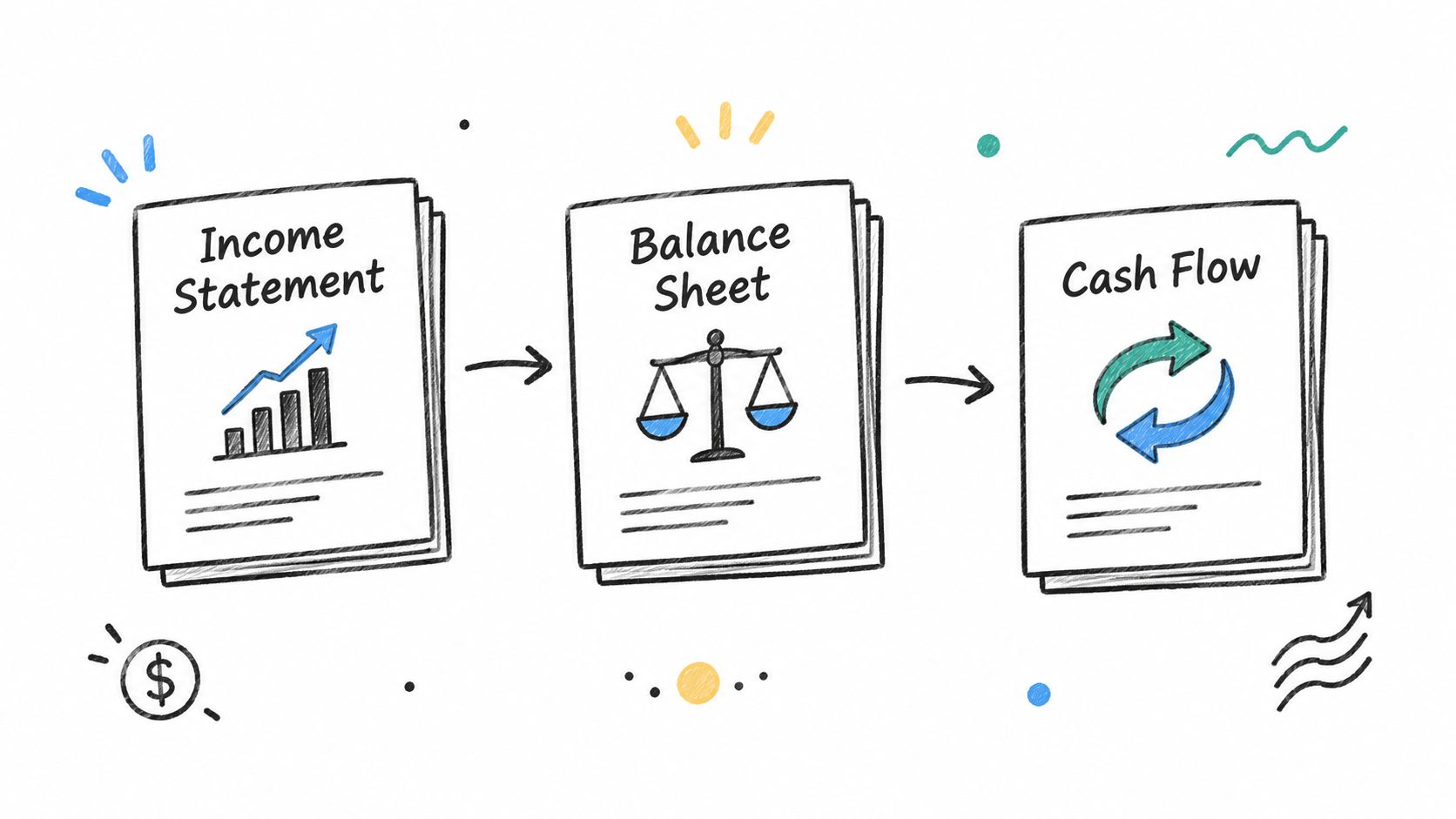
Start with the three statements in a logical order. The income statement explains what happened during a period, the balance sheet shows what the company owns and owes at a point in time, and the cash flow statement explains how cash moved through operating, investing, and financing activities. Interviewers are listening for connections, not isolated definitions.
A strong example could involve a subscription business. Subscription revenue and operating expenses appear on the income statement, while unpaid invoices affect receivables on the balance sheet. Cash collected from customers appears in operating cash flow, and an equipment purchase increases property, plant, and equipment while reducing investing cash flow. If the purchase is financed with debt, the balance sheet also records the obligation and financing cash flow reflects the borrowing.
A practical answer structure
Explain the income statement first, then link its result to equity on the balance sheet. Move to working capital, debt, fixed assets, and cash. Finish by explaining why profit isn't the same as cash. A company can report earnings while collections lag, inventory rises, or capital spending absorbs liquidity.
For a career switcher, use a genuine example. You might explain how project costs became capital assets, depreciation reduced accounting income without a current cash outflow, and the related investment appeared in cash flow. Keep the example tied to your resume rather than inventing a company-specific story.
Practical rule: Pause briefly before answering. A short moment to organize the three statements sounds more credible than rushing through memorized definitions.
Practice retrieving the project name, your role, and the financial consequence from your resume with resume-grounded finance interview practice. Then answer aloud: “A company reports rising profit but falling operating cash flow. What would you investigate first?”
2. How Would You Evaluate a Company's Financial Health?
Don't list every ratio you know. Choose a small set that matches the business model, then explain the trend and the reason behind each metric. For a bank or lender, liquidity, interest coverage, asset quality, and cash generation may dominate. For an operating company, working capital efficiency, margins, asset turnover, and return on equity may provide more useful context.
A concise response can follow this sequence:
- Liquidity: Assess whether the company can meet near-term obligations and whether receivables or inventory are tying up cash.
- Financial structure: Review debt relative to equity, earnings, and cash generation, then consider repayment capacity.
- Profitability: Separate revenue growth from margin performance and identify whether improvements come from durable operations or temporary items.
- Cash flow: Use operating cash flow to test whether reported earnings convert into liquidity.
- Trend and context: Compare periods and interpret the result against the company's industry, maturity, and strategy.
Turn ratios into a business narrative
Suppose a manufacturer has stable operating margins but worsening receivables and inventory turnover. You shouldn't call the business healthy because profit is steady. Ask whether customers are paying later, whether production is ahead of demand, or whether management is building stock to protect against supply disruption.
A technology company and a packaged-goods company won't have identical “normal” ratios. State that explicitly, then explain which benchmark or peer group you'd use. For an international student or career switcher, a scorecard can keep the answer organized, but the scorecard should lead to cash flow analysis rather than replace it.
Practice this prompt: “Revenue is growing, margins are flat, debt is rising, and operating cash flow is weakening. Give a two-minute assessment and name the first follow-up data you need.”
3. Explain a Time You Identified a Cost-Saving Opportunity and How You Implemented It
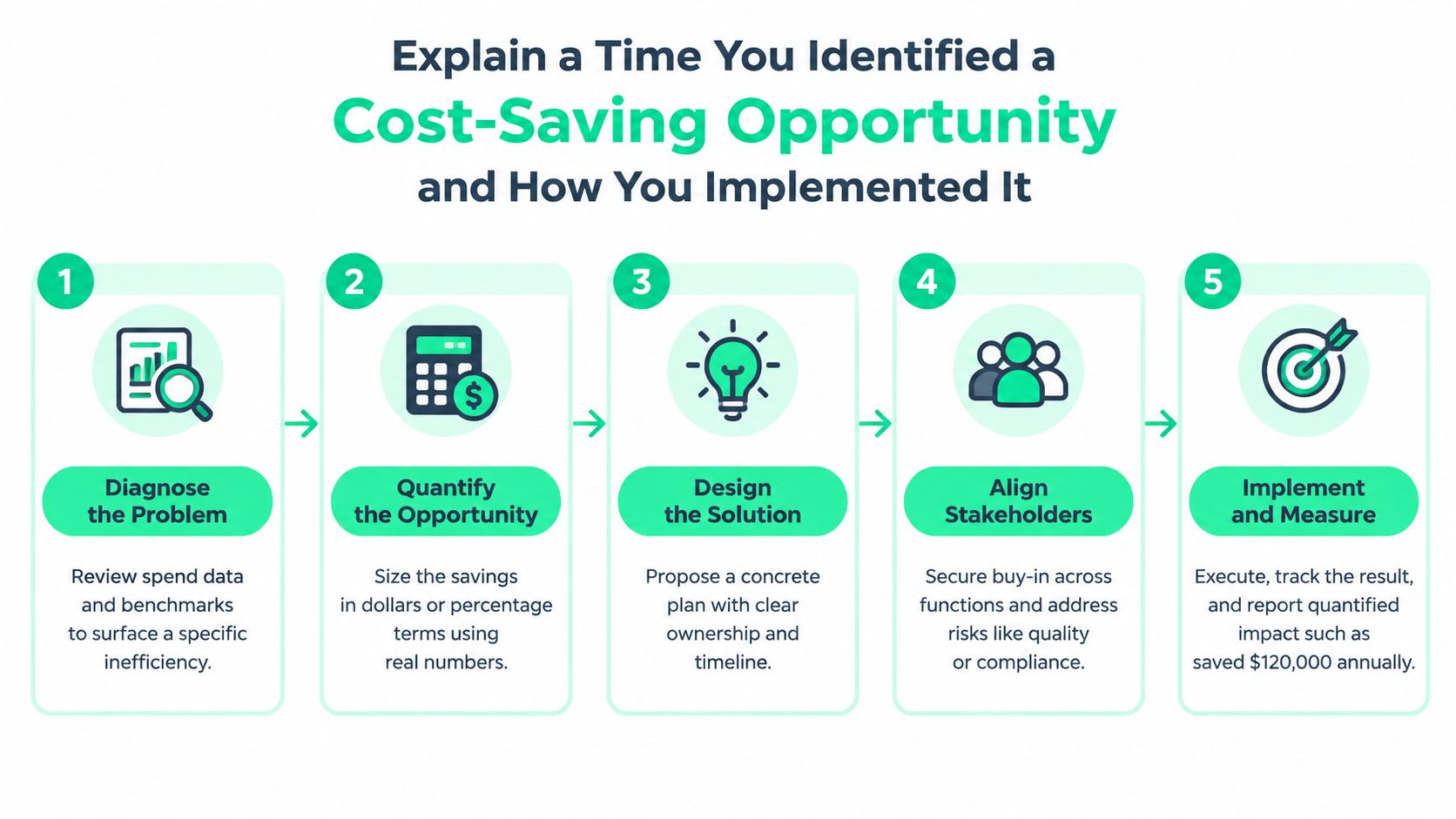
This is a behavioral question disguised as a finance exercise. The interviewer wants to hear how you diagnosed the problem, proved the opportunity, influenced stakeholders, and made the change stick. A vague answer about “reducing expenses” misses the implementation test.
Use a problem, analysis, action, and result sequence. For example, you might review vendor invoices and discover that the company misses early-payment discounts because the payment calendar doesn't align with approval timing. You could map the process, identify the control points, coordinate with procurement and accounts payable, and propose a revised workflow. The best answer explains both the financial benefit and the safeguards that prevent errors or duplicate payments.
Show the trade-off, not just the saving
Cost reduction can create operational risk. A cheaper supplier might increase defects, a larger production batch might raise inventory exposure, and a faster approval process might weaken controls. Say what you checked before recommending the change.
Be precise about your contribution. Did you lead the analysis, build the model, present the recommendation, or help implement it? If the result is measured, include the verified figure from your actual experience. If it isn't, describe the outcome qualitatively rather than manufacturing a percentage or dollar amount.
A finance candidate earns credibility by explaining the effort required, the stakeholders involved, and the risk that had to be controlled.
Likely follow-ups include: “How did you know the saving was real?” “Who disagreed?” and “What would you do if the vendor rejected the proposal?” Practice answering each in one or two sentences. Your live prompt is: “Find a recurring expense on your resume, identify a possible driver, and explain how you'd test the opportunity before recommending action.”
4. What Is DCF Analysis and When Would You Use It?
A discounted cash flow analysis values a business based on the present value of expected future free cash flows. Begin with that purpose. Then explain the mechanics: forecast operating performance, convert it into free cash flow, estimate terminal value, discount the cash flows using an appropriate rate such as WACC, and test the result against key assumptions.
A simple numerical illustration can clarify intuition without pretending precision. If a project is expected to generate $100 of free cash flow one year from now and the discount rate is 10%, its present value is about $91, because future cash is worth less than cash received today. Keep the example separate from any company valuation and explain that a full model also includes taxes, reinvestment, working capital, terminal value, and sensitivity analysis.
Where judgment enters the model
The discount rate reflects financing and business risk. You may discuss cost of equity using a risk-free rate, beta, and a market risk premium, alongside the after-tax cost of debt. Terminal growth must remain plausible for the company's maturity and market. The exact assumption matters less than showing that you understand its influence and will stress-test it.
In private equity, DCF can force explicit assumptions about margins, reinvestment, and value creation. In banking, you might compare the implied value with trading or transaction comparables. The limitation is straightforward: a DCF is only as reliable as its assumptions.
Practice aloud: “Walk me through a DCF, then tell me which assumption you'd challenge first if the valuation looked unusually high.” If you use a spreadsheet, explain how you'd separate inputs, calculations, outputs, and sensitivities.
5. Describe Your Experience With Financial Modeling and What Tools You Use
Tool names don't demonstrate modeling ability by themselves. Explain what you built, how the pieces connected, how you validated the output, and what decision the model supported. “I'm advanced in Excel” is weaker than “I built a linked three-statement model with operating drivers, debt schedules, sensitivity tables, and documented assumptions.”
An investment-banking example might include an acquisition model, merger outputs, a debt schedule, or a returns analysis. A startup finance example could involve a P&L projection, cash forecast, and cap table in Excel or Google Sheets. A technology-to-finance candidate might describe SQL data extraction, Python transformations, and Tableau reporting, then explain the finance question those tools answered.
Demonstrate control and honesty
Good models separate assumptions from formulas, use consistent formatting, document unusual calculations, and include checks that flag broken links or an unbalanced balance sheet. Mention the level at which you've used Excel, SQL, Python, Power BI, or Tableau. If you're learning macros, array formulas, or advanced SQL, say so and describe how you're applying the skill.
The trade-off is speed versus auditability. A quick model may answer an urgent question, but a reusable model needs clear ownership and traceable logic. Interviewers generally prefer an accurate description of your actual work to an inflated tool list.
Use Qcard's AI Interview Coach to practice a 60-second answer, then respond to these follow-ups: “What was the hardest assumption?” “How did you test the model?” and “What would you improve now?” Your real-time prompt is: “Describe one model from input to decision, without naming a tool unless you explain what it did.”
6. Walk Me Through a Leveraged Buyout and Its Value Creation Drivers
Start with the transaction, not the acronym. Suppose a business produces $100 million of EBITDA and is acquired at 5x EBITDA, implying a $500 million entry enterprise value. If 60% of the purchase price is financed with debt, the sponsor contributes the remainder as equity, subject to the detailed sources-and-uses structure.
Then explain the return path. Over the holding period, the company can create value by growing EBITDA, expanding margins, paying down debt with free cash flow, and achieving a favorable exit valuation. Returns are commonly discussed through MOIC and IRR, but a strong answer makes clear which driver produced the outcome. EBITDA growth from better pricing, vendor negotiations, or back-office consolidation is more durable than relying only on additional debt or a higher exit multiple.
Make downside risk visible
An attractive base case can fail if earnings decline, interest expense rises, working capital absorbs cash, or the company breaches a covenant. Discuss interest coverage, debt paydown, recession sensitivity, and the exit multiple. You don't need to build a full LBO in a conceptual answer, but you should show how a missed operating plan affects debt service and equity returns.
A candidate with operations experience can add real value here. Explain how pricing discipline, procurement savings, capacity utilization, or customer retention could improve EBITDA. It is a financing tool, not a business strategy.
Practice this prompt: “Build a verbal LBO in two minutes. State entry value, financing, three operating levers, the main downside case, and what would make you reject the deal.”
7. How Do You Approach Building and Validating a Financial Forecast?
A credible forecast begins with business drivers, not a convenient growth percentage. For a subscription business, start with customer additions, churn, average revenue per user, pricing, and sales capacity. For a manufacturer, use volume, price, utilization, materials, labor, and working capital. Then translate those drivers into revenue, margins, cash flow, and funding needs.
A bottoms-up model often produces better operational discussion because sales, operations, and finance can challenge the assumptions they own. A top-down view still has value as a reasonableness check. If the two methods disagree, investigate the gap rather than averaging them without explanation.
Validate through scenarios and variance review
Build base, downside, and upside cases. A credit analyst might stress a recession, a major customer loss, or competitor entry and then examine debt-service capacity. FP&A might compare forecast revenue and margin against actual results each month, classify the variance, and update the driver logic rather than changing the output.
Forecasting has a communication component. State why an assumption differs from history, identify the evidence supporting it, and explain who validated it. Don't hide uncertainty behind excessive decimal precision.
Good forecasting is a learning loop. The model improves when the team studies why actual performance differed from the prior forecast.
Practice aloud: “Forecast revenue for the next period using three operating drivers. Give a base case, one downside case, and the first variance you would monitor.”
8. Tell Me About a Time You Had to Deliver Bad News or Manage a Stakeholder Conflict
Finance professionals often have to communicate an unwelcome result before they have a perfect solution. The answer should show preparation, candor, empathy, and an action plan. Bring the relevant data, check that it is correct, understand the operational context, and avoid presenting a surprise as an accusation.
Consider an FP&A conversation where your review identifies a meaningful revenue shortfall. You would explain the variance, ask the sales leader for context, test whether a competitor launch or pipeline timing caused the gap, and then agree on revised assumptions and actions. The sequence matters. You don't start by assigning blame.
Separate the person from the problem
In an audit or compliance example, describe the control weakness as a process issue and propose a practical remediation. In an internship example, verify account coding before confronting a business unit about overspending. If the problem is your own delay, acknowledge it and bring a revised timeline with clear ownership.
Likely follow-ups include: “What if the stakeholder still disagreed?” and “What did you say in the room?” Give a short version of the conversation, then explain how you preserved the relationship without weakening the conclusion.
Practice with this prompt: “Deliver a negative forecast update to a senior stakeholder in 45 seconds. Include the result, the cause you know, the uncertainty you still need to resolve, and the next action.” Keep your tone measured. Authentic pacing is more persuasive than polished corporate language.
9. Qcard User Best Practices
Resume-grounded preparation works best when every story has a retrieval path. Link each major example to a specific resume bullet, project name, timeframe, your role, and the verified result. That structure helps you answer a technical question with a real example instead of reaching for a generic hypothetical.
Prepare a short lead for each story. In 30 to 60 seconds, state the problem, your responsibility, the analysis or action, and the outcome. You can expand when the interviewer asks a follow-up, but you shouldn't make the interviewer search for the point.
Build a flexible story set
Keep examples that cover different kinds of work:
- Technical analysis: A model, statement review, valuation, dashboard, or data process you completed.
- Business judgment: A forecast change, investment recommendation, cost decision, or risk assessment.
- Execution: A process improvement that required coordination with another team.
- Interpersonal maturity: A conflict, difficult update, mistake, or stakeholder conversation.
The best story isn't always the most impressive one. It's the one that answers the question directly and gives you enough detail to defend your choices. Avoid memorizing full paragraphs, because a scripted answer can break when the interviewer changes the wording.
Practice retrieval rather than recitation. Look at a project cue, answer the opening question, and then handle three follow-ups aloud: “What did you personally do?” “What assumption was weakest?” and “What would you change?” The goal is to remember the evidence while keeping the language natural.
10. Common Interview Themes for Finance Roles
Across finance interview questions and answers, the recurring standard is consistent: explain the technical idea, apply it to a business situation, acknowledge uncertainty, and communicate the conclusion clearly. Finance interviews commonly test motivation for finance, technical knowledge, commercial awareness, behavioral competencies, and numerical reasoning under pressure (finance interview guidance).
Role changes the emphasis. Investment banking candidates should expect valuation, transaction mechanics, accounting links, and fast technical follow-ups. Corporate finance and FP&A candidates need driver-based forecasting, variance analysis, budgeting, and stakeholder influence. Trading and quant roles place greater weight on probability, statistics, machine learning, and computer science, areas identified as prevalent in quantitative finance interviews (quantitative finance interview guide).
Add the newer finance skills
Many traditional question lists still concentrate on DCF, WACC, and basic accounting. A stronger candidate can also explain how they would evaluate data quality, automation controls, cybersecurity exposure, or the financial impact of an AI tool. Those answers should remain practical. Name the workflow, the decision, the risks, and the control you would use.
For every role, anchor the answer in a company, project, or transaction. Use a bottoms-up approach where the question calls for it, quantify outcomes only when the result is verified, and state the effort required. The finance interview preparation guide can support that broader practice, but your own examples must remain the substance of the answer.
Build Your Finance Interview Answer Bank
A strong answer bank isn't a document full of polished paragraphs. It's a set of reliable memory cues that help you retrieve real evidence quickly. Start by choosing one technical question, one valuation or modeling question, one forecasting question, and one behavioral question. For each, write the opening conclusion, the project or company you'll use, the key assumption, the verified result, and the follow-ups most likely to expose a weak point.
Rehearse the answer in layers. First, deliver the concise version without notes. Next, expand the technical reasoning and explain the trade-off. Finally, answer a follow-up that changes the facts. For example, after explaining a DCF, discuss what happens when margins fall. After describing a cost-saving project, explain the operational risk. After presenting a forecast, identify which driver you would monitor first.
Your emphasis should change with the role. Investment banking answers need speed, accounting fluency, transaction logic, and valuation discipline. Corporate finance and FP&A answers should connect planning assumptions to operating behavior and explain variances to non-finance stakeholders. Trading and quant candidates need probabilistic reasoning and comfort with uncertainty. Credit candidates should emphasize liquidity, repayment capacity, and downside cases. Equity research candidates need a clear investment view supported by drivers, catalysts, and risks.
Career switchers should not apologize for coming from another function. Translate prior work into finance language without overstating it. A project-cost analysis can demonstrate capital allocation judgment. A data pipeline can show analytical discipline. A difficult client conversation can demonstrate stakeholder management. The interviewer needs to understand what you did, what changed, and how confidently you can defend the conclusion.
Qcard can be one optional practice layer for this routine. Its resume-grounded prompts are designed to surface concise memory cues rather than force candidates to recite scripts. That can help when anxiety, language differences, or brain fog makes retrieval harder, while the final answer still needs to sound like you.
Set a repeatable schedule. Choose four prompts, record yourself answering them, review pacing and answer length, then repeat with new follow-ups. Replace any unsupported claim with a verified detail or qualitative explanation. A candidate who can explain assumptions, acknowledge limitations, and connect analysis to action will usually sound more prepared than someone who has memorized far more definitions.
Key Takeaways
- Finance interviews reward connections over definitions — interviewers listening to a financial statements answer want to hear how the income statement result flows to equity, how working capital and capital spending absorb liquidity, and why a company can report profit while cash collections lag, not three isolated textbook descriptions.
- Ratios only matter when they become a business narrative — a manufacturer with stable margins but worsening receivables and inventory turnover isn't healthy, and a strong answer asks whether customers are paying later, whether production is ahead of demand, or whether management is building stock against supply risk rather than declaring the business fine because profit held steady.
- Quantify only what you can defend, and name your actual contribution — if you led the analysis, built the model, presented the recommendation, or helped implement, say which, and when a result was never formally measured, describe the outcome qualitatively rather than manufacturing a percentage that collapses under "how did you know the saving was real?"
- Show the trade-off, because that's where credibility lives — a cheaper supplier can raise defects, a larger production batch can increase inventory exposure, a faster approval process can weaken controls, and an LBO base case can fail if earnings decline or a covenant breaks, so naming what you checked separates a finance professional from someone reciting a framework.
- Practice retrieval, not recitation — memorizing full paragraphs breaks the moment an interviewer rephrases the question, while a cue path (project name, your role, key assumption, verified result) lets you answer a technical question with a real example and then handle the three follow-ups that actually decide the round: what did you personally do, which assumption was weakest, and what would you change now.
Qcard offers resume-grounded practice cues, mock interview follow-ups, and an AI Interview Coach for pacing, filler words, and answer length. Visit Qcard to rehearse finance interview questions and answers while keeping your responses authentic rather than scripted.
Ready to ace your next interview?
Qcard's AI interview copilot helps you prepare with personalized practice and real-time support.
Try Qcard Free