TL;DR
A final interview is the last structured round where employers decide whom to trust, not whether you can do the work — and only 1–3% of applicants reach it. Formats vary: panel, technical, values, case, and executive conversations each test something different, so ask the recruiter who'll attend and what each session covers. Prepare with a seven-step workflow: re-read the job posting, mine prior rounds for repeated follow-ups, build six to eight STAR stories, create one-line recall cues ("vendor delay, launch risk, reset scope, shipped safely"), rehearse aloud with a timer, confirm logistics, and prepare a 60-second opening. Anxiety is a real performance factor — a meta-analysis found a −0.19 correlation with interview performance, and 65% of jobseekers say nerves prevented them from showing their true ability, with 30% losing their train of thought. The fix isn't calm, it's cognitive load reduction: brief prompts instead of scripts, practiced recovery phrases, and enough working memory left over to listen. Afterward, send a specific thank-you within 24 hours and wait for a written offer before negotiating.
You've just refreshed your inbox again when the message appears: “We'd like to invite you to the final interview.” For a moment, you feel relief. Then your stomach tightens, your heart speeds up, and your mind starts listing every question you might be asked.
That reaction doesn't mean you're unprepared. Final-round interviews carry real pressure because the shortlist is small. One industry summary says only 1–3% of applicants typically reach a final interview, with high-volume roles sometimes closer to 0.5–1%, according to InterviewPal's final-interview analysis. The employer has already made a serious investment in evaluating you.
The right response isn't to memorize perfect scripts. It's to reduce cognitive load, organize your evidence, and create enough mental space for your real judgment and experience to come through. This guide gives you practical workflows for that process, whether you're a graduate, career changer, international student, neurodivergent candidate, or experienced professional making a move.
What Is a Final Interview and What Does It Actually Test?
A final interview is usually the last structured stage of a hiring process, where the company compares qualified candidates and decides whom it trusts with the role. Only 1–3% of applicants typically reach this stage — closer to 0.5–1% for high-volume roles — and managers often narrow an initial group of 6–10 candidates down to 2–4 finalists.
The evaluation shifts at this stage. Earlier interviewers ask, "Can this person do the work?" Final interviewers ask, "Would we trust this person's judgment, communication, and reliability when the work becomes ambiguous?" They also compare your answers against what you showed in earlier rounds, so consistency matters more than delivering a brand-new performance.
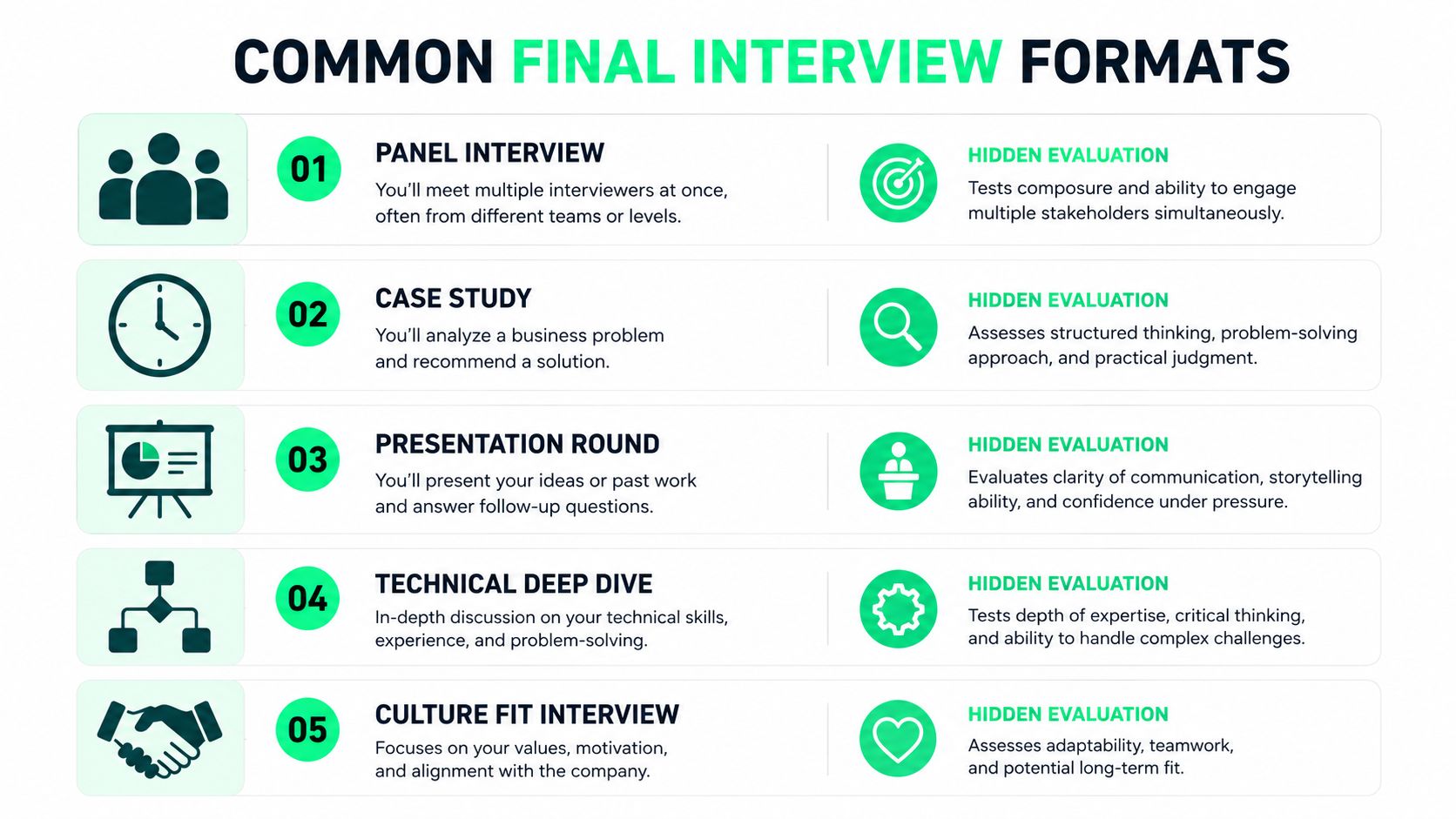
Five formats you're likely to encounter, and what each one tests:
- Panel interview — Whether you include the whole group, listen closely, and adjust your explanation for different levels of expertise. Answering only the most senior person is a red flag.
- Technical examination — Your reasoning process more than the answer. Explain assumptions, name tradeoffs, and say what you'd verify. Bluffing creates more concern than an admitted gap.
- Culture or values interview — Adaptability, response to feedback, and behavior when priorities conflict. Presenting yourself as someone who never errs sounds rehearsed.
- Case or business critique — Structure, hypothesis generation, prioritization, and stakeholder communication. Clarify the objective first, then state your working assumption.
- Executive or hiring committee conversation — Judgment, leadership signal, and trajectory. Connect immediate decisions to customers, colleagues, and measurable outcomes rather than answering tactically.
Ask the recruiter who will attend, how sessions are divided, and whether each interviewer assesses a different competency. Those details reduce uncertainty, which frees attention for listening and judgment instead of memorizing more answers.
The Moment You Realize the Final Interview Is Real
Maya read the invitation three times. She had completed a recruiter screen, spoken with the hiring manager, and submitted a work sample. The final email should have brought relief. Instead, her shoulders tightened as she replayed each earlier answer and searched for mistakes.
Her mind generated questions faster than she could assess them: What if the executive asks something technical? What if I freeze? What if they have already chosen someone else? What if my nerves show? She opened a document and began drafting full responses. Ten minutes later, the page was crowded, and her confidence had dropped.
That reaction reflects a cognitive-load problem, not a lack of commitment. A published meta-analysis of interview-anxiety research found a moderate negative association between interview anxiety and performance, with a correlation of −0.19. Anxiety can make information harder to retrieve, speed up or disrupt pacing, weaken answer structure, and reduce your attention to the interviewer's actual question.
The same pressure can look different across candidates. A neurodivergent candidate may need predictable transitions or a moment to process an unfamiliar question. An international student may be translating ideas while also monitoring language and cultural expectations. A career changer may struggle to identify which past examples count, while an early-career graduate may assume limited experience means having nothing useful to say.
Your preparation target is not complete calm. Give yourself reliable cues that make the next response easier to retrieve and deliver.
Grounding principle: Preparation should give your brain handles to grab, not paragraphs it has to recite.
Use brief prompts instead of scripts, practice answers aloud, and rehearse recovery phrases such as, “Let me think about that for a moment.” Organize two or three examples around the skills the role requires. This leaves working memory available for listening, adapting, and showing judgment. The final interview remains a high-stakes conversation, but you do not need to perform a memorized character. You need accessible evidence and enough flexibility to respond as yourself.
What a Final Interview Actually Is
You have answered screening questions, completed practical work, and now a senior leader asks how you would handle an unclear priority. That conversation is the final interview. It is usually the last structured stage, where the company compares qualified candidates and decides whom it trusts with the role.
Earlier rounds usually serve narrower purposes:
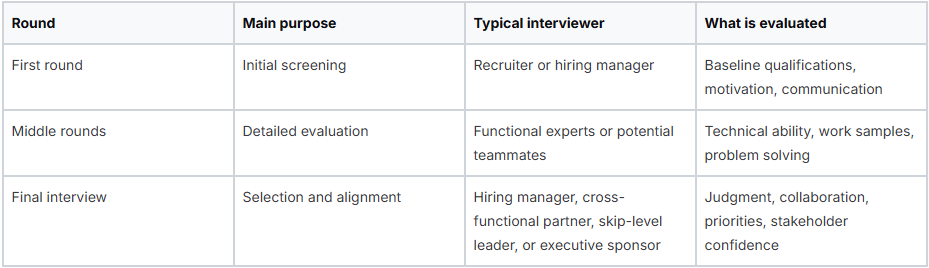
Hiring manager, cross-functional partner, skip-level leader, or executive sponsor
Judgment, collaboration, priorities, stakeholder confidence
Hiring processes often include several conversations before a decision. A 2026 hiring-statistics summary says over half of employers require four or more interviews, with processes lasting 4–6 weeks, placing the final conversation near the end of a structured sequence, as described by Career.io's hiring statistics and interview guidance. Managers may narrow an initial group of 6–10 candidates to 2–4 finalists, according to InterviewPal's discussion of final-round selection.
The schedule can vary: a 45-minute conversation with a senior leader, a 90-minute panel, or several sessions on one day. Ask the recruiter who will attend, how sessions are divided, and whether each interviewer assesses a different competency. Those details reduce uncertainty, which frees attention for listening and judgment instead of forcing you to memorize more answers.
The evaluation also shifts. Earlier interviewers may ask, “Can this person do the work?” Final interviewers often ask, “Would we trust this person's judgment, communication, and reliability when the work becomes ambiguous?” They compare your decisions and examples with what you showed earlier, so consistency matters more than producing a completely new performance.
Reaching this stage is meaningful, but it is not a guarantee. Prepare to show how you think, collaborate, learn, and make decisions while treating the meeting as a serious comparison point.
Common Final Interview Formats and What They Test
The format signals what the company wants to observe. A panel may examine how you handle competing perspectives. A technical examination may test whether you can explain tradeoffs without becoming defensive. A values conversation may reveal how you respond to feedback, rather than whether your personality resembles the interviewer's.
Panel interview
Several stakeholders ask questions in one conversation. They observe whether you include the group, listen closely, and adjust your explanation for different levels of expertise.
A red flag is answering only the most senior person while overlooking everyone else. A green flag is acknowledging each questioner briefly, answering the question directly, and checking whether the group wants more detail. If the room feels crowded, treat the conversation like passing a ball around a circle. Keep track of who asked, while remaining aware of everyone's reaction.
Technical examination
This may involve architecture, analysis, coding, domain knowledge, or a detailed review of a previous project. The central test is often your reasoning process. Explain assumptions, name tradeoffs, and state what you would verify before committing.
Bluffing when you do not know creates more concern than an admitted gap. A stronger response is, “I haven't worked with that directly, but I'd start by clarifying the constraint, checking the relevant documentation, and testing the smallest safe version.”
Culture or values interview
“Culture fit” should not mean personality matching. A well-run conversation examines adaptability, feedback, motivation, and your behavior when priorities conflict.
Presenting yourself as someone who never makes mistakes or disagrees can sound rehearsed. Describe a real adjustment you made after receiving feedback, including what changed in your approach.
Case or business critique
The interviewer may give you an ambiguous business problem, product scenario, or operational challenge. They usually assess structure, hypothesis generation, prioritization, and stakeholder communication more than one correct answer.
Start by clarifying the objective. Then state your working assumption, ask focused questions, and explain why you are prioritizing one path. If new information appears, revise your approach openly. That shows flexible reasoning rather than confusion.
Executive or hiring committee conversation
Senior decision-makers often focus on judgment, leadership signal, and long-term trajectory. They may ask why this company, what you would prioritize, or how you would handle a difficult organizational choice.
A tactical answer can miss a strategic question. Connect the immediate decision to customers, colleagues, business goals, and measurable outcomes. Do not pretend to know what you have not been told. This kind of restraint is part of sound judgment, especially when anxiety makes candidates rush to fill every silence.
A Practical Preparation Workflow
Use preparation to make retrieval easier. Structured behavioral interviews are more predictive of job performance than unstructured interviews because standardized questions and consistent scoring improve comparability, reliability, and signal quality, as discussed in the peer-reviewed research on structured behavioral interviews.
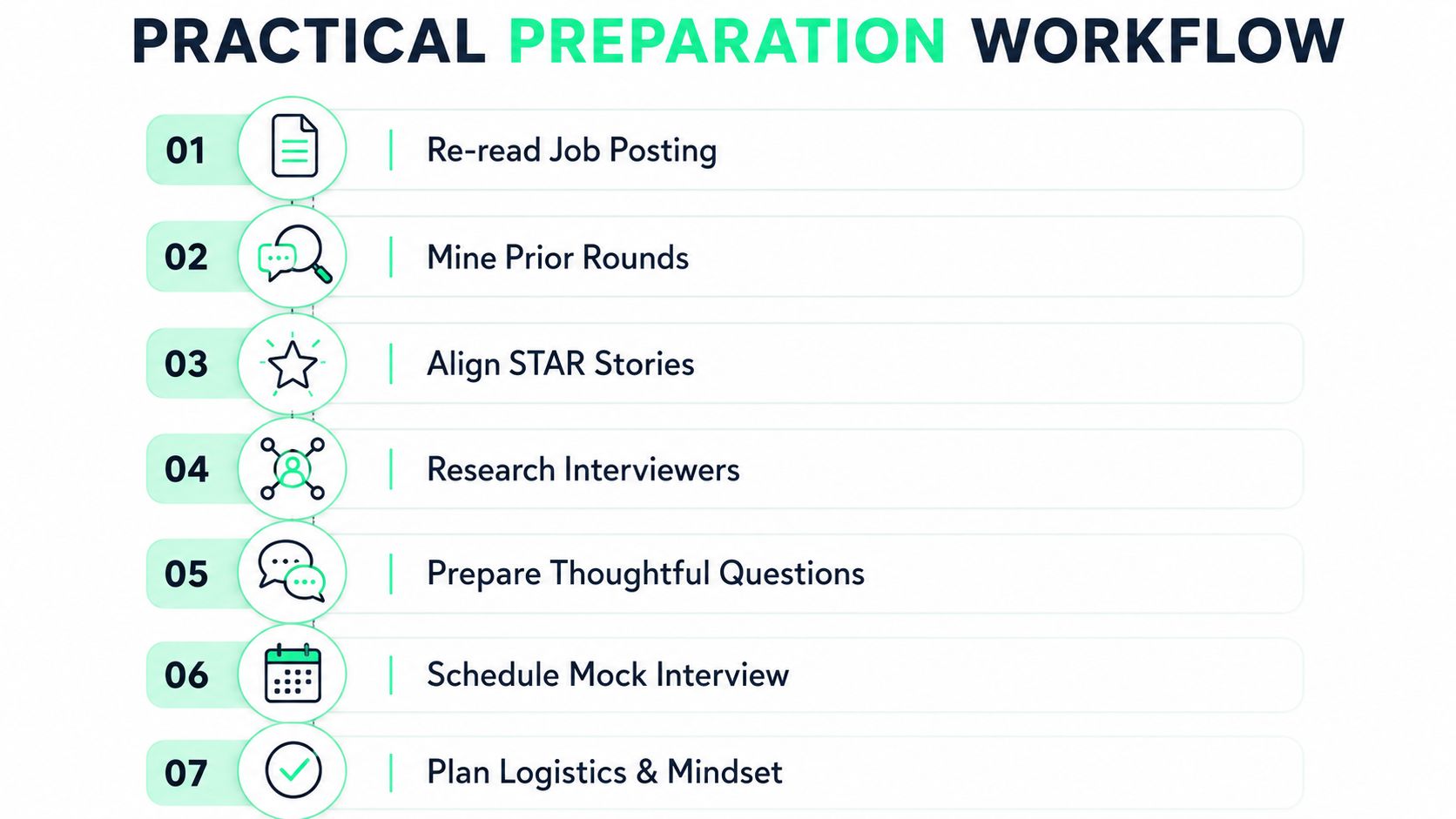
- Re-read the job posting. Highlight required skills, recurring verbs, and outcomes. If the posting emphasizes influencing, choose a story where you persuaded people without formal authority.
- Mine prior rounds. Review questions you've already received and note what interviewers asked you to clarify. Repeated follow-ups often reveal the evidence they still need.
- Build six to eight STAR stories. Cover leadership, conflict, failure, collaboration, difficult prioritization, and a result you're proud of. The STAR method means Situation, Task, Action, and Result, with emphasis on your personal contribution, as explained in Dartmouth's STAR interview guide.
- Create one-line cues. “Vendor delay, launch risk, reset scope, shipped safely” is more useful than a memorized paragraph. Each cue should remind you of the context, your action, and the outcome.
- Rehearse aloud. Use a timer, record yourself, and practice stopping after the answer is complete. A totaljobs survey summarized by Onrec reported that 65% of jobseekers said nerves prevented them from showing their true ability, while 26% said they talked too quickly, 20% talked too much, and 30% lost their train of thought. Practice pacing and recovery, not just content.
- Check logistics. Confirm the time zone, platform, camera, microphone, lighting, internet connection, and backup contact method. For an in-person meeting, plan the route and arrive with your notes organized.
- Prepare a 60-second opening. State what you do, the evidence you bring, and why this role makes sense now. Keep it conversational rather than delivering a compressed autobiography.
You can use an AI interview copilot as a support for high-level story cues, provided the material stays grounded in your verified experience and doesn't replace practice. Qcard's interview preparation guide can sit alongside your preparation workflow as one example of a tool built around recall and practice rather than word-for-word scripts.
Sample Answers for the Questions You Will Actually Get
The strongest answers have a visible shape. Before speaking, identify the question's purpose, choose the relevant story cue, explain the tension, and close by connecting the experience to the role.
“Tell me about yourself”
Don't begin with every job you've held. Choose a present-to-past-to-future path.
Sample: “I'm a customer operations analyst focused on turning recurring service problems into clearer processes. In my current role, I analyzed support patterns, coordinated with product and training teams, and helped improve how agents handled a difficult workflow. I'm now looking for a role where I can combine analysis with cross-functional problem solving, which is what attracted me to this position.”
The closing line tells the interviewer why your history belongs in this conversation.
“Why this company?”
Use one company-specific observation, one connection to your experience, and one reason the timing makes sense.
Sample: “I'm interested in this company because the role sits close to both customer needs and product decisions. In my previous work, I enjoyed translating recurring customer problems into operational changes, and I'd like to apply that experience in a setting where those insights can influence a broader product strategy.”
Avoid flattery you can't support. Curiosity about the team, challenges, success measures, or future direction sounds more credible.
“Describe a leadership failure”
Choose a contained failure with a real consequence, not a disguised strength. Explain what you misunderstood, what you did next, and what changed afterward.
Sample: “I once moved a project forward without confirming that two partner teams had the same definition of readiness. We reached a late review with unresolved concerns, so I paused the launch, documented the gaps, and set up a shared checklist for future releases. I learned that alignment isn't complete because a meeting happened. It needs a visible decision and owner.”
“Where do you see yourself in five years?”
Show direction without pretending to know every title you'll hold.
Sample: “I'd like to become someone who can own increasingly complex problems and help others work through them. In the near term, I'm focused on building depth in this function, learning the company's customers, and earning broader responsibility through reliable execution.”
“What questions do you have for us?”
Bring questions that help you evaluate the role and demonstrate thoughtful preparation. Ask about the first meaningful challenge, how success is recognized, how the team handles disagreement, or what has kept the interviewer at the company.
You can use these practice interview questions to rehearse the structure, then adapt the wording to the actual conversation.
A useful test: If the answer would help you decide whether to accept the job, it's probably a stronger question than one designed only to impress.
Tailored Advice for Every Type of Candidate
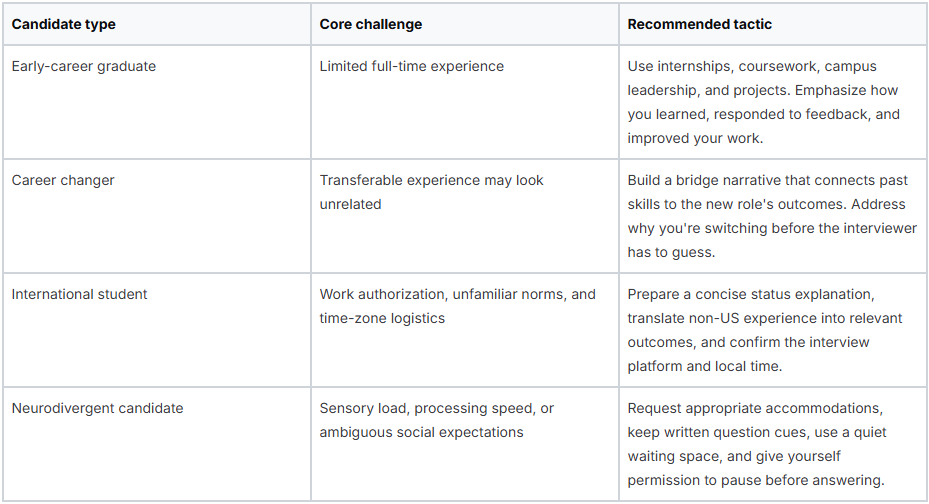
The same final interview advice doesn't work equally well for everyone. A graduate may worry about having too little experience. A career changer may have plenty of evidence but struggle to make it legible to a new industry. An international student may be managing work authorization and communication expectations at the same time.
Early-career graduates
Use a class project to show prioritization, an internship to show execution, and a group assignment to show collaboration. Don't apologize for the source of the example. Explain the scale, your responsibility, the obstacle, and what you learned.
A useful answer might begin, “In my internship, I noticed…” rather than “I haven't had a real job yet.” Learning velocity is evidence when you show the behavior that produced it.
Career changers
Your bridge narrative should have three parts: what you did, what capability it proves, and why the new role needs that capability. For example, a teacher moving into customer enablement could connect lesson design, audience adaptation, feedback, and measurable learning outcomes to onboarding customers.
Avoid saying you're leaving your old field because you're tired of it. Lead with the work you want to do more often.
International students
Prepare a direct answer about work authorization and keep it separate from your value proposition. When discussing experience from another country, explain the business context briefly and focus on decisions, results, and skills that transfer.
Check the interview time zone yourself rather than relying on an automatically converted calendar invitation. Also test captions, pronunciation of names, and the video platform before the conversation.
Neurodivergent candidates
You can ask about accommodations before the final interview. Depending on your needs, that might include written instructions, a quieter environment, additional processing time, captions, or a clear agenda.
During the interview, pausing is allowed. Try, “I'd like a moment to organize that,” then use a cue such as “context, decision, action, result.” The Measure of Anxiety in Selection Interviews research distinguishes performance, communication, behavioral, social, and appearance anxiety, with average scores from 276 participants ranging from 2.24 to 2.64 on a 1-to-5 scale. That distinction supports targeted practice rather than treating all nerves as one problem.
Negotiation, Thank-You Notes, and What Comes Next
Your work doesn't end when the video call closes. The post-interview exchange gives you a chance to demonstrate the same judgment the company has been assessing.
Send a specific thank-you email within 24 hours. Refer to one conversation point and connect it to one contribution you could make. “I enjoyed learning about the team's challenge with cross-functional prioritization. My experience creating shared decision criteria for product and operations teams would help me contribute to that work” is stronger than “Thank you for your time.”
This interview thank-you email guide can help you organize the message without making it sound generic.
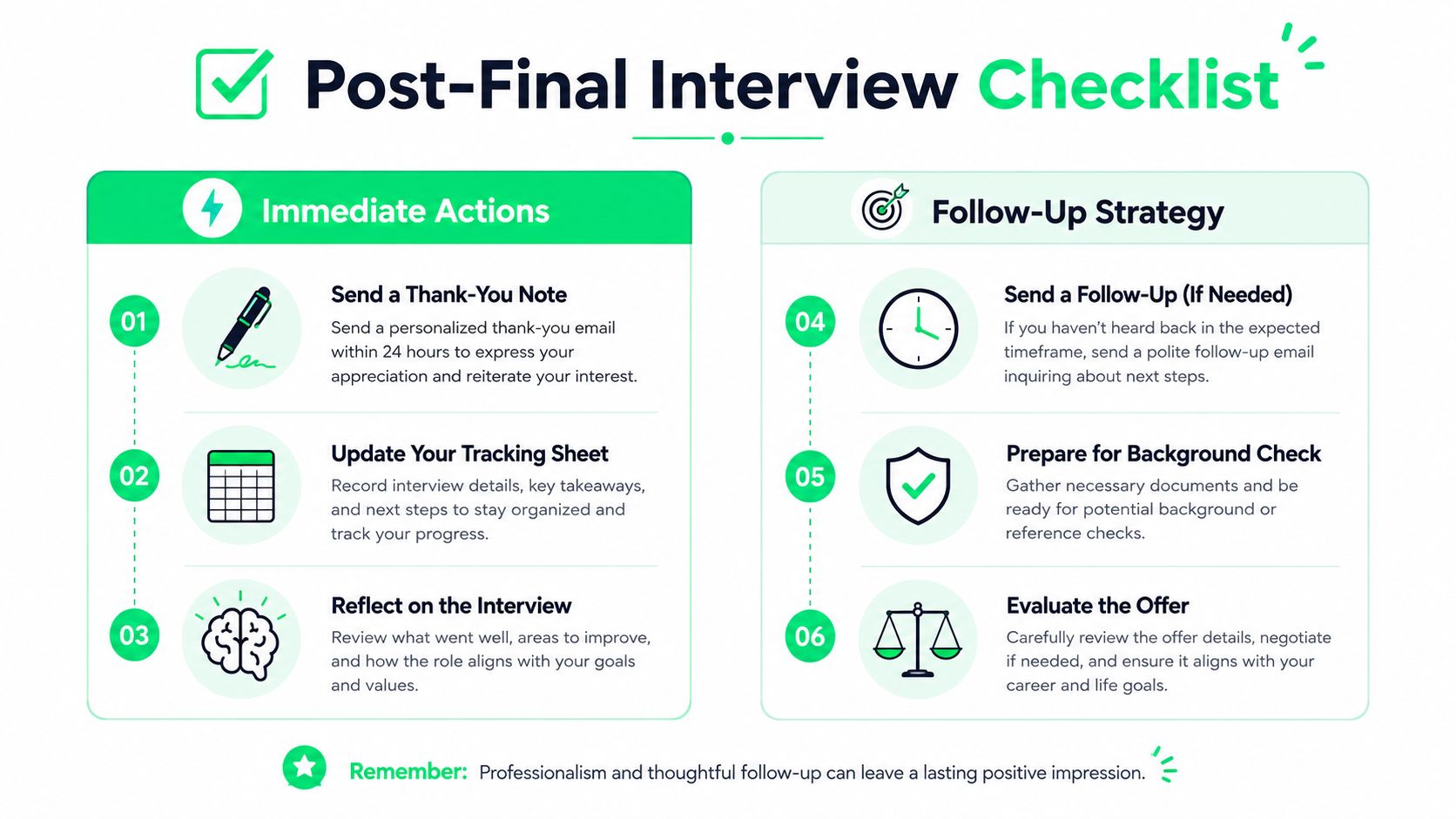
Wait for a written offer before negotiating. Then compare the offer with your alternatives, including the option of staying where you are or continuing your search. Make a clear counter-anchor based on the value and scope of the role, and consider total compensation, flexibility, development, benefits, and start-date constraints rather than base salary alone.
If the company goes quiet, send a brief follow-up that restates your interest and asks whether the timeline has changed. If you decline, be direct and gracious: “Thank you for the offer. I've decided to pursue another opportunity that better fits my current priorities, and I appreciate the time your team invested.”
You can use an AI tool to draft negotiation language or summarize salary research, but verify every detail and make the final message sound like you. Your follow-through matters because it reveals how you communicate when the interview room is gone.
Key Takeaways
- The final interview asks a different question than earlier rounds — instead of "Can this person do the work?", interviewers are assessing whether they'd trust your judgment, communication, and reliability when the work becomes ambiguous, and they compare your answers against what you showed earlier, which means consistency matters more than a fresh performance.
- Format determines what's being observed, so ask before you prepare — a panel tests whether you include the whole room, a technical round tests reasoning over correctness, a values conversation tests how you handle feedback and conflict, a case tests structure under ambiguity, and an executive session tests strategic connection rather than tactical detail.
- Cue words beat scripts because anxiety attacks retrieval, not knowledge — research shows a moderate negative association between interview anxiety and performance (−0.19), and a totaljobs survey found 65% of jobseekers say nerves stop them showing their true ability, 30% lose their train of thought, 26% talk too quickly, and 20% talk too much.
- Admitting a gap beats bluffing in technical rounds — "I haven't worked with that directly, but I'd start by clarifying the constraint, checking the documentation, and testing the smallest safe version" demonstrates the judgment senior interviewers are actually scoring, while a confident wrong answer damages credibility that's hard to rebuild in a final round.
- Different candidates need different preparation emphasis — early-career graduates should lead with "In my internship, I noticed…" rather than apologizing for limited experience, career changers need a three-part bridge narrative connecting past capability to the new role's outcomes, international students should separate work authorization from their value proposition, and neurodivergent candidates can request accommodations and use a practiced pause ("I'd like a moment to organize that") with a cue like "context, decision, action, result."
Qcard helps final-interview candidates organize resume-grounded talking points, practice behavioral and technical questions, and manage recall without relying on memorized scripts. Visit Qcard to prepare concise cues, rehearse under pressure, and enter your next final interview ready to speak naturally.
Ready to ace your next interview?
Qcard's AI interview copilot helps you prepare with personalized practice and real-time support.
Try Qcard Free