
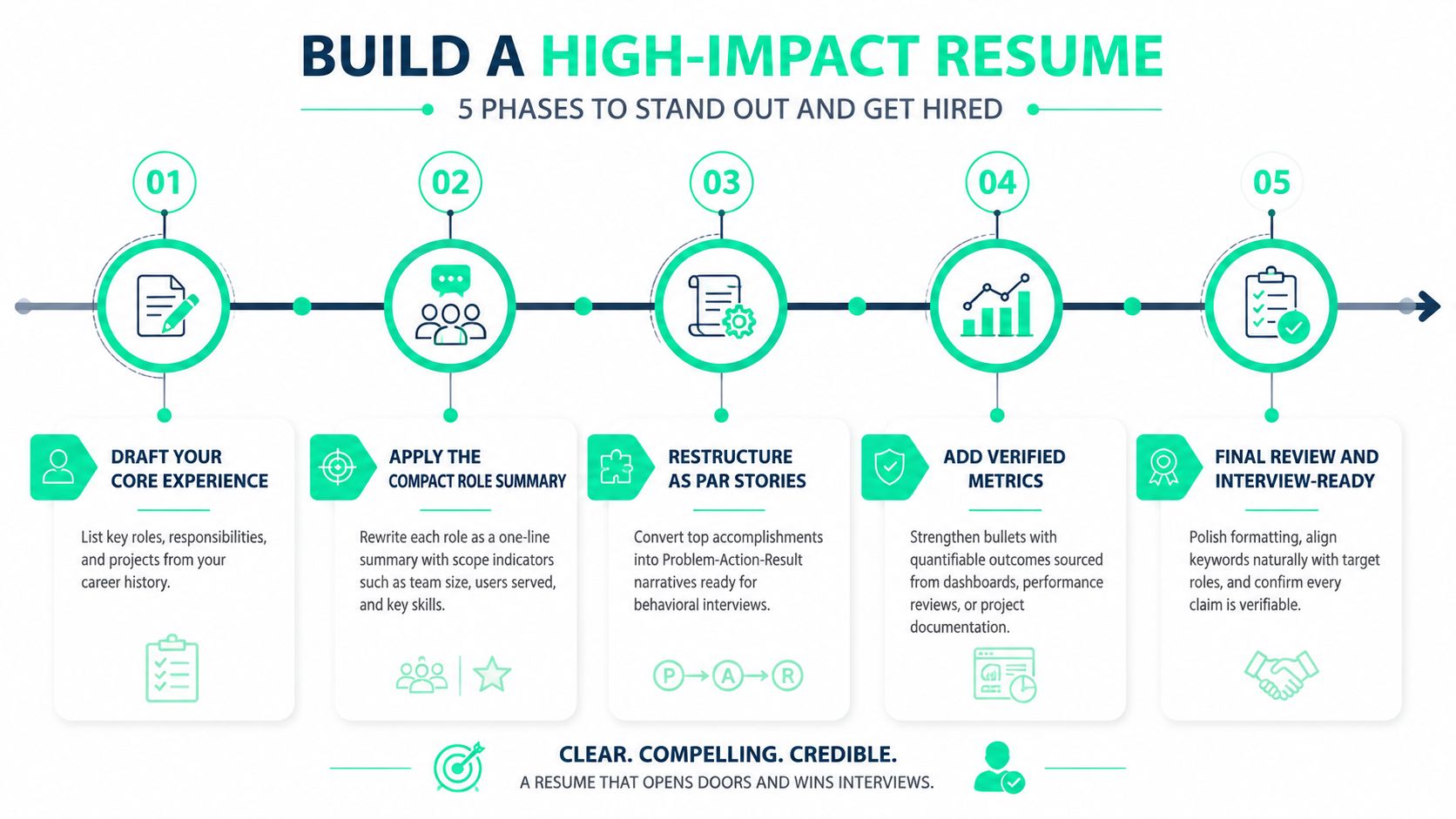
TL;DR
Strong resume examples prove impact rather than list duties — which matters when an average posting draws about 250 resumes and only ~2% lead to an interview. The eight approaches are quantified achievement bullets (action verb + task + measurable result), skill categories that show honest depth levels, PAR stories compressed into single sentences, role-specific keywords placed inside accomplishments rather than stuffed into lists, compact role summaries that establish scope, a progressive responsibility arc across roles, domain context that makes career-change relevance obvious, and verified metrics with accurate attribution. Match your verb to your actual ownership — owned, led, drove, and contributed to signal different things, and accurate attribution strengthens rather than weakens a bullet. Formatting matters too: a 2026 recruiter survey found 96.6% say formatting influences their decision, 80.1% prefer bullets over paragraphs, 82.1% consider 1–2 pages ideal, and 98.7% value quantifiable achievements. Then convert your three or four strongest bullets per role into private interview cues with context, action, result, evidence source, and likely follow-up.
The best resume examples give you something to prove, not merely something to list. The popular advice to “describe your responsibilities” often produces bullets that explain where you worked but not why anyone should interview you. A stronger bullet shows the problem, your contribution, and a credible result. If you maintained a process, say what changed because you maintained it. If you supported a team, identify the decision, deliverable, or outcome you influenced.
This guide presents eight examples for a resume, covering quantified achievements, skill organization, PAR stories, role-specific language, scope summaries, career progression, domain context, and verified attribution. Treat every number as evidence, not decoration. Replace the sample details only with facts you can support through project records, dashboards, performance reviews, or other reliable documentation.
The examples also connect resume writing to interview recall. Qcard is an optional way to turn selected, verified resume facts into short memory cues for interviews, rather than memorized scripts. The approach here uses plain, ATS-friendly language, standard structure, and practical templates. It avoids tables, visual gimmicks, and keyword-heavy formatting that can make a resume harder for both parsing systems and people to understand.
What Are the Best Examples for a Resume?
The best resume examples give you something to prove, not merely something to list. "Describe your responsibilities" produces bullets explaining where you worked but not why anyone should interview you. A stronger bullet shows the problem, your contribution, and a credible result — and that difference matters when an average online job opening receives about 250 resumes (386 for IT roles) and only about 2% of submitted resumes lead to an interview.
Here are the eight examples and when each one applies:
1. Achievement-focused bullets with quantified impact — Use action verb + specific task + measurable result. "Increased customer retention by 23% through personalized email campaigns, reducing quarterly churn from 8% to 6%."
2. Skill-category organization with progressive complexity — Group skills and distinguish depth honestly: "Data Analysis: Python, SQL, Tableau, fluent; R and Power BI, developing; statistical modeling, learning." Place the most role-relevant category first.
3. PAR story structure in work experience — Problem, Action, Result compressed into one sentence: "Redesigned onboarding after early users abandoned the product, combining user interviews with a guided tutorial flow that improved first-week retention to 78% and reduced support tickets by 35%."
4. Role-specific keyword alignment without stuffing — Put terminology inside accomplishment statements: "Implemented zero-trust architecture across 50+ microservices, reducing unauthorized lateral movement by 92% through network segmentation."
5. Compact role summary with scope indicators — Establish scale before the bullets: "Full-Stack Engineer, 2020 to 2022: Built a customer portal serving 500K+ users, mentored 3 junior engineers, React, Node.js, PostgreSQL."
6. Progressive responsibility arc across roles — Show expanding scope, not just chronology: individual features → owned components and code review → architectural decisions and delivery coordination.
7. Domain expertise and context clarity for career changers — Name the environment so relevance is obvious: "Built HIPAA-compliant healthcare software. Experience with encryption, secure data handling, compliance auditing."
8. Verified metrics and attribution statements — "Led prospecting strategy that contributed to a 32% increase in pipeline velocity, verified through Salesforce dashboards for Q3 to Q4 2022." Match the verb to your actual role: owned, led, drove, contributed to.
1. Achievement-Focused Bullet Points with Quantified Impact
A duty tells a recruiter what you were assigned to do. An achievement tells them what your work changed. That difference matters in a crowded application pool. A widely cited benchmark says an average online job opening receives about 250 resumes, IT roles average around 386 applications, and only about 2% of submitted resumes lead to an interview. These figures are summarized in resume application and interview statistics, and they explain why a generic responsibility can disappear quickly.
A useful construction is action verb + specific task + measurable result. For example:
- Increased customer retention by 23% through personalized email campaigns, reducing quarterly churn from 8% to 6%.
- Led the migration of 500+ legacy databases to cloud infrastructure, reducing infrastructure costs by $120K annually and improving query performance by 40%.
- Mentored 8 junior engineers over 18 months, with 75% promoted or hired into senior roles within 6 months of transition.
These examples work because each one gives the reader a clear action, a defined scope, and an outcome. They also create natural interview anchors. An interviewer can ask how the campaign was designed, how the migration was managed, or how mentoring effectiveness was assessed.
Build bullets from evidence
Start with the result, then work backward. Review performance evaluations, project documentation, reports, dashboards, and team records. Confirm whether the result belongs entirely to you or reflects a broader team contribution. “Led” and “contributed to” communicate different levels of ownership.
Use financial and non-financial evidence where available. Cost reduction, retention, speed, quality, customer experience, process reliability, and team development can all demonstrate impact.
Interview cue: Keep three or four strongest bullets per role ready as primary talking points. Each should remind you of the situation, your action, and the evidence behind the result.
For additional practice connecting resume facts to answers, use this interview preparation guide. Qcard can help surface concise cues from the details you provide, but you still need to verify every metric before it appears on your resume or becomes part of an interview answer.

2. Skill-Category Organization with Progressive Complexity
A skills section becomes more persuasive when it shows structure and honest depth. Listing tools alphabetically can make every skill look equally strong, even when you've used some in production and only studied others. Group related abilities, then distinguish established experience from developing knowledge.
Consider this format:
- Data Analysis: Python, SQL, Tableau, fluent; R and Power BI, developing; statistical modeling, learning.
- Leadership: Team management, performance coaching, cross-functional stakeholder alignment.
- Emerging Leadership: Executive communication and strategic planning.
- Cybersecurity Fundamentals: Network security, threat analysis, incident response.
- Advanced Security: Zero-trust architecture and SIEM platforms.
The format helps a hiring manager scan for relevant capabilities without forcing them to interpret a long inventory. It also gives you a truthful way to present a career transition. A developing skill can support your target role, but it shouldn't be presented as equivalent to a tool you've used extensively.
Match the order to the role
Read the job description and place the most relevant category first. If the position emphasizes SQL, dashboarding, and stakeholder communication, those skills should appear before unrelated tools. Use standard terms rather than internal workplace language. ATS-friendly resume guidance recommends standard headings such as Work Experience, Education, Skills, and Certifications, along with a simple single-column layout that avoids tables, sidebars, text boxes, icons, charts, skill bars, and images or logos. This ATS resume guide explains why those design choices support parsing.
Include hard and soft skills together only when you can demonstrate both. “Stakeholder alignment” becomes stronger when a work bullet shows how you handled competing priorities. “Python” becomes more credible when a project bullet explains what you analyzed or automated.
For interview preparation, flag two or three categories as focus areas. Prepare a short progression narrative for each one: where you first used the skill, how your responsibility expanded, and what you can do with it now. That approach helps international candidates and career switchers explain a mixed background without overstating proficiency.
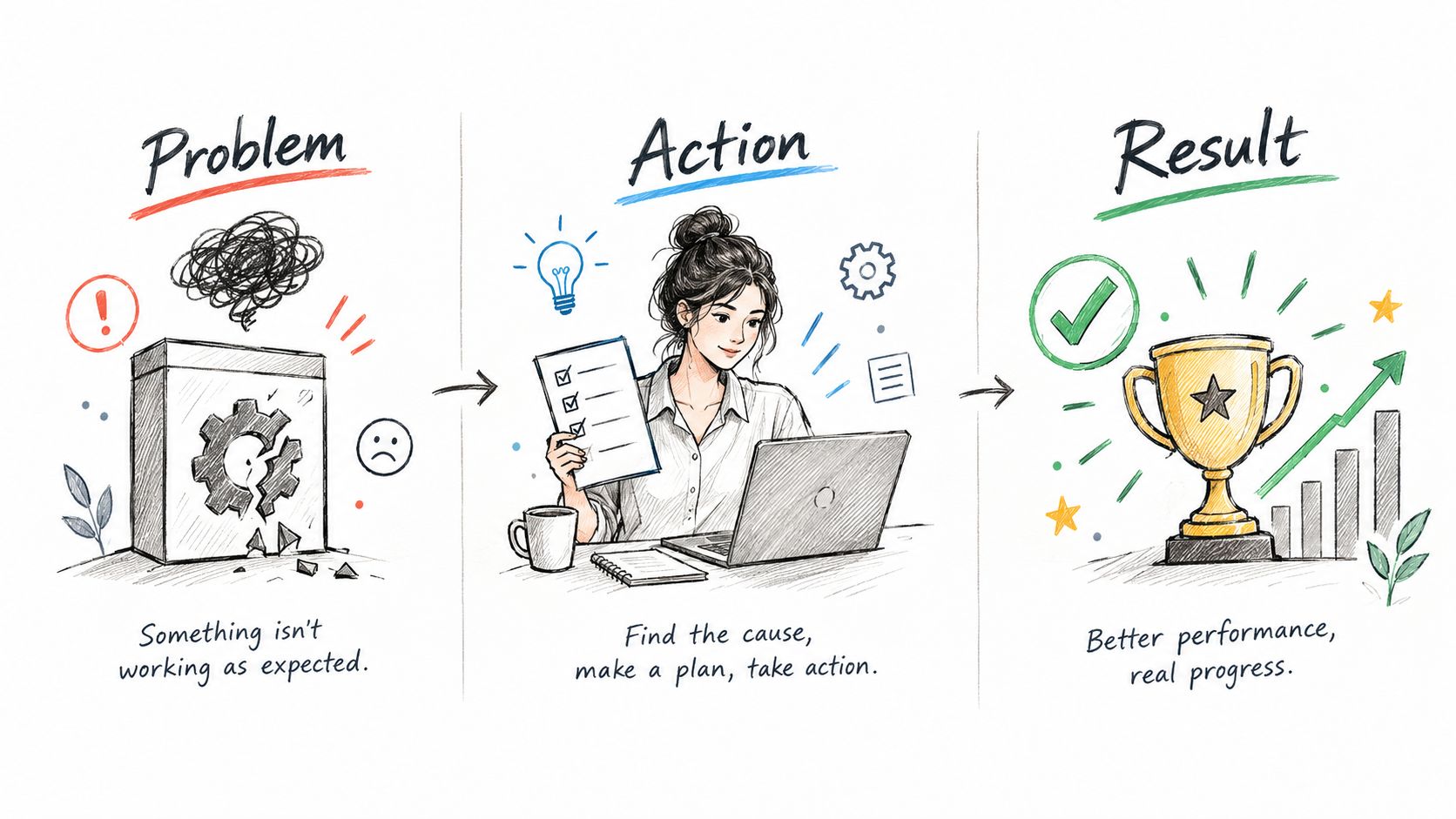
3. PAR Story Structure in Work Experience
A strong resume bullet can function as a compressed story. The PAR structure, Problem, Action, Result, makes the reader understand why the work mattered before they reach the outcome. It also gives you a ready-made foundation for behavioral interview answers.
Consider these examples:
- Problem: A new product launch faced 40% churn in its first quarter because onboarding was unclear. Action: Designed and implemented a guided tutorial flow, conducted 12 user interviews, and iterated the interface based on feedback. Result: Improved first-week retention to 78% and reduced support tickets by 35%.
- Problem: An engineering team was context-switching across 6+ projects, reducing shipping velocity. Action: Proposed and championed a sprint-based prioritization model, facilitated weekly planning sessions, and created a roadmap transparency dashboard. Result: Increased sprint velocity by 28% and delivered 3 additional features per cycle.
The first example establishes the customer problem, identifies your research and product work, and closes with two outcomes. The second makes your agency visible. It doesn't say the team “used agile methods.” It shows what you proposed, facilitated, and built.
Keep the resume version compact
You don't need to label every bullet with Problem, Action, and Result. Use the structure underneath the sentence:
“Redesigned onboarding after early users abandoned the product, combining user interviews with a guided tutorial flow that improved first-week retention to 78% and reduced support tickets by 35%.”
Identify three or four stories per role, with different capabilities represented. One might show analysis, another collaboration, another conflict resolution, and another technical execution. Extract evidence from retrospectives, impact dashboards, or performance reviews rather than guessing.
The spoken version should be more detailed than the resume version, but it shouldn't become a script. Practice explaining the context, your specific action, and the result in roughly 90 to 120 seconds when that timing is appropriate for the interview format. The resume interview questions resource can help you anticipate follow-up questions grounded in the experience you've written down.
4. Role-Specific Keyword Alignment Without Keyword Stuffing
Keywords help only when they describe work you can defend. Copying a job description into a skills section creates a dense list, but it doesn't prove that you've used those methods, tools, or frameworks. Put relevant terminology inside accomplishment statements so the words have context.
For a product management application, replace “worked on projects” with:
“Drove product discovery interviews with 20+ customers to validate feature hypotheses, resulting in 3 prioritized roadmap items with 85% adoption rates.”
For cybersecurity, a more useful version is:
“Implemented zero-trust architecture across 50+ microservices, reducing unauthorized lateral movement by 92% through network segmentation and policy enforcement.”
For management consulting, try:
“Conducted root-cause analysis using 5-forces and value chain frameworks, delivered findings in an executive presentation, and contributed to a $2M cost optimization initiative.”
Each sample makes the target role visible through terms such as product discovery, feature hypotheses, zero-trust architecture, root-cause analysis, and value chain frameworks. The achievement still carries the sentence. The keyword supports the evidence instead of replacing it.
Adapt language carefully
Scan several job descriptions for the role you want and note recurring terminology. Then ask whether your own work matches each phrase. If an employer asks for “stakeholder management” and you coordinated requirements with customers, engineers, and finance, use that language if it accurately describes your work. If you only attended meetings, choose a narrower phrase.
Career changers and international students may know the work under different names. Translate internal or regional terminology into language a target employer recognizes, but don't claim experience you don't have. A certification, course, volunteer project, or open-source contribution can support a transition when you clearly identify its context.
For interview recall, select a few aligned keywords and attach each to a real example. Be ready to explain what the term meant in your work, which decision you made, and what evidence followed. That keeps your answer conversational rather than memorized.
5. Compact Role Summary with Scope and Scale Indicators
A role summary gives context before the recruiter reads individual bullets. It can clarify the size of the product, customer base, team, or responsibility area without forcing every detail into a long paragraph. The summary should supplement your achievements, not replace them.
Examples include:
- Data Analyst, 2022 to Present: Analytics for 15+ product teams, owned conversion funnel optimization, Python, SQL, Tableau.
- Full-Stack Engineer, 2020 to 2022: Built a customer portal serving 500K+ users, mentored 3 junior engineers, React, Node.js, PostgreSQL.
- Sales Development Representative, 2021: Generated $1.2M pipeline, top performer for 6 consecutive months, outbound prospecting, demo qualification.
These lines establish scope quickly. The first points to cross-team exposure, the second signals user scale and mentorship, and the third connects sales activity to pipeline generation. A recruiter can then read the bullets with a clearer understanding of the environment in which the work happened.
Make scale verifiable
Use scope indicators you can substantiate. User counts may come from product documentation, team size from organizational records, and pipeline figures from a CRM. If a number reflects a group result, state your personal role accurately in the bullets that follow.
Avoid inflated labels. “Supported analytics for product teams” may be more defensible than “owned company-wide strategy” if your work was advisory. Similarly, “mentored junior engineers” doesn't automatically mean you managed them.
This format also supports focused interview preparation. A scope indicator can prompt useful questions about complexity, prioritization, communication, or leadership. Prepare to explain how the scale affected your decisions. Serving many users isn't an achievement by itself. The value comes from what you built, improved, analyzed, or led at that scale.
Keep the summary short and include only skills relevant to the target role. A clear line can orient the reader, while the bullets provide the proof.
6. Progressive Responsibility Arc Shown Across Roles
A resume should show movement, not just chronology. Progressive responsibility appears when your roles reveal expanding scope, deeper technical judgment, stronger leadership, or more complex stakeholder work. The pattern helps an employer understand how you've developed and what kind of challenge you're ready to handle next.
A software engineering progression might look like this:
- Junior Software Engineer: Delivered individual features, fixed defects, and learned team development practices.
- Senior Software Engineer: Owned larger components, reviewed code, and influenced technical design.
- Tech Lead: Guided architectural decisions, coordinated delivery, and supported the engineering team.
The same logic applies outside technology. A marketing path can move from campaign execution to team building to cross-functional strategy. A business path can move from analysis to product ownership to broader strategic scope. The titles matter, but the achievements beneath them should show where responsibility expanded.
Explain growth with evidence
Map your real development before editing the resume. Identify when you began making decisions independently, influencing other teams, managing people, owning a budget, or handling more complex customers. Use one meaningful expansion indicator for each promotion, such as team size, budget, system complexity, or stakeholder breadth, but include it only when you can verify it.
Lateral moves need context. A move from operations to product may reflect a deliberate shift toward customer discovery and roadmap decisions. You can explain that reasoning in a cover letter or interview preparation, while the resume focuses on transferable evidence.
A career arc is credible when the reader can see what changed between roles. Titles alone don't prove progression.
For interview practice, prepare one sentence about what you learned at each level and why you pursued the next move. Career switchers can use the same method to connect earlier work to a new direction. Qcard's resume-grounded cues can help you remember the relevant transition points, but your explanation should remain your own and should match the facts on your resume.
7. Domain Expertise and Context Clarity for Career Changers
Career changers often have relevant experience that recruiters can't identify because the industry context is buried. Name the domain, customer group, compliance environment, or business model directly. The reader should understand both what you did and why that experience transfers.
A consultant moving into fintech might write:
“Management Consultant, 2019 to 2023. Led 15+ transformation projects in financial services across banking, insurance, and payments. Expertise in regulatory compliance, customer experience, and operations.”
An engineer moving from healthcare to cybersecurity could use:
“Full-Stack Engineer, 2020 to 2022. Built HIPAA-compliant healthcare software. Experience with encryption, secure data handling, compliance auditing, Python, TypeScript, and AWS.”
A marketer moving toward product might write:
“Product Marketing Manager, 2018 to 2022. Drove go-to-market for B2B SaaS products in data analytics. Customer research, competitive positioning, and feature prioritization.”
These examples work because they don't ask the employer to infer relevance. They name the previous environment and connect it to capabilities valued in the target field.
Build the bridge honestly
Research how your earlier domain is described in the target industry. Then choose two or three transferable skills and explain the connection through evidence. A healthcare engineer shouldn't claim cybersecurity experience solely because the product handled sensitive information. Instead, the resume can highlight secure data handling, encryption, and compliance auditing, then explain how those practices support the intended transition.
International students can use the same approach for education, volunteer work, coursework, open-source projects, and certifications. Publication-specific conventions may differ, so keep the final document readable for the market where you're applying. Include active English practice or communication experience when it's relevant and truthful, but demonstrate communication through clear bullets too.
Prepare a concise bridge for interviews: what you learned in the previous domain, which part transfers, and why the new role is the logical next step. The AI interview coach can support practice around that transition, while the answer itself should come from your actual experience and motivation.
8. Verified Metrics and Attribution Statements for Authenticity
A precise bullet loses value if you can't explain where its result came from. Verification and attribution protect your credibility, especially when a result belongs to a team rather than one individual. They also make interview preparation easier because you won't need to reconstruct the evidence under pressure.
Compare these versions:
- Instead of “Increased sales by 50%,” write: “Led prospecting strategy that contributed to a 32% increase in pipeline velocity, verified through Salesforce dashboards for Q3 to Q4 2022.”
- Instead of “Improved customer satisfaction,” write: “Facilitated 15 customer interviews that led to 3 product features addressing top friction points, with an adoption rate of 68%.”
- Instead of “Optimized system performance,” write: “Refactored database queries across 4 microservices, reducing average API response time from 850ms to 320ms, measured through CloudWatch metrics.”
The second version of each bullet answers questions a recruiter may otherwise ask immediately. What does “increased” mean? Over what period? How was it measured? What did you personally do?
Separate contribution from ownership
Use verbs that match your role. “Owned” suggests direct responsibility. “Led” suggests direction or coordination. “Drove” suggests meaningful influence. “Contributed to” is appropriate when several people shaped the result. Accurate attribution doesn't weaken a bullet. It gives the interviewer a reliable starting point.
Before writing, gather supporting documentation such as Salesforce, Google Analytics, CloudWatch, project reviews, performance systems, emails, or team messages. You don't need to attach those records to a resume, but you should know how to describe the source if asked.
Proofreading matters as much as measurement. A labor-market study found that each additional 1 percentage point increase in resume error rate was associated with a 3% decrease in the probability of being hired. The study's resume error findings support treating small spelling, grammar, and formatting defects as consequential rather than cosmetic.
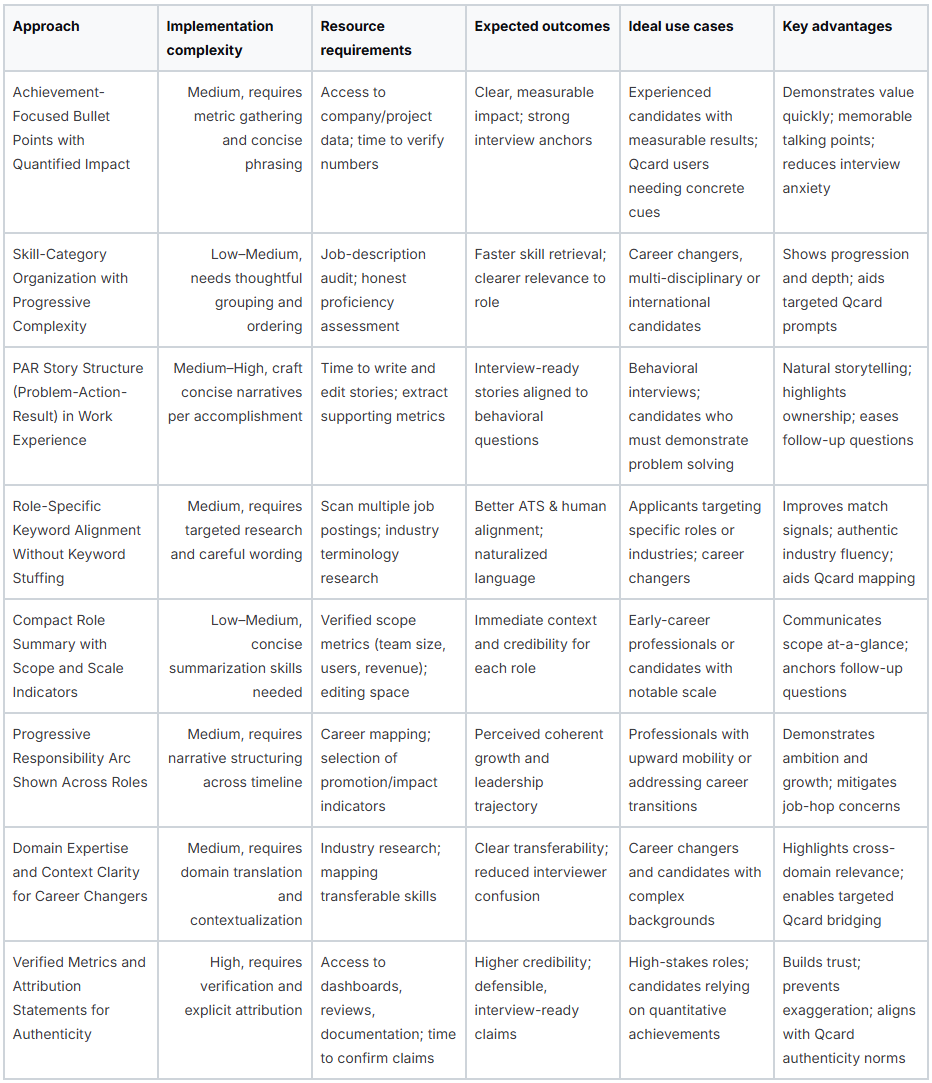
Comparison of 8 Resume Examples
Approach Implementation complexity Resource requirements Expected outcomes Ideal use cases Key advantages
Turn Your Strongest Bullets Into Interview Cues
Start with the target role, not a blank document. Select the examples that best match the responsibilities, tools, customer problems, and outcomes in the job description. Then replace every sample metric, title, timeframe, and technology with a verified fact from your own work. If you can't support a number, remove it or describe the result qualitatively.
Review ownership next. Ask whether you led the work, completed it independently, coordinated a team, or contributed to a shared result. Adjust the verb accordingly. Clear ownership gives interviewers a fair understanding of your role and helps you answer follow-up questions without exaggerating.
Mirror relevant job-description language naturally. Use the employer's terminology when it accurately describes your experience, but place it inside a bullet with a task and outcome. A skills list can help ATS systems recognize your background, while work-history bullets show how you applied those skills. Keep the layout simple, with standard headings and readable bullets. Recruiter-preference data reported in a 2026 hiring survey found that 96.6% said formatting influences their decision, 98.8% valued clean, consistent formatting, and 80.1% preferred bullet points over paragraphs. The same survey reported that 82.1% considered 1 to 2 pages ideal, while 94.5% preferred reverse-chronological work history and 98.7% valued quantifiable achievements. These findings are detailed in the recruiter formatting and resume trends report.
Choose three or four strongest bullets per role. For each one, write a private preparation note containing the context, action, result, evidence source, and likely follow-up. You might be asked why the problem mattered, how you made the decision, who helped, what went wrong, or what you'd change. The resume should stay concise, but your memory cue should preserve enough context to answer naturally.
Read each bullet aloud as if it were the beginning of an interview story. If you can't explain the metric, clarify your ownership, or remember the sequence of events, revise the bullet. A separate study found that improving resume and cover-letter writing quality by one point was associated with about 7% more interviews relative to applications and a job secured nearly 10 days earlier. The writing-quality study also reported a positive relationship between writing quality and interview invitations, reinforcing the value of specific, structured, error-free examples.
Qcard can help surface concise, resume-grounded memory cues during preparation or interviews. Its usefulness depends on the information you provide, so you remain responsible for accuracy, authenticity, and natural delivery. Use it to remember verified achievements, not to replace judgment or recite a script.
Key Takeaways
- Duties describe assignment; achievements describe change — and with roughly 250 applications per opening and only about 2% converting to interviews, a generic responsibility bullet disappears quickly, while "Led the migration of 500+ legacy databases to cloud infrastructure, reducing infrastructure costs by $120K annually" gives a recruiter action, scope, and outcome in one line.
- Attribution verbs are not interchangeable, and precision protects credibility — owned implies direct responsibility, led implies direction or coordination, drove implies meaningful influence, and contributed to fits shared results, so choosing accurately gives interviewers a reliable starting point rather than setting up a follow-up question you can't answer.
- Keywords only work when they carry evidence — copying a job description into a skills section creates a dense list without proof, while placing terminology inside an accomplishment ("Conducted root-cause analysis using 5-forces and value chain frameworks, contributed to a $2M cost optimization initiative") lets the achievement carry the sentence and the keyword support it.
- Career changers should name the domain rather than making recruiters infer relevance — "Built HIPAA-compliant healthcare software. Experience with encryption, secure data handling, compliance auditing" bridges toward cybersecurity honestly, whereas claiming cybersecurity experience simply because a product handled sensitive data creates a gap that surfaces in the interview.
- Small errors carry measurable cost, and every bullet should double as an interview cue — one labor-market study found each additional percentage point in resume error rate was associated with a 3% decrease in hiring probability, while another found improving writing quality by one point correlated with about 7% more interviews and a job secured nearly 10 days earlier, so read each bullet aloud as the start of a story and revise any you can't explain, verify, or attribute.
Qcard turns the verified facts in your resume into concise interview talking points, practice questions, and preparation cues grounded in your actual experience. Visit Qcard to connect your strongest resume examples to more confident, natural interview preparation.
Ready to ace your next interview?
Qcard's AI interview copilot helps you prepare with personalized practice and real-time support.
Try Qcard Free