Top 10 Engineer Interview Questions to Master in 2026
Top 10 Engineer Interview Questions to Master in 2026
Landing a top engineering role today goes beyond acing algorithms. Companies use a sophisticated mix of behavioral, system design, and problem-solving questions to assess not just your technical knowledge, but how you think, collaborate, and overcome complex challenges. This guide provides a comprehensive breakdown of the most impactful engineer interview questions you're likely to encounter, from foundational coding tasks to intricate architectural designs.
This is not just another list. We offer a clear roadmap for each question, detailing what interviewers are really looking for when they ask it. You will learn how to structure your answers effectively, frame your experience with compelling, real-world examples, and sidestep common pitfalls that can derail an otherwise strong performance.
We’ll dissect everything from designing a URL shortening service and implementing an LRU Cache to navigating difficult behavioral scenarios, like disagreeing with a manager or learning from a significant failure.
More importantly, this resource is designed for clarity and practical application. We will introduce neurodivergent-friendly preparation strategies to help manage cognitive load and showcase your true capabilities under pressure. You’ll find actionable tips for using tools like Qcard to stay grounded in your experience and communicate with confidence. This structured approach ensures you’re prepared not just to answer the questions, but to demonstrate the critical thinking and problem-solving skills that define a top-tier engineer.
1. System Design: Design a URL Shortening Service (Like Bit.ly)
This is a foundational system design question that tests your ability to architect a scalable, distributed system from the ground up. Interviewers use it to assess how you handle core engineering challenges, from database schema design and caching strategies to API development and load balancing. It's one of the most popular engineer interview questions because it reveals both your breadth of knowledge across system components and your depth in analyzing specific trade-offs.
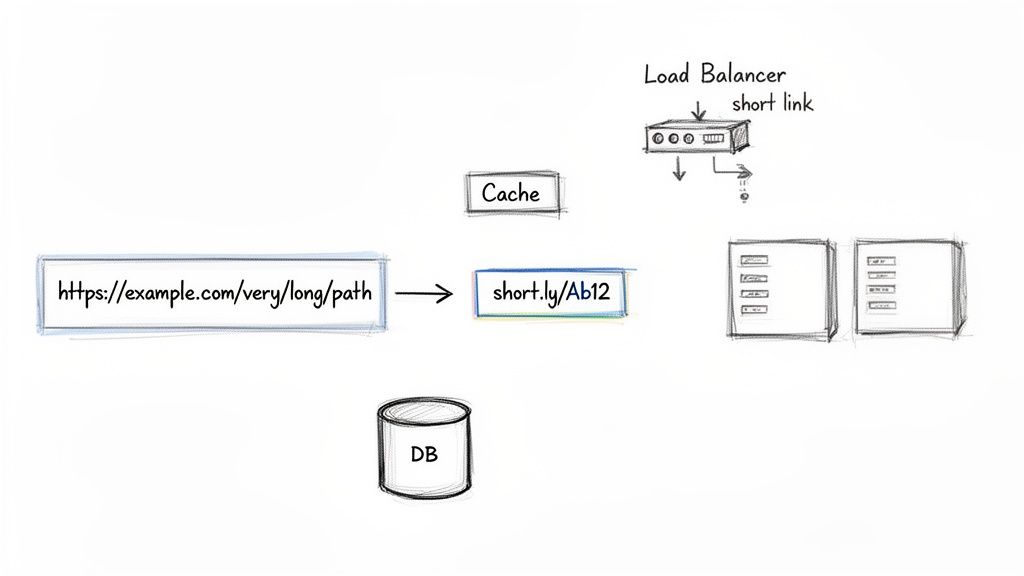
This question is a favorite at companies like Google, Meta, and Amazon. It effectively simulates the real-world process of translating a simple product idea into a robust technical architecture capable of handling millions of requests per second (QPS).
What Interviewers Are Assessing
- Requirement Gathering: Can you ask clarifying questions before diving into a solution? (e.g., "What is the expected QPS?", "Do short links need to expire?")
- Architectural Thinking: Can you sketch a high-level architecture and explain how each component (load balancer, web server, database, cache) interacts?
- Data Modeling: How do you design the database schema? What are the trade-offs between a relational database like PostgreSQL and a NoSQL database like Cassandra for this use case?
- Scalability and Performance: How do you handle high traffic? Your discussion on caching (like using Redis) and database sharding is critical here.
Actionable Tips for Your Answer
- Start with the API: Define the core API endpoints first, such as POST /api/v1/shorten and GET /{short_url}. This provides immediate structure to your discussion.
- Clarify Functional and Non-Functional Requirements: Before drawing, list the requirements. For example, functional: shorten URL, redirect URL. Non-functional: high availability, low latency.
- Explain Your Trade-offs: Don't just state your choices; defend them. For instance, explain why you chose a 6-8 character hash for the short URL, linking it to the required number of unique links the system must support.
- Connect to Your Experience: Ground your answer in your own work. You can say, "In my last project, we handled 100K QPS by implementing a Redis cache, which reduced database load by 70%. I'd apply a similar strategy here."
2. Behavioral: Tell Me About a Time You Disagreed with a Manager
This classic behavioral question probes your conflict resolution skills, professional maturity, and ability to navigate difficult conversations. Interviewers want to see how you handle professional friction: do you advocate for your ideas constructively, or do you create a negative environment? It's one of the most revealing engineer interview questions because it uncovers your emotional intelligence and ability to prioritize project success over personal ego.
This question is a cornerstone of behavioral interviews at companies like Amazon, which uses it to evaluate its "Have Backbone; Disagree and Commit" leadership principle. It assesses whether you can challenge decisions you disagree with, even when doing so is uncomfortable, and then fully support the final decision once it's made.
What Interviewers Are Assessing
- Professional Maturity: Can you disagree respectfully without making it personal? Do you focus on the technical or business merits of the disagreement?
- Communication Skills: How clearly can you articulate your position? Did you present data or a well-reasoned argument to support your case?
- Problem-Solving: Did you propose an alternative solution, or did you simply point out a flaw? Interviewers value constructive, solution-oriented disagreement.
- Outcome and Ownership: What was the result? Can you show that your actions led to a better outcome, or demonstrate that you could commit to your manager’s direction even if you disagreed?
Actionable Tips for Your Answer
- Use the STAR Framework: Structure your story clearly with Situation (the context of the disagreement), Task (your responsibility), Action (the specific steps you took to voice your disagreement and propose an alternative), and Result (the positive outcome).
- Frame it as Principle, Not Personality: Emphasize that you disagreed with the approach or strategy, not the manager as a person. For example, "I was concerned the proposed architecture wouldn't scale, not that my manager's idea was bad."
- Show You Listened First: Before explaining your counter-argument, mention that you took the time to understand your manager's perspective. This demonstrates respect and a collaborative mindset.
- Focus on a Data-Driven Argument: The strongest answers are backed by evidence. Instead of saying "I felt it was wrong," say, "I disagreed and compiled data showing our current approach would increase latency by 300ms, so I proposed an alternative that kept it under 50ms."
3. Technical: Implement a LRU Cache
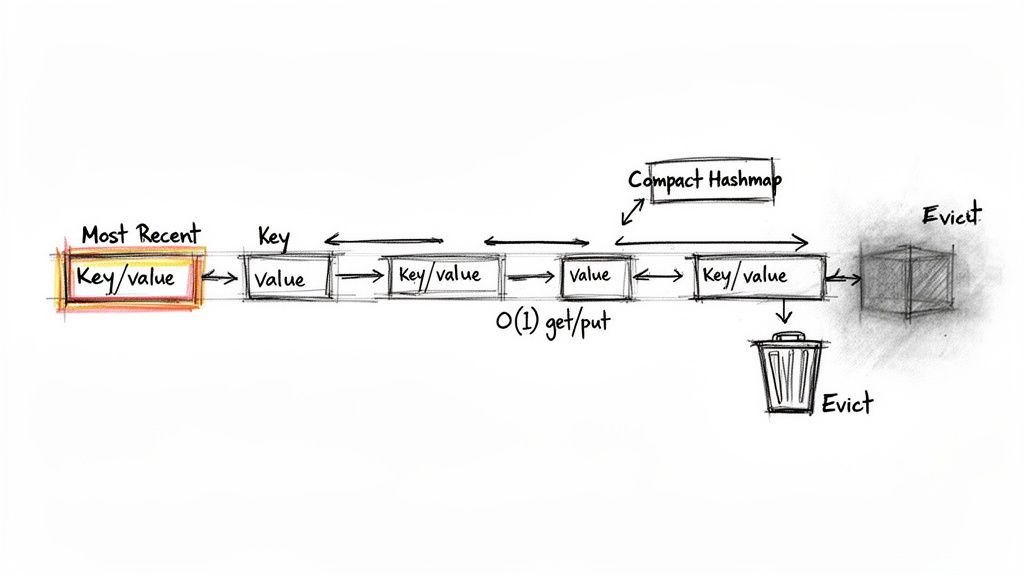
This is a classic data structures and algorithms question that perfectly blends coding with system-level thinking. Interviewers use it to evaluate your understanding of core data structures, your ability to manage performance constraints, and your communication skills while writing code. As one of the most common engineer interview questions, it requires you to implement a cache that evicts the "least recently used" item when it reaches capacity.
This question is a favorite at companies like Google, Amazon, and Meta. It’s valuable because its principles are directly applicable to real-world systems, such as CPU memory management, database query caching, and content delivery networks (CDNs).
What Interviewers Are Assessing
- Data Structure Proficiency: Can you identify the optimal data structures for the job? The ideal solution requires a combination of a hash map and a doubly-linked list.
- Algorithmic Complexity: Are you conscious of the time complexity of your operations? The goal is to achieve O(1) time complexity for both get and put operations.
- Problem Decomposition: Can you break down the problem into smaller, manageable parts, like handling cache hits, cache misses, and evictions?
- Edge Case Handling: Do you consider edge cases, such as a cache with capacity 1, updating an existing key, or getting a non-existent key?
Actionable Tips for Your Answer
- Verbalize Your Data Structure Choice: Start by explaining your approach. Say, "I will use a hash map for O(1) lookups of keys and a doubly-linked list to maintain the order of recent use, allowing O(1) additions and removals."
- Code Incrementally: Don't try to write the perfect solution at once. Implement the basic get and put logic first, then add the eviction policy and handle updates.
- Test Your Code Aloud: As you write, walk through examples and edge cases. For instance, "Now let's test what happens if the capacity is 2, and I add three items. The first item should be evicted."
- Relate to Real-World Applications: Connect your solution to practical scenarios. You could mention, "This is similar to how web browsers cache recently visited pages, evicting older ones to save memory."
4. Behavioral: Describe a Time You Failed and What You Learned
This classic behavioral question is designed to test your self-awareness, accountability, and capacity for growth. Interviewers use it to see if you take ownership of mistakes or deflect blame. How you answer reveals your resilience and whether you possess the growth mindset essential for thriving in a dynamic engineering environment. This is one of the most revealing engineer interview questions because it uncovers your character and professional maturity.
This question is a staple at companies like Google, Stripe, and Netflix, where a culture of learning from mistakes is actively cultivated. They want to hire engineers who can not only solve complex technical problems but also adapt and improve their processes after a setback.
What Interviewers Are Assessing
- Accountability: Do you take ownership of the failure, or do you blame external factors, systems, or other people?
- Self-Awareness: Can you accurately diagnose the root cause of the failure? Did you understand your role in the outcome?
- Growth Mindset: Most importantly, can you articulate what you learned and, crucially, what specific, tangible actions you took to prevent the same mistake from happening again?
- Humility and Resilience: Are you comfortable discussing a vulnerability? Can you demonstrate that you bounce back from professional challenges?
Actionable Tips for Your Answer
- Use the STAR+L Method: Structure your response clearly: Situation (context), Task (your goal), Action (what you did), Result (the failure), and Learning (the concrete change you made).
- Choose a Bounded Failure: Select a specific, isolated incident, like a missed project deadline or a flawed technical decision. Avoid systemic or character-related failures. The ideal example is one that is at least six months old, giving you enough distance to reflect calmly.
- Quantify Your Learning: Don't just say "I learned to communicate better." Instead, say, "After that incident, I implemented a weekly risk-assessment update for my team. In the next project, this practice helped us identify a critical dependency three weeks ahead of schedule."
- Connect It to Engineering Practices: Frame your failure and learning in an engineering context. For example, "I initially over-architected a service, leading to a delayed launch. I learned the value of building an MVP first, and now I always advocate for an iterative approach to validate assumptions before committing to a complex design."
5. System Design: Design a Real-time Notification System
This advanced system design question challenges your ability to architect a highly available, scalable, and low-latency system for asynchronous communication. Interviewers use it to probe your understanding of message queues, distributed systems, and designing for failure. It’s one of the more complex engineer interview questions because it involves multiple delivery channels (push, SMS, email) and requires a deep analysis of reliability and performance trade-offs.
Designing a notification system is a core problem for any large-scale platform, making this a common question at companies like Meta, Uber, and Twitter. It effectively simulates the real-world challenge of building infrastructure that must reliably deliver billions of messages to users across different platforms with minimal delay.
What Interviewers Are Assessing
- Asynchronous Processing: Can you articulate the need for and design of a system using message queues (like Kafka or RabbitMQ) to decouple notification creation from delivery?
- Scalability and Reliability: How do you handle massive throughput? Your discussion should cover worker pools, retries with exponential backoff, and idempotency to prevent duplicate notifications.
- Multi-Channel Complexity: Can you design a flexible architecture that supports various delivery providers (e.g., APNS for iOS, Twilio for SMS) and handles their unique failure modes?
- System Observability: How do you monitor the system's health? This includes distributed tracing to track a notification's journey and metrics for latency and delivery success rates.
Actionable Tips for Your Answer
- Start with a High-Level Flow: Sketch the end-to-end architecture: an API endpoint for triggering notifications, a message queue for buffering, a set of worker services to process them, and third-party gateways for delivery.
- Clarify Key Requirements: Ask about throughput (e.g., millions of notifications per minute), latency targets (e.g., P99 latency of <5 seconds), and delivery guarantees (at-least-once vs. at-most-once).
- Detail the Worker Logic: Explain how your worker services would function. This includes fetching a message, routing it to the correct delivery channel (Push, SMS, Email), handling API responses from providers, and implementing a robust retry mechanism.
- Discuss Failure Scenarios: Address potential failures head-on. Explain what happens if a third-party provider like Twilio is down or if a worker service crashes. This is where you can demonstrate your experience by talking about dead-letter queues and monitoring alerts.
6. Problem-Solving: Two Sum (Find Two Numbers That Add to Target)
As one of the most foundational engineer interview questions, "Two Sum" is often the first technical problem you'll encounter in a phone screen or online assessment. Its simplicity is deceptive; interviewers use it to gauge your fundamental problem-solving process, your ability to optimize an algorithm, and your coding clarity under pressure. It's a critical litmus test for your analytical thinking and communication skills right from the start.
This question is a rite of passage for software engineers and is frequently used by companies like Google, Amazon, and countless startups. Its ubiquity on platforms like LeetCode, where it is problem #1, means that a smooth, confident delivery is expected, making it a key indicator of your preparation and competence.
What Interviewers Are Assessing
- Problem Comprehension: Do you ask clarifying questions before jumping into code? (e.g., "Are the numbers integers?", "Can there be duplicates?", "What should I return if no solution exists?")
- Algorithmic Thinking: Can you identify the brute-force O(n²) solution and then articulate a more optimal O(n) approach using a hash map or dictionary?
- Trade-off Analysis: Can you explain the space-time trade-off between the brute-force method (O(1) space) and the hash map solution (O(n) space)?
- Code Quality: Is your code clean, readable, and correct? Do you use meaningful variable names and handle edge cases like an empty array or no possible solution?
Actionable Tips for Your Answer
- Start with the Brute-Force Approach: Briefly mention the naive solution (a nested loop) to show you understand the problem's core, then immediately explain why it's inefficient.
- Clearly Articulate the Optimal Strategy: Before writing a single line of code, explain your hash map approach. Say, "I will iterate through the array once. For each number, I'll calculate its required 'complement' and check if that complement already exists in my hash map. If it does, I've found a solution."
- Code with Intent: Use clear variable names like current_num and complement instead of generic ones like x and y. This demonstrates a commitment to writing maintainable code.
- Verbally Test Your Solution: Walk through an example like [2, 7, 11, 15] with a target of 9. Explain how the hash map stores 2 and its index, and when you reach 7, you find 2 (the complement) in the map and return the indices. This proves your logic works.
7. Behavioral: Tell Me About Your Greatest Achievement
This classic behavioral question is designed to reveal what you value, how you define success, and your ability to articulate impact. Unlike questions about failure, this one assesses your confidence, ownership, and communication style. Interviewers use this prompt to understand if your definition of "great" aligns with the company's values, making it one of the most insightful engineer interview questions for gauging cultural fit and leadership potential.
This question is a staple at leadership-focused companies like Amazon, Google, and Apple. It allows them to evaluate whether you focus on team success or individual glory, your understanding of business context, and your ability to connect technical work to tangible outcomes.
What Interviewers Are Assessing
- Definition of Impact: What do you consider a significant achievement? Is it a complex technical problem, a successful team collaboration, or a direct business result?
- Ownership and Initiative: Did you take the lead on a project? Did you identify a problem and drive the solution without being asked?
- Quantifiable Results: Can you clearly articulate the outcome of your work using specific metrics? This demonstrates a data-driven mindset.
- Communication and Humility: How do you describe your role within a team? A strong answer balances personal contribution with acknowledging the efforts of others.
Actionable Tips for Your Answer
- Use the STAR Method: Structure your story using Situation, Task, Action, and Result. This provides a clear, concise narrative that is easy for the interviewer to follow.
- Choose a Relevant Achievement: Select a project that showcases skills and values relevant to the role you're applying for. Focus on an achievement that demonstrates both technical competence and business impact.
- Quantify Everything: Don't just say you improved performance; say, "I led the migration of our monolithic payment system to microservices, which reduced API latency by 70%." Connect this technical metric to a business outcome, like, "This enabled us to onboard enterprise clients and the system now processes $2B annually."
- Acknowledge the Team: Frame your contribution clearly while giving credit to your colleagues. For example, "I designed the core architecture and managed the project timeline, while my team of three engineers executed the implementation brilliantly." This shows leadership and collaboration.
8. Technical: Reverse a Linked List
This is a classic data structures question that serves as a fundamental check on your understanding of pointers and memory manipulation. Interviewers use it to see if you can carefully manage state and work through a problem iteratively or recursively. While it seems simple, this is one of the most effective engineer interview questions for filtering candidates who lack a core grasp of how linked lists operate, distinguishing rote memorization from true comprehension.
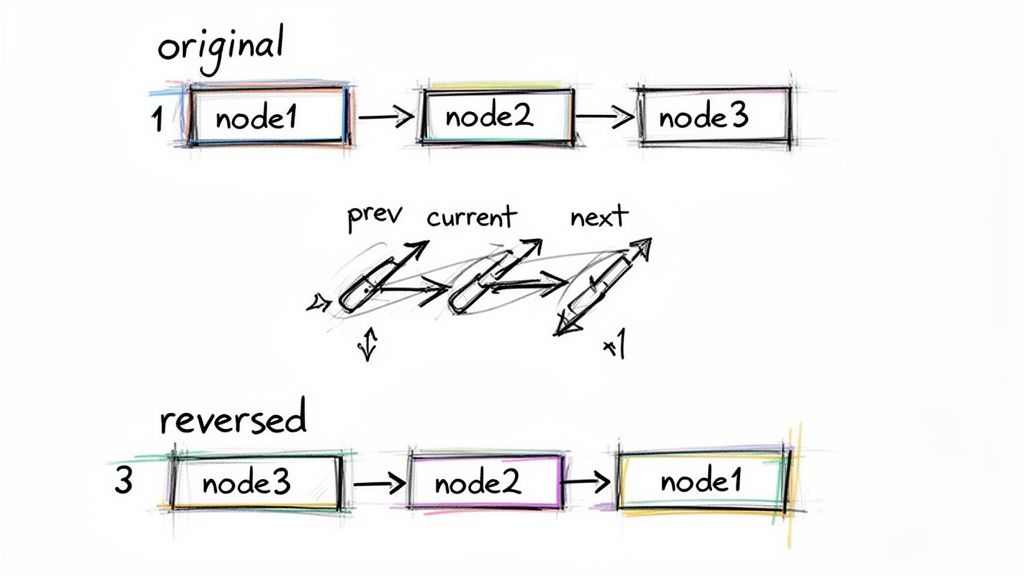
This question is a staple in phone screens and early-round interviews at companies like Google and Microsoft. It's often used as a warm-up to gauge your coding mechanics and communication skills before moving on to more complex algorithm challenges. Its real-world applications include implementing undo/redo functionality or managing navigation history, like a browser's back button.
What Interviewers Are Assessing
- Pointer Manipulation: Can you correctly and confidently re-assign next pointers without losing the rest of the list? This is the core of the problem.
- Algorithmic Thinking: Can you articulate both an iterative (using pointers like prev, current, next) and a recursive solution?
- Edge Case Handling: Do you proactively consider and test for edge cases, such as an empty list, a single-node list, or a two-node list?
- Communication: Can you explain your thought process clearly while you code, especially as you manipulate pointers step-by-step?
Actionable Tips for Your Answer
- Visualize First: Immediately draw a simple linked list (3-4 nodes) on the whiteboard or virtual equivalent. This is crucial for tracking pointer changes and preventing mistakes.
- Explain Your Approach Clearly: State your plan before coding. For an iterative solution, say, "I'll use three pointers: previous, current, and next_node. I will iterate through the list, reversing the current node's pointer to previous at each step."
- Talk Through a Small Example: Walk through your drawing, explaining each pointer reassignment aloud. For instance, "First, current.next points to previous (which is null). Then, I move previous to current and current to next_node."
- Discuss Trade-offs: Be prepared to discuss the iterative vs. recursive solutions. Mention that the iterative approach uses O(1) space, while the recursive approach uses O(n) space due to the call stack, which could be a risk for very long lists.
9. System Design: Design a Ride-Sharing Service (Like Uber)
This complex system design question challenges your ability to architect a real-time, large-scale, and geographically distributed platform. Interviewers use it to evaluate how you handle multi-stakeholder interactions (riders, drivers), real-time data processing, and critical non-functional requirements like low latency and high availability. As one of the more advanced engineer interview questions, it separates candidates who can think about interconnected microservices versus those who focus on a single application.
This question is a staple at companies like Uber, Lyft, and others managing complex logistical or real-time operational platforms. It effectively assesses your capacity to design a system that must balance user experience, operational efficiency, and business logic like dynamic pricing under heavy, unpredictable load.
What Interviewers Are Assessing
- Problem Scoping: Can you narrow down a vast problem? A great answer starts by scoping the design to a single city and defining core features first.
- Real-Time Data Handling: How do you manage constant updates of driver locations? This tests your knowledge of WebSockets, polling, and data ingestion pipelines.
- Algorithmic Thinking: How does the matching service work? Your discussion on proximity searches, geohashing, and driver-rider matching logic is crucial.
- Microservices Architecture: Can you break down the system into logical, independent services (e.g., Rider Service, Driver Service, Matching Service, Payment Service) and explain their communication patterns?
- Scalability and Reliability: How do you ensure the system remains responsive during peak hours (surge)? Your ideas on message queues (like Kafka), database sharding, and geo-partitioning are key.
Actionable Tips for Your Answer
- Define the Scope Aggressively: Start by saying, "To begin, let's design for a single city like San Francisco with 100,000 active drivers and 1 million riders. We can expand later." This makes the problem manageable.
- Sketch the High-Level Architecture: Draw boxes for the core services: Rider App, Driver App, API Gateway, and backend microservices for matching, payments, and user management. Explain how they interact.
- Focus on the Geolocation and Matching Service: This is the heart of the problem. Explain your choice of technology for location updates (e.g., WebSockets) and your strategy for finding nearby drivers (e.g., using geohashing to partition the map into a grid).
- Discuss Trade-offs Explicitly: Justify your decisions. For instance, explain why eventual consistency is acceptable for a driver's location on a map but strong consistency is required for payment processing.
- Address Dynamic Pricing: Proactively bring up surge pricing. Explain it as a mechanism to balance supply and demand, implemented by the matching service based on the ratio of active ride requests to available drivers in a specific geographic area.
10. Problem-Solving: Merge K Sorted Lists
This is a classic algorithm question that effectively gauges your understanding of data structures, complexity analysis, and optimization. Interviewers use it to see if you can escalate a simple concept (merging two sorted lists) to a more complex scenario (merging K lists) while identifying the most efficient solution. It's one of the more advanced algorithmic engineer interview questions because it clearly distinguishes candidates who can reason about performance from those who only know brute-force methods.
This problem is a staple in technical screens and onsite interviews at companies like Google, Facebook, and Microsoft, especially for mid-level to senior roles. It simulates real-world challenges found in distributed systems, such as merging sorted data segments from multiple database shards or aggregating results in a map-reduce framework.
What Interviewers Are Assessing
- Algorithmic Thinking: Can you progress from a naive, brute-force solution (like pairwise merging) to a more optimal one?
- Data Structure Knowledge: Do you recognize that a min-heap (priority queue) is the ideal data structure for this problem to efficiently track the smallest element across all lists?
- Complexity Analysis: Can you accurately calculate and compare the time and space complexity of different approaches (e.g., O(NK) for brute-force vs. O(N log K) for the heap-based solution, where N is the total number of elements)?
- Coding Proficiency: How cleanly can you implement the solution, particularly with linked list manipulation, which is often error-prone?
Actionable Tips for Your Answer
- Start with the Naive Approach: Begin by suggesting a simple, iterative solution. Say, "We could merge the first two lists, then merge the result with the third list, and so on." Acknowledge its inefficiency.
- Analyze the Complexity Aloud: Walk through the trade-offs. For the pairwise approach, explain, "This method is easy to conceptualize but becomes slow as K increases, leading to redundant comparisons."
- Introduce the Optimal Solution: Propose using a min-heap. Explain the logic: "A more optimal approach is to use a min-heap to store the head node of each of the K lists. We can then extract the minimum node, add it to our result, and insert the next node from its original list into the heap."
- Handle Edge Cases: Discuss what happens with empty lists, lists of different lengths, or if the input array of lists itself is empty. This demonstrates thoroughness.
From Preparation to Performance: Your Next Steps
Navigating the landscape of modern engineer interview questions can feel like a high-stakes gauntlet. However, as we've explored through these ten critical examples, success isn't about rote memorization or finding a single "correct" answer. Instead, it's about developing and demonstrating a robust, repeatable framework for thinking. Whether you're architecting a ride-sharing service, navigating a past disagreement with a manager, or reversing a linked list, the core goal remains the same: showcase your thought process, articulate trade-offs, and connect your technical decisions to tangible business outcomes.
The true value of practicing these specific engineer interview questions lies in their ability to build muscle memory for problem-solving. Each question acts as a microcosm of the challenges you'll face in a real engineering role. They force you to think about scalability, resilience, user impact, and collaborative dynamics all at once. By mastering this collection, you aren't just preparing for ten questions; you are preparing for any question.
Key Insight: The interview is not the test; it is the performance. Your preparation is the rehearsal, where you refine your communication, structure your thoughts, and build the confidence to perform under pressure.
Synthesizing Your Learnings into Action
The transition from understanding these questions to mastering them requires a deliberate and strategic approach. It's time to move beyond passively reading and start actively doing. Here are the actionable next steps to transform this knowledge into a powerful interview performance.
- Deconstruct, Don't Just Solve: For each technical question, don't stop at a working solution. Articulate the time and space complexity. Discuss alternative approaches and justify why your chosen method is optimal under specific constraints. For example, with "Two Sum," explain why a hash map is superior to a brute-force nested loop in terms of performance.
- Build Your "STAR" Story Bank: For every behavioral question, prepare two or three distinct examples from your experience. Document them using the STAR (Situation, Task, Action, Result) method, focusing heavily on quantifiable results. For instance, when discussing a failure, specify the metric that was impacted and how your actions led to its recovery or improvement.
- Articulate System Design Trade-offs Aloud: The core of any system design question is the discussion of trade-offs. Practice verbalizing these decisions. Say things like, "I'm choosing a message queue like RabbitMQ for its guaranteed delivery, but that introduces a new point of failure. We can mitigate this with a high-availability cluster, which increases infrastructure cost." This demonstrates senior-level thinking.
The Neurodivergent Advantage and Final Preparation
Remember, preparation strategies are not one-size-fits-all. The neurodivergent-friendly tips integrated throughout this guide are designed to help you leverage your unique cognitive strengths. Using tools to externalize memory, structure your thoughts visually, and practice in a controlled environment can turn potential challenges into distinct advantages.
Your final step is to simulate the real environment. The pressure of a live interview can make it difficult to recall your well-prepared stories and technical details. This is where mock interviews become indispensable. They help you bridge the gap between knowing the material and communicating it effectively.
Ultimately, the goal is to walk into your next interview not with a rigid script, but with a flexible and powerful problem-solving toolkit. By internalizing the frameworks behind these engineer interview questions, you can confidently demonstrate that you are more than just a coder; you are a thoughtful, impactful, and collaborative engineer ready to solve real-world problems.
Ready to turn your preparation into a standout performance? Qcard uses AI to help you master your delivery, practice with real-time feedback, and recall key metrics from your own experiences, ensuring you're confident and prepared for any engineer interview questions. Transform your interview skills and land your dream role by visiting us at Qcard today.
Engineer Interview Frequently Asked Questions
Q: What are the most common types of engineer interview questions?
A: Engineer interviews typically consist of two main categories: behavioral questions (which assess your soft skills and past experiences) and technical questions (which test your problem-solving, coding, and system design abilities). You need to prepare for both.
Q: How should I answer behavioral questions like "Tell me about a time you had a conflict with a teammate"?
A: Use a structured framework to give a clear and impactful answer. The STAR method (Situation, Task, Action, Result) is excellent for achievement stories. For questions about conflict or failure, the CIAA framework (Conflict, Impact, Action, Analysis) helps you focus on resolution and learning.
Q: What is the best strategy for technical whiteboard coding questions?
A: The key is to communicate your process. Before writing code, ask clarifying questions, discuss edge cases, and talk through your initial approach and potential trade-offs. Interviewers want to see how you think. Start with a brute-force solution if needed, then optimize.
Q: How do I approach a system design interview question?
A: Begin by clarifying the requirements and scope. Then, outline the high-level architecture, breaking it down into core components. Discuss data storage, scalability, potential bottlenecks, and how you would handle failure. There is no single right answer; the goal is to demonstrate a logical, structured thought process.
Q: What makes the difference between a good answer and a great answer?
A: A good answer responds to the question. A great answer is specific, quantifiable, and directly tied to the job's requirements. It uses frameworks for clarity, incorporates metrics to prove impact ("improved efficiency by 20%"), and shows genuine enthusiasm for engineering problem-solving.
Ready to ace your next interview?
Qcard's AI interview copilot helps you prepare with personalized practice and real-time support.
Try Qcard Free