TL;DR
Difficult questions test retrieval and composure under evaluation, not just subject knowledge — which is why a candidate can understand a question perfectly and still answer below their real capability. Research shows a moderate negative correlation between interview anxiety and interview scores (ρ = -0.19), while later job performance was unrelated to that effect, meaning anxious interviews damage selection outcomes without predicting actual ability. Stabilize first with a purposeful pause, identify the hidden competency behind the literal question, then pick the framework that fits: STAR weighted toward Action (roughly 15/10/50/25) for past evidence, or Scope-Impact-Result for analytical and hypothetical prompts. Prepare anchors, not scripts — "launch delay, supplier risk, revised sequence" retrieves better under pressure than a memorized paragraph, which adds cognitive load by making you track wording, sequence, and delivery at once. Practice with short drills: a two-minute retrieval drill reviewed in three passes, and a pressure-switch drill that answers the same story five different ways.
You're halfway through an interview when the interviewer asks, “Tell me about a time you made a decision with incomplete information.” You know you've handled situations like this before, but the example won't come forward. Your thoughts race, the silence feels loud, and you start speaking before you've decided what you want to say.
Difficult questions rarely test knowledge alone. They test retrieval, judgment, structure, pacing, and emotional control at the same time. The most effective preparation doesn't produce perfect scripts. It gives you enough mental structure to think clearly when the question arrives in an imperfect form.
How Do You Answer Difficult Questions Under Pressure?
Difficult questions rarely test knowledge alone. They test retrieval, judgment, structure, pacing, and emotional control simultaneously — which is why candidates who clearly know the subject still produce answers weaker than their actual capability.
Work through four moves:
1. Stabilize before you solve. Your first job isn't to answer — it's to slow the moment enough to choose one. A short pause is professional when you fill it with purpose: "That's a useful question. Let me choose the example that best illustrates it." Or "Could you clarify whether you're asking about the decision itself or the result?" These buy time without sounding evasive and show how you organize information.
2. Identify the hidden competency. "Tell me about a conflict" may be testing collaboration, judgment, listening, or accountability. "What would you do if a deadline moved forward?" usually tests prioritization, not technical skill. Separate three moments: receive the question, select the competency being tested, then choose the smallest structure that can carry the answer.
3. Match the framework to the question type. Use STAR for past evidence, weighted roughly 15% Situation, 10% Task, 50% Action, 25% Result — because the most common failure is spending too long on what happened and too little on what you decided. For analytical or hypothetical prompts (consulting, product, strategy), use Scope, Impact, Result instead: define the boundary, explain the factors that could change the outcome, then state your recommendation and next test.
4. Recover without apologizing. "Sorry, I'm terrible at interviews" turns a temporary retrieval problem into a judgment about your identity. Use a recovery line instead: "I want to give you a specific example rather than a vague answer. Let me think for a moment." If an answer is going nowhere, stop cleanly: "I'm giving you too much background. The key point is that I owned the decision, changed the sequence of work, and communicated the trade-off early." That correction usually improves the answer, because it demonstrates monitoring and judgment.
The target isn't calm. It's functional delivery — steady breathing, understandable pacing, concise answers, and the ability to recover when retrieval slows.
The Pressure Moment in Interviews
The question lands differently from the ones before it. You've explained your background, discussed a project, and answered a few predictable questions. Then the interviewer asks, “What's the biggest mistake you've made at work, and what did you learn from it?”
You understand the words, but your mind starts searching in too many directions. Should you choose a minor mistake or a serious one? Should you focus on the result or the lesson? How much detail is appropriate? While you're making those decisions, the interviewer is waiting.

A 2024 VR interview-simulator study found that professional interview questions produced much higher self-perceived anxiety than personal questions. The mean difference was 24.07, with a highly significant result, ηp2 = .40, t133 = 9.45, p < .01, as reported in the summary of interview-question research. The same study found that insufficient preparation increased self-perceived anxiety, which means the pressure comes partly from the feeling that you have no usable path into the answer.
That distinction matters. You may know the subject, but still struggle to retrieve an example while someone evaluates you. Professional questions combine uncertainty, judgment, and time pressure. The difficulty isn't always the content. It's the demand to construct a relevant response in real time.
Stabilize before you solve
Your first job isn't to answer. It's to slow the moment down enough to choose an answer.
A short pause is professional. Try saying:
- “That's a useful question. Let me choose the example that best illustrates it.”
- “Could you clarify whether you're asking about the decision itself or the result?”
- “I've handled this in a few contexts. I'll use the most recent example.”
Each sentence gives you time without sounding evasive. It also helps the interviewer understand how you organize information.
Then take one quiet breath and identify the question underneath the question. “Tell me about a conflict” may be testing collaboration, judgment, listening, or accountability. “What would you do if a deadline moved forward?” may be testing prioritization rather than technical expertise.
Practical rule: a pause becomes uncomfortable mainly when you interpret it as failure. Treat it as part of your answer structure, and the interviewer is more likely to experience it as deliberate thinking.
The same principle applies to research interviews and recorded conversations. If you're collecting or reviewing spoken answers, tools designed for researchers and podcasters can help you revisit the exact wording, pauses, and follow-up points instead of relying on memory.
A difficult question becomes manageable when you separate three moments: receive the question, select the competency being tested, and choose the smallest structure that can carry your answer. You don't need to eliminate pressure before speaking. You need to stop pressure from choosing your words for you.
Why Anxiety Impairs Interview Performance
Anxiety changes the mechanics of answering. Your attention narrows toward threat, your working memory has less room for retrieval, and your speech may become faster or less organized. That's why a candidate can understand a question perfectly and still produce an answer that sounds weaker than their actual capability.
Interview anxiety has a measurable relationship with interviewer ratings. A study summarized by the Center for Evidence-Based Management reported a moderate negative correlation between self-reported interview anxiety and interview scores, ρ = -0.19. The same summary notes that later job performance was unrelated to this anxiety effect, which means an anxious interview can damage selection outcomes without accurately predicting how someone will perform in the role.
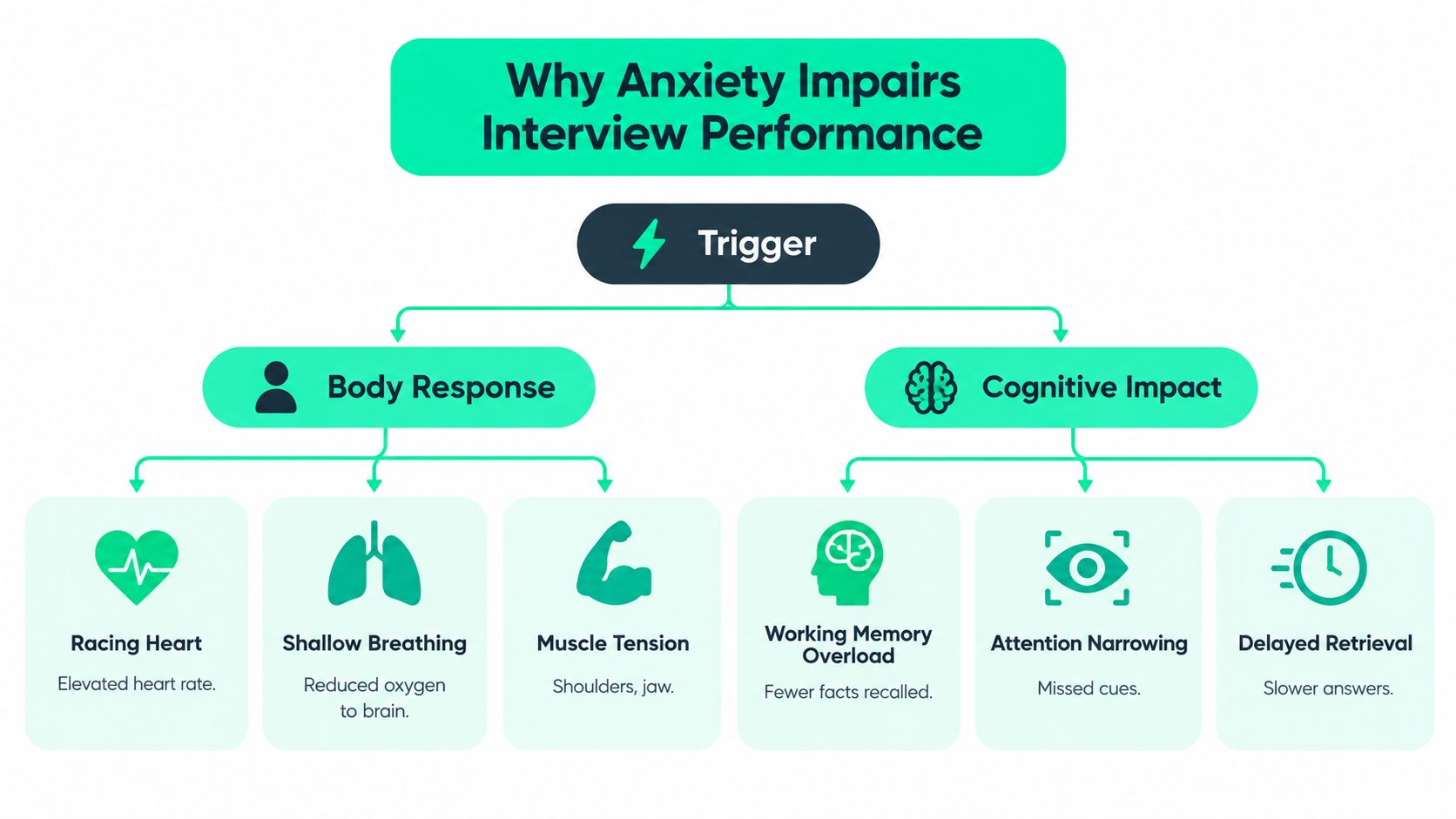
You don't need to aim for complete calm. That target creates another problem because normal activation starts to feel like evidence that you're losing control. A better target is functional delivery: steady breathing, understandable pacing, concise answers, and the ability to recover when retrieval slows.
What the interviewer hears
Anxiety often becomes visible through speech rather than through an obviously nervous statement. Candidates may fill gaps with “um,” “like,” or repeated phrases, rush through the Action part of a story, or keep adding context because they're afraid the first answer wasn't sufficient.
In a controlled study of interview perception, observers could detect anxiety from vocal and verbal cues, and they most often identified filler words as the strongest signal in high-anxiety responses. The reported findings on feedback and filler usage indicate that immediate feedback reduced filler usage to less than half of a no-feedback condition without increasing anxiety or lowering self-perceived competence.
That finding changes how you should practice. Memorizing better sentences may help content, but it won't automatically improve delivery. You need repetitions that show you where you speed up, where you lose the thread, and what you say while searching for the next idea.
Try this simple recording exercise:
- Record an answer to a difficult question without restarting.
- Listen once for content and once for filler words.
- Mark the exact point where your answer becomes less clear.
- Repeat the answer with a deliberate pause at that point.
- Keep the second version if it sounds more controlled, even if it feels slower.
Preparation reduces cognitive load when it gives you retrieval cues. A list of polished scripts can increase cognitive load because you're trying to remember wording, sequence, and performance at once. Prepare experiences, decisions, constraints, and outcomes instead. Those elements let you rebuild an answer in your own language.
Foundational cognitive-interviewing research makes a similar point about difficult questions outside employment. Researchers have studied how people comprehend questions, recall information, make judgments, and map thoughts onto available response options. Work connected with the European Social Survey and UCSF cognitive-interviewing methods treats question difficulty as a design problem that can be examined, rather than as a random failure by the person answering.
The practical lesson is direct: rehearse the mental work, not only the final wording.
Mental Preparation and In-Room Recovery Tactics
Preparation starts before the interview window opens. Don't spend the final minutes reading a dense document full of possible answers. That approach can make you feel informed while leaving your working memory crowded.
Use a compact preparation page with three categories:
- Your evidence: projects, decisions, problems solved, conflicts handled, and lessons learned.
- Your signals: the skills each example demonstrates, such as prioritization, ownership, analysis, or communication.
- Your anchors: short phrases that help you retrieve the example without forcing you to recite it.
A useful anchor might be “launch delay, supplier risk, revised sequence” rather than a complete story. Those words are enough to bring back the context while preserving natural delivery.

Use the body as an interrupt
Before the interview, place both feet on the floor and relax your jaw. Breathe in comfortably, then make the exhale slightly longer than the inhale. You aren't trying to perform a complicated breathing exercise. You're creating a physical interruption to the cycle of rushing thoughts.
Choose one visual anchor near your screen, such as a small mark on a notebook. When you notice yourself speeding up, look at that anchor, lower your shoulders, and finish the sentence you're currently saying. Don't attempt to reset your entire performance. Reset the next sentence.
For candidates who want a broader explanation of attention and cognitive load, Voice Control Pro for task focus provides useful context on reducing competing demands while working through complex tasks.
Recover without apologizing
Brain fog doesn't require a dramatic explanation. Avoid saying, “Sorry, I'm terrible at interviews,” or “I'm completely blank.” Those statements turn a temporary retrieval problem into a judgment about your identity.
Use a recovery line instead:
“I want to give you a specific example rather than a vague answer. Let me think for a moment.”
If the question is ambiguous, ask for its frame:
- “Would you like an example from a team setting or an individual project?”
- “Should I focus on how I made the decision or on what happened afterward?”
- “Can I take that as a question about my approach under pressure?”
If you start an answer and realize it's going nowhere, stop cleanly:
“I'm giving you too much background. The key point is that I owned the decision, changed the sequence of work, and communicated the trade-off early.”
This kind of correction often improves the answer because it demonstrates monitoring and judgment. The trade-off is that you may sound less perfectly rehearsed. That's usually preferable to continuing with a story that no longer serves the question.
Structured Answer Frameworks That Actually Work
Frameworks help when they organize thinking, not when they replace it. Use STAR when the interviewer asks for evidence from your past. Use a more compressed structure when the question asks how you would analyze a business problem or make a recommendation.
Behavioral interviews commonly use STAR. Situation establishes context, Task defines your responsibility, Action explains what you personally did, and Result shows the outcome. The MIT Career Advising and Professional Development guide to STAR describes a useful weighting of about 15% Situation, 10% Task, 50% Action, and 25% Result. The exact proportions aren't a script, but they correct a common weakness: candidates spend too long describing what happened and too little time explaining their decisions.
STAR for behavioral evidence
Question: “Tell me about a time you handled conflict.”
Weak answer: “There was a disagreement between design and engineering. We discussed it several times, and eventually we found a solution.”
The story has a setting, but it doesn't show your behavior. A stronger version sounds like this:
- Situation: “During a product release, design wanted to preserve a feature that engineering considered too risky for the deadline.”
- Task: “I owned the release coordination and needed to protect the launch date without dismissing the design concern.”
- Action: “I separated the disagreement into two decisions, asked engineering to identify the specific failure modes, and worked with design to define the smallest version of the feature we could test safely. I documented the trade-off, assigned a follow-up owner, and communicated the revised scope to both teams.”
- Result: “We kept the release plan, avoided the disputed risk, and had a clear test path for the fuller feature.”
The Action section carries the evidence. It shows your choices, not merely the group's activity. Practice interview prompts can help you test whether your answers contain personal actions rather than general team descriptions. A question bank such as Qcard's practice interview questions can also expose gaps through varied behavioral prompts.
Scope, Impact, Result for analytical questions
STAR can feel awkward in consulting, banking, product, or strategy interviews when the interviewer wants a recommendation rather than a chronological story. Scope, Impact, Result gives you a cleaner alternative.
Start with Scope: define the decision, customer, market, or operational boundary. Move to Impact: explain the factors that could change the outcome. End with Result: state your recommendation, expected consequence, or next test.
For example:
“First, I'd scope this to the customer segment with the highest usage but the weakest retention. The impact depends on whether the problem is price, onboarding, or product value, so I'd compare behavior across those points before changing the offer. My initial recommendation would be to address the largest verified friction point, run a focused test, and use retention and contribution margin to decide whether to expand.”
This structure is efficient because it shows how you think without pretending that you have historical experience for a hypothetical problem. Don't force STAR into every answer. The right framework should reduce mental load, not make you translate every thought into a rigid sequence.
Answering Difficult Questions When You Think Differently
Many interview guides assume that every candidate thinks in a neat sequence. That assumption excludes people whose thinking is associative, visual, detail-first, or highly sensitive to format. For neurodivergent candidates, the difficulty may come less from knowing the answer and more from timed responses, unpredictable transitions, implicit expectations, or uncertainty about what competency sits behind the literal question.
Recent guidance on neurodivergent candidates in job interviews highlights several gaps in mainstream preparation. Candidates may answer the literal question while missing the hidden competency, find standard STAR sequencing unnatural, or lack clear guidance on whether they can pause, ask for clarification, or use grounding routines.
That doesn't mean you need to abandon structure. It means you should adapt the entry point.
Adapt the framework to the way you retrieve
A non-sequential thinker might remember the decisive action before remembering the background. Start there if it helps:
“I'll begin with the decision because that's the most relevant part. I changed the implementation sequence after the original dependency became a risk. The context was…”
You can then add the Situation and Task after the anchor is established. The interviewer still receives a coherent answer, but you aren't forcing yourself to retrieve information in an order that blocks recall.
Another option is a signposted format:
“The short answer is that I prioritized customer impact over internal convenience. There were three steps behind that decision. First, I checked the evidence. Second, I involved the affected team. Third, I communicated the trade-off.”
Signposting makes a nonlinear thought process easier to follow without requiring you to flatten it into a memorized story.
Clarify the hidden test
If a question feels underspecified, ask what kind of evidence the interviewer wants:
- “Are you most interested in the technical decision, the stakeholder management, or the outcome?”
- “Would a project example be useful, or are you asking how I'd approach this hypothetically?”
- “Can I take a few seconds to organize the example?”
Accommodation can be part of effective preparation, not an admission that you're less capable. U.S. guidance on interviewing applicants with disabilities says employers should be willing to provide appropriate accommodations so applicants can participate. Examples may include changing the interview format, allowing more time for tests, or providing questions in advance, as described in National Career Development Association guidance.
Request the adjustment early and state what helps you perform accurately. For example: “I process complex questions more effectively with a short pause before responding. I'd appreciate the opportunity to take that pause during the interview.” That is clearer than apologizing for silence after the interview has begun.
AI-mediated interviews add another layer of format stress. Candidates may receive less social and emotional feedback, face rigid evaluation cues, and encounter eye-contact expectations that are particularly difficult for some neurodivergent job seekers. Treat the format as a separate skill: test camera position, decide where you'll look while thinking, practice responding to unclear prompts, and use a short verbal signpost when the system gives no human reaction.
Micro-Practice Drills and Rehearsal Strategies
Long rehearsals create polished monologues that often collapse when the question changes. Short drills build retrieval flexibility. Practice the same experience from different angles, then stop before the answer becomes automatic.
The two-minute retrieval drill
Choose a difficult question and give yourself a short preparation pause. Answer without restarting. Aim to cover the decision, your role, and the outcome, but don't chase perfect wording.
Then review the recording in three passes:
- Listen for whether the answer addressed the question.
- Note where you used filler words or repeated the same idea.
- Mark the first point where your pace became rushed.
Repeat once, using only a few memory cues. If your second answer is more concise but less polished, that's acceptable. The purpose is to maintain structure while your wording changes.
The pressure-switch drill
Take one story and practice answering these variations:
- “What did you do?”
- “Why did you choose that approach?”
- “What would you change?”
- “What was the conflict?”
- “How did you measure success?”
This prevents you from memorizing one route into the story. It also prepares you for follow-up questions, where interviewers test whether your example reflects genuine experience or a rehearsed surface answer.
Feedback that changes behavior
Use feedback for one variable at a time. If you try to fix content, eye contact, pace, posture, and filler words in one session, you'll overload the same system you're trying to train.
A practice environment such as Qcard's AI mock interview can be used for personalized prompts, follow-up questions, recorded responses, and feedback on delivery. The useful question after each session isn't “Did I sound impressive?” It's “What specific behavior will I change in the next answer?”
Track observations qualitatively:
- Did you answer the question before giving context?
- Did you name your personal contribution?
- Did you pause instead of filling silence?
- Did your result show what changed?
- Did you recover when the prompt surprised you?
Finish each session by writing three memory cues for the experience you practiced. Those cues become your preparation material. They're more durable than a paragraph you may not remember under pressure.
Recovery, Follow-Up, and Moving Forward After Tough Interviews
A difficult interview doesn't end when the call closes. Give yourself a short reset before judging the performance. Write down the questions you remember, the examples you used, and the point where your retrieval failed. That record turns discomfort into a targeted practice list.
Send a thank-you message that refers to a real discussion rather than repeating a generic expression of interest. You can use Qcard's interview thank-you email resource to organize the message, then edit it so the wording reflects the conversation.
AI-mediated formats deserve a separate review. The lack of human feedback can intensify uncertainty, and rigid cues around pacing, silence, or eye contact may not reflect the full quality of your thinking, as discussed in recent reporting on AI interview technology. Practice the format, but don't mistake algorithmic smoothness for professional competence.
The strongest preparation combines authentic evidence, flexible structure, and recovery skill. Perfect scripts break when the question changes. Clear memory cues, deliberate pauses, and focused rehearsal keep working.
Key Takeaways
- Anxiety damages interview outcomes without predicting job performance — research found a moderate negative correlation between self-reported interview anxiety and interview scores (ρ = -0.19) while later job performance was unrelated, which means the right target is functional delivery (steady pacing, concise answers, reliable recovery) rather than complete calm.
- The Action section is where behavioral answers are won or lost — MIT's STAR guidance weights it at roughly 50%, because the most common weakness is describing what happened at length while barely explaining what you personally decided, and "we discussed it and eventually found a solution" gives an interviewer nothing to evaluate.
- STAR isn't universal, and forcing it costs you — consulting, banking, product, and strategy questions asking for a recommendation fit Scope-Impact-Result far better, since that structure shows how you reason through a problem without pretending you have historical experience with a hypothetical.
- Anchors beat scripts because scripts increase cognitive load — a memorized paragraph requires you to track wording, sequence, and performance simultaneously, while three cue words ("launch delay, supplier risk, revised sequence") retrieve the context and leave your language natural, which is exactly what survives an unexpected follow-up.
- Neurodivergent candidates should adapt the entry point rather than abandon structure — if the decisive action surfaces before the background, start there ("I'll begin with the decision because that's the most relevant part…") or use signposting ("There were three steps behind that decision"), and requesting format adjustments early is a legitimate preparation step rather than an admission of weakness.
Qcard helps candidates prepare with AI-scored practice, adaptive follow-up questions, resume-grounded talking points, and feedback on pacing, filler words, answer length, and depth. Use Qcard to rehearse difficult questions without memorizing scripts, then walk into your next interview with a clearer way to retrieve and communicate your real experience.
Ready to ace your next interview?
Qcard's AI interview copilot helps you prepare with personalized practice and real-time support.
Try Qcard Free