TL;DR
DevOps interviews reward answers that connect technical decisions to measurable outcomes rather than tool recitation. Use a single framework — context, action, trade-off, result — across all ten question areas: personal narrative, CI/CD pipeline design, infrastructure as code, Kubernetes and container orchestration, observability and alerting, production troubleshooting, security practices, disaster recovery, continuous learning, and implementation challenges. The strongest responses explain why a gate, control, or architecture choice exists and what risk you accepted in return. For incidents, structure a timeline: detection, mitigation, resolution, prevention — and include outage duration or business impact. For security and DR, name the attack a control prevents or the failure a drill exposed, since an untested recovery plan is only a recovery assumption. Build one truthful example per category with four short notes (situation, action, trade-off, result), rehearse a one-minute version plus a deeper version, and verify every tool name, percentage, and metric against your actual experience before the interview.
Strong answers to DevOps interview questions connect tools to outcomes: faster releases, safer changes, lower recovery time, or clearer ownership. This roundup helps you prepare for both technical and behavioral rounds without memorizing scripts.
Use the framework of context, action, trade-off, and result. For example, explain how you introduced automated tests in a CI pipeline, why you chose a deployment strategy, what risk you accepted, and how change failure rate improved. If you lack production experience, describe a lab, internship, migration project, or realistic scenario honestly.
The questions cover personal narrative, delivery pipelines, infrastructure as code, Kubernetes, observability, incidents, security, resilience, continuous learning, and collaboration. Each item includes an actionable example, a sample response, likely follow-up prompts, and preparation guidance.
Connect every technical decision to a measurable outcome, and state what you would verify next.
Short sections and clear visual separation make this guide easier to review in focused sessions. Candidates building their own practice environment can create a small pipeline, deploy a containerized service, and document one failure. Readers forming or hiring a DevOps team may also find Hire Developers useful for exploring developer talent.
What Are the Most Common DevOps Interview Questions?
Strong DevOps answers connect tools to outcomes: faster releases, safer changes, lower recovery time, or clearer ownership. Use one framework across every question — context, action, trade-off, result — and name what you'd verify next.
The ten questions that appear most consistently:
- Tell me about yourself — 60 to 90 seconds covering what you do, one or two measurable achievements, and why this role. Lead with the result, not the tool.
- Walk me through your CI/CD pipeline design — Explain the stages in order (commit and review, build and scan, integration tests, staging with approval gates, production with monitoring and rollback), then justify why each gate exists, not just which tool runs it.
- Infrastructure as code and configuration management — How your code is versioned, tested, approved, and applied across environments, plus state locking, secret stores, drift detection, and why manual production edits are restricted.
- Container orchestration and Kubernetes — Go beyond deployment files: how pods schedule, services expose, storage persists, and desired state is maintained. Then describe one incident, the diagnosis, the fix, and the result.
- Monitoring, logging, and alerting — Distinguish monitoring (known signals) from observability (metrics, logs, traces for unknown failures), and explain how you reduce false positives with severity levels, dependency checks, and business-aware thresholds.
- Troubleshooting a production issue — Structure as a timeline: detection and assessment, mitigation and resolution, then what changed to prevent recurrence. Include outage duration, affected users, or business impact.
- Security in DevOps practices — Secrets management, dependency and image scanning with remediation deadlines by severity, and least-privilege access with short-lived roles. Name the attack each control prevents and how you verify it works.
- Disaster recovery and business continuity — RPO, RTO, dependencies, and cost. Describe the architecture, how you tested it (game days, chaos experiments, failover drills), and one failure testing revealed.
- How you stay current — A technology you're studying, a project where you applied it, and a community or certification that grounds your perspective. Show you evaluate tools against real problems.
- Challenges you've overcome — The problem and its operational impact, your approach, how you worked with others, the measurable result, and what you'd do differently.
If you lack production experience, describe a lab, internship, migration project, or certification build honestly — then explain what transfers.
1. Tell Me About Yourself
This opening question appears in most DevOps interviews because it reveals how clearly you connect technical work with business results. Keep your response to 60–90 seconds and organize it around three points:
- What you do now or have trained to do.
- One or two achievements with measurable outcomes.
- Why this role and its environment interest you.
Focus on the result of your work, not only the tool you used.
For example, a senior infrastructure engineer might explain how automated disaster recovery reduced recovery time objectives from four hours to 15 minutes across 12 production services. A career switcher could describe learning Ansible and reducing server provisioning from two days to 30 minutes. A graduate might mention specific Kubernetes pull requests accepted by an open-source project.
Before the interview, review the job description and adjust your emphasis toward its stack, such as Terraform, AWS, Kubernetes, or GitHub Actions. Record yourself to identify filler words and practice a calm pace, especially if interview anxiety affects delivery. Learn more about resume-grounded interview preparation, and ensure every claim reflects your real experience.
2. Walk Me Through Your CI/CD Pipeline Design
This question tests whether you can connect commits to reliable production releases, including testing, security, approvals, and rollback planning. Explain the stages in order, then justify the design choices with measurable results.
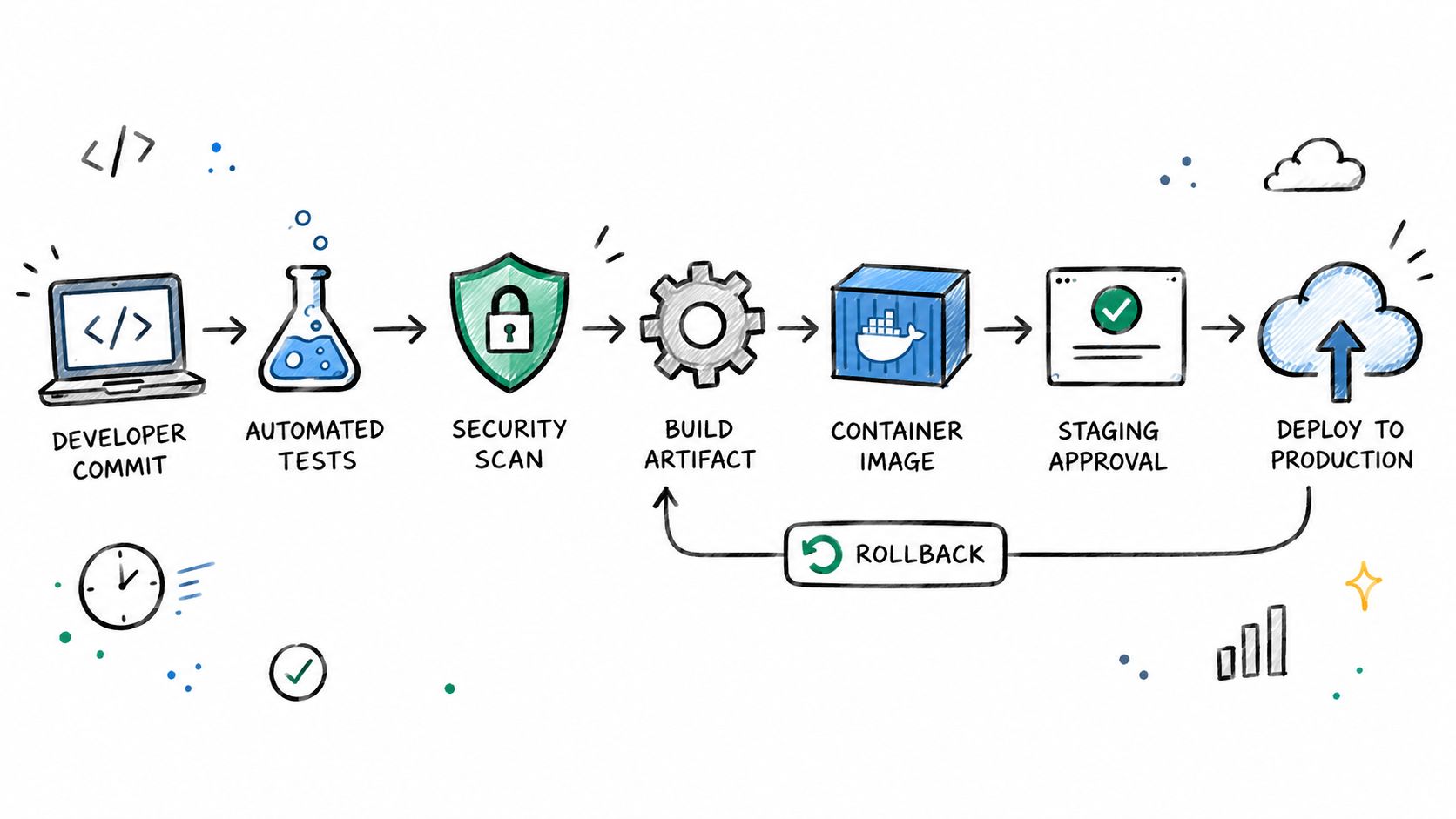
- Code commit and review.
- Build, unit tests, linting, and dependency scans.
- Integration, performance, and database migration tests.
- Staging deployment, approval gates, and production release.
- Monitoring, rollback, and post-deployment checks.
Explain why each gate exists, not only which tool runs it.
For example, a candidate might describe separate frontend and backend pipelines that reduced lead time from two days to 20 minutes. A healthcare SaaS example could include audit logs, secret rotation, and documented approvals. Mention trade-offs between Jenkins, GitLab CI, GitHub Actions, or other CI CD tools comparison, plus metrics such as deployment frequency and change failure rate. Practice recalling resume-specific figures with AI mock interview practice, especially if anxiety makes technical details harder to retrieve.
3. Infrastructure-as-Code and Configuration Management
This question tests whether you can define, review, and maintain infrastructure reliably rather than create resources manually. Explain how your code is versioned, tested, approved, and applied across environments, then address state, secrets, and configuration drift.
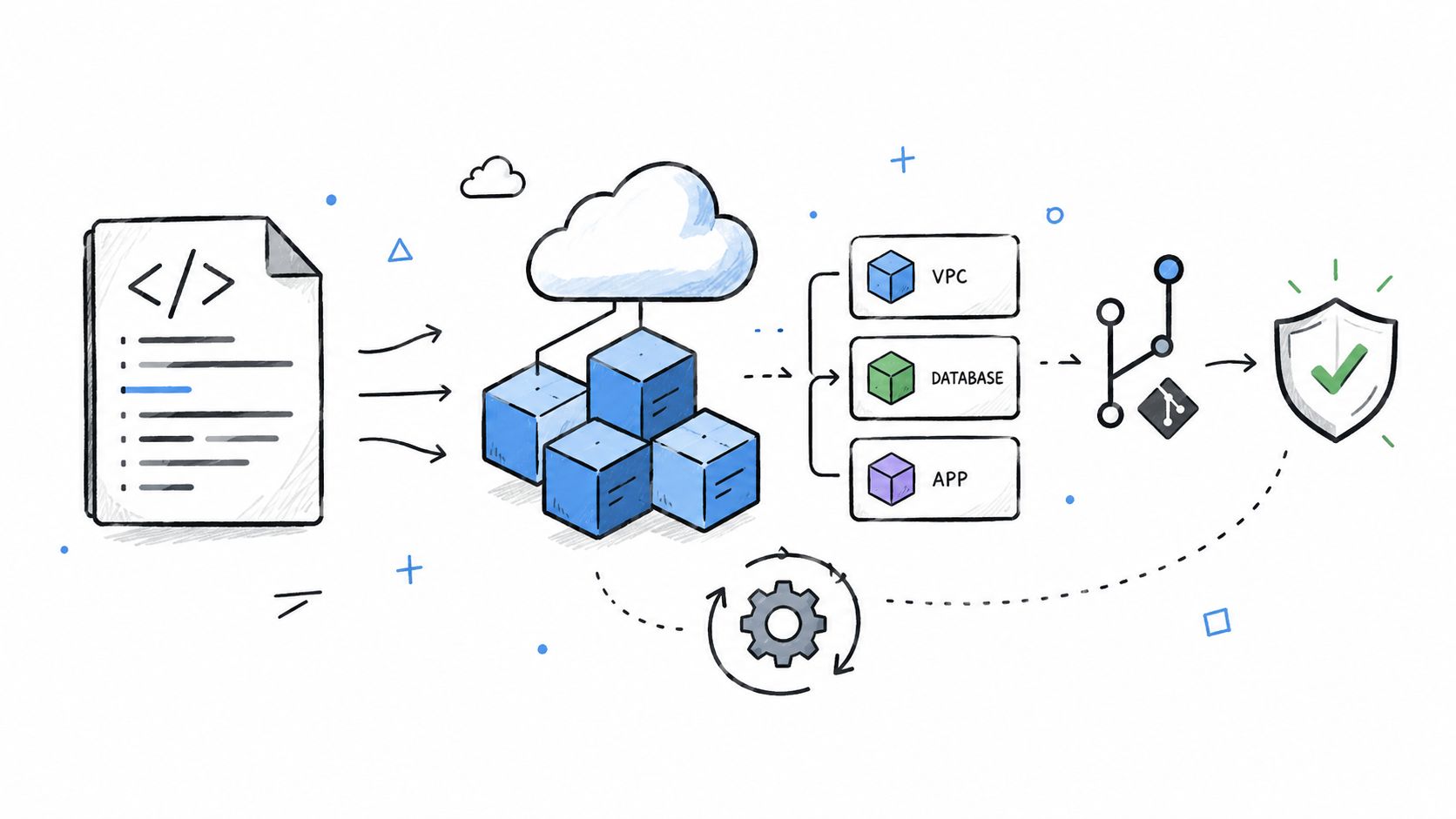
Infrastructure code should be reviewed and tested like application code, with production changes traceable to a specific commit.
For example, a financial services team might use Terraform modules with peer review and automated policy checks to block noncompliant storage settings. A startup could use Pulumi with Python to help developers contribute sooner, while an enterprise might use Ansible for post-provisioning configuration across thousands of hybrid-cloud servers.
Prepare to discuss module structure, linting, validation, and plan reviews. Explain why you chose Terraform, Pulumi, or Ansible based on team skills, ecosystem maturity, and required cloud support. Mention remote state locking, separate workspaces or accounts, and secret stores such as Vault or a cloud secrets manager. In these DevOps interview questions, also explain how scheduled scans detect drift and why manual production edits are restricted.
4. Describe Your Experience with Container Orchestration and Kubernetes
This question tests whether you can manage containerized workloads beyond writing a deployment file. Explain how Kubernetes schedules pods, exposes services, manages storage, and maintains desired state through the API server, etcd, kubelet, kube-proxy, and a CNI plugin.
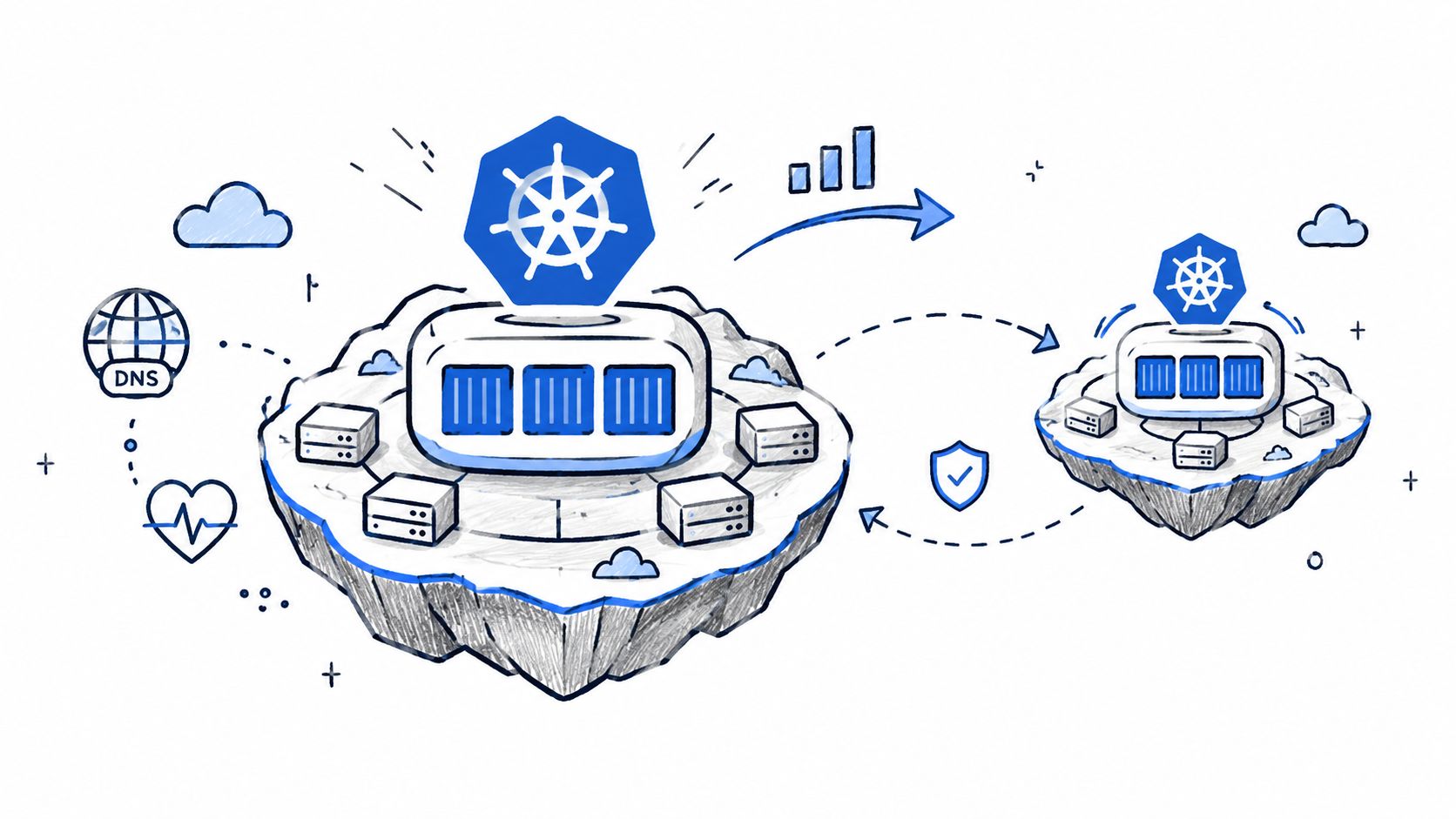
Describe one incident, the diagnosis, the fix, and the measurable result.
For example, an e-commerce team might migrate services from VMs to Kubernetes, use namespaces for business-unit isolation, and set requests and limits to prevent noisy neighbors. A career switcher could discuss a certification project that deployed an application with persistent volumes, services, and basic service-mesh routing. An international student might explain a personal cluster where custom alerts detected crash loops and high node memory use.
Prepare to discuss OOM kills, cross-namespace networking, storage after pod restarts, and upgrade testing. Explain how you would test a new version in staging, back up cluster state, use a controlled rollout, and preserve a rollback path. Practice answering aloud with a clear timeline, and review Kubernetes documentation before technical DevOps interview questions.
5. How Do You Handle Monitoring, Logging, and Alerting in Your Systems?
This question tests whether you can turn system data into useful operational decisions. Explain that monitoring tracks known signals, while observability uses metrics, logs, and traces to investigate unknown failures.
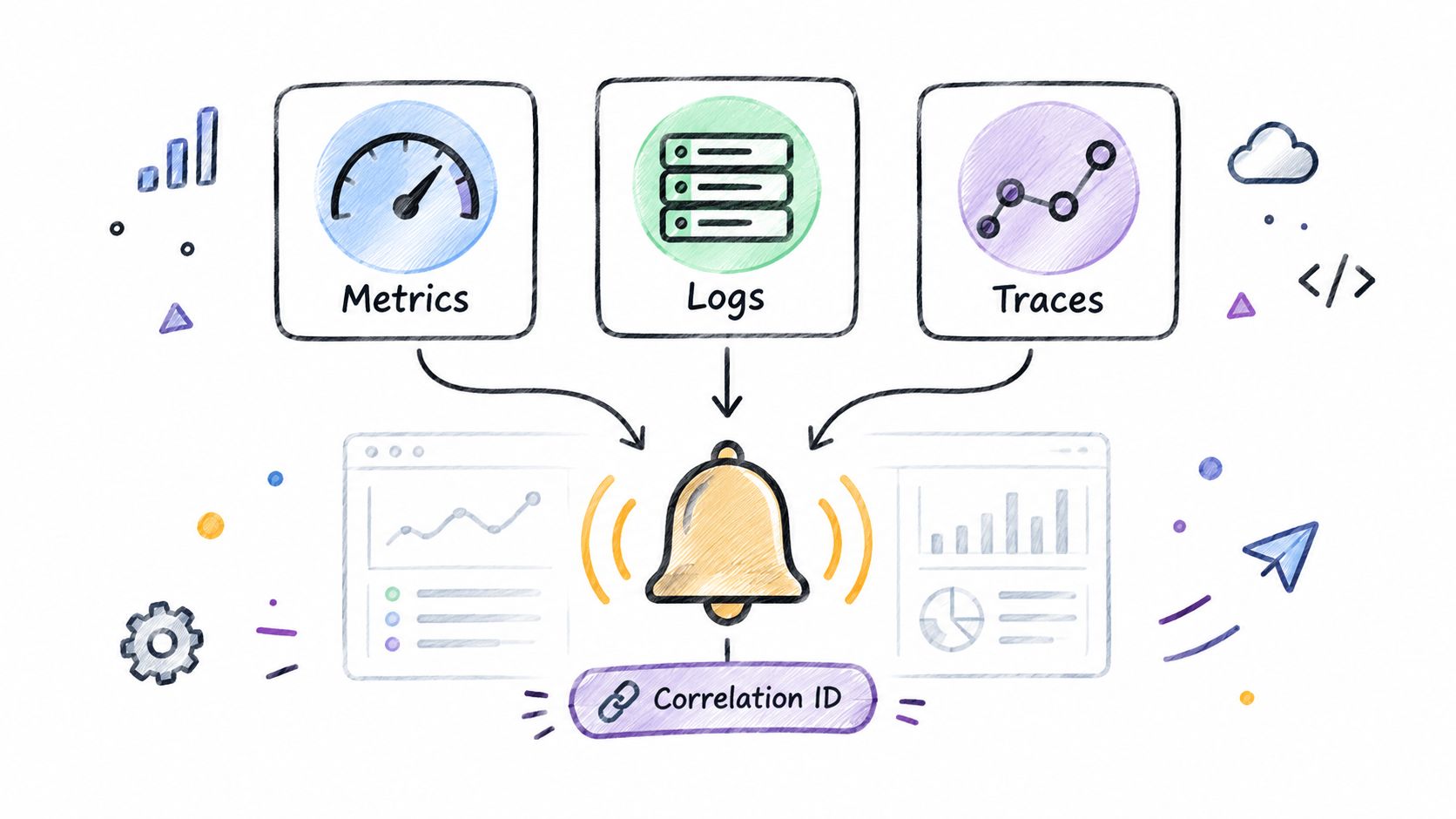
Good alerting notifies people about user or business impact, not every unusual data point.
For example, a SaaS team could add structured JSON logs and correlation IDs across 15 microservices, helping support trace a customer request. Mention custom metrics such as checkout failures, queue age, or payment latency, then explain how dashboards serve developers, operations, and business teams.
In these DevOps interview questions, describe your response to a real incident: the signal, alert threshold, time to acknowledge, and fix. Explain how you reduce false positives by using severity levels, dependency checks, maintenance windows, and business-aware thresholds, such as stricter alerts during payment processing peaks.
Before the interview, prepare one monitoring example using metrics, logs, and traces, and practice explaining why each signal mattered.
6. Describe a Time You Had to Troubleshoot a Production Issue
This behavioral question appears in many DevOps interviews because it shows how you think under pressure, communicate during incidents, and turn failures into improvements. Structure your response as a clear timeline:
- How you detected and assessed the issue.
- What you did to mitigate and resolve it.
- What changed afterward to prevent recurrence.
Explain your decisions and measurable impact, not just the commands or tools you ran.
For example, a graduate might describe using Go heap dumps and flame graphs to trace a memory leak, then reducing service restarts from every 20 minutes to none during a full production day. A career switcher could explain how application and database teams identified an incorrect schema change during a traffic spike. An international candidate might discuss supporting a failed data pipeline, documenting escalation steps, and learning incident-management procedures.
State your specific contribution while crediting teammates. Include outage duration, affected users, or business impact, and acknowledge any mistake without becoming defensive. Practice the story aloud using detection, triage, mitigation, resolution, and prevention as prompts. Practice more DevOps interview questions and receive structured feedback.
7. How Do You Approach Security in Your DevOps Practices?
This question evaluates whether you build security into DevOps workflows rather than treating it as a final review. Explain how you protect secrets, infrastructure, software dependencies, and production access through automated controls:
- Store credentials in Vault or a cloud secrets manager, never in repositories or pipeline logs.
- Scan dependencies and container images with Trivy, then define remediation deadlines by severity.
- Enforce least-privilege permissions with short-lived roles, protected branches, and audited infrastructure changes.
Describe the attack a control prevents, then explain how you verify that the control works.
For example, an e-commerce team could sign container images in CI and block deployment of critical vulnerabilities. A healthcare startup might encrypt data in transit and at rest, restrict access through role-based policies, and retain audit logs for HIPAA reviews. A fintech company could protect encryption keys with hardware security modules and require approval for production changes.
Discuss the trade-off between developer velocity and risk, such as using automated low-risk approvals while requiring manual review for network or identity changes. Mention compliance requirements you have worked with, and explain measurable results, such as fewer exposed secrets or faster vulnerability remediation. These details can distinguish strong answers in DevOps interviews.
8. What Is Your Experience with Disaster Recovery and Business Continuity?
This question appears in DevOps interviews because it tests whether you can keep critical services running through regional outages, data loss, or traffic surges. Explain recovery point objective (RPO), recovery time objective (RTO), dependencies, and the cost of each reliability decision.
- Describe the architecture, including backups, replication, failover, and access controls.
- Explain how you tested it through game days, chaos experiments, or full failover drills.
- Share one failure discovered during testing and the fix that followed.
A recovery plan that has never been tested is only a recovery assumption.
For example, a financial services engineer might discuss active-active regions with sub-second failover for regulatory requirements. An e-commerce candidate could explain validating failover during a simulated peak-season traffic spike. A healthcare engineer should mention encrypted backups, audit logging, and HIPAA-compliant access during data-center recovery.
Before the interview, prepare a concise example using real numbers: an RPO of five minutes, an RTO of 30 minutes, or a tested failover involving 40 services. State the trade-off clearly: shorter recovery targets may require duplicate infrastructure and higher operating costs. If you lack production experience, describe a lab using Terraform, cloud backups, and documented restore tests.
9. How Do You Stay Current with DevOps Technology and Best Practices?
This question appears in many DevOps interviews because it tests curiosity, judgment, and commitment to continuous learning. Explain how you combine three activities:
- A technology you are currently studying and why it matters.
- A practical project or workplace improvement where you applied that knowledge.
- A community, certification, conference, or open-source activity that keeps your perspective grounded.
Show that you evaluate tools against a real problem instead of adopting every new release.
For example, a graduate might maintain a public GitHub repository that compares Terraform modules, GitHub Actions, and Kubernetes deployment patterns, documenting lessons and test results. A career switcher could describe preparing for an AWS or Kubernetes certification, then applying IAM and cost-control practices in a lab project. A mid-career engineer might explain contributing a bug fix to an open-source monitoring project and sharing the lesson with their team.
Mention how you assess security, maintenance effort, team skills, and measurable benefits before selecting a tool. Schedule weekly study time, keep notes, and turn each lesson into a small implementation task. This approach is especially useful for candidates who need clear evidence behind their interview answers.
10. What Challenges Have You Overcome in Previous DevOps Implementations?
This question appears in many DevOps interviews because it shows how you handle technical problems, resistance, and incomplete information. Choose one challenge where your actions produced a clear improvement, then explain it in five steps:
- The problem and its operational impact.
- Your approach and the obstacles involved.
- How you worked with others to resolve it.
- The measurable result.
- What you would do differently next time.
Focus on your decisions, collaboration, and learning, not just the difficulty of the situation.
For example, a graduate might describe finding no deployment documentation, creating runbooks, and reducing onboarding time. An international student could explain how clearer diagrams and written change summaries improved communication with a distributed team. A career switcher might describe earning skeptical sysadmins’ trust by piloting automation on a noncritical service, measuring failures, and expanding only after reliable results.
Be honest if the solution required help from security, operations, or development teams. Before answering, prepare a brief version and a detailed version, and rehearse unfamiliar technical terms aloud. Mention what you would change, such as adding tests earlier or involving stakeholders sooner, to demonstrate continuous learning.
10-Question DevOps Interview Comparison
The following comparison summarizes the purpose, complexity, resources, outcomes, and use cases of each question without replacing the detailed preparation guidance above.
Tell Me About Yourself
- Implementation complexity: Low
- Resource requirements: Low, primarily preparation time
- Expected outcomes: A clear narrative that establishes fit
- Ideal use cases: Opening interview pitch and first impressions
- Key advantages: Controls the narrative and highlights metrics and motivation
Walk Me Through Your CI/CD Pipeline Design
- Implementation complexity: High
- Resource requirements: Medium to high, including tools, infrastructure, and testing
- Expected outcomes: Faster, safer deployments with fewer failures
- Ideal use cases: Architecture interviews and senior or lead roles
- Key advantages: Shows architectural thinking, trade-offs, and team enablement
Infrastructure-as-Code and Configuration Management
- Implementation complexity: Medium to high
- Resource requirements: Medium, including IaC tooling and testing frameworks
- Expected outcomes: Reduced drift and repeatable provisioning
- Ideal use cases: Cloud migrations and multi-environment operations
- Key advantages: Improves maintainability and enforces versioning and testing
Describe Your Experience with Container Orchestration and Kubernetes
- Implementation complexity: High
- Resource requirements: High, including clusters, tooling, and expertise
- Expected outcomes: Scalable and resilient deployments
- Ideal use cases: Large-scale workloads, microservices, and multi-cluster setups
- Key advantages: Enables scaling, high-availability patterns, and advanced deployment strategies
How Do You Handle Monitoring, Logging, and Alerting in Your Systems?
- Implementation complexity: Medium
- Resource requirements: Medium, including an observability stack and instrumentation
- Expected outcomes: Faster detection, actionable alerts, and less noise
- Ideal use cases: Production operations, SRE roles, and on-call teams
- Key advantages: Improves troubleshooting, reduces alert fatigue, and emphasizes user-focused metrics
Describe a Time You Had to Troubleshoot a Production Issue
- Implementation complexity: Medium
- Resource requirements: Variable, depending on the incident
- Expected outcomes: Demonstrates problem-solving and post-incident improvements
- Ideal use cases: Behavioral interviews and on-call assessments
- Key advantages: Shows methodical triage, mitigation, and learning orientation
How Do You Approach Security in Your DevOps Practices?
- Implementation complexity: Medium to high
- Resource requirements: Medium to high, including security tools and policies
- Expected outcomes: Fewer vulnerabilities and improved compliance readiness
- Ideal use cases: Regulated industries and software-supply-chain-sensitive systems
- Key advantages: Integrates security into CI/CD and enforces least privilege and scanning
What Is Your Experience with Disaster Recovery and Business Continuity?
- Implementation complexity: High
- Resource requirements: High, including redundant infrastructure and DR drills
- Expected outcomes: Defined RTO and RPO with validated failover readiness
- Ideal use cases: Mission-critical systems and compliance-driven operations
- Key advantages: Ensures resilience through tested recovery procedures and business-aligned trade-offs
How Do You Stay Current with DevOps Technology and Best Practices?
- Implementation complexity: Low to medium
- Resource requirements: Low to medium, including time and learning resources
- Expected outcomes: Continuous skill growth and informed tool choices
- Ideal use cases: Career development and hiring interviews
- Key advantages: Demonstrates adaptability, community engagement, and thoughtful adoption
What Challenges Have You Overcome in Previous DevOps Implementations?
- Implementation complexity: Medium
- Resource requirements: Variable, including organizational and technical effort
- Expected outcomes: Evidence of stakeholder management and delivery
- Ideal use cases: Leadership and cross-team collaboration interviews
- Key advantages: Shows resilience, communication, and the ability to drive complex projects
Turn These Questions into Interview-Ready Stories
Strong answers to DevOps interview questions do more than define tools. They show how you think about reliability, delivery speed, risk, communication, and business impact. The most convincing responses connect a specific situation to a clear action, a considered trade-off, and a measurable result.
Build a focused practice set
Select one truthful example for each major category covered in this guide:
- CI/CD design or deployment improvement
- Infrastructure-as-Code or configuration management
- Containers or Kubernetes
- Monitoring, logging, or alerting
- Production troubleshooting
- Security, recovery, or continuity
- Collaboration, learning, or implementation challenges
For every example, write four short notes:
- Situation: What system, team, or risk was involved?
- Action: What did you personally change or investigate?
- Trade-off: What did you give up, limit, or decide not to automate?
- Result: What improved, and how do you know?
Rehearse a concise version that takes about one minute, then prepare a deeper version covering architecture, commands, metrics, and lessons learned. Check every tool name, percentage, incident detail, and performance figure against your real experience. If you have not used Kubernetes in production, say so, then explain a lab, course, personal project, or comparable orchestration work.
Adapt your evidence to the role
A platform engineering interview may require deeper discussion of deployment strategies, observability, and infrastructure design. A junior role may focus more on debugging steps, teamwork, and safe learning habits. Candidates from different backgrounds can show equivalent evidence through employment, study, open-source contributions, personal projects, or collaborative problem-solving.
Prepare questions about deployment practices, on-call expectations, security ownership, incident reviews, and the team’s learning culture. Qcard can serve as an optional resume-locked rehearsal and memory-cue tool for practicing DevOps interview questions, but it should never replace authentic answers or become a script.
Key Takeaways
- Tools alone prove nothing — the pattern that separates strong candidates is connecting each technical decision to an outcome (lead time from two days to 20 minutes, restarts from every 20 minutes to none, RTO from four hours to 15 minutes) and stating the trade-off you accepted to get there.
- Pipeline and infrastructure answers should explain why each gate exists, not which vendor runs it — describing how a dependency scan blocks a known severity class, why a plan review precedes apply, or why manual production edits are restricted demonstrates ownership thinking that a tool list cannot.
- Incident questions are timeline questions — detection and assessment, mitigation and resolution, then the specific change that prevents recurrence, with your personal contribution stated clearly while crediting teammates, and any mistake acknowledged without defensiveness.
- Security and disaster recovery answers need verification, not intent — name the attack a control prevents and how you confirm the control works, and for DR describe a tested failover with real numbers (a five-minute RPO, a 30-minute RTO, 40 services) plus one failure the test exposed, since an untested plan is only an assumption.
- Honesty about gaps beats inflated claims — if you haven't run Kubernetes in production, say so and describe the lab, certification project, or comparable orchestration work instead, because every tool name, percentage, incident detail, and performance figure will be checked under follow-up questioning.
Clear thinking, honest ownership, and measurable outcomes will make your experience easier to trust.
Use Qcard to rehearse examples drawn from your actual resume, organize memory cues, and practice concise answers to DevOps interview questions without losing your own voice.
Ready to ace your next interview?
Qcard's AI interview copilot helps you prepare with personalized practice and real-time support.
Try Qcard Free